
1) easton company and lofton company were combined in a purchase transaction.
easton was able to acquire lofton at a bargain price. the sum of the fair values of
identifiable assets acquired less the fair value of liabilities assumed exceeded the cost to
easton. proper accounting treatment by easton is to report the excess amount as
a.a gain
b.part of current income in the year of combination
c.a deferred credit and amortize it
d.paid-in capital
2) which of the following is false concerning the statement of cash flows?
a.when pension expense exceeds cash funding, the difference is deducted from
investing activities on the statement of cash flows
b.the fasb requires companies to classify all income taxes paid as operating cash
outflows
c.under u.s. gaap, the purchase of land by issuing stock will be shown as a cash outflow
under investing activities and a cash inflow under financing activities
d.all of the above are true concerning the statement of cash flows
3) the occurrence that most likely would have no effect on 2012 net income is the
a.sale in 2012 of an office building contributed by a stockholder in 1961
b.collection in 2012 of a dividend from an investment
c.correction of an error in the financial statements of a prior period discovered
subsequent to their issuance
d.stock purchased in 1996 deemed worthless in 2012
4) simpson company applies revaluation accounting to plant assets with a carrying
value of $1,600,000, a useful life of 4 years, and no salvage value. depreciation is
calculated on the straight-line basis. at the end of year 1, independent appraisers
determine that the asset has a fair value of $1,500,000.
the journal entry to record depreciation for year one will include a
a.debit to accumulated depreciation for $400,000
b.debit to depreciation expense for $100,000
c.credit to accumulated depreciation for $100,000
d.debit to depreciation expense for $400,000
5) both u.s. gaap and ifrs exclude which of the following from the cost of inventory?
a.selling costs
b.general administrative costs
c.most storage costs
d.all of these are excluded by u.s. gaap and ifrs
6) arlington company is constructing a building. construction began on january 1 and
was completed on december 31. expenditures were $4,000,000 on march 1, $3,300,000
on june 1, and $5,000,000 on december 31. arlington company borrowed $2,000,000 on
january 1 on a 5-year, 12% note to help finance construction of the building. in
addition, the company had outstanding all year a 10%, 3-year, $4,000,000 note payable
and an 11%, 4-year, $7,500,000 note payable.
what is the actual interest for arlington company?
a.$1,465,000
b.$1,485,000
c.$1,225,000
d.$587,012
7) the pre-emptive right of a common stockholder is the right to
a.share proportionately in corporate assets upon liquidation
b.share proportionately in any new issues of stock of the same class
c.receive cash dividends before they are distributed to preferred stockholders
d.exclude preferred stockholders from voting rights
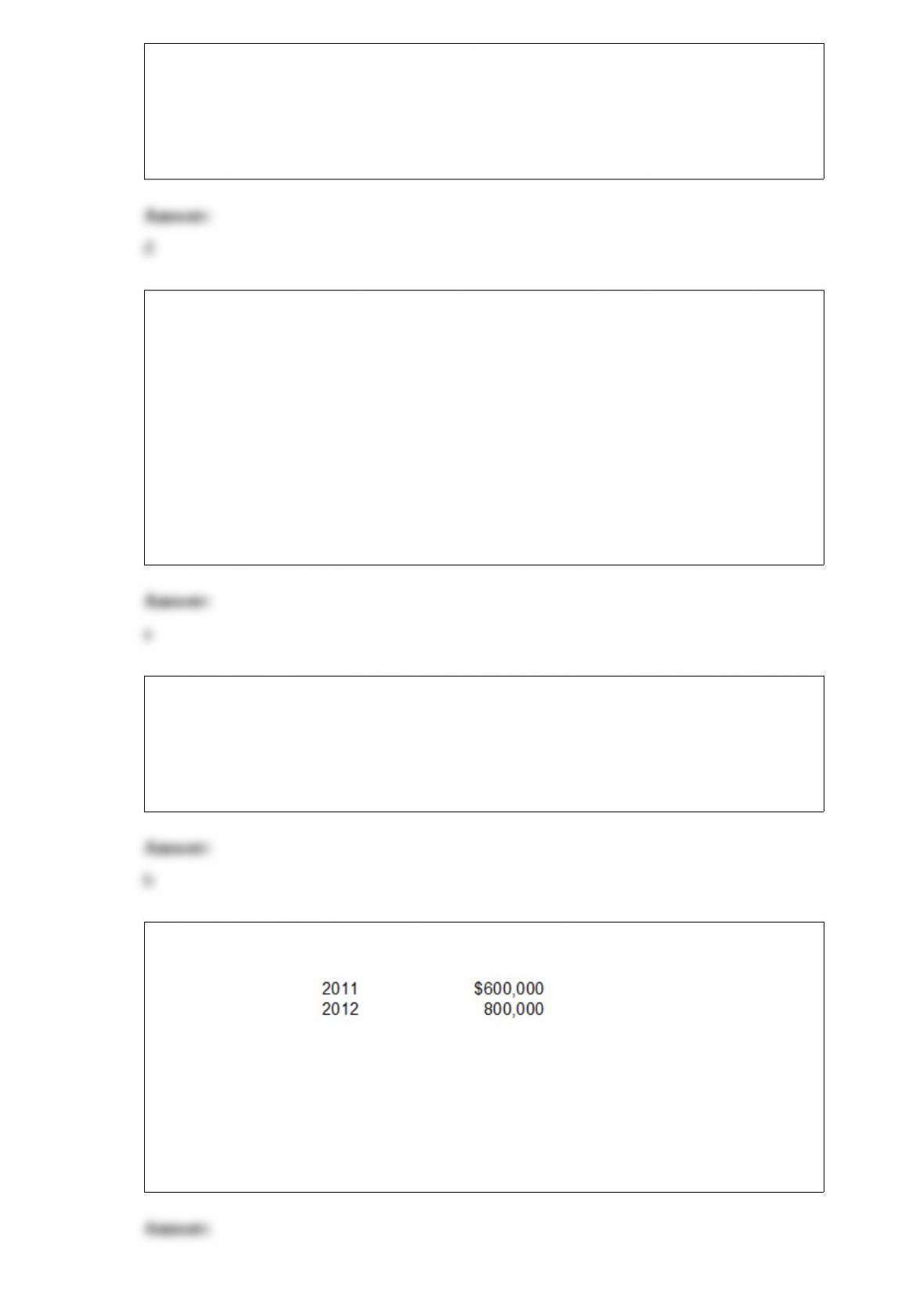
8) khan, inc. reports a taxable and financial loss of $1,300,000 for 2013. its pretax
financial income for the last two years was as follows:
the amount that khan, inc. reports as a net loss for financial reporting purposes in 2013,
assuming that it uses the carryback provisions, and that the tax rate is 30% for all
periods affected, is
a.$1,300,000 loss
b.$ -0-
c.$390,000 loss
d.$910,000 loss

9) of the following questions, which one would not be answered by the statement of
cash flows?
a.where did the cash come from during the period?
b.what was the cash used for during the period?
c.were all the cash expenditures of benefit to the company during the period?
d.what was the change in the cash balance during the period?
10) didde co. had 300,000 shares of common stock issued and outstanding at december
31, 2012. no common stock was issued during 2013. on january 1, 2013, didde issued
200,000 shares of nonconvertible preferred stock. during 2013, didde declared and paid
$150,000 cash dividends on the common stock and $120,000 on the preferred stock. net
income for the year ended december 31, 2013 was $930,000. what should be didde’s
2013 earnings per common share?
a.$3.10
b.$2.70
c.$2.60
d.$2.20
11) part (a)compute the amount that a $30,000 investment today would accumulate at
10% (compound interest) by the end of 6 years.
part (b)tom wants to retire at the end of this year (2012). his life expectancy is 20 years
from his retirement. tom has come to you, his cpa, to learn how much he should deposit
on december 31, 2012 to be able to withdraw $50,000 at the end of each year for the
next 20 years, assuming the amount on deposit will earn 8% interest annually.
part (c)judy thomas has a $1,800 overdue debt for medical books and supplies at joe’s
bookstore. she has only $600 in her checking account and doesn’t want her parents to
know about this debt. joe’s tells her that she may settle the account in one of two ways
since she can’t pay it all now:
1>.pay $600 now and $1,500 when she completes her residency, two years from today.
2>.pay $2,400 one year after completion of residency, three years from today.
assuming that the cost of money is the only factor in judy’s decision and that the cost of
money to her is 8%, which alternative should she choose? your answer must be
supported with calculations.
12) a statement of cash flows typically would not disclose the effects of
a.capital stock issued at an amount greater than par value
b.stock dividends declared
c.cash dividends paid
d.a purchase and immediate retirement of treasury stock
13) an early extinguishment of bonds payable, which were originally issued at a
premium, is made by purchase of the bonds between interest dates. at the time of
reacquisition
a.any costs of issuing the bonds must be amortized up to the purchase date
b.the premium must be amortized up to the purchase date
c.interest must be accrued from the last interest date to the purchase date
d.all of these
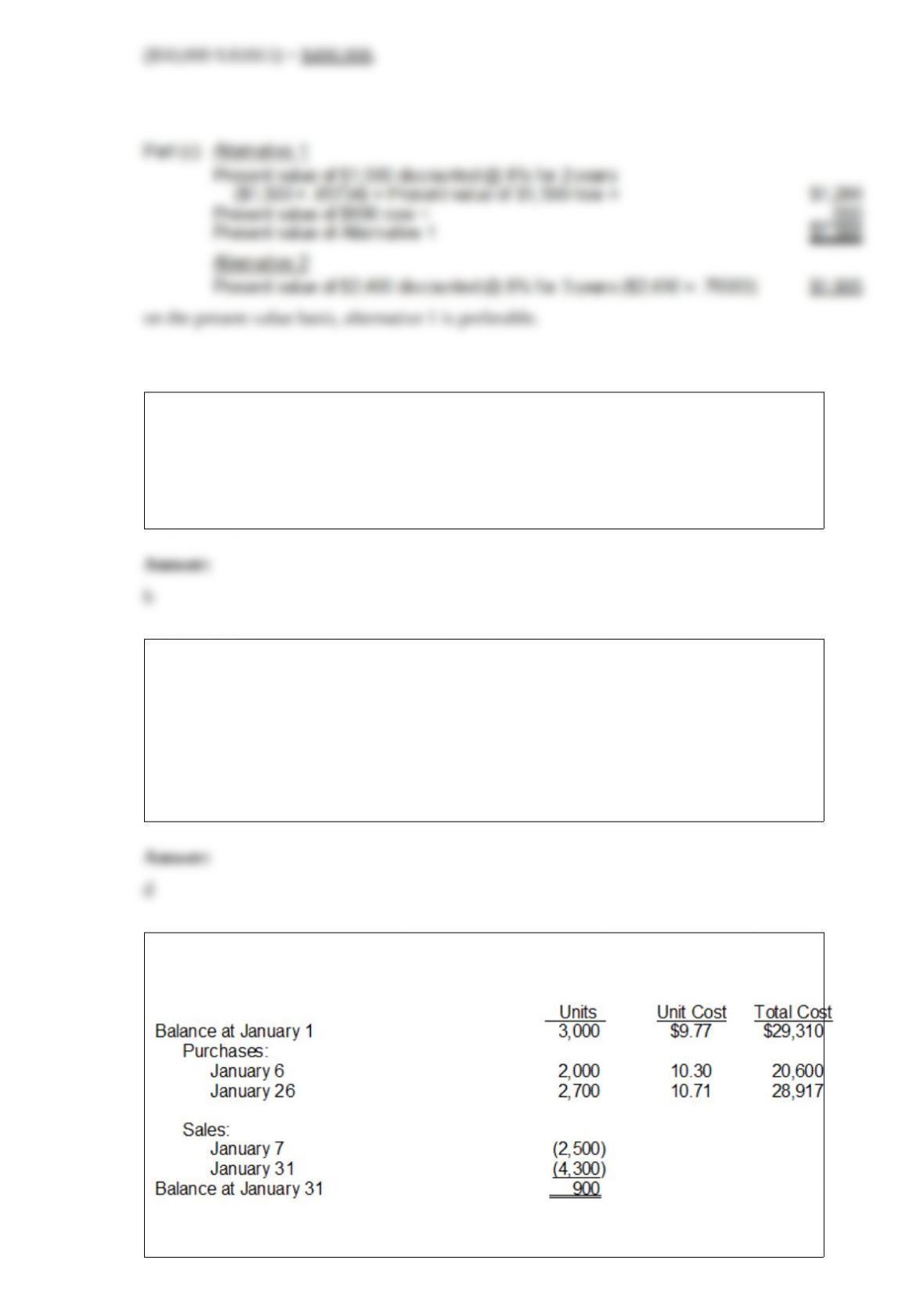
14) the following information was available from the inventory records of rich
company for january:
assuming that rich maintains perpetual inventory records, what should be the inventory
at january 31, using the moving-average inventory method, rounded to the nearest

dollar?
a.$9,454
b.$9,213
c.$9,234
d.$9,324
15) confectioners, a chain of candy stores, purchases its candy in bulk from its
suppliers. for a recent shipment, the company paid $1,800 and received 8,500 pieces of
candy that are allocated among three groups. group 1 consists of 2,500 pieces that are
expected to sell for $0.15 each. group 2 consists of 5,500 pieces that are expected to sell
for $0.36 each. group 3 consists of 500 pieces that are expected to sell for $0.72 each.
using the relative sales value method, what is the cost per item in group 2?
a.$0.225
b.$0.360
c.$0.210
d.$0.239
16) the financial statements most frequently provided include all of the following
except the
a.balance sheet
b.income statement
c.statement of cash flows
d.statement of retained earnings