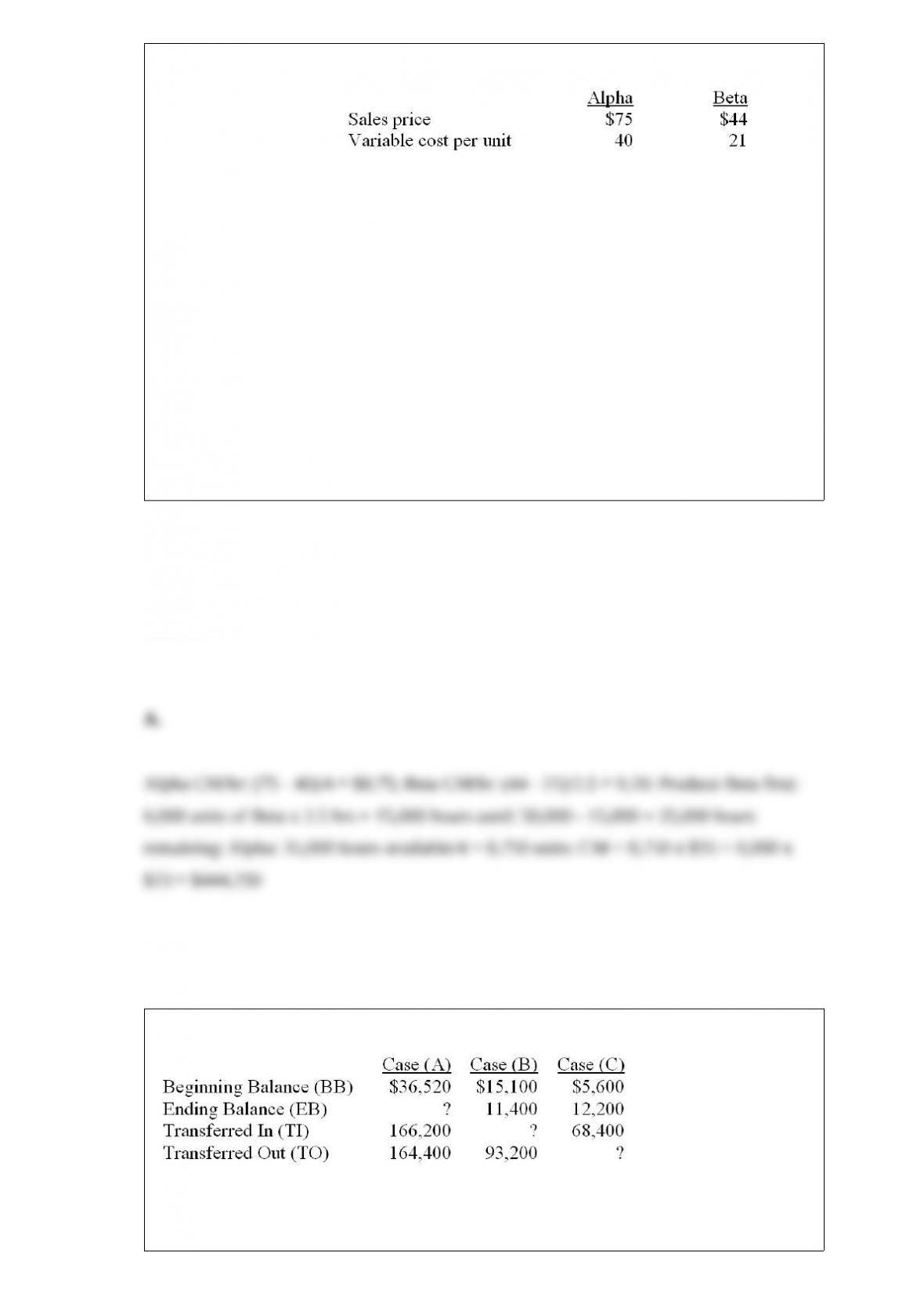
The Clapton Company manufactures two products: Alpha and Beta. The costs and
revenues are as follows:
Total demand for Alpha is 10,000 units and for Beta is 6,000 units. Machine time is a
scarce resource. During the year, 50,000 machine hours are available. Alpha requires 4
machine hours per unit, while Beta requires 2.5 machine hours per unit.
What is the maximum contribution margin Clapton can achieve during a year?
A. $444,250
B. $1,014,000
C. $488,000
D. $855,500
Answer:
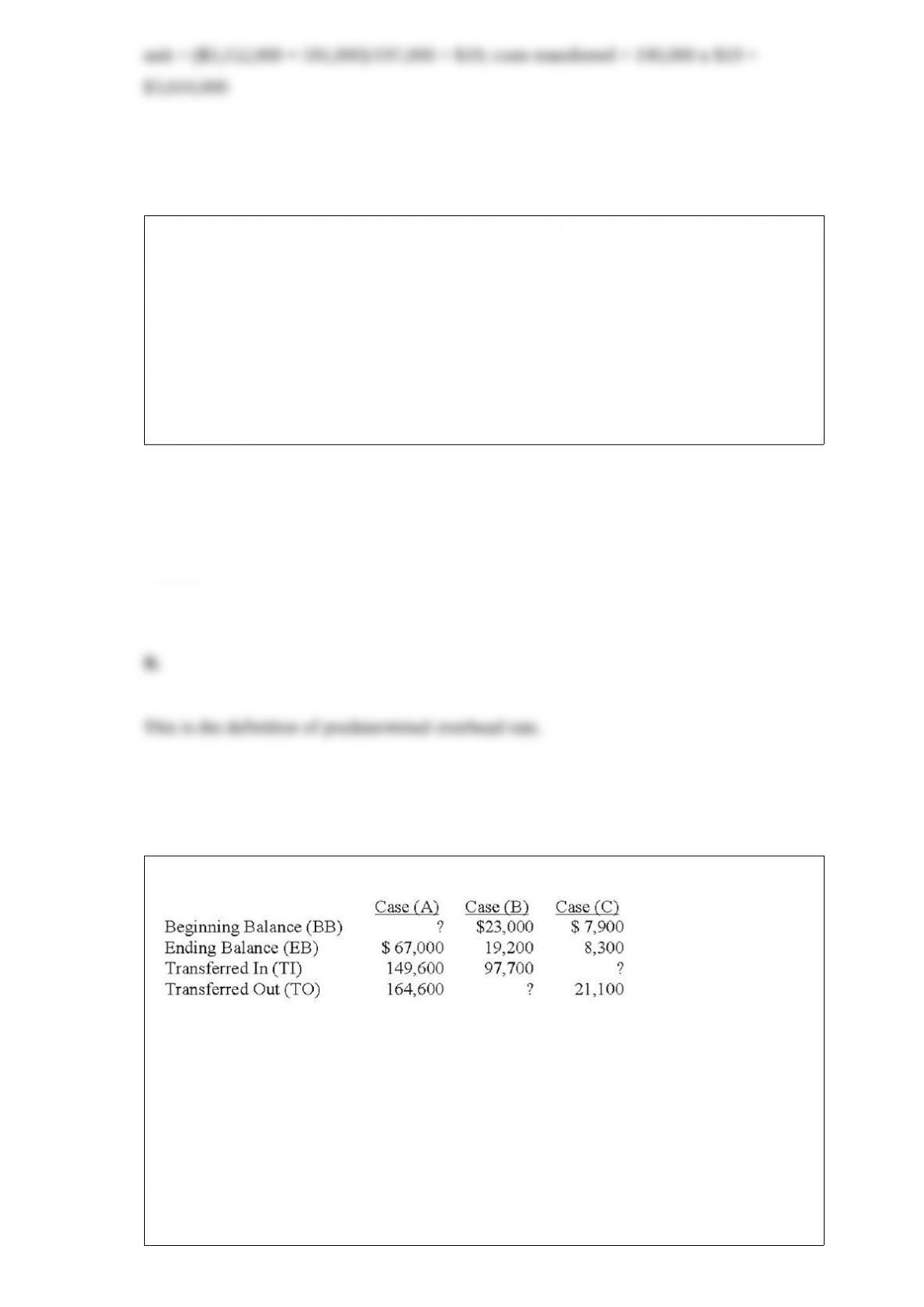
For Case (C) above, what is the Transferred-Out (TO)?

A. $75,000
B. $61,800
C. $68,400
D. $80,600
Answer:
Which of the following items would not require an adjustment to capital employed
when using economic value added (EVA)?
A. Research & development costs
B. Advertising expenditures
C. Preferred stock
D. Patents developed
Answer:
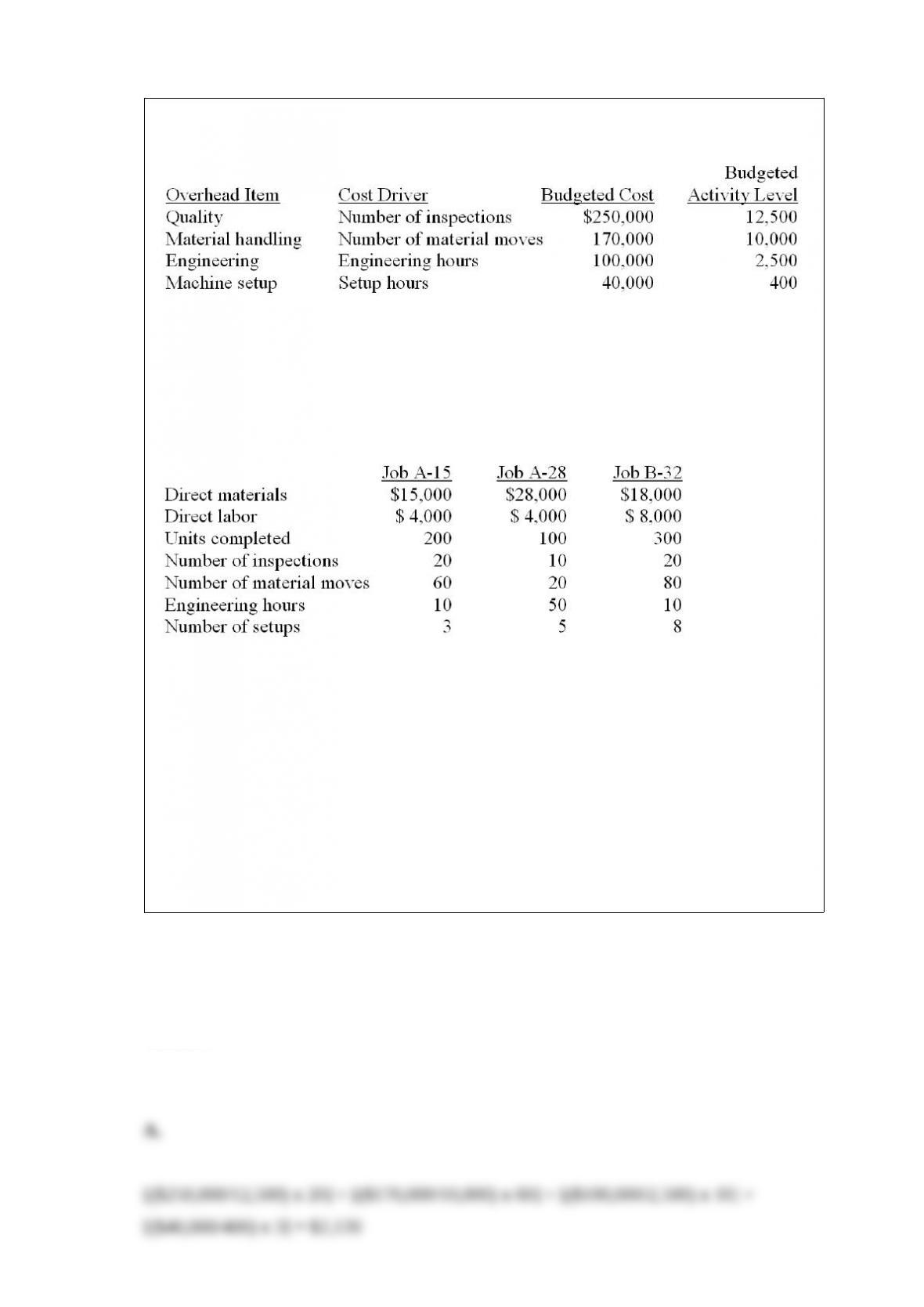
Scottso Enterprises has identified the following overhead costs and cost drivers for the
coming year:
Budgeted direct labor cost was $200,000 and budgeted direct material cost was
$800,000. The following information was collected on three jobs that were completed
during the month:
If the company uses activity-based costing (ABC), how much overhead cost should be
assigned to Job A-15?
A. $2,120
B. $11,200
C. $1,600
D. $2,050
Answer:

Which of the following statements is (are) true regarding financial measures?
(A) One disadvantage of using financial measures to evaluate performance is that they
are typically reported on a monthly, quarterly, or annual basis.
(B) One reason financial measures are used to evaluate performance is that they are
easily quantifiable.
A. Only A is true.
B. Only B is true.
C. Both A and B are true.
D. Neither A nor B is true.
Answer:
The financial records for the Lee Manufacturing Company have been destroyed in a
fire. The following information has been obtained from a separate set of books
maintained by the cost accountant. The cost accountant now asks for your assistance in
computing the missing amounts.
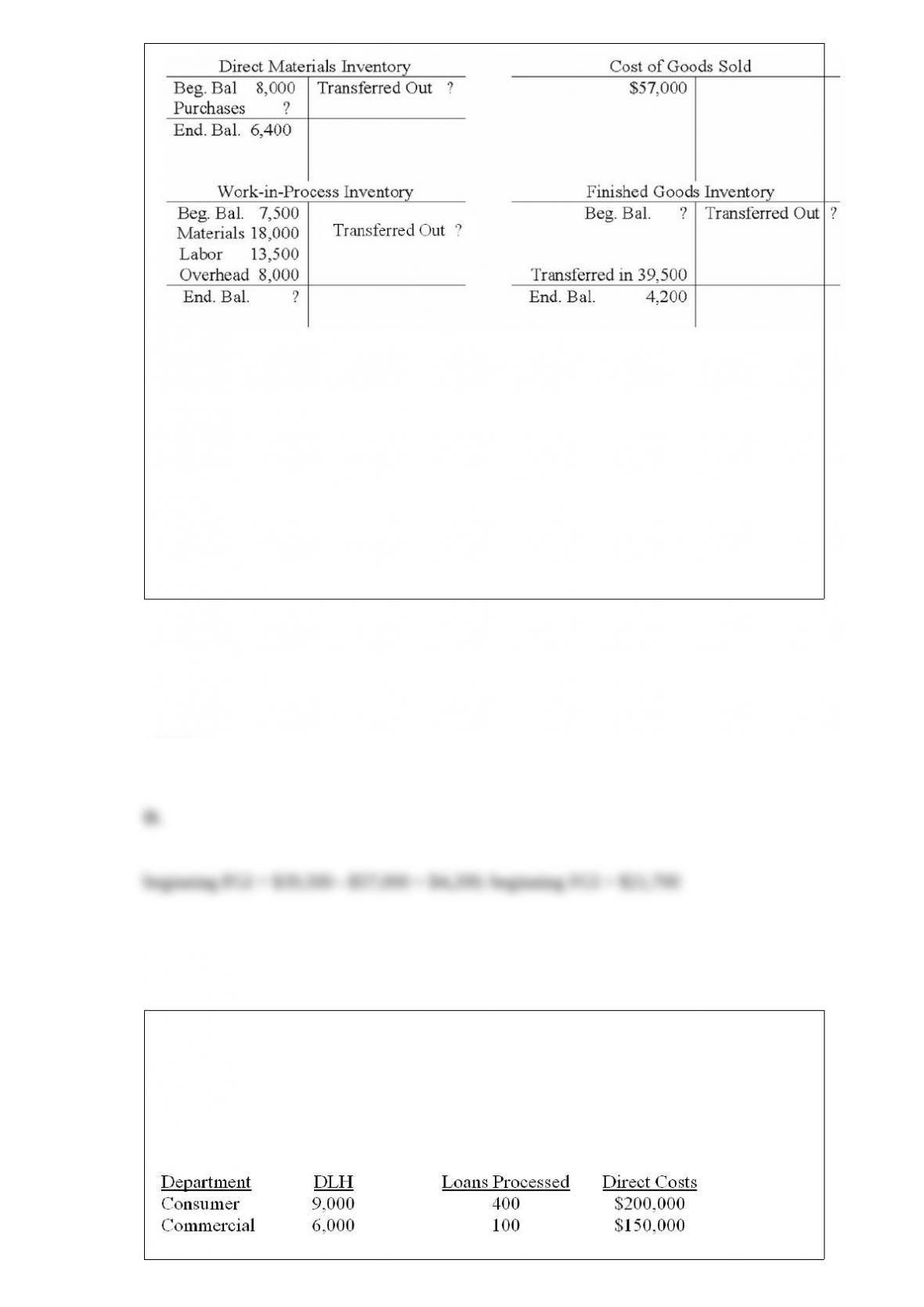
What is the value of the beginning Finished Goods Inventory?
A. $-0-
B. $4,200
C. $13,300
D. $21,700
Answer:
The Muskego National Bank is considering either a bankwide overhead rate or
department overhead rates to allocate $250,000 of indirect costs. The bankwide rate
could be based on either direct labor hours (DLH) or the number of loans processed.
The departmental rates would be based on direct labor hours for Consumer Loans and a
dual rate based on direct labor hours and the number of loans processed for Commercial
Loans. The following information was gathered for the upcoming period:

Management estimates that it costs $400 to analyze and close a commercial loan. What
is the overhead rate if Muskego allocates the remaining indirect costs using direct labor
hours?
A. $14.00 per hour
B. $16.67 per hour
C. $1,000 per loan
D. $500 per loan
Answer:
A balanced scorecard is a set of
A. performance measures.
B. financial statements.
C. budget schedules.
D. annual reports.
Answer:
A management method by which the organization seeks to excel on all dimensions of
quality is called
A. customer relationship management
B. distribution chain
C. total quality management
D. cost of quality
E. enterprise resource planning
Answer:
An internal transfer between two divisions is in the best economic interest of the entire
organization when
A. the variable costs plus the opportunity cost of the selling division is greater than the
external price for the buying division.
B. the variable costs plus the opportunity cost of the selling division is less than the
external price for the buying division.
C. there is excess capacity in the buying division with no alternative use.
D. there is no established market prices for the buying division.
Answer:
Partial productivity
A. is a ratio of the value of output to the value of all key inputs.
B. is the same thing as the production volume variance.
C. focuses on an individual input.
D. includes materials and labor but not overhead.
Answer:
Welsh Corporation’s return on investment (ROI) on some new equipment was 20%
using beginning-of-year net book value. The gross book value of the equipment is
$250,000. Accumulated depreciation at the beginning of the year was $10,000. This
represents one-half year’s straight-line depreciation. What is the annual before-tax cash
flow from the new equipment?

A. $68,000
B. $60,000
C. $48,000
D. $20,000
Answer:
Lo-crete produces quick setting concrete mix. Production of 200,000 tons was started
in April, 190,000 tons were completed. Material costs were $3,152,000 for the month
while conversion costs were $591,000. There was no beginning work-in-process; the
ending work-in-process was 70% complete. What is the cost of the product that was
completed and transferred to finished goods?
A. $3,610,000
B. $3,555,850
C. $2,994,400
D. $3,743,000
Answer:
The cost per unit of the allocation base used to charge overhead to products is the
A. job cost.
B. predetermined overhead rate.
C. operational cost.
D. process cost.
Answer:
For Case (C) above, what is the amount Transferred In (TI)?
A. $12,800
B. $20,700
C. $21,500
D. $29,400

Answer:
The method of accounting for joint product costs that will produce the same gross
margin percentage for all products is the
A. replacement method.
B. physical quantities method.
C. net realizable value method.
D. units produced method.
Answer:
Which of the following statements is true?
A. Job costing can only be used when a single unit is produced rather than a batch.
B. Process costing is used when products are customized.
C. Job costing must be used in a continuous flow processing environment.
D. Process costing does not separately record the costs for each unit.
Answer:
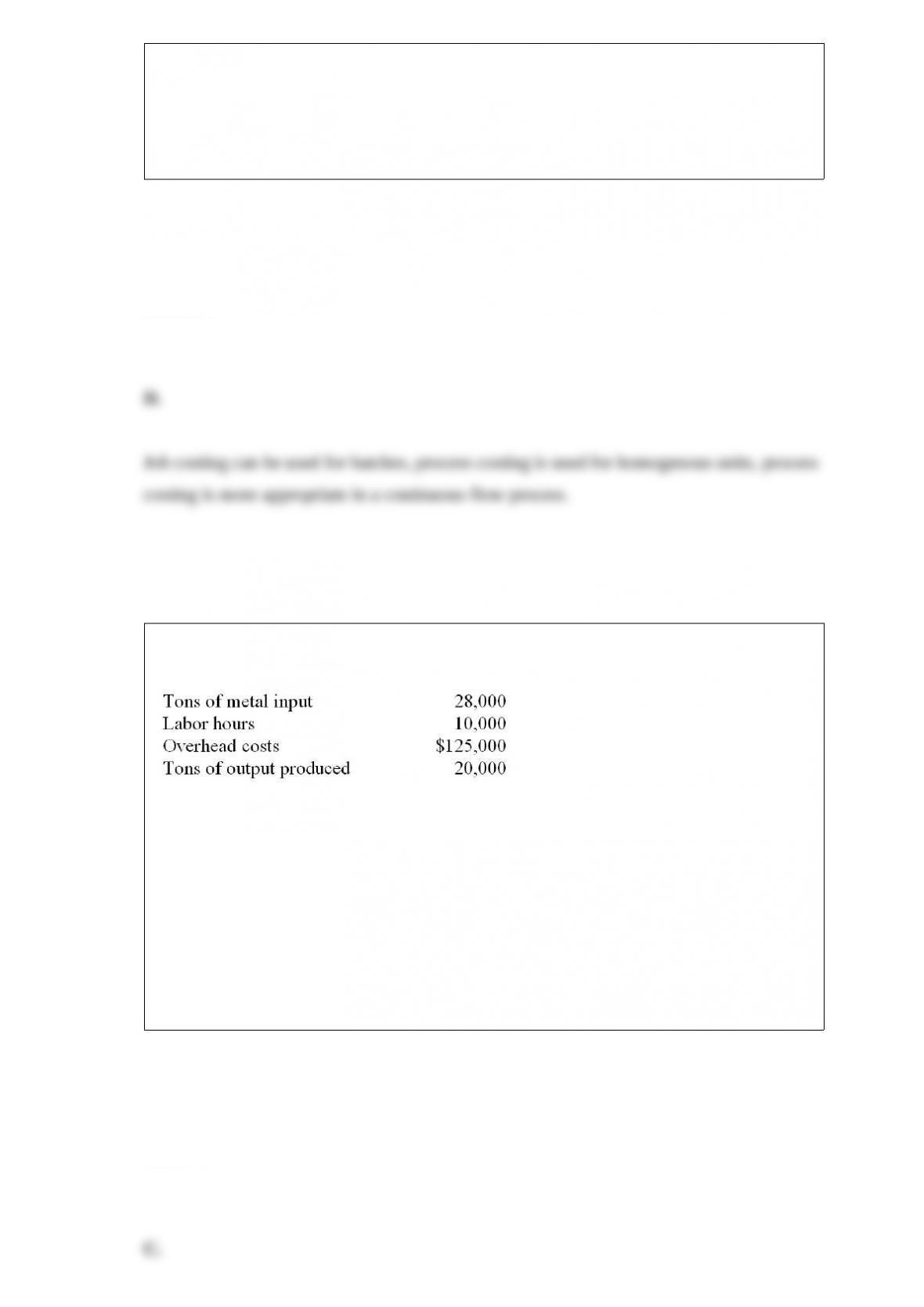
The Lutsen Machining Co has the following information for last year
The partial productivity for metal is
A. 2.800
B. 1.400
C. 0.714
D. 0.526
Answer:
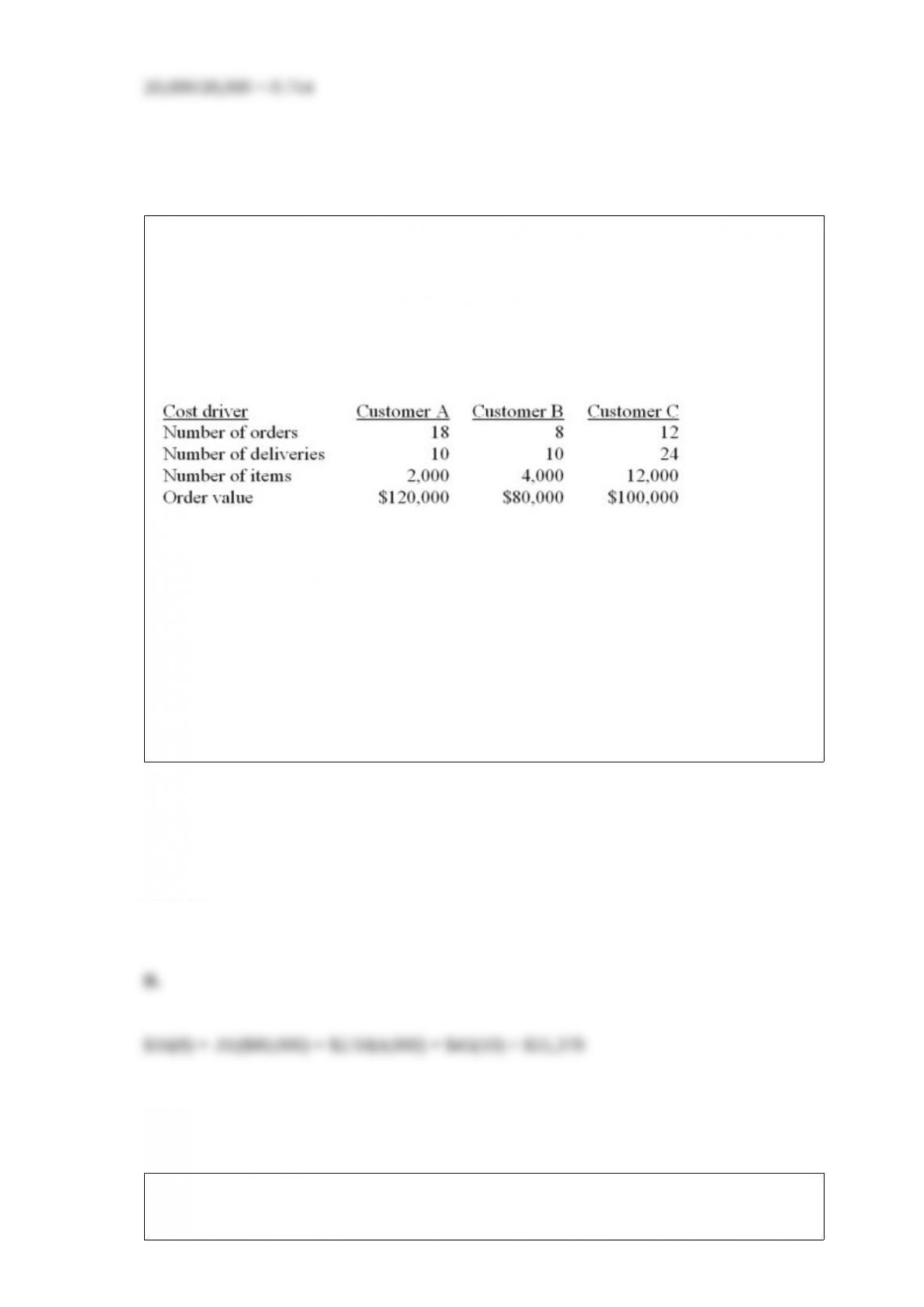
Folly Beach Industries decides to price delivery service according to the results of a
recent activity-based costing (ABC) study. The study indicates Folly Beach should
charge $16 per order, 1% of the order’s value for general delivery costs, $2.50 per item,
and $45 for delivery.
A year later, Folly Beach collected the following information for three of its customers:
What are the total delivery costs charged to Customer B during the year?
A. $13,490
B. $11,378
C. $10,800
D. $10,578
Answer:
Which of the following costs would most likely be classified as variable assuming the
account analysis method is used to determine cost behaviors?
A. Indirect materials.
B. Supervisory salaries.
C. Equipment maintenance.
D. Annual Christmas party.
E. Building occupancy costs.
Answer:
Fenway Telcom has three divisions, commercial, retail and consumer, that share the
common costs of the company’s computer server network. The annual common costs
are $2,400,000. You have been provided with the following information for the
upcoming year:
Fenway Telcom uses the single rate method and allocates common costs based on the
number of connections. What is the total computer server network cost allocated to the
Commercial Division?
A. $480,000
B. $514,286
C. $600,000
D. $1,200,000

Answer:
Which of the following statements regarding variances is (are) false?
(A) In general and holding all other things constant, an unfavorable variance decreases
operating profits.
(B) A favorable variance is not always good, and an unfavorable variance is not always
bad.
A. Only A is false.
B. Only B is false.
C. Both A and B are false.
D. Neither A nor B is false.
Answer:
The journal entry to record the completion of a job in a job order cost system is
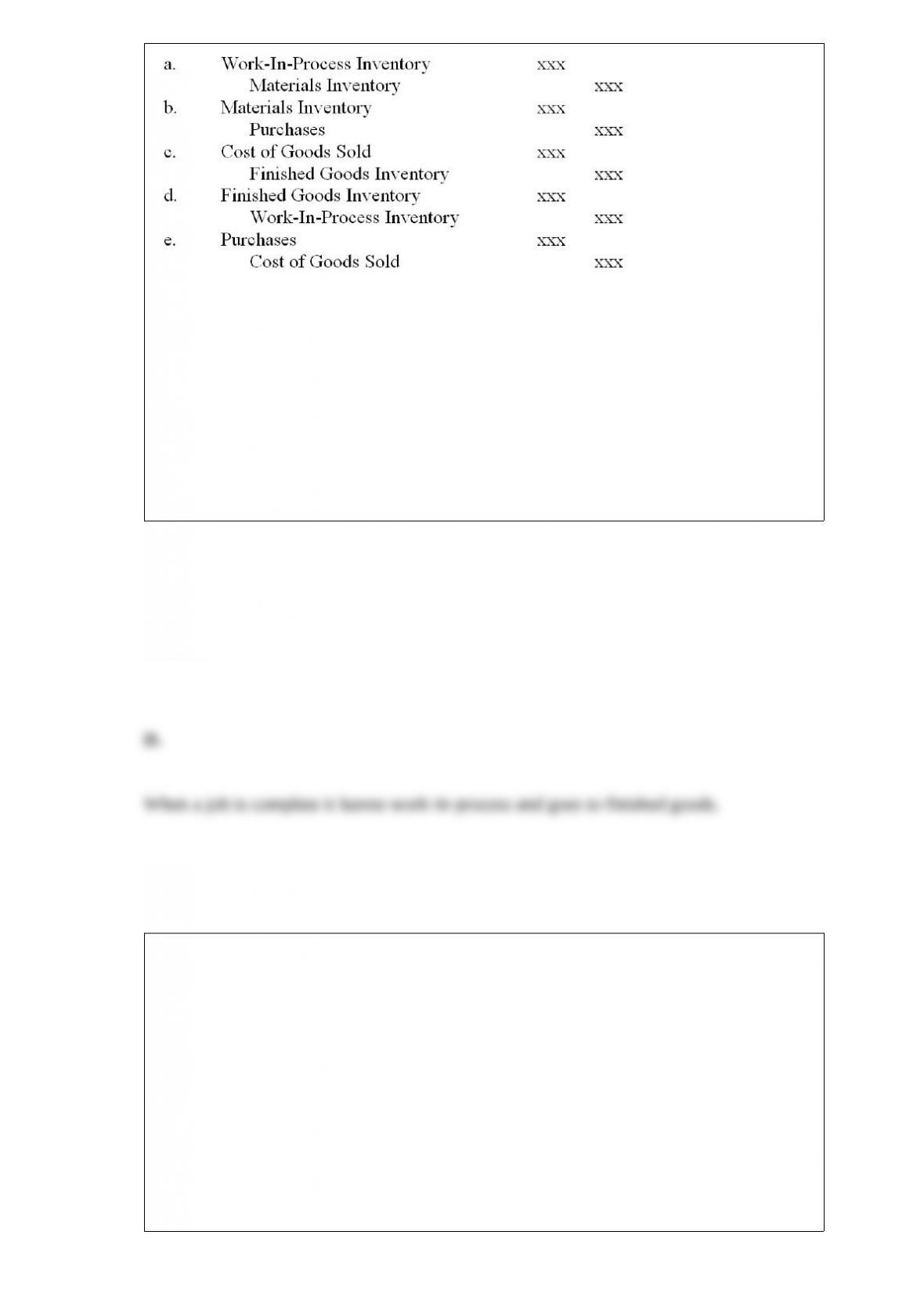
A. a
B. b
C. c
D. d
E. e
Answer:
Engineering cost estimates are usually based on operating conditions that are
considered:
A. optimal.
B. practical.
C. attainable.
D. historical.
E. realistic.
Answer:
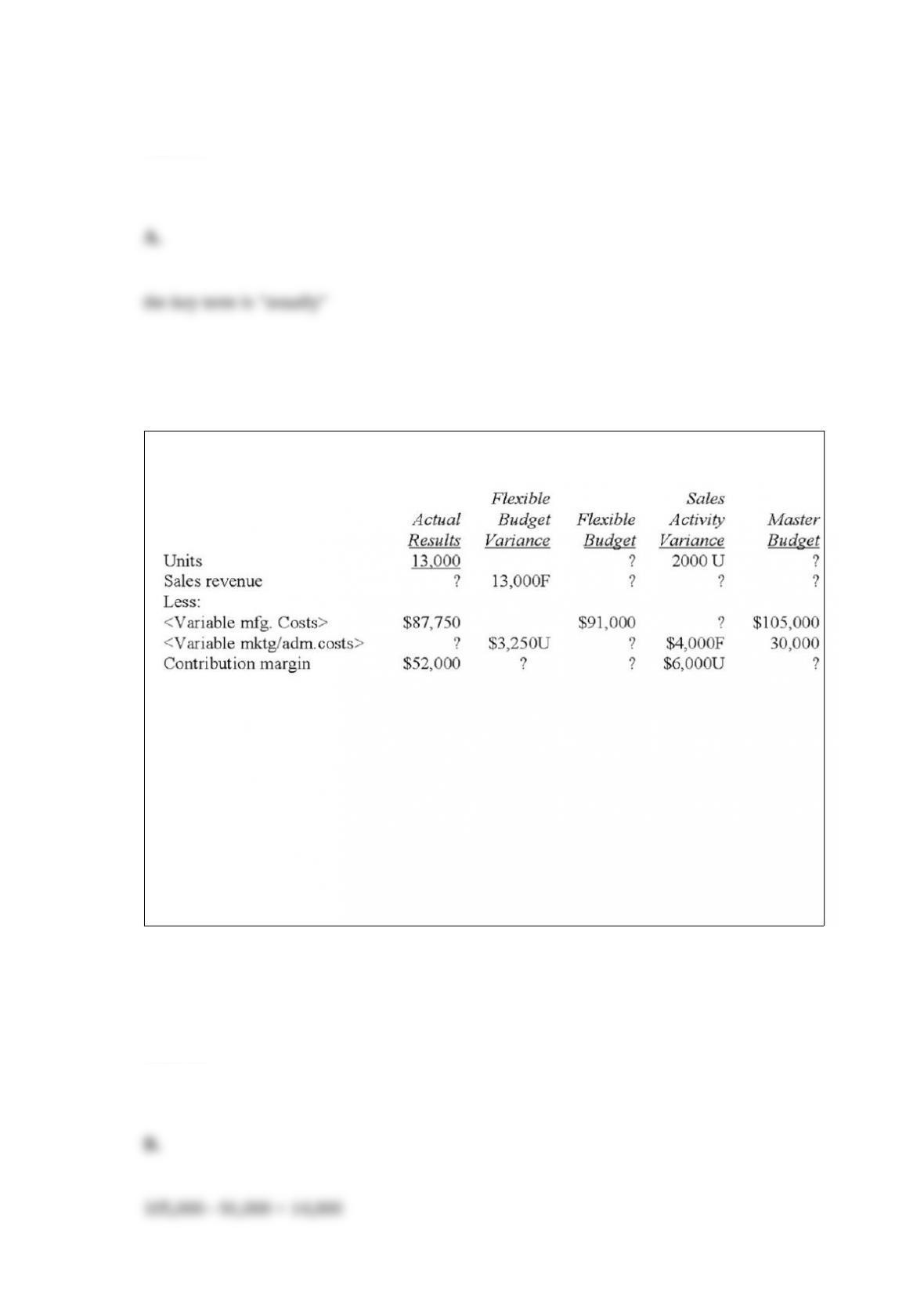
What is the activity variance for the variable manufacturing costs?
A. $4,000
B. $14,000
C. $24,000
D. $34,000
Answer:
Given a competitive outside market for identical intermediate goods, what is the BEST
transfer price, assuming all relevant information is readily available?
A. standard production cost per unit.
B. market price of the intermediate goods.
C. actual full cost per unit plus a normal markup.
D. market price of the final goods less any opportunity costs.
Answer:
Palo Products has provided the following information for last year:
The total factor productivity measure is:
A. 1.25
B. 1.60
C. 15.63
D. 1.17
Answer:
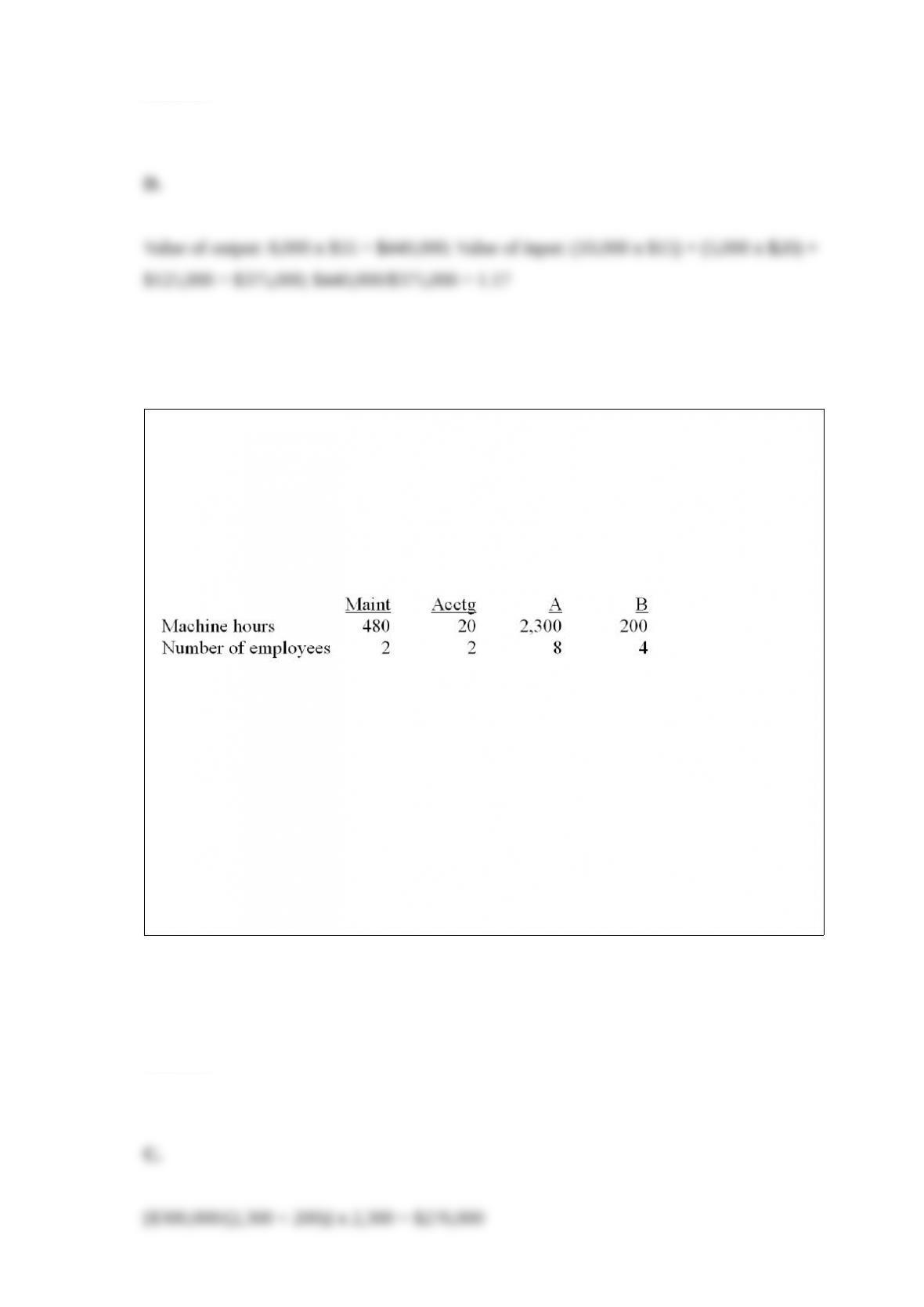
The RAH Manufacturing Company has two service departments: Maintenance and
Accounting. The Maintenance Department’s costs of $300,000 are allocated on the basis
of machine hours. The Accounting Department’s costs of $120,000 are allocated on the
basis of the number of employees within a specific department. The direct departmental
costs for A and B are $300,000 and $500,000, respectively.
What is the Maintenance Department’s cost allocated to Department A using the direct
method?
A. $92,000
B. $230,000
C. $276,000
D. $386,400
Answer:
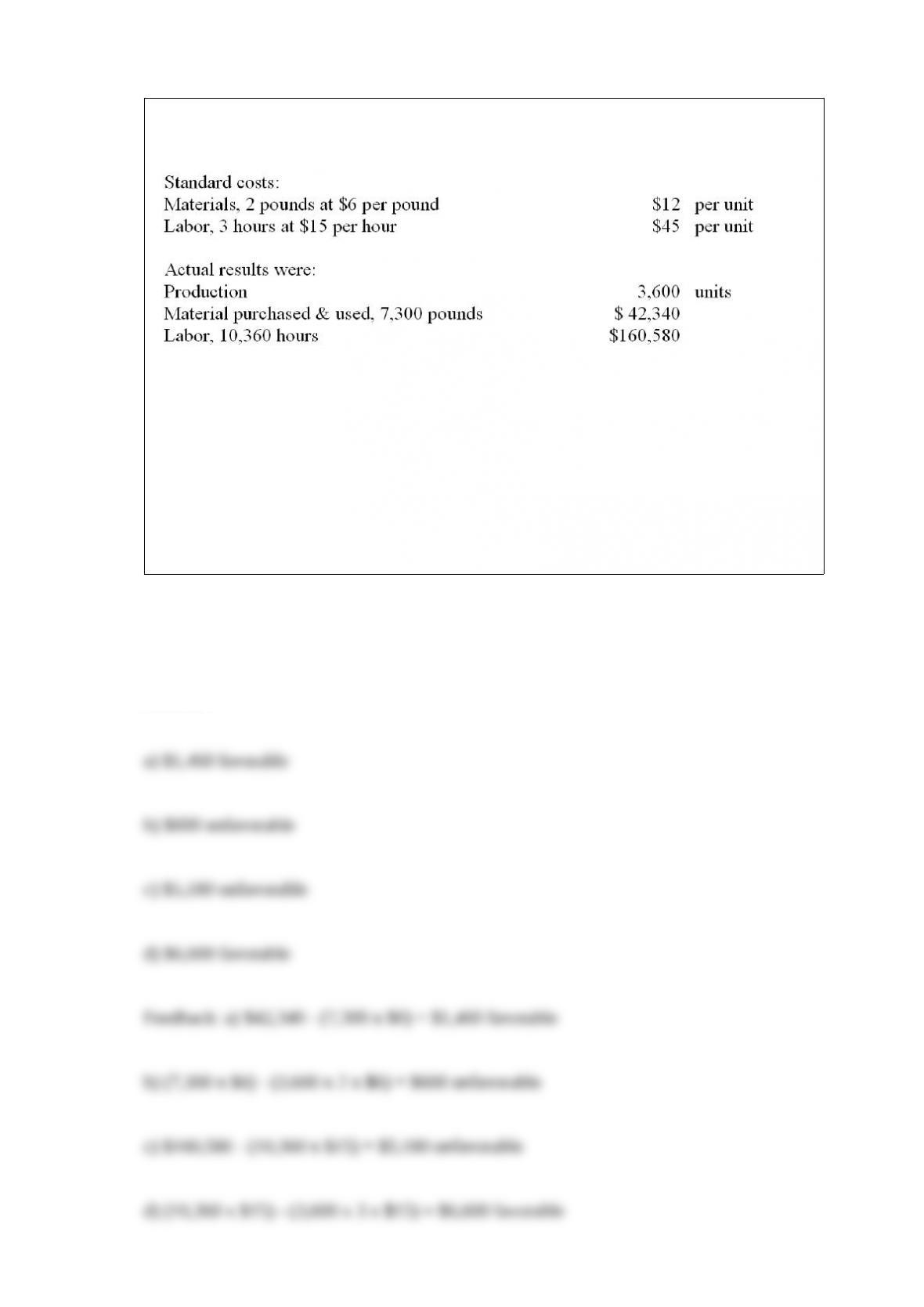
The data below relate to a product of Benoit Company.
Required: (Be sure to indicate whether the variances are favorable or unfavorable.)
a) Compute the direct material price variance.
b) Compute the direct material usage variance.
c) Compute the direct labor rate variance.
d) Compute the direct labor efficiency variance.
Answer:
The manufacturing overhead budget requires that costs be separated into their fixed
and variable components. Another budget that has this requirement is the
A. direct labor.
B. direct materials.
C. cost of goods sold.
D. marketing and administrative expenses.
Answer: