Mortgage bonds are backed only by the good faith and credit of the issuing company.
The primary purpose of the statement of cash flows is to report all major cash receipts
(inflows) and cash payments (outflows) during a period.
A company had net sales of $500,000 and an average accounts receivable of $80,000.
Its accounts receivable turnover equals 6.25.
Equivalent units of production refer to the number of units that would be completed if
all effort during a period had been applied only to those units that were started and
completed in a period.
Stated value stock is par stock that is assigned a value per share by the corporation’s
board of directors.
The inventory turnover ratio is computed by dividing average merchandise inventory by
cost of goods sold.
The maturity date of a note refers to the date the note must be paid.
Permanent accounts carry their balances into the next accounting period. Moreover,
asset, liability and revenue accounts are not closed as long as a company continues in
business.
Liquidity and efficiency are considered to be building blocks of financial statement
analysis.
A manufacturer’s cost of goods manufactured is the sum of direct materials, direct labor,
and factory overhead costs incurred in producing products.
Adjustments must be entered in the journal and posted to the ledger after the work sheet
is prepared.

Materials requisitions and time tickets are cost accounting source documents.
A multiple-step income statement format shows detailed computations of net sales and
other costs and expenses, and reports subtotals for various classes of items.
Financial reporting includes not only general purpose financial statements, but also
information from SEC filings, press releases, shareholders’ meetings, forecasts,
management letters, auditor’s reports, and Webcasts.
Advertising expense can be reasonably allocated to departments on the basis of sales.
In the absence of a partnership agreement, the law says that income of a partnership
will be shared equally by the partners.
An ordinary annuity refers to a series of equal payments made or received at the end of
each period.
Intangible assets are certain nonphysical assets used in operations that confer on their
owners long-term rights, privileges, or competitive advantage.
The first five steps in the accounting cycle include analyzing transactions, journalizing,
posting, preparing an unadjusted trial balance, and recording adjusting entries.
Depreciation expense for a period is the portion of a plant asset’s cost that is allocated to
that period.
As long as a company accurately records total credit sales information, it is not
necessary to have separate accounts for specific customers.
U. S. Government Treasury bonds provide high return and low risk to investors.
A budget performance report that includes variances can have variances caused by both
price differences and quantity differences.
In a perpetual inventory system, the Merchandise Inventory account reflects the cost of
goods available for sale.
Indirect expenses should be allocated to departments based upon the benefits received
by each department.
A flexible budget expresses variable costs on a per unit basis and fixed costs on a total
basis.
The use of debt is sometimes described as financial leverage because debt can have the
effect of increasing the return on equity.
Liabilities are the owner’s claim on assets.
A cash equivalent must be readily convertible to a known amount of cash, and must be
sufficiently close to its maturity so its market value is unaffected by interest rate
changes.
A company’s quick assets are $147,000 and its current liabilities are $143,000. This
company’s acid-test ratio is 1.03.
Return on total assets can be separated into the profit margin ratio and total asset
turnover.
On December 31, a company needed to estimate its ending inventory to prepare its
fourth quarter financial statements. The following information is currently available:
Inventory as of October 1: $12,500
Net sales for fourth quarter: $40,000
Net purchases for fourth quarter: $27,500
This company typically achieves a gross profit ratio of 15%. Ending Inventory under
the gross profit method would be:
A.$ 4,000.
B.$ 6,000.
C.$10,000.
D.$16,000.
E.$34,000.
On May 1, 2009, Carter Advertising Company received $3,600 from Kaitlyn Breanna
for advertising services to be completed April 30, 2010. The Cash receipt was recorded
as unearned fees. The adjusting entry on December 31, 2010 should include:
A.a debit to Earned Fees for $3,600.
B.a debit to Unearned Fees for $1,200.
C.a credit to Unearned Fees for $1,200.
D.a debit to Earned Fees for $2,400.
E.a credit Earned Fees for $2,400.
Available-for-sale equity securities:
A.Are recorded at cost when acquired.
B.May earn dividends that are reported in that year’s income statement.
C.May be classified as either short-term or long-term securities.
D.Are reported at market value on the balance sheet.
E.All of these.
Breanna Boutique purchased on credit 50,000 worth of clothing from a British company
when the exchange rate was $1.97 per British pound. At the year-end balance sheet date
the exchange rate increased to $2.76. Breanna Boutique must record a:
A.gain of $39,500.
B.loss of $39,500.
C.gain of $138,000.
D.loss of $138,000.
E.neither a gain nor loss.
The total cost of goods completed during the accounting period for a manufacturer is
called:
A.Ending finished goods inventory.
B.Total manufacturing costs.
C.Ending goods in process inventory.
D.Cost of goods manufactured.
E.Cost of goods sold.
Which of the following statements is incorrect?
A.Working papers are useful aids in the accounting process.
B.On the work sheet, the effects of the accounting adjustments are shown on the
account balances.
C.After the work sheet is completed, it can be used to help prepare the financial
statements.
D.On the work sheet, the adjusted amounts are sorted into columns according to
whether the accounts are used in preparing the unadjusted trial balance or the adjusted
trial balance.
E.A worksheet is not a substitute for financial statements.
A record of the increases and decreases in a specific asset, liability, equity, revenue, or
expense is a(n):
A.Journal.
B.Posting.
C.Trial balance.
D.Account.
E.Chart of accounts.
Equivalent units of production are equal to:
A.The number of units that could have been completed if all effort had been applied to
units that were started and completed that period.
B.The number of finished units actually produced that period.
C.The number of units introduced into the process that period.
D.The number of units still in process that period.
E.Physical units that were completed this period from all effort being applied to them.
Which one of the following is representative of typical cash flows from operating
activities?
A.Proceeds from collecting the principal amount of loans.
B.Repayment of principal on loans.
C.Proceeds from the issuance of bonds and notes payable.
D.Payments by a merchandiser to acquire equity securities of other companies.
E.Receipts of cash sales.
On January 1 of Year 1, Drum Line Airways issued $3,500,000 of par value bonds for
$3,200,000. The bonds pay interest semiannually on January 1 and July 1. The contract
rate of interest is 7% while the market rate of interest for similar bonds is 8%. The bond
premium or discount is being amortized at a rate of $10,000 every six months.
The amount of interest expense recognized by Drum Line Airways on the bond issue in
Year 1 would be:
A.$132,500.
B.$225,000.
C.$265,000.
D.$245,000.
E.$280,000.
Use the following data to determine the cost of goods manufactured.
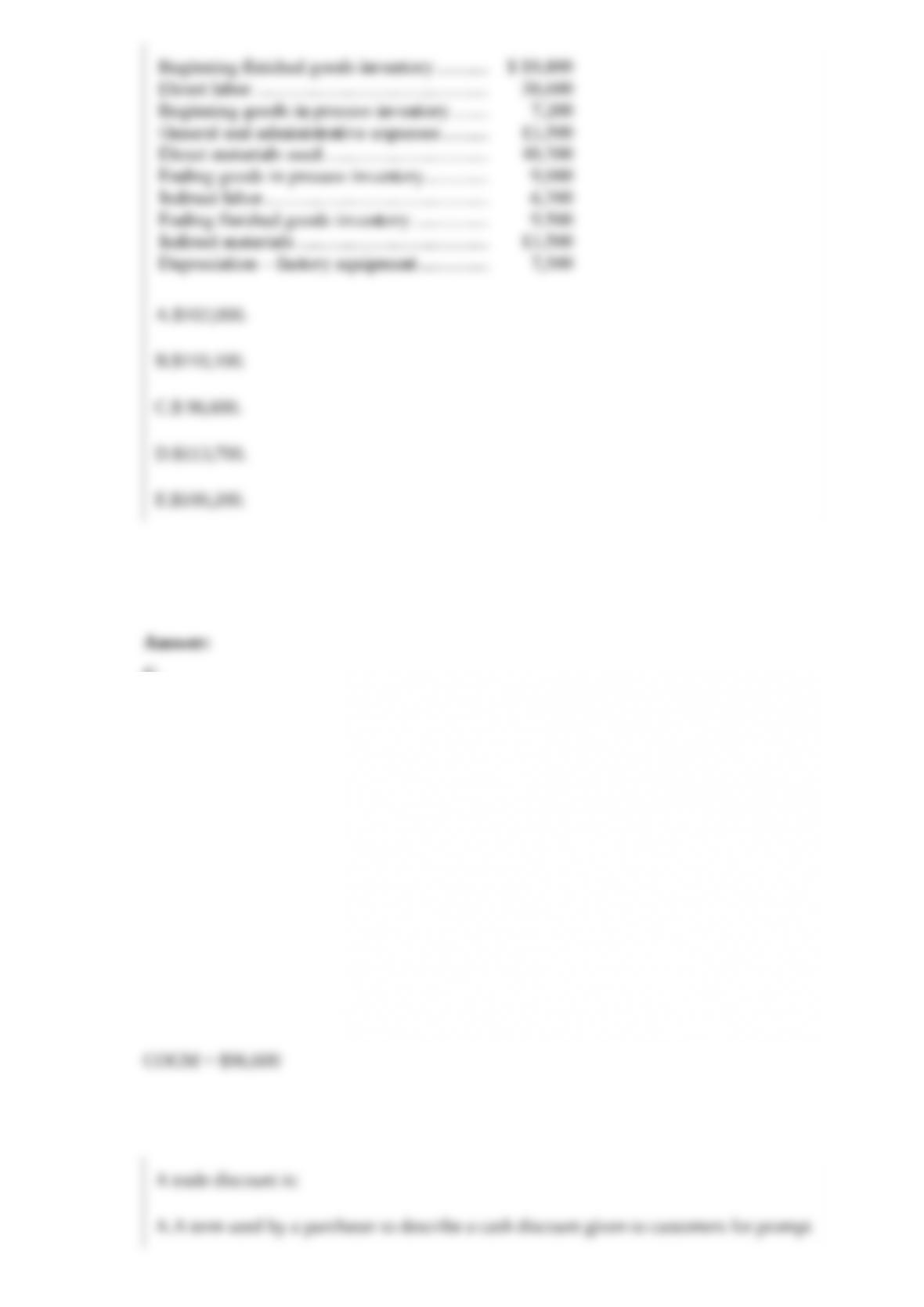
A.$102,000.
B.$110,100.
C.$ 96,600.
D.$113,700.
E.$100,200.
A trade discount is:
A.A term used by a purchaser to describe a cash discount given to customers for prompt
payment.
B.A reduction in price below the list price.
C.A term used by a seller to describe a cash discount granted to customers for prompt
payment.
D.A reduction in price for prompt payment.
E.Also called a rebate.
A class of stock that does not have a par value, and can usually be issued at any price
without creating a minimum legal capital deficiency, is called:
A.Convertible stock.
B.No-par stock.
C.Callable stock.
D.Noncumulative stock.
E.Discounted stock.
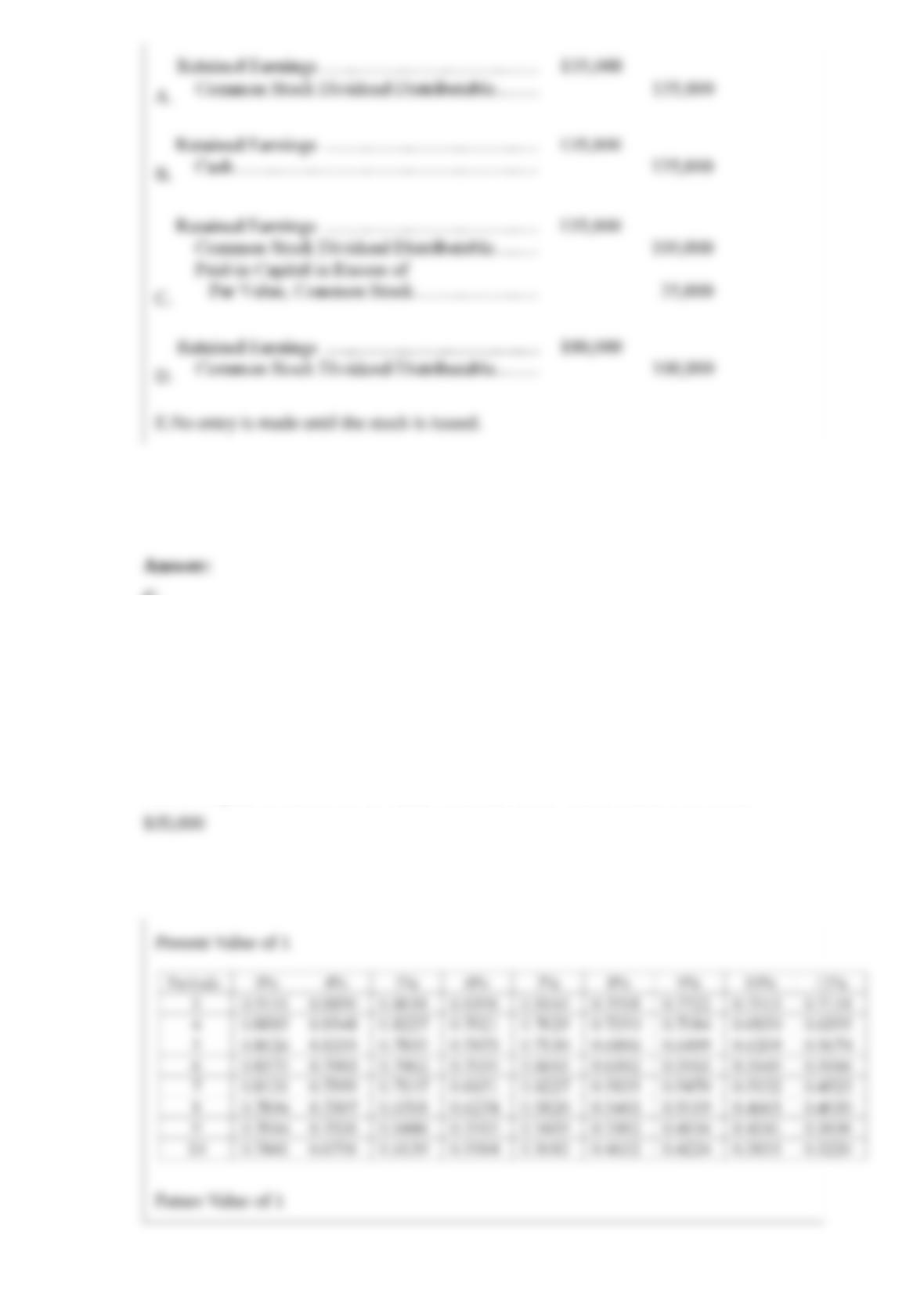
A corporation had 50,000 shares of $20 par value common stock outstanding on July 1.
Later that day the board of directors declared a 10% stock dividend when the market
value of each share was $27. The entry to record this dividend is:
A.
B.
C.
D.
E.No entry is made until the stock is issued.
Present Value of 1
Future Value of 1
Present Value of an Annuity of 1
Future Value of an Annuity of 1
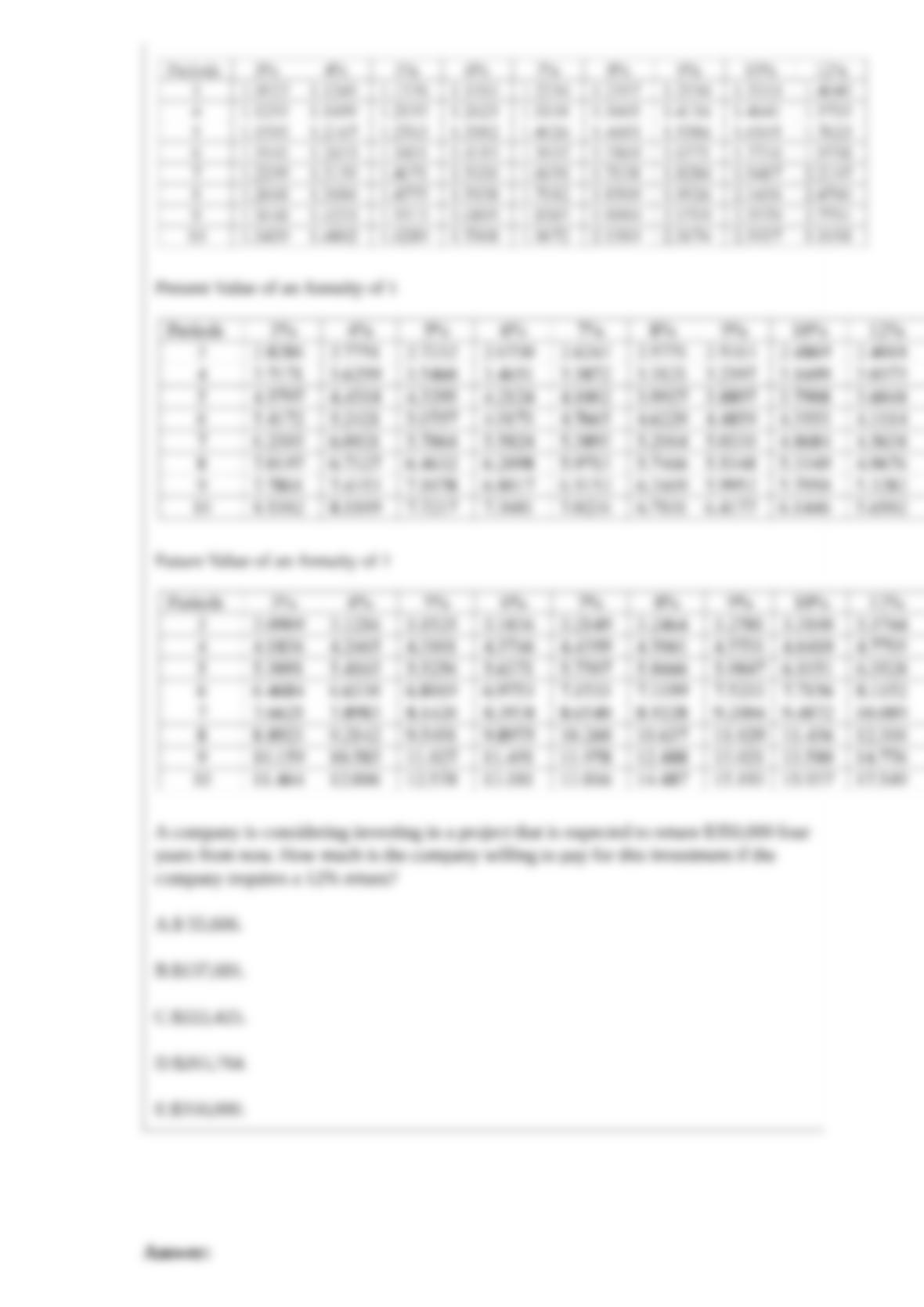
A company is considering investing in a project that is expected to return $350,000 four
years from now. How much is the company willing to pay for this investment if the
company requires a 12% return?
A.$ 55,606.
B.$137,681.
C.$222,425.
D.$265,764.
E.$350,000.
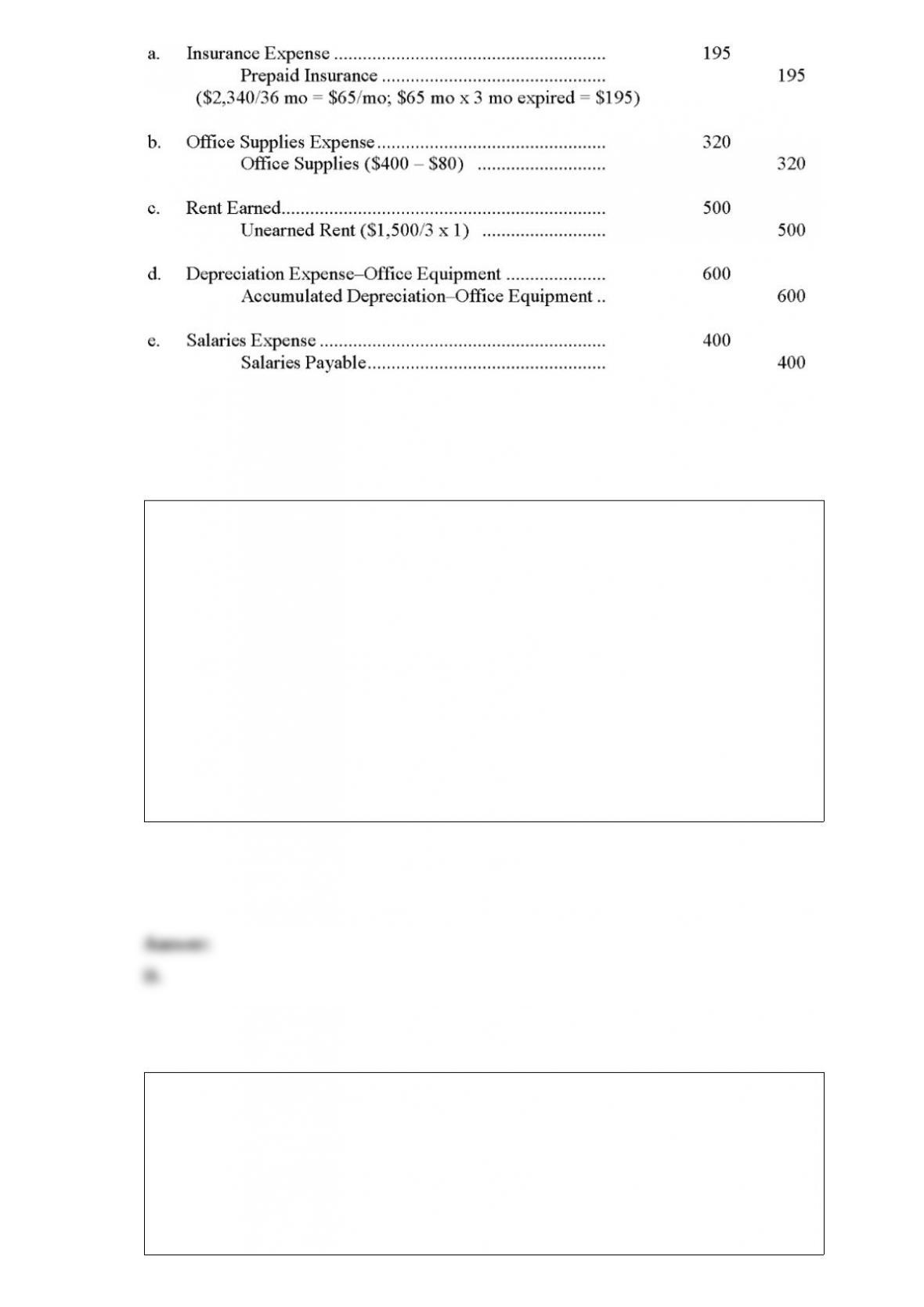
In general journal form, record the December 31 adjusting entries for the following
transactions and events. Assume that December 31 is the end of the annual accounting
period.
a. The Prepaid Insurance account shows a debit balance of $2,340, representing the cost
of a three-year fire insurance policy that was purchased on October 1 of the current
year.
b. The Office Supplies account has a debit balance of $400; a year-end inventory count
reveals $80 of supplies still on hand.
c. On November 1 of the current year, Rent Earned was credited for $1,500. This
amount represented the rent earned for a three-month period beginning November 1.
d. Estimated depreciation on office equipment is $600.
e. Accrued salaries amount to $400.
Variable budget is another name for:
A.Cash budget.
B.Flexible budget.
C.Fixed budget.

D.Manufacturing budget.
E.Rolling budget.
The cost of labor that is not clearly associated with specific units or batches of product
is called:
A.Unspecified labor.
B.Direct labor.
C.Indirect labor.
D.Basic labor.
E.Joint labor.
The days’ sales uncollected ratio is used to:
A.Measure how many days of sales remain until the end of the year.
B.Determine the number of days that have passed without collecting on accounts
receivable.
C.Identify the likelihood of collecting sales on account.
D.Estimate how much time is likely to pass before the amount of accounts receivable is
received in cash.
E.Measure the amount of layaway sales for a period.
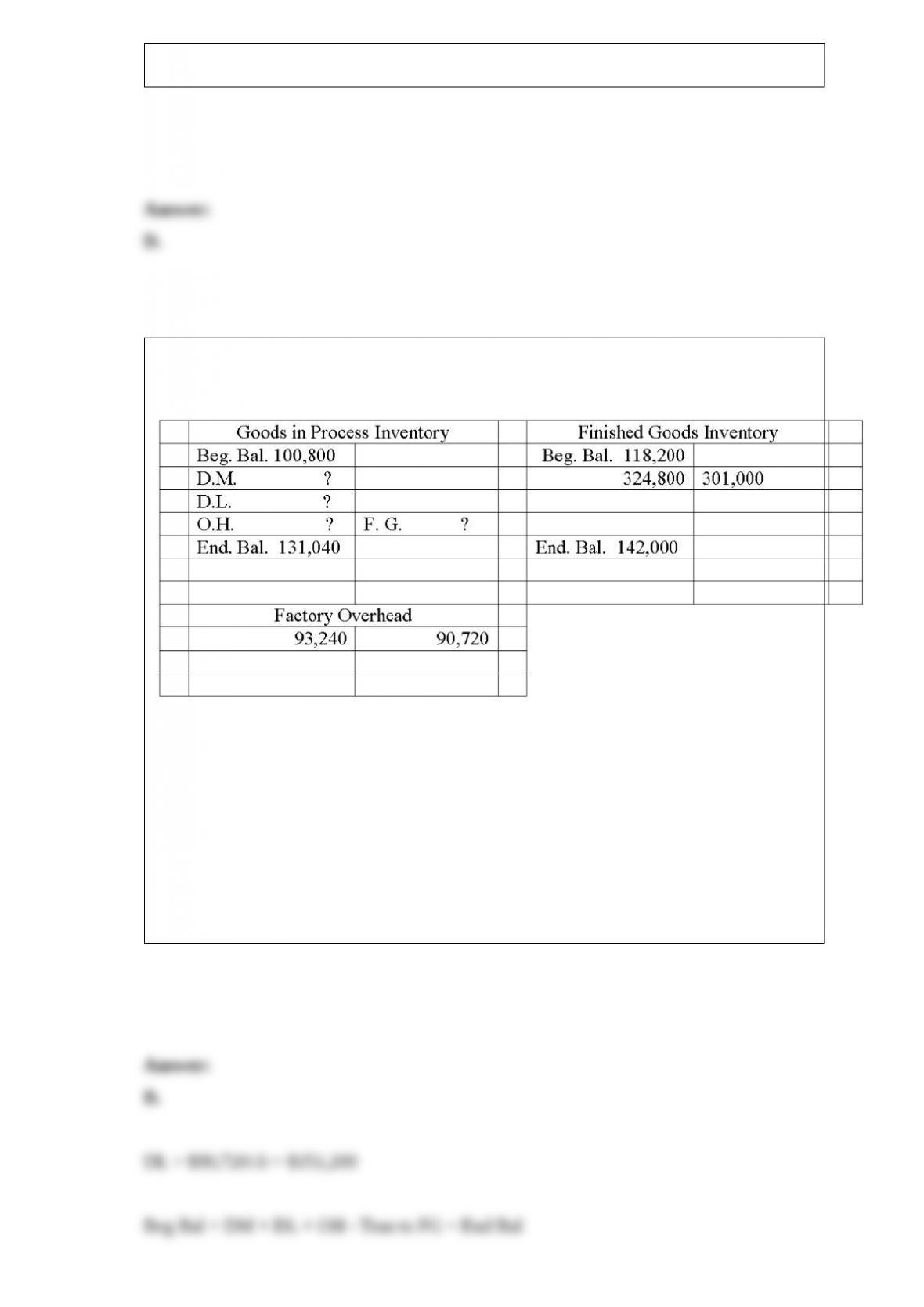
A company’s overhead rate is 60% of direct labor cost. Using the following incomplete
accounts, determine the cost of direct materials used.
A.$106,400.
B.$113,120.
C.$ 30,240.
D.$211,680.
E.$324,800.

A written promise to pay a definite sum of money on a specified future date is a(n):
A.Unearned revenue.
B.Prepaid expense.
C.Credit account.
D.Note payable.
E.Account receivable.
Source documents:
A.Are input devices.
B.Provide the basic information processed by an accounting system.
C.Cannot be electronic files.
D.Store processed information for future use.
E.All of these.

To compute an equivalent unit of production, one must be able to reasonably estimate:
A.The percentage of completion.
B.Units completed.
C.Units started and completed.
D.Direct labor cost.
E.Materials cost.
A proxy is:
A.A legal document that gives a designated agent of a stockholder the power to vote the
stock.
B.A contractual commitment by an investor to purchase unissued shares of stock.
C.An amount of assets defined by state law that stockholders must invest and leave
invested in a corporation.
D.The right of common stockholders to protect their proportionate interests in a
corporation by having the first opportunity to purchase additional shares of common
stock issued by the corporation.
E.An arbitrary amount assigned to no-par stock by the corporation’s board of directors.

Fees earned (but not yet received in cash) by a business in exchange for services it
provided appear on which of the following statements?
A.Balance sheet.
B.Income statement.
C.Statement of owner’s equity.
D.Statement of cash flows.
E.Both A and B.
If in preparing a work sheet an adjusted trial balance amount is mistakenly sorted to the
wrong work sheet column. The Balance Sheet columns will balance on completing the
work sheet but with the wrong net income, if the amount sorted in error is:
A.An expense amount placed in the Balance Sheet Credit column.
B.A revenue amount placed in the Balance Sheet Debit column.
C.A liability amount placed in the Income Statement Credit column.
D.An asset amount placed in the Balance Sheet Credit column.
E.A liability amount placed in the Balance Sheet Debit column.
Which of the following is the correct interpretation of a degree of operating leverage of
5?

A.Operating leverage of 5 means that sales can decrease by 5% before the firm’s current
level of sales will hit the break-even point.
B.Operating leverage of 5 means that if sales increase by 5% the firm will hit its
break-even point.
C.Operating leverage of 5 means that if sales increase by 5%, there will be a 25%
increase in the firm’s pretax profit.
D.Operating leverage of 5 measures the degree of debt employed by the firm’s debt
structure.
E.Operating leverage of 5 means that the company would need to increase sales by 5
times in order to hit its break-even point.
Total asset turnover is used to evaluate:
A.The efficiency of management’s use of assets to generate sales.
B.The necessity for asset replacement.
C.The number of times operating assets were sold during the year.
D.The cash flows used to acquire assets.
E.The relation between asset cost and book value.
The common-size percent is computed by:
A.Dividing the analysis amount by the base amount.
B.Dividing the base amount by the analysis amount.
C.Dividing the analysis amount by the base amount and multiplying the result by 100.
D.Dividing the base amount by the analysis amount and multiplying the result by 1,000.
E.Subtracting the base amount from the analysis amount and multiplying the result by
100.
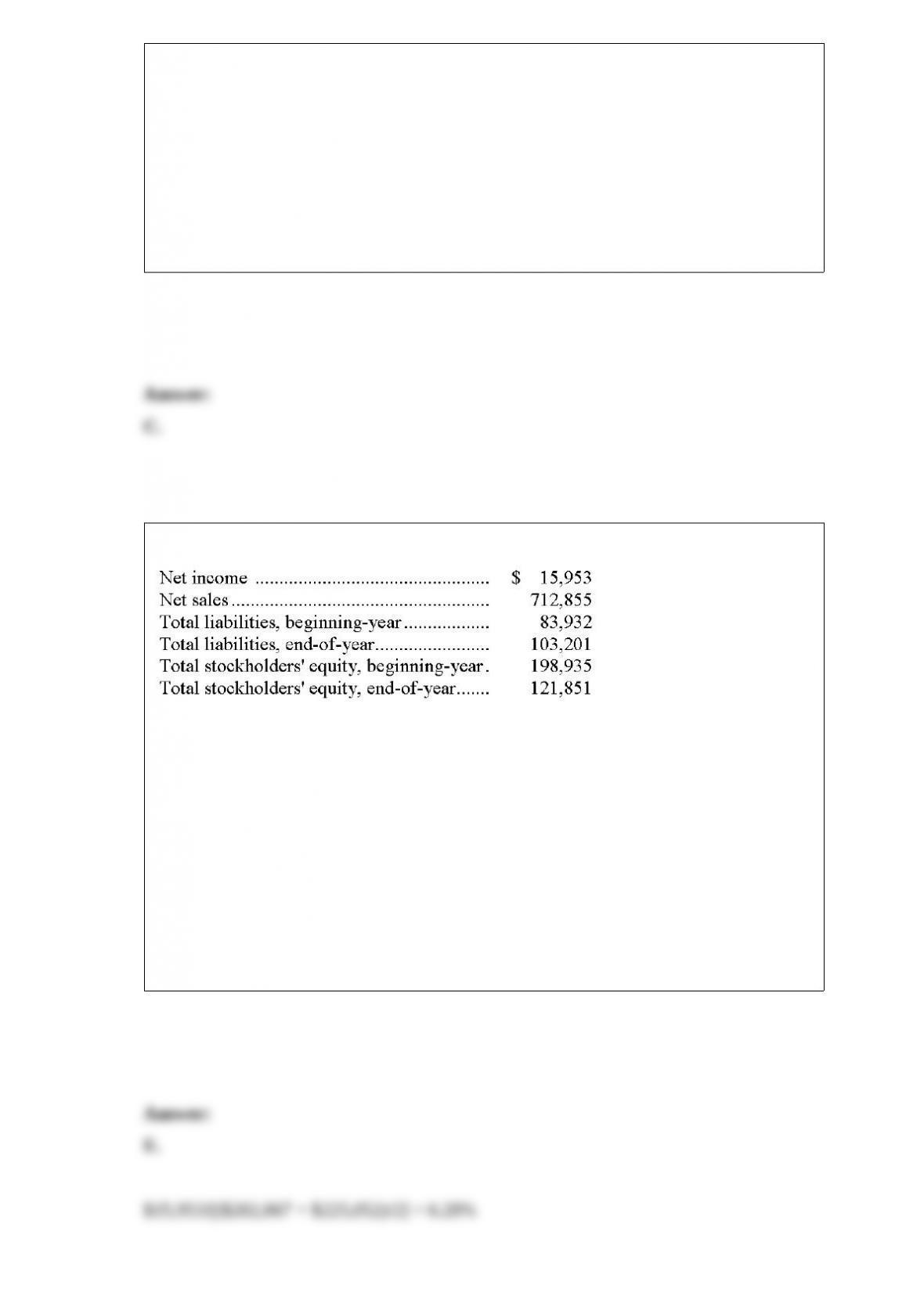
Selected current year company information follows:
The return on total assets is:
A.2.24%
B.2.81%
C.3.64%
D.4.67%
E.6.28%
Define and contrast period costs and product costs. How are they reported in the
financial statements of a manufacturing company?
What is a cost center?
Explain how the owners of PopCap Games adapted to and used the accrual basis of
accounting.
Identify the three categories of manufacturing costs.
____________________ leases are long-term or noncancelable leases by which the
lessor transfers substantially all risks and rewards of ownership to the lessee.
Montgomery Marketing Co. had assets of $475,000; liabilities of $275,500; and equity
of $199,500. Calculate its debt ratio.

For each of the following items, indicate whether it would be classified as an (O)
operating activity, an (I) investing activity, a (F) financing activity, or a significant (N)
noncash financing and investing activity.
1) Issued bonds payable for cash.
2) Purchases of land for cash.
3) Collected accounts receivable from customers.
4) Paid wages to employees.
5) Purchased land in exchange for a note payable.
6) Paid cash dividends.
7) Issued stock for cash.
8) Received cash dividends from investments in trading securities.
9) Sold equipment for cash.
10) Received interest from investments in trading securities.
______________________ are required at the end of the accounting period because
certain internal transactions and events remain unrecorded.
If a U.S. company makes a credit sale to a foreign company, the sales price must be
translated into dollars as of the date of _____________.
On January 1, 2009 a company borrowed $70,000 cash by signing a 9% installment
note that is to be repaid with 4 annual year-end payments of $21,607. While the amount
borrowed equals $70,000, the total payments on this note amount to $86,428. Explain.
Beginning inventory plus the net cost of purchases is the _____________________.
Describe how materials flow through a job order cost accounting system, and identify
the key documents in the system.
Identify the four types of classifications for non-influential investments in securities.
The opening story for Chapter 6 indicated that Jacquelyn Tran initially struggled with
inventory and sales when the business was first opened. The major challenge was
maintaining appropriate levels of inventories while controlling costs. What is meant by
this statement?
The rate of interest that borrowers are willing to pay and lenders are willing to accept
for a particular bond and its risk level is the ____________________ of interest.