In its 2013 income statement, WME reported $695,000 for service revenue earned from
membership fees. WME received $681,000 cash in advance from members during
2013. In its reconciliation schedule, WME should: A. Show a $14,000 negative
adjustment to net income under the indirect method for the increase in unearned
revenue.
B. Show a $14,000 negative adjustment to net income under the indirect method for the
decrease in unearned revenue.
C. Show a $14,000 positive adjustment to net income under the indirect method for the
increase in unearned revenue.
D. Show a $14,000 positive adjustment to net income under the indirect method for the
decrease in unearned revenue.
Answer:
Paid-in capital in excess of par is reported: A. As a reduction of shareholders’ equity.
B. As a noncurrent asset.
C. As a noncurrent liability.
D. As an increase in shareholders’ equity.
Answer:

The use of LIFO in accounting for a firm’s inventory: A. Usually matches the physical
flow of goods through the business.
B. Is usually used for internal management purposes.
C. Usually provides a better match of expenses with revenues.
D. None of the above is correct.
Answer:
Orange Corp. constructed a machine at a total cost of $70 million. Construction was
completed at the end of 2009 and the machine was placed in service at the beginning of
2010. The machine was being depreciated over a 10-year life using the
sum-of-the-years’-digits method. The residual value is expected to be $4 million. At the
beginning of 2013, Orange decided to change to the straight-line method. Ignoring
income taxes, what will be Orange’s depreciation expense for 2013? A. $4.8 million.
B. $5.4 million.
C. $6.6 million.
D. $9.4 million.
Answer:
The 12/31/2013 balance sheet of Despot Inc. included the following:
In January 2013, Despot recorded a transaction with this journal entry:
The transaction was for the: A. Issue of 2 million shares of common stock at par value.
B. Issue of common stock for $150 million in cash.
C. Receipt of $20 per share for a new stock issue.
D. All of the above are correct.
Answer:

Investments in securities to be held for an unspecified period of time are reported at: A.
Historical cost.
B. Present value.
C. Lower of cost or market.
D. Fair value.
Answer:
In a statement of cash flows in which operating activities are reported by the direct
method, which of the following would increase reported cash flows from operating
activities? A. Gain on sale of equipment.
B. Interest revenue.
C. Gain on early extinguishment of bonds.
D. Proceeds from sale of land.
Answer:
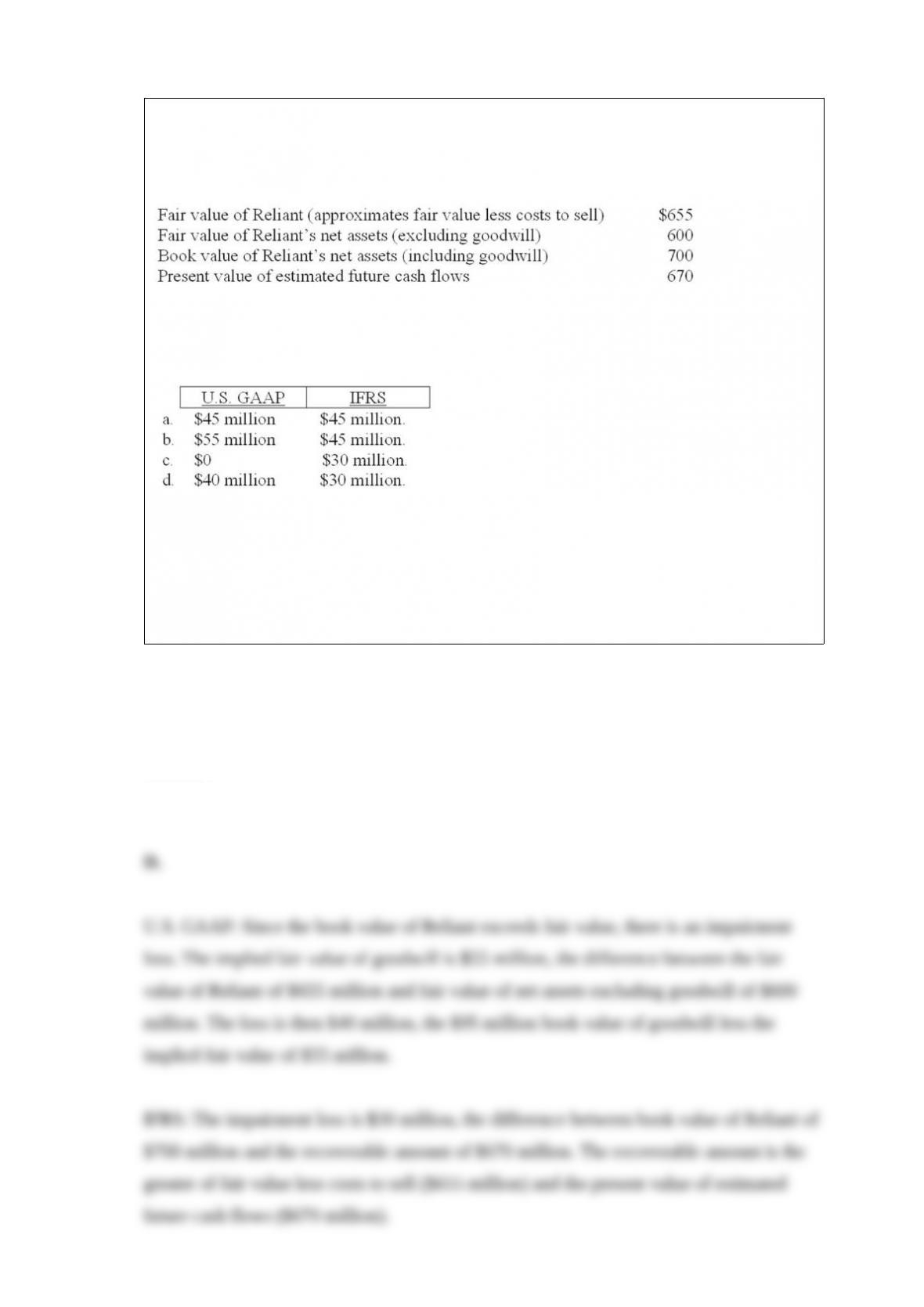
Kingston Corporation has $95 million of goodwill on its books from the 2011
acquisition of Reliant Motors. At the end of its 2013 fiscal year, management has
provided the following information for its required goodwill impairment test ($ in
millions):
Assuming that Reliant is considered a reporting unit for U.S. GAAP and a
cash-generating unit for IFRS, the amount of goodwill impairment loss that Kingston
should recognize according to U.S. GAAP and IFRS, respectively, is:
A. Option a
B. Option b
C. Option c
D. Option d
Answer:

When a lease qualifies as a capital lease, what is the cost basis of the asset acquired? A.
The present value of the minimum lease payments, exclusive of executory costs.
B. The present value of the minimum lease payments plus executory costs.
C. The sum of the gross minimum lease payments.
D. The present value of the minimum lease payments plus the present value of
executory costs.
Answer:
Listed below are 5 terms followed by a list of phrases that describe or characterize each
of the terms. Match each phrase with the correct term. 1)FIFO
2)LIFO
3)Cost of goods sold
4)Average cost
5)Consignment
A. Goods are transferred to another party but title remains with transferor
B. Items sold are assumed to be those acquired first
C. Items sold are assumed to be those acquired last
D. Items sold are assumed to come from a mixture of goods acquired during the period
E. Cost of goods available for sale less ending inventory

Answer:
Listed below are five terms followed by a list of phrases that describe or characterize
each of the terms. Match each phrase with the most correct term. 1) Noninterest-bearing
notes
2) Committed lines of credit
3) Pledging arrangements
4) Accounts payable
5) Loss contingencies
A. Effective interest higher than stated interest
B. Often require compensating balance
C. Recorded if probable and amount is known or reasonably estimable
D. Use accounts receivable as collateral
E. Only formal credit instrument is the invoice
Answer:
Heidi Aurora Imports applies International Financial Reporting Standards. The
company issued shares of the company’s Class B stock. Heidi Aurora Imports should
report the stock in the company’s statement of financial position: A. Among liabilities if
the shares are mandatorily redeemable or redeemable at the option of the shareholder.
B. As equity unless the shares are mandatorily redeemable.

C. As equity unless the shares are redeemable at the option of the issuer.
D. Among liabilities unless the shares are mandatorily redeemable.
Answer:
Tropical Tours reported revenue of $400,000 for its year ended December 31, 2013.
Accounts receivable at December 31, 2012 and 2013, were $35,000 and $32,000,
respectively. Using the direct method for reporting cash flows from operating activities,
Tropical Tours would report cash collected from customers of: A. $400,000.
B. $397,000.
C. $403,000.
D. $365,000.
Answer:

On December 31, 2012, the Frisbee Company had 250,000 shares of common stock
issued and outstanding. On March 31, 2013, the company sold 50,000 additional shares
for cash. Frisbee’s net income for the year ended December 31, 2013, was $700,000.
During 2013, Frisbee declared and paid $80,000 in cash dividends on its nonconvertible
preferred stock. What is the 2013 basic earnings per share (rounded)? A. $2.16.
B. $3.50.
C. $3.10.
D. $2.80.
Answer:
During 2013, Hoffman Co. decides to use FIFO to account for its inventory
transactions. Previously, it had used LIFO. A. Hoffman is not required to make any
accounting adjustments.
B. Hoffman has made a change in accounting principle requiring retrospective
adjustment.
C. Hoffman has made a change in accounting principle requiring prospective
application.
D. Hoffman needs to correct an accounting error.
Answer:

Listed below are 5 terms followed by a list of phrases that describe or characterize the
terms. Match each phrase with the correct term. 1)Disclaimer
2)Summary of significant accounting policies
3)Proxy statement
4)Debt to equity ratio
5)Inventories
A. If four to one, 80% of assets are debt financed.
B. Includes disclosures of executive compensation.
C. Given by an auditor when information is insufficient to express an opinion.
D. Important in comparing financial information across companies.
E. Goods to be sold in the ordinary course of business.
Answer:
Purchases equal the invoice amount: A. Plus freight-in, plus discounts lost.
B. Less purchase returns, plus purchase allowances.
C. Plus freight-in, less purchase discounts.
D. Plus discounts, less purchase returns.

Answer:
A subsequent event for an entity with a December 31, 2013, year-end would not
include: A. A change in the estimated useful lives of equipment in January 2014.
B. An issuance of bonds in January 2014.
C. An acquisition of another company in January 2014.
D. A major uncertainty at December 31, resolved in January 2014.
Answer:
Preferred dividends would not be subtracted from earnings when computing basic
earnings per share in a year when the dividends are not declared if the preferred stock
is: A. Noncumulative.
B. Convertible.
C. Participating.
D. Cumulative.
Answer:
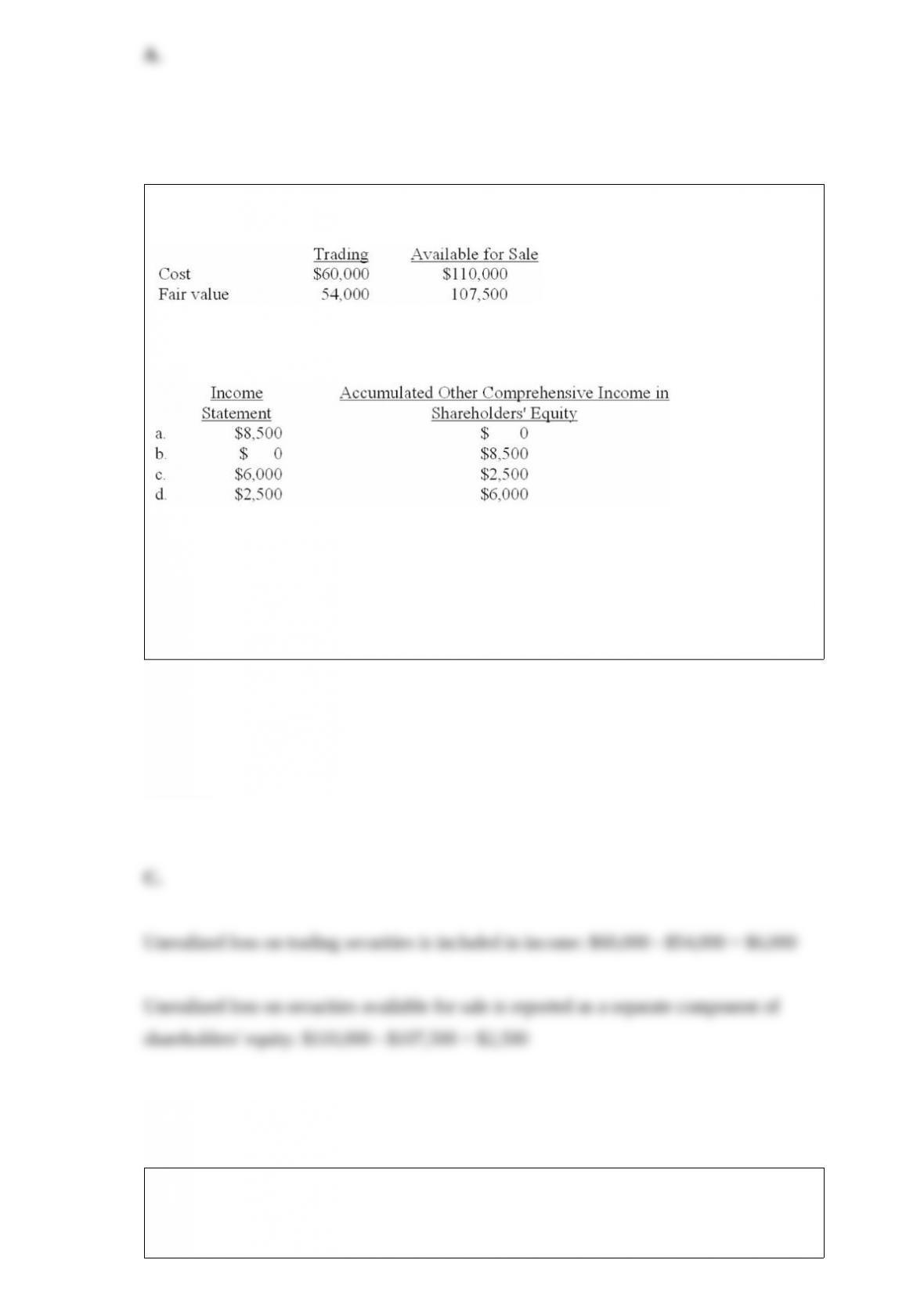
Boulter, Inc. began business on January 1, 2013. At the end of December 2013, Boulter
had the following investments in equity securities:
All declines in value are deemed to be temporary in nature. How should the
corresponding losses be reflected in the financial statements at December 31, 2013?
A. Option a
B. Option b
C. Option c
D. Option d
Answer:
The balance in accounts receivable at the beginning of 2013 was $300. During 2013,
$1,600 of credit sales were recorded. If the ending balance in accounts receivable was
$250 and $100 in accounts receivable were written off during the year, the amount of

cash collected from customers during 2013 was: A. $1,600.
B. $1,650.
C. $1,550.
D. $1,900.
Answer:
The distinction between operating and nonoperating income relates to: A. Continuity of
income.
B. Principal activities of the reporting entity.
C. Consistency of income stream.
D. Reliability of measurements.
Answer:
Frasquita acquired equipment from the manufacturer on 6/30/2013 and gave a
noninterest-bearing note in exchange. Frasquita is obligated to pay $550,000 on
4/30/2014 to satisfy the obligation in full. If Frasquita accrued interest of $15,000 on
the note in its 2013 year-end financial statements, what would the manufacturer record
in its 2013 income statement for this transaction? A. $15,000 of interest revenue.
B. $25,000 of interest revenue.
C. $15,000 of interest revenue and $525,000 of sales revenue.
D. $550,000 of sales revenue.
Answer:
A statement of comprehensive income does not include: A. Gains resulting from the
return on assets exceeding expectations.
B. Gains and losses on unsold held-to-maturity securities.
C. Losses resulting from the return on pension assets falling short of expectations.
D. Prior service cost.
Answer:

All of the following may qualify as cash equivalents except: A. Money market
accounts.
B. Certificates of deposit.
C. U.S. Treasury bills.
D. Newly issued corporate bonds.
Answer:
When the service method is used for amortizing prior service costs, the amount
recognized each year is:A. In proportion to the fraction of the total remaining service
years worked during the year.
B. A constant amount or fixed amount.
C. Prior service cost divided by the average remaining service life of the active
employee group.
D. Prior service cost divided by the average estimated retirement age of the currently
enrolled employee group.
Answer:
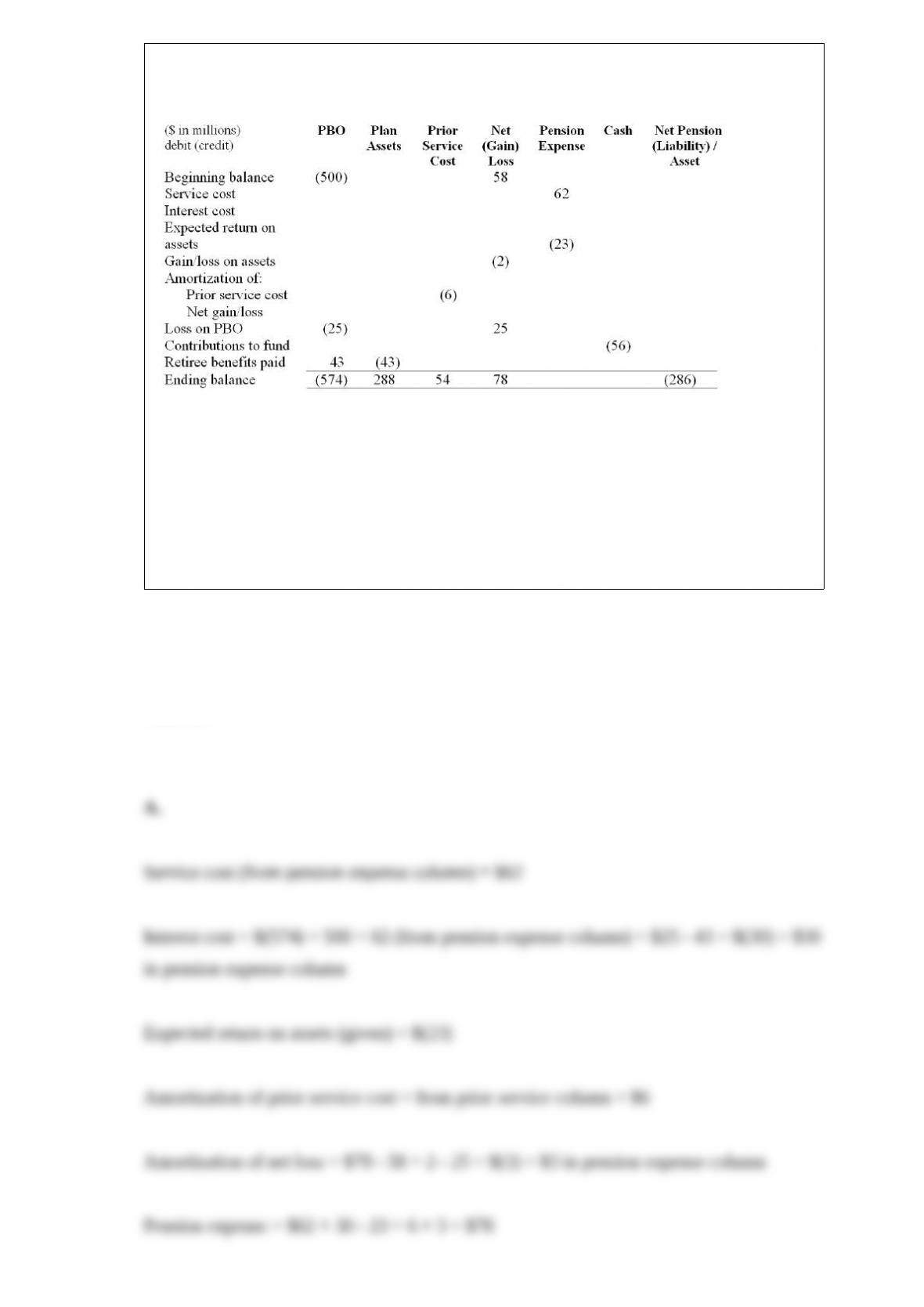
The following incomplete (columns have missing amounts) pension spreadsheet is for
Old Tucson Corporation (OTC).
What is OTC’s pension expense for the year? A. $78.
B. $72.
C. $66.
D. $18.
Answer:

Stock options do not affect the calculation of: A. Diluted EPS.
B. Weighted-average common shares.
C. The denominator in the diluted EPS fraction.
D. Basic EPS.
Answer:
The employer has an obligation to provide future benefits for: A. Defined benefit
pension plans.
B. Defined contribution pension plans.
C. Defined benefit and defined contribution plans.
D. None of the above
Answer:

If the fair value of a debt investment that is classified as an available-for-sale
investment declines for a reason that is viewed as “other than temporary” because it is
viewed as “more likely than not” that the investor will be required to sell the investment
prior to recovering the amortized cost of the investment less any credit losses arising in
the current year: A. The investment is not written down to fair value.
B. The investment is written down to fair value, and the impairment loss is recognized
in net income.
C. The investment is written down to fair value, and the impairment loss is recognized
in accumulated other comprehensive income.
D. The investment is written down to fair value, and only the noncredit loss is included
in net income.
Answer:
In its 2013 income statement, WME reported a $40,000 loss on the sale of equipment.
In its reconciliation schedule, WME should:A. Report a $40,000 cash outflow for the
direct method.
B. Show a $40,000 positive adjustment to net income under the indirect method.
C. Show a $40,000 negative adjustment to net income under the indirect method.
D. None of the above is correct.
Answer:

A note receivable Mild Max Cycles discounted with recourse was dishonored on its
maturity date. Mild Max would debit: A. A loss on dishonored receivable.
B. A receivable.
C. Dishonored note expense.
D. Interest expense.
Answer:
The debt to equity ratio indicates:A. The margin of safety provided to creditors.
B. The extent of “trading on the equity” or financial leverage.
C. Profitability without regard to how resources are financed.
D. The effectiveness of employing resources provided by owners.
Answer:

Diversified Systems, Inc., reports consolidated financial statements this year in place of
statements of individual companies reported in previous years. This results in: A. An
accounting change that should be reported prospectively.
B. An accounting change that should be reported by restating the financial statements of
all prior periods presented.
C. A correction of an error.
D. Neither an accounting change nor a correction of an error.
Answer:
Cucumber Company concluded at the beginning of 2013 that the company’s ownership
interest in PickelCo had decreased to the point that it became appropriate to begin
accounting for its investment as available for sale, rather than using the equity method
as it had been doing. The balance in the investment account is $75,000 at the time of the
change, and accountants working with company records determined that the balance
would have been $50,000 if the investment had been accounted for as an
available-for-sale investment. At the time of implementing the change to the
available-for-sale method, if financial statements were prepared: A. Net income and
retained earnings will be lower by $25,000.
B. Net income will be unchanged, and retained earnings will be lower by $25,000.
C. The accounts will be unchanged, because no adjustment is necessary.
D. Other comprehensive income and accumulated other comprehensive income will be
lower by $25,000.
Answer:
In its 2012 Annual Report to Shareholders, Kinney Inc. reported the following
Consolidated Statement of Cash Flows:
For the years ended December 31,
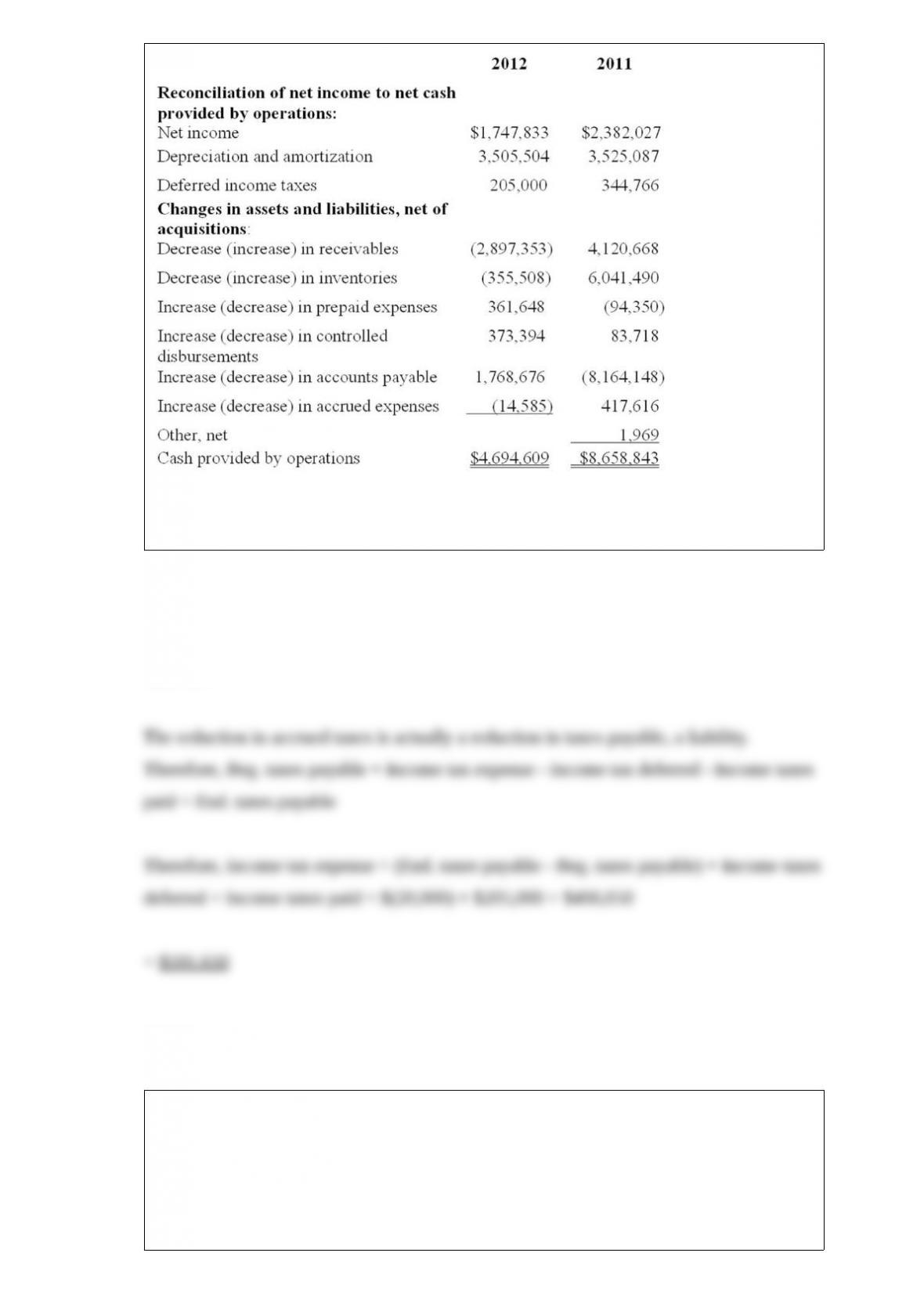
Assuming the decrease in accrued expenses during fiscal year 2012 included a $20,000
reduction due to taxes, compute the income tax expense for Kinney in that year.
Answer:
On December 31, 2012, Witherspoon Services had 800,000 shares of common stock
and 200,000 shares of 5.5%, noncumulative, nonconvertible $10 par preferred stock
issued and outstanding.
On March 2, 2013, Witherspoon sold 120,000 common shares. In keeping with its
long-term share repurchase plan, 30,000 shares were retired on August 31. Witherspoon
distributed a 10% common stock dividend on June 3. Witherspoon’s net income for the
year ended December 31, 2011, was $600,000. The company paid cash dividends of
$110,000 to preferred shareholders on December 20, 2013. The income tax rate is 40%.
Required:
Compute Witherspoon’s earnings per share for the year ended December 31,
Answer:
A zero-coupon bond pays no interest. Explain.
Answer:
Pinnacle Corporation has been using the straight-line depreciation method to depreciate
some office equipment that was acquired at the beginning of 2010. At the beginning of
2013, Pinnacle decided to change to the sum-of-the-years’-digits method. The
equipment cost $120,000 and is expected to have no salvage value. The estimated
useful life of the equipment is five years. The tax rate is 30%.
Required:
Prepare the journal entry, if any, to record the accounting change at the beginning of
2013.
Answer:
On May 1, Lectric Industries issued 9-month notes in the amount of $60 million.
Interest is payable at maturity.
Required:
Determine the amount of interest expense that should be recorded in a year-end
adjusting entry under each of the following independent assumptions:
Answer:
Imagine that the Ace Construction Company (ACC) is going to switch from the
percentage of completion method to the completed contract method. Assume that none
of their construction projects are going to produce a loss. Is it possible that, in a
particular year, ACC will show higher gross profit under the completed contract method
than they would under the percentage-of-completion method? Explain.
Answer:
How are bonds and notes the same? How do they differ?
Answer:
Briefly explain what is meant by a subsequent event. Give two examples of subsequent
events?
Answer:
In 2013, Poe’s Products completed the treasury stock transactions described below.
January 2: Reacquired 10 million shares at $16 per share.
February 15: Sold 3 million shares at $20 per share.
September 20: Sold 3 million treasury shares at $15 per share.
Poe had issued 50 million shares of its $1 par common stock for $18 several years ago.
Required:
Record the above transactions, assuming that Poe’s Products uses the cost method.
Answer:

On January 1, 2013, Hobart Mfg. Co. purchased a drill press at a cost of $36,000. The
drill press is expected to last 10 years and has a residual value of $6,000. During its
10-year life, the equipment is expected to produce 500,000 units of product. In 2013
and 2014, 25,000 and 84,000 units, respectively, were produced.
Required:
Compute depreciation for 2013 and 2014 and the book value of the drill press at
December 31, 2013 and 2014, assuming the sum-of-the-years’-digits method is used.
Answer:
Mattson Company receives royalties on a patent it developed several years ago.
Royalties are 5% of net sales, receivable on September 30 for sales from January
through June and receivable on March 31 for sales from July through December. The
patent rights were distributed on July 1, 2012, and Mattson accrued royalty revenue of
$60,000 on December 31, 2012, as follows:
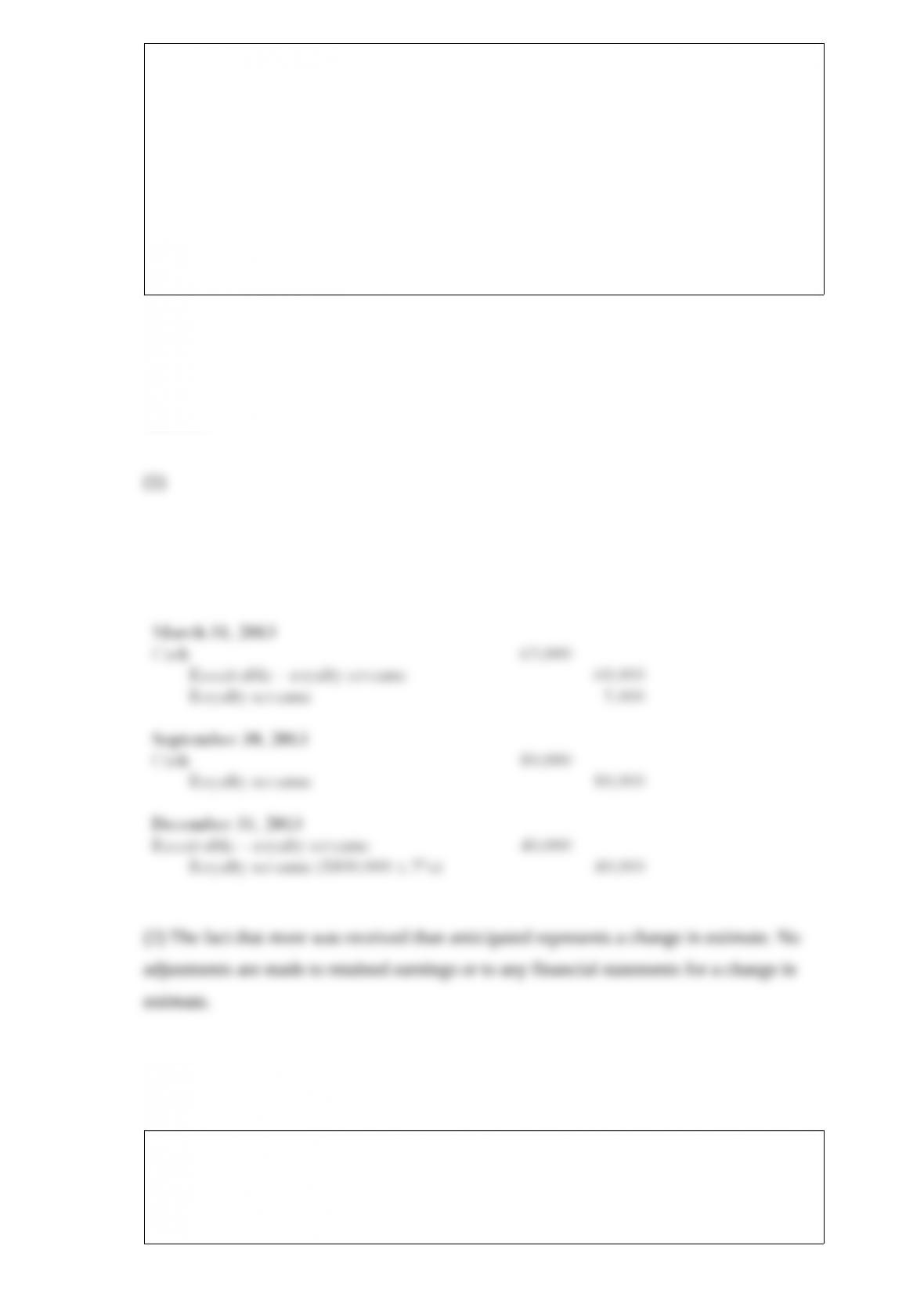
Mattson received royalties of $65,000 on March 31, 2013, and $80,000 on September
30, 2013. The patent user indicated to Mattson that sales subject to royalties for the
second half of 2013 should be $800,000.
Required:
(1) Prepare any journal entries Mattson should record during 2013 related to the royalty
revenue.
(2) What changes should be made to retained earnings relative to these royalties?
Answer:
Fully vested incentive stock options for 60,000 shares of common stock at an exercise
price of $50 were outstanding at the beginning of 2013. The market price of the stock
averaged $56 during the year.
Required:
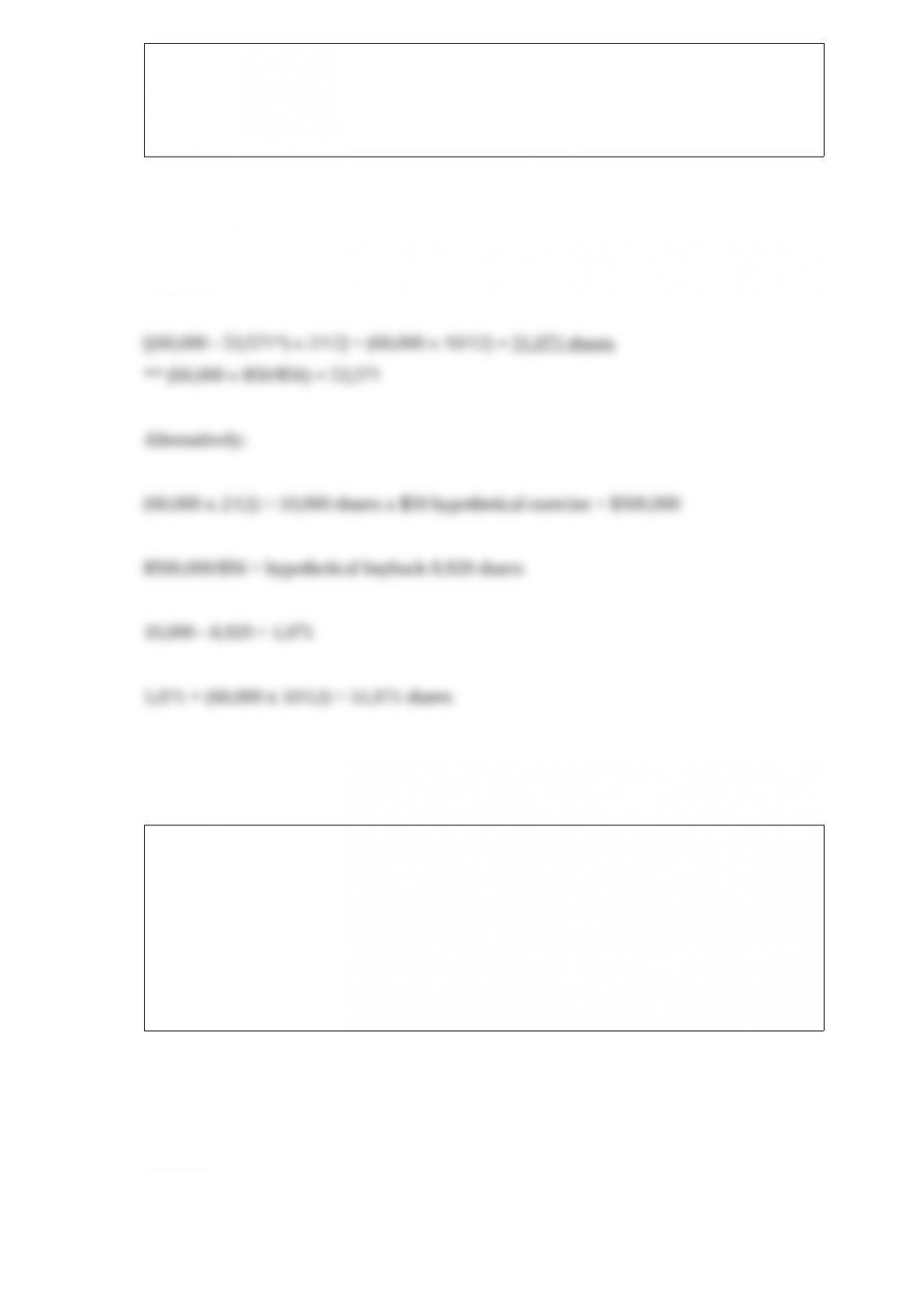
If these options are exercised on March 1 of the current year, by how many shares will
the options increase the weighted-average number of shares outstanding when
calculating diluted earnings per share?
Answer:
Meca Concrete purchased a mixer on January 1, 2011, at a cost of $45,000.
Straight-line depreciation for 2011 and 2012 was based on an estimated eight-year life
and $3,000 estimated residual value. In 2013, Meca revised its estimate and now
believes the mixer will have a total service life of only six years, and that the residual
value will be only $2,000.
Required:
Compute depreciation for 2013 and 2014.
Answer:
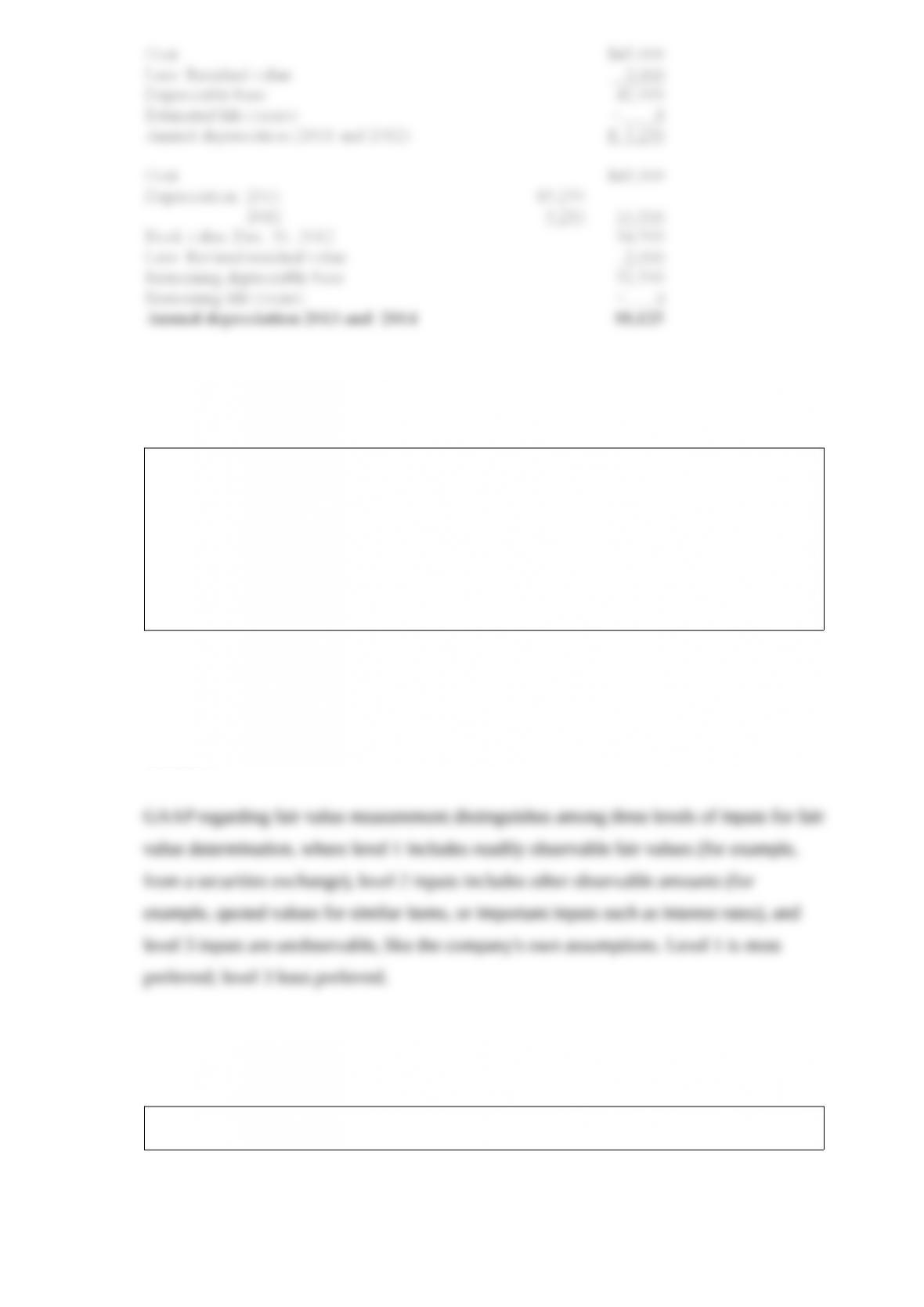
Companies need to consider GAAP regarding fair value measurements when
determining the fair value of an investment that distinguishes between various levels of
inputs to fair value determination.
Required:
Describe the various levels of inputs, explaining key aspects that distinguish them, and
indicate which level is most preferred and which is least preferred.
Answer:
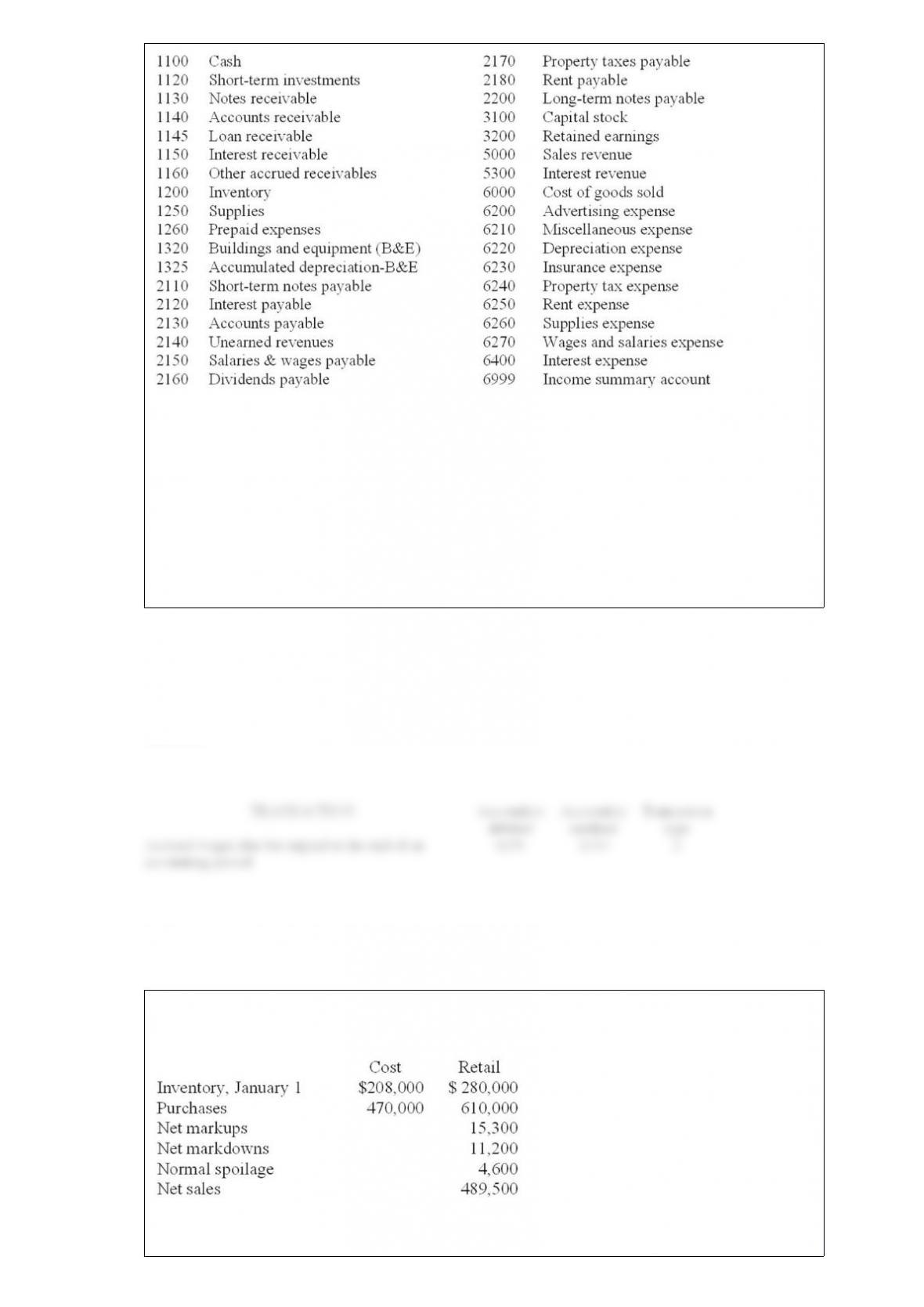
Using the chart of accounts provided, indicate by account number the account or
accounts that would be debited and credited in the following transactions and indicate
the type of transaction as: (1) an external transaction, (2) an internal transaction
recorded as an adjusting journal entry, or (3) a closing entry. The company uses a
perpetual inventory system. All prepayments are initially recorded in permanent
accounts.
Wages have been earned but are unpaid at the end of an accounting period.
Answer:
Harley Inc. uses the conventional retail method to estimate its ending inventories. The
following data has been summarized for December 31, 2013:
Required:
Estimate the cost of ending inventory applying the conventional retail method.
Answer:
Indicate whether each of the actions listed below will immediately increase (I), decrease
(D), or have no effect (N) on the ratios shown. Assume each ratio is greater than 1.0
before the action is taken.
Answer:
Calegari Mining paid $2 million to obtain the rights to operate a coal mine in
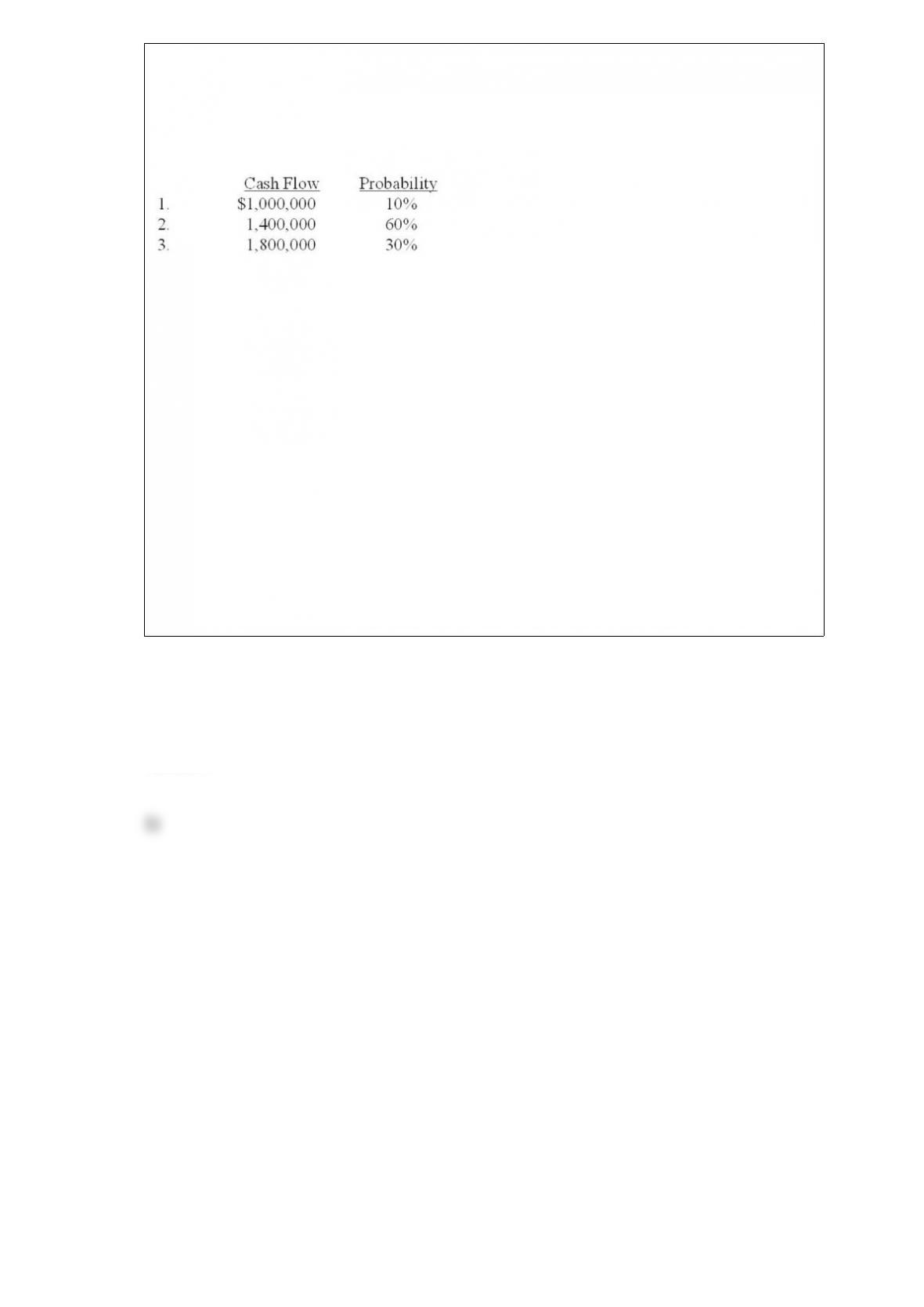
Tennessee. Costs of exploring for the coal deposit totaled $1,500,000, and development
costs of $5 million were incurred in preparing the mine for extraction, which began on
January 2, 2013. After the coal is extracted in approximately five years, Calegari is
obligated to restore the land to its original condition. The company’s controller has
provided the following three cash flow possibilities for the restoration costs:
The company’s credit-adjusted, risk-free rate of interest is 7%, and its fiscal year ends
on December 31.
Required:
1) What is the initial cost of the coal mine? (Round computations to nearest whole
dollar.)
2) How much accretion expense will Calegari report in its 2013 and 2014 income
statements?
3) What is the carrying value (book value) of the asset retirement obligation that
Calegari will report in its 2013 and 2014 balance sheets?
4) Assume that actual restoration costs incurred in 2018 totaled $1,370,000. What
amount of gain or loss will Calegari recognize on retirement of the liability?
Answer:
Travis Transportation reported a net loss-AOCI in last year’s balance sheet. This year,
the company revised its estimate of future salary levels causing its PBO estimate to
decline by $12. Also, the $24 million actual return on plan assets was less than the $27
million expected return.
Required:
1) Prepare the appropriate journal entries to record the gain and loss.
2) How do this gain and loss affect Travis’ income statement, statement of
comprehensive income, and balance sheet?
Answer:
In its 2013 Annual Report to shareholders, V Co. had the following disclosure note
about its EPS:
NOTE 9 – EARNINGS PER SHARE:
The following represents the reconciliation from basic earnings per share to diluted
earnings per share. Options to purchase 8.3 million and 7 million shares of common
stock were outstanding at May 31, 2013 and May 31, 2012, respectively, but were not
included in the computation of diluted earnings per share because the options’ exercise
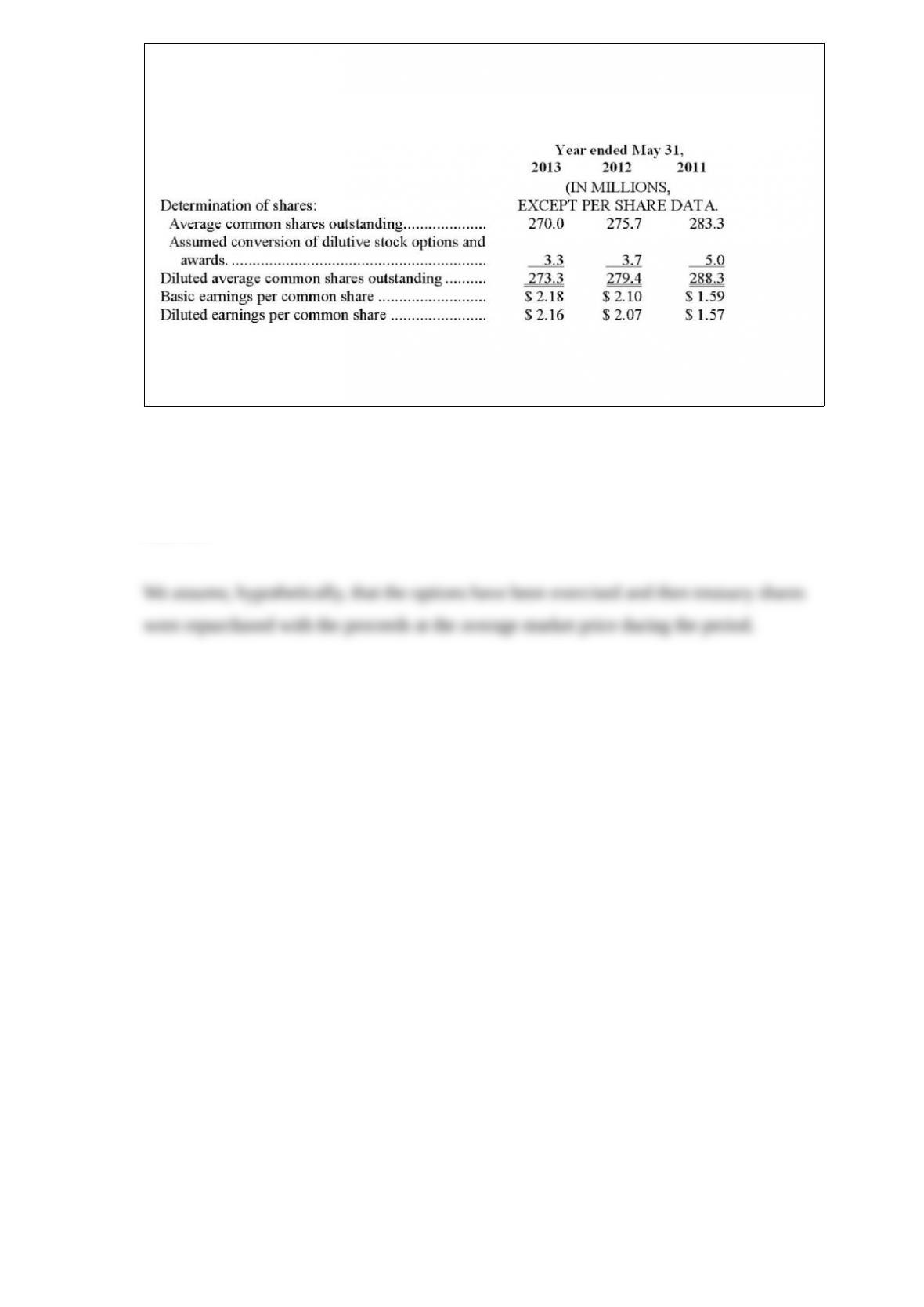
prices were greater than the average market price of the common shares and, therefore,
the effect would be antidilutive. No such antidilutive options were outstanding at May
31, 2011.
How are outstanding stock options and awards taken into account in computing diluted
EPS for V Co.?
Answer: