To avoid the time-consuming process of taking an inventory each year, most companies
use the gross profit method to estimate ending inventory.
Future value can be found if the interest rate (i), the number of periods (n), and the
present value (p) are known.
A promissory note is a written promise to pay a specified amount of money either on
demand or at a definite future date.
Under the accrual basis of accounting, adjustments are often made for prepaid expenses
and unearned revenues.

Land held for future expansion is an intangible asset.
A cost center does not directly generate revenues.
A company’s debt-to-equity ratio was 1.0 at the end of Year 1. By the end of Year 2, it
had increased to 1.7. Since the ratio increased from Year 1 to Year 2, the degree of risk
in the firm’s financing structure decreased during Year 2.
Income Summary is a temporary account only used for the closing process.
Earnings per share is calculated by dividing the total number of common shares
outstanding by net income.
Hybrid costing systems can only be applied to auto manufacturing.
The budgets within the master budget must be prepared in a definite sequence as
dictated by GAAP.

The series of activities that add value to a company’s products or services is called a
value chain.
A balance sheet covers a period of time such as a month or year.
Contribution margin is the amount of sales that exceeds total variable costs.
There are only two methods to derive an estimated line of cost behavior: the high-low
method and the scatter diagram.

Internal control in technologically advanced accounting systems depends more on the
design and operation of the information system and less on the analysis of its resulting
documents.
Revenue accounts should begin each accounting period with zero balances.
The accounts receivable method to estimate bad debts obtains the estimated balance in
the Allowance for Doubtful Accounts in one of two ways: (1) computing the percent
uncollectible from the total accounts receivable or (2) aging accounts receivable.
Cost accounting information is helpful to management in controlling costs but has no
effect on pricing decisions.
A company holds $40,000 of 7% bonds as a held-to-maturity security. This
bondholder’s journal entry to record receipt of the semiannual interest payment includes
a debit to Cash for $2,800 and a credit to Interest Revenue for $2,800.
An accounting information system communicates data to help businesses make better
decisions.

A discount on stock occurs when a corporation sells its stock for more than par value.
If budgeted beginning inventory is $8,300, budgeted ending inventory is $9,400, and
cost of goods sold is expected to be $10,260, then budgeted purchases should be
$9,160.
A good financial statement analysis report often includes the following sections:
Executive summary, analysis overview, evidential matter, assumptions, key factors, and
inferences.
Two common ways of retiring bonds before maturity are to (1) exercise a call option or
(2) purchase them on the open market.
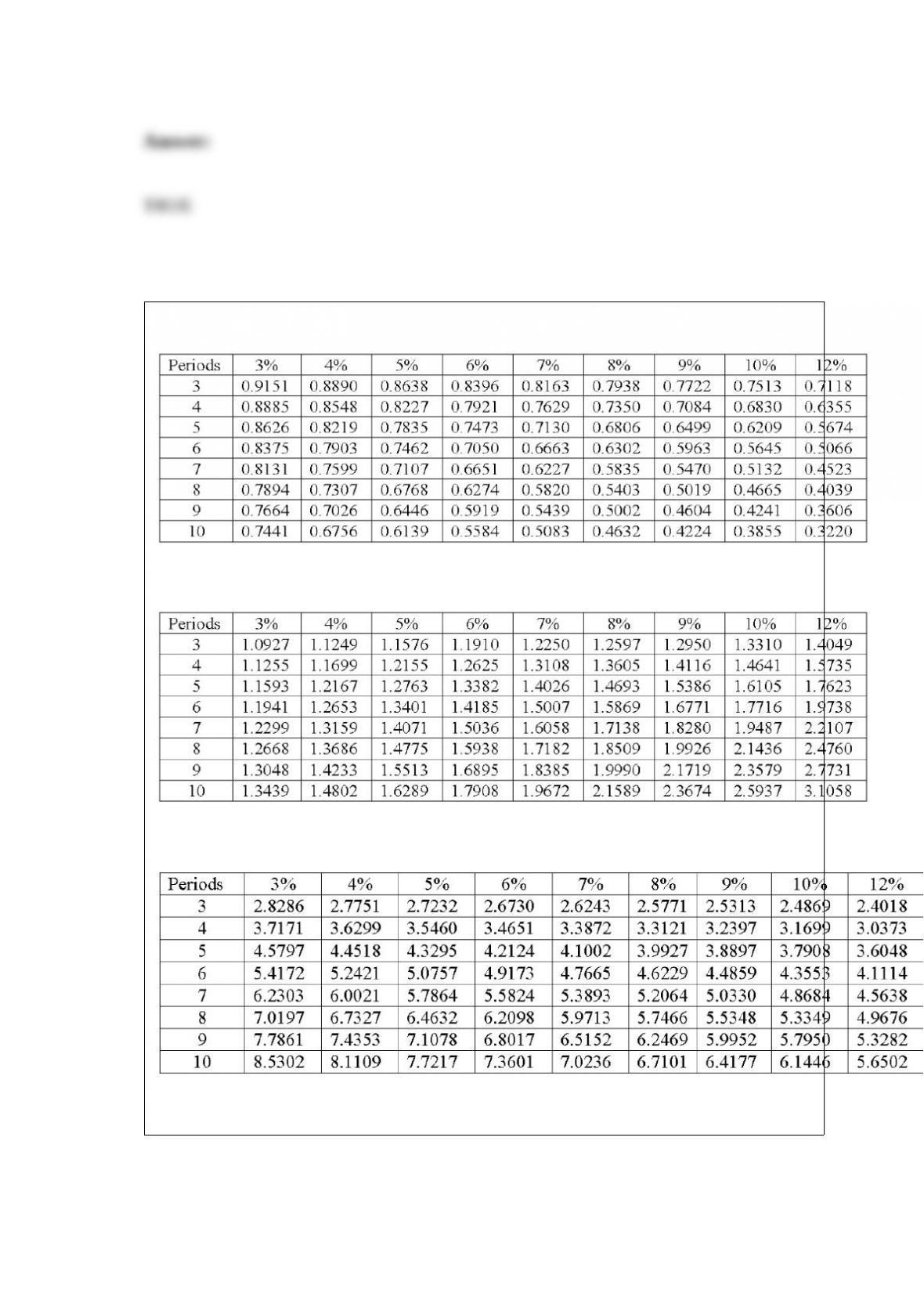
Present Value of 1
Future Value of 1
Present Value of an Annuity of 1
Future Value of an Annuity of 1
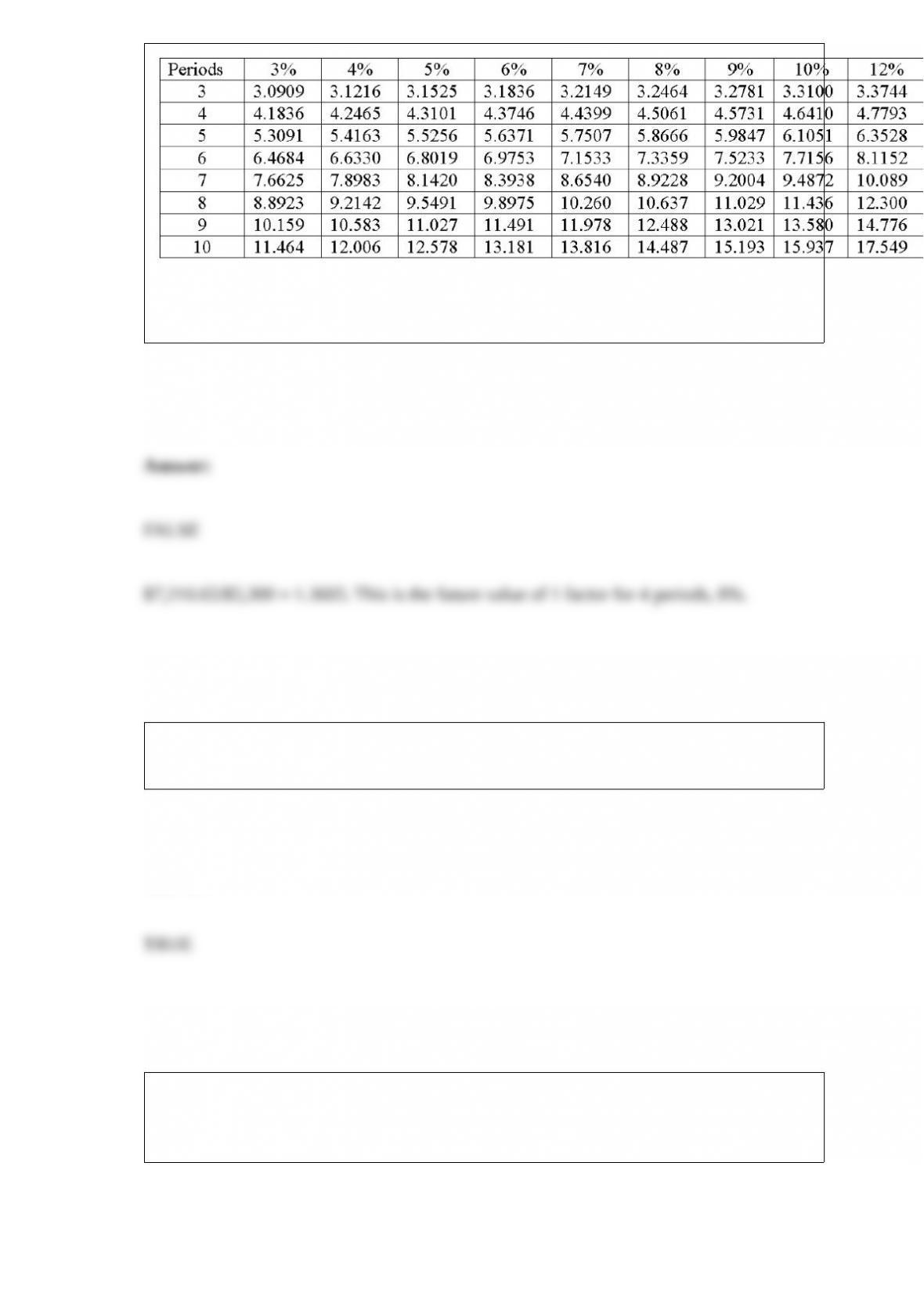
At an annual interest rate of 8% compounded annually, $5,300 will accumulate to a
total of $7,210.65 in 5 years.
The assignment of costs to the goods sold and to inventory using specific identification
is the same for both the perpetual and periodic systems.
A process cost summary for a production department accounts for all costs assigned to
that department during the period plus costs that were in the department’s Goods in
Process Inventory account at the beginning of the period.

The modified accelerated cost recovery system (MACRS) is a depreciation method
used for tax reporting.
The first step in the processing of a transaction is to analyze the transaction and source
documents.
A high accounts receivable turnover in comparison with competitors suggests that the
firm should tighten its credit policy.

Stocks with a price-earnings ratio greater than 20 to 25 are likely to be underpriced.
The Present Value of 1 formula is often useful when a borrowed asset must be repaid in
full at a later date and the borrower wants to know its worth at the future date.
The accounting rate of return uses cash flows in its calculation.
Withdrawals by the owner are a business expense.

Since the revenue recognition principle requires that revenues be earned, there are no
unearned revenues in accrual accounting.
Accounting information systems are designed to capture information about a company’s
transactions and events and to provide output including financial, managerial, and tax
reports.
An employee earned $47,000 during the year working for an employer. The FICA tax
rate for social security is 6.2% and the FICA tax rate for Medicare is 1.45%. The
employee’s annual FICA taxes amount is:
A.$ 681.50.
B.$2,914.00.
C.$3,595.50.
D.$7,191.00.
E.Zero, since the employee’s pay exceeds the FICA limit.
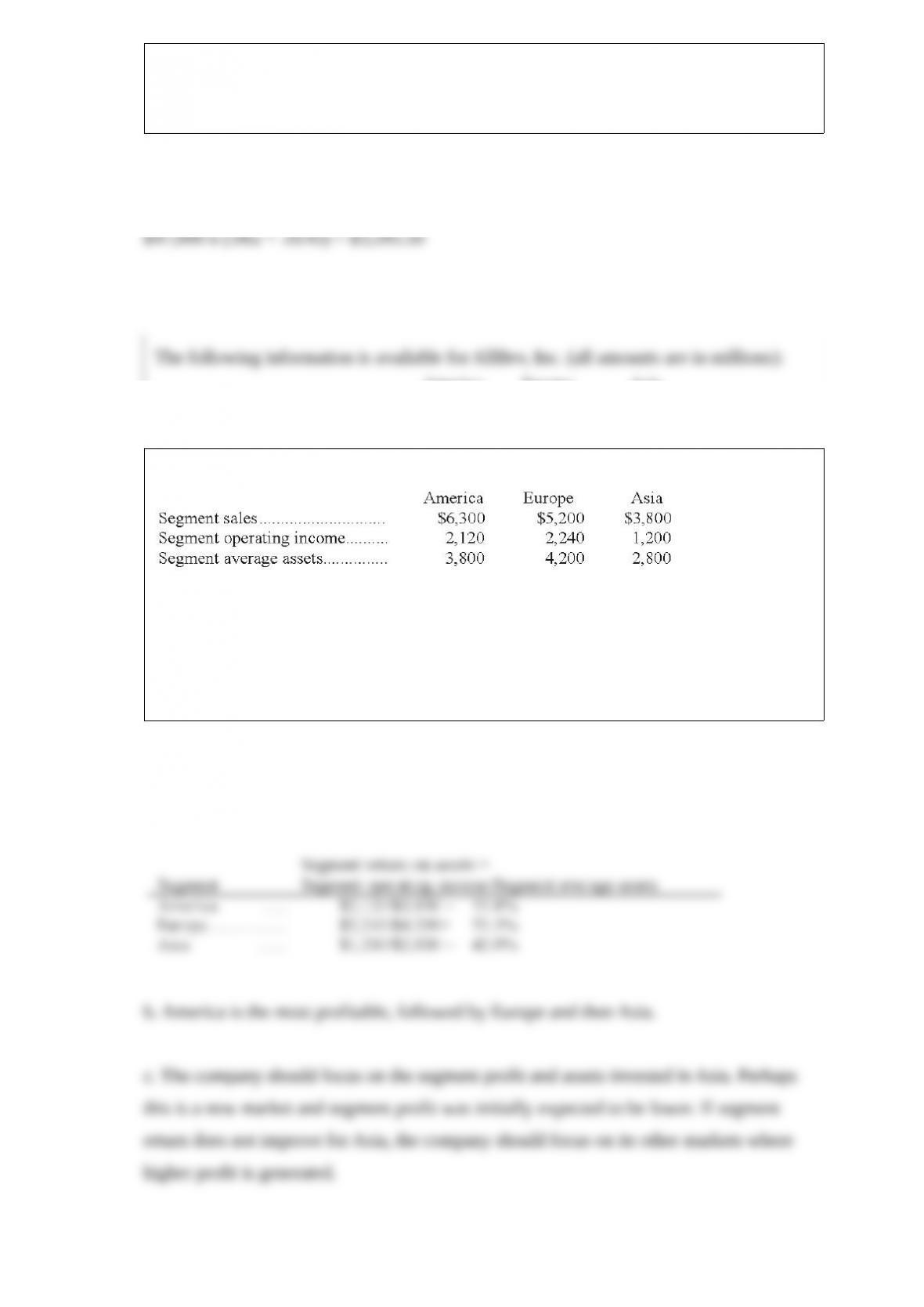
The following information is available for AllBev, Inc. (all amounts are in millions):
a. Determine the segment return on assets for each geographic segment.
b. Comment on the results. How do the segments compare with respect to profitability?
c. What measures could be taken to improve segment return?

Decreases in equity that represent costs of assets or services used to earn revenues are
called:
A.Liabilities.
B.Equity.
C.Withdrawals.
D.Expenses.
E.Owner’s Investment.
An opportunity cost is:
A.An uncontrollable cost.
B.A cost of potential benefit lost.
C.A change in the cost of a component.
D.A direct cost.
E.A sunk cost.

A company has 40,000 shares of common stock outstanding. The stockholders’ equity
applicable to common shares is $470,000, and the par value per common share is $10.
The book value per share is:
A.$ 0.09.
B.$ 1.75.
C.$10.00.
D.$11.75.
E.$47.50.
If equity is $300,000 and liabilities are $192,000, then assets equal:
A.$108,000.
B.$192,000.
C.$300,000.
D.$492,000.
E.$792,000.

The document, also known as the check authorization, that is a checklist of steps
necessary for approving an invoice for recording and payment is the
A.Purchase requisition.
B.Purchase order.
C.Invoice.
D.Receiving report.
E.Invoice approval
When analyzing the changes on a spreadsheet used to prepare a statement of cash flows,
the cash flows from financing activities generally affect
A.Net income, current assets, and current liabilities.
B.Noncurrent assets.
C.Noncurrent liability and the equity accounts.
D.Both noncurrent assets and noncurrent liabilities.
E.Equity accounts only.
An investment that is readily convertible to a known amount of cash and that is
sufficiently close to its maturity date so that its market value is relatively insensitive to
interest rate changes is a(n):

A.Short-term marketable equity security.
B.Operating activity.
C.Common stock.
D.Cash equivalent.
E.Financing activity.
The Federal Insurance Contributions Act (FICA) requires that each employer file a:
A.W-4.
B.Form 941.
C.Form 1040.
D.Form 1099.
E.All of these.
Based on the information included in Question #102, the balance in the Andrea
Conaway, Capital account reported on the Statement of Owner’s Equity at the end of the
month would be:
A.$31,400.
B.$39,200.

C.$31,150.
D.$40,175.
E.$30,875.
An overstatement of ending inventory will cause
A.An overstatement of assets and equity on the balance sheet.
B.An understatement of assets and equity on the balance sheet.
C.An overstatement of assets and an understatement of equity on the balance sheet.
D.An understatement of assets and an overstatement of equity on the balance sheet.
E.No effect on the balance sheet.
Advance ticket sales totaling $6,000,000 cash would be recognized as follows:
A.Debit Sales, credit Unearned Revenue.
B.Debit Unearned Revenue, credit Sales.
C.Debit Cash, credit Unearned Revenue.

D.Debit Unearned Revenue, credit Cash.
E.Debit Cash, credit Revenue Payable.
The voucher system of control:
A.Is a set of procedures and approvals designed to control cash receipts and the
acceptance of obligations.
B.Establishes procedures for verifying, approving, and recording obligations for
eventual cash disbursement.
C.Establishes procedures for receiving checks for the sale of verified, approved, and
recorded activities.
D.Applies only when multiple purchases are made from the same supplier.
E.All of these.
The ratio of the sales volume for the various products sold by a company is called the:
A.Current product mix.
B.Relevant mix.
C.Sales mix.
D.Inventory cost ratio.
E.Production ratio.

The profit margin:
A.Reflects the percent of profit in each dollar of revenue.
B.Is also called return on sales.
C.Can be used to compare a firm’s performance to its competitors.
D.Is calculated by dividing net income by net sales.
E.All of these.
A short-term note payable:
A.Is a written promise to pay a specified amount on a definite future date within one
year or the company’s operating cycle, whichever is longer.
B.Is a contingent liability.
C.Is an estimated liability.
D.Is not a liability until the due date.
E.Cannot be used to extend the payment period for an account payable.

A company reported that its bonds with a par value of $50,000 and a carrying value of
$57,000 are retired for $60,000 cash, resulting in a loss of $3,000. The amount to be
reported under cash flows from financing activities is:
A.$ (3,000).
B.$(60,000).
C.$(57,000).
D.Zero. This is an operating activity.
E.Zero. This is an investing activity.
At Flint Company’s break-even point of 9,000 units, fixed costs are $180,000 and
variable costs are $540,000 in total. The unit sales price is:
A.$ 20.
B.$ 40.
C.$ 60.
D.$ 80.
E.$100.

Which of the following statements is true?
A.Partners are employees of the partnership.
B.Salaries to partners are expenses on the partnership income statement.
C.Salary allowances usually reflect the relative value of services provided by partners.
D.Salary allowances are expenses.
E.Interest allowances are expenses.
A merit rating:
A.Is assigned by the state.
B.Reflects a company’s stability or instability in employing workers.
C.Adjusts the employer’s SUTA tax rate.
D.Affects state unemployment taxes paid by an employer.
E.All of these.
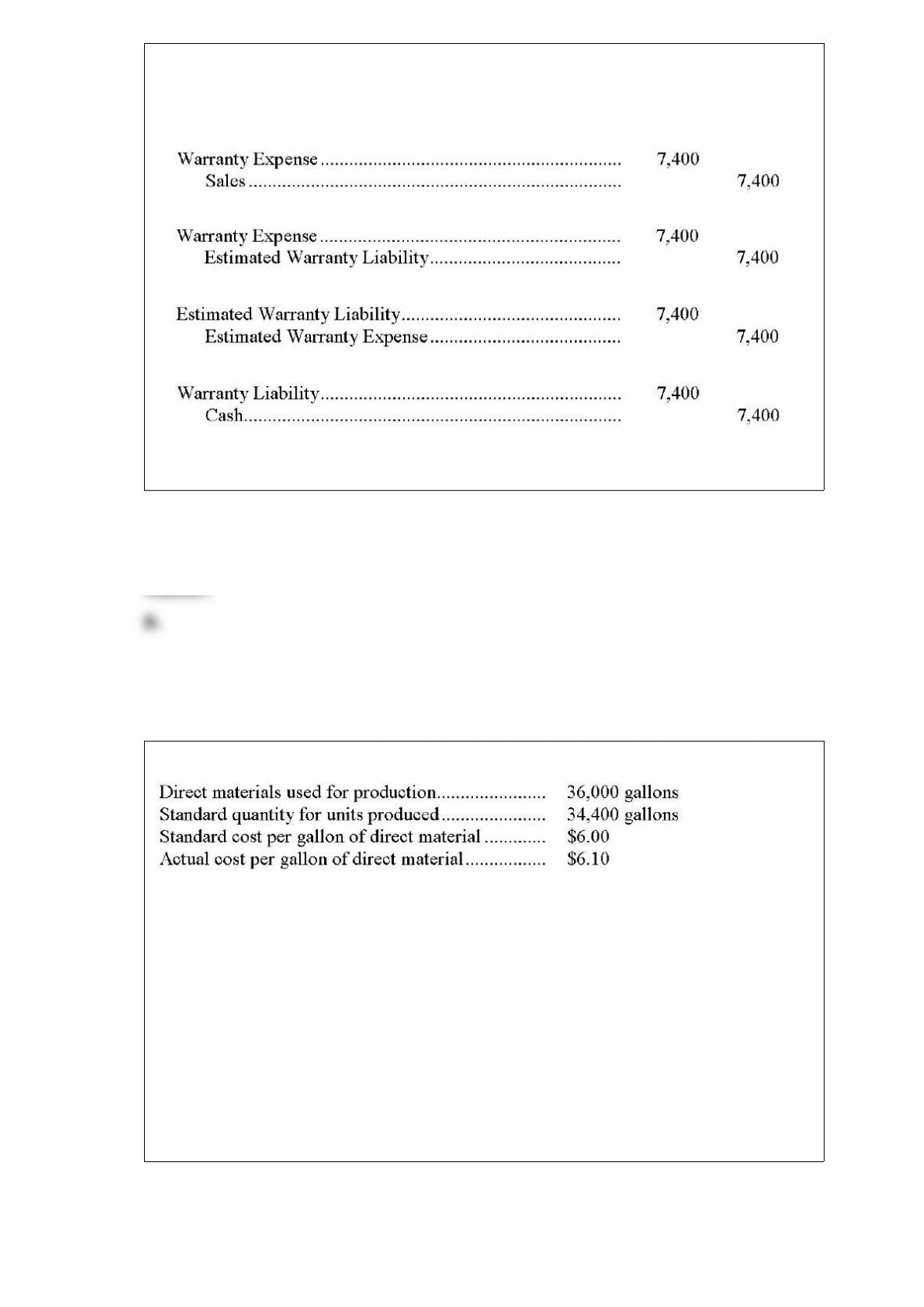
A company estimates that warranty expense will be 4% of sales. The company’s sales
for the current period are $185,000. The current period’s entry to record the warranty
expense is:
A.
B.
C.
D.
E.No entry is recorded until the items are returned for warranty repairs.
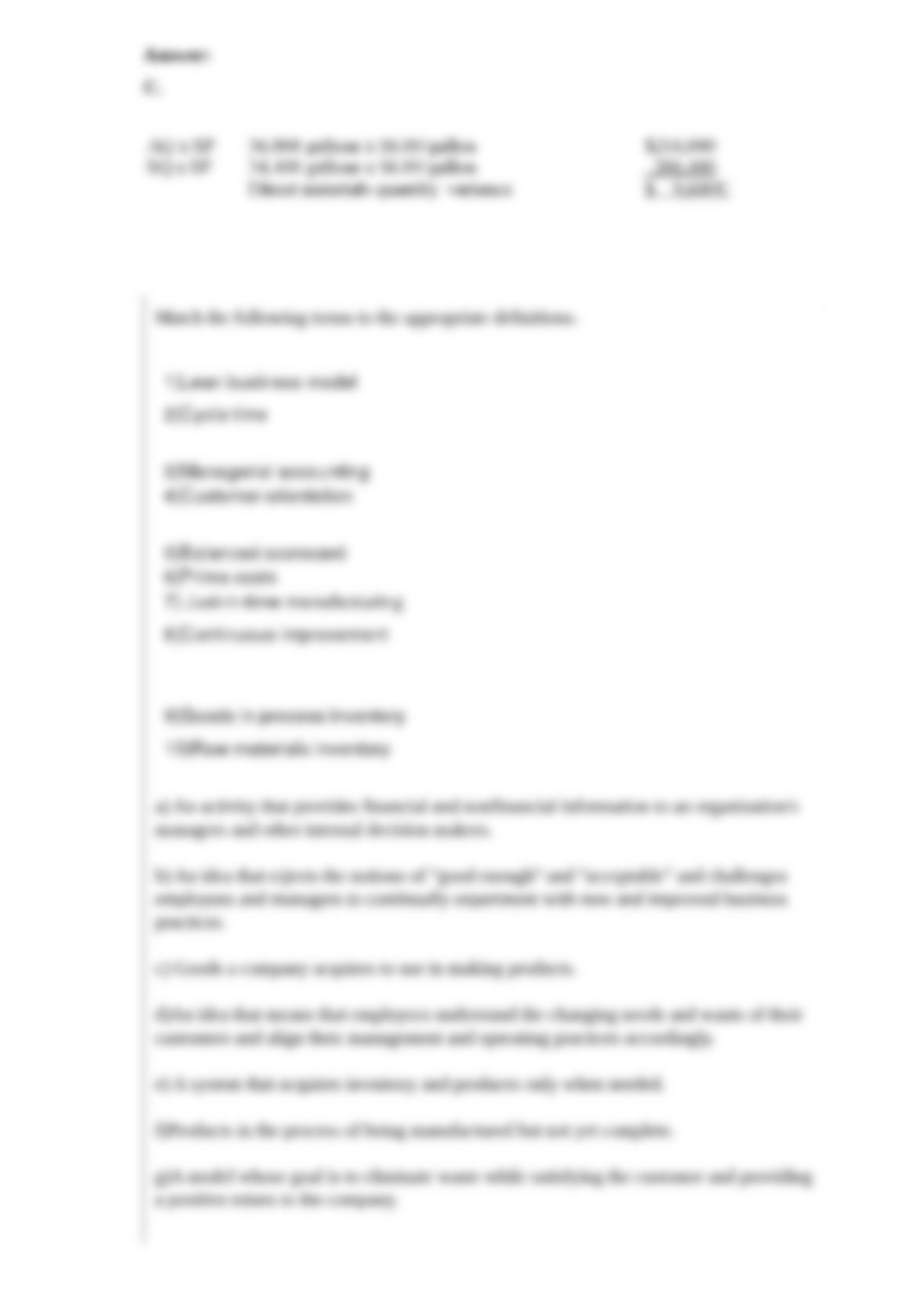
The following company information is available:
The direct materials quantity variance is:
A.$10,000 unfavorable.
B.$13,200 unfavorable.
C.$ 9,600 unfavorable.
D.$10,000 favorable.
E.$13,200 favorable.
A company has inventory of 10 units at a cost of $10 each on June 1. On June 3, it
purchased 20 units at $12 each. 12 units are sold on June 5. Using the FIFO perpetual
inventory method, what is the cost of the 12 units that were sold?
A.$120.
B.$124.
C.$128.
D.$130.
E.$140.
Data pertaining to a company’s joint production for the current period follows:
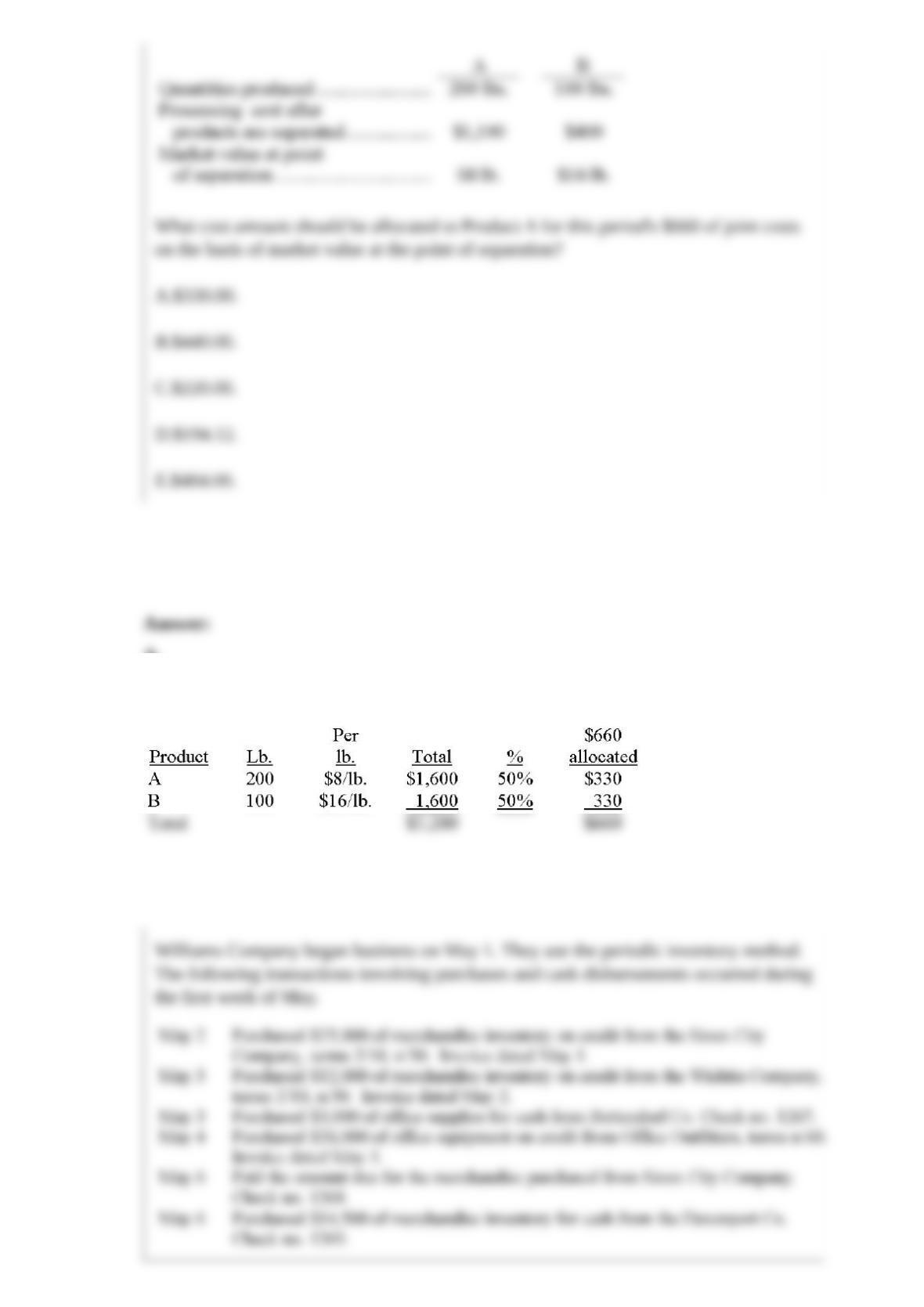
What cost amount should be allocated to Product A for this period’s $660 of joint costs
on the basis of market value at the point of separation?
A.$330.00.
B.$440.00.
C.$220.00.
D.$194.12.
E.$484.00.
Williams Company began business on May 1. They use the periodic inventory method.
The following transactions involving purchases and cash disbursements occurred during
the first week of May.
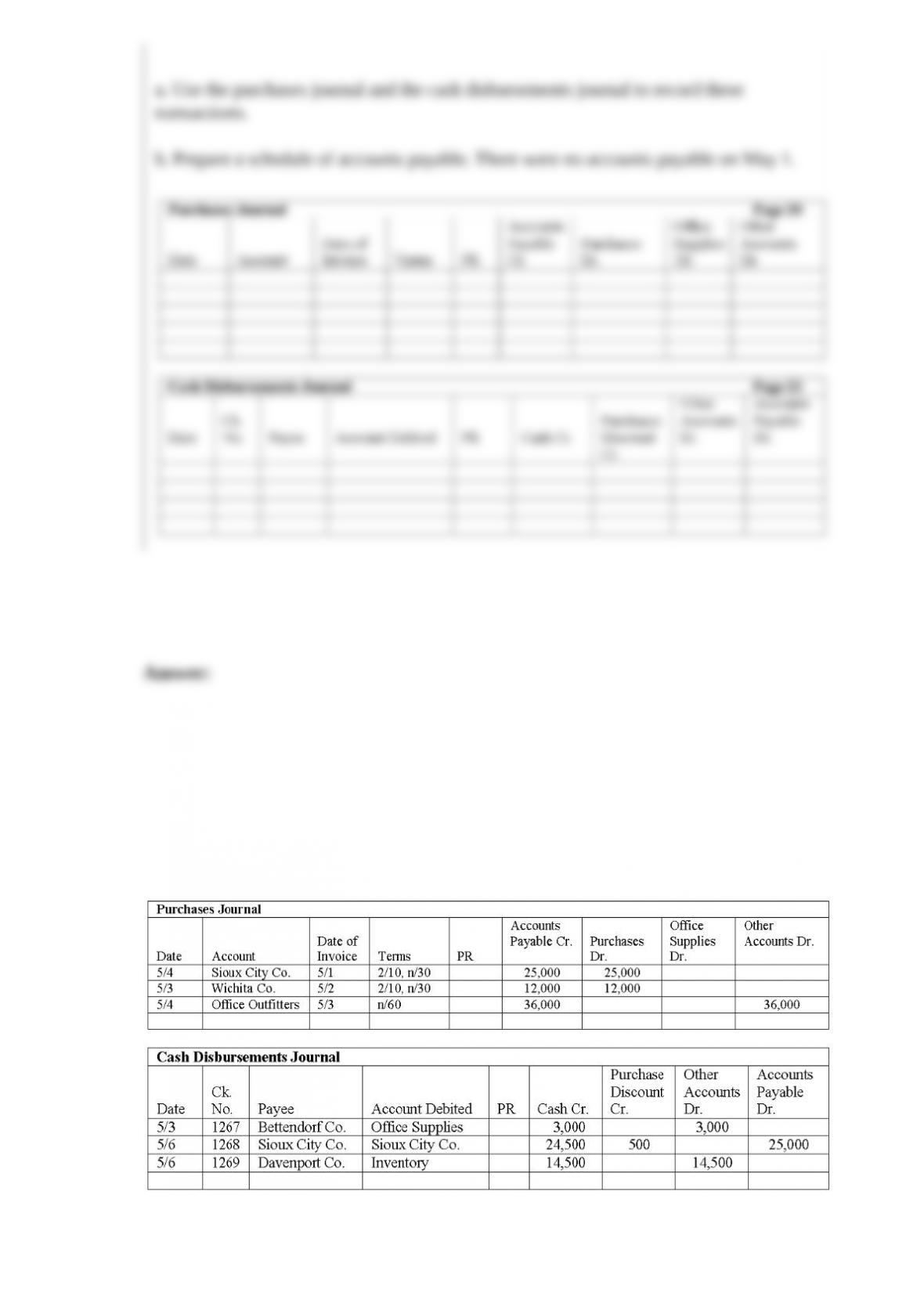
a. Use the purchases journal and the cash disbursements journal to record these
transactions.
b. Prepare a schedule of accounts payable. There were no accounts payable on May 1.
A company records purchases using the net method. On February 1, they purchased
merchandise inventory on account for $8,300 with terms of 1/10, n/30. The February 1
journal entry to record this transaction would include a:
A.Debit to Merchandise Inventory of $8,300.
B.Debit to Merchandise Inventory of $8,217.
C.Debit to Merchandise Inventory of $83.
D.Credit to Merchandise Inventory of $83.
E.Credit to Accounts Payable of $8,300.
A total asset turnover ratio of 3.5 indicates that:
A.For every $1 in sales, the firm acquired $3.50 in assets during the period.
B.For every $1 in assets, the firm produced $3.50 in net sales during the period.
C.For every $1 in assets, the firm earned gross profit of $3.50 during the period.
D.For every $1 in assets, the firm earned $3.50 in net income.
E.For every $1 in assets, the firm paid $3.50 in expenses during the period.
Input devices include:
A.Bar-code readers.
B.Printers.
C.Software.
D.Ledgers.
E.All of these.
Short-term investments in held-to-maturity debt securities are accounted for using the:
A.Market value method with market adjustment to income.
B.Market value method with market adjustment to equity.
C.Cost method with amortization.
D.Cost method without amortization.
E.Equity method.
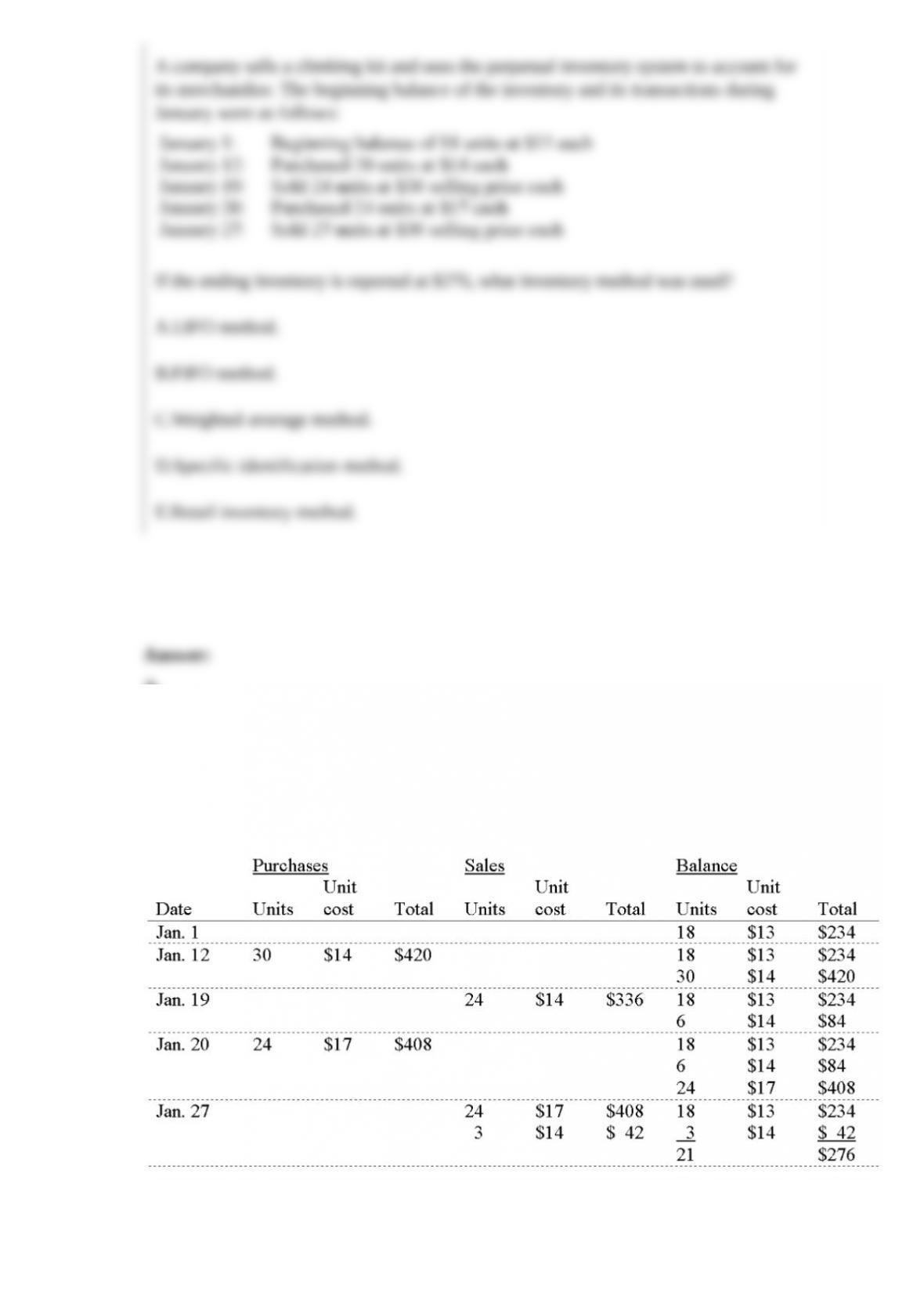
A company sells a climbing kit and uses the perpetual inventory system to account for
its merchandise. The beginning balance of the inventory and its transactions during
January were as follows:
If the ending inventory is reported at $276, what inventory method was used?
A.LIFO method.
B.FIFO method.
C.Weighted-average method.
D.Specific identification method.
E.Retail inventory method.
The accounting principle that requires accounting information to be based on actual
cost and requires assets and services to be recorded initially at the cash or
cash-equivalent amount given in exchange, is the:
A.Accounting equation.
B.Cost principle.
C.Going-concern principle.
D.Realization principle.
E.Business entity principle.
On December 31, 2009, a company forgot to record $7,000 of depreciation on office
equipment. In the 2009 financial statements, what is the effect of this error on assets,
net income, and equity?
The ______________ principle assumes business will continue operating indefinitely
instead of being closed or sold.
In using the internal rate of return method, management must consider a hurdle rate in
making its decisions. What is a hurdle rate? What factors does management have to
consider in selecting a hurdle rate?
Identify and discuss the key differences between common and preferred stock.
A standard that takes into account the reality that some loss usually occurs with any
process under normal application of the process is known as a __________________
standard.
On a process cost summary, the total costs to account for (the processing costs for the
period plus the goods in process at the end of the period) should equal
___________________ (____________________ plus _____________________).
When a company has no reportable nonoperating activities, its income from operations
is reported as ___________________
The following are the steps in the accounting cycle. List them in the order in which they
are completed:
Prepare adjusted trial balance
Post transactions
Prepare an unadjusted trial balance
Journalize transactions
Prepare the financial statements
Close the temporary accounts
Adjust the ledger accounts
Prepare a post-closing trial balance
Analyze transactions
A company purchased land on which to construct a new building for a cost of $250,000.
Additional costs incurred were:
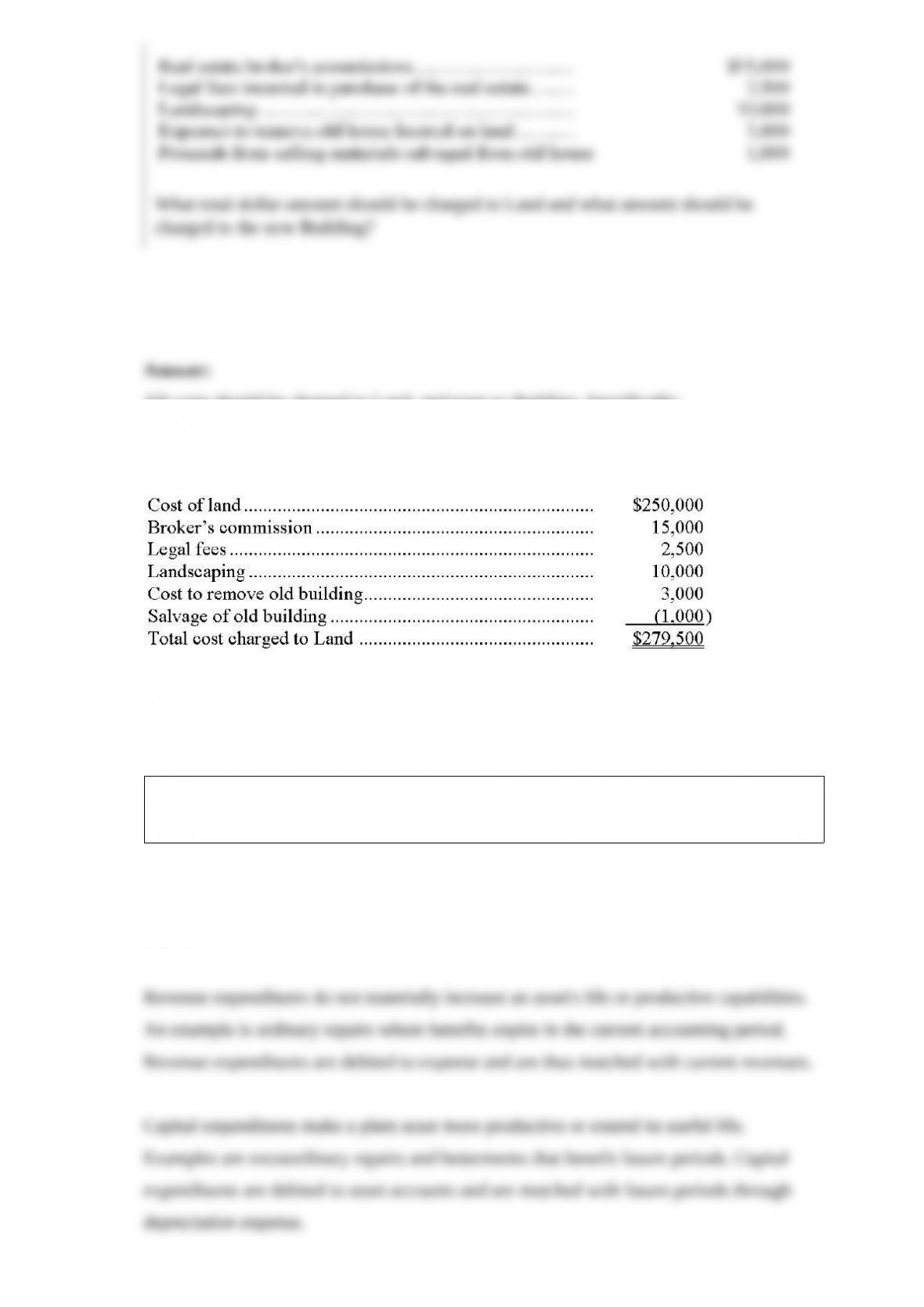
What total dollar amount should be charged to Land and what amount should be
charged to the new Building?
Some companies use the _________________ principle or the __________________
constraint to avoid assigning incidental costs of acquiring merchandise to inventory.