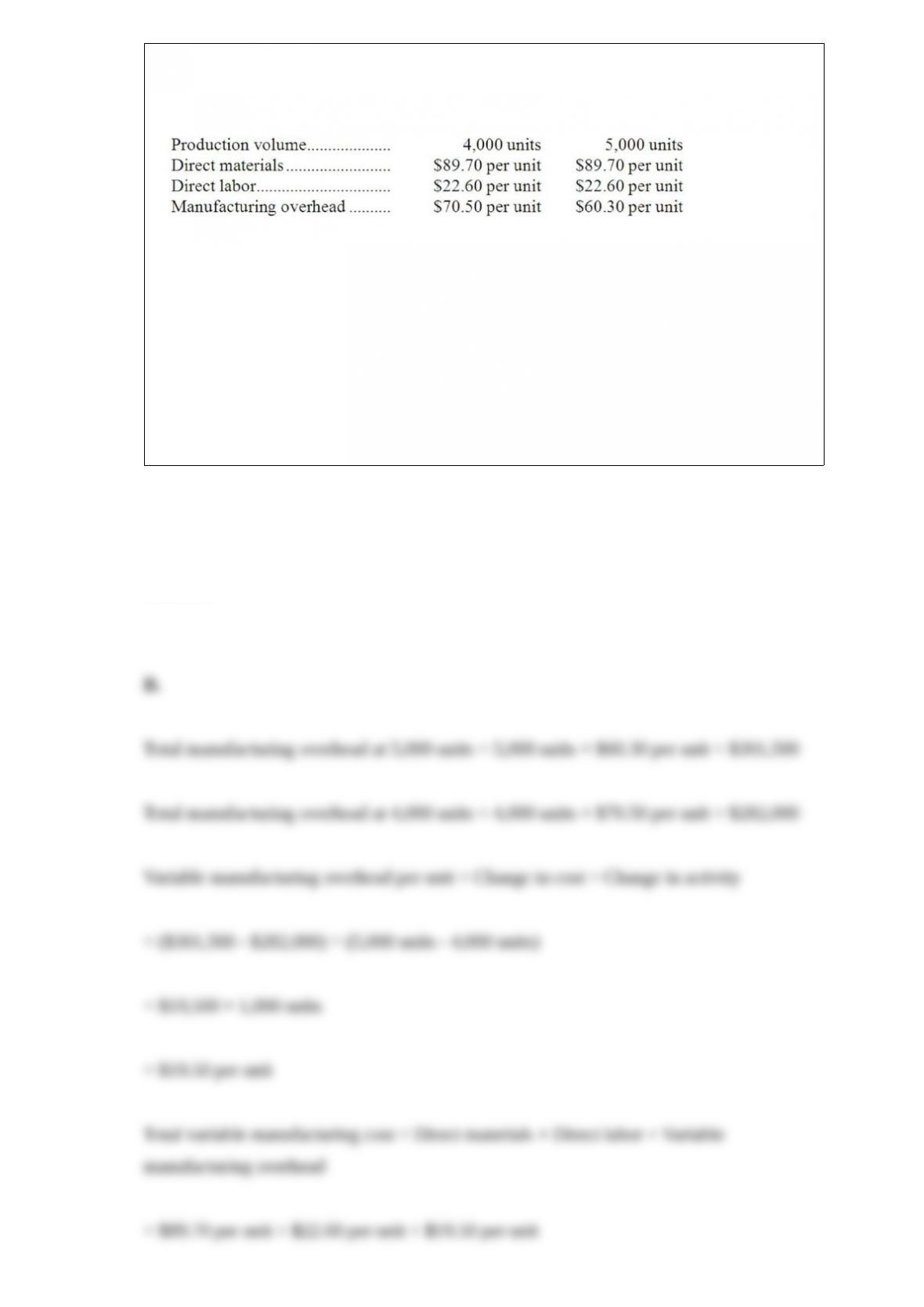
Bakker Corporation has provided the following production and average cost data for
two levels of monthly production volume. The company produces a single product.
The best estimate of the total variable manufacturing cost per unit is:
A. $89.70
B. $131.80
C. $19.50
D. $112.30
Answer:
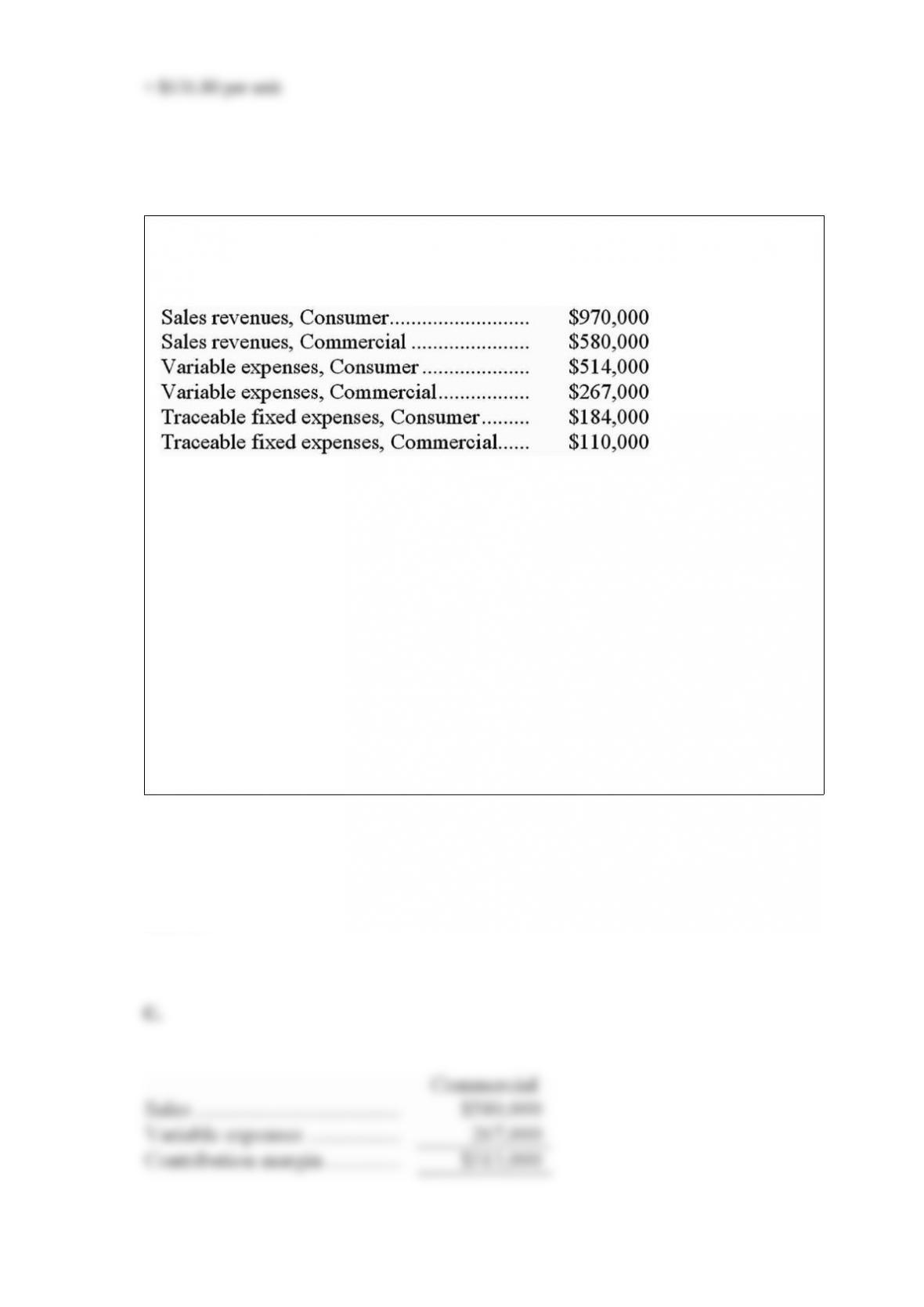
Tennison Corporation has two major business segments-Consumer and Commercial.
Data for the segment and for the company for May appear below:
In addition, common fixed expenses totaled $371,000 and were allocated as follows:
$186,000 to the Consumer business segment and $185,000 to the Commercial business
segment.
The contribution margin of the Commercial business segment is:
A. $769,000
B. $272,000
C. $313,000
D. $86,000
Answer:
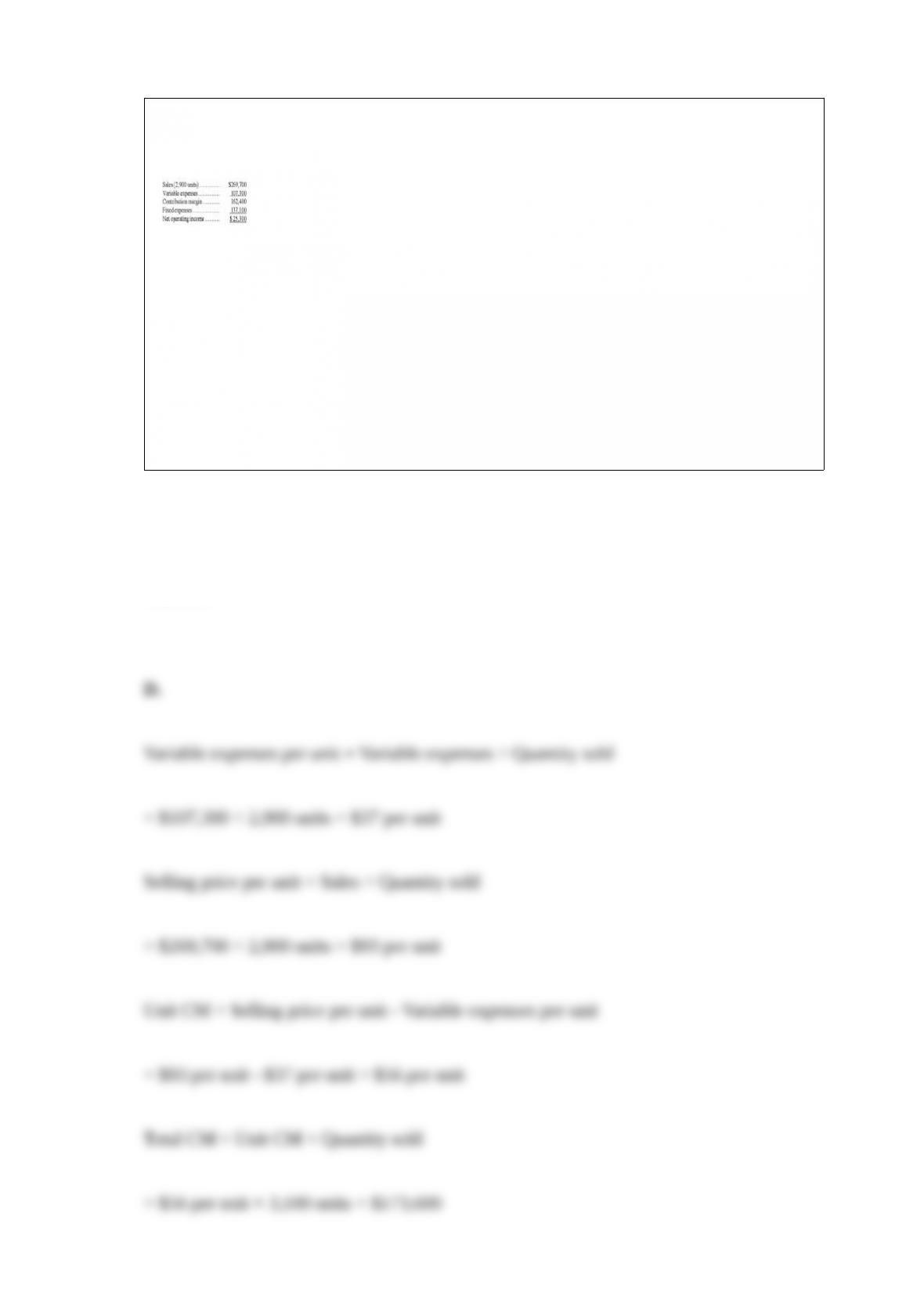
Mancuso Corporation has provided its contribution format income statement for
January. The company produces and sells a single product.
If the company sells 3,100 units, its total contribution margin should be closest to:
A. $27,045
B. $181,000
C. $162,400
D. $173,600
Answer:
Zollars Cane Products, Inc., processes sugar cane in batches. The company buys a batch
of sugar cane from farmers for $70 which is then crushed in the company’s plant at a
cost of $19. Two intermediate products, cane fiber and cane juice, emerge from the
crushing process. The cane fiber can be sold as is for $21 or processed further for $13 to
make the end product industrial fiber that is sold for $42. The cane juice can be sold as
is for $44 or processed further for $26 to make the end product molasses that is sold for
$88. How much profit (loss) does the company make by processing one batch of sugar
cane into the end products industrial fiber and molasses?
A. $26
B. $2
C. $(24)
D. $(128)
Answer:
Job 731 was recently completed. The following data have been recorded on its job cost
sheet:
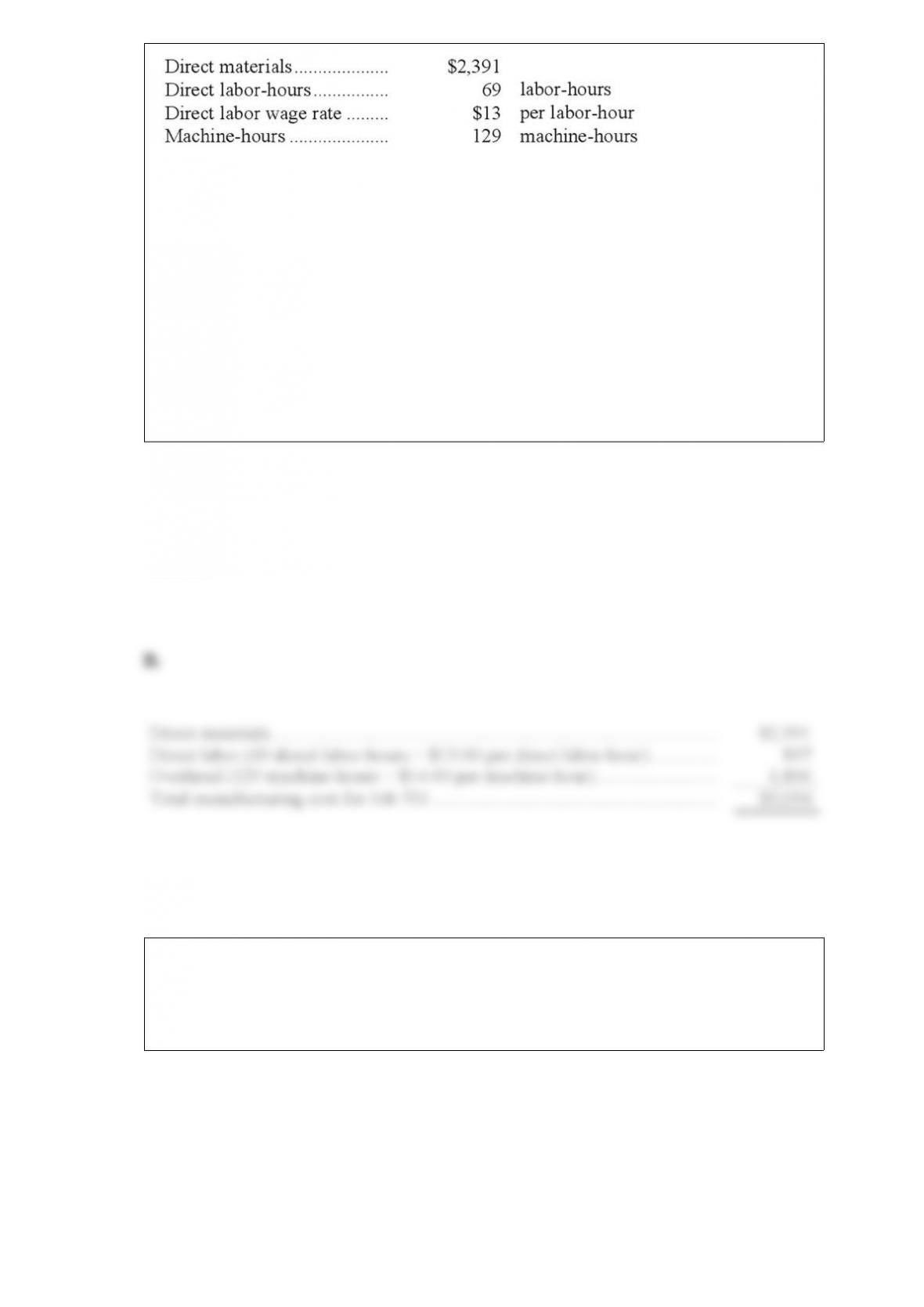
The company applies manufacturing overhead on the basis of machine-hours. The
predetermined overhead rate is $14 per machine-hour. The total cost that would be
recorded on the job cost sheet for Job 731 would be:
A. $3,288
B. $5,094
C. $4,254
D. $2,418
Answer:
Reference: 8-25
Lotson Corporation bases its budgets on machine-hours. The companys static planning
budget for May appears below:
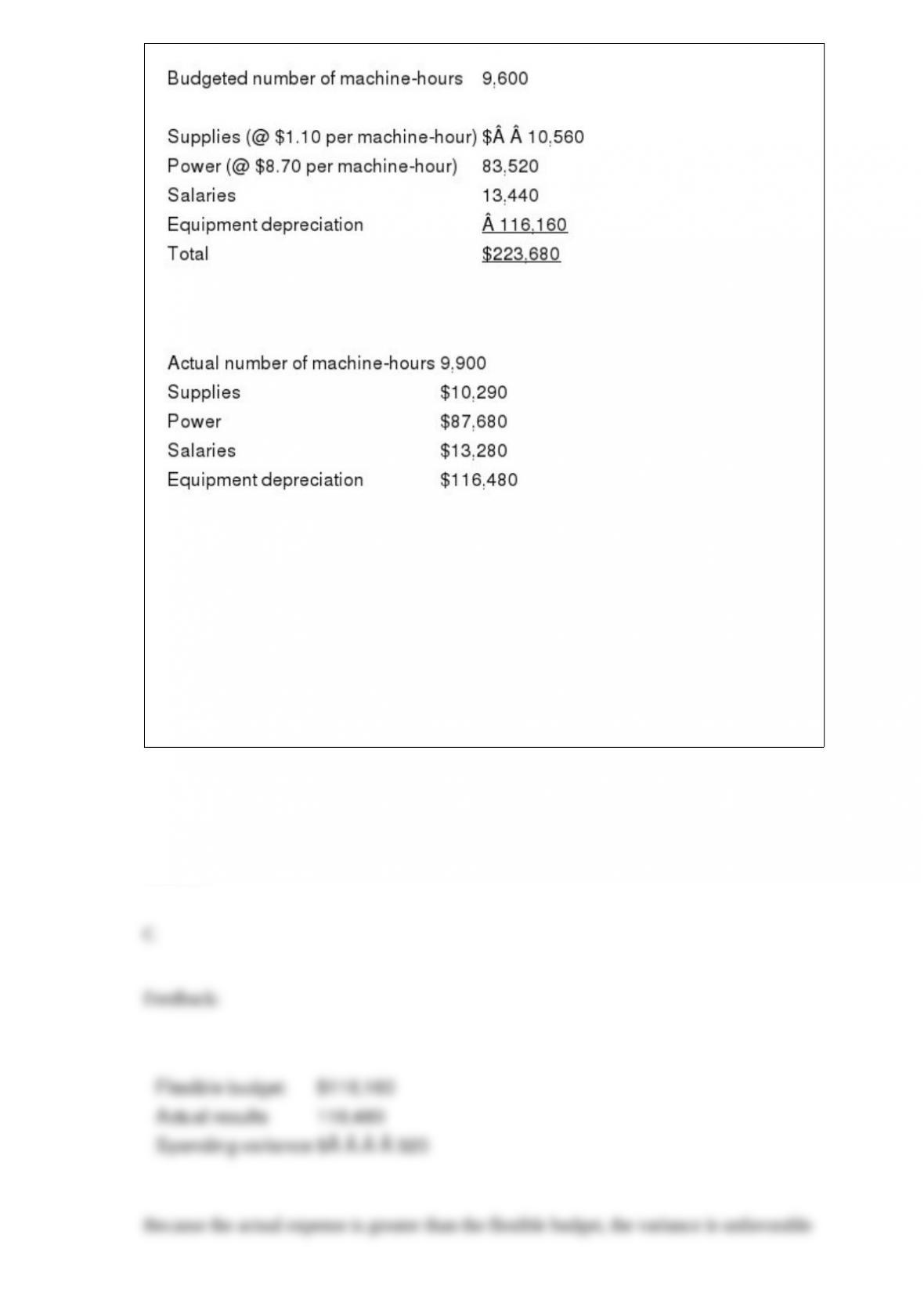
Actual results for the month were:
The spending variance for equipment depreciation for the month should be:
A) $320 F
B) $3,310 U
C) $320 U
D) $3,310 F
Answer:
Compound K47E is used to make Goforth Corporations major product. The standard
cost of compound K47E is $24.50 per ounce and the standard quantity is 6.1 ounces per
unit of output. In the most recent month, 5,030 ounces of the compound were used to
make 700 units of the output. When recording the use of materials in production, Raw
Materials would be:
A) credited for $123,235.
B) debited for $123,235.
C) debited for $104,615.
D) credited for $104,615.
Answer:
Reference: 8-17
Hamp Kennel uses tenant-days as its measure of activity; an animal housed in the
kennel for one day is counted as one tenant-day. During December, the kennel budgeted
for 3,000 tenant-days, but its actual level of activity was 3,050 tenant-days. The kennel
has provided the following data concerning the formulas to be used in its budgeting:
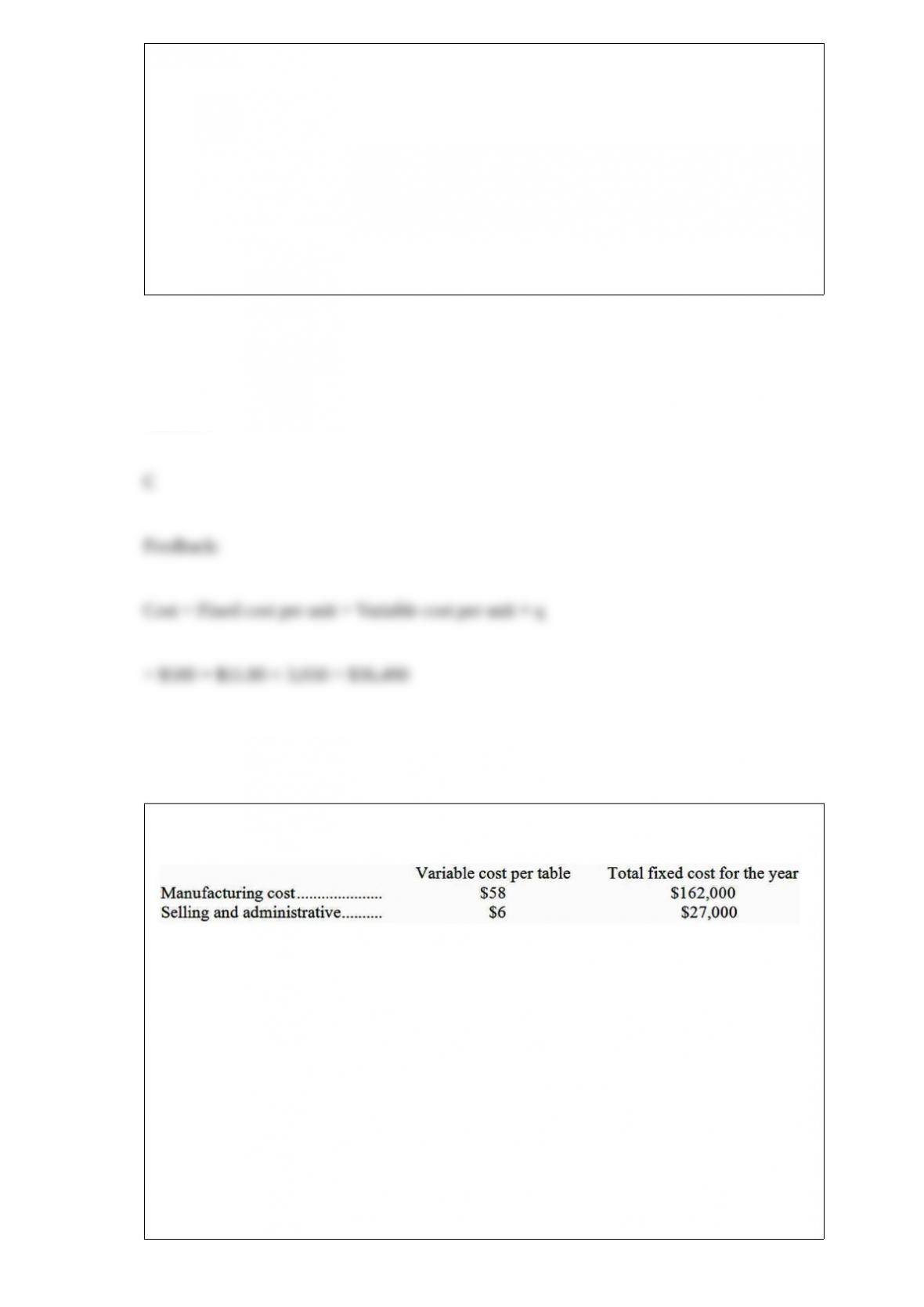
The expendables in the flexible budget for December would be closest to:
A) $35,900
B) $34,466
C) $36,490
D) $35,624
Answer:
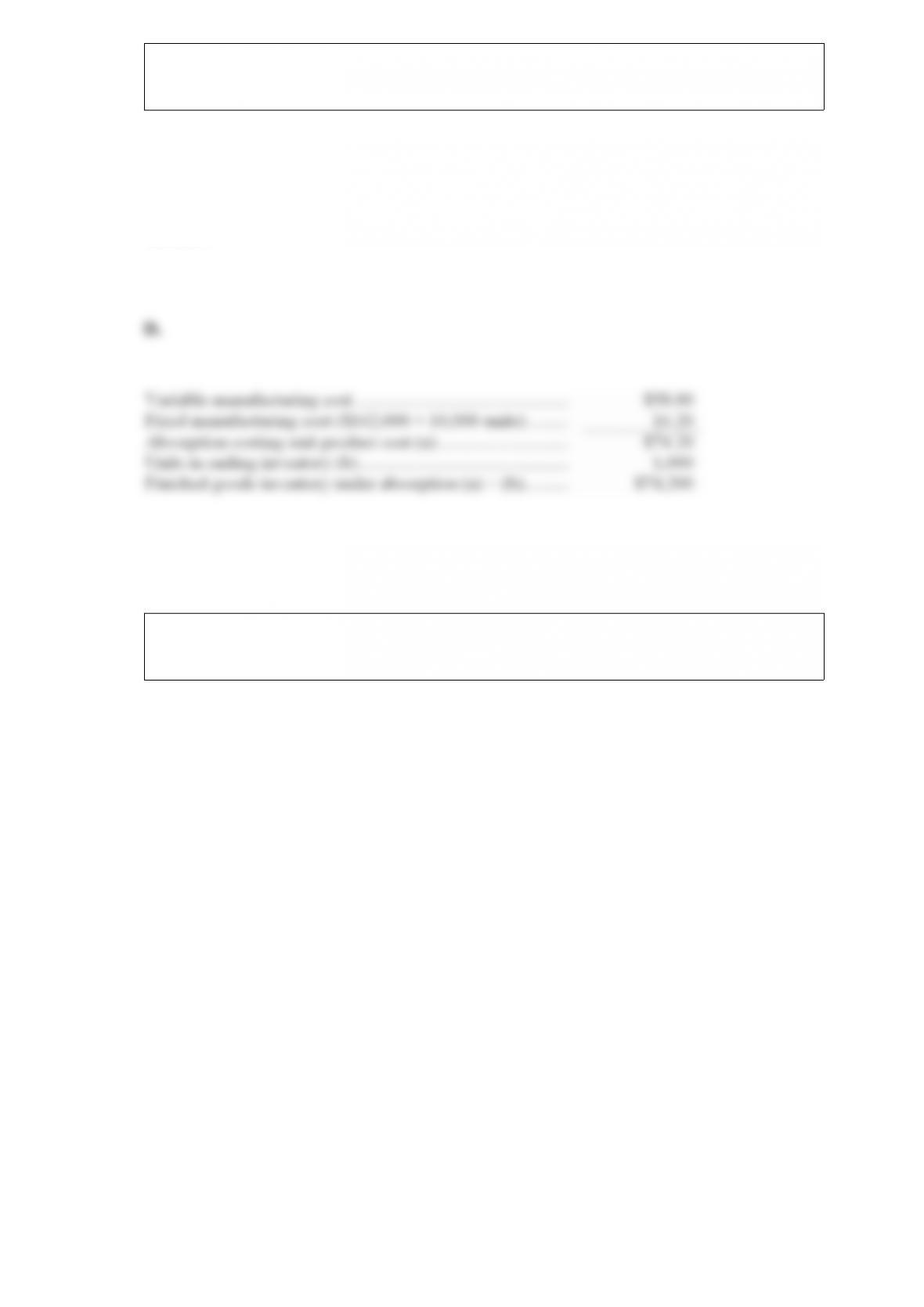
Eagle Corporation manufactures a picnic table. Shown below is Eagle’s cost structure:
In its first year of operations, Eagle produced and sold 10,000 tables. The tables sold for
$120 each.
If Eagle had sold only 9,000 tables in its first year, what total amount of cost would
have been assigned to the 1,000 tables in finished goods inventory under the absorption
costing method?
A. $37,100
B. $45,800
C. $58,000
D. $74,200
Answer:
Hartzog Corporation’s most recent balance sheet and income statement appear below:
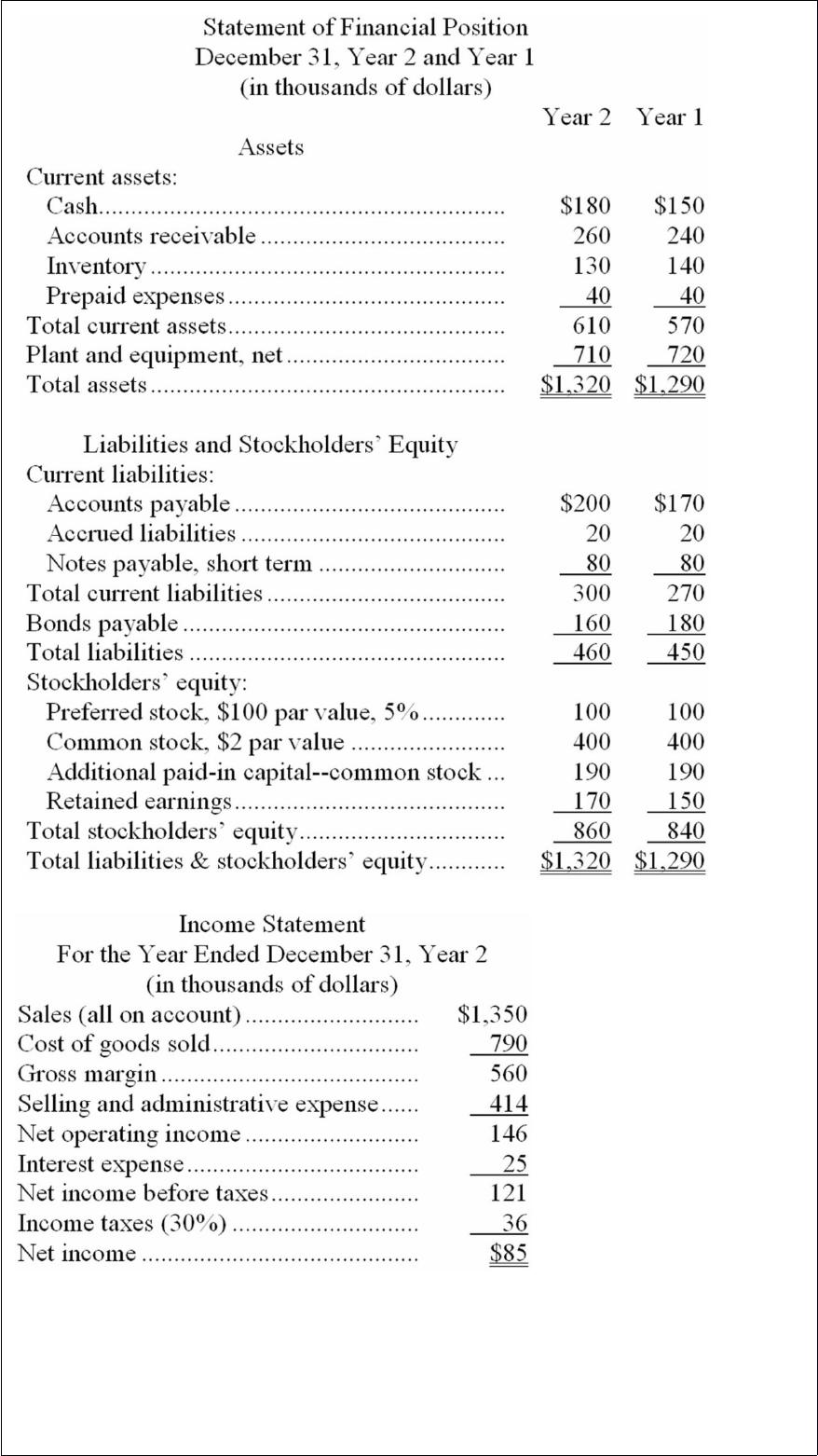
Dividends on common stock during Year 2 totaled $60 thousand. Dividends on
preferred stock totaled $5 thousand. The market price of common stock at the end of
Year 2 was $7.04 per share.
The accounts receivable turnover for Year 2 is closest to:
A. 5.19
B. 5.40
C. 1.08
D. 0.92
Answer:
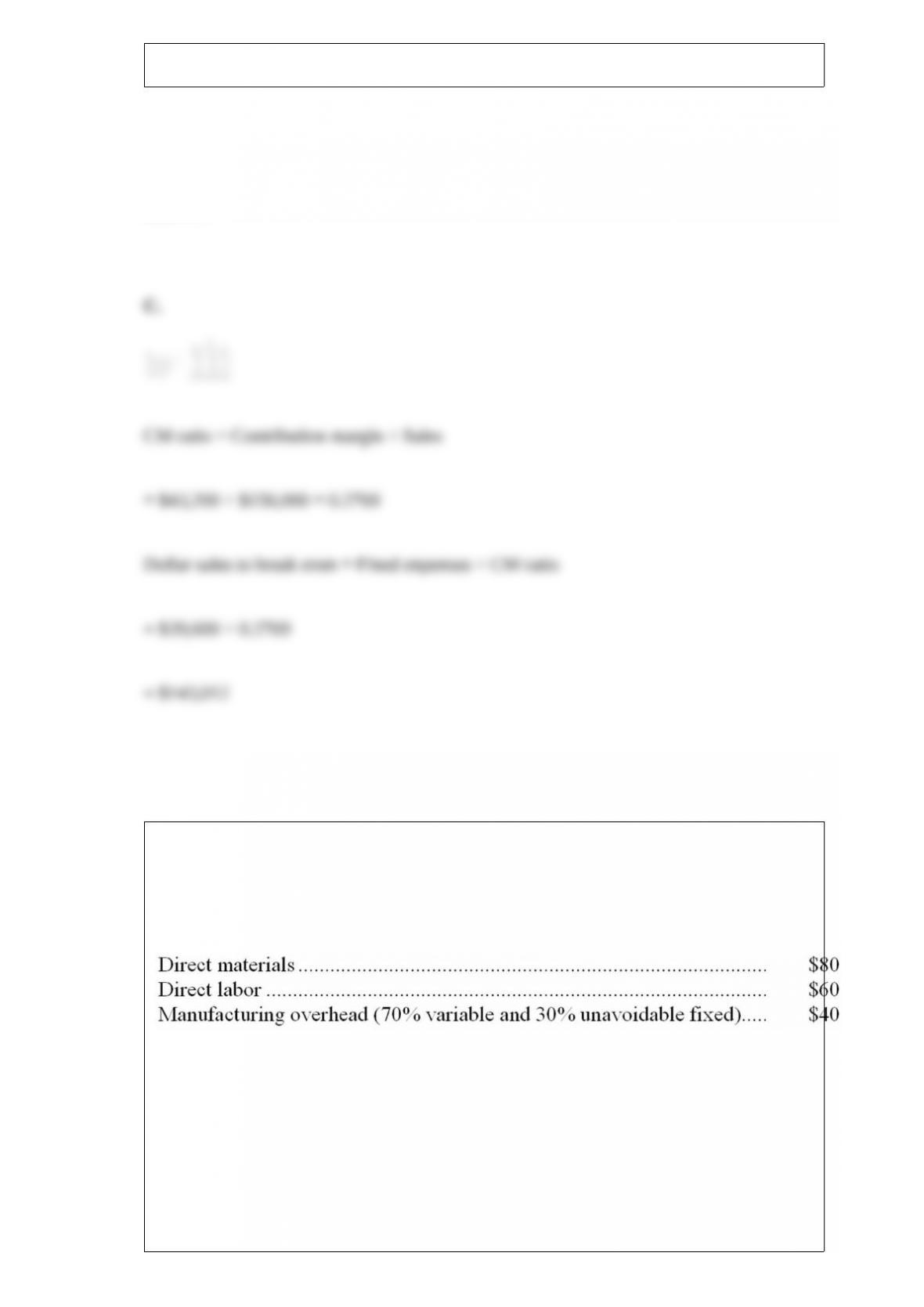
Weiss Corporation produces two models of wood chairs, Colonial and Early American.
The Colonial sells for $60 per chair and the Early American sells for $80 per chair.
Variable expenses for each model are as follows:
Total fixed expenses are $39,600 per month. Expected monthly sales are: Colonial,
1,800 units; Early American, 600 units.
If the sales mix and sales units are as expected, the break-even in sales dollars is closest
to:
A. $132,000
B. $148,500
C. $143,000
D. $139,764
Answer:
Ellis Television makes and sells portable televisions. Each television regularly sells for
$210. The following cost data per television is based on a full capacity of 10,000
televisions produced each period.
A special order has been received by Ellis for a sale of 2,000 televisions to an overseas
customer. The only selling costs that would be incurred on this order would be $6 per
television for shipping. Ellis is now selling 6,000 televisions through regular channels
each period. What should be the minimum selling price per television in negotiating a
price for this special order?
A. $174
B. $168
C. $210
D. $180
Answer:
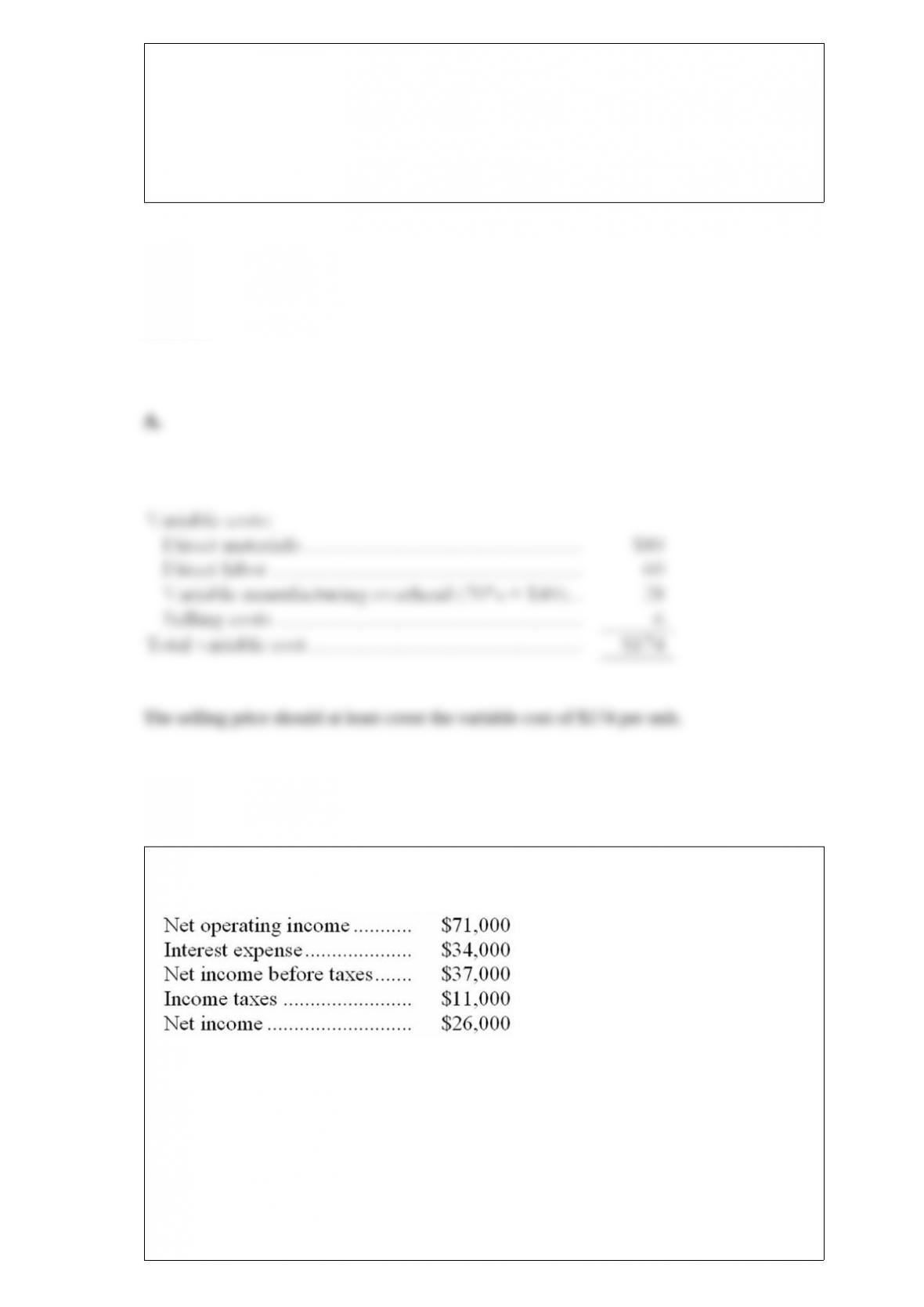
Pia Corporation has provided the following data from its most recent income statement:
The times interest earned ratio is closest to:
A. 2.09
B. 1.09
C. 0.76
D. 2.98
Answer:
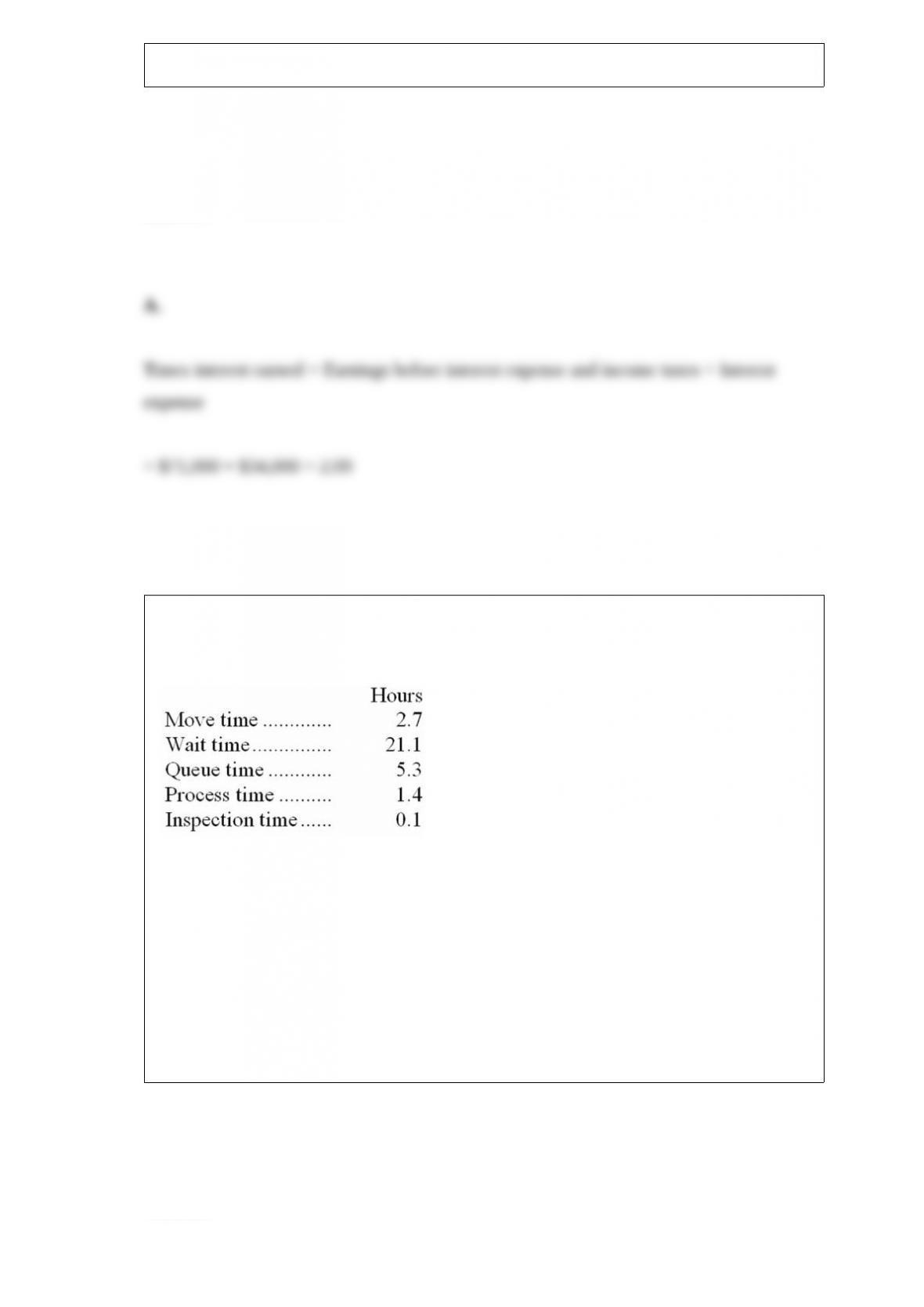
Diorio Corporation keeps careful track of the time required to fill orders. The times
recorded for a particular order appear below:
The manufacturing cycle efficiency (MCE) was closest to:
A. 0.15
B. 0.05
C. 0.45
D. 0.18
Answer:
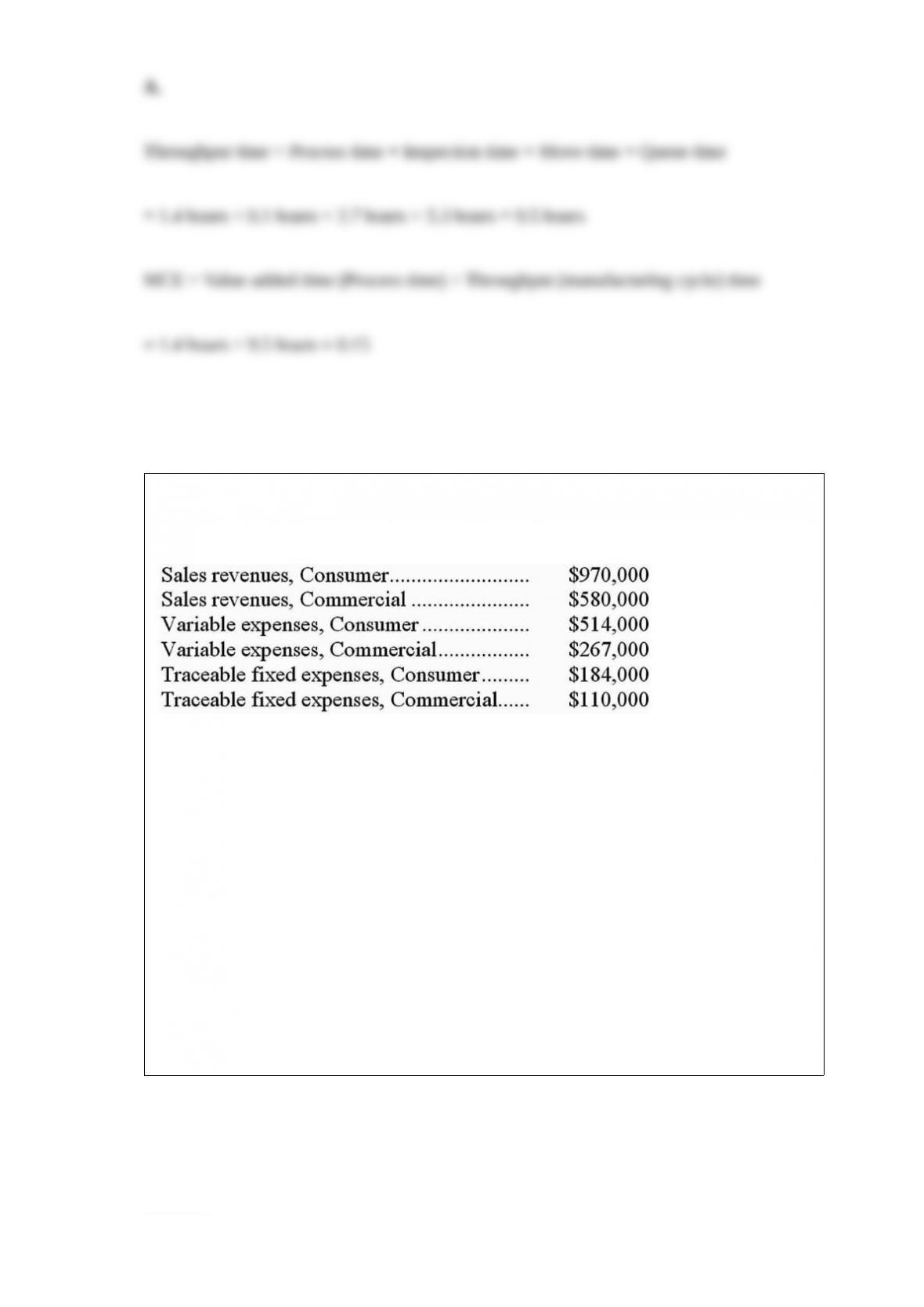
Tennison Corporation has two major business segments-Consumer and Commercial.
Data for the segment and for the company for May appear below:
In addition, common fixed expenses totaled $371,000 and were allocated as follows:
$186,000 to the Consumer business segment and $185,000 to the Commercial business
segment.
A properly constructed segmented income statement in a contribution format would
show that the segment margin of the Consumer business segment is:
A. $272,000
B. $270,000
C. $86,000
D. $514,000
Answer:

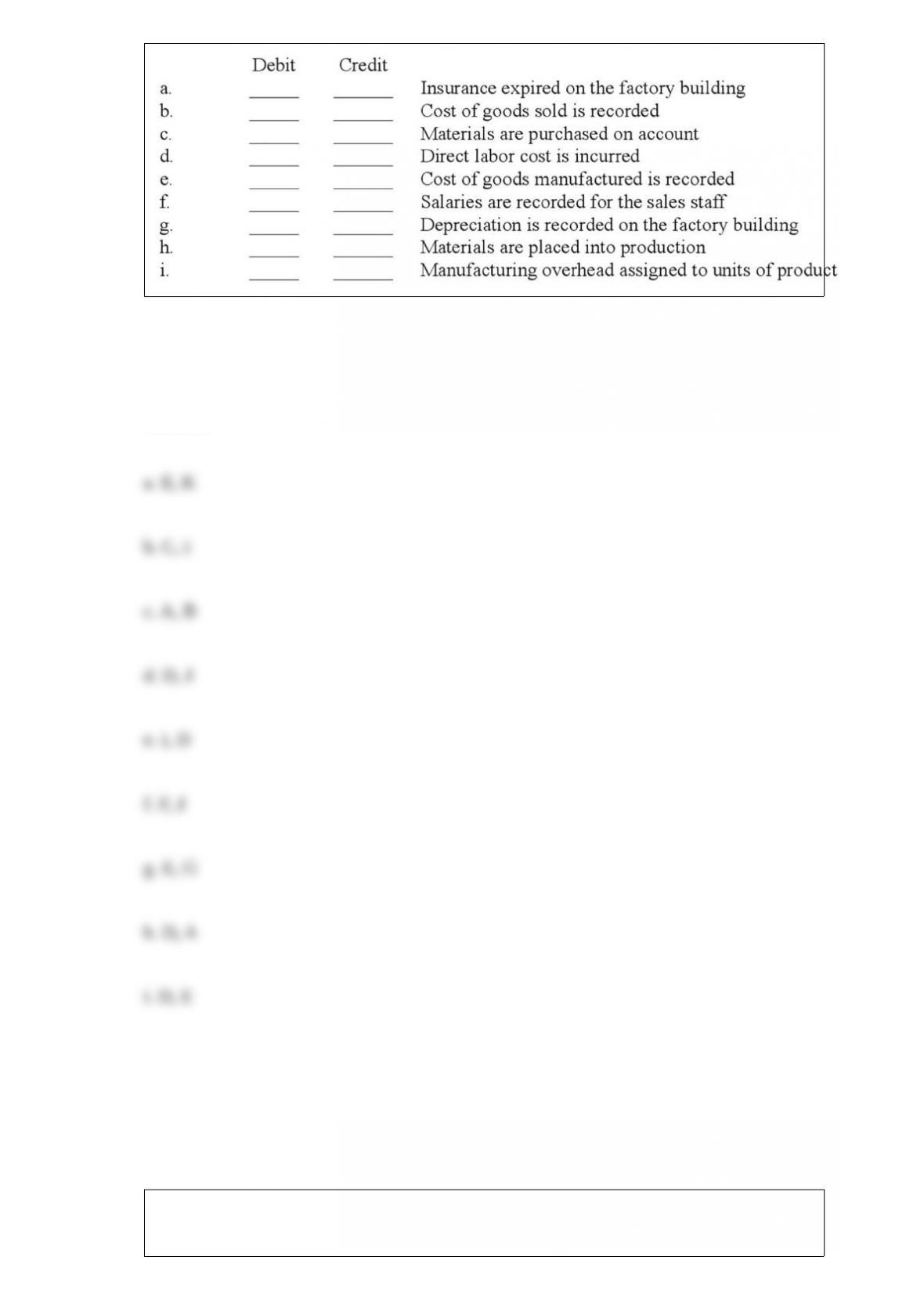
The following accounts will be used in this problem:
A. Raw materials inventory
B. Accounts payable
C. Cost of goods sold
D. Work in process inventory
E. Manufacturing overhead
F. Wages and salaries expense
G. Accumulated depreciation
H. Depreciation expense
I. Finished goods inventory
J. Wages and salaries payable
K. Prepaid insurance
L. Insurance expense
Enter identifying letters in the blanks below to indicate the accounts debited and
credited under a job-order costing system for each of the following summary
transactions:
Answer:
Which of the following are considered to be product costs under absorption costing?
I. Variable manufacturing overhead.
II. Fixed manufacturing overhead.
III. Selling and administrative expenses.
A. I, II, and III.
B. I and II.
C. I and III.
D. I.
Answer:
Addy Company has two products: A and B. The annual production and sales of Product
A is 1,700 units and of Product B is 1,100 units. The company has traditionally used
direct labor-hours as the basis for applying all manufacturing overhead to products.
Product A requires 0.3 direct labor-hours per unit and Product B requires 0.6 direct
labor-hours per unit. The total estimated overhead for next period is $98,785.
The company is considering switching to an activity-based costing system for the
purpose of computing unit product costs for external reports. The new activity-based
costing system would have three overhead activity cost pools–Activity 1, Activity 2,
and General Factory–with estimated overhead costs and expected activity as follows:
(Note: The General Factory activity cost pool’s costs are allocated on the basis of direct
labor-hours.)
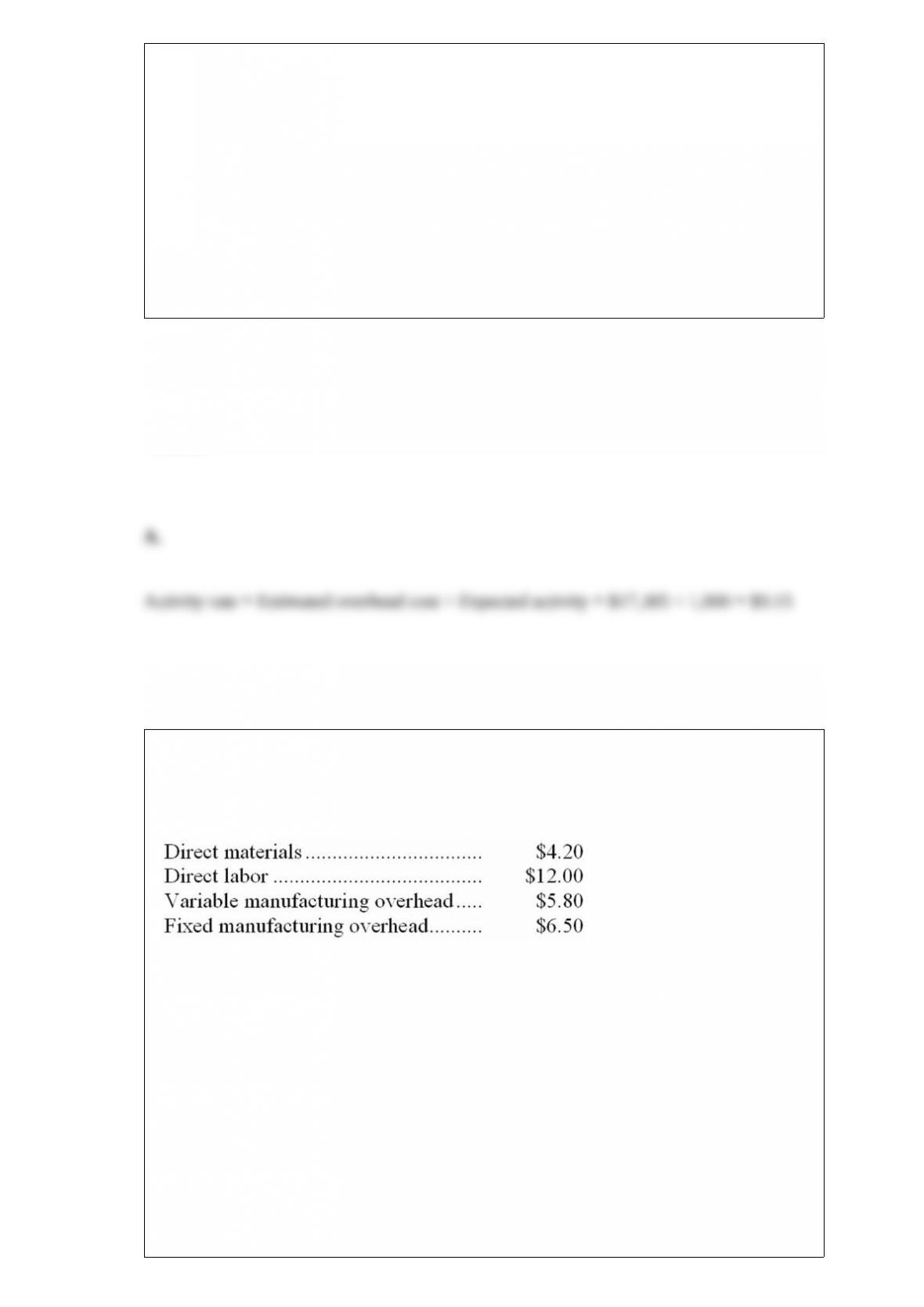
The predetermined overhead rate (i.e., activity rate) for Activity 2 under the
activity-based costing system is closest to:
A. $9.15
B. $51.99
C. $86.93
D. $10.23
Answer:
The Rodgers Company makes 27,000 units of a certain component each year for use in
one of its products. The cost per unit for the component at this level of activity is as
follows:
Rodgers has received an offer from an outside supplier who is willing to provide 27,000
units of this component each year at a price of $25 per component. Assume that direct
labor is a variable cost. None of the fixed manufacturing overhead would be avoidable
if this component were purchased from the outside supplier.
Assume that there is no other use for the capacity now being used to produce the
component and the total fixed manufacturing overhead of the company would be
unaffected by this decision. If Rodgers Company purchases the components rather than
making them internally, what would be the impact on the company’s annual net
operating income?
A. $94,500 increase
B. $81,000 decrease
C. $237,600 decrease
D. $124,000 increase
Answer:
Diltex Farm Supply is located in a small town in the rural west. Data regarding the
store’s operations follow:
o Sales are budgeted at $220,000 for November, $200,000 for December, and $210,000
for January.
o Collections are expected to be 70% in the month of sale, 27% in the month following
the sale, and 3% uncollectible.
o The cost of goods sold is 65% of sales.
o The company desires to have an ending merchandise inventory at the end of each
month equal to 50% of the next month’s cost of goods sold. Payment for merchandise is
made in the month following the purchase.
o Other monthly expenses to be paid in cash are $22,500.
o Monthly depreciation is $19,000.
o Ignore taxes.
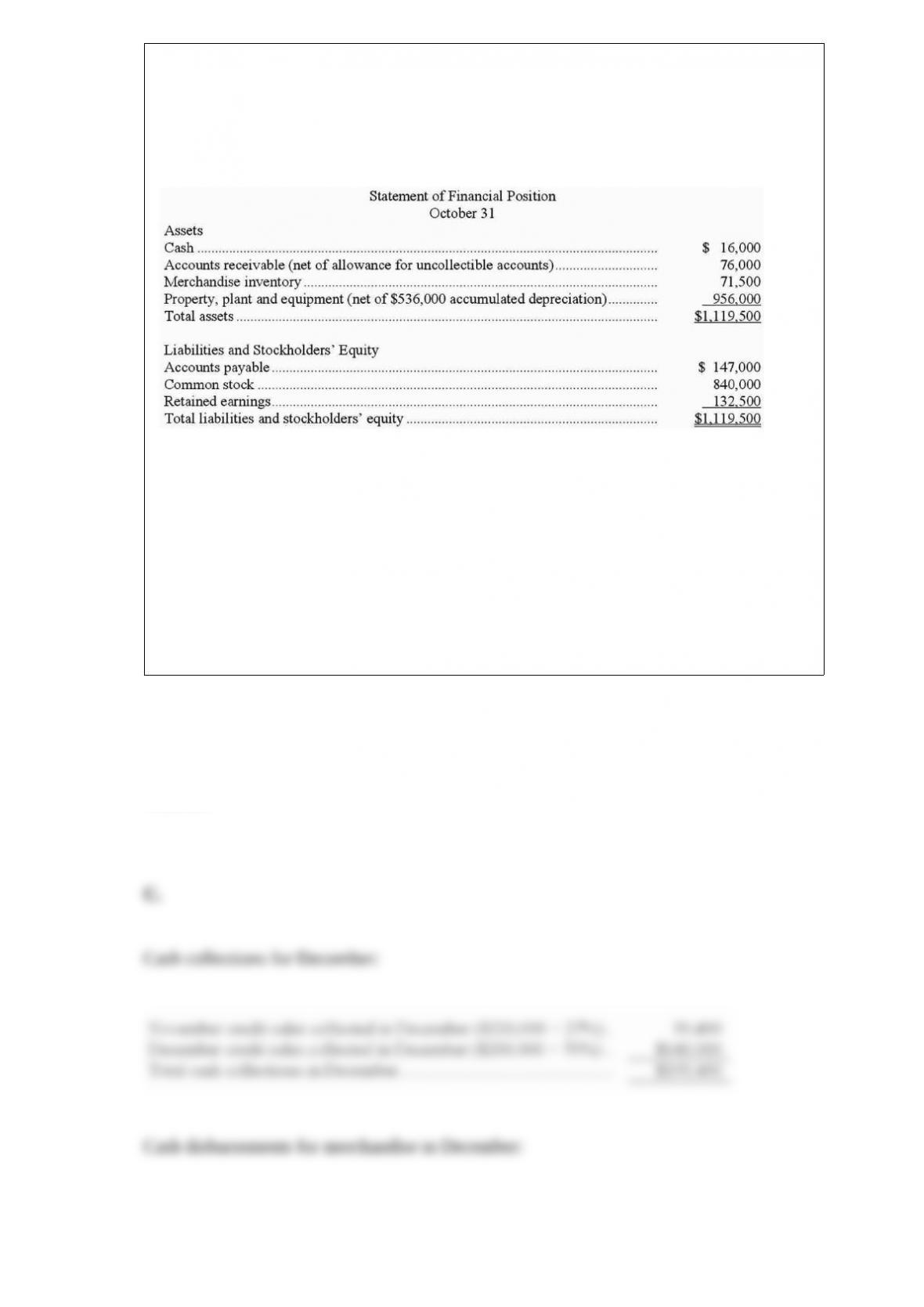
The difference between cash receipts and cash disbursements for December would be:
A. $17,900
B. $22,500
C. $40,400
D. $62,900
Answer:
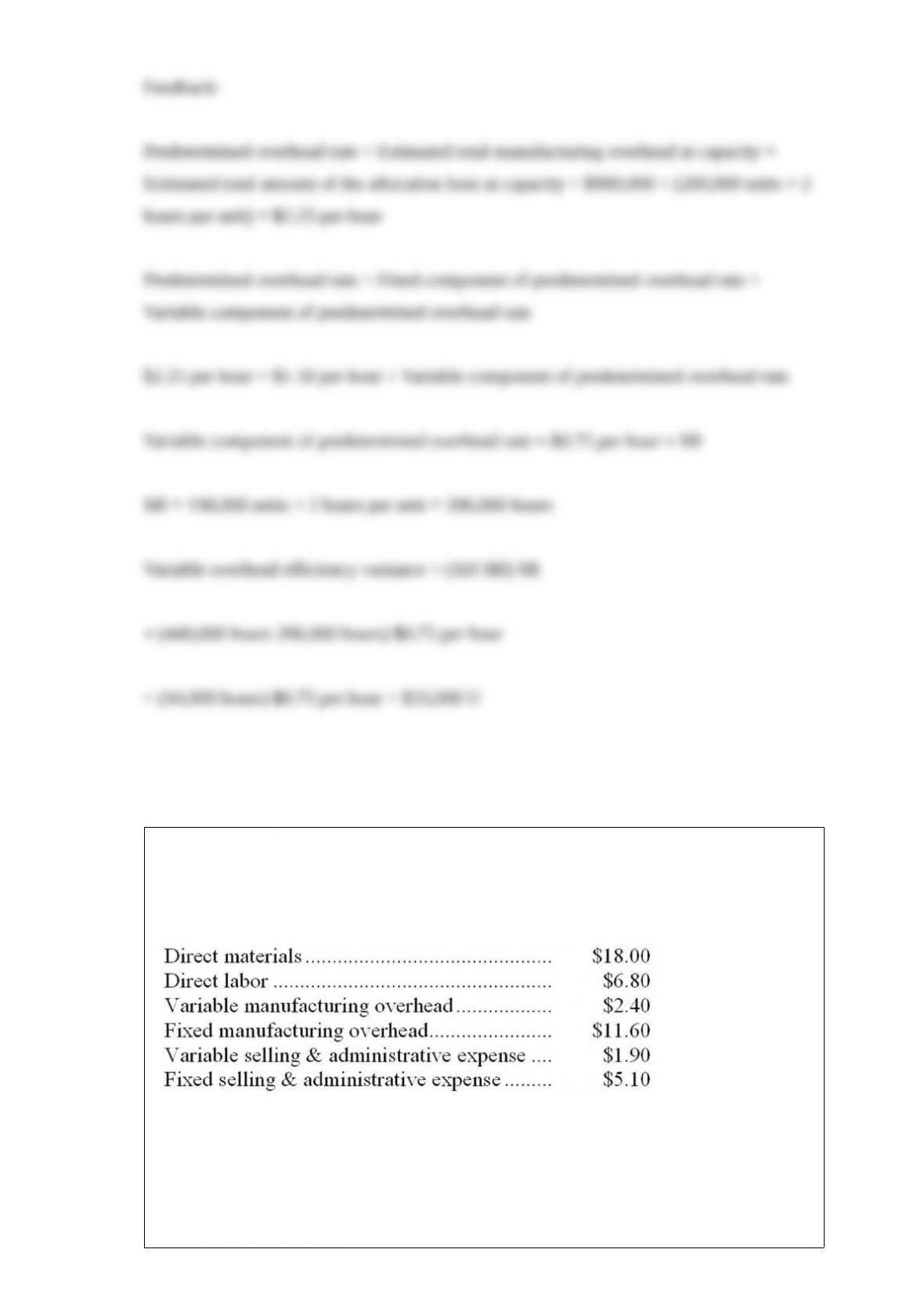
Franklins variable overhead efficiency variance for the year is:
A) $33,000 unfavorable
B) $35,200 favorable
C) $35,200 unfavorable
D) $33,000 favorable
Answer:
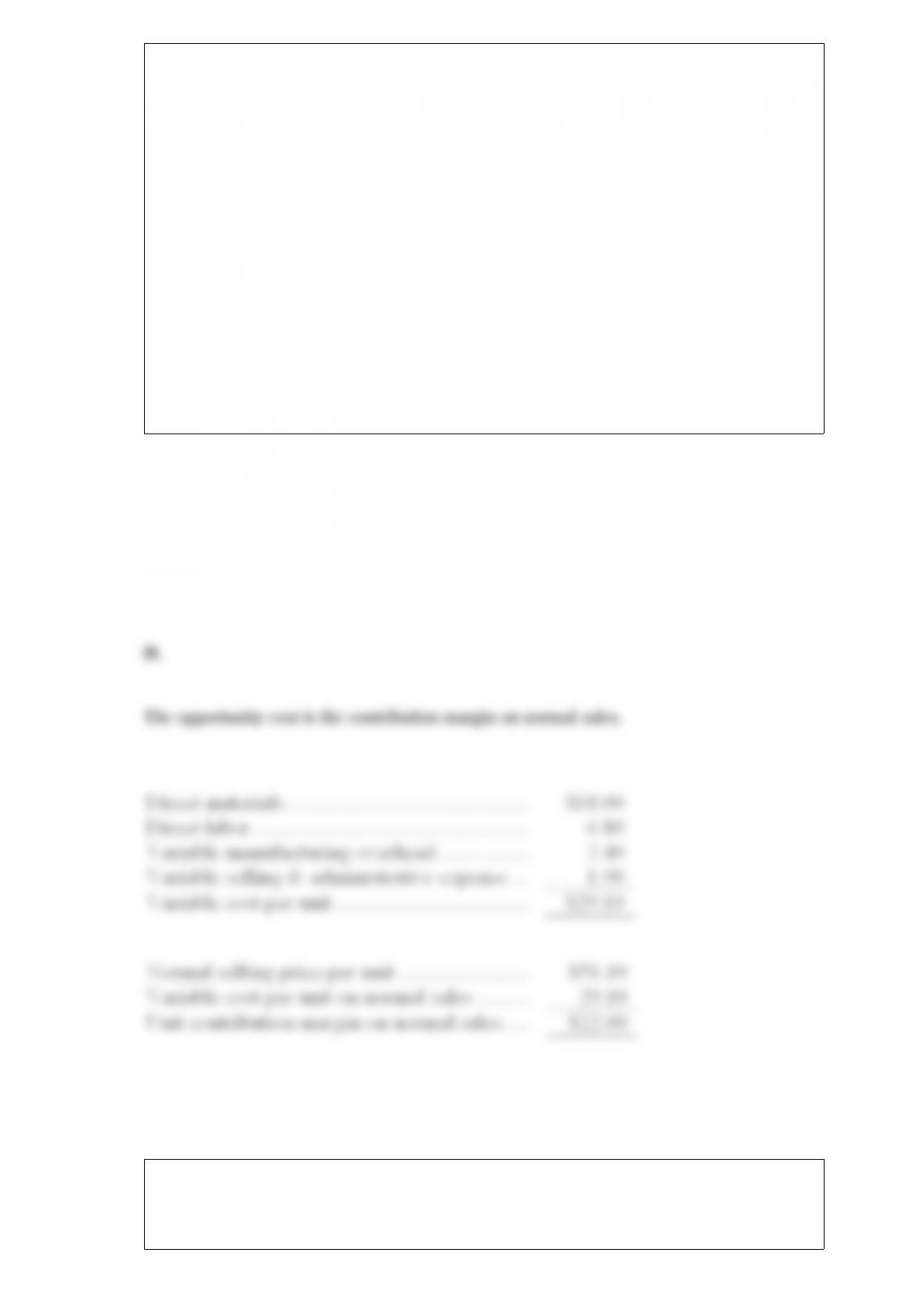
Elhard Company produces a single product. The cost of producing and selling a single
unit of this product at the company’s normal activity level of 40,000 units per month is
as follows:
The normal selling price of the product is $51.10 per unit.
An order has been received from an overseas customer for 2,000 units to be delivered
this month at a special discounted price. This order would have no effect on the
company’s normal sales and would not change the total amount of the company’s fixed
costs. The variable selling and administrative expense would be $0.10 less per unit on
this order than on normal sales.
Direct labor is a variable cost in this company.
Suppose the company is already operating at capacity when the special order is received
from the overseas customer. What would be the opportunity cost of each unit delivered
to the overseas customer?
A. $5.40
B. $5.30
C. $9.50
D. $22.00
Answer:
A company should use process costing, rather than job order costing, if:
A. production is only partially completed during the accounting period.
B. the product is manufactured in batches only as orders are received.
C. the product is composed of mass-produced homogeneous units.
D. the product goes through several steps of production.
Answer:
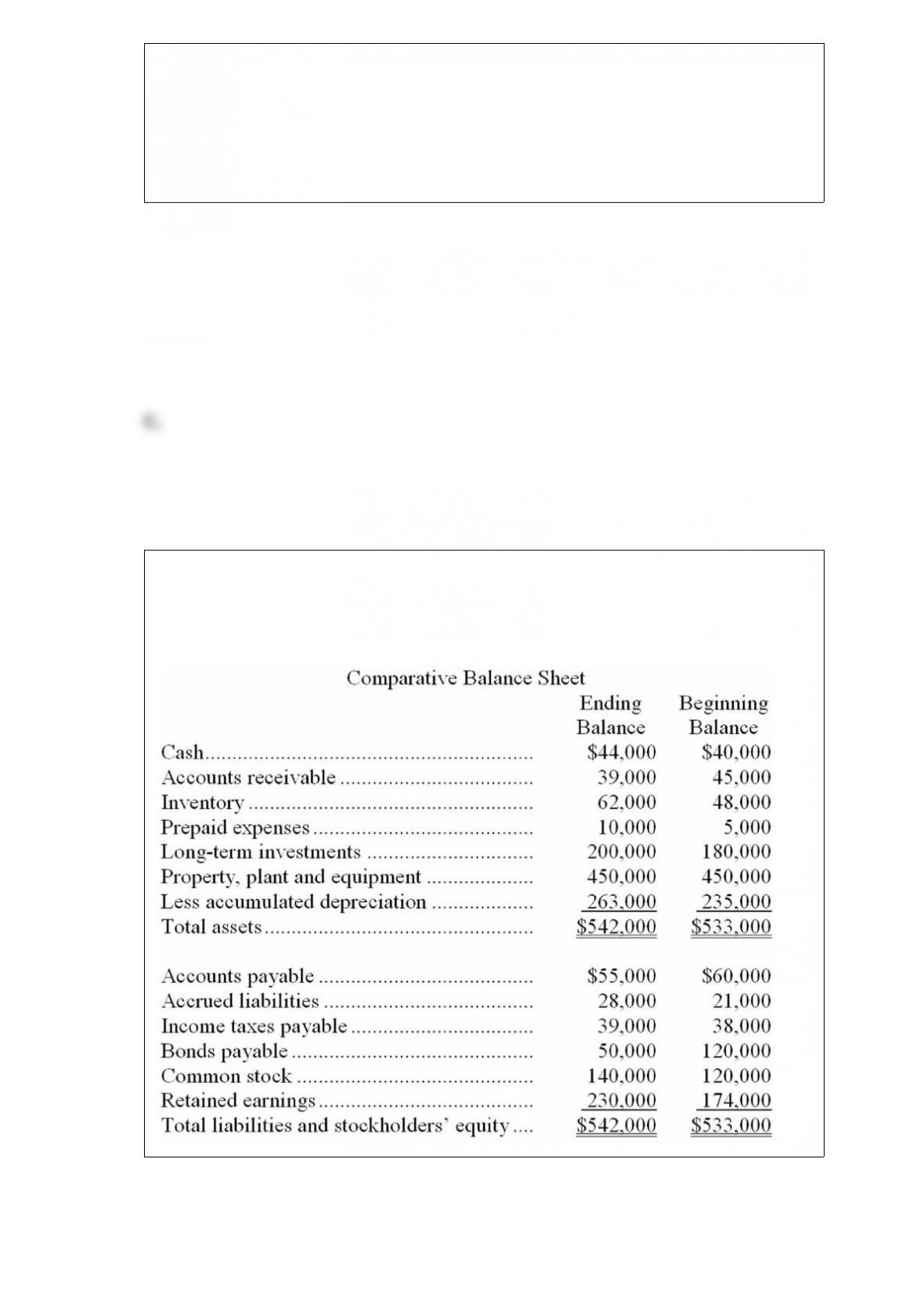
Watson Company’s comparative balance sheet and income statement for last year
appear below:
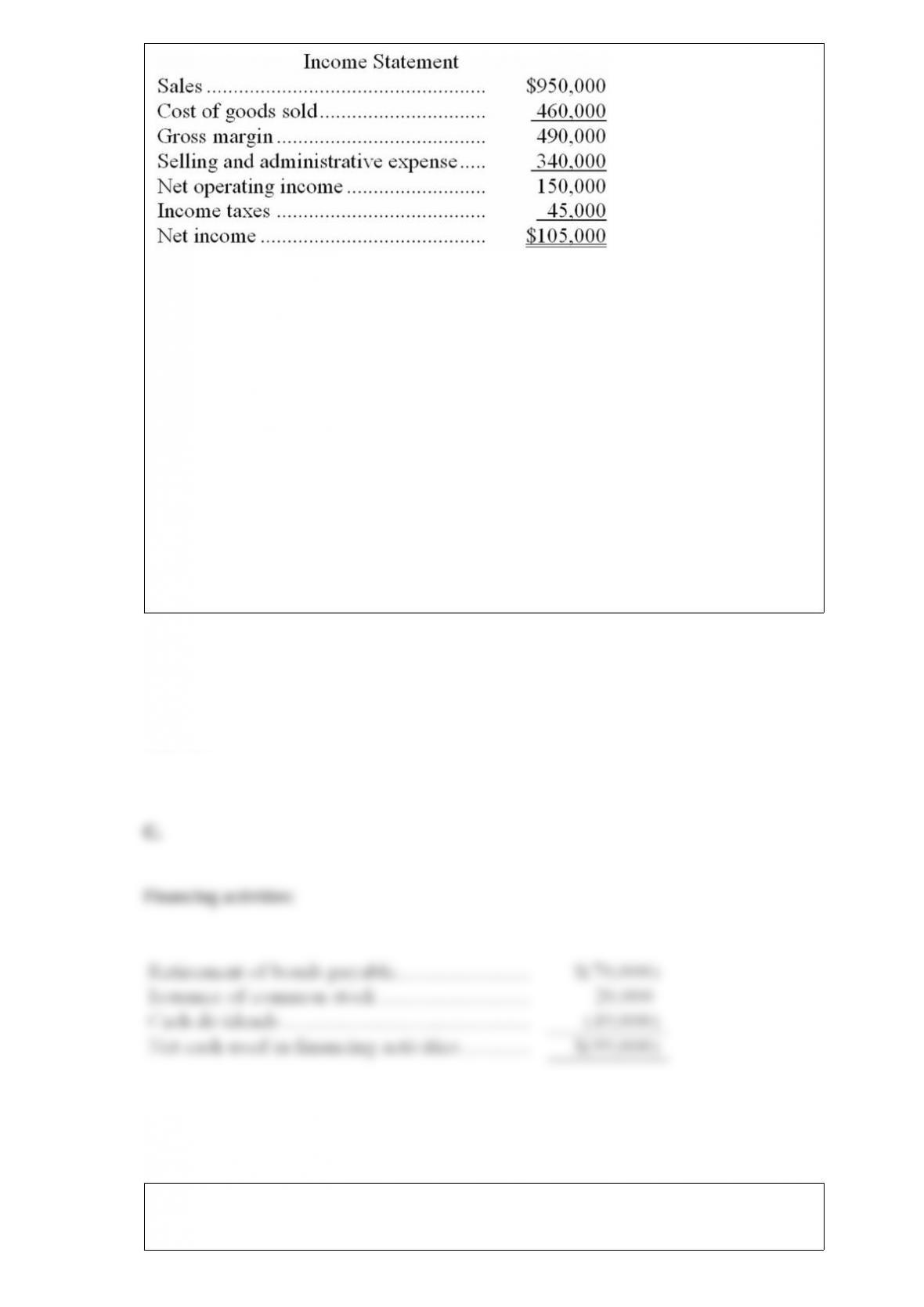
The company declared and paid a cash dividend during the year. It did not purchase or
dispose of any property, plant, and equipment. It did not issue any bonds or repurchase
any of its own common stock. The following question pertain to the company’s
statement of cash flows.
The net cash provided by (used in) financing activities last year was:
A. $99,000
B. $(50,000)
C. $(99,000)
D. $50,000
Answer:
Reference: 8A-9
The Steff Company has the following flexible budget (in condensed form) for
manufacturing overhead:
The following data concerning production pertain to last years operations:
– The company used a denominator activity of 15,000 direct labor-hours to compute
the predetermined overhead rate.
– The company made 6,850 units of product and worked 14,200 actual hours during
the year.
– Actual variable manufacturing overhead was $15,904 and actual fixed
manufacturing overhead was $30,s850 for the year.
– The standard direct labor time is two hours per unit of product.
The variable element of the predetermined overhead rate was (per DLH):
A) $4.15
B) $3.00
C) $2.00
D) $1.15
Answer:
Electrical costs at one of Vanartsdalen Corporation’s factories are listed below:
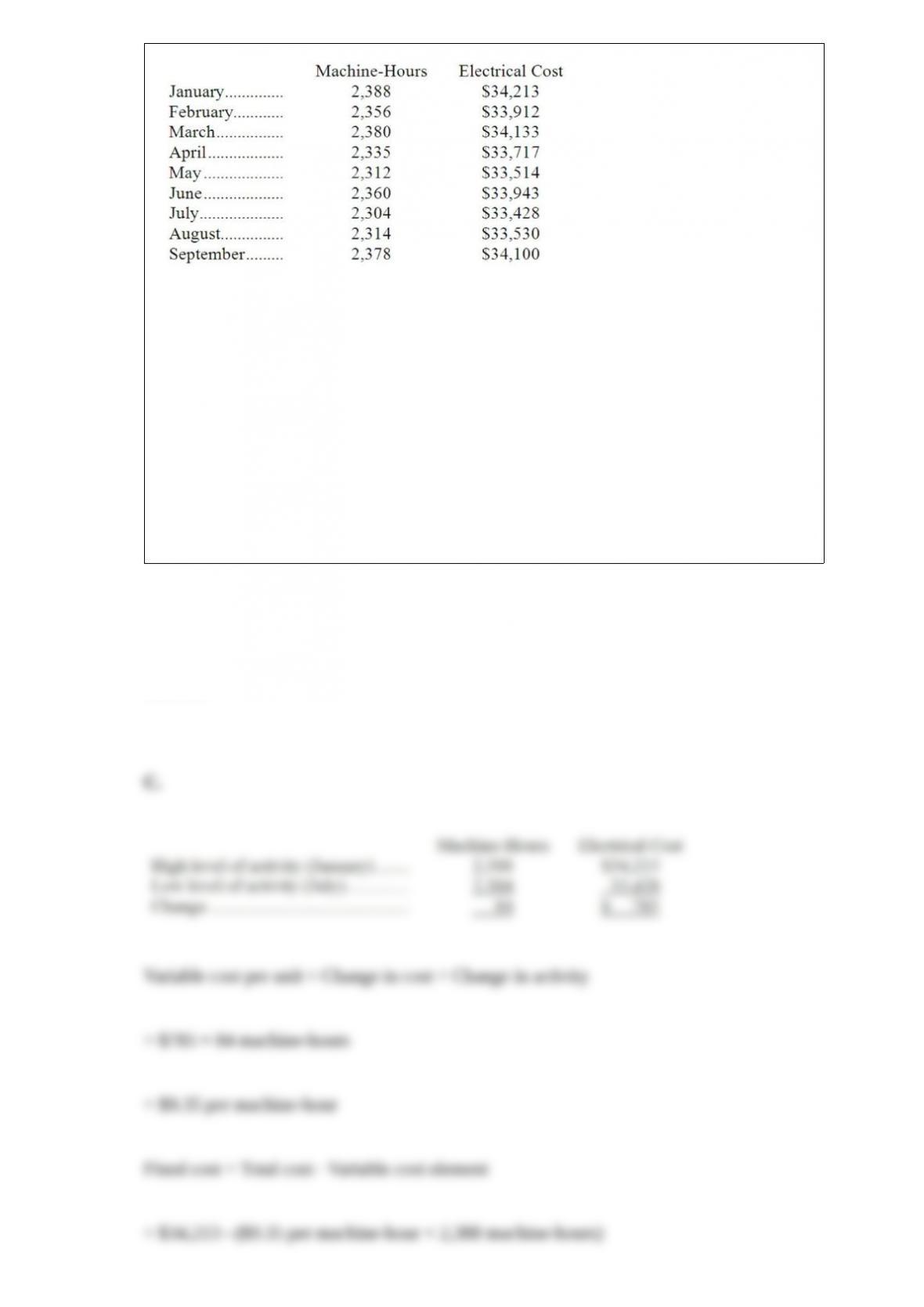
Management believes that electrical cost is a mixed cost that depends on
machine-hours. Using the high-low method to estimate the variable and fixed
components of this cost, these estimates would be closest to:
A. $14.41 per machine-hour; $33,832 per month
B. $0.11 per machine-hour; $33,957 per month
C. $9.35 per machine-hour; $11,885 per month
D. $11.30 per machine-hour; $7,229 per month
Answer:
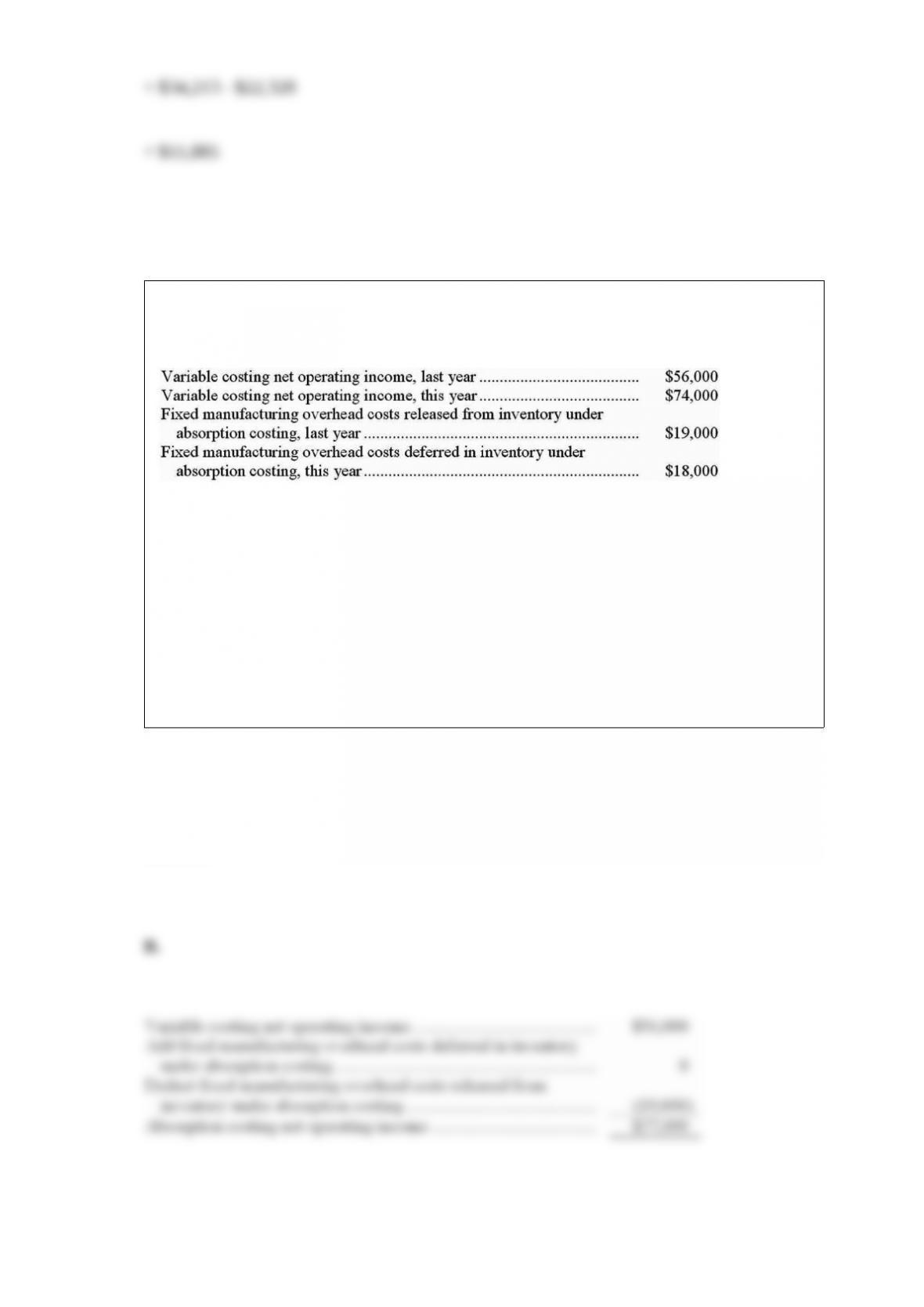
Enz Corporation manufactures a variety of products. The following data pertain to the
company’s operations over the last two years:
What was the absorption costing net operating income last year?
A. $56,000
B. $37,000
C. $57,000
D. $75,000
Answer:
Reference: 8-29
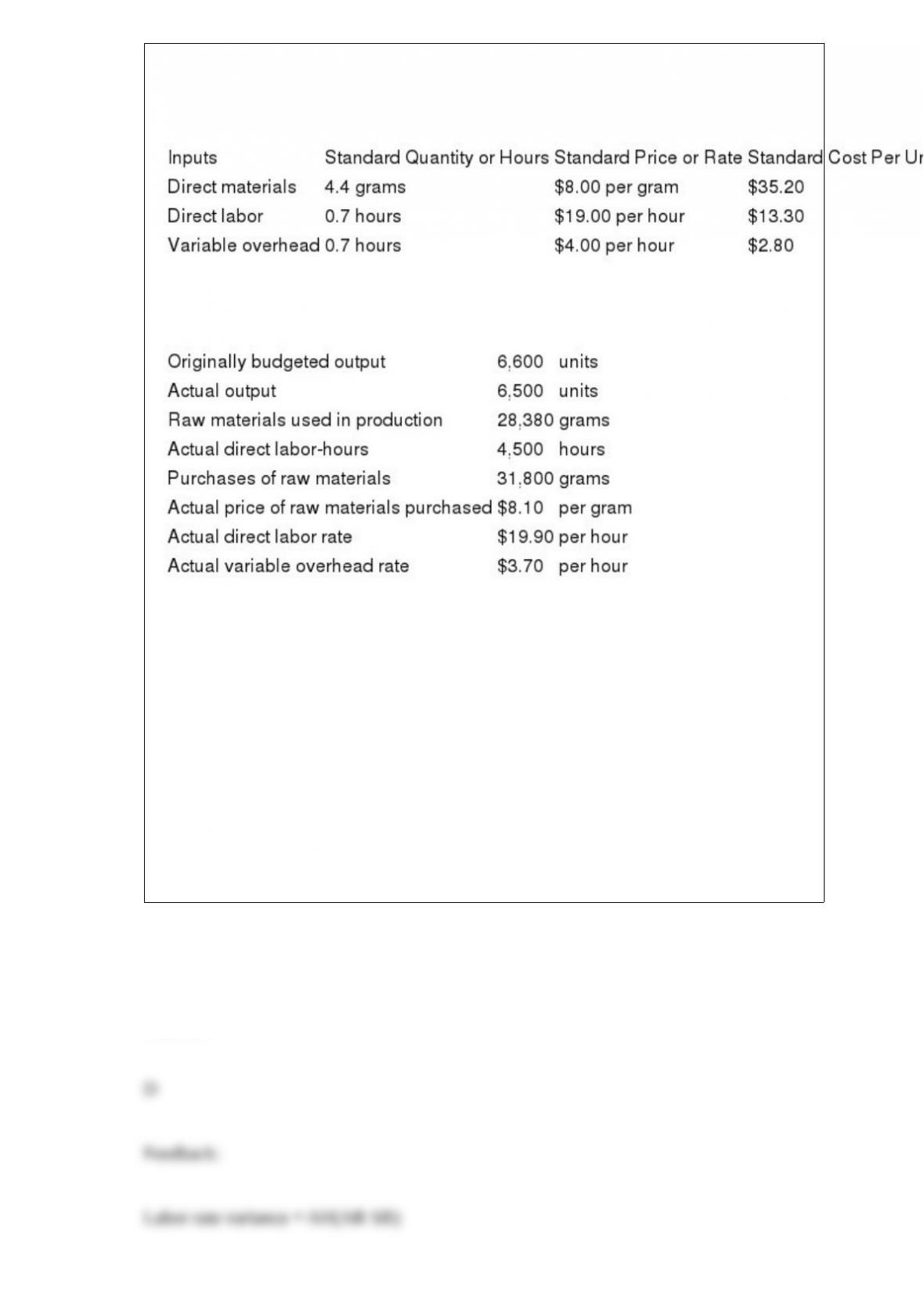
Hurren Corporation makes a product with the following standard costs:
The company reported the following results concerning this product in June.
The company applies variable overhead on the basis of direct labor-hours. The direct
materials purchases variance is computed when the materials are purchased.
The labor rate variance for June is:
A) $4,095 F
B) $4,050 F
C) $4,095 U
D) $4,050 U
Answer:
Reference: 8-43
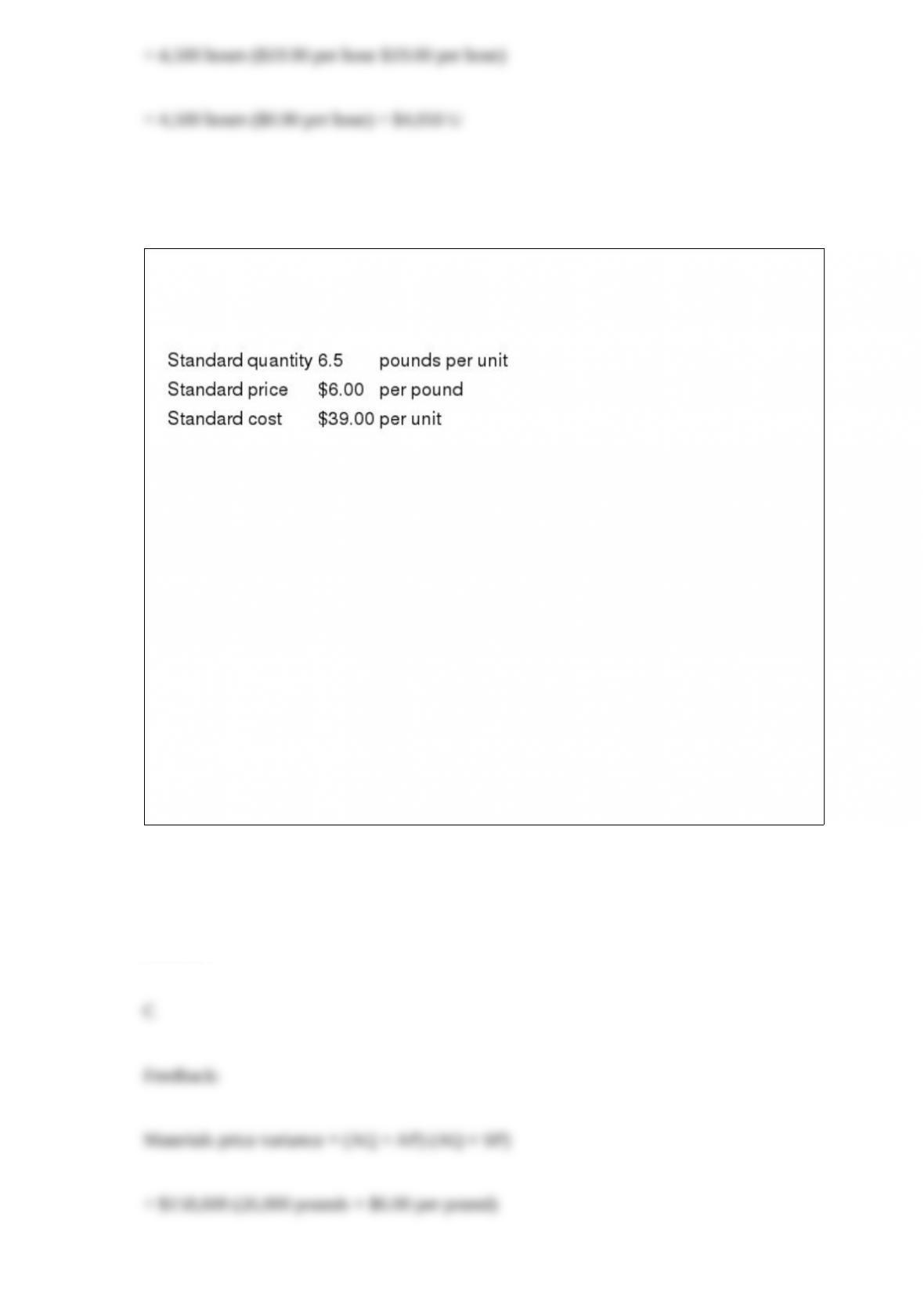
Cuda Corporation makes a product that uses a material with the following standards:
The company budgeted for production of 3,500 units in November, but actual
production was 3,300 units. The company used 23,050 pounds of direct material to
produce this output. The company purchased 26,000 pounds of the direct material at a
total cost of $158,600. The direct materials purchases variance is computed when the
materials are purchased.
The materials price variance for November is:
A) $2,145 U
B) $2,145 F
C) $2,600 U
D) $2,600 F
Answer:
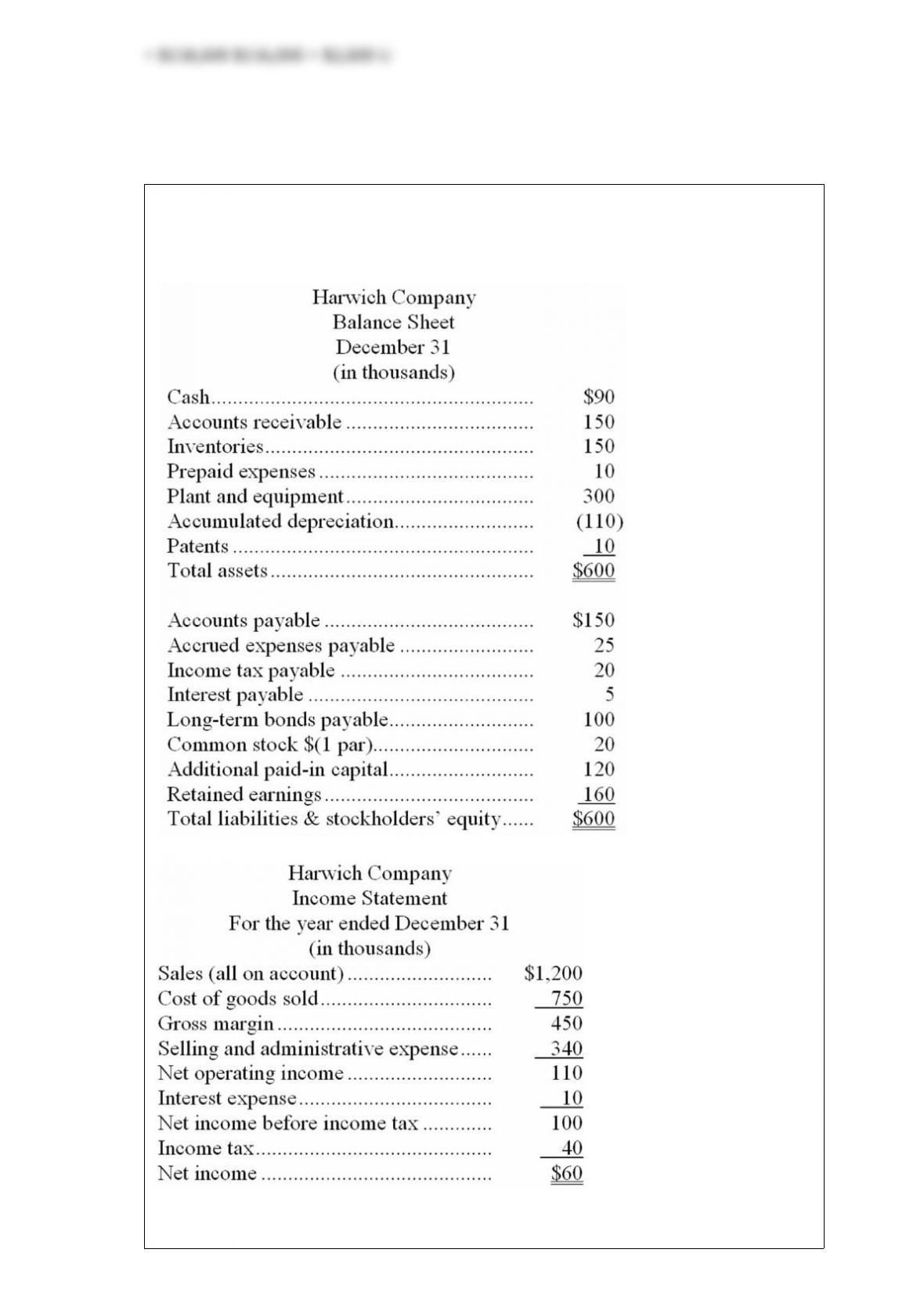
Financial statements for Harwich Company for the most recent year appear below:
The balances in the Cash, Accounts Receivable, Inventory, Bonds Payable, Common
Stock, and Additional Paid-In Capital accounts are unchanged from the beginning of the
year. A $0.75 per share dividend was declared and paid during the year. On December
31, Harwich Company’s common stock was trading at $24.00 per share.
Harwich Company’s debt-to-equity ratio at the end of the year was closest to:
A. 0.33
B. 0.50
C. 0.67
D. 1.00
Answer: