1) An investor has a long-term available-for-sale stock investment. The investor
receives a stock dividend on the stock investment. No journal entry is necessary for the
stock dividend.
2) The adjusted trial balance lists only the balance sheet accounts and their final
balances in a single place.
3) Callable bonds allow the issuer to pay off the bonds whenever the issuer chooses.
4) Common-size financial statements report only dollar amounts.
5) Maturities of long-term debt due within one year of the balance sheet date are
reported separately from long-term debt.
6) An audit report is addressed to the board of directors and stockholders of the audited
company.
7) Cash dividends received on stock investments with less than 20% ownership of the
investee should be credited to the Investment in Available-for-Sale Securities account.
8) Earnings per share shows how much income a company earned for each share of
stock.
9) The statement of cash flows measures operating performance.
10) The ratio of the dollar amount of each individual asset to the dollar amount of total
assets is an example of vertical analysis.
11) The present value of a single amount in the future can be determined using a present
value of $1 table.
12) Examples of a weak control environment are:
A) a CEO who overrides controls
B) a weak and ineffective Board of Directors
C) no company-wide code of ethics
D) all of the above
13) Which of the following depreciation methods best applies to those assets that
generate greater revenue earlier in their useful lives?
A) Straight-line method
B) Depletion method
C) Double-declining-balance method
D) Units-of-production method
14) Which is NOT a component of comparisons and compliance monitoring?
A) control environment
B) budgets
C) audits
D) all of the above
15) An airline has the following data about an airplane:
Annual lease cost $10,000,000
Lease term: 10 years
Useful life of airplane: 25 years
Fair market value of leased asset: $85 million
Present value of lease payments: $80 million
Bargain purchase option: None
Transfer to lessor at end of lease? Yes
Is this a capital or operating lease and why?
A) This is an operating lease. It fails all of the capital lease tests
B) This is a capital lease because the substance of the transaction is a capital lease
C) This is a capital lease because it meets at least one of the four tests
D) This is a capital lease because the leased asset costs over $1 million
16) The cash paid to purchase available-for-sale investments is reported on the
statement of cash flows as a(n):
A) increase in financing activities
B) decrease in financing activities
C) increase in investing activities
D) decrease in investing activities
17) Pillsbury Company declares and distributes a 30% common stock dividend when it
has 20,000 shares of $10 par common stock outstanding. The market price per share is
$50 at the date of declaration. What journal entry is prepared?
A) debit Retained Earnings $300,000, credit Common Stock $60,000 and credit Paid-in
Capital in Excess of ParCommon $240,000
B) debit Retained Earnings $300,000, credit Paid-in Capital in Excess of ParCommon
$300,000
C) debit Retained Earnings $300,000 and credit Common Stock $300,000
D) debit Retained Earnings $60,000 and credit Common Stock $60,000
18) On January 1, 2015, Bonds Payable have a balance of $700,000. On December 31,
2015, Bonds Payable have a balance of $800,000. During 2015, one bond of $10,000
was retired. No discounts or premiums were amortized in 2015. What amount of new
bonds were issued in 2015?
A) $0
B) $90,000
C) $100,000
D) $110,000
19) Which of the following is a TRUE statement regarding expenses?
A) Expenses represent future assets
B) The expense recognition principle is also called the matching principle
C) Expenses must be paid immediately
D) Expenses must always be less than revenues
20) Generally companies will prepare financial statements:
A) after every transaction
B) only when both the balance sheet and income statement are affected
C) at the end of the accounting period
D) at the close of every business day
21) An example of a company with cash flow problems is:
A) a company sold property, plant and equipment for $50 million and purchased
property, plant and equipment for $10 million
B) a company borrowed $1 million with long-term bonds payable and paid $1 million
on long-term notes payable
C) a company sold property, plant and equipment for $5 million and purchased
property, plant and equipment for $100 million
D) net cash provided by operating activities is $10 million and net income is $1 million
22) Double taxation means that the:
A) corporation’s income tax is allocated to the shareholders based on ownership
percentage
B) corporate earnings are subject to state and federal income tax
C) corporation pays taxes on its earnings and the shareholders pay taxes on the
dividends received from the corporation
D) shareholders’ dividends are taxed at the corporate tax rate
23) Jaronski Company uses the periodic inventory system. At the end of the accounting
period, journal entries are prepared to close out:
A) beginning inventory and ending inventory
B) purchases only
C) beginning inventory and purchases
D) beginning inventory, purchases and ending inventory
24) The equity method of accounting for a stock investment should generally be used
when the investor owns a level of stock ownership that:
A) gives the investor minor influence over the investee
B) usually indicates a plan to acquire a controlling interest in the investee company
C) requires the investor to prepare consolidated financial statements
D) gives the investor significant influence over the investee company
25) Badger Corporation issued 5,000 shares of its $5 par value common stock in
payment for attorney services billed at $40,000. Badger Corporation’s stock has been
actively trading at $8 per share. The journal entry for this transaction would include a:
A) debit to Legal Expense $25,000
B) debit to Legal Expense $40,000
C) credit to Common Stock $15,000
D) credit to Common Stock $40,000
26) Stockholders of a corporation directly elect the:
A) Board of directors
B) President of the corporation
C) Chief Financial Officer of the corporation
D) Chairperson of the Board
27) A financial statement that shows each line item as a percentage of one key item on
the statement is referred to as:
A) benchmarking
B) common-size statement
C) horizontal analysis
D) financial ratio analysis
28) Which of the following transactions will increase one asset and decrease another
asset?
A) The purchase of office supplies on account
B) The performance of services on account
C) The purchase of equipment for cash
D) The performance of services for cash
29) Bonds which are backed only by the good faith of the borrower are referred to as:
A) junk bonds
B) uncertified bonds
C) debenture bonds
D) callable bonds
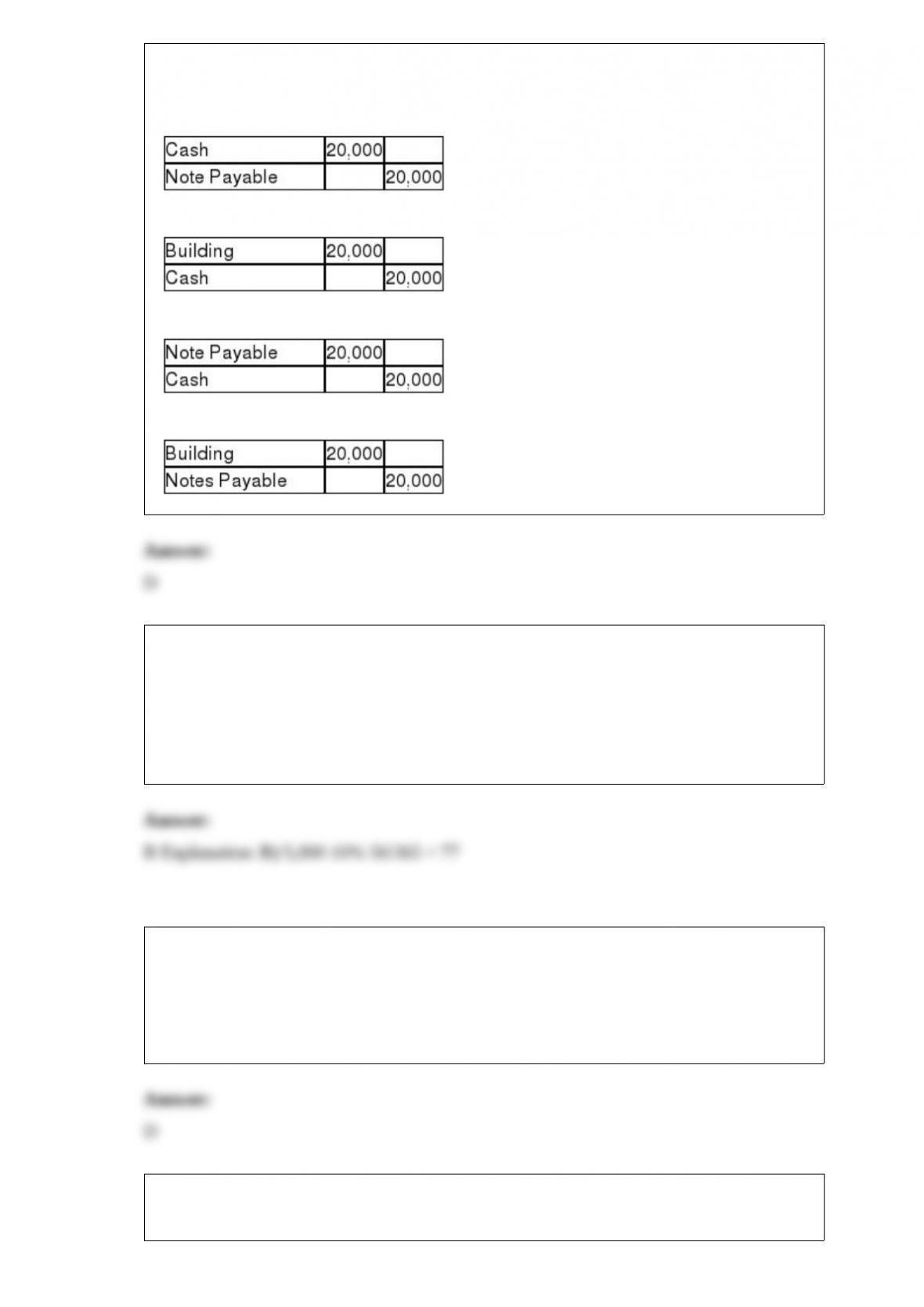
30) Jaye Company purchased a new building by signing a note for $20,000 The entry to
record the transaction is:
A)
B)
C)
D)
31) On December 31, 2015, the lender on a $5,000, 120-day, 10% note dated November
5, 2015, will recognize: (Use a 365 day year and round to the nearest dollar.)
A) interest receivable, $164
B) interest receivable, $77
C) interest payable, $164
D) interest payable, $77
32) Double-declining balance depreciation:
A) is an accelerated method of depreciation
B) ignores the residual value in computing depreciation, except during the last year
C) is based on the book value of the plant asset
D) is all of the above
33) A company who uses the allowance method, writes-off a receivable of $2,000. Prior
to the journal entry, the credit balance in the Allowance for Uncollectible Accounts was
$18,432 and Accounts Receivable were $2,000,000. After the entry to write-off the
receivable is made, the net realizable value of Accounts Receivable will be:
A) $1,979,568
B) $1,981,568
C) $1,998,000
D) $2,000,000
34) For accounting purposes, the method used to account for long-term investments in
common stock is determined by:
A) the size of the investor
B) the size of the investor when compared to the size of the investee
C) vote by the Board of Directors of the investor
D) the investor’s percentage ownership of the investee’s stock
35) When preparing the financial statements with a spreadsheet obtained from
transaction analysis:
A) assets, liabilities, and revenues are reported on the balance sheet
B) the balance sheet reports the beginning balance of retained earnings
C) assets, liabilities, and stockholders’ equity are reported on the balance sheet
D) assets, liabilities, and dividends are reported on the balance sheet
36) Which statement is FALSE?
A) The bookkeeper should not handle incoming checks from customers
B) Cashiers should not have access to the accounting records
C) The treasurer’s department should be in charge of handling customers’ incoming
checks, signing checks and approving payments
D) The accounting department should be in charge of record keeping and depositing
customers’ checks
37) Deposits that have been recorded on the books, but have not yet been recorded by
the bank are:
A) nonsufficient funds deposits
B) outstanding deposits
C) deposits in transit
D) electronic funds deposits
38) Under the indirect method of preparing the statement of cash flows, a gain on the
sale of equipment is:
A) subtracted from net income in the operating activities section
B) added to net income in the operating activities section
C) subtracted from the book value of the equipment in the financing activities section
D) ignored since this transaction does not affect cash