
A product may be processed beyond the split-off point if management believes that
A. its marketability will be enhanced.
B. the incremental cost of further processing will be less than the incremental revenue
of further processing.
C. the joint cost assigned to it is not already greater than its prospective selling price.
D. both a and b.
A company annually consumes 10,000 units of Part C. The carrying cost of this part is
$2 per year and the ordering costs are $100. The company uses an order quantity of 500
units. By how much could the company reduce its total costs if it purchased the
economic order quantity instead of 500 units?
A. $500
B. $2,000
C. $2,500
D. $0
Grant Corporation
The following information is available for Grant Corporation for the current month:
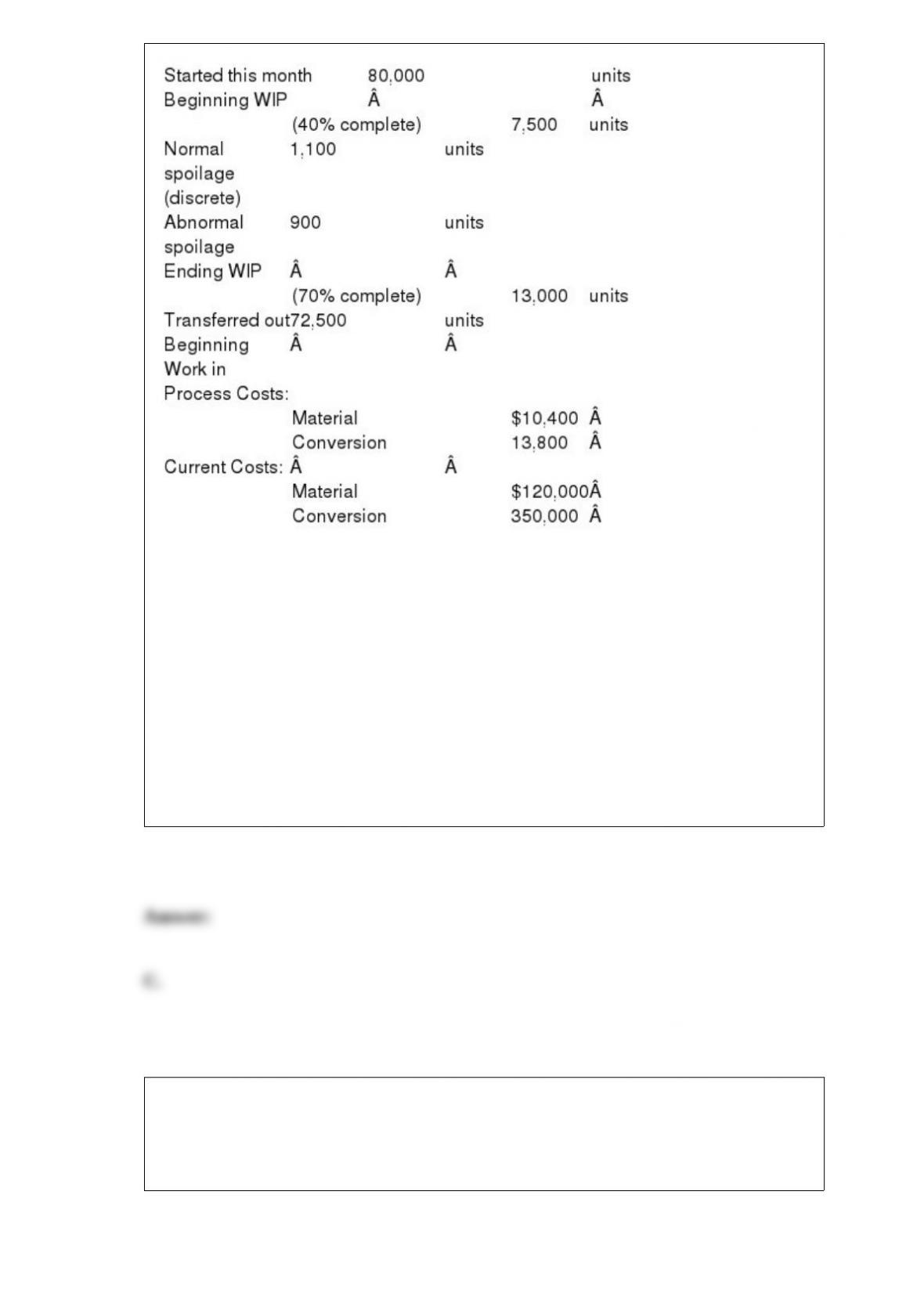
All materials are added at the start of production and the inspection point is at the end
of the process.
Refer to Grant Corporation. What is cost per equivalent unit for material using FIFO?
A. $1.63
B. $1.37
C. $1.50
D. $1.56
Franklin Company
Franklin Company uses a job-order costing system. Assume that Job #309 is the only
one in process. The following information is available:
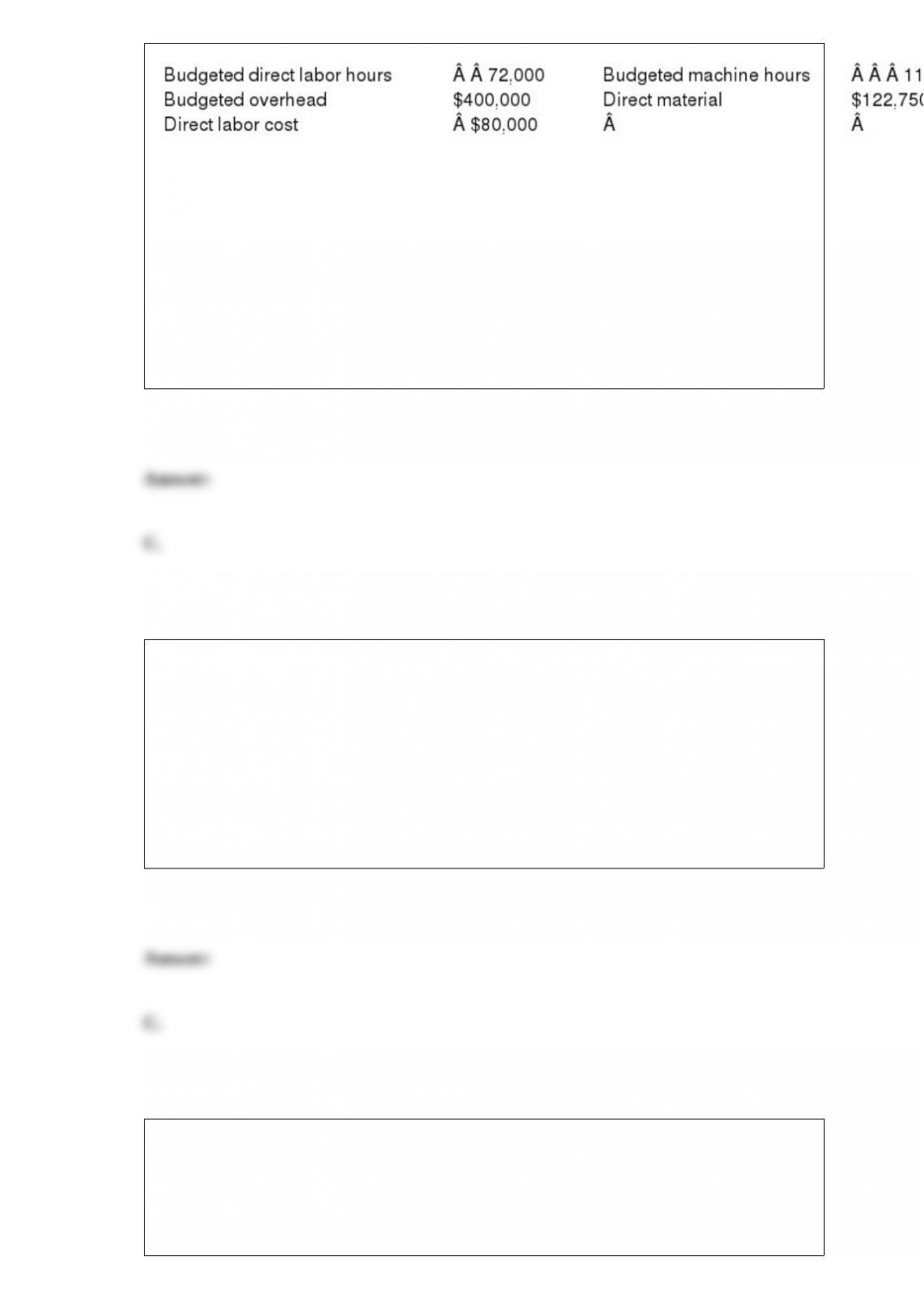
Refer to Franklin Company. What is the total cost of Job #309 assuming that overhead
is applied at the rate of 130% of direct labor cost (rounded to the nearest whole dollar)?
A. $194,800
B. $274,100
C. $306,750
D. $340,075
A major benefit of cost-based transfers is that
A. it is easy to agree on a definition of cost.
B. costs can be measured accurately.
C. opportunity costs can be included.
D. they provide incentives to control costs.
Spoiled units are
A. units that cannot be economically reworked to bring them up to standard.
B. units that can be economically reworked to bring them up to standard.

C. the same as defective units.
D. considered abnormal losses.
ERP systems should help a company
A. improve quality.
B. improve service.
C. reduce overhead.
D. all of the above.
If activity-based costing is implemented in an organization without any other changes
being implemented, total overhead manufacturing costs will
A. be reduced because of the elimination of non-value-added activities.
B. be reduced because organizational costs will not be assigned to products or services.
C. be increased because of the need for additional people to gather information on cost
drivers and cost pools.
D. remain constant and simply be spread over products using different cost drivers.
Weaknesses of the high-low method include all of the following except
A. only two observations are used to develop the cost function.
B. the high and low activity levels may not be representative.
C. the method does not detect if the cost behavior is nonlinear.
D. the mathematical calculations are relatively complex.
Commodore Company
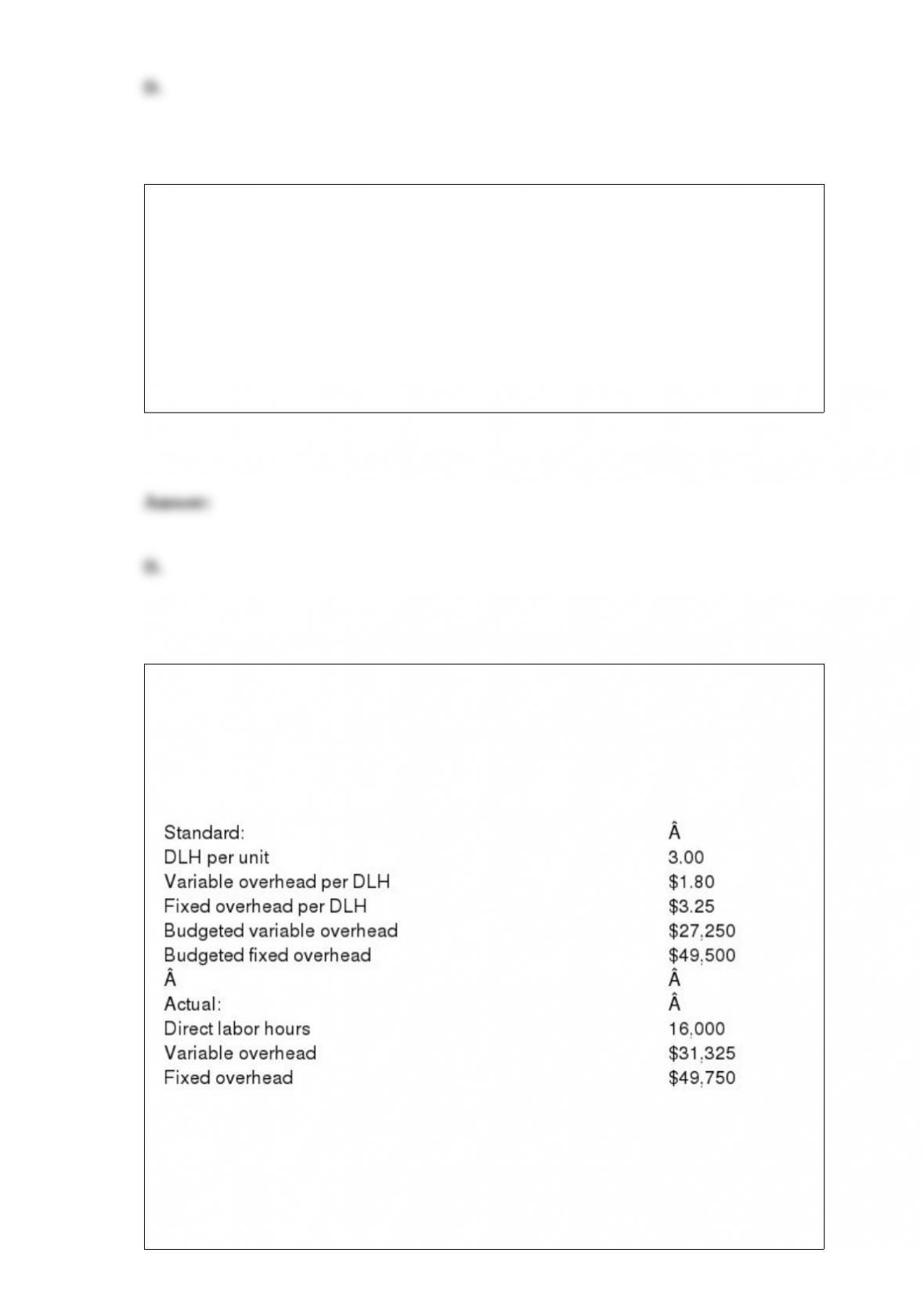
Commodore Company uses a standard cost system for its production process and
applies overhead based on direct labor hours. The following information is available for
September when Commodore produced 5,000 units:
Refer to Commodore Company. Using the one-variance approach, what is the total
overhead variance?
A. $ 275 U
B. $ 1,000 U

C. $ 4,325 U
D. $ 5,325 U
If investment A has a payback period of three years and investment B has a payback
period of four years, then
A. A is more profitable than B.
B. A is less profitable than B.
C. A and B are equally profitable.
D. the relative profitability of A and B cannot be determined from the information
given.