
Confirmation is most likely to be a relevant form of evidence with regard to assertions
about accounts receivable when the auditor has concerns about the accounts receivable’s
A) valuation.
B) classification.
C) existence.
D) completeness.
For listed clients, the audit committee should approve both the appointment of the
auditor and
A) all services that the PA firm provides to the client.
B) an engagement that might affect the appearance of independence, such as design of
control systems.
C) any services that are provided for senior management.
D) the material that is included in the management letter by the PA firm.
If the auditor is appointed after the year end of the client, the auditor
A) should qualify the audit opinion for the inventory balance and cost of sales.

B) could attend a current perpetual inventory count and roll backward with the records.
C) should do an inventory count as soon as he is appointed.
D) will inquire with management of the company about the inventory count performed
at year end.
A client representation letter is a written statement from a non-independent source and
therefore
A) cannot be regarded as reliable evidence on its own.
B) can be regarded as reliable evidence only if the auditor finds strong internal controls.
C) can be regarded as reliable evidence if the high-level corporate officials who sign it
are trustworthy.
D) needs to be confirmed by an outside, independent source such as a financial
institution, or law firm.
Simon owns a clothing store, Simonello. Simonello recently purchased a material
amount fabrics from Simonique Inc., a textile company also owned by Simon. With
regards to this transaction, the auditors should
A) request a confirmation from Simonique that the transaction took place.
B) inspect the textile received in the warehouse to ensure that the amount sent equals

the amount ordered.
C) qualify the audit report as this puts into question management’s integrity.
D) verify that the business relationship is disclosed in the financial statements.
As part of the review for subsequent events, the auditor will review financial statements
prepared after the balance sheet date. The purpose of this review is to examine changes
after year end and to look for
A) errors in capital versus maintenance charge allocations that occurred after the year
end.
B) subsequent payments to accounts payable and long term debt.
C) subsequent receipts in accounts receivable, especially for the larger customers.
D) changes in the business relative to results for the same period in the year under audit.
A risk of material misstatement in accounts receivable associated with the accuracy
balance-related audit objective is that ‘sales recorded at the incorrect price result in
revenue and accounts receivable that are over or under stated.” Which of the following
tests of detail of balances would respond to this risk?
A) select a sample of master file change forms and verify that all sales prices changes
were appropriately authorized

B) use audit software to match sales invoice price details to authorized prices in the
sales price master files
C) inquire of management with respect to the procedures used to update sales price
master file
D) match shipping details for a sample of invoices to the invoice details, on an item by
item basis
Fabio recently sold his restaurant for $650,000, the value of the net assets as reported
on the balance sheet. After the sale, Fabio realized that he could’ve sold the restaurant
for as much as $950,000 as the fair value of the assets was $300,000 higher than what
was reported on the balance sheet. Fabio is suing the auditors for his loss. The auditor’s
best defence is
A) absence of a misstatement.
B) lack of duty.
C) no damages.
D) absence of causal connection.
The information systems audit specialist on your audit team has indicated that the
general controls over program changes are inadequate for all application cycles. What
impact does this have upon your audit of sales invoice processing?

A) The auditor could potentially rely upon only manual controls.
B) Only interdependent controls should be considered for control testing.
C) It is likely that calculations, such as extensions, are performed consistently and
accurately throughout the year.
D) Unauthorized access to information recorded in the master files is likely.
Management’s objectives with respect to internal control include
A) having reasonable assurance that the financial statements are in accordance with
IFRS or ASPE.
B) ensuring that all policies and procedures are clearly documented to reduce employee
training costs.
C) preventing fraud and illegal activities at all costs.
D) providing reasonable assurance that the goals and objectives important to the entity
have been met.
Gabori Company would like to pay less income tax this year. It decided that it could do
this by understating its inventory values, increasing costs of goods sold. This was done
by deliberately pricing the inventory at incorrect amounts, so that it would be shown at
a lower value than it was really worth (for example, items worth five dollars each were
shown at fifty cents each). Which management assertion has been violated?

A) valuation
B) accuracy
C) statement presentation
D) completeness
In auditing the imprest payroll account, which of the following procedures will take the
least amount of auditor time?
A) tests of controls
B) risk analysis and obtaining an understanding of controls
C) analytical procedures
D) tests of details of balances
An investor suing an auditor for not discovering that the financial statements of a
company are materially misstated is an example of
A) criminal liability.
B) fiduciary duty.

C) third party liability.
D) liability to client under common law.
Proper accounting requires that an account receivable must be written off by the client
when
A) the client company concludes that an amount is no longer collectible.
B) the customer files for bankruptcy.
C) a collection agency cannot inspire the customer to pay the debt.
D) the account is at least six months old.
When the auditor examines the client’s documents and records to support recorded
transactions or amounts, it is commonly referred to as
A) inquiry.
B) confirmation.
C) vouching.
D) physical examination.

When the CICA Handbook is silent on an auditing issue, which of the following is the
best of other authoritative sources that the auditor could use?
A) audit technique studies
B) audit firm practice manuals
C) past practice at the client
D) reference to audit standards partner
The internal audit group typically reports directly to the
A) board of directors.
B) management of the company.
C) external auditor
D) audit committee.

A useful starting point for becoming familiar with the client’s inventory is for the
auditor to
A) obtain and review industry ratios.
B) review accounting theory covering special problems, such as gas and oil accounting,
or lease-purchase agreements.
C) read client’s Accounting Manual.
D) tour the client’s facility.
A common test of details of balances procedure for notes payable is “examine duplicate
copies of notes to determine whether notes were dated on or before the balance sheet
date.” Which audit assertion is this test of detail associated with?
A) allocation (accuracy)
B) allocation (cut-off)
C) existence
D) completeness
The information systems audit specialist on your audit team has indicated that the
general controls over program changes are excellent for all application cycles. What
impact does this have upon your audit of sales invoice processing?

A) Generalized audit software should be used to select a sample of sales transactions
for control testing.
B) Tests of controls should be omitted; only substantive tests may be conducted.
C) There could be problems with the accuracy of calculations for sales taxes and goods
and excise taxes.
D) The auditor can place reliance upon the programs performing sales calculations.
To do an audit, it is necessary to have information in a verifiable form and some criteria
by which the auditor can evaluate the information.
Required:
A) What information and criteria would a public accounting firm use when auditing a
company’s financial statements?
B) What information and criteria would a Canada Revenue Agency auditor use when
auditing that same company’s tax return?
C) What information and criteria would an internal auditor use when performing an
operational audit to evaluate whether the company’s computerized payroll processing
system is operating efficiently and effectively?

It is important for the auditor to obtain a good understanding of the industry of the
client to develop a client risk profile. If the auditor is looking at a client in the fashion
clothing industry, a risk specific to the industry would be
A) the high risk of poor governance and management oversight.
B) the high risk of defective products.
C) the high risk of obsolescence of their inventory.
D) the volatility in the stock market with regards to common stock.
The Rules of Professional Conduct require a successor auditor to communicate with the
previous auditor. The primary concern in this communication is
A) to acquire information which will help the successor auditor determine whether the
client management has integrity.
B) to learn about the client by examining the predecessor’s working papers.
C) to enable the successor to perform a more efficient audit.
D) to save the successor auditor time and money in gathering data.

The appropriate test of controls for separation of duties is
A) documentation.
B) confirmation.
C) examination.
D) observation.
A) Discuss three important differences between the human resources and payroll cycle
and other cycles in a typical audit.
B) Describe each of the six business functions in a typical human resources and payroll
cycle.
C) Describe each of the primary documents and records used in the timekeeping and
payroll preparationfunction in the payroll and personnel cycle.
D) Discuss each of the primary documents and records used in the (1) payment of
payroll function, and (2) preparation of employee withholdings and benefits remittance
forms function in the payroll and personnel cycle.
The test of details of balance procedure which requires the auditor to account for
unused inventory tag numbers to make sure none have been omitted is an attempt to
satisfy the objective of

A) allocation.
B) existence.
C) completeness.
D) accuracy.
The provincial institutes’ Rules of Professional Conduct state, in part, that a public
accountant should maintain integrity and due care. Integrity in the Rules refers to a
public accountant’s
A) ability to maintain an impartial attitude on all matters that come under the public
accountant’s review.
B) ability to distinguish independently between accounting practices that are acceptable
and those that are not.
C) ability to be unyielding in all matters dealing with auditing procedures.
D) reputation for honesty and fair dealing.
Serena is the assistant controller of Opus Inc. As a result of a recent expansion the
controller has been very busy and delegated the signing authority of the cheques to
Serena. Further, due to the cash accountant leaving on maternity leave, Serena was
asked to perform the bank reconciliation until they found someone to replace the cash
accountant.
Serena is a qualified accountant and has been able to handle all of these additional
tasks. However, she asked her boss for a raise to compensate her for the additional
responsibilities that she currently has. Her boss indicated that this was only temporary
and the company could not afford a raise for now.
Serena created a vendor in the system with her home address. She has been paying this
vendor $2,000 for the past 3 months as a means of compensating herself. This theft has
yet to be discovered by Opus.
Required:
A) What internal controls are missing to enable the theft to occur?
B) What audit procedures might detect the theft?

Management assertions are
A) stated in the footnotes to the financial statements.
B) implied or expressed representations about the accounts in the financial statements.
C) explicitly expressed representations about the financial statements.
D) provided to the auditor in the engagement letter, but are not disclosed on the
financial statements.
Which of the following scenarios regarding a lawsuit filed against a client by a third
party would qualify as a “contingent liability”? A lawsuit has been filed
A) but not yet resolved.
B) and concluded with the client winning.
C) and concluded with a third party winning an award of $100,000, but the client hasn’t
paid yet.
D) and concluded with a third party winning an award of $100,000, which the client
paid after the balance sheet date but before the statements are issued.

When reading the corporate minutes, the auditor obtained information regarding the
loans that were authorized for borrowing. What audit step would the auditor likely
conduct with this information?
A) trace the authorized amounts to the bank statements
B) verify that notes payable have been recorded
C) calculate interest payable as of the end of the year
D) contact a credit rating agency to determine the rating of the lender
Each of the following situations involves a possible violation of the provincial
institutes’ Rules of Professional Conduct. For each situation, (1) decide whether or not
the Rules have been violated, and (2) briefly explain how the situation violates (or does
not violate) the Rules.
A) Johnny Line has a successful dentistry practice in Calgary. Johnny has
recommended one of his patients to Leslie King, public accountant. To show gratitude
for the referral, Leslie has agreed to pay Johnny 5% of the fee for audit services
rendered by Leslie to Johnny’s patient. Leslie discloses the payment agreement to her
new client.
Violation? Yes No
Explanation:
B) The accounting firm of Bayer & Peng, public accountants, is negotiating a fee with a
new audit client. They agree the client will pay $75,000 if Bayer & Peng issues a clean,
unqualified opinion, $50,000 if a qualified opinion is issued, $40,000 if an adverse
opinion is issued, and $10,000 if a denial of opinion is issued.
Violation? Yes No
Explanation:
C) Don Smith, public accountant, takes part in the audit of Shaw Corporation. Don is
not a partner or a manager in the public accounting firm, and does not own any stock in
Shaw Corporation. Don’s five year-old daughter, Betty Lou, received one share of Shaw
Corporation’s common stock for her fifth birthday. The stock was a gift from Betty
Lou’s grandmother. Betty Lou treasures that share of stock and is absolutely unwilling
to part with it.
Violation? Yes No
Explanation:
D) On August 5, 2012, Page Dane, public accountant, issued the audit report on Borhut
Corporation’s June 30, 2012 financial statements. On August 30, 2012, Borhut paid
Page’s audit fee with stock rather than cash. Page sold the stock on September 15, 2012,
two months prior to the beginning of the planning phase for the audit of the June 30,
2013, financial statements.
Violation? Yes No
Explanation:
When comparing the reliability of external versus internal documents, the external
documents are generally considered
A) more reliable.
B) less reliable.
C) equally reliable.
D) unreliable.
During your lunch, your audit team went to a local mall, in the food court, since they
needed to be quick today. You dropped off a photofinishing film at a film developer,
saying that you would pick it up after work that day. After telling you that she preferred
using her digital camera to using regular film, your supervisor said,
“Next week, you are going to be working at a client that just happens to be a group of
photography stores. Tell me, what controls do you think should be programmed into the
cash register to help ensure that sales transactions are accurate and complete?”
Required:
Answer your supervisor’s question.
Discuss the audit tests the auditor would use to audit capital assets acquired in prior
years.
Discuss the ways the accounting profession and society encourage public accountants to
conduct themselves in a professional manner; i.e., the factors that influence the ethical
conduct of audit practitioners.
Discuss the purposes of tests of controls and tests of details of balances. Give an
example of each.
Outline the three performance standards of CICA Handbook section 5025, “Standards
for Assurance Engagements.”
Besides the search for contingent liabilities and the review for subsequent events, the
auditor has four important final evidence accumulation responsibilities, all of which are
required by current professional auditing standards. Discuss each of these four
responsibilities.
List four specific matters that should be included in a client representation letter.
Identify the reporting standards for compilation engagements.
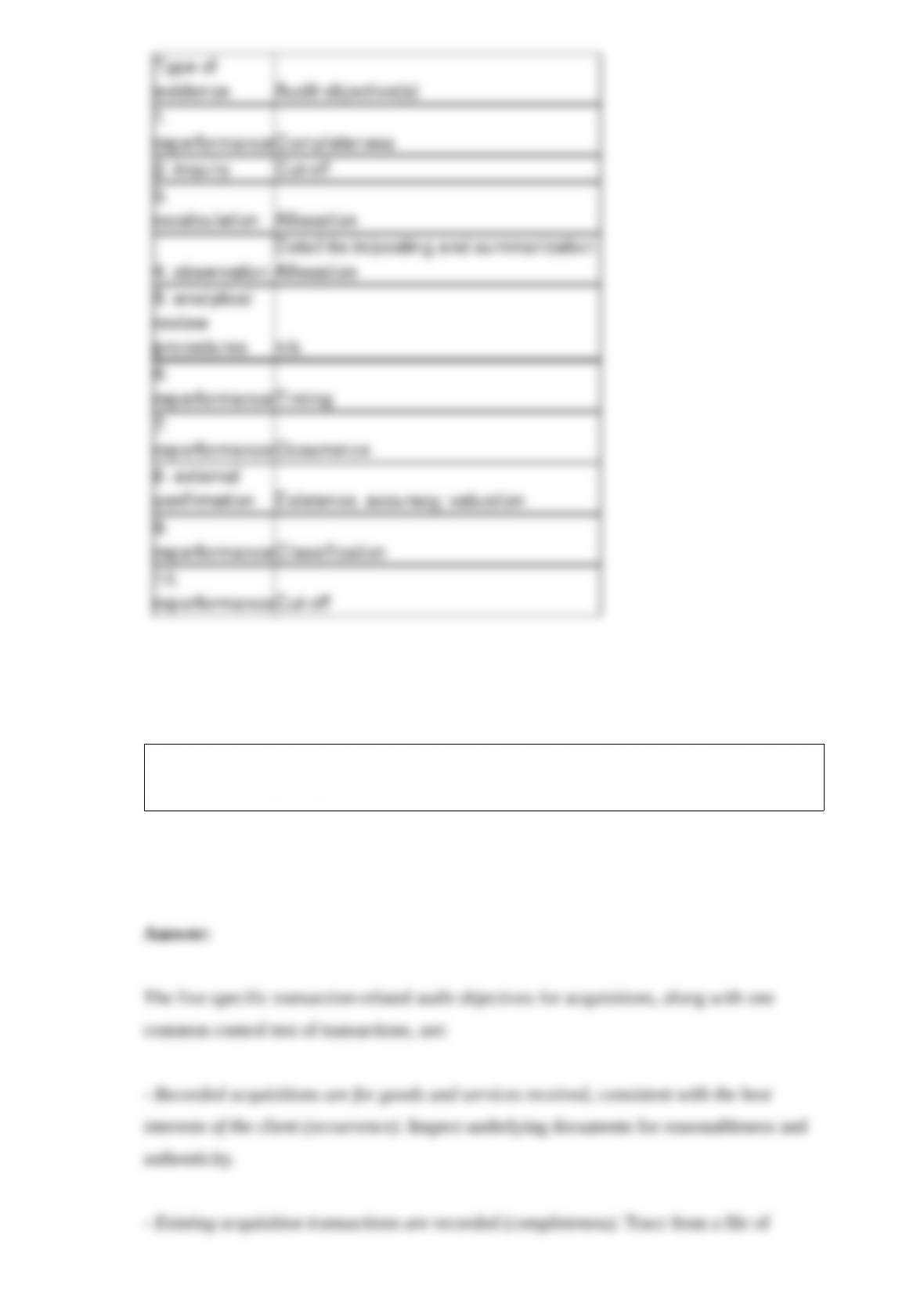
The following are audit procedures in the sales and collection cycle.
1. Inspect a sample of shipping documents to determine if each has a sales invoice
number included on it.
2. Discuss with the sales manager whether any sales allowances have been granted after
the balance sheet date that may apply to the current period.
3. Add the columns on the aged trial balance and compare the total with the general
ledger.
4. Observe whether the controller makes an independent comparison of the total in the
general ledger with the trial balance of accounts receivable.

5. For the month of May, count the approximate number of shipping documents filed in
the shipping department, and compare the total with the number of sales invoices in the
sales journal.
6. Compare the date on a sample of shipping documents throughout the year with
related duplicate sales invoices and the accounts receivable master file.
7. Examine a sample of customer orders and see if each has a credit authorization.
8. Send letters directly to former customers whose accounts have been written off as
uncollectible to determine if any have actually been paid.
9. Examine the master file of accounts receivable to see if each has an indication of “C”
for a regular customer, “N” for interest-bearing receivables, and “R” for related parties.
10. Compare the date on a sample of shipping documents a few days before and after
the balance sheet date with related sales journal transactions.
Required:
For each procedure, identify the type of evidence being used. For each procedure,
identify either the transaction-related audit objective(s) being met or the balance-related
audit objective(s) being met.
State each of the five specific transaction-related audit objectives for acquisitions and,
for each objective, describe one common test of transactions.
A financial statement review emphasizes four broad areas, one of which is to “Perform
analytical procedures.” State the other three areas emphasized.
Your firm has been the auditor of Chappello Design and Construction Limited for
several years. During the current year, a consultant on staff at your firm assisted
Chappello in the selection and implementation of a new computer system. The audit
staff were not involved in this process.
The new system was an enterprise wide system that was to be implemented without
modification using the direct cut-over approach (the old system was discontinued and
the new one continued the next day). Unfortunately, staff had extreme difficulty using
the system, and discontinued it after two months. During that time, Chappello was
unable to document and bill its work for progress billings, and borrowed heavily to
continue to pay its employees while work continued. The company reverted to its old
system and claims that it has lost several hundreds of thousands of dollars in revenues
as it was unable to issue quotes and bids on new contracts.
Chappello has sued your firm for negligence with respect to the implementation of the
computer system.
Required:
Which defences should the firm use? Support your answer with reasons.
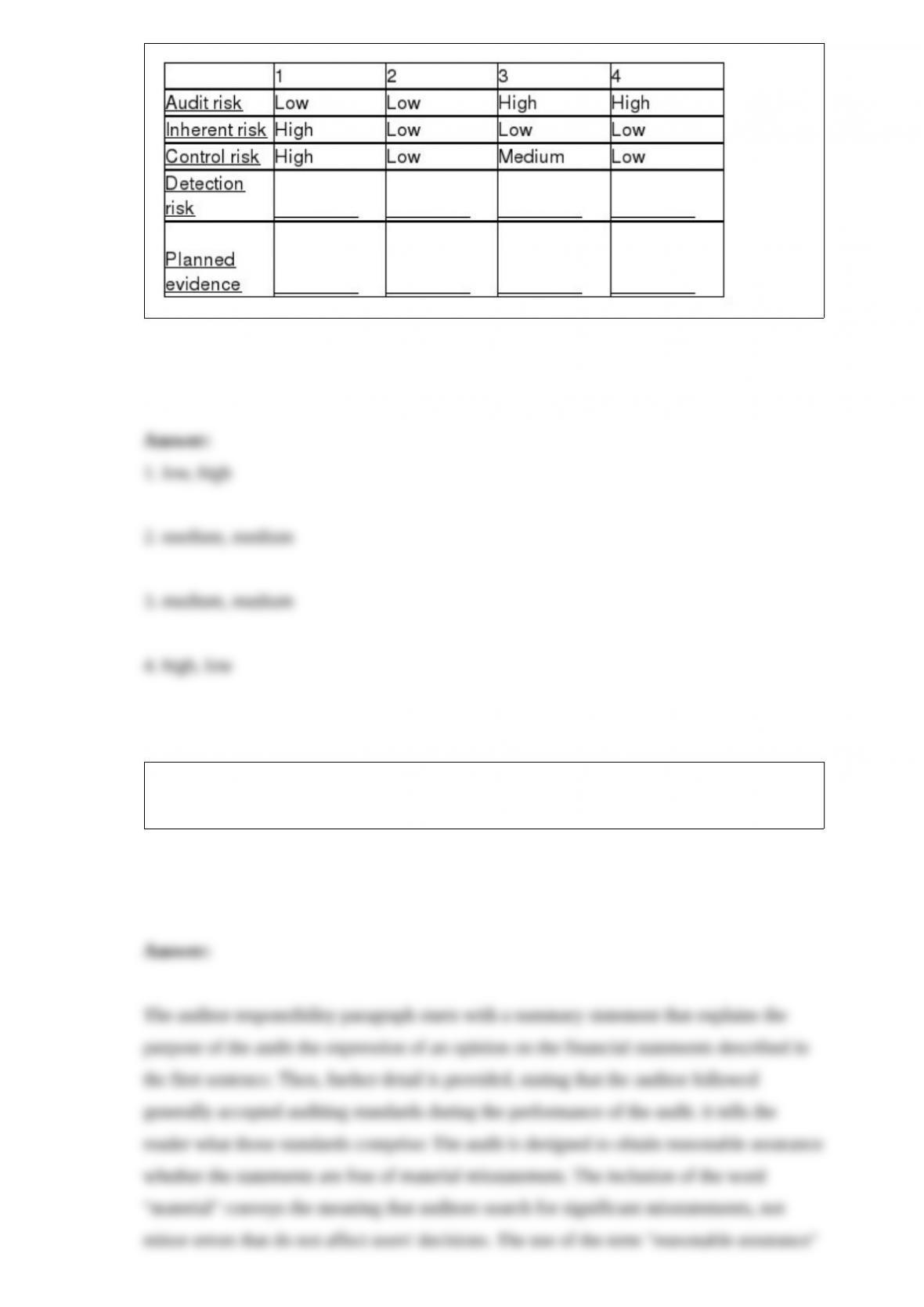
In practice, auditors rarely assign numerical probabilities to inherent risk, control risk,
or audit risk. It is more common to assess these risks as high, medium, or low. For each
of the four situations below, fill in the blanks for detection risk and the amount of
evidence you would plan to gather (“planned evidence”) using the terms high, medium,
or low.
SITUATION
Analyze the “Auditor Responsibility Section” of the standard Independent Auditor’s
Report, ie. explain the intended purpose of the sentences in this section.
Describe the audit procedures typically used to test for out-of-period liabilities (also
referred to as the search for unrecorded accounts payable).
There are six factors that affect the reliability of audit evidence. One factor is the
independence of the provider; i.e., evidence obtained from a source outside the client
company is more reliable than that obtained within. Identify and discuss the remaining
five factors that affect the appropriateness of evidence.
State the specific balance-related audit objectives applicable to notes payable and
interest and, for each objective, identify one common test of details of balances.
The audit of the inventory and distribution cycle consists of five parts. State the five
parts and, for each part, identify the cycle in which that part is tested by the auditor.
Discuss the differences and similarities between the roles of accountants and auditors.
What additional expertise must an auditor possess beyond that of an accountant?