On September 1, a company purchased a vehicle for $23,000 with a residual value of
$3,000. The estimated useful life is 5 years and the company uses the straight-line
method. What is the depreciation expense for the year ended December 31?
A) $1,333
B) $1,000
C) $4,000
D) $1,533
Alphabet Company, which uses the periodic inventory method, purchases different
letters for resale. Alphabet had no beginning inventory. It purchased A thru G in January
at $4 per letter. In February, it purchased H thru L at $6 per letter. It purchased M thru R
in March at $7 per letter. It sold A, D, E, H, J and N in October. There were no
additional purchases or sales during the remainder of the year.
Use the information above to answer the following question. If Alphabet Company uses
the LIFO method, what is the cost of its ending inventory?
A) $24
B) $42
C) $58
D) $76
Which of the following statements about capitalizing costs is correct?
A) Capitalizing costs refers to the process of converting assets to expenses.
B) All costs incurred to acquire an asset may be capitalized.
C) Capitalizing a cost means to record it as an asset.
D) Capitalizing costs results in an immediate decrease in net income.
On March 1, Preston Corporation loans $3,000 to an employee and receives a 5%,
three-month note. Interest will be paid when the note matures on May 31. Assuming
that interest on the note has not previously been accrued, what entry will Preston make
on April 30?
A) Debit Interest Revenue and credit Interest Receivable $25
B) Debit Interest Receivable and credit Interest Revenue $25
C) Debit Interest Receivable and credit Interest Revenue $50
D) Debit Cash and credit Interest Revenue for $50
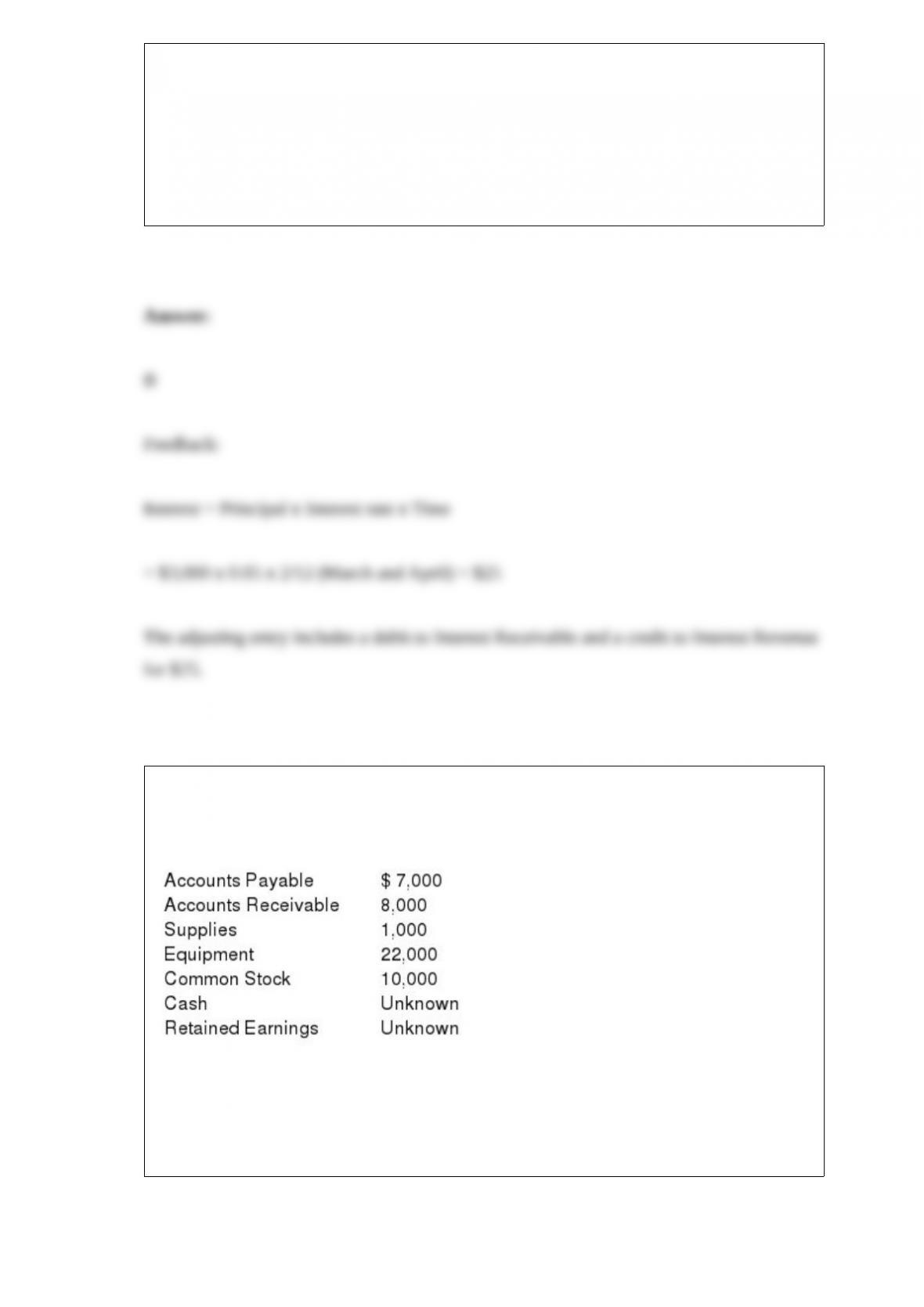
The company’s total assets are $36,000. The following is a listing of the company ‘s
accounts and account balances as of December 31, Year 3. This company doesn’t have
any other accounts.
Required:
Part a. Determine the balance of the Cash account.
Part b. Determine the balance of the Retained Earnings account.
A company incurred $2,000 for utilities for the last month of Year 2. The company paid
the bill during the first month of Year 2. Which of the following statements is correct?
A) The related $2,000 should be reported on the income statement for Year 1 as Utilities
Expense.
B) Since it has not been paid, this utility bill would not be reported in the financial
statements for Year 1.
C) The related $2,000 should be included in Accounts Receivable on the balance sheet
at the Year 1.
D) The related $2,000 should be included in Utilities Expense on the balance sheet at
the end Year 1.
A company has current assets of $450,000 and a current ratio is 2.5. Assume that the
company prepays rent for 9 months in the amount of $20,000. The current ratio after
this transaction is closest to:
A) 2.39
B) 2.61
C) 2.5
D) 2.81
Ordinary repairs and maintenance:
A) are part of the asset cost of equipment and facilities.
B) are recorded as expenses.
C) are always recorded as liabilities.
D) improve the asset beyond the current accounting period.
Which of the following would be included in cash flows from financing activities?
A) Cash proceeds from sales
B) Cash received from a sale of land
C) Cash dividends paid
D) Cash used to purchases of equipment
BetterBuy purchases computers from companies like Hewlett Packard and IBM and
sells them to consumers. BetterBuy is a:
A) merchandising company at the retail level.
B) service company.
C) merchandising company at the wholesale level.
D) manufacturer.
A debit balance in Retained Earnings is:
A) an indication of a contra-equity account.
B) called an Accumulated Deficit.
C) called a net loss.
D) impossible.
On December 31, 2015, Infinity Inc. records an adjusting entry to accrue interest on a
note. On January 31, 2016, Infinity receives a check for $4,680, which represents two
months of accumulated interest on the note. Upon receipt of this interest payment,
Infinity should debit:
A) Interest Receivable for $2,340, debit Cash $2,340, and credit Interest Revenue for
$4,680.
B) Cash for $4,680, credit Interest Receivable for $2,340, and credit Interest Revenue
for $2,340.
C) Cash for $4,680 and credit Interest Receivable for $4,680.
D) Cash for $4,680 and credit Interest Revenue for $4,680.
Recording an adjusting journal entry to recognize depreciation would cause which of
the following?
A) An increase in assets, an increase in liabilities, and a decrease in expenses
B) A decrease in assets, an increase in liabilities, and an increase in expenses
C) An increase in liabilities, an increase in expenses, and a decrease in stockholders’
equity
D) A decrease in assets, a decrease in stockholders’ equity, and an increase in expenses
In recording the acquisition cost of an entire business:
A) goodwill is recorded as the excess of cost over the fair value of identifiable net
assets.
B) assets are recorded at the seller’s book values.
C) goodwill, if it exists, is never recorded.
D) goodwill is recorded as the excess of cost over the book value of identifiable net
assets.
On June 30, a company paid a premium of $2,400 for one year of insurance coverage,
which started on July 1. The company has a calendar year-end. Which of the following
statements about this situation is correct?
A) On June 30, Cash would be debited for $2,400.
B) Insurance Expense of $1,200 will be reported on the income statement for the year
ending December 31.
C) Prepaid Insurance of $200 will be reported on the balance sheet at December 31.
D) Prepaid Insurance of $2,400 will be reported on the balance sheet at December 31.
Receivables might be sold (“factored”) to:
A) lengthen the time to collect from customers.
B) reduce the receivables turnover ratio.
C) generate cash immediately.
D) generate a gain on sale.
The income statements for Urban Outfits, Inc. are presented below:
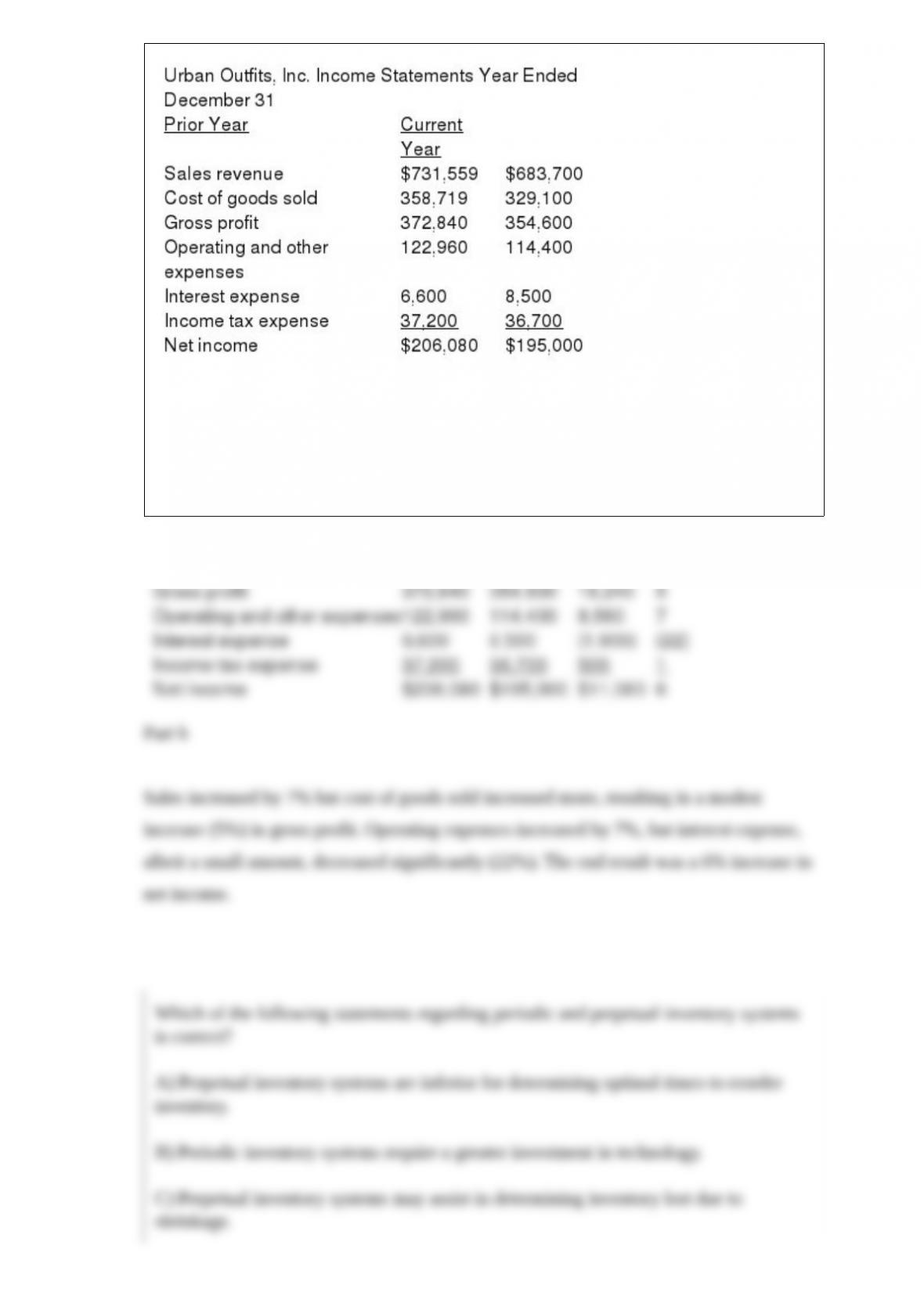
Required:
Part a. Prepare a horizontal analysis of the income statement above. Round to the
nearest whole percent.
Part b. Interpret your analysis. Comment on significant changes.

Which of the following statements regarding periodic and perpetual inventory systems
is correct?
A) Perpetual inventory systems are inferior for determining optimal times to reorder
inventory.
B) Periodic inventory systems require a greater investment in technology.
C) Perpetual inventory systems may assist in determining inventory lost due to
shrinkage.
D) Periodic inventory systems allow sales personnel to provide more immediate
information regarding availability of inventory.