The period of time from buying goods and services to collecting cash from customers is
the accounting cycle.
Contingent liabilities arise from past transactions, but depend on future events.
A major advantage of debt financing is that interest expense is tax deductible.
Horizontal analysis is the comparison of each financial statement amount to another
amount on the same financial statement.
A lower of cost or market write-down would be recorded with a debit to Inventory
Expense.
A declining fixed asset turnover ratio can be caused by acquiring additional assets in the
current period in anticipation of increased revenue in the future.
The threshold for recording contingent liabilities under IFRS is higher than that under
GAAP.
Your company issues a 5-year bond with a face value of $10,000 and a stated interest
rate of 7%. The market interest rate is 5%. The issue price of the bond is calculated as
the:
A) present value of $10,000 to be received in 5 years plus the present value of $700 per
year for 5 years.
B) face value of the bonds, $10,000.
C) amount investors would have to pay to earn 7% interest.
D) amount investors would have to pay to earn an average of the stated interest rate and
the market interest rate.
A company issued $100,000 5-year, 7% bonds and received $101,137 in cash. The
market rate of interest when the bonds were issued was 6.5%. What is the amount of
interest expense to be recorded for the first annual interest period if the company uses
simplified effective-interest amortization?
A) $6,573.91
B) $7,000.00
C) $6,500.00
D) $7,079.59
Which of the following statements about bonds and notes is not correct?
A) A company can borrow the funds necessary to finance its activities using bonds or
promissory notes.
B) Borrowings using bonds or notes are initially recorded with a journal entry that
debits Cash and credits the relevant liability account.
C) The journal entry that records interest owed on bonds and notes includes a debit to
Interest Expense and a credit to Interest Payable.
D) Bonds Payable and Notes Payable are always classified as noncurrent liability
accounts.
A corporate bond with a face value of $1,000 is issued at 107. This means that the bond
actually sold for:
A) $107 and the stated interest rate was higher than the market interest rate.
B) $1,070 and the stated interest rate was higher than the market interest rate.
C) $107 and the stated interest rate was lower than the market interest rate.
D) $1,070 and the stated interest rate was lower than the market interest rate.
If XYZ Company had $12 million in revenue and net income of $3 million, then its:
A) expenses must have been $15 million.
B) expenses must have been $9 million.
C) assets must have been $12 million.
D) assets must have been $3 million.
A company has 110,000 shares authorized, 50,000 shares issued, and 5,000 shares of
treasury stock. How many shares are outstanding?
A) 45,000
B) 155,000
C) 55,000
D) 145,000
Which of the following must be paid by both the employee and the employer?
A) FICA taxes
B) State unemployment tax
C) State withholding tax
D) Federal unemployment tax
Which of the following statements about a corporation is not correct?
A) A corporation is a separate legal entity.
B) A corporation has easy transferability of ownership.
C) A corporation may have the ability to raise large amounts of capital.
D) A corporation’s owners have unlimited liability.
All of the following are requirements of the Sarbanes-Oxley Act (SOX) except:
A) evaluation and reporting on the effectiveness of internal control over financial
reporting by management for all public companies.
B) evaluation and reporting on the effectiveness of internal control over financial
reporting by external auditors only for large public companies.
C) establishment of an audit committee of independent directors to ensure the company
‘s accounting, internal control, and audit functions are effective.
D) adoption of a code of ethics covering all employees.
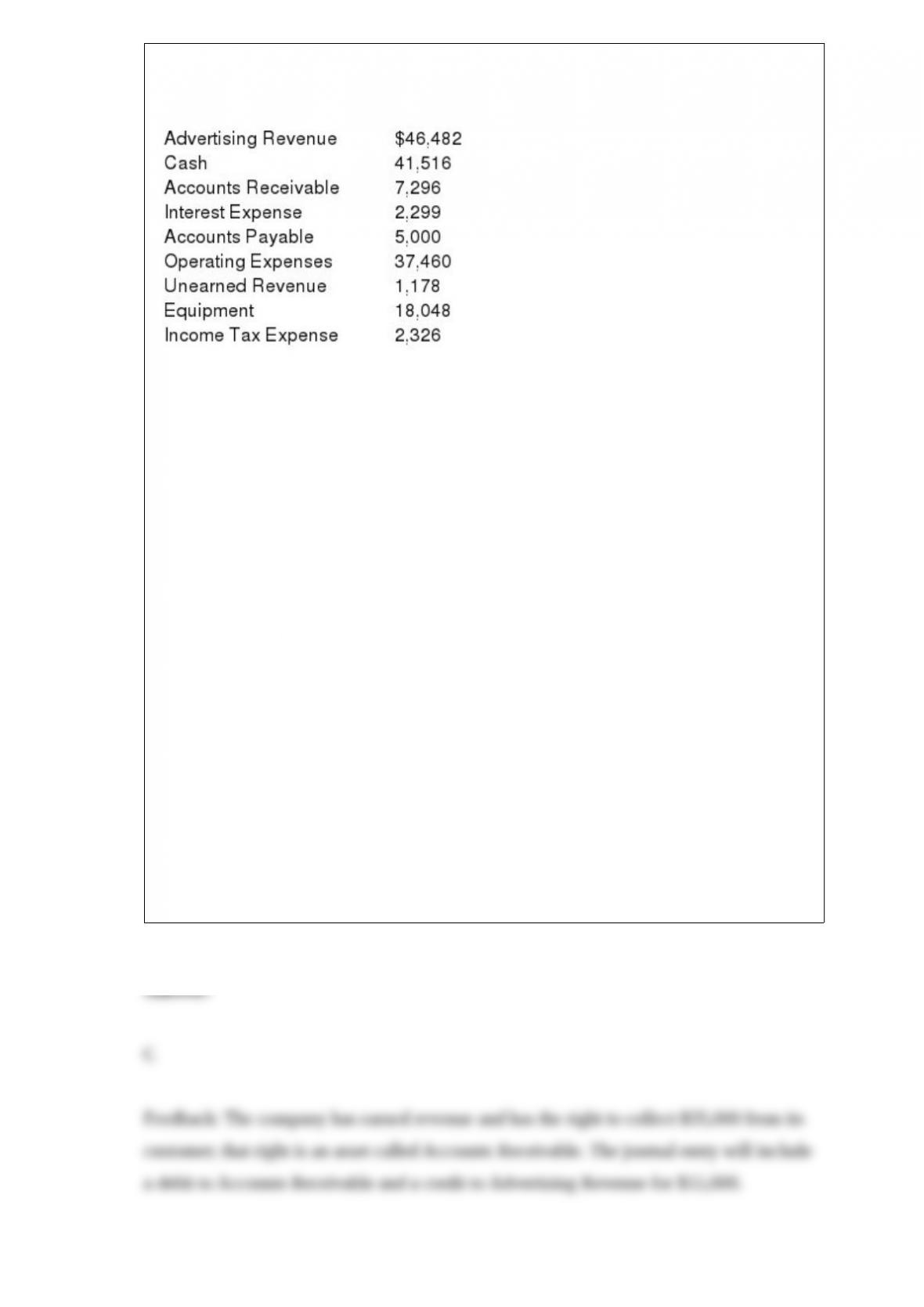
The following account balances are taken from the December 31, 2015, financial
statements of ABZ Advertising Company. The company uses accrual basis accounting.
The following activities occurred in 2016:
1> Performed advertising services on account, $55,000.
2> Received cash payments on account, $10,400.
3> Received deposits from customers for advertising services to be performed in 2017,
$2,500.
4> Made payments to suppliers on account, $5,000.
5> Incurred $45,000 of operating expenses; $39,000 was paid in cash and $6,000 was
on account and unpaid as of the end of the year.
Use the information above to answer the following question. Which of the following is
the journal entry that will be used to record activity #1?
A) Debit Advertising Revenue and credit Accounts Receivable for $55,000
B) Debit Accounts Receivable and credit Cash for $55,000
C) Debit Accounts Receivable and credit Advertising Revenue for $55,000
D) Debit Cash and credit Advertising Revenue for $55,000
A company owes rent at a rate of $6,000 per month. The company pays the rent owed
on the tenth of each month for the previous month. At the end of each month, what kind
of adjustment is required?
A) An accrual adjustment
B) A closing adjustment
C) A deferral adjustment
D) No adjustment
How will a company ‘s current ratio be affected by the purchase of equipment for cash?
A) The current ratio will increase because current assets increase.
B) The current ratio will decrease because current liabilities increase.
C) The current ratio will decrease because current assets decrease.
D) The current ratio will remain unchanged.
If a fully depreciated asset with no residual value is “retired” to a junk yard without
receiving any cash:
A) a gain on disposal will be recorded.
B) depreciation must be recorded as though the asset were still on the books.
C) a loss on disposal will be recorded.
D) no gain or loss on disposal will be recorded.
If Company A has a debt-to-assets ratio of 0.73 while Company B has a debt-to-assets
ratio of 0.45, which of the following statements is correct?
A) Stockholders own a smaller proportion of Company A than Company B.
B) Company A must make less profit than Company B.
C) Creditors own a smaller proportion of Company A than Company B.
D) Company A must have fewer assets than Company B.
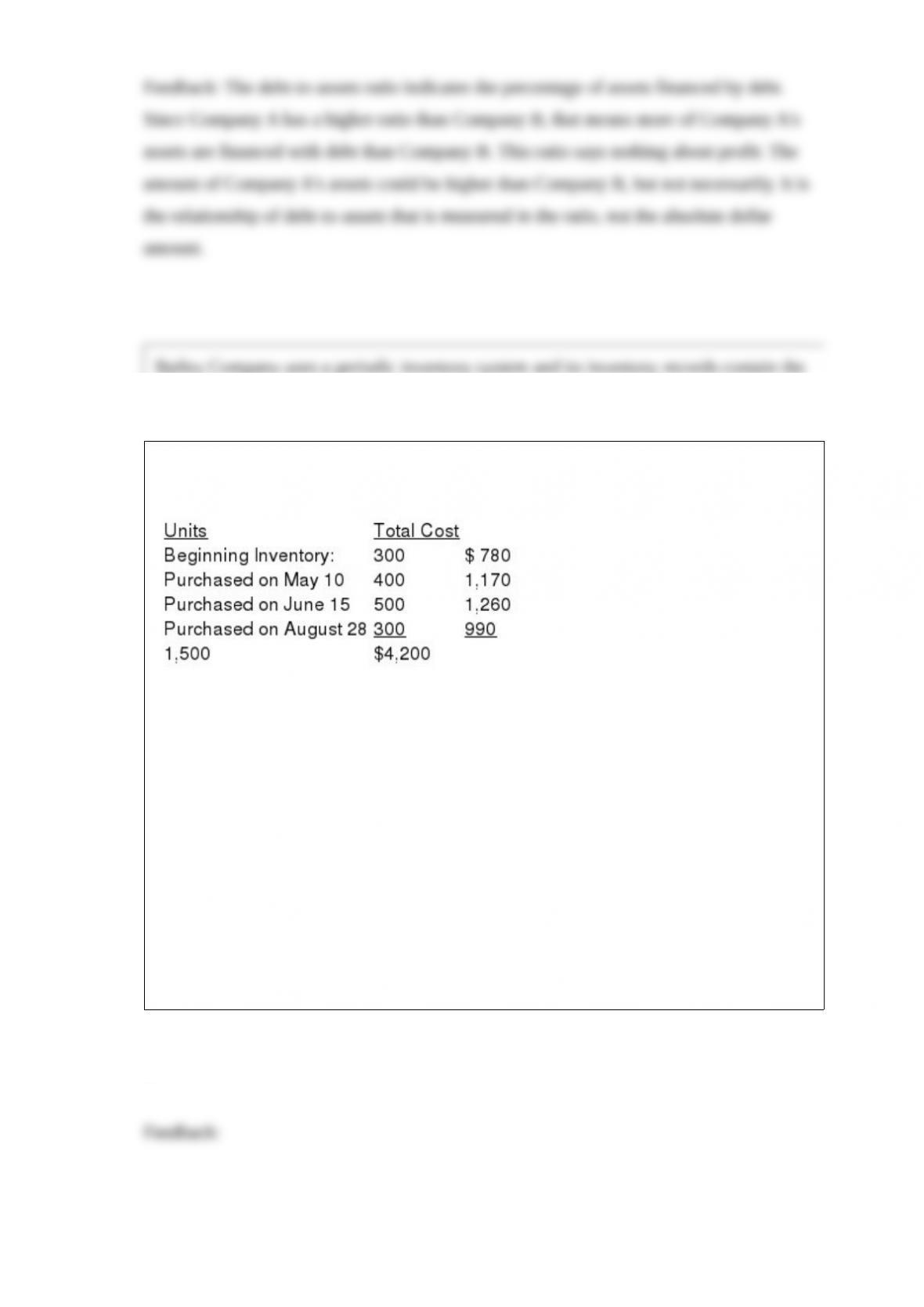
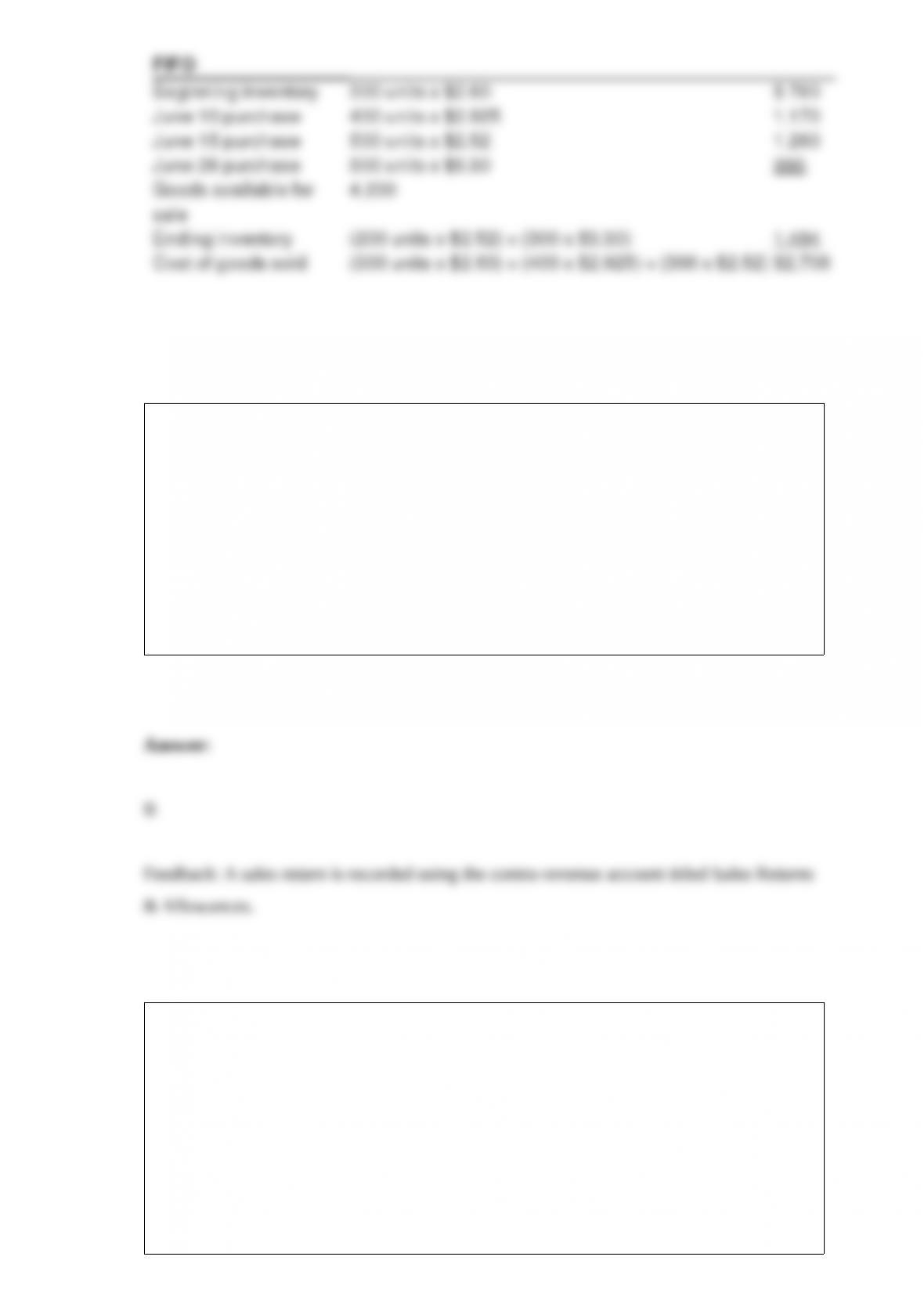
Bailey Company uses a periodic inventory system and its inventory records contain the
following information:
The company sold 1,000 units during June. There were no additional purchases or sales
during the remainder of the year. The company had 500 units were in its ending
inventory at the end of the year.
Use the information above to answer the following question. If Bailey Company uses
the FIFO costing method, what is the cost of its ending inventory?
A) $1,494
B) $2,290
C) $2,580
D) $2,706
When a customer returns for credit a defective product it had purchased, the seller
would record the transaction using which of the following accounts?
A) Purchase Returns & Allowances
B) Sales Returns & Allowances
C) Sales Revenue
D) Sales Discounts
Inventory was sold on credit for $3,000, terms 1/10, n/30. How should the seller record
the cash collection?
A) Debit Cash for $3,000 and credit Accounts Receivable for $3,000, if collected within
the discount period.
B) Debit Cash for $3,000, credit Accounts Receivable for $2,970, and credit Sales
Discounts for$30, if collected within the discount period.
C) Debit Cash for $3,000, credit Accounts Receivable for $2,970, and credit Sales
Discounts for$30, if collected after the discount period.
D) Debit Cash for $3,000 and credit Accounts Receivable for $3,000, if collected after
the discount period.
An asset is purchased on January 1 for $40,000. It is expected to have a useful life of
five years after which it will have an expected residual value of $5,000. The company
uses the straight-line method. If it is sold for $30,000 exactly two years after it is
purchased, the company will record a:
A) gain of $6,000.
B) gain of $4,000.
C) loss of $4,000.
D) loss of $6,000.
The days-to-collect measures the:
A) number of days it takes to collect accounts receivable.
B) average number of times the firm completes the selling and collecting cycle during
the year.
C) average number of days for a customer’s payment to clear the banking system.
D) average number of days before the company receives a customer’s payment and uses
the cash to re-order merchandise.
Leanley Co. issues $100,000 of 10-year, 10% bonds on January 1, 2016.
Required:
Determine the amounts (bonds payable, unamortized premium or discount, and bonds
payable, net) that will be reported on a balance sheet prepared as of the date of issuance
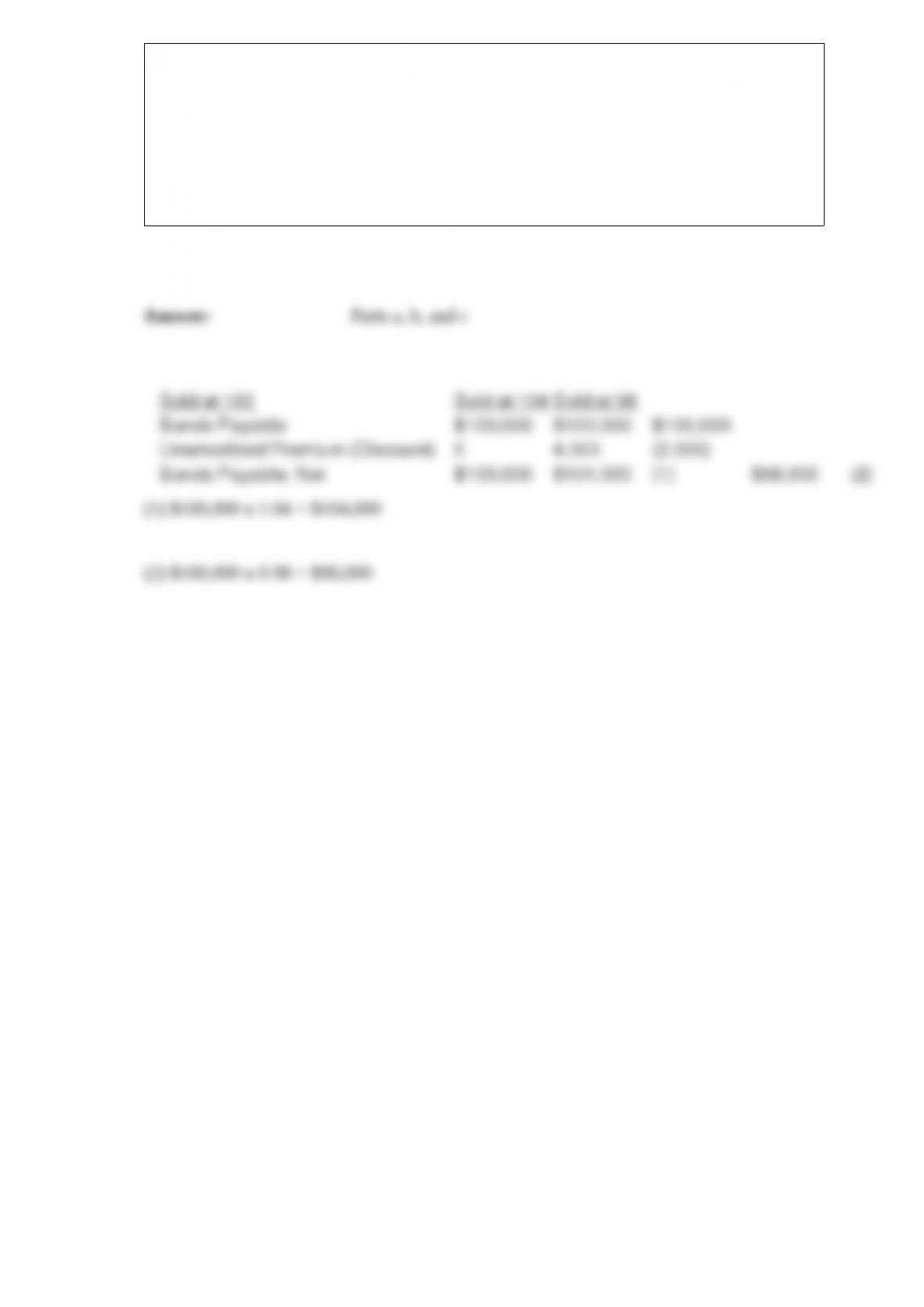
of January 1, 2016 under each of the following assumptions:
Part a. The bonds are sold at 100.
Part b. The bonds are sold at 104.
Part c. The bonds are sold at 98.