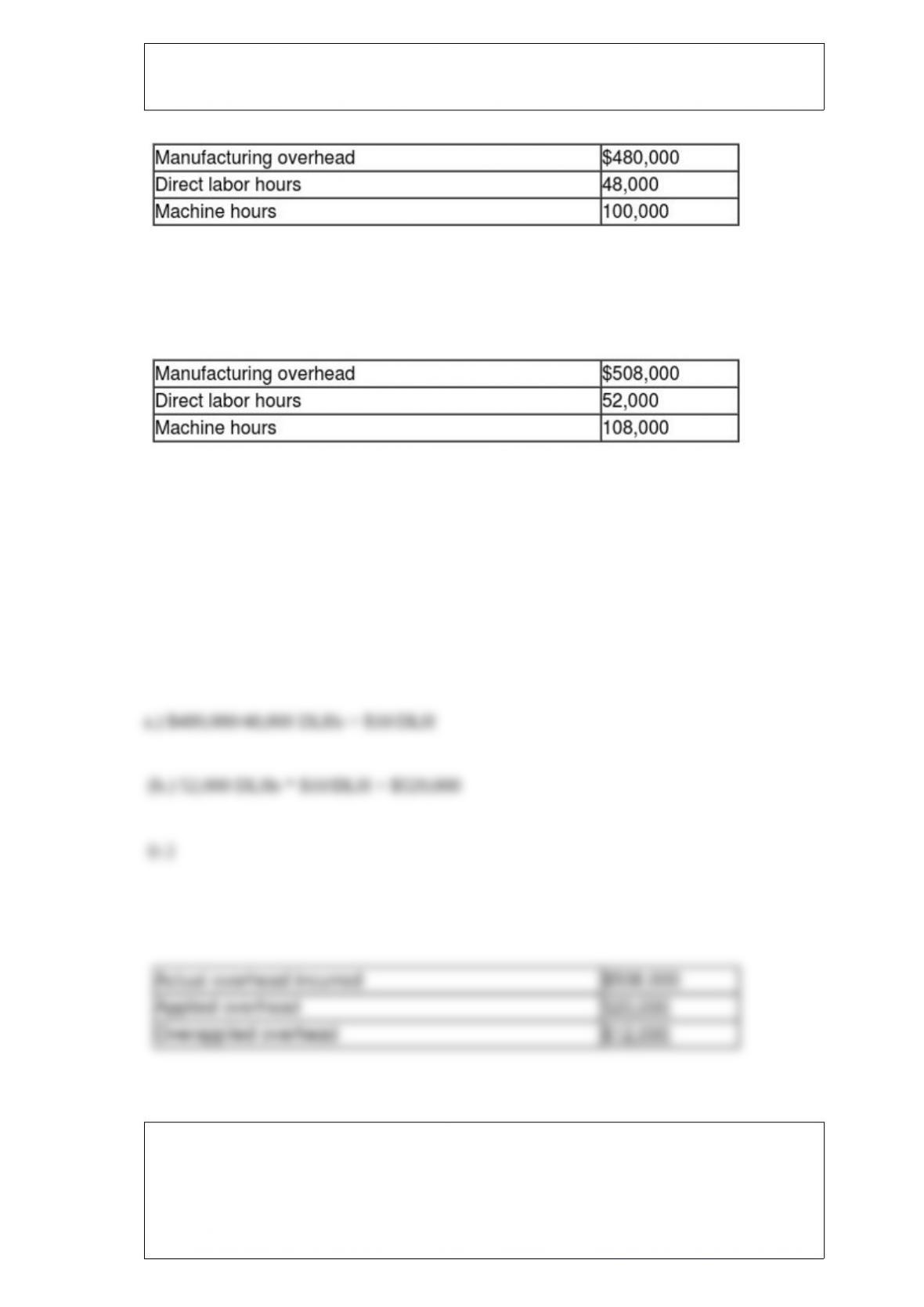
Eberlin Boats estimates the following for 2016:
During 2016 Eberlin incurs the following costs and activity:
Eberlin uses direct labor hours to calculate the predetermined overhead rate for the year.
(a.) Calculate the predetermined overhead rate for 2016.
(b.) Calculate the applied overhead for 2016.
(c.) Calculate the amount of overapplied or underapplied overhead for 2016.
Budget slack is:
A. sometimes called padding or cushion.
B. the result of budget estimates submitted that are slightly higher than what the costs
are really expected to be.
C. an allowance for contingencies built into a budget.
D. all of the above.
Which of the following is a true statement pertaining to segment income statements?
A. Present the individual segments’ net income.
B. Variable costs should be reported by segment.
C. Do not present a segment margin.
D. Do not include arbitrarily allocated common fixed expenses when calculating
segment margin.
E. All of the above.
Which of the following costs are included in the cost classification that is based on the
relationship between total cost and volume of activity?
A. Variable cost and fixed cost.
B. Direct cost and indirect cost.
C. Product cost and period cost.
D. Committed cost and discretionary cost.
An organization’s system of internal control is designed primarily to:
A. ensure that no employees steal the organization’s property.
B. increase efficiency by letting one employee handle all aspects of a transaction from
beginning to end.
C. ensure that the organization’s balance sheet will always balance.
D. provide an operating framework for all employees as they work to achieve the
organization’s goals.

How is performance evaluated for an investment center?
A. Actual costs incurred compared to budgeted costs.
B. Actual segment margin compared to budgeted segment margin.
C. Comparison of actual and budgeted return on investment (ROI) based on segment
margin and assets controlled by the segment.
D. None of the above.
An excess of cost of goods manufactured over cost of goods sold for the period
represents:
A. an increase in gross profit.
B. a decrease in work in process inventory.
C. overapplied manufacturing overhead.
D. an increase in finished goods inventory.
Which of the following is not an important qualitative factor to consider in the capital
budgeting decision?
A. regulations that mandate investment to meet safety, environmental, or access
requirements.
B. technological developments within the industry may require new facilities to
maintain customers or market share at the cost of lower ROI for a period of time.
C. commitment to a segment of the business that requires capital investments to achieve
or regain competitiveness even though that segment does not have as great an ROI as
others.
D. all of the above are important qualitative factors to consider.
If the net variance of a business using standard costing is significant relevant to total
production cost, the net variance should be:
A. assigned to cost of goods sold.
B. allocated between WIP and FG inventories and cost of goods sold.
C. carried forward to the next accounting period.
D. none of the above.

Which of the following is not a characteristic or limitation of the kind of information
that financial reporting by business enterprises can provide?
A. The information results in approximate, rather than exact, measures.
B. The information largely reflects the financial effects of transactions that have already
happened.
C. The information is provided and used at a cost.
D. All of the above are characteristics or limitations of the kind of information that
financial reporting by business enterprises can provide.
When the cost behavior pattern has been identified as fixed at a certain volume of
activity:
A. any change in volume will probably cause the cost to change.
B. it is appropriate to express the cost on a per unit of activity basis.
C. the total cost will not change even if the volume of activity changes substantially.
D. the total cost may change if the volume of activity changes substantially.
A cash budget would not include:
A. sale of common stock.
B. payment of dividends.
C. payment of property taxes.
D. plant and building depreciation.
A(n) _____________ is the minimum cost that can be incurred, which when subtracted
from the selling price, allows for a desired profit to be earned.
A. relevant cost
B. opportunity cost
C. incremental cost
D. target cost
Matching revenues and expenses refers to:
A. having revenues equal expenses.
B. recording revenues when cash is received.
C. accurately reflecting the results of operations for a fiscal period.
D. recording revenues when a product is sold or a service is rendered.
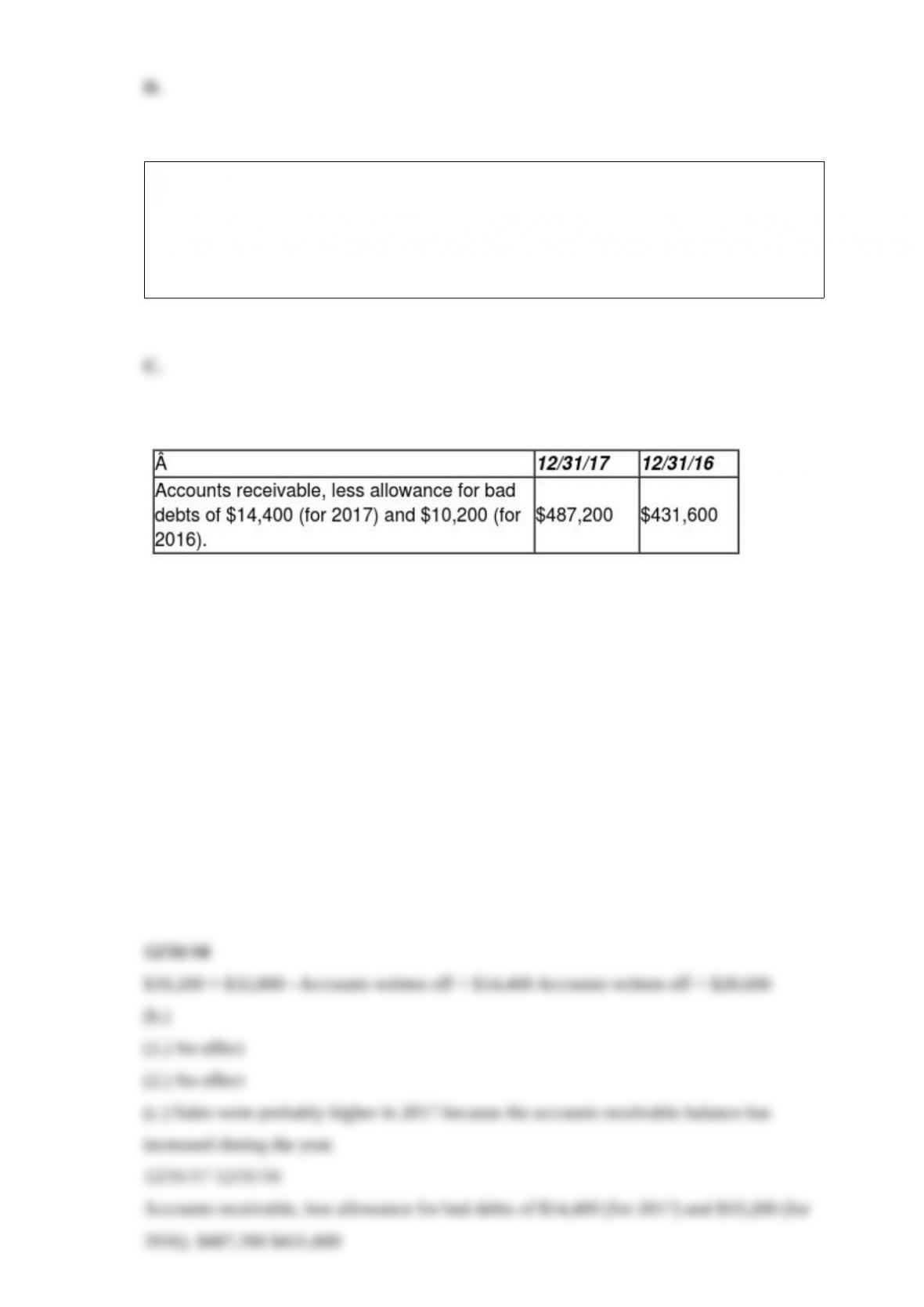
(a.) If bad debts expense for 2017 totaled $32,800, what was the amount of accounts
receivable written off during the year?
(b.) The December 31, 2017, Allowance account balance includes $6,800 for a past due
account that is not likely to be collected. This account has not been written off. If it had
been written off, what would have been the effect of the write off on:
(1.) The current ratio at December 31, 2017?
(2.) Net income and ROE for the year ended December 31, 2017?
(c.) What do you suppose was the level of The Sweet Cafe’s sales in 2017, compared to
2016? Explain your answer.

A set of integrated financial and operating performance measures that communicate an
organization’s priorities associated with achieving strategic goals is known as a:
A. balanced scorecard.
B. segment report.
C. responsibility report.
D. master budget.
Leasehold is an example of which of the following types of assets?
A. Current asset.
B. Property, plant and equipment.
C. Goodwill.
D. Intangible asset.
Financial leverage refers to which of the following?
A. The difference between the rate of return earned on assets (ROI) and the rate of
return earned on stockholders’ equity (ROE).
B. The difference between the rate of return earned on current assets and the rate of
return earned on retained earnings.
C. The leverage a firm obtains from increasing production.
D. Decreasing fixed costs per unit by increasing production.
Cost behavior refers to:
A. costs that are both good and bad.
B. costs that increase at a quicker rate than others.
C. costs that decrease at a quicker rate than others.
D. costs that are variable or fixed.
E. none of the above.

In the statement of cash flows, an increase in the accounts receivable balance from the
beginning of the period to the end of the period would:
A. be added to net income because this represents earned revenues that have not been
collected.
B. be subtracted from net income because this represents earned revenue provided by
operating earnings.
C. be added to net income because this means that revenues were less than cash
collected.
D. be subtracted from net income because this means that revenues were more than
cash collected.
Each of a company’s two product lines has a different contribution margin ratio. If the
company’s total sales remain the same but the sales mix shifts toward selling more of
the product with the higher contribution ratio, which of the following is true?
A. operating income will increase.
B. the average contribution margin ratio will increase.
C. the break-even point will decrease.
D. all of the above are true.
The objectives of financial reporting for nonbusiness enterprises:
A. are exactly the same as those for business enterprises.
B. focus on providing information for resource providers, rather than investors.
C. have more of an internal utilization rather than external reporting focus.
D. do not give consideration to the cost of providing information.
Which of the following captions would be not be reported on a single step income
statement?
A. Net sales
B. Income from operations
C. Income before taxes
D. Net income
Stockholders’ equity refers to which of the following?
A. A listing of the organization’s assets and liabilities.
B. The ownership right of the stockholder(s) of the entity.
C. Probable future sacrifices of economic benefits.
D. All of the above.
E. None of the above.
The contribution margin format income statement is organized by:
A. responsibility centers.
B. functional classifications.
C. sales territories.
D. cost behavior classifications.
The kind of standard that will almost never be achieved and results in an unrealistic
performance target is:
A. an attainable standard.
B. an engineered standard.
C. a negotiated standard.
D. a past experience standard.
Developing a standard cost for a product or service will usually involve:
A. efforts of cost accounting personnel only.
B. focusing only on variable costs.
C. the same kind of communication involved in the overall budgeting process.
D. concentrating on historical costs and performance levels.

Cost accounting is a subset of which of the following?
A. Internal auditing.
B. Public auditing.
C. Cost analysis.
D. Managerial accounting.
The potential rental value of space used in the manufacturing process:
A. is a variable production cost.
B. is an unavoidable production cost.
C. is a sunk production cost.
D. is an opportunity cost if production is not outsourced.
When a supplier makes a downward adjustment in the amount owed by a creditor, the
creditor will:
A. reduce the amount of the account payable to the supplier, and decrease an asset such
as inventory.
B. increase the amount of the account payable to the supplier, and decrease an asset
such as inventory.
C. reduce the amount of the account payable to the supplier, and increase cash.
D. reduce the amount of the account payable to the supplier, and decrease cash.
The operating budget depends on key information developed in the:
A. cash forecast.
B. sales forecast.
C. labor forecast.
D. operating forecast.
Accumulated depreciation on a balance sheet:
A. is part of stockholders’ equity.
B. represents the portion of the cost of an asset that is assumed to have been “used up”
in the process of operating the business.
C. represents cash that will be used to replace worn out equipment.
D. recognizes the economic loss in value of an asset because of its age or use.