FOB shipping or FOB factory means ownership of goods transfers to the buyer at the
buyer’s place of business.
The first five steps in the accounting cycle include analyzing transactions, journalizing,
posting, preparing an unadjusted trial balance, and recording adjusting entries.
A company must have less than 30 days’ sales uncollected in order to be adequately
liquid.
The trial balance is a list of the accounts that have balances in the ledger.
The economic effect of an expense is incurred when the benefit expires or is used up,
not when cash is paid.
Net realizable value for damaged or obsolete goods is sales price plus the cost of
making the sale.
If interim financial statements are required, adjusting entries must be journalized and
posted to obtain the adjusted data needed for their preparation.
Cash consists of cash on hand and demand deposits. This includes coins, currency, and
amounts on deposits in bank accounts, chequing accounts and some savings accounts.
The acid-test ratio is also called the quick ratio.
Businesses normally get a full credit for both the goods and services tax (GST) and/or
Harmonized Sales Tax (HST), and the provincial sales tax (PST) that they have paid.
When posting from special journals all debit and credit entries are entered as separate
amounts.
Prepaid expenses may be recorded as debits to expense accounts.
Ownership of a corporation is divided into units called shares.
Firewalls and encryption can be used as methods to eliminate some of the risks
involved in e-commerce.
According to the cost principle, it is acceptable for managers to use their own estimate
of an asset’s value when recording the purchase.
Since all figures are eventually posted to the ledger, the posting reference column in a
journal is not necessary.
If the Balance Sheet columns of a work sheet fail to balance when the amount of the net
income is added to the Balance Sheet Credit column, the cause could be:
A. An expense amount entered in the Balance Sheet Debit column.
B. A revenue amount entered in the Balance Sheet Credit column.
C. An asset amount entered in the Income Statement Debit column.
D. A liability amount entered in the Balance Sheet Debit column.
E. A liability amount entered in the Income Statement Credit column.

The current ratio:
A. Is current assets divided by current liabilities.
B. Helps to assess a company’s ability to pay its debts in the near future.
C. Suggests there may be problems in a business if it is less than 1.
D. Is a measure of a company’s liquidity.
E. All of these answers are correct.
The principle of faithful representation:
A. Requires that information be complete, neutral and free from error so assets and
income are not overstated and liabilities and expenses are not understated.
B. Requires that a company use the same accounting methods period after period.
C. Requires that revenues and costs be reported in the period in which they are earned
or incurred.
D. Requires that all items of a material nature be included in financial statements.
E. Requires that all inventory items be reported at full cost.
The Purchases Journal is used for:
A. Recording credit purchases.

B. Recording credit sales.
C. Recording cash sales.
D. Recording cash purchases.
E. Recording both credit purchases and credit sales.
In reconciling the bank balance, an unrecorded debit memorandum for printing cheques
should be:
A. Noted as a memo.
B. Added to the book balance of cash.
C. Deducted from the book balance of cash.
D. Added to the bank balance of cash.
E. Deducted from the bank balance of cash.
Classified multiple-step income statements:
A. Are required by Canada Revenue Agency.
B. Are generally used for internal reporting.
C. Are required for the perpetual system.
D. List cost of goods sold as an operating expense.
E. Do not report gross profit.
Of the following accounts, the one that normally has a credit balance is:
A. Cash.
B. Office Equipment.
C. Sales Salaries Payable.
D. Ted Neal, Withdrawals.
E. Sales Salaries Expense.
Explain how to calculate the gross profit ratio and interpret its meaning.
Describe the purpose and importance of accounting
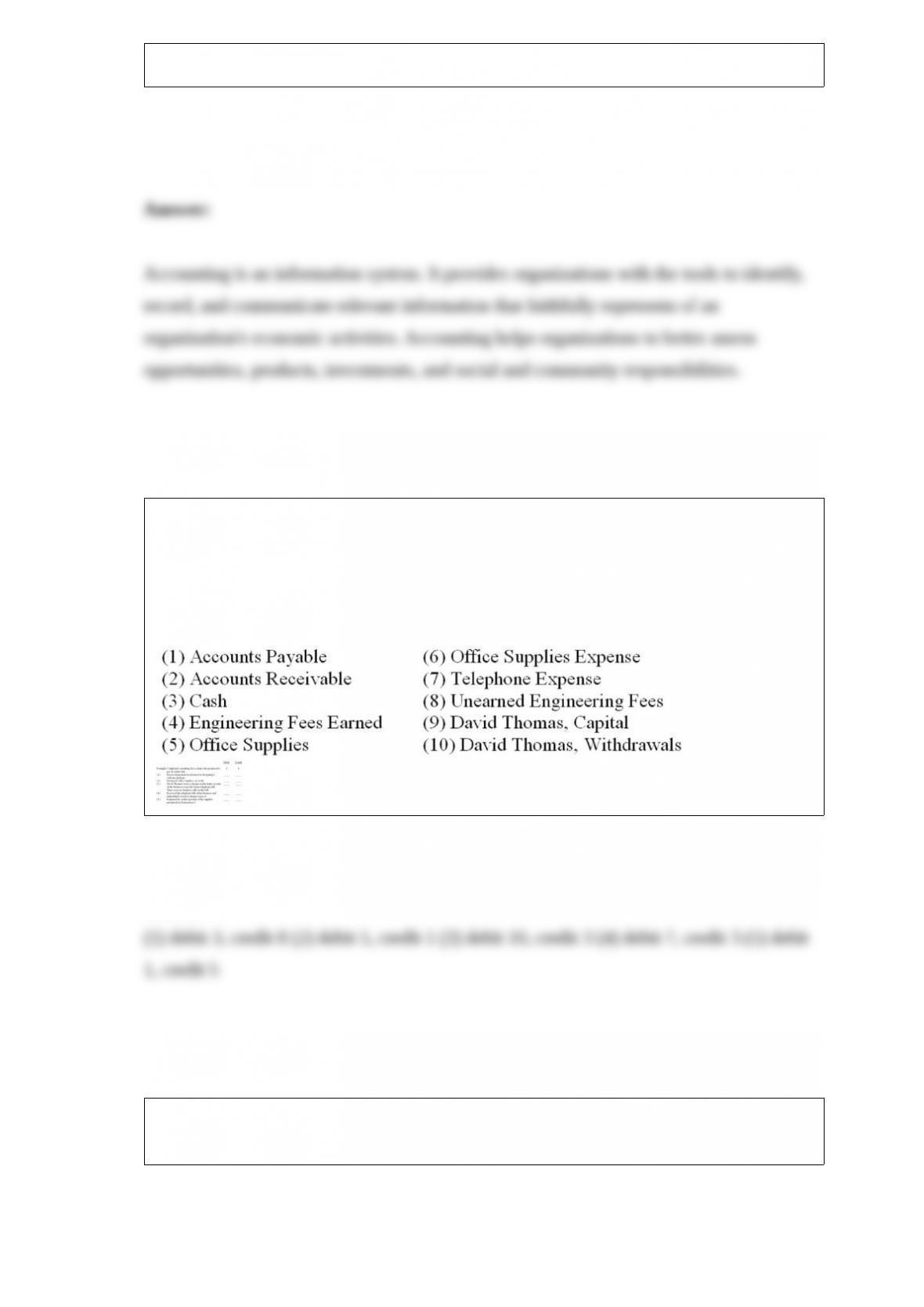
David Thomas is a computer consultant and software engineer. Below are the names of
several accounts in his ledger with each account name preceded by a number.
Following the account names are several transactions completed by Mr. Thomas.
Indicate the accounts debited and credited in recording each transaction by placing the
proper account numbers in the boxes to the right of each transaction.
A major goal in accounting for inventory is __________________ relevant costs with
revenues.
Identify the three forms of business organizations.
Identify the accounting principle involved in deciding between the allowance method
and the direct write-off method. Indicate which principle is associated with each
method.
The cost of an inventory item includes _____________________, plus
______________ costs necessary to put it in a place and condition for sale.
Discuss the difference between the periodic and perpetual inventory systems.
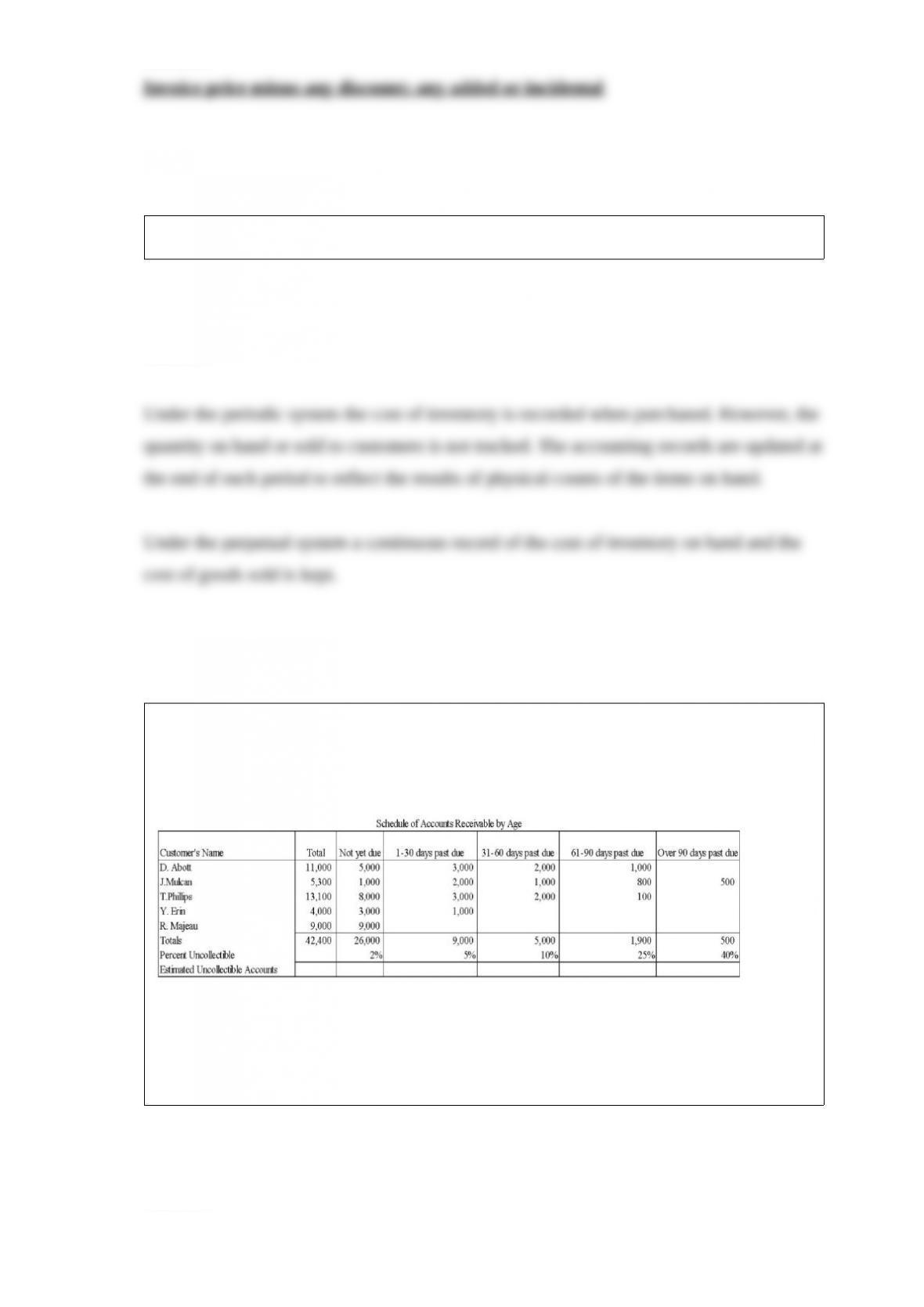
Fife Company has the following account balances at December 31 of the current year:
Accounts Receivable $42,400 and Allowance for Doubtful Accounts $1,600 (credit
balance). Fife uses the aging of accounts receivable to estimate bad debts. The
following aging schedule reflects the situation at year-end:
(1) Calculate the amount of the Allowance for Doubtful Accounts that should appear on
the December 31, current year, balance sheet.
(2) Prepare the journal entry to record bad debts expense for the current year.
Goods on consignment are goods shipped by their owner, called the _______________,
to another party called the _______________.