
The methods of evaluating capital investment proposals can be separated into two
general groups–present value methods and:
A.past value methods
B.straight-line methods
C.reducing value methods
D.methods that ignore present value
Answer:
Zach Company owns 45% of the voting stock of Tomas Corporation and uses the equity
method in recording this investment. Tomas Corporation reported a $20,000 net loss.
Zach Company’s entry would include a
A.Credit to cash for $9,000
B.Debit to the investment account for $9,000
C.Credit to the investment account for $9,000
D.Credit to a loss account for $9,000
Answer:
The three categories of manufacturing costs comprising the cost of work in process are
direct labor, direct materials, and:
A.office expenses
B.direct expenses
C.sales salaries expense
D.factory overhead
Answer:
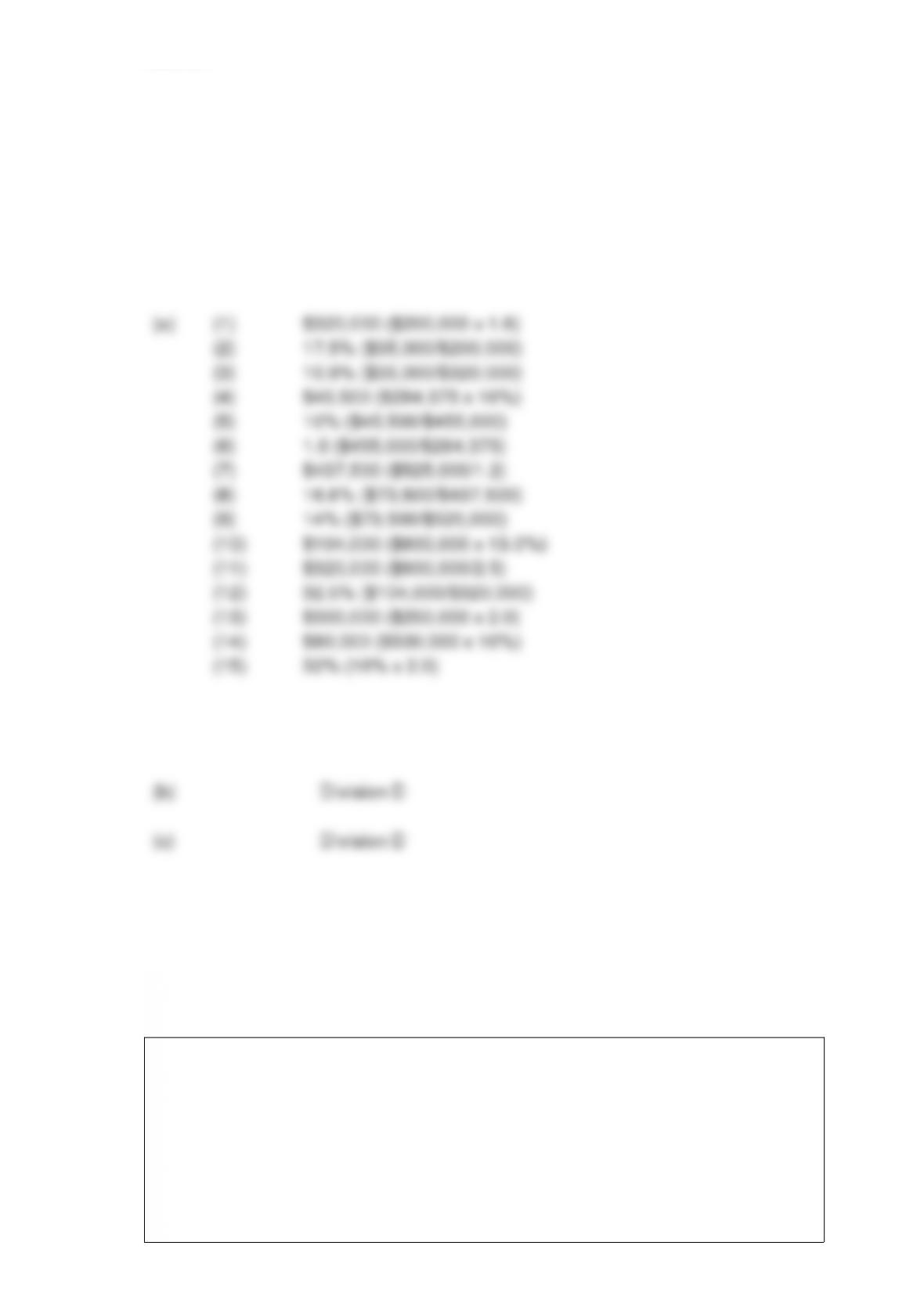
Data for Divisions A, B, C, D, and E are as follows:
(a) Determine the missing items, identifying each by number.
(b) Which division is most profitable in terms of income from operations?
(c) Which division is most profitable in terms of rate of return on investment?
Round percentage values to one decimal point.
Answer:
A widely used activity base for developing factory overhead rates in highly automated
settings is:
A.direct labor hours
B.direct labor dollars
C.direct materials

D.machine hours
Answer:
Benton and Orton are partners who share income in the ratio of 1:3 and have capital
balances of $70,000 and $30,000 respectively. Ramsey is admitted to the partnership
and is given a 40% interest by investing $20,000. What is Benton’s capital balance after
admitting Ramsey?
A.$20,000
B.$7,000
C.$70,000
D.$63,000
Answer:
On the first day of the fiscal year, Lisbon Co. issued $1,000,000 of 10-year, 7% bonds
for $1,050,000, with interest payable semiannually. Orange Inc. purchased the bonds on
the issue date for the issue price. The journal entry to record the amoritization of the
bond premium (by straight-line method) for the year by Orange Inc. includes a credit to:
A.Interest Revenue for $5,000
B.Interest Revenue for $2,500
C.Investment in Lisbon Co. Bonds $5,000
D.Investment in Lisbon Co. Bonds $2,500
Answer:
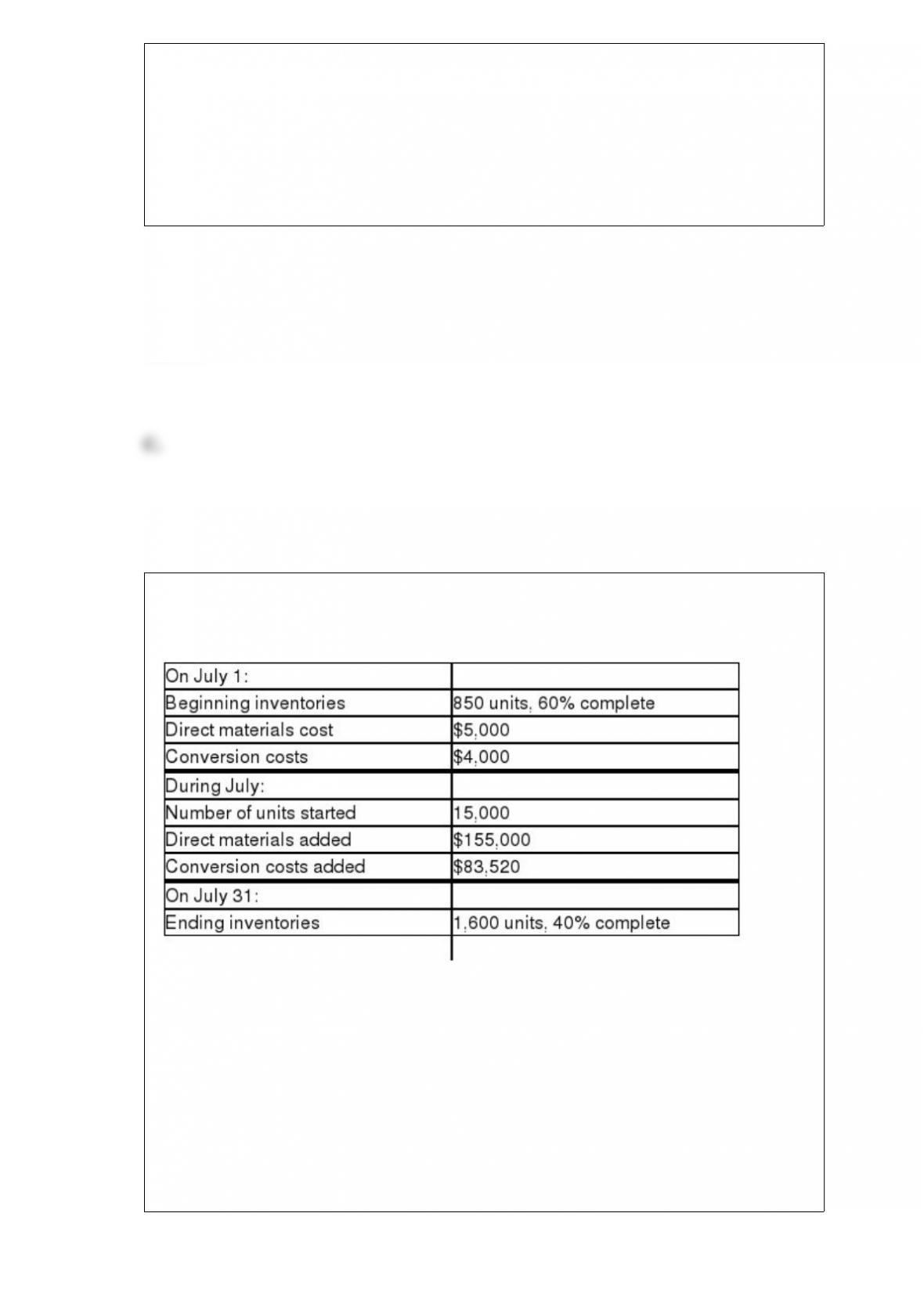
Penny, Inc. employs a process costing system. Direct materials are added at the
beginning of the process. Here is information about July’s activities:
Using the FIFO method, the cost per equivalent unit for materials used during July was
A.$10.78
B.$10.33
C.$9.78
D.$10.65

Answer:
Cash paid for equipment would be reported in the statement of cash flows in
A.the cash flows from operating activities section
B.the cash flows from financing activities section
C.the cash flows from investing activities section
D.a separate schedule
Answer:
Carmelita Company sells 40,000 units at $18 per unit. Fixed costs are $62,000 and
income from operations is $258,000. Determine the (a) variable cost per unit, (b) unit
contribution margin, and (c) contribution margin ratio .
Answer:
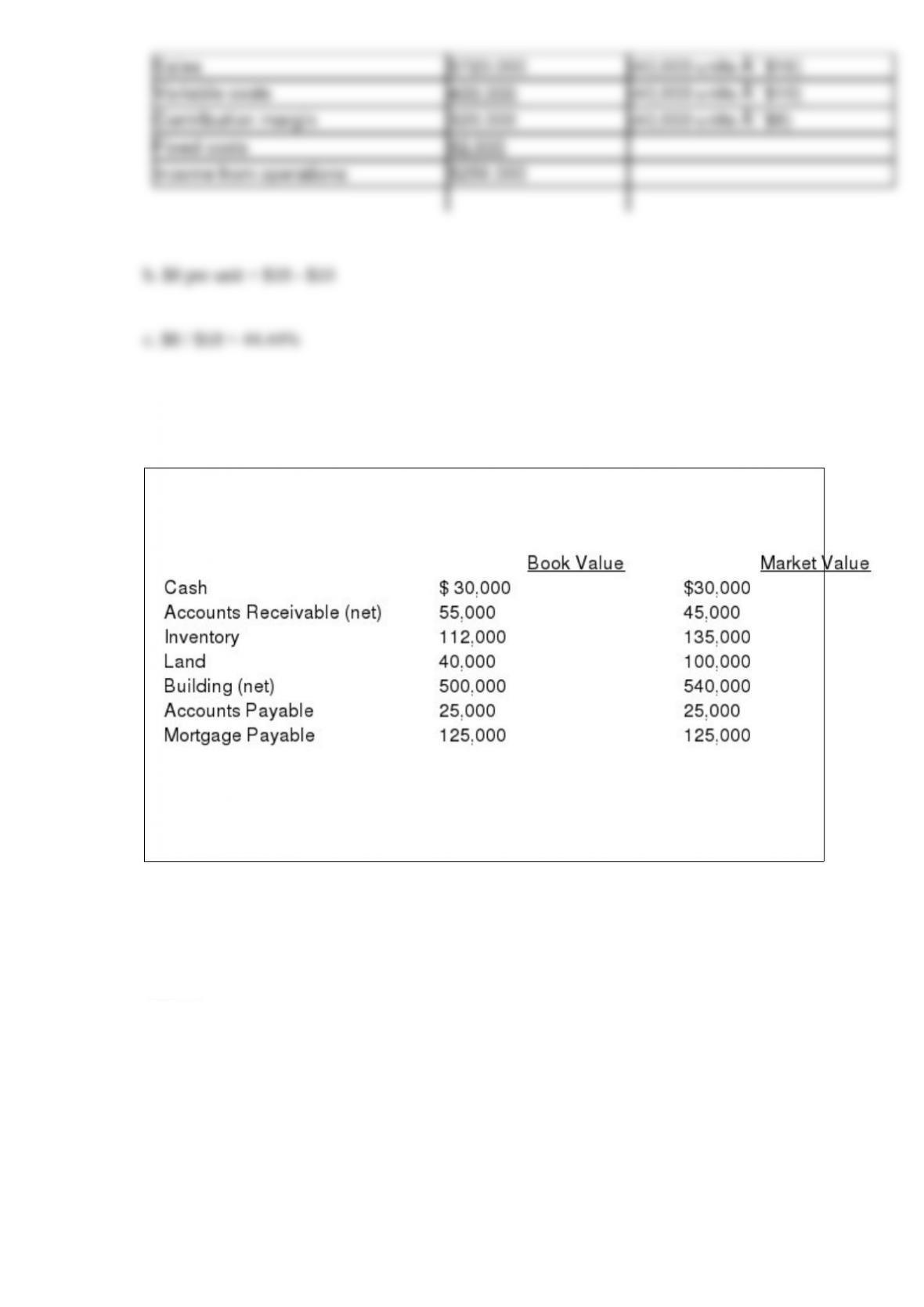
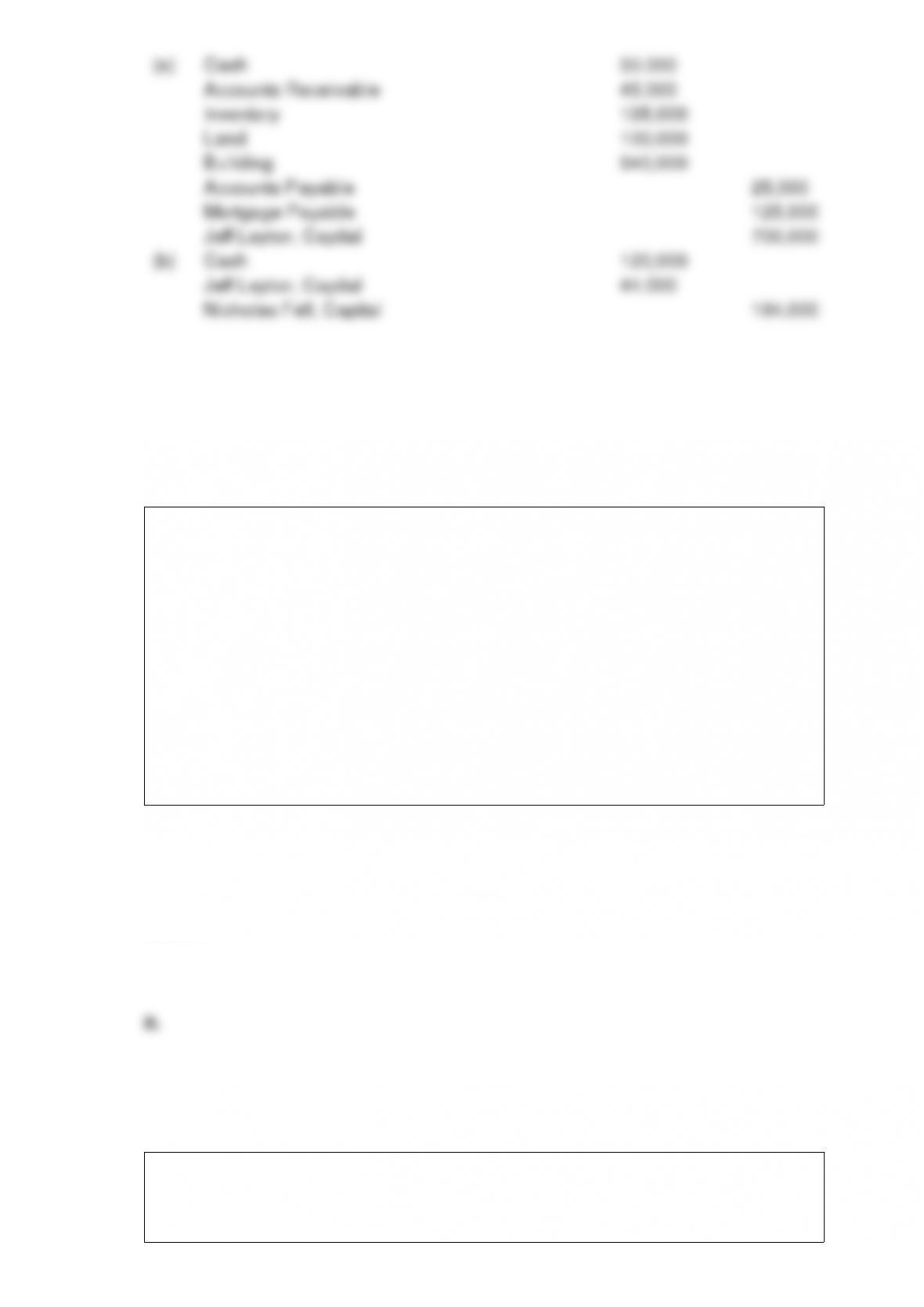
Jeff Layton, sole proprietor of a hardware business, decides to form a partnership with
Nicholas Fell. Jeff’s accounts are as follows:
Nicholas agrees to contribute $120,000 for a 20% interest. Journalize the entries to
record (a) Jeff’s investment and (b) Nicholas’ investment.
Answer:
On January 1, 2011, Zero Company obtained a $52,000, four-year, 6.5% installment
note from Regional Bank. The note requires annual payments of $15,179, beginning on
December 31, 2011. The December 31, 2012 carrying amount in the amortization table
for this installment note will be equal to:
A.$26,000
B.$27,635
C.$21,642
D.$28,402
Answer:
The amount of increase or decrease in cost that is expected from a particular course of
action as compared with an alternative is termed:

A.period cost
B.product cost
C.differential cost
D.discretionary cost
Answer:
Which of the following should not be considered cash by an accountant?
A.money orders
B.bank checking accounts
C.postage stamps
D.travelers’ checks
Answer:
On February 12, Addison, Inc. purchased 6,000 shares of Lucas Company at $22 per
share plus a $240 brokerage fee. On August 22, Lucas paid a $0.42 dividend per share.
On November 10, 4,000 shares of Lucas stock were sold for $28 per share less a $160

brokerage fee. The journal entry for the sale would include:
A.a debit to Cash for $111,840
B.a credit to Investments for $112,000
C.a credit to Loss on Sale for $23,680
D.a debit to Cash for $112,000
Answer:
Next year’s sales forecast shows that 20,000 units of Product A and 22,000 units of
Product B are going to be sold for prices of $10 and $12 per unit, respectively. The
desired ending inventory of Product A is 20% higher than its beginning inventory of
2,000 units. The beginning inventory of Product B is 2,500 units. The desired ending
inventory of B is 3,000 units.
Budgeted purchases of Product A for the year would be:
A.22,400 units
B.20,400 units
C.20,000 units
D.12,200 units
Answer:

When the perpetual inventory system is used, the inventory sold is debited to
A.supplies expense
B.cost of merchandise sold
C.merchandise inventory
D.sales
Answer:
Which of the accounts below would be closed by posting a debit to the account?
A.Unearned Revenue
B.Fees Earned
C.Josh Morton, Drawing
D.Miscellaneous Expense
Answer:
The operating agreement for a Limited Liability Company is sometimes called:
A.articles of organization
B.articles of partnership
C.Schedule C
D.the Uniform Partnership Act
Answer:
What is the last account that should be listed in the Post Closing Trial Balance?
A.Income Summary
B.Capital account
C.Cash
D.Fees Earned
Answer:
Which of the following is true regarding normal balances of accounts?

A.All accounts have a normal debit balance.
B.The normal balance of all accounts will have either a positive or negative balance.
C.Accounts that have a normal debit balance will only have debit entries, never credit
entries.
D.The normal balance is the side of the account that increases the account.
Answer:
What is the major difference between the Unadjusted Trial Balance and the Adjusted
Trial Balance?
A.The Adjusted Trial Balance will show the net income (loss) as an additional account.
B.Unlike the Adjusted Trial Balance, the Unadjusted Trial Balance will continue with
the end-of-period processing even if it is not in balance.
C.The Adjusted Trial Balance includes the postings of the adjustments for the period in
the balance of the accounts.
D.The Adjusted Trial Balance will be used to record the adjustments for the period.
Answer:
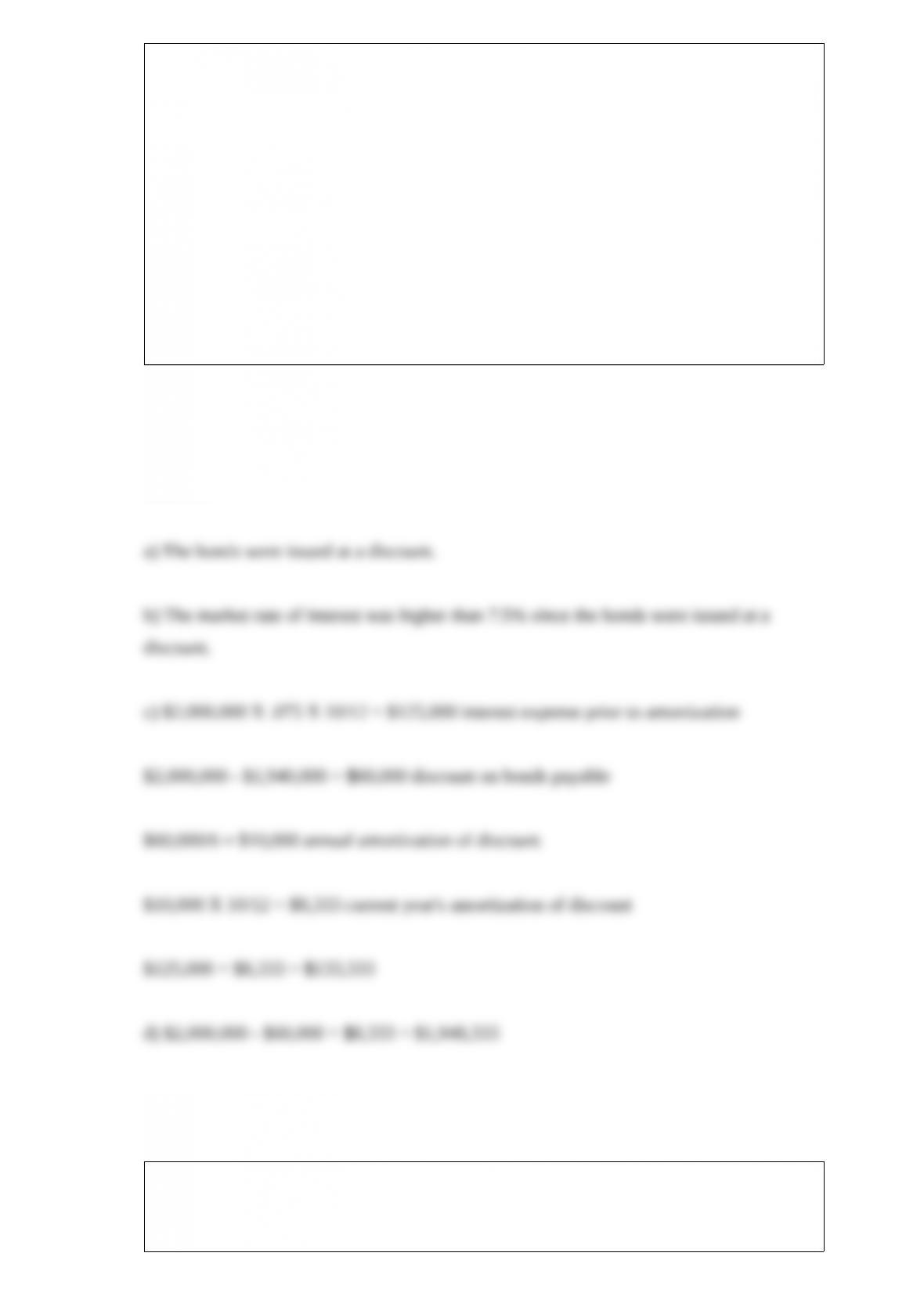
Glover Corporation issued $2,000,000 of 7.5%, 6-year bonds dated March 1, 2011, with
semiannual interest payments on September 1 and March 1. The bonds were issued on
March 1, 2011, at 97. Glover’s year-end is December 31.
a) Were the bonds issued at a premium, a discount, or at par?
b) Was the market rate of interest higher, lower, or the same as the contract rate of
interest?
c) If the company uses the straight-line method of amortization, what is the amount of
interest expense Glover Corporation will show for the year ended December 31, 2011?
d) What is the carrying value of the bonds on December 31, 2011?
Answer:
A note receivable due in 18 months is listed on the balance sheet under the caption
A.long-term liabilities
B.fixed assets
C.current assets
D.investments
Answer:
Which of the following is NOT a special journal?
A.cash receipts
B.purchases
C.accounts receivable
D.cash payments
Answer:
If fixed costs are $1,500,000, the unit selling price is $250, and the unit variable costs
are $130, what is the amount of sales required to realize an operating income of
$200,000?
A.14,166 units
B.12,500 units
C.16,000 units
D.11,538 units
Answer:
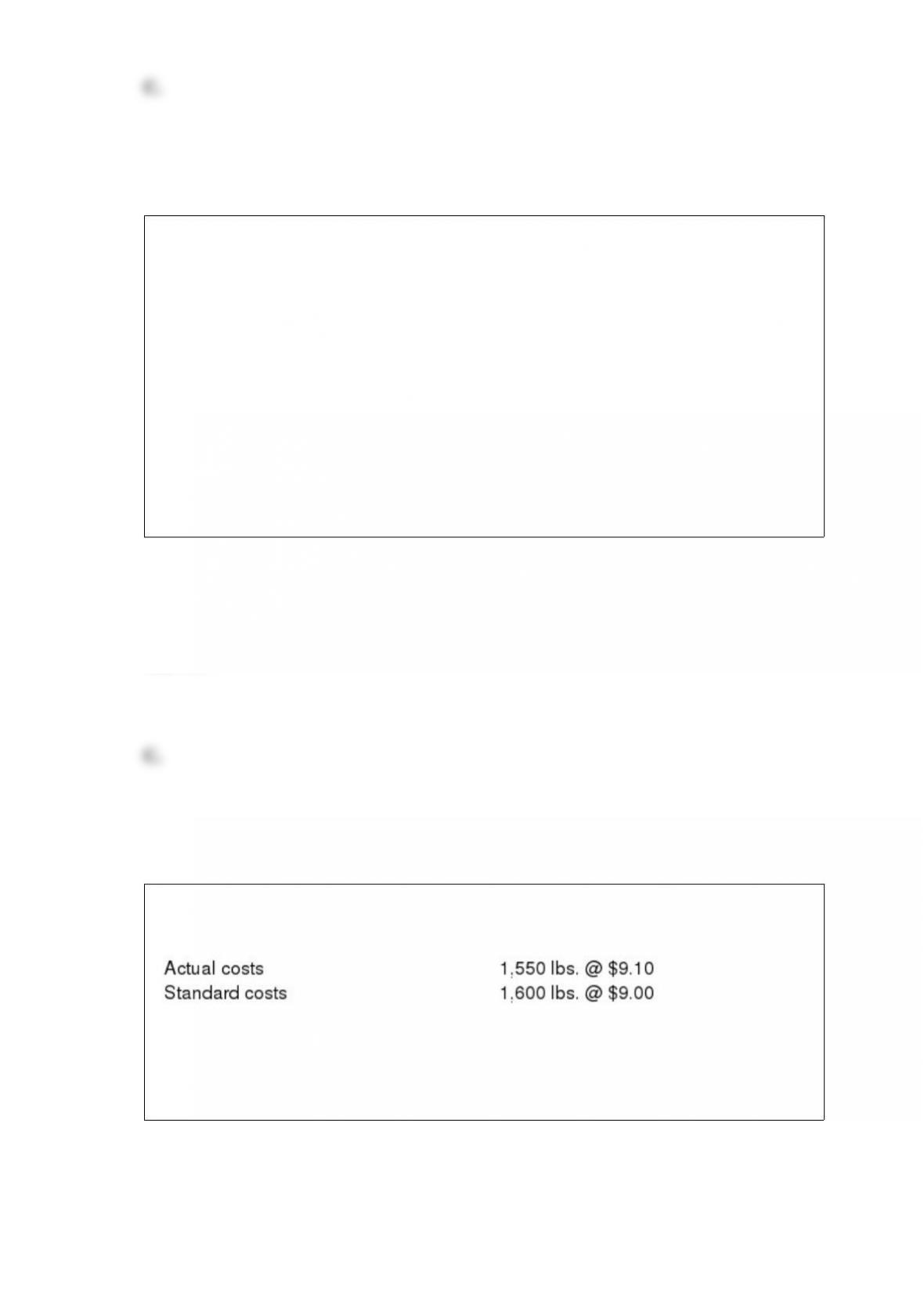
Production and sales estimates for March for the Robin Co. are as follows:
The number of units expected to be manufactured in March is:
A.24,000
B.27,000
C.27,300
D.21,300
Answer:
Abbey Co. sold merchandise to Gomez Co. on account, $35,000, terms 2/15, net 45.
The cost of the merchandise sold is $24,500. Abbey Co. issued a credit memo for
$3,600 for merchandise returned that originally cost $1,700. Gomez Co. paid the
invoice within the discount period. What is the amount of gross profit earned by Abbey
Co. on the above transactions?
A.10,500
B.30,772
C.7,972
D.31,400
Answer:
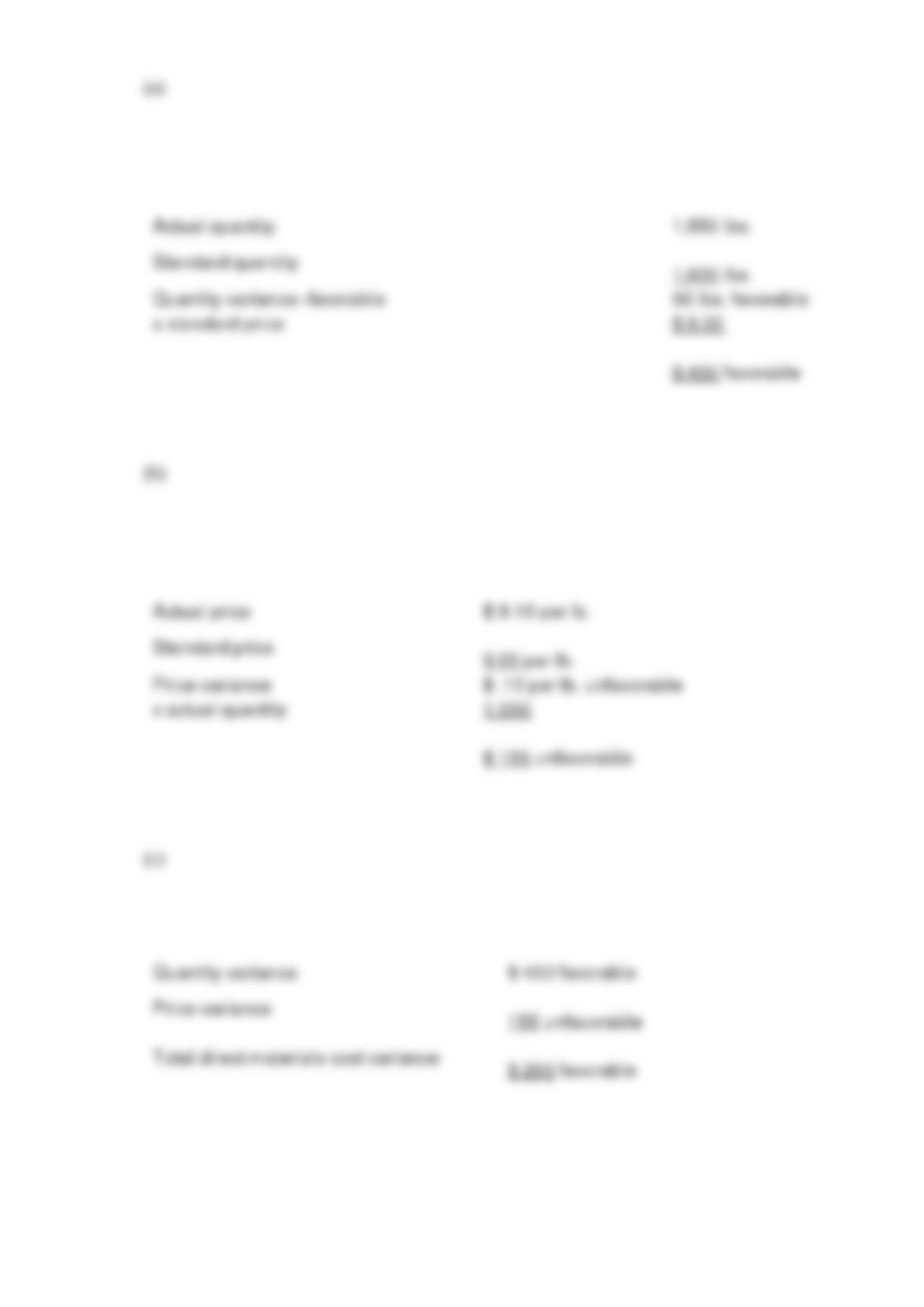
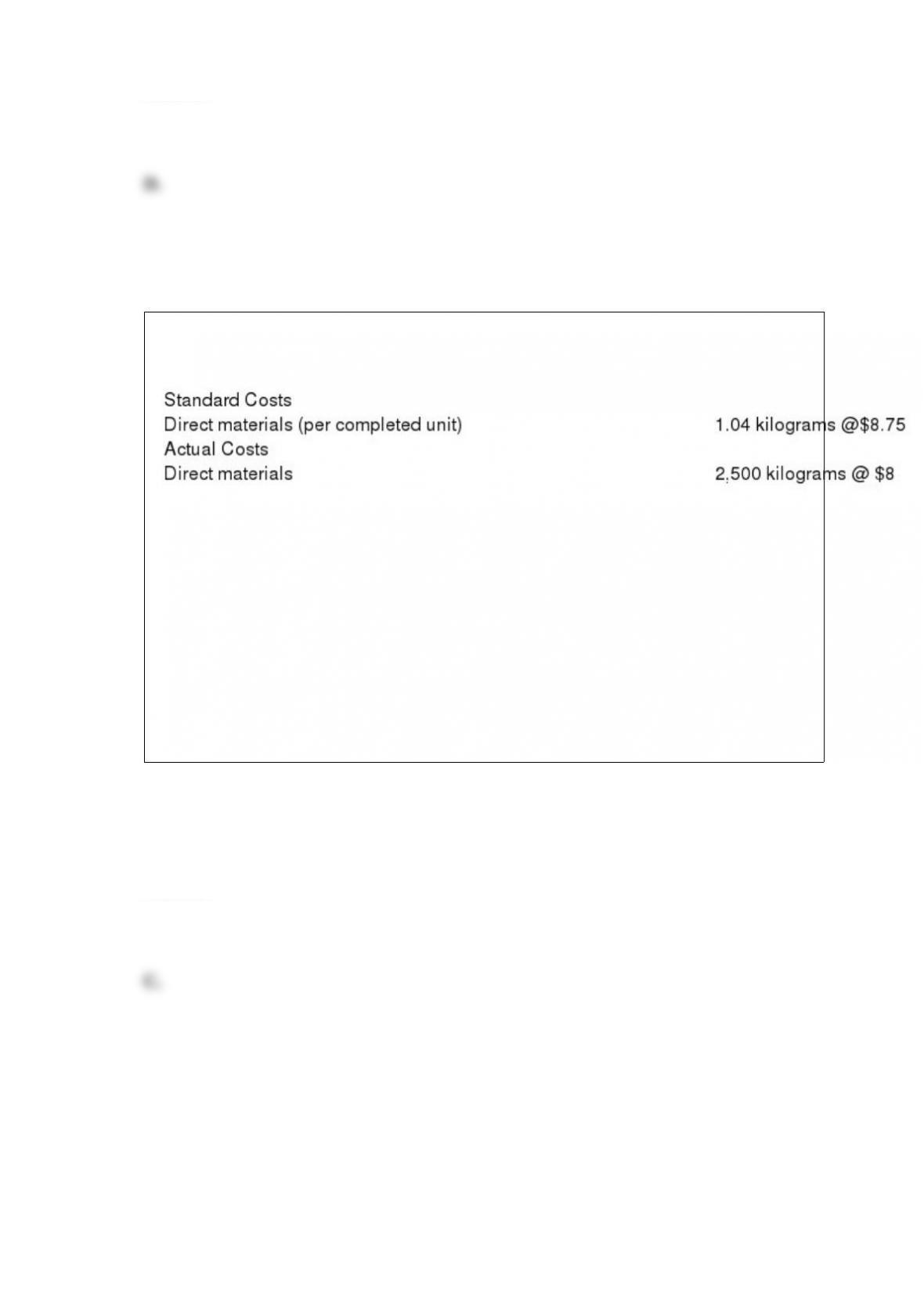
Standard and actual costs for direct materials for the manufacture of 1,000 units of
product were as follows:
Determine the (a) quantity variance, (b) price variance, and (c) total direct materials
cost variance.
Answer:
During September, Excom sold 100 radios for $50 each. Each radio cost Excom $30 to
purchase, and carried a two-year warranty. If 5% of the goods sold typically need to be
replaced over the warranty period and one is actually replaced during September, for
what amount in September would Excom debit Product Warranty Expense?
A.$50
B.$150
C.$30
D.$120
Answer:
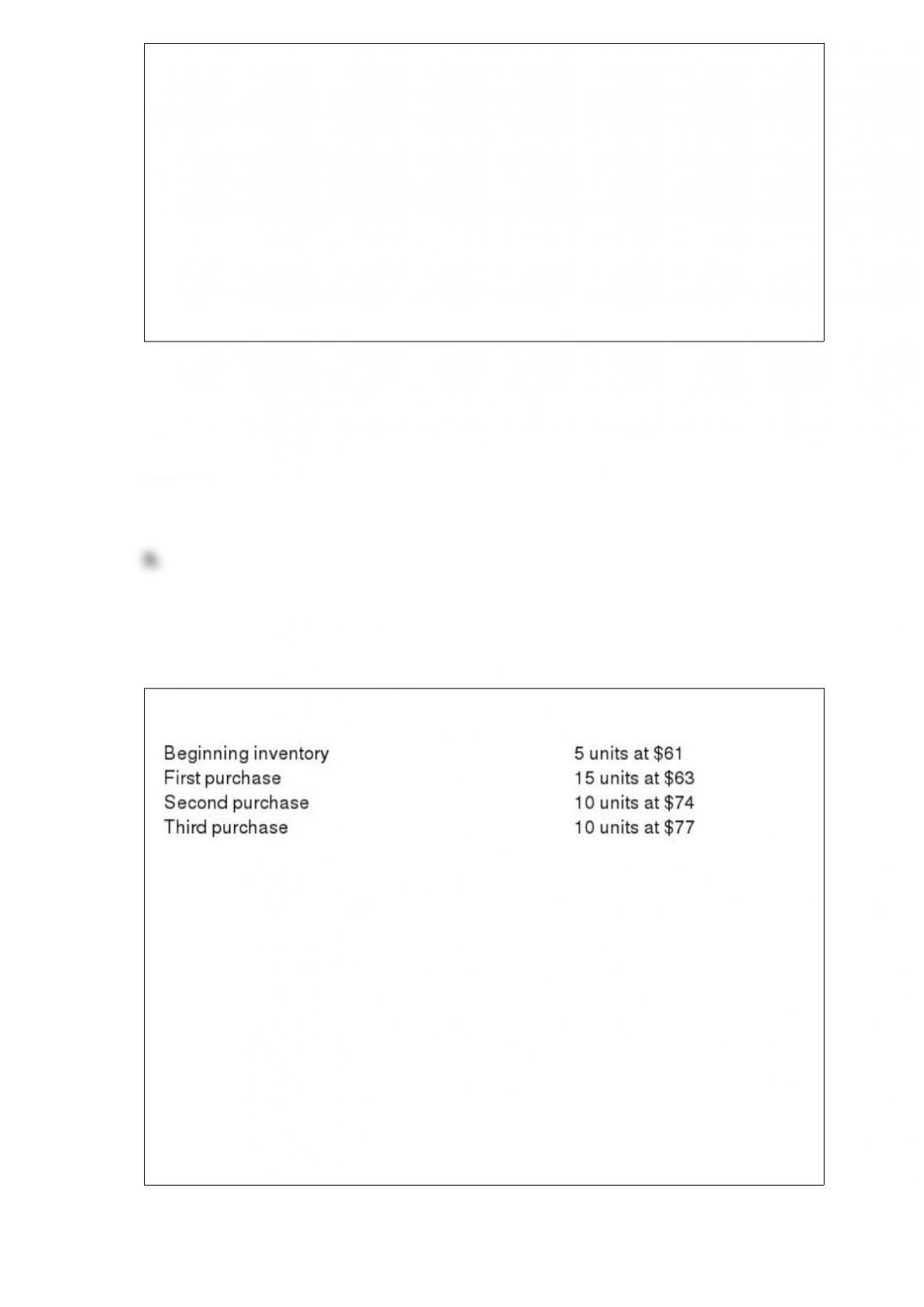
The following lots of a particular commodity were available for sale during the year:
The firm uses the periodic system and there are 20 units of the commodity on hand at
the end of the year.
What is the amount of cost of goods sold for the year according to the FIFO method?
A.$1,380
B.$1,375
C.$1,510
D.$1,250
Answer:
The standard costs and actual costs for direct materials for the manufacture of 3,000
actual units of product are as follows:
The amount of direct materials price variance is:
A.$2,250 unfavorable
B.$1,950 favorable
C.$1,875 favorable
D.$1,950 unfavorable
Answer: