Partial productivity measures are most closely related to what type of variances?
A. price variances
B. sales mix variances
C. efficiency variances
D. production volume variances
Answer:
Pardee Company makes 30% of its sales for cash and 70% on account. 60% of the
account sales are collected in the month of sale, 25% in the month following sale, and
12% in the second month following sale. The remainder is uncollectible. The following
information has been gathered for the current year:
Total cash receipts in Month 4 will be
A. $38,000.
B. $47,900.
C. $27,230.
D. $36,230.
Answer:

Which of the following statements is (are) true regarding product costing?
(A) Twenty cans of paint that are 25% full are equivalent to four cans of paint that are
completely full.
(B) The equivalent unit concept refers to the actual amount of work during the period
stated in terms of whole units.
A. Only A is true.
B. Only B is true.
C. Both A and B are true.
D. Neither A nor B is true.
Answer:
Given the following information:
What would expected net income be if the company experienced a 10 percent increase
in fixed costs and 10 percent increase in sales volume?
A. $1,750.
B. $1,550.
C. $1,250.
D. $1,375.
Answer:
The Muskego National Bank is considering either a bankwide overhead rate or
department overhead rates to allocate $250,000 of indirect costs. The bankwide rate
could be based on either direct labor hours (DLH) or the number of loans processed.
The departmental rates would be based on direct labor hours for Consumer Loans and a
dual rate based on direct labor hours and the number of loans processed for Commercial
Loans. The following information was gathered for the upcoming period:
Management estimates that it costs $500 to analyze and close a commercial loan. This
amount has been included in the $250,000 of indirect costs. How much of the $250,000
indirect costs should be allocated to the Consumer Department?
A. $50,000
B. $90,000
C. $160,000
D. $200,000
Answer:
The following information relates to a product produced by Bayfield Company:
Fixed selling costs are $1,000,000 per year. Although production capacity is 900,000
units per year, Bayfield expects to produce only 800,000 units next year. The product
normally sells for $180 each. A customer has offered to buy 60,000 units for $150 each.
The customer will pay the transportation charge on the units purchased.
Required:
a) Compute the effect on income if Bayfield accepts the special order.
b) If Bayfield accepts the special order, how much could normal sales drop before all of
the differential profits disappear?
Answer:
In analyzing company operations, the controller of the Jason Corporation found a
$250,000 favorable flexible budget revenue variance. The variance was calculated by
comparing the actual results with the flexible budget. This variance can be wholly
explained by (CMA adapted)
A. the total flexible budget variance.
B. the total static budget variance.
C. changes in unit selling prices.
D. changes in the number of units sold.
Answer:
A master budget consists of (a) organizational goals, (b) strategic long-range profit
plan, and (c) tactical short-range profit plan.
Answer:
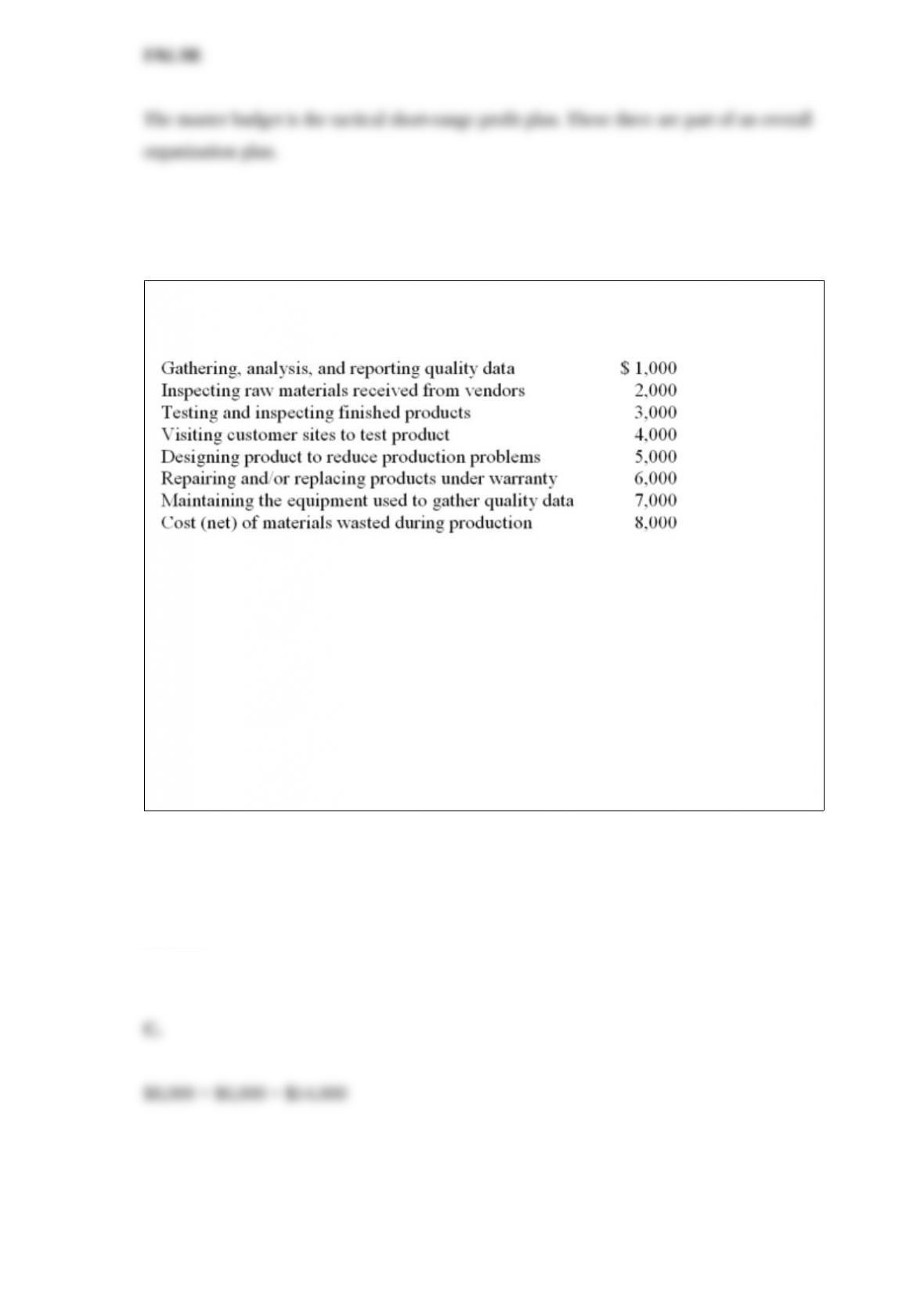
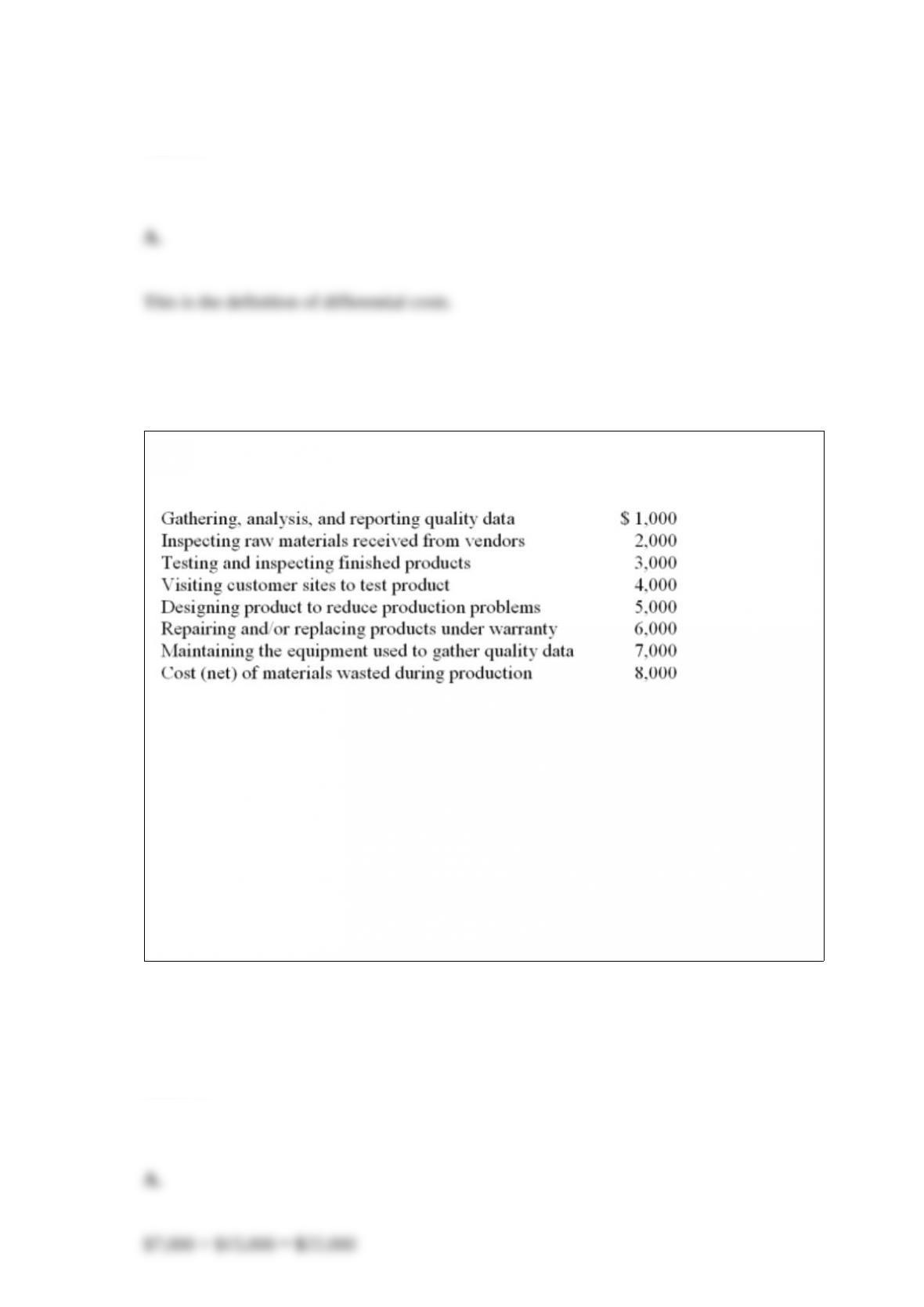
BC Enterprises’ quality control report for August contains the following items.
What would be the total of the nonconformance costs on the August quality control
report for BC Enterprises?
A. $22,000
B. $21,000
C. $14,000
D. $13,000
Answer:
The basic cost flow model is:
A. BB + TO = TI + EB
B. BB + TO – TI = EB
C. EB = BB + TI – TO
D. EB – BB = TO – TI
E. EB + TI – TO = BB
Answer:
Which of the following items would be classified as a volume-level cost in an
activity-based cost management (ABM) system?
A. Indirect materials
B. Production supervisor’s salary
C. Depreciation on factory building
D. Research and development
Answer:
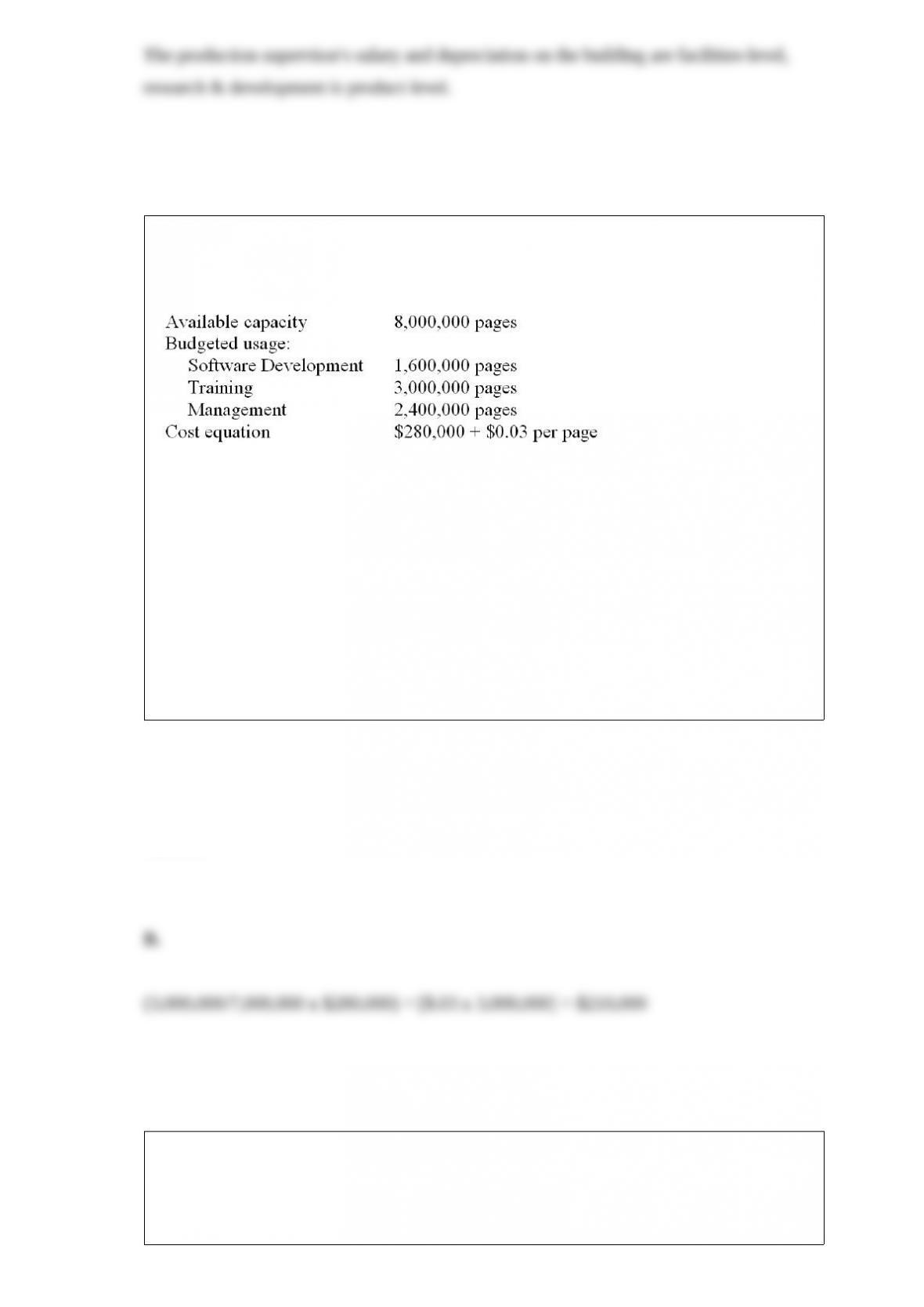
The Document Creation Center (DCC) for Alegis Corp. provides photocopying and
document services for three departments in the St. Paul office. The following budget
has been prepared for the year.
If DCC uses a dual rate for allocating its costs based on usage, how much cost will be
allocated to the Training Department?
A. $183,750
B. $210,000
C. $195,000
D. $222,857
Answer:
Which of the following statements is (are) true?
(A) A favorable variance is not necessarily good, and an unfavorable variance is not
necessarily bad.
(B) The master budget includes operating budgets (e.g., production budget) and
financial budgets (e.g., cash budget).
A. Only A is true.
B. Only B is true.
C. Both A and B are true.
D. Neither A nor B is true.
Answer:
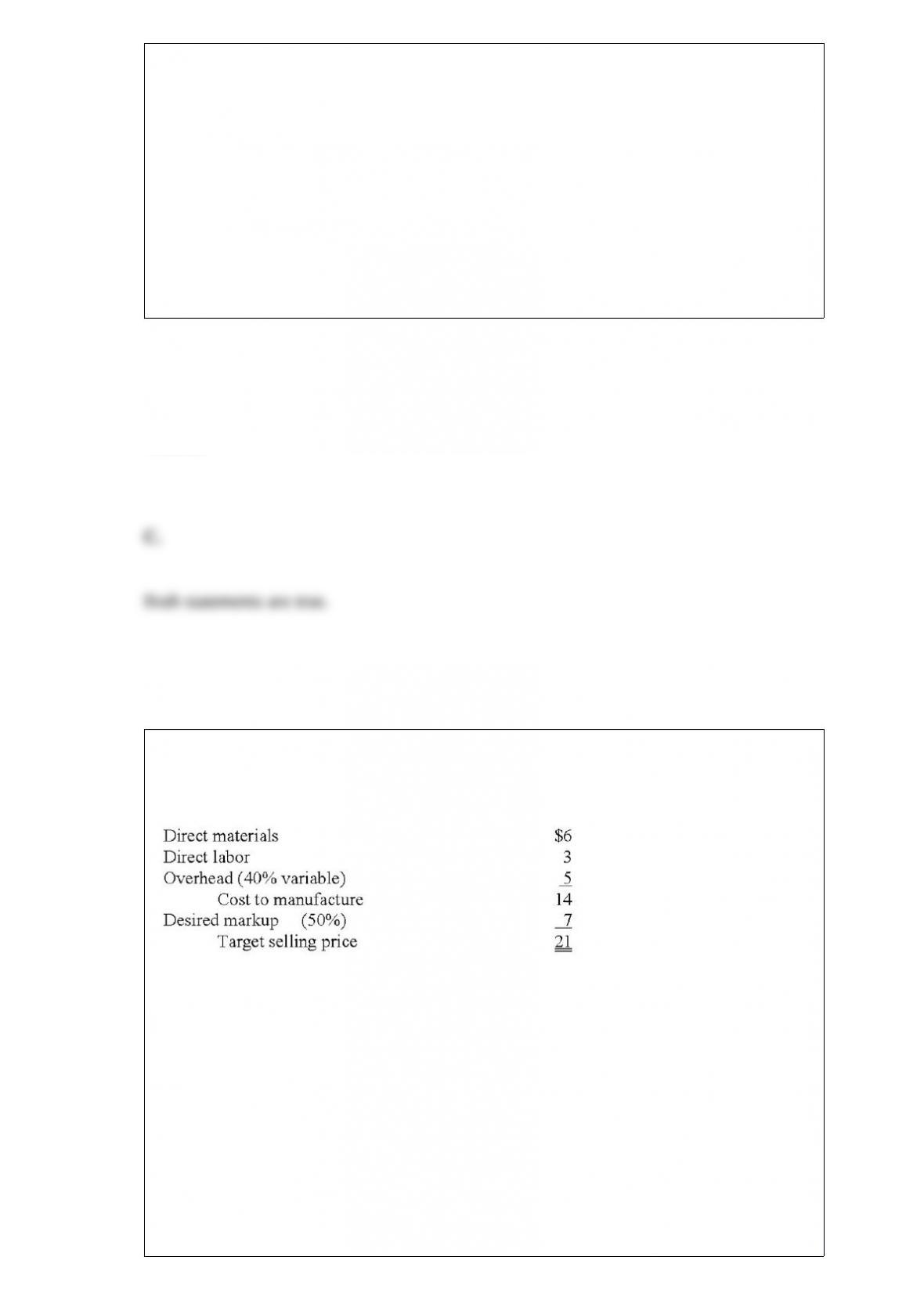
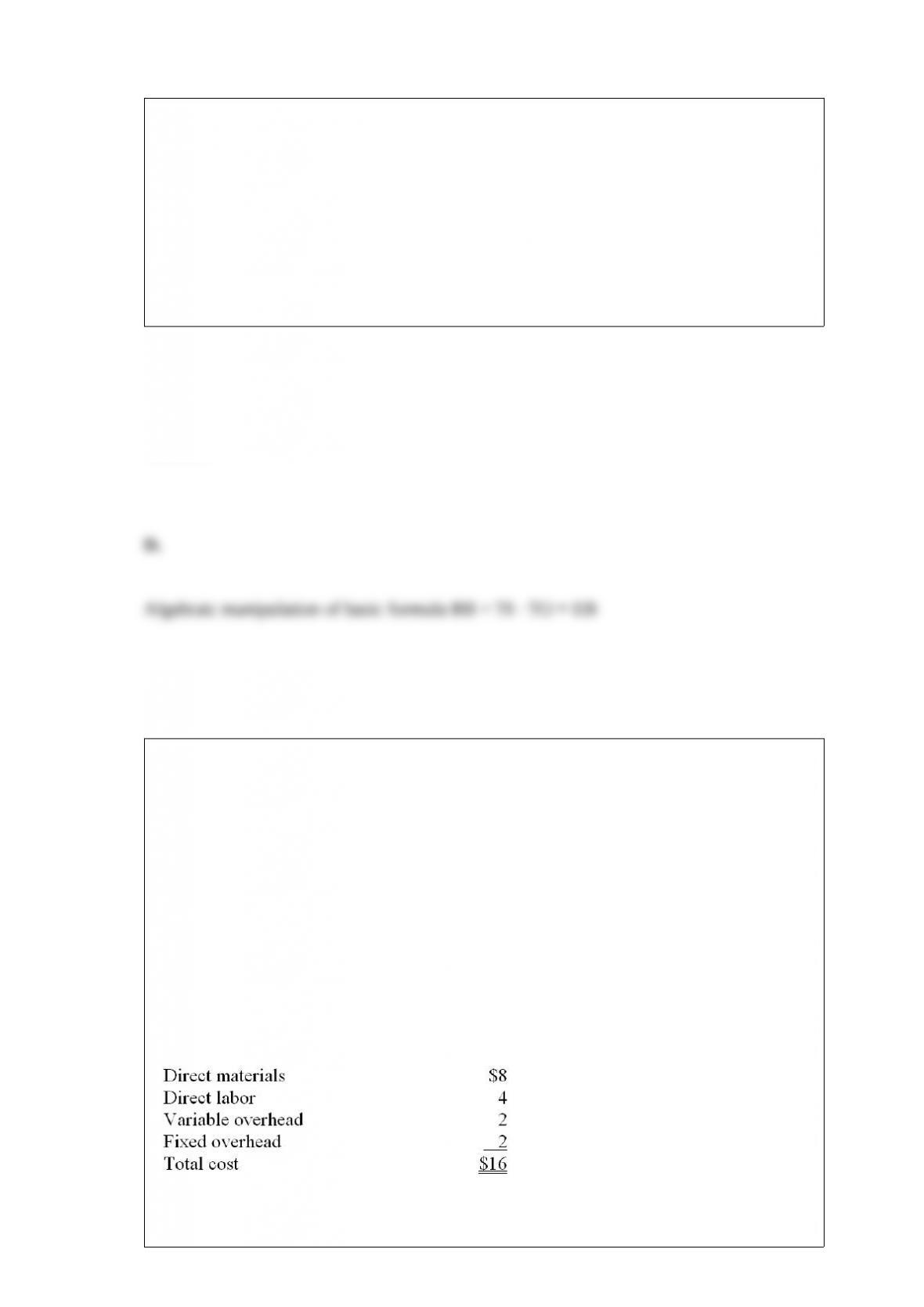
The MNK Company has gathered the following information for a unit of its most
popular product:
The above cost information is based on 4,000 units. A foreign distributor has offered to
buy 1,000 units at a price of $16 per unit. This special order would not disturb regular
sales. Variable shipping and other selling expenses would be an additional $1 per unit
for the special order. If the special order is accepted, MNK’s operating profits will
increase by:
A. $1,000.
B. $1,600.
C. $2,000.
D. $4,000.
E. $5,000.
Answer:
One of the primary differences between job costing for service and manufacturing
companies is service firms generally
A. use fewer direct materials.
B. have less direct labor.
C. do not use predetermined overhead rates.
D. have no Work in Process Inventory.
Answer:
The Task Company is to begin operations in April. They have budgeted April sales of
$30,000. May sales of $34,000, June sales of $40,000, July sales of $42,000, and
August sales of $38,000. 10% of each month’s sales will represent cash sales; 75% of
the balance will be collected in the month following the sale, 17% the second month,
6% the third month and the balance is bad debts.
Assume the Task Company charges 1 1/2% on any balance that is not collected in the
month following the month of sale. This charge will also change the collection
percentages to 15% cash sales, 80% of the balance collected in the month following the
sale, 16% the second month, 3% the third month. This stricter credit policy will reduce
the estimated sales budgets by 7% each month. What is the amount of cash to be
collected in July?
A. $39,199
B. $35,312
C. $38,193
D. $36,242
Answer:
Differential costs are (CMA adapted)
A. the difference in total costs that result from selecting one choice instead of another.
B. the profit foregone by selecting one choice instead of another.
C. a cost that continues to be incurred in the absence of activity.
D. a cost common to all choices in questions and not clearly allocable to any of them.
Answer:
BC Enterprises’ quality control report for August contains the following items.
What would be the total of the conformance costs on the August quality control report
for BC Enterprises?
A. $22,000
B. $20,000
C. $15,000
D. $13,000
Answer:
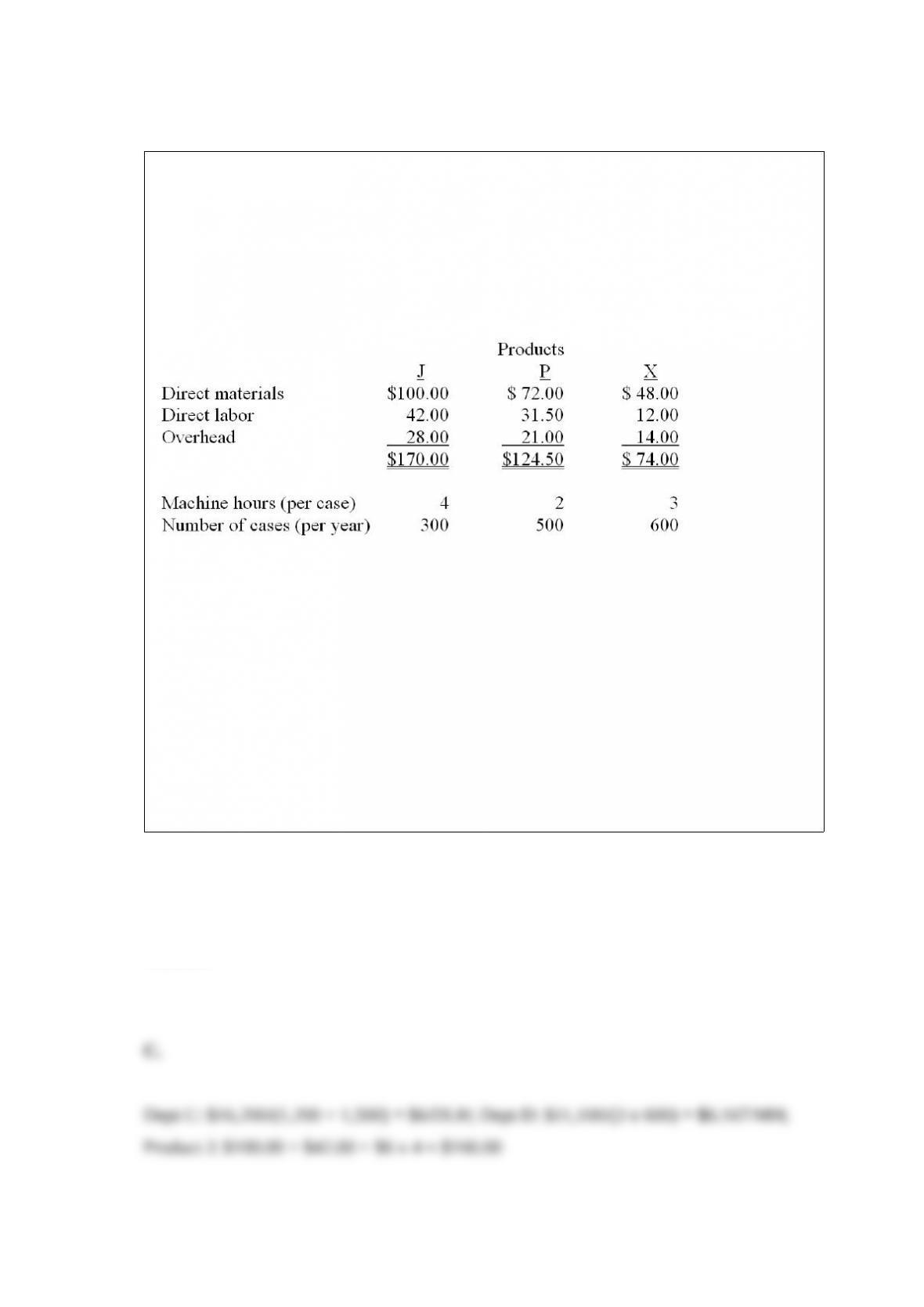
Smelly Perfume Company manufactures and distributes several different products.
They currently use a plantwide allocation method for allocating overhead at a rate of $7
per direct labor hour. Cindy is the department manager of Department C which
produces Products J and P. Department C has $16,200 in traceable overhead. Diane is
the department manager of Department D which manufactures Product X. Department
D has $11,100 in traceable overhead. The product costs (per case of 24 bottles) and
other information are as follows:
If Smelly changes its overhead allocation to departmental rates, what is the product
cost per case for Product J assuming Departments C and D use direct labor hours and
machine hours as their respective allocation bases?
A. $169.30
B. $161.50
C. $166.00
D. $182.44
Answer:
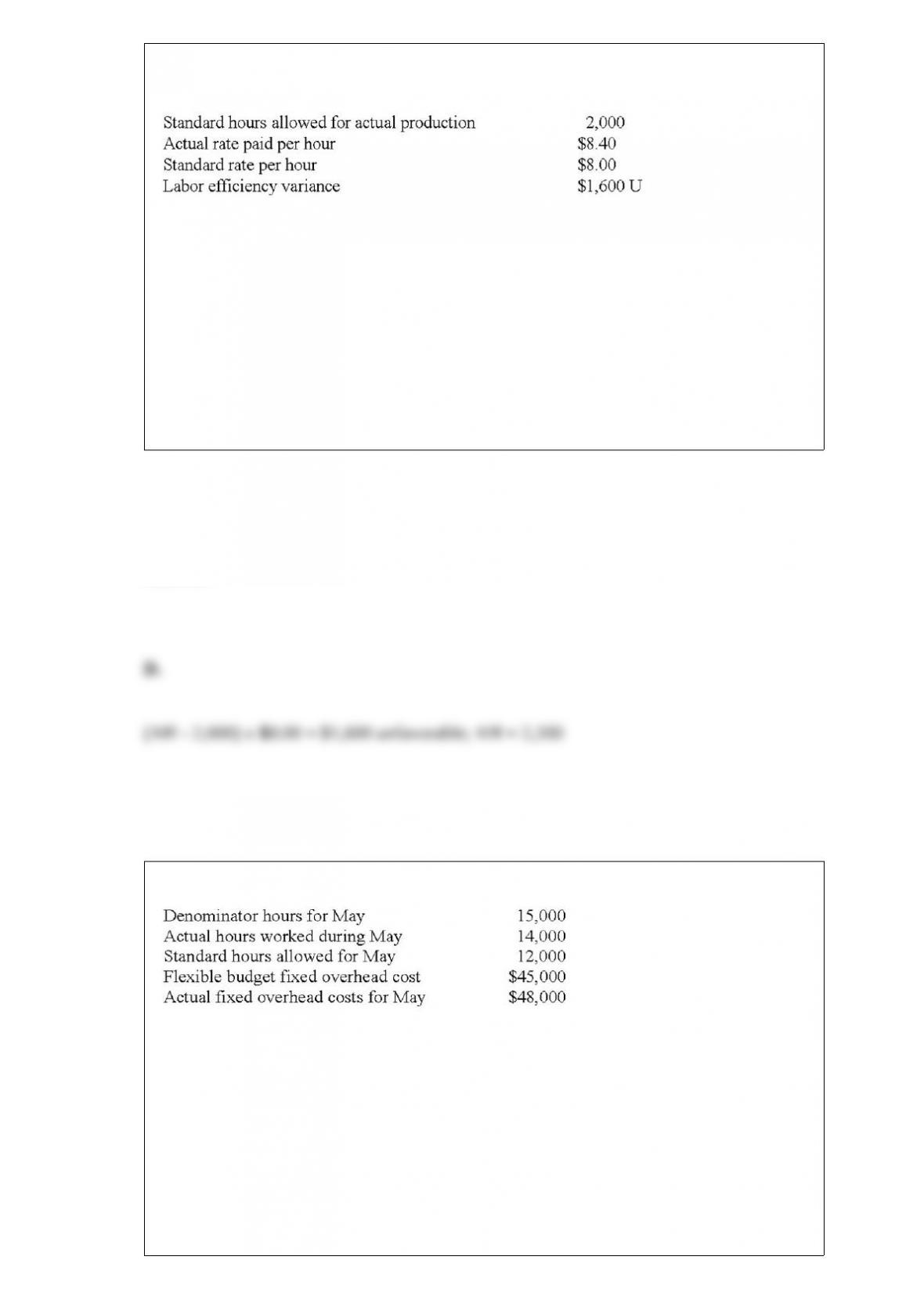
Tub Company uses a standard cost system. The following information pertains to direct
labor for product B for the month of October:
What were the actual hours worked for the month of October?
A. 1,800
B. 1,810
C. 2,190
D. 2,200
Answer:
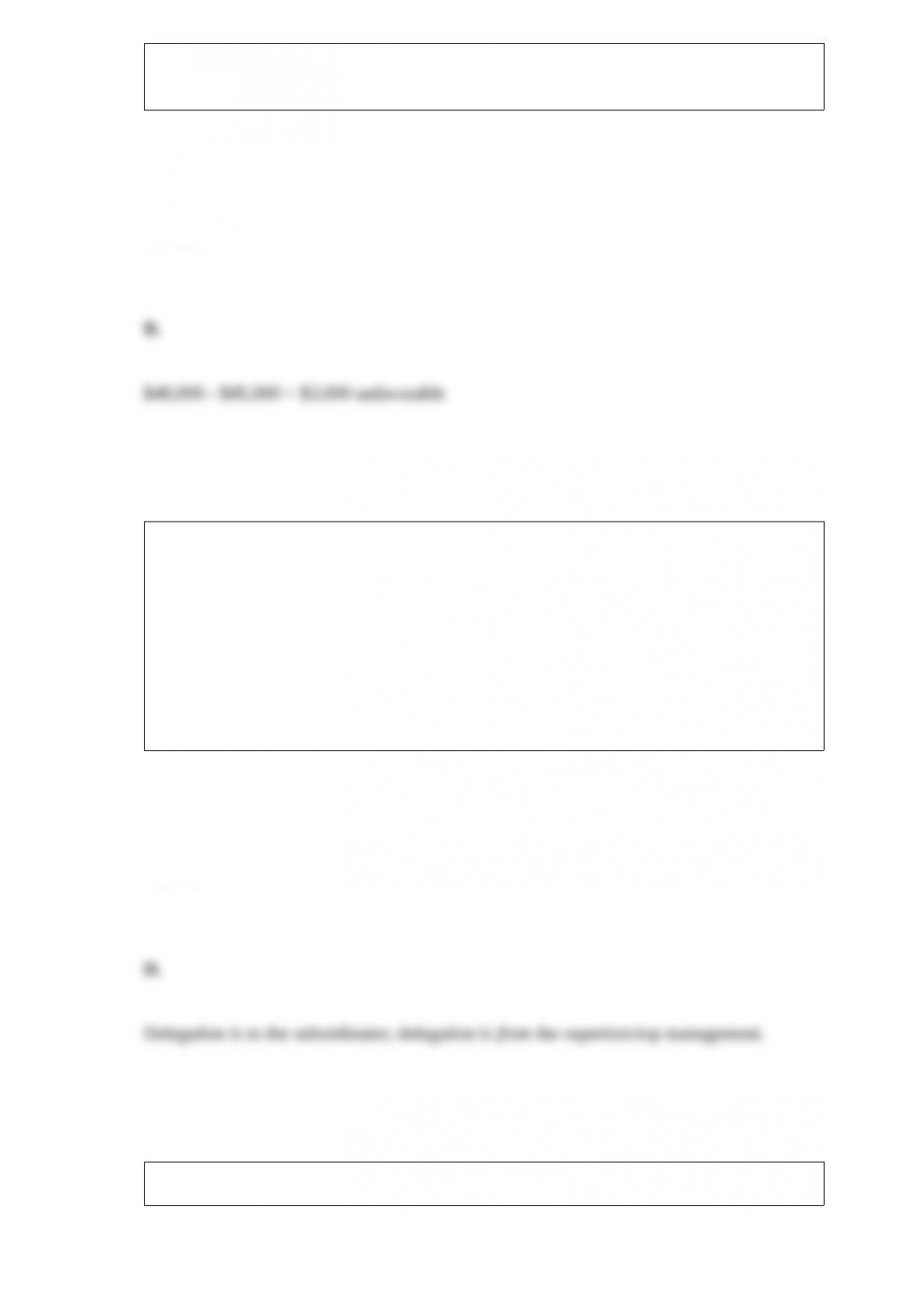
What is the fixed overhead spending (budget) variance for May?
A. $1,000 unfavorable
B. $3,000 unfavorable
C. $2,000 unfavorable
D. $2,000 favorable
E. $3,000 favorable
Answer:
Decentralization refers to the delegation of decision-making authority to
A. top management.
B. superiors.
C. board of directors.
D. subordinates.
Answer:
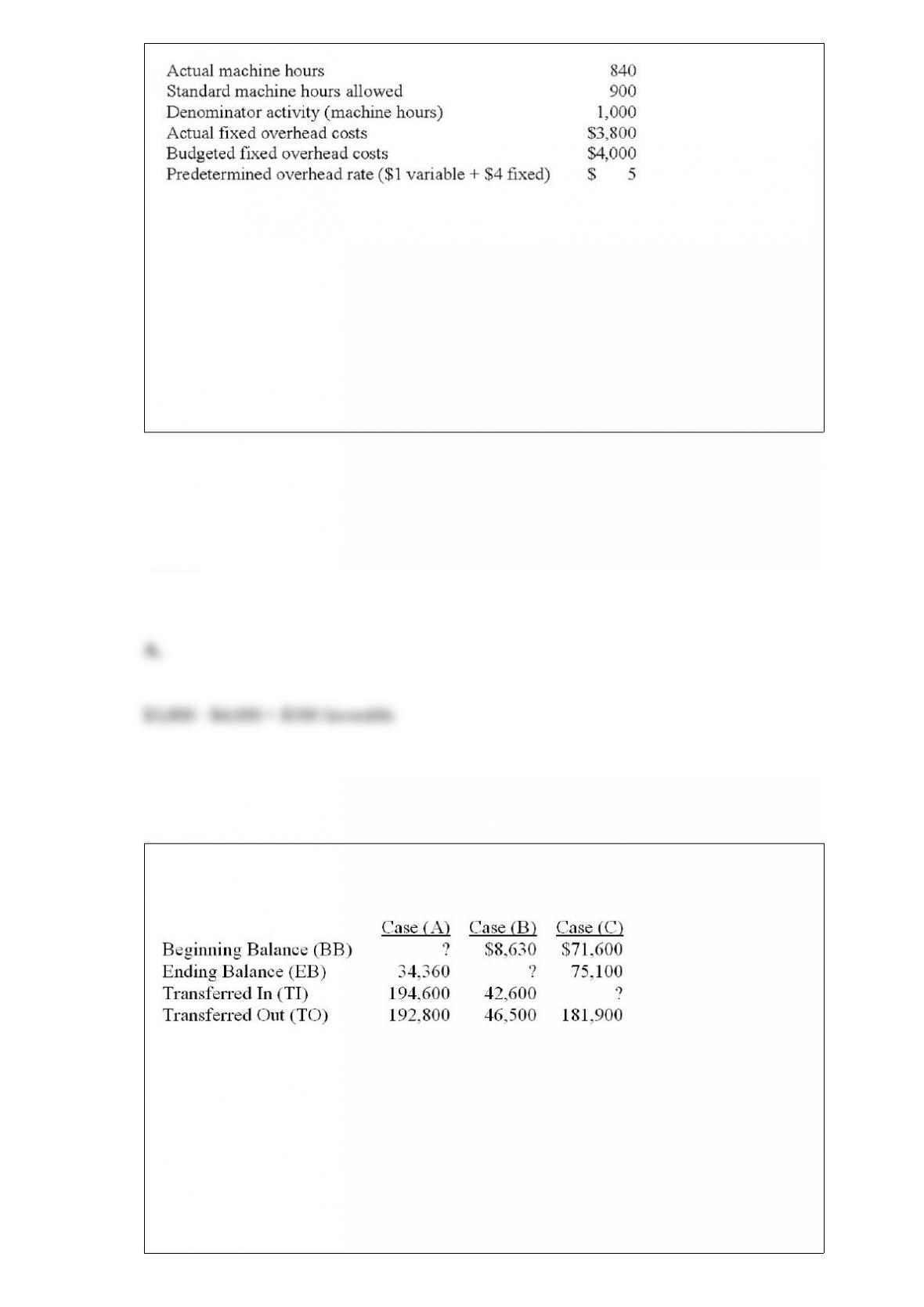
What is the fixed overhead spending (budget) variance?
A. $200
B. $400
C. $300
D. $240
Answer:
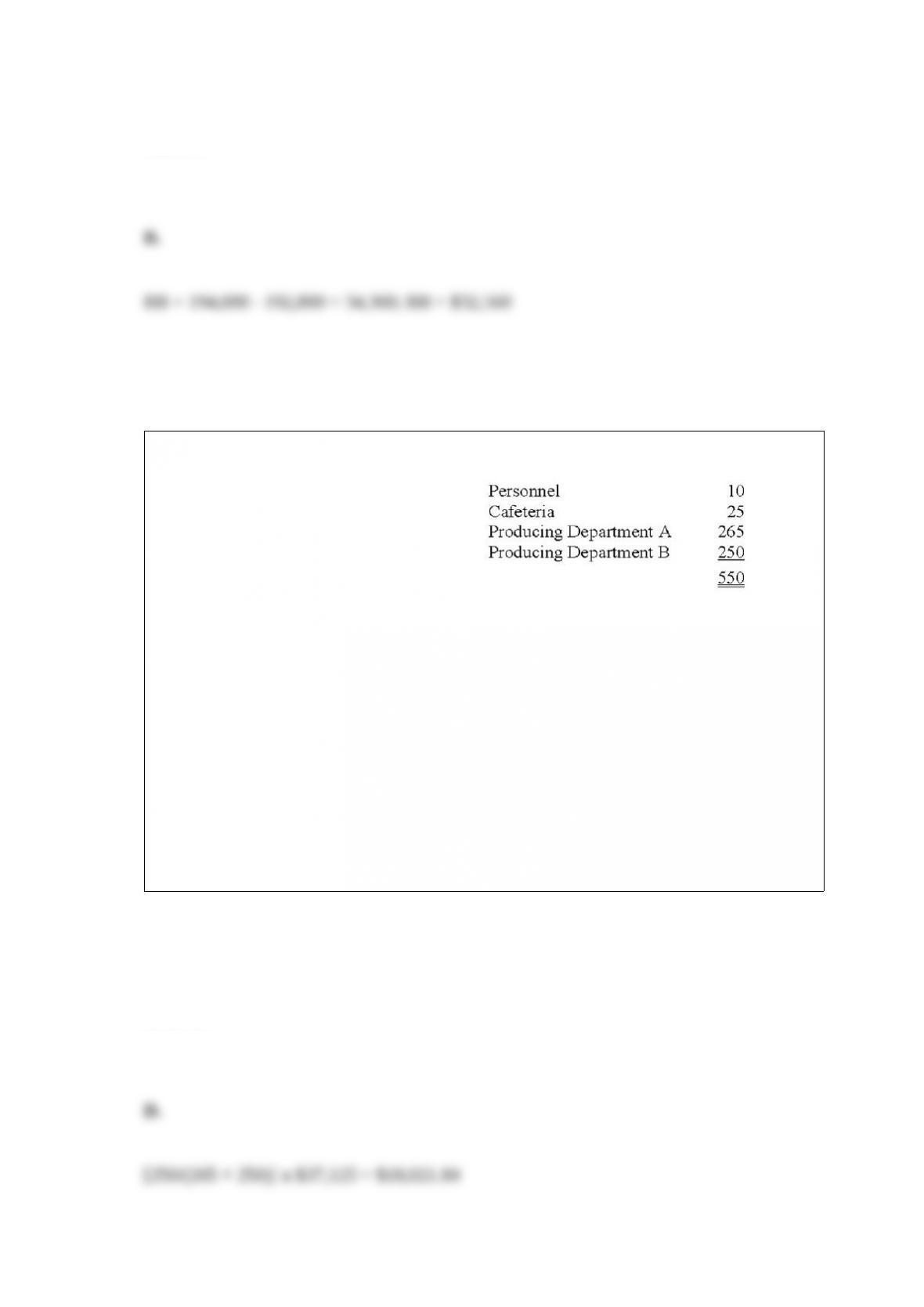
For Case (A) above,
what is the Beginning Balance (BB)?
A. $36,400
B. $32,560
C. $37,680
D. $34,040
Answer:
Castle Company has two service departments and two producing departments. The
number of employees in each department is
The department costs of the Personnel Department are allocated on a basis of the
number of employees. If these costs are budgeted at $37,125 during a given period, the
amount of cost allocated to Department B under the direct method would be
A. $0.
B. $17,187.50.
C. $16,875.00.
D. $18,021.84.
Answer:
The basic cost flow model is:
A. BB + TO – TI = EB
B. BB + EB – TO = TI
C. BB – TI – TO = EB
D. BB + TI – TO = EB
Answer:
Meredith Motor Works has just acquired a new Battery Division. The Battery Division
produces a standard 12volt battery that it sells to retail outlets at a competitive price of
$20. The retail outlets purchase about 800,000 batteries a year. Since the Battery
Division has a capacity of 1,000,000 batteries a year, top management is thinking that it
might be wise for the company’s Automotive Division to start purchasing batteries from
the newly acquired Battery Division.
The Automotive Division now purchases 300,000 batteries a year from an outside
supplier, at a price of $18 per battery. The discount from the competitive $20 price is a
result of the large quantity purchased.
The Battery Division’s cost per battery is shown below:
Fixed costs are based on 1,000,000 batteries.
Both divisions are to be treated as investment centers, and their performance is to be
evaluated by the ROI formula.
Required:
a) What transfer price would you recommend and why?
b) What transfer price would you recommend if the Battery Division is now selling
1,000,000 batteries a year to retail outlets?
c) Suppose the manager of the Battery Division can increase its capacity to 1,500,000
units for $1,200,000. She then has the option of (a) cutting the retail price to $17.50
with the certainty that sales will increase to 1,500,000 batteries, or (b) maintaining the
outside price of $20.00 for the 800,000 batteries and transferring the 300,000 batteries
to the Automotive Division at some price that would produce the same income for the
Battery Division as option (a). What is the minimum transfer price you would
recommend in this situation?
Answer:
The FGH Company has an asset turnover of 3.0 times, using assets of $45,000. The
company also has a return on investment (ROI) of 20%. If the residual income was
$2,250, what was the company’s cost of capital?
A. 6.0%
B. 10.0%
C. 15.0%
D. 20.0%
Answer:
During 2006, Thor Lab supplied hospitals with a comprehensive diagnostic kit for
$120. At a volume of 80,000 kits, Thor had fixed costs of $1,000,000 and a profit
before income taxes of $200,000. Due to an adverse legal decision, Thor’s 2007 liability
insurance increased by $1,200,000 over 2006. Assuming the volume and other costs are
unchanged, what should the 2007 price be if Thor is to make the same $200,000 profit
before income taxes? (CPA adapted)
A. $122.50
B. $135.00
C. $152.50
D. $240.00
Answer:
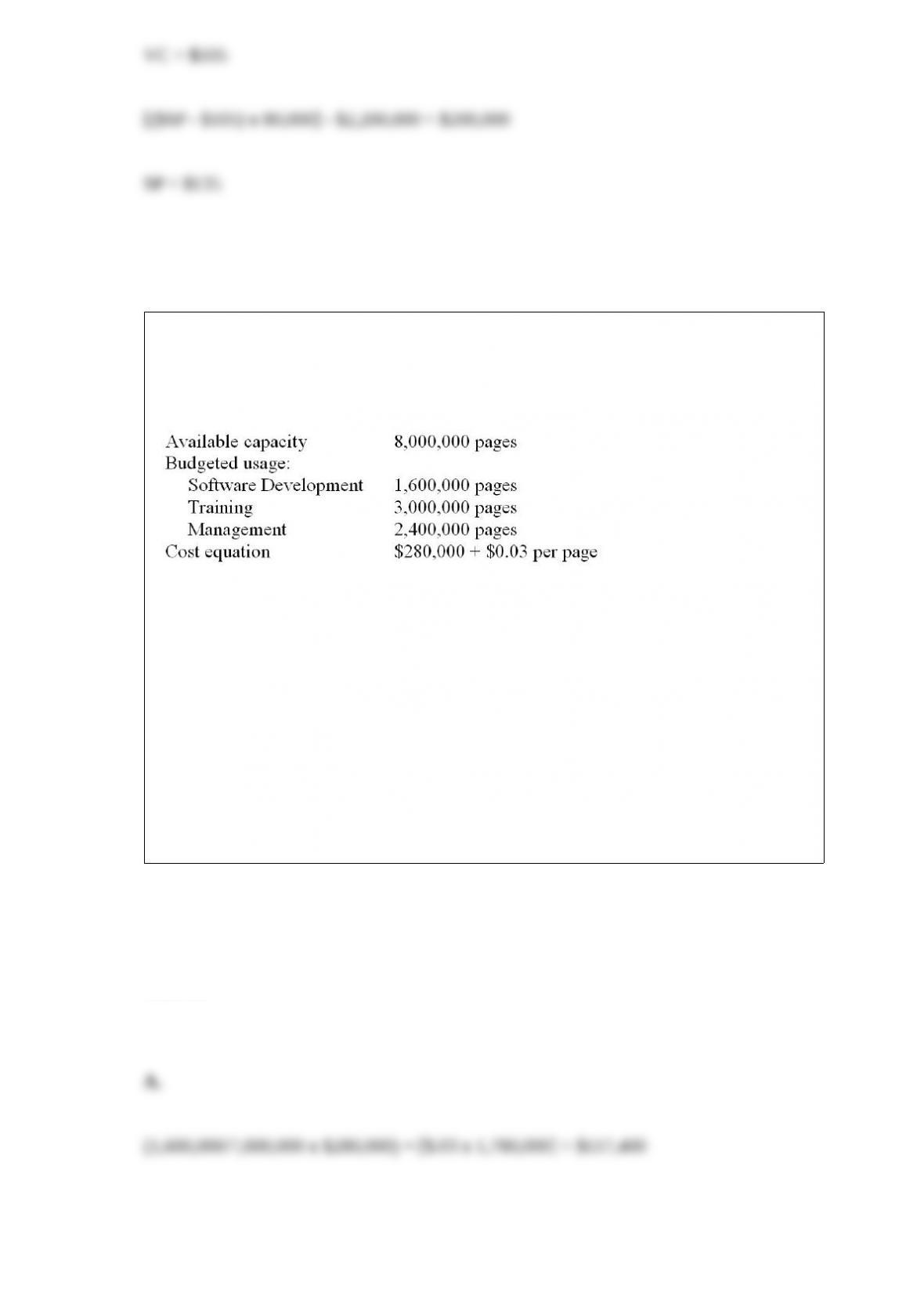
The Document Creation Center (DCC) for Alegis Corp. provides photocopying and
document services for three departments in the St. Paul office. The following budget
has been prepared for the year.
If DCC uses a dual-rate for allocating its costs, how much cost will be allocated to the
Software Development Department, assuming the Software Development Department
actually made 1,780,000 copies during the year?
A. $117,400
B. $115,700
C. $124,600
D. $129,376
Answer:
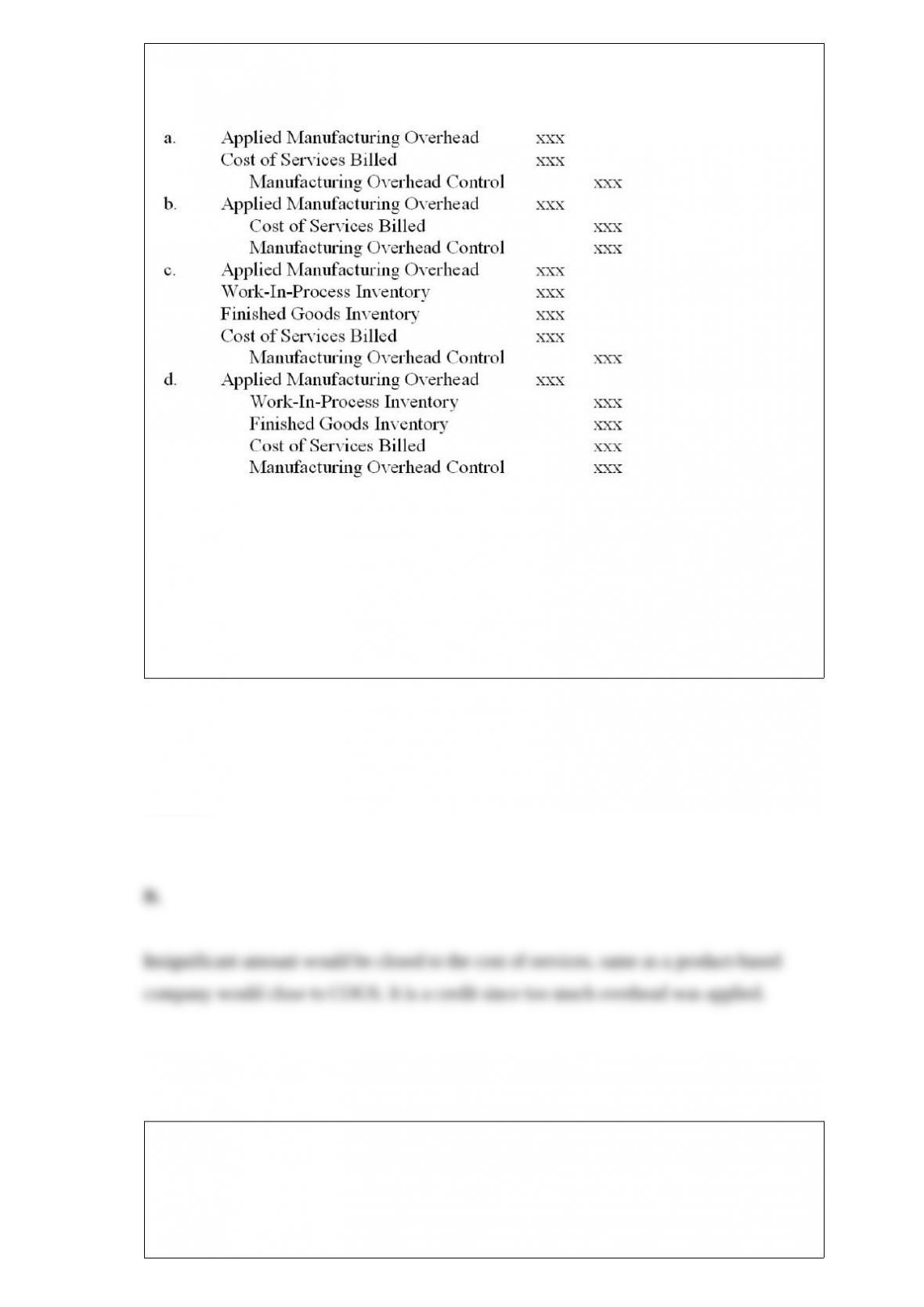
The journal entry to write-off an insignificant overapplied overhead balance at the end
of an accounting period for a service firm is
A. a
B. b
C. c
D. d
Answer:
Which of the following best describes the objective of joint cost allocation?
A. Inventory valuation.
B. Pricing goods for sale.

C. Making decisions about levels of production.
D. Making decisions about raw materials requirements.
Answer:
Which of the following is the most probable reason a company would experience an
unfavorable labor rate variance and a favorable labor efficiency variance?
A. The mix of workers assigned to the particular job was heavily weighted towards the
use of higher paid experienced individuals.
B. The mix of workers assigned to the particular job was heavily weighted towards the
use of new relatively low paid unskilled workers.
C. Because of the production schedule, workers from other production areas were
assigned to assist this particular process.
D. Defective materials caused more labor to be used in order to produce a standard unit.
Answer:
Residual income is a performance evaluation that is used in conjunction with, or
instead of, return on investment (ROI). In many cases, residual income is preferred to
ROI because (CIA adapted)
A. Residual income is a measure over time, while ROI represents the results for one
period.
B. Residual income concentrates on maximizing absolute dollars of income rather than
a percentage return as with ROI.
C. The imputed interest rate used in calculating residual income is more easily derived
than the target rate that is compared to the calculated ROI.
D. Average investment is employed with residual income while year-end investment is
employed with ROI.
Answer: