On February 16, a company declares a 34¢ dividend to be paid on April 5. There are
1,900,000 shares of common stock issued and outstanding. The entry recorded by the
company on February 16 includes a debit to:
A) Dividends Payable and a credit to Cash for $680,000.
B) Dividends and a credit to Dividends Payable for $646,000.
C) Dividends Payable and a credit to Cash for $646,000.
D) Dividends and a credit to Dividends Payable for $680,000.
A company’s sales are $285,000 and $200,000 during the current and prior years,
respectively. The percentage change is:
A) 42.5%.
B) 70%.
C) 29.8%.
D) 130%.
Which amount should be reported as cash on the balance sheet?
A) The ending cash balance per the bank statement
B) The beginning cash balance per the bank statement
C) The up-to-date ending cash balance per the bank reconciliation
D) The ending cash balance per the books
A company declared a $0.80 per share cash dividend. The company has 100,000 shares
authorized, 45,000 shares issued, and 42,000 shares of common stock outstanding.
What is the journal entry to record the dividend declaration?
A) Debit Dividends and credit Dividends Payable for $36,000
B) Debit Dividends and credit Dividends Payable for $33,600
C) Debit Dividends Payable and credit Cash for $36,000
D) Debit Dividends Payable and credit Cash for $80,000
Which of the following statements about transaction analysis is correct?
A) Transactions are analyzed from the standpoint of the owners.
B) All business activities are considered to be accounting transactions.
C) The transaction amount is determined for each exchange based on the cost of the
items given and received.
D) A business needs journal entries only to show how transactions affect the balance
sheet.
Outstanding checks refer to checks that have been:A)written, recorded, sent to payees,
and received and paid by the bank.B)written and not yet recorded in the company
books.C)written, recorded, sent to the payees, but not yet paid by the bank.D)paid by
the bank.
Which of the following statements about methods of accounting for bad debts is
correct?
A) When the allowance method is used, the journal entry to write-off an uncollectible
account does not change the amount reported as Accounts Receivable, Net on the
balance sheet.
B) The two methods of accounting for bad debts that are acceptable under GAAP are
the allowance method and the direct write-off method.
C) When the allowance method is used, Bad Debt Expense is equal to the write-offs
that occurred during the period.
D) When the allowance method is used, if actual results differ from the estimates, the
prior year financial statements must be corrected.
If total liabilities decreased by $25,000 and stockholders’ equity increased by $5,000
during a period of time, then total assets must change by what amount and direction
during the same time period?
A) $20,000 increase
B) $20,000 decrease
C) $30,000 increase
D) $30,000 decrease
Find the missing data.
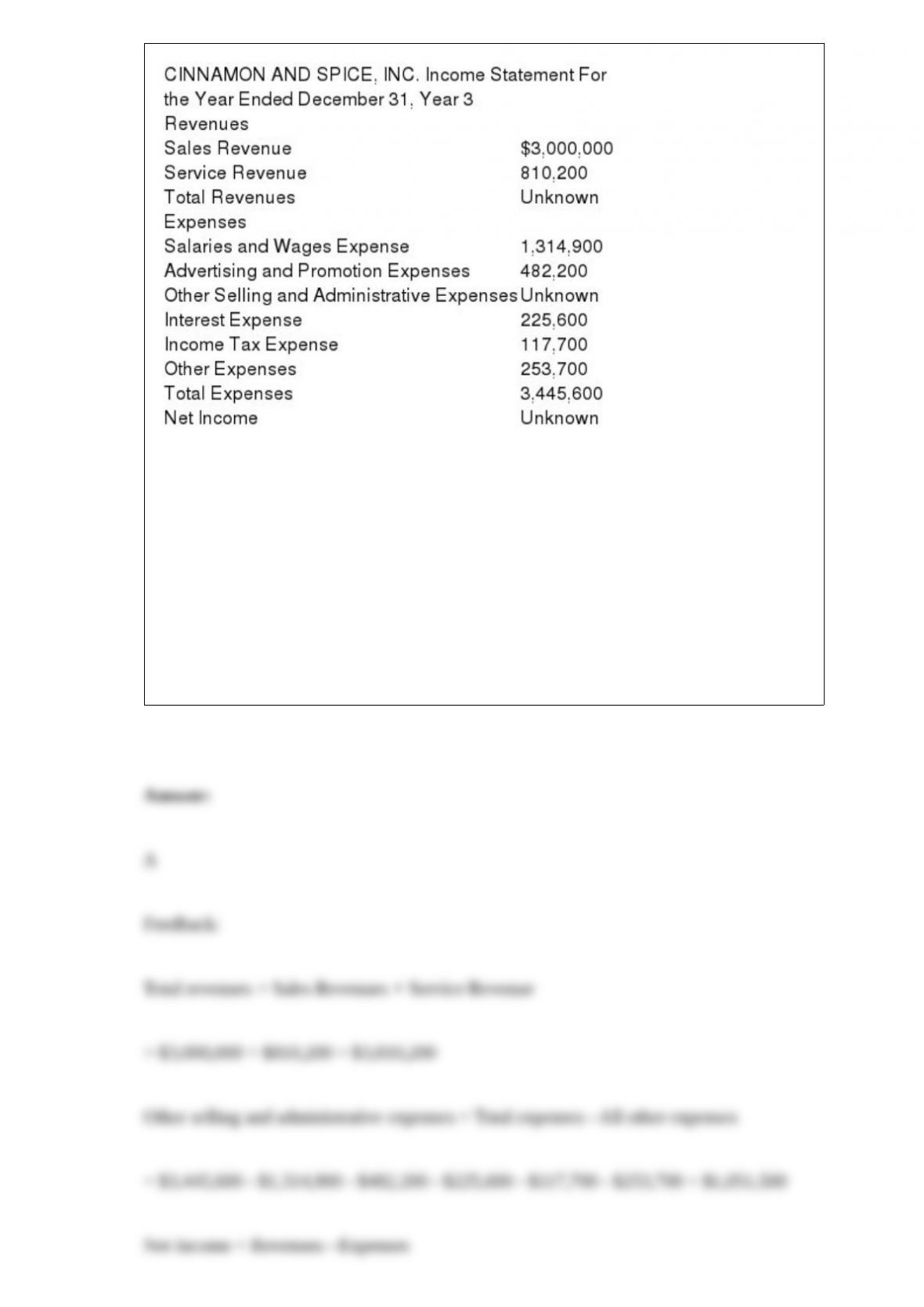
A) Total revenues are $3,810,200, other selling and administrative expenses are
$1,051,500, and net income is $364,600.
B) Total revenues are $2,495,300, other selling and administrative expenses are
$1,051,500, and net income is ($950,300).
C) Total revenues are $364,600, other selling and administrative expenses are
$3,081,000, and net income is $7,255,800.
D) Total revenues are $3,810,200, other selling and administrative expenses are
$364,600, and net income is $7,255,800.
A company started the year with the following: Assets $100,000; Liabilities $30,000;
Common Stock $60,000; Retained Earnings $10,000. During the year, the company
earned revenue of $5,000, all of which was received in cash, and incurred expenses of
$3,000, all of which were unpaid as of the end of the year. In addition, the company
paid dividends of $1,000 to owners. Assume no other activities occurred during the
year.
Use the information above to answer the following question. The amount of liabilities at
the end of the year is
A) $30,000.
B) $33,000.
C) $28,000.
D) $32,000.
Accrual adjustments involve increasing:
A) assets and revenues or increasing liabilities and expenses.
B) assets and expenses or increasing liabilities and revenues
C) assets and decreasing revenues or increasing liabilities and decreasing expenses
D) assets and decreasing expenses or increasing liabilities and decreasing revenues
Which of the following measures would assist in assessing the solvency of a company?
A) Debt-to-assets
B) Fixed asset turnover
C) Return on equity
D) Current ratio
The control components used by companies as a framework when analyzing their
internal control systems include all of the following except:
A) control environment.
B) compliance.
C) monitoring activities.
D) risk assessment.
Use the information above to answer the following question. Which one of the
following statements regarding the balance sheet for Anonymous Inc. is correct?
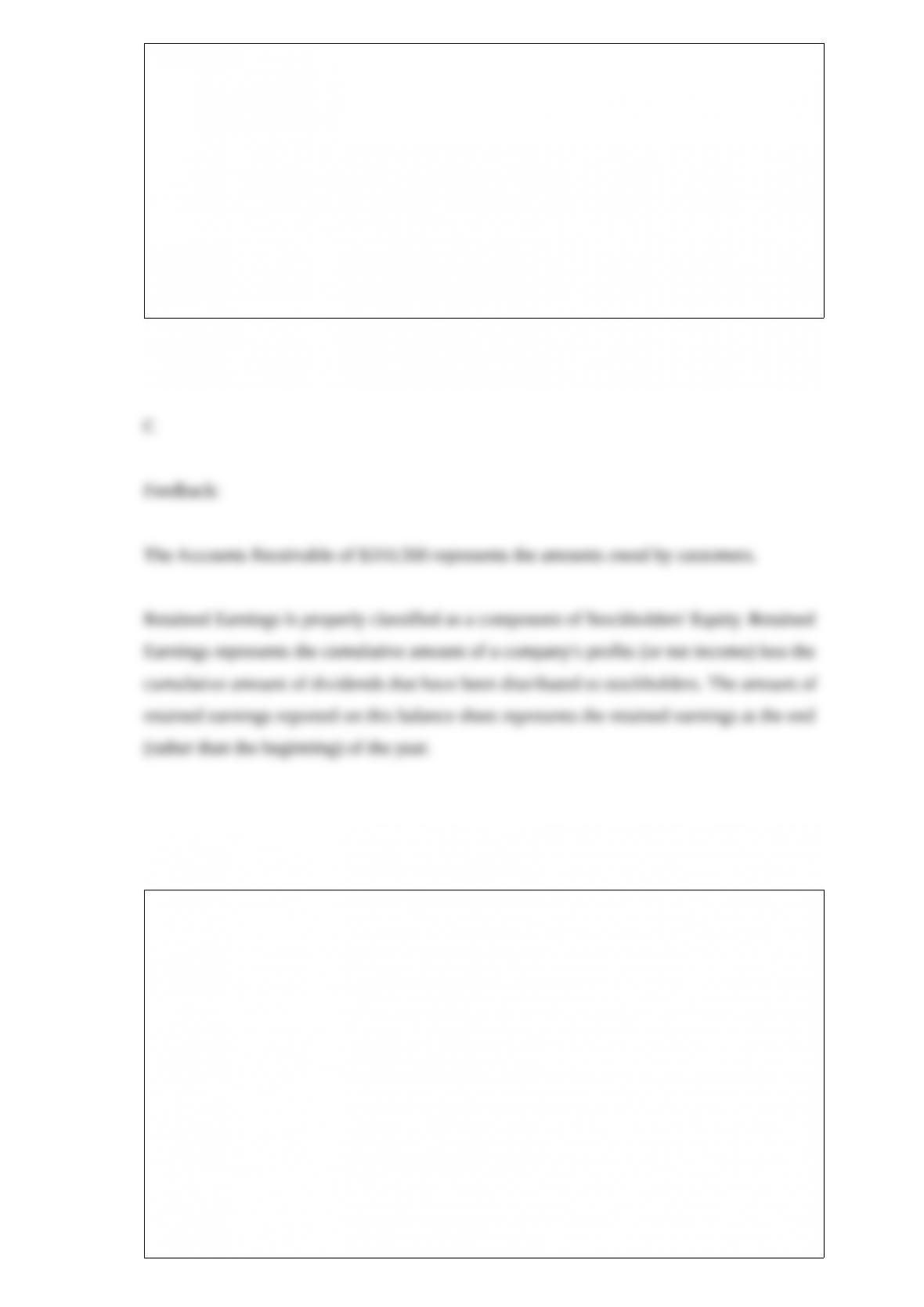
A) Retained Earnings is misclassified; it should be reported in the Assets section of the
balance sheet.
B) The $207,100 shown as Retained Earnings on the balance sheet represents the
cumulative amount of dividends distributed.
C) Anonymous, Inc. is owed $310,500 from customers who have purchased goods or
services from the company, but have not yet paid for them.
D) The amount of retained earnings reported on this balance sheet represents the
retained earnings at the beginning of the year.
The following transactions occurred during July:
1> Received $800 cash for services performed during July.
2> Received $5,000 cash from the issuance of common stock to owners.
3> Received $400 from a customer as payment for services performed during June.
4> Billed $3,500 to customers for services performed on account in July.
5> Borrowed $2,500 from the bank and signed a promissory note.
6> Received $1,000 from a customer for services to be performed during August.
Use the information above to answer the following question. Which of the following
statements about the recording of these transactions is correct?
A) Transaction #1 would include a debit to Service Revenue.
B) Transaction #3 would include a debit to Accounts Receivable.
C) Transaction #4 would include a debit to Accounts Receivable.
D) Transaction #6 would include a debit to Unearned Revenue.
On January 1, your company issues a 5-year bond with a face value of $10,000 and a
stated interest rate of 7%. The market interest rate is 5%. The issue price of the bond
was $10,866. Using the effective-interest method of amortization and rounding to the
nearest dollar, the interest expense for the first year ended December 31 would be:
A) $700.
B) $543.
C) $667.
D) $759.

Each item in the statement of retained earnings can appear on another financial
statement. Choose the appropriate letter to match the item in the statement of retained
earnings with the related financial statement.
ITEM ON STATEMENT OF RETAINED EARNINGS
1> ____ Retained earnings, January 1, Year 3
2> ____ Net income for Year 3
3> ____ Dividends for Year 3
4> ____ Retained earnings, December 31, Year 3
FINANCIAL STATEMENT
A. Balance sheet at end of Year 3
B. Statement of cash flows for Year 3
C. Income statement for Year 2
D. Balance sheet at end of Year 2
E. Income statement for Year 3
Which of the following accounts does not have a normal credit balance?
A) Common Stock
B) Accounts Payable
C) Service Revenue
D) Rent Expense
A company issues 1 million shares of preferred stock with a par value of $2 at its
market price of $26 per share. The issuance should be recorded with a debit to Cash for:
A) $26 million and a credit to Preferred Stock for $26 million.
B) $2 million and a credit to Preferred Stock for $2 million.
C) $26 million, a credit to Additional Paid-in Capital for $2 million, and a credit to
Preferred Stock for $24 million.
D) $26 million, a credit to Preferred Stock for $2 million, and a credit to Additional
Paid-in Capital for $24 million.