1) If fixed costs are $650,000 and the unit contribution margin is $30, the sales
necessary to earn an operating income of $30,000 are 14,000 units.
2) The major advantage of residual income as a performance measure is that it gives
consideration to not only a minimum rate of return on investment but also the total
magnitude of income from operations earned by each division.
3) The amount of interest expense reported on the income statement will be more than
the interest paid to bondholders if the bonds were originally sold at a discount.
4) Companies with large amounts of fixed costs will generally have a high operating
leverage.
5) During periods of rapidly rising costs, the use of the LIFO method results in illusory
or inventory profits.
6) Flexible budgeting builds the effect of changes in level of activity into the budget
system.
7) If the standard to produce a given amount of product is 600 direct labor hours at $15
and the actual was 500 hours at $17, the time variance was $1,700 unfavorable.
8) The declaration of a stock dividend decreases a corporation’s stockholders’ equity
and increases its liabilities.
9) The accounting cycle begins with preparing an unadjusted trial balance.
10) Cost-volume-profit analysis can be presented in both equation form and graphic
form.
11) Volume variance measures fixed factory overhead.
12) Withdrawals decrease owner’s equity and are listed on the income statement as a
deduction from revenue.
13) The order of the flow of accounting data is (1) record in the ledger, (2) record in the
journal, (3) prepare the financial statements.
14) Adriana and Belen are partners who share income in the ratio of 3:2 and have
capital balances of $50,000 and $90,000 at the time they decide to terminate the
partnership. After all noncash assets are sold and all liabilities are paid, there is a cash
balance of $90,000. How much cash should be distributed to Adriana?
A.$50,000
B.$20,000
C.$30,000
D.$45,000
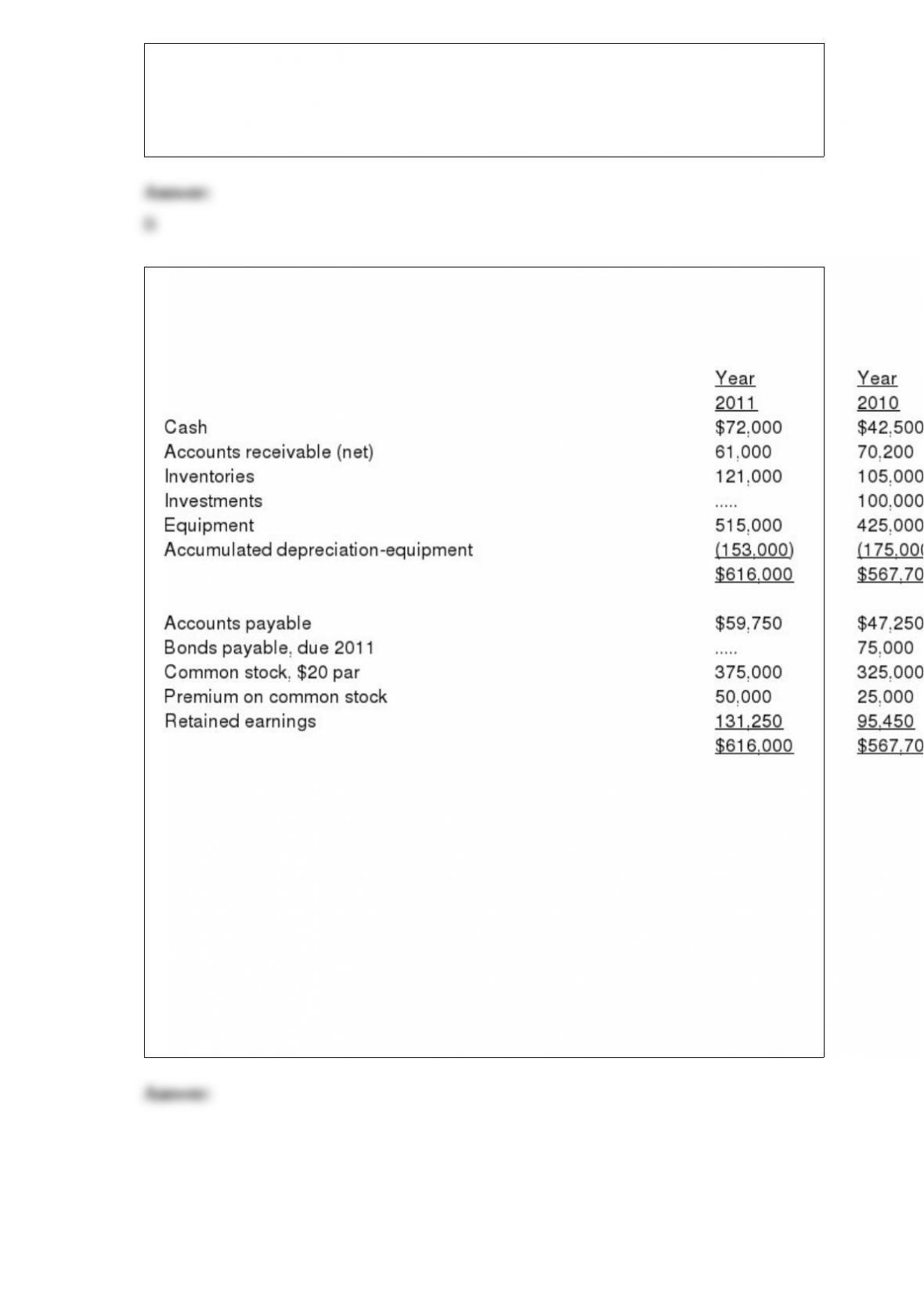
15) The comparative balance sheet of Barry Company, for 2011 and the preceding year
ended December 31, 2010, appears below in condensed form:
Additional data for the current year are as follows:
(a) Net income, $75,800.
(b) Depreciation reported on income statement, $38,000.
(c) Fully depreciated equipment costing $60,000 was scrapped, no salvage, and
equipment was purchased for $150,000.
(d) Bonds payable for $75,000 were retired by payment at their face amount.
(e) 2,500 shares of common stock were issued at $30 for cash.
(f) Cash dividends declared and paid, $40,000.
(g) Investments of $100,000 were sold for $125,000.
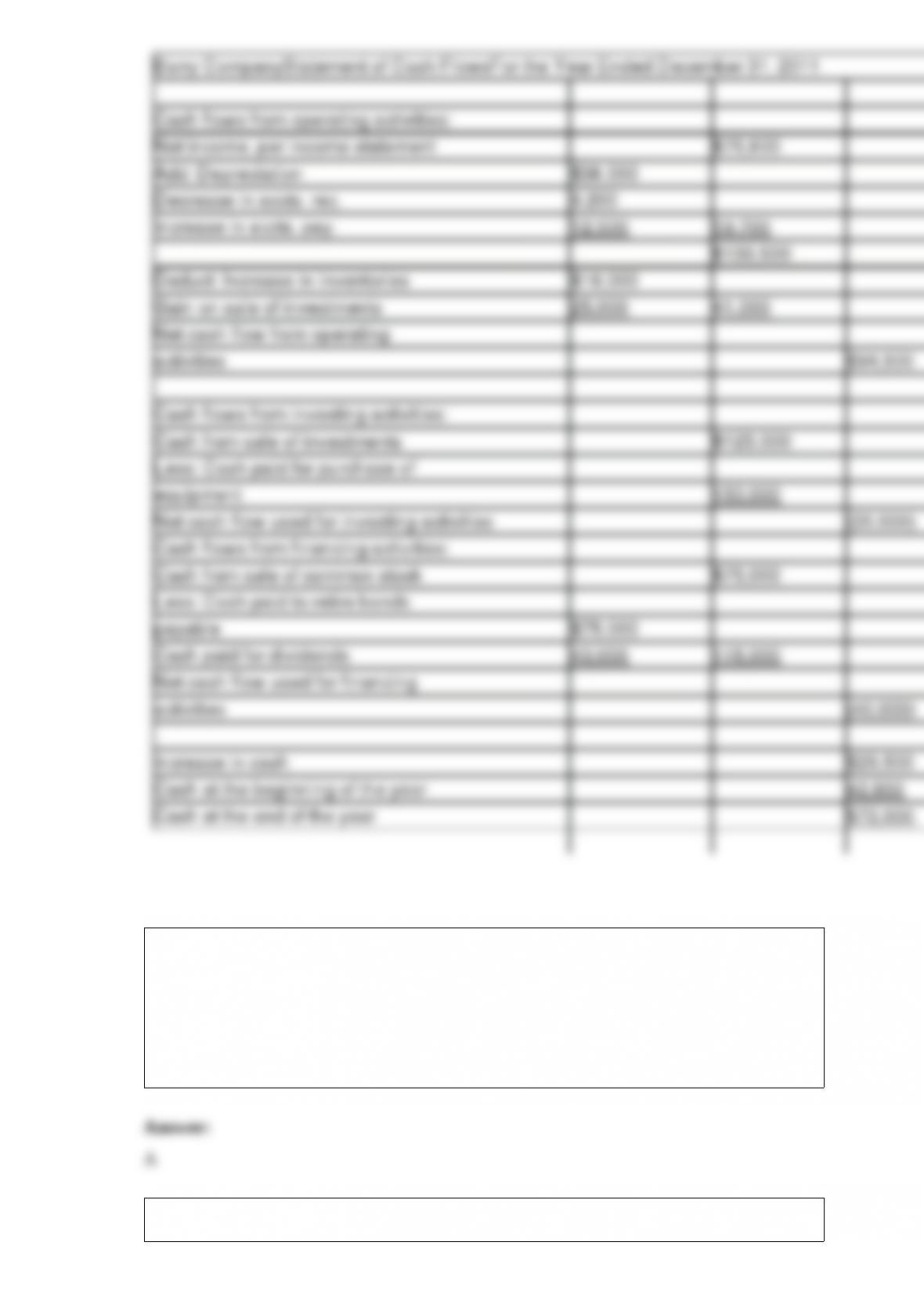
Prepare a statement of cash flows using the indirect method.
16) The adjusting entry to adjust supplies was omitted at the end of the year. This would
effect the income statement by having
A.expenses understated and therefore net income overstated
B.revenues understated and therefore net income understated
C.expenses understated and therefore net income understated
D.expenses overstated and therefore net income understated
17) Interest on a note can be calculated without knowledge of the
A.fair value of the note
B.rate of interest
C.notes duration
D.principal amount
18) On January 12th, JumpStart Co. purchased $870 in office supplies.
(a) Journalize this transaction as if JumpStart paid cash.
(b) (1) Journalize this transaction as if JumpStart placed it on account.
(b) (2) On January 18th, JumpStart pays the amount due. Journalize this event.
19) Quail Co. can further process Product B to produce Product C. Product B is
currently selling for $60 per pound and costs $42 per pound to produce. Product C
would sell for $92 per pound and would require an additional cost of $13 per pound to
produce. What is the differential revenue of producing and selling Product C?
A.$32 per pound
B.$42 per pound
C.$50 per pound
D.$18 per pound
20) The posting process will include the transfer of the following information from the
journal to the account.
A.date, amount (debit or credit)
B.date, amount (debit or credit), journal page number
C.amount (debit or credit), account number
D.date, amount (debit or credit) account number
21) Which of the following is true of the cash payback period?
A.The longer the payback, the longer the estimated life of the asset
B.The longer the payback, the sooner the cash spent on the investment is recovered
C.The shorter the payback, the less likely the possibility of obsolescence
D.All of the above are correct
22) The Cardinal Company had a finished goods inventory of 55,000 units on January
1. Its projected sales for the next four months were: January – 200,000 units; February –
180,000 units; March – 210,000 units; and April – 230,000 units. The Cardinal Company
wishes to maintain a desired ending finished goods inventory of 20% of the following
months sales.
What should the budgeted production be for January?
A.236,000
B.181,000
C.200,000
D.219,000
23) Sinking Fund Cash would be classified on the balance sheet as
A.a current asset
B.a fixed asset
C.an intangible asset
D.an investment
24) The formula to compute direct materials price variance is to calculate the difference
between
A.actual costs – (actual quantity * standard price)
B.actual cost + standard costs
C.actual cost – standard costs
D.(actual quantity * standard price) -standard costs
25) Percentage analyses, ratios, turnovers, and other measures of financial position and
operating results are
A.a substitute for sound judgment
B.useful analytical measures
C.enough information for analysis, industry information is not needed
D.unnecessary for analysis, but reaction is better
26) Manley Co. manufactures office furniture. During the most productive month of the
year, 4,500 desks were manufactured at a total cost of $86,625. In its slowest month, the
company made 1,800 desks at a cost of $49,500. Using the high-low method of cost
estimation, total fixed costs are:
A.$61,875
B.$33,875
C.$24,750
D.cannot be determined from the data given
27) A firm’s internal control environment is not influenced by
A.management’s operating style
B.organizational structure
C.personnel policies
D.monitoring policies
28) A copy machine acquired with a cost of $1,410 has an estimated useful life of 4
years. It is also expected to have a useful operating life of 13,350 copies. Assuming that
it will have a residual value of $75, determine the depreciation for the first year by the
a. straight-line method
b. double declining-balance method
c. production method (4,500 copies were made the first year)
29) On January 1, 2014, the Horton Corporation issued 10% bonds with a face value of
$200,000. The bonds are sold for $192,000. The bonds pay interest semiannually on
June 30 and December 31 and the maturity date is December 31, 2018. Horton records
straight-line amortization of the bond discount. The bond interest expense for the year
ended December 31, 2014, is
A.$10,800
B.$18,400
C.$21,600
D.$28,000
30) Which of the following are included in the employer’s payroll taxes?
A.SUTA taxes
B.FUTA taxes
C.FICA taxes
D.all of the above
31) Which of the following is true?
A.If using the double-declining-balance the total amount of depreciation expense during
the life of the asset will be the highest
B.If using the units-of-production method, it is possible to depreciate more than the
depreciable cost
C.If using the straight line method, the amount of depreciation expense during the first
year is higher than that of the double-declining-balance
D.Regardless of the depreciation method, the amount of total depreciation expense
during the life of the asset will be the same
32) Department E had 4,000 units in Work in Process that were 40% completed at the
beginning of the period at a cost of $12,500. 14,000 units of direct materials were added
during the period at a cost of $28,700. 15,000 units were completed during the period,
and 3,000 units were 75% completed at the end of the period. All materials are added at
the beginning of the process. Direct labor was $32,450 and factory overhead was
$18,710.
The number of equivalent units of production for the period for materials if the average
cost method is used to cost inventories was:
A.15,650
B.18,000
C.17,250
D.17,700
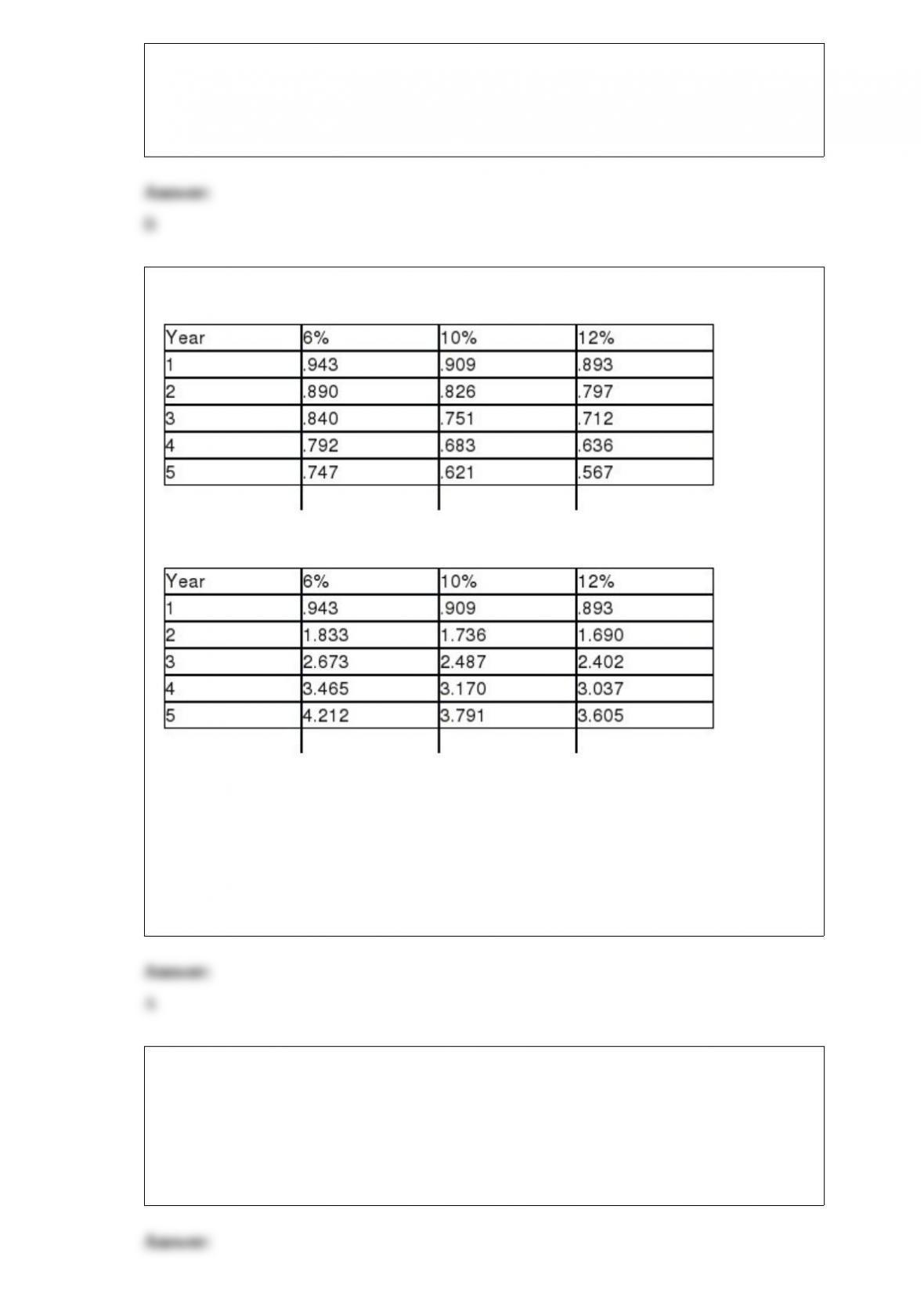
33) Below is a table for the present value of $1 at Compound interest.
Below is a table for the present value of an annuity of $1 at compound interest.
Using the tables above, what would be the internal rate of return of an investment of
$294,840 that would generate an annual cash inflow of $70,000 for the next 5 years?
A.6%
B.10%
C.12%
D.cannot be determined from the data given
34) If sales are $500,000, variable costs are 75% of sales, and operating income is
$40,000, what is the operating leverage?
A.0
B.1.25
C.1.3
D.3.1

35) The cost of merchandise sold during the year was $45,000. Merchandise inventories
were $13,500 and $10,500 at the beginning and end of the year, respectively. Accounts
payable were $7,000 and $5,000 at the beginning and end of the year, respectively.
Using the direct method of reporting cash flows from operating activities, cash
payments for merchandise total
A.$46,000
B.$44,000
C.$50,000
D.$40,000
36) The capital accounts of Harrison and Marti have balances of $160,000 and
$110,000, respectively, on January 1, 2014, the beginning of the current fiscal year. On
April 10, Harrison invested an additional $20,000. During the year, Harrison and Marti
withdrew $96,000 and $78,000, respectively, and net income for the year was $264,000.
The articles of partnership make no reference to the division of net income.
Based on this information, the statement of partners equity for 2014 would show what
amount in the capital account for Harrison on December 31, 2014?
A.$216,000
B.$164,000
C.$380,000
D.$52,000
37) Using the perpetual inventory system, journalize the entries for the following
selected transactions:
(a) Sold merchandise on account, for $12,000. The cost of the merchandise sold was
$6,500.
(b) Sold merchandise to customers who used MasterCard and VISA, $9,500. The cost
of the merchandise sold was $5,300.
(c) Sold merchandise to customers who used American Express, $2,900. The cost of the
merchandise sold was $1,700.
(d) Paid an invoice from First National Bank for $385, representing a service fee for
processing MasterCard and VISA sales.
(e) Received $4,325 from American Express Company after a $115 collection fee had
been deducted.
38) Next years sales forecast shows that 20,000 units of Product A and 22,000 units of
Product B are going to be sold for prices of $10 and $12 per unit, respectively. The
desired ending inventory of Product A is 20% higher than its beginning inventory of
2,000 units. The beginning inventory of Product B is 2,500 units. The desired ending
inventory of B is 3,000 units.
Budgeted purchases of Product A for the year would be:
A.22,400 units
B.20,400 units
C.20,000 units
D.12,200 units
39) Edison Corporation paid a dividend of $10 per share on its $100 par preferred stock
and $4 per share on its $20 par common stock. The market value of the common stock
is $80 per share. Edisons dividend yield is:
A.5%
B.10%
C.25%
D.20%
40) Which of the following statements is not true about a 2-for-1 split?
A.Par value per share is reduced to half of what it was before the split
B.Total contributed capital increases
C.The market price will probably decrease
D.A stockholder with ten shares before the split owns twenty shares after the split
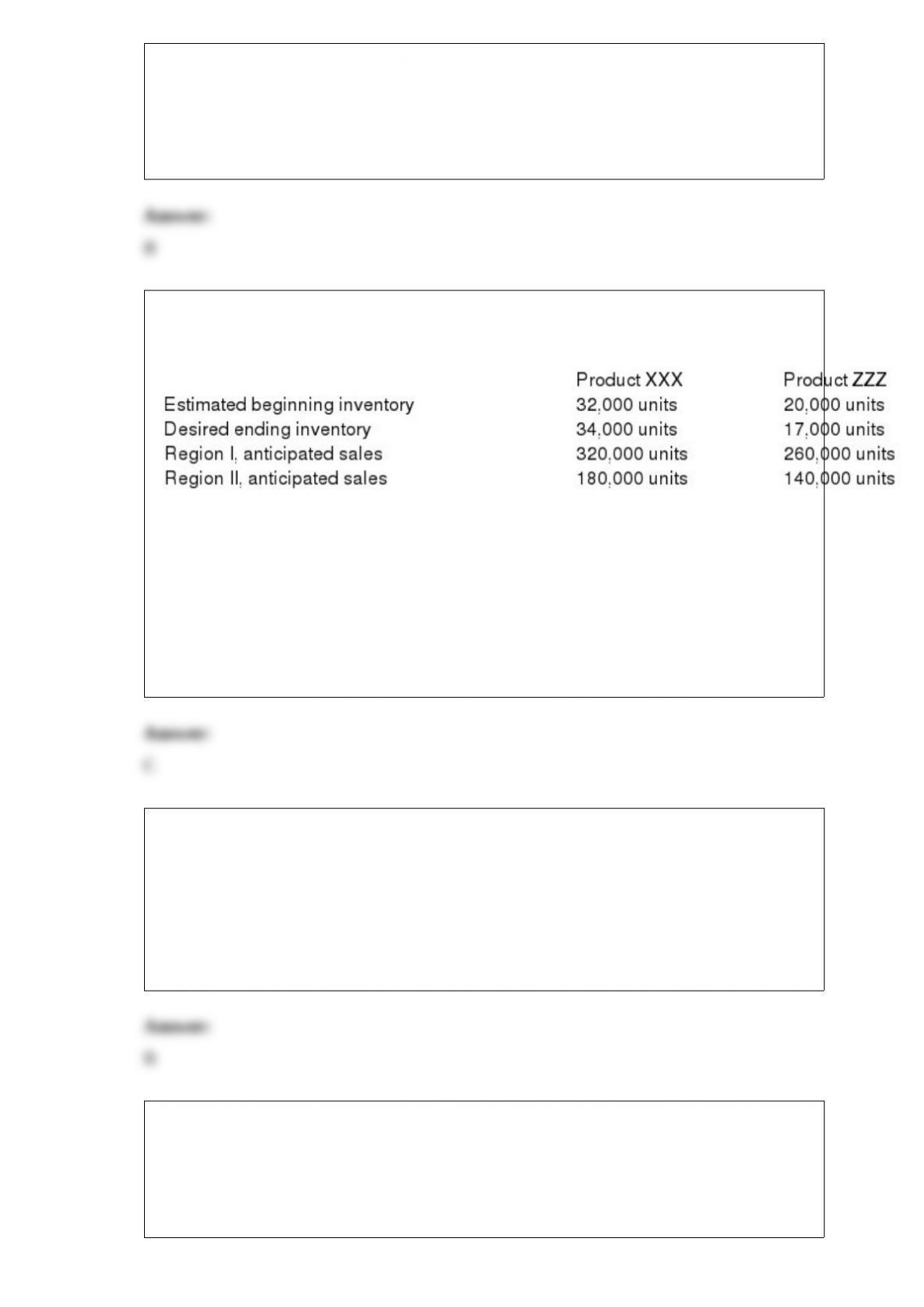
41) Below is budgeted production and sales information for Flushing Company for the
month of December:
The unit selling price for product XXX is $5 and for product ZZZ is $15.
Budgeted production for product ZZZ during the month is:
A.403,000 units
B.380,000 units
C.397,000 units
D.417,000 units
42) Cost of goods manufactured during 2011 is $240, work in process inventory on
December 31, 2011, is $50. Work in process inventory during 2011 decreased by 60%.
Total manufacturing costs incurred during 2011 amount to:
A.$190
B.$165
C.$290
D.$315
43) EFT
A.means Efficient Funds Transfer
B.can process certain cash transactions at less cost than by using the mail
C.makes it easier to document purchase and sale transactions
D.means Effective Funds Transfer
44) The company determines that the interest expense on a note payable for period
ending December 31st is $775. This amount is payable on January 1st. Prepare the
journal entries required on December 31st and January 1st.
45) Crain Company budgeted 35,000 direct labor hours and incurred 40,000 direct labor
hours. It incurred $780,000 of overhead and estimated overhead was $735,000.
What is Crains predetermined overhead rate? Was overhead overapplied or
underapplied for the year? By how much?
46) Materials used by the Layton Company Division 1 are currently purchased from
outside supplier at $58 per unit. Division 2 is able to supply Division 1 with 22,000
units at a variable cost of $46 per unit. The two divisions have recently negotiated a
transfer price of $50 per unit for the 20,000 units.
Required:
By how much will each divisions income increase as a result of this transfer?
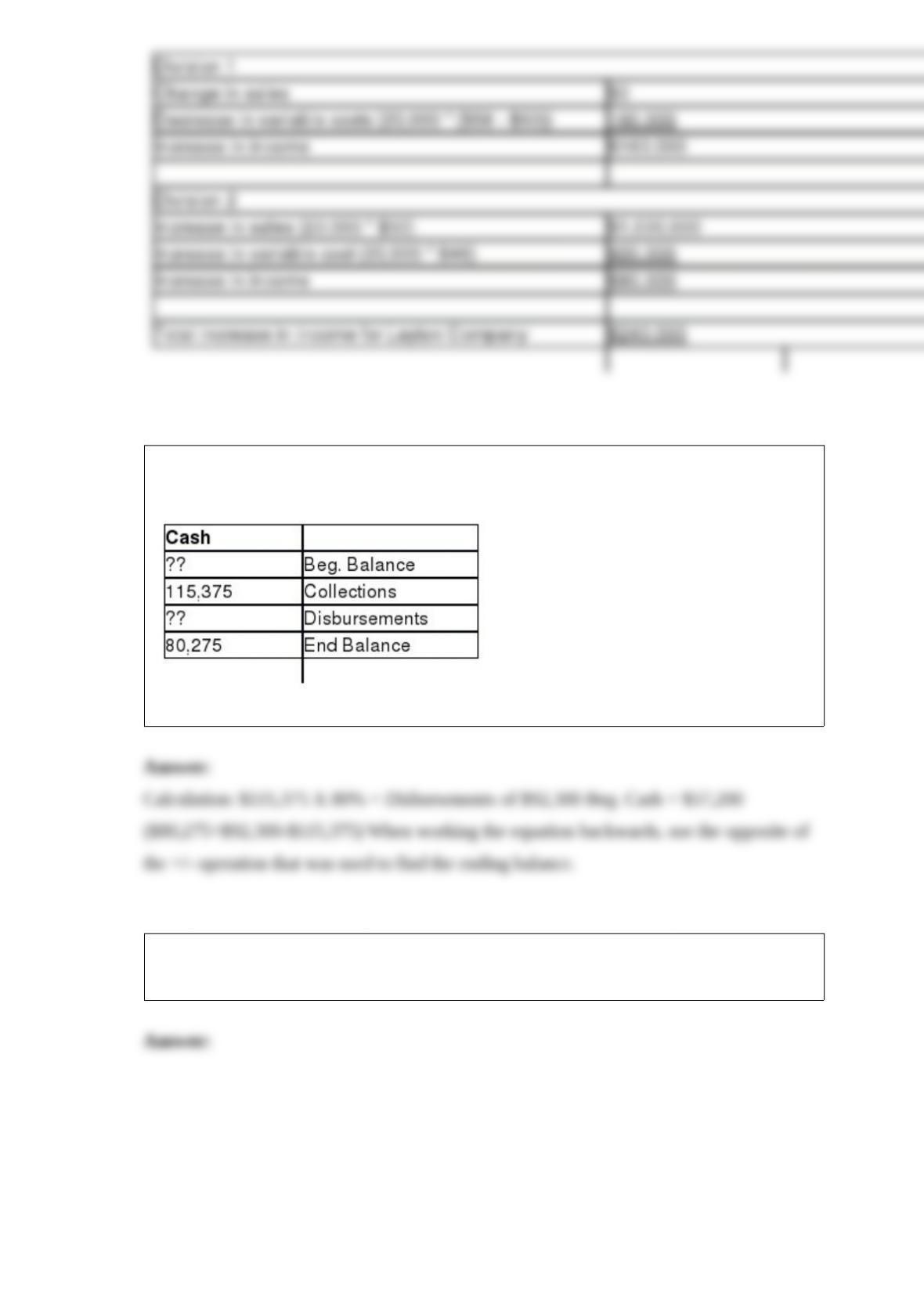
47) Consider the cash account below.
Additional Information: cash disbursements were 80% of collections.
How much was the Beginning Balance of the Cash Account?
48) Job order manufacturing and process manufacturing are two major costing systems
used in manufacturing. Briefly contrast the characteristics of these two systems.