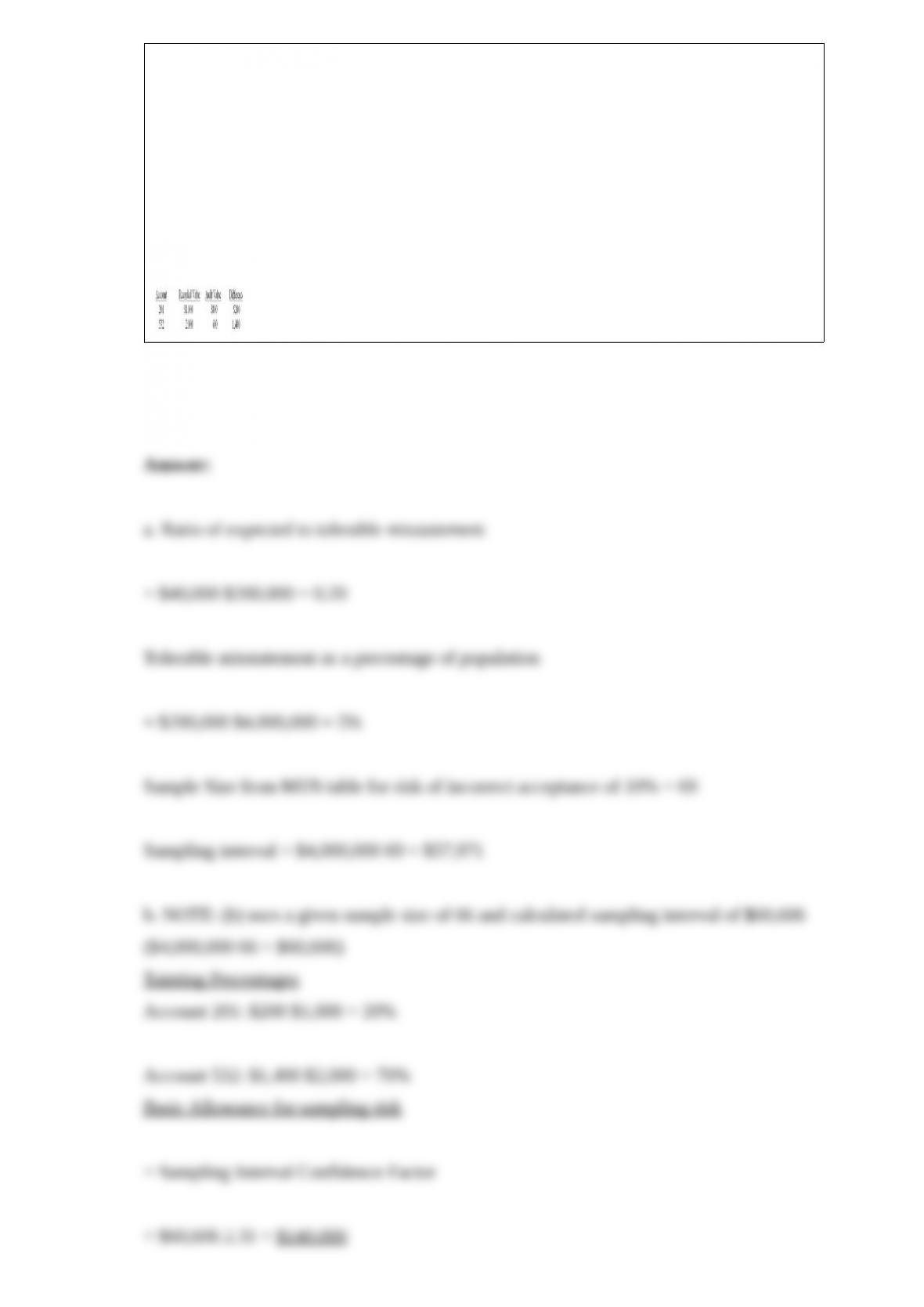
You are planning to use monetary unit sampling to evaluate accounts receivable for
Rose Company. The accounts receivable account totals $4,000,000. You have assessed a
risk of incorrect acceptance of 10%, a tolerable misstatement of $200,000, and an
expected misstatement of $40,000.
a. Calculate the sample size and sampling interval.
b. Regardless of your answer to (a), use a sample size of 66 and the related sampling
interval to calculate the upper limit on misstatements assuming you found the following
differences.

In an agreed-upon procedures engagement, an accountant
A. follows all of the Fundamental Principles of GAAS.
B. restricts the report to specified users.
C. includes negative assurance in the report.
D. gives a qualified audit report.
Which of the following is NOT one of the AICPA Principles of Professional Conduct?
A. Responsibilities
B. Reliability
C. Objectivity
D. Due Care

An internal auditor’s report should contain five elements for each finding. Which of the
following are the correct elements?
A. Condition, criteria, cause, effect, recommendation.
B. Condition, relevance, cause, effect, recommendation.
C. Condition, evidence, cause, effect, recommendation.
D. Condition, relevance, evidence, effect, recommendation.
When conducting variables sampling, auditors typically examine
A. transactions of components of the account balance or class of transactions.
B. the balances in an account balance or class of transactions from one or more prior
years.
C. the separation of duties among client personnel for transactions related to the
account balance or class of transactions.
D. minutes from meetings of the client’s board of directors.

Why is the auditor more concerned with the risk of overreliance than the risk of
underreliance?
A. The risk of underreliance is not a type of sampling risk.
B. The risk of overreliance exposes the auditor to an efficiency loss.
C. The risk of overreliance may result in the auditor failing to perform sufficient
substantive procedures.
D. The risk of overreliance cannot be controlled by the auditor during the sampling
process.
Brown, CPA, was using monetary unit sampling to audit an inventory of $3,000,000
that was comprised of 6,000 items. A sample size of 500 was determined and a tolerable
misstatement of $20,000 was established. The sampling interval would be
A. $500.
B. $5,000.
C. $6,000.
D. $20,000.
Which of the following best describes assurance services?

A. Independent professional services that report on the client’s financial statements
B. Independent professional services that improve the quality of information for
decision makers
C. Independent professional services that report on specific written management
assertions
D. Independent professional services that improve the operations of the client
Auditors conclude that the omission of a substantive procedure considered necessary at
the time of the examination may impair their present ability to support the
previously-expressed opinion. Auditors need not try to perform the omitted procedure if
A. the risk of adverse publicity or litigation is low.
B. some financial statement users are currently relying on the auditors’ reports.
C. the auditors’ opinion was qualified because of a departure from generally accepted
accounting principles.
D. the results of other procedures that were applied at the time compensated adequately
for the omitted procedure by providing sufficient appropriate evidence.
Which of the following does not have a direct relationship with sample size?
A. Expected population deviation rate
B. Population size

C. Risk of overreliance
D. All of these have a direct relationship with sample size
“As described in Note 5 to the financial statements, General Express changed its
statistical method of computing product warranty expense for the year ended December
31, 2014″ is an illustration of a
A. consistency change requiring a qualified opinion.
B. scope limitation.
C. departure from generally accepted accounting principles.
D. report with a consistency modification.
Your client plans to count inventory at several locations on the same day. No location is
material in amount, but the total of inventory is quite material. How is an auditor likely
to plan to observe?
A. Observe all counts at all locations by using the required number of auditors.
B. Insist the inventory be counted on separate days so the auditor can be present at all
locations.
C. Work with the client to determine which locations to observe.
D. Observe a sample of locations on a surprise basis.

Hart, CPA is auditing the year 2 financial statements of Kell Co. Previously, Hart
audited Kell’s year 1 financial statements and expressed a qualified opinion due to a
scope limitation. Hart decides to include an other-matter paragraph in the year 2 report
because comparative financial statements are being presented for year 2 and year 1.
This paragraph should indicate the
A. substantive reasons for the prior-year’s qualification.
B. reason that Hart continued to provide audit services, despite the previous scope
limitation.
C. consistency of application of accounting principles between year 2 and year 1.
D. restriction on the distribution of the report.
The audit objective that footnotes in the financial statements should be clear and
expressed such that the information is easily conveyed to the readers of the financial
statements is related most closely with which of the ASB presentation and disclosure
assertions?
A. Occurrence
B. Rights and obligations
C. Comprehensibility
D. Understandability

The risk of underreliance is the probability that the evidence in the sample indicates:
A. Low control risk when the actual operating effectiveness of the control does not
justify a low control risk assessment.
B. Low control risk when the actual operating effectiveness of the control justifies a
low control risk assessment.
C. High control risk when the actual operating effectiveness of the control would justify
a lower control risk assessment.
D. High control risk when the actual operating effectiveness of the control would justify
a higher control risk assessment.
A report on sustainability, as defined by the AICPA, might include all of the following
except
A. economic viability.
B. social responsibility.
C. environmental responsibility.
D. internal control over financial reporting.

Which of the following internal control activities will most likely prevent the
concealment of a cash shortage by improperly writing off a trade account receivable?
A. Write-offs must be approved by a responsible officer after review of credit
department recommendations and supporting evidence.
B. Write-offs must be supported by an aging schedule showing that only receivables
overdue several months have been written off.
C. Write-offs must be approved by the cashier who is in a position to know if the
receivables have, in fact, been collected.
D. Write-offs must be authorized by company field sales employees who are in a
position to determine the financial standing of the customers.
Shown below are a number of situations that may be encountered during the audit
examination. For each, indicate how the auditors’ standard (unmodified) report would
be modified (each reporting situation may result in more than one modification to the
auditors’ standard (unmodified) report).
A. Modification to introductory paragraph.
B. Modification to Management’s Responsibility section.
C. Modification to Auditor’s Responsibility section.
D. Modification to opinion paragraph.
E. Additional paragraph added to report.
F. No modifications to the standard (unmodified) report are necessary.
___ 1. Departure from GAAP that does not materially affect the financial statements.
___ 2. Inability of auditors to confirm accounts receivable with customers; while the
scope limitation is material, the auditors still believe an opinion may be expressed on
the entity’s financial statements.
___ 3. Group auditors decide to refer to the work of component auditors in their report.
___ 4. Entity has changed from FIFO to LIFO accounting for inventories.

___ 5. Auditors wish to highlight an event that occurred following the date of the
financial statements.
___ 6. Departure from GAAP that has a material, but not pervasive, effect on the
financial statements.
___ 7. Group auditors decide to assume full responsibility for the work of component
auditors and not refer to component auditors’ work in their report.
___ 8. Scope limitation that precludes auditors from expressing an opinion.
___ 9. Auditors would like to disclose potential going-concern uncertainties in their
report (these uncertainties have been appropriately disclosed in the entity’s financial
statements and related disclosures).
___ 10. Departure from GAAP that has a material and pervasive effect on the financial
statements.
Which of the following statements is correct regarding an audit team’s documentation
requirements for attributes sampling?
A. The audit team’s conclusions do not need to be documented unless they decide to
rely on internal control at planned levels.
B. The audit team should document information regarding the number of deviations and
sample deviation rate, but not the allowance for sampling risk.
C. The audit team’s documentation should include information about the control
environment, including an assessment of management’s integrity.
D. The audit team’s documentation should include information regarding all steps of the
sampling process and implications of the conclusions reached on internal control
reliance and substantive procedures.
Which of the following would be considered in determining whether an internal audit
department is independent?
A. The organizational level of the chief audit officer and the objectivity of the audit
staff.
B. A requirement for the auditors to report to the audit committee and the composition
of the audit committee.
C. The organizational status of the audit committee and the individual independence of
internal auditors in the department.
D. The nature of the audit charter and the objectivity of the audit staff.
Explain briefly the two directions of inventory test counts.

Which of the following expense accounts would not normally be tested by listing all
debits and examining any significant items?
A. Legal expense.
B. Miscellaneous expense.
C. Repairs and Maintenance.
D. Payroll expense.
Which of the following situations indicates a potential material weakness in internal
control over acquisition and expenditure?
A. Purchase orders are not prepared for services acquired directly under authorization
of department heads.
B. The same person authorizes voucher packages and signs checks.
C. Unacceptable goods are not scheduled on receiving reports.
D. The same person signs checks and stamps vouchers PAID.
“All purchase orders are supported by requisitions from proper persons” is a specific
example of which management assertion?
A. Occurrence.
B. Completeness.

C. Cutoff.
D. Classification.
Cutoff tests designed to detect purchases made before the end of the year that have been
recorded in the subsequent year provide assurance about management’s assertion of
A. presentation and Disclosure.
B. completeness.
C. rights and obligations.
D. existence.
If an auditor calculated an upper limit rate of deviation of 5% when the tolerable rate of
deviation was 4%, the auditor would conclude that
A. the population deviation rate is low enough to rely on internal control as planned.
B. the population deviation rate may be higher than that necessary to rely on internal
control as planned.
C. the control risk can be assessed at planned levels.
D. the control risk should be assessed at lower levels.

Maralee has been approached by J. Fox Entertainment to perform an audit of her theatre
company. Maralee has never audited a theatre company before. Maralee can
A. not accept the engagement because she does not have the specialized industry
knowledge.
B. recommend another auditor and receive a fee for the referral.
C. accept the engagement if she can obtain the required knowledge before the end of
the engagement.
D. accept the engagement with the understanding that additional hours will be required
for Maralee to learn and understand the nature of the business.
Which of the following is not an appropriate statement with regard to computer control
activities?
A. The duties of application programming, computer operation, and control of data files
should be separated.
B. Computer operators should maintain control of all software programs.
C. Specific passwords should be required to access online files.
D. Computer programmers should be periodically rotated across different applications.

Which of the following is an example of a computer operations control?
A. Control totals
B. Balancing input to output
C. File backup and retention
D. Transaction logs
An engagement letter is used primarily to
A. ensure a clear contractual understanding of the services to be provided by the CPA.
B. express an opinion on the financial statements.
C. provide management representations to be included in the audit evidence.
D. disclaim liability.
While conducting an audit of a public entity, Wallace failed to identify material
misstatements in its client’s financial statements. Investors then sued Wallace in
connection with this audit. Which of the following would not need to be demonstrated
in order for the shareholders to successfully bring suit against Wallace?
A. Wallace was in privity with the shareholders.
B. The shareholders relied upon the materially misstated financial statements.
C. Wallace acted with gross negligence in his audit.

D. The reliance on the materially misstated financial statements caused the
shareholders’ losses.
The engineering department at Omni Company built a piece of equipment in the
company’s own shop for use in the company’s operations. The auditor reviewed all
work orders that were capitalized as part of the equipment costs. Which of the
following is the ASB transaction assertion most closely related to the auditor’s testing?
A. Occurrence
B. Completeness
C. Accuracy
D. Classification
For each of the following statements, indicate whether it is more closely related to
attributes sampling or variables sampling by using the letter A (attributes) and V
(variables).
___ 1. Used to allow the auditor to assess risk of material misstatement.
___ 2. Sampling risks include the risk of incorrect acceptance and risk of incorrect
rejection.
___ 3. The population variability affects the sample size.
___ 4. The auditor’s sample would include transactions or components comprising the
account balance.
___ 5. Sampling risks include the risk of assessing control risk too high and the risk of
assessing control risk too low.
___ 6. The auditor’s sample would include potential applications of control policies and
procedures.
___ 7. This type of sampling is influenced by the auditor’s acceptable level of detection
risk.
What are the six steps auditors of public companies should use to audit internal control
over financial reporting (ICOFR)?

Define assurance, attestation, and auditing in the context of “lending credibility.”
Indicate how each of the following conditions affect sample size by using the letters I
(increase), D (decrease), or N (no effect). For each condition, hold all other factors
constant.
____ 1. Holmes is expecting more deviations in the population from prior years because
the client has recently implemented a new transaction processing system.
____ 2. Holmes has been criticized for going over budget in the past so he has
decreased the risk of underreliance from 15% to 5%.
____ 3. At the beginning of the period, the client hired a new accounting manager to
oversee the implementation of policies and procedures relating to accurate and
complete financial reporting. Holmes believes the new manager has helped decrease
employee errors.
____ 4. Holmes has decided that the tolerable rate of deviation was set too low initially
and should be increased slightly to better reflect the planned level of control risk.
____ 5. Holmes defined the population as all sales invoices found in the client’s
computerized listing. However, the first list he received did not include sales made
during the last two weeks of the period. When an updated list was provided the
population (which was already large) increased by 5%.
____ 6. The risk of overreliance has been decreased because Holmes wants to place
more reliance on the controls being tested.
____ 7. Due to a change in firm policy, the tolerable rate of deviation has been
decreased.

Indicate how each of the following conditions affect the upper limit rate of deviation by
using the letters I (increase), D (decrease), or N (no effect). For each condition, hold all
other factors constant.
____ 1. An increase in the tolerable rate of deviation from 2% to 5%.
____ 2. A decrease in the number of deviations from 5 to 1.
____ 3. An increase in the risk of underreliance from 5% to 10%.
____ 4. A decrease in the risk of overreliance from 10% to 5%.
____ 5. An increase in the sample rate of deviation from 2.3% to 3.5%.
Match the examples of specific control assertions in the production cycle with the ASB
transaction assertions.
1. Payroll reviews the allocation of payroll for pay periods that begin in one reporting
period and end in the next reporting period Cutoff 1
2. All documents are prenumbered and the numerical sequence is reviewed Accuracy
3. Labor usage reports are compared to job time tickets Completeness
4. Job cost sheet entries are reviewed by a person independent of their preparation
Classification
5. The production supervisor is required to account for all material and labor used as
direct or indirect Occurrence
A. Cutoff
B. Accuracy
C. Completeness

D. Classification
E. Occurrence
Two widely used confirmation forms to test accounts receivable are
_________________________________ and _________________________________
confirmations.
Below are situations that illustrate tests of controls performed as a part of an attributes
sampling application. Match each description of a situation with the related term. Each
term is associated with only one description.
1. Tolerable rate of deviation.
2. Upper limit rate of deviation.
3. Risk of overreliance.
4. Sample rate of deviation.
5. Expected population deviation rate.
6. Risk of underreliance.
A. Based on experience with the client and industry, Herbert, CPA, estimated that a 3%
deviation rate exists in the client’s credit approval of sales invoices this year.
B. Based on a random sample, Kelly, CPA, found that the upper limit rate of deviation
was less than the tolerable rate of deviation and assessed control risk as moderate, as
originally planned. Unknown to Kelly, the true deviation rate in the population was
greater than the tolerable rate of deviation.
C. Based on a random sample, Fitzmaurice, CPA, found that the tolerable rate of
deviation was less than the upper limit rate of deviation and assessed control risk at the
maximum. Unknown to Fitzmaurice, the true deviation rate in the population was less
than the tolerable rate of deviation.
D. Alison required the control that all sales invoices were supported by a bona fide
shipping document to be functioning very effectively (deviation rate of less than 2%)
because of the importance of this control.
E. Grayson, CPA, calculated the statistical estimate of the population deviation rate as
the sum of the sample rate of deviation and allowance for sampling risk.
F. Jones, CPA, found four deviations from prescribed control procedures in her sample
of 100 sales invoices.
A sample from the perpetual inventory records meets the
_____________________________ requirement to determine whether all recorded
transactions are supported by reports and documents.
The actions in tests of controls involve ________________________________,
________________________________, ________________________________,
_________________________________ and ________________________________.