When determining a transfer price, outlay cost is often the variable cost for producing
the item transferred.
The inventory method a company uses does not affect its income statement.
Job-order costing only applies to specific jobs with a single physical unit.
The internal rate of return and the net present value methods usually result in the same
investment decisions.
A follow-up evaluation of capital-budgeting decisions is called a post-audit.
The last line item on an income statement is earnings per share.
When evaluating a segment manager, unallocated costs usually include central
corporate costs.
The flexible budget variance for direct labor equals the labor price variance plus the
labor quantity variance.
If the fair value of a subsidiary’s assets exceeds their book value when the subsidiary is
acquired, the assets of the subsidiary are written up at the time consolidated financial
statements are prepared.
If actual costs are used for transfer pricing by a selling division, the selling division has
little incentive to control costs.
Land is not depreciated.
Regardless of the nature of a company’s production system, there will always be
resources that are shared among different products.
When allocating service department costs to user departments, fixed costs should be
allocated using budgeted cost rates times the actual cost driver level.
Most companies make capacity decisions frequently.
The corporate culture is a larger influence on the ethical climate of an organization than
a code of ethics.
A cost is a sacrifice of resources for a particular purpose.
An example of an investing activity on the statement of cash flows is the purchase of
equipment for cash.
Accountants support only some of the value-chain functions.
Perfection standards and ideal standards are different.
When calculating the budgeted overhead rate, the numerator of the fraction is the actual
amount of the cost driver.
A cost of quality report displays the financial impact of organizational goals and
objectives.
Budgetary slack helps buffer managers from budget cuts imposed by higher-level
management.
The lower in the organization that authority is delegated, the greater the
decentralization.
Discriminatory pricing is the act of charging different prices to different customers for
the same product or service.
In imperfect competition, marginal revenue usually decreases as volume increases.
In managerial accounting, variable cost is a reasonable approximation of marginal cost
in many situations.
Backflush costing has no Work-In-Process Inventory account.
Return on investment equals return on sales divided by capital turnover.
When performing an engineering analysis, one must consider that the observed time
period may be abnormal.
A company will bid near the minimum sales price to establish a presence in new
markets or with a new customer.
Adjusting entries at the end of an accounting period record explicit transactions.
In perfect competition, the marginal revenue curve is a vertical line equal to the price
per unit at all volumes of sales.
Market focus group studies and surveys may be used by a firm to determine the price of
a product or service.
The total manufacturing cost and full cost approaches to pricing often fail to highlight
different cost behavior patterns.
Financial performance measures are usually not included in a balanced scorecard.
A scarce resource restricts or constrains the production or sale of a product.
The beginning available cash balance equals the beginning cash balance plus the
minimum cash balance desired.
Segment autonomy means that the activities of segment managers are directed by top
managers.
For a corporation, the excess of assets over liabilities are called ________.
A) retained earnings
B) paid-in capital
C) common stock
D) stockholders’ equity
Sterling Company’s revenues are $300 for the year. Average invested capital for the
year is $240. Expenses are currently 70% of revenues. If Sterling Company can reduce
its average invested capital by 25%, return on investment will be ________.
A) 18.75%
B) 50.00%
C) 75.00%
D) 93.75%
Why is variable costing used for internal reports?
A) It can also be used for external reports.
B) It is readily available through most computer systems.
C) It removes the impact of changing inventory levels from the financial results.
D) B and C
Brankov Company has budgeted sales of $30,000 with the following budgeted costs:
Direct materials $6,300
Direct labor $4,100
Variable factory overhead $3,700
Fixed factory overhead $5,600
Variable selling and administrative costs $2,400
Fixed selling and administrative costs $3,200
What is the average target markup percentage for setting prices as a percentage of
variable manufacturing costs?
A) 53%
B) 76%
C) 113%
D) none of the above
What is Other Comprehensive Income?
A) unrealized gains and loss that are reported on the Statement of Retained Earnings
B) unrealized gains and losses that are reported on the traditional Income Statement
C) unrealized gains and losses that are reported on the Balance Sheet
D) unrealized gains and losses that are not reported on the financial statements
Wininger Company has the following information available for the past quarter:
Division A Division B Division C
Sales $250,000 $400,000 $350,000
Variable expenses 52% 30% 40%
Fixed expenses controllable by division manager $60,000 $200,000 $175,000
Fixed expenses controllable by others $10,000 $5,000 $7,500
Unallocated expenses for all three divisions are $22,000. What is the contribution
controllable by the division manager in Division B?
A) $53,000
B) $75,000
C) $80,000
D) $280,000
Which of the following is a major factor causing changes in management accounting
today?
A) additional value chain functions
B) small advances in technology
C) shift to manufacturing-based economy
D) increased global competition
Which company is NOT a service organization?
A) Affiliated Dermatologists
B) Michael Flynn Dentistry
C) Lowe’s Home Improvement Store
D) United Internists
A plant asset with a book value of $50,000 is sold for $40,000. The applicable tax rate
is 50%. What is the tax effect of the loss on sale?
A) $5,000 cash outflow
B) $5,000 cash inflow
C) $20,000 cash inflow
D) $25,000 cash inflow
Fish Company manufactures greeting cards. Special glittery material is added at the end
of the process in the Printing Department. Conversion costs are applied uniformly
throughout the process. The weighted-average method of process costing is used. Data
for the Printing Department for the month of September follow:
Work-In-Process Inventory, September 1:
Units 22,500
Direct materials (0% complete) $0
Conversion costs (30% complete) $20,472
Units started in September 127,500
Units completed in September 123,000
Work-In-Process Inventory, September 30 27,000
Direct materials added in September $492,000
Conversion costs added in September $315,000
With regard to the Work-In-Process Inventory on September 30, materials are 0 percent
complete and conversion costs are 60 percent complete. The total cost of goods
transferred out of the Printing Department is ________.
A) $688,800
B) $714,000
C) $788,430
D) $813,972
________ is the classification, accumulation, and reporting of data that help users
understand and evaluate organizational performance.
A) Scorekeeping
B) Attention directing
C) Problem solving
D) Cost accounting
Bryant Company has obtained the following data about a possible planned investment:
Cost $270,000
Terminal salvage value in 8 years $10,000
Annual cash operating savings for 8 years (end of year) $50,000
Estimated useful life in years 8
Minimum desired rate of return 10%
Present value of ordinary annuity of one, 10%, 8 periods 5.3349
Present value of one, 10%, 8 periods 0.4665
The company uses straight-line depreciation method for financial reporting. Ignore
income taxes. The cash operating savings of $50,000 do not include depreciation
expense.
Required:
A) Compute the net present value of the investment.
B) Compute the payback period.
C) Compute the accounting rate of return using the initial required investment.
The adjusting entry for wages earned but unpaid results in a(n) ________.
A) increase in expenses and an increase in liabilities
B) increase in expenses and a decrease in liabilities
C) decrease in expenses and a decrease in liabilities
D) decrease in expenses and an increase in liabilities
John Company has the following sales budget:
Month Cash Sales Credit Sales
September $100,000 $200,000
October 125,000 180,000
November 130,000 210,000
December 135,000 190,000
Collections of credit sales are 50% in the month of sale, 40% in the month following
sale, and 10% two months following sale. No uncollectible accounts are expected. What
is the expected balance in Accounts Receivable at December 31?
A) $95,000
B) $116,000
C) $190,000
D) $210,000
When estimating cost functions, engineering analysis based on observations of
employee behavior has the following disadvantage: ________.
A) the employees may have altered their normal work habits because they are being
observed
B) it is less expensive than account analysis
C) it does not use all of the data points
D) the coefficient of determination is not reliable
The Tulip Company makes mugs for which the following standards have been
developed:
Standard Inputs Expected Standard Price Expected
For Each Unit of Output Per Unit of Input
Direct Materials 5 ounces $2 per ounce
Direct Labor 2.5 hours $8 per hour
Production of 400 mugs was expected in August, but 440 mugs were actually
completed. Direct materials purchased and used were 2,100 ounces at an actual price of
$2.20 per ounce. Direct labor cost for the month was $5,310, and the actual pay per
hour was $9.00. What is the direct labor price variance for August?
A) $420 Favorable
B) $420 Unfavorable
C) $590 Favorable
D) $590 Unfavorable
At the date of acquisition by a parent company, the fair value of a subsidiary’s fixed
assets was larger than their book value. When preparing consolidated financial
statements, the fixed assets of the subsidiary are ________ and depreciation expense is
________.
A) decreased to fair value; decreased
B) increased to fair value; increased
C) not adjusted; not adjusted
D) increased to fair value; not adjusted
The master budget is a detailed and comprehensive analysis of the ________ of the
________ plan.
A) first month; activity-based strategic
B) first month; strategic
C) first year; continuous
D) first year; long-range
According to the Institute of Management Accountants, management accountants
should follow several ethical principles that include ________.
A) honesty, fairness, respect and compassion
B) honesty, fairness, responsibility and objectivity
C) honesty, competence, confidentiality and integrity
D) competence, confidentiality, integrity and honesty
Potter Company manufactures a part for its production cycle. The annual costs per unit
for 10,000 units of the part are as follows:
Per Unit
Direct materials $20.00
Direct labor 15.00
Variable factory overhead 16.00
Fixed factory overhead 10.00
Total costs $61.00
The fixed factory overhead costs are unavoidable. Paulson Company has offered to sell
10,000 units of the same part to Potter Company for $60 per unit. The facilities
currently used to make the part could be rented out to another manufacturer for
$100,000 per year. Potter Company should ________.
A) make the part to save $10,000
B) make the part to save $25,000
C) buy the part and rent the facilities to save $10,000
D) buy the part and rent the facilities to save $25,000
One variance often influences another variance. If the direct materials price variance is
favorable, then it is possible that this variance will cause ________.
A) the direct materials quantity variance to be unfavorable
B) the direct labor price variance to be unfavorable
C) the direct labor price variance to be favorable
D) the direct materials quantity variance to be favorable
Purple Rain Company planned to sell 35,000 units. Actual sales were 30,000 units.
Based on this information, Blue Company was ________.
A) efficient
B) inefficient
C) effective
D) ineffective
In a typical manufacturing factory, staff functions do NOT include ________.
A) inspection
B) storeroom
C) maintenance
D) welding
Presented below is the production data for six months showing the mixed costs incurred
by Anderson Company.
Month Cost Units
July $5,890 4,100
August $4,012 3,200
September $7,480 6,300
October $9,000 7,500
November $5,800 5,800
December $7,336 6,600
Anderson Company uses the high-low method to analyze mixed costs. The cost
function is ________ where Y= Total Cost and X= Number of units.
A) Y = $440 + $1.12X
B) Y = $300 + $1.16X
C) Y = $440 + $1.20X
D) Y = $7,850 + $0.132X
If a selling segment has excess capacity, the opportunity cost of selling a product
internally equals ________.
A) the variable costs of producing the product
B) the contribution margin the producing segment could have received from selling in
the external market rather than the internal market
C) the variable costs plus the avoidable fixed costs of producing the product
D) zero
Differential cost is the difference in ________ between two alternatives.
A) average cost
B) marginal cost
C) median cost
D) total cost
Radison Company owns a fixed asset with an original cost of $100,000. The company
estimates it will use the fixed asset for 5 years, at which time the fixed asset will be sold
for $5,000. The company uses straight-line depreciation. The annual depreciation
expense is ________.
A) $0
B) $10,000
C) $18,000
D) $19,000
In job-order costing, a Debit to Direct Materials Inventory is used to record ________.
A) a requisition of direct materials for production
B) cost of goods completed
C) a sale of goods
D) a purchase of direct materials
Taco Bell wants to increase profitability of stores in the Midwest by adding new menu
items and increasing advertising. This is an experiment and the company is unsure if
these actions will be fruitful. On the part of management, this is an example of
________.
A) control
B) scorekeeping
C) feedback
D) planning
The ________ system is better suited for a single physical unit or a few similar units.
A) process-costing
B) job-order costing
C) activity-based costing
D) activity-based management
Cooley Company reports the following accounts and balances at December 31, 2015:
Accounts Payable $22,800
Accounts Receivable 18,800
Cash 24,400
Land 82,400
Machine 129,200
Merchandise Inventory 63,600
Long-term Note Payable 79,200
Short-term Note Payable 14,400
Paid-in Capital 200,000
Retained Earnings ?
Sales Revenue 122,000
Cost of Goods Sold 80,000
Operating Expenses 40,000
Required:
Prepare a balance sheet at December 31, 2015. Also, prepare an income statement for
the year ended December 31, 2015. Ignore depreciation expense and interest expense.
What are some common causes of unfavorable quantity variances for direct labor?
Using activity analysis, Arnoldson Company has identified the appropriate cost driver
for maintenance costs in a factory as the number of machine hours. The maintenance
costs have been observed as follows within the relevant range of 5,000 to 8,000
machine-hours.
Month Maintenance Cost Machine Hours
January $7,900 5,600
February $8,500 7,100
March $7,400 5,000
April $8,200 6,500
May $9,100 7,300
June $9,800 8,000
July $7,800 6,200
Required:
1. Estimate the cost function using the high-low method.
2. If you were going to use the visual-fit method to estimate the cost function, what
steps will you take?
Maryland Company had net income of $21,850 for the year ended December 31, 2015.
Additional information from the income statement follows:
Depreciation expense $8,400
Interest expense 3,900
Income tax expense 5,700
The company also reported the following balances:
December December
31, 2014 31, 2015
Accounts receivable $10,000 $11,800
Accounts payable $20,000 $23,200
Income taxes payable $22,000 $21,300
Inventory $30,000 $25,000
Required:
Prepare the operating activities section of the statement of cash flows for the year ended
December 31, 2015. Use the indirect method.
Direct Material Direct Labor
Std. price per unit of input $12 per foot $14 per hour
Actual price per unit of input $14 per foot $13 per hour
Std. inputs allowed per unit of output 5 feet 3 hours
Actual units of input 2,500 feet 1,550 hours
Actual units of output 600 units
Required:
Compute the price and quantity variances for direct materials and direct labor.
What are some common causes of unfavorable quantity variances for direct labor?
List and explain five reasons why more firms are adopting activity-based costing
systems.
GEM Company has the following information available:
Quality engineering of products $20,000
Quality training of employees $2,000
Net cost of scrap $30,000
Rework labor $4,500
Warranty repairs $100,000
Product recalls $200,000
Liability arising from defective products $1,000,000
Maintenance of test equipment $44,000
Quality improvement projects $55,000
Setups for testing $3,000
Supplies used in testing $5,500
Downtime caused by defects $70,000
Disposal of defective products $80,000
Required:
Prepare the quality cost report for the GEM Company.
Direct Material Direct Labor
Std. price per unit of input $12 per foot $14 per hour
Actual price per unit of input $14 per foot $13 per hour
Std. inputs allowed per unit of output 5 feet 3 hours
Actual units of input 2,500 feet 1,550 hours
Actual units of output 600 units
Required:
Compute the price and quantity variances for direct materials and direct labor.
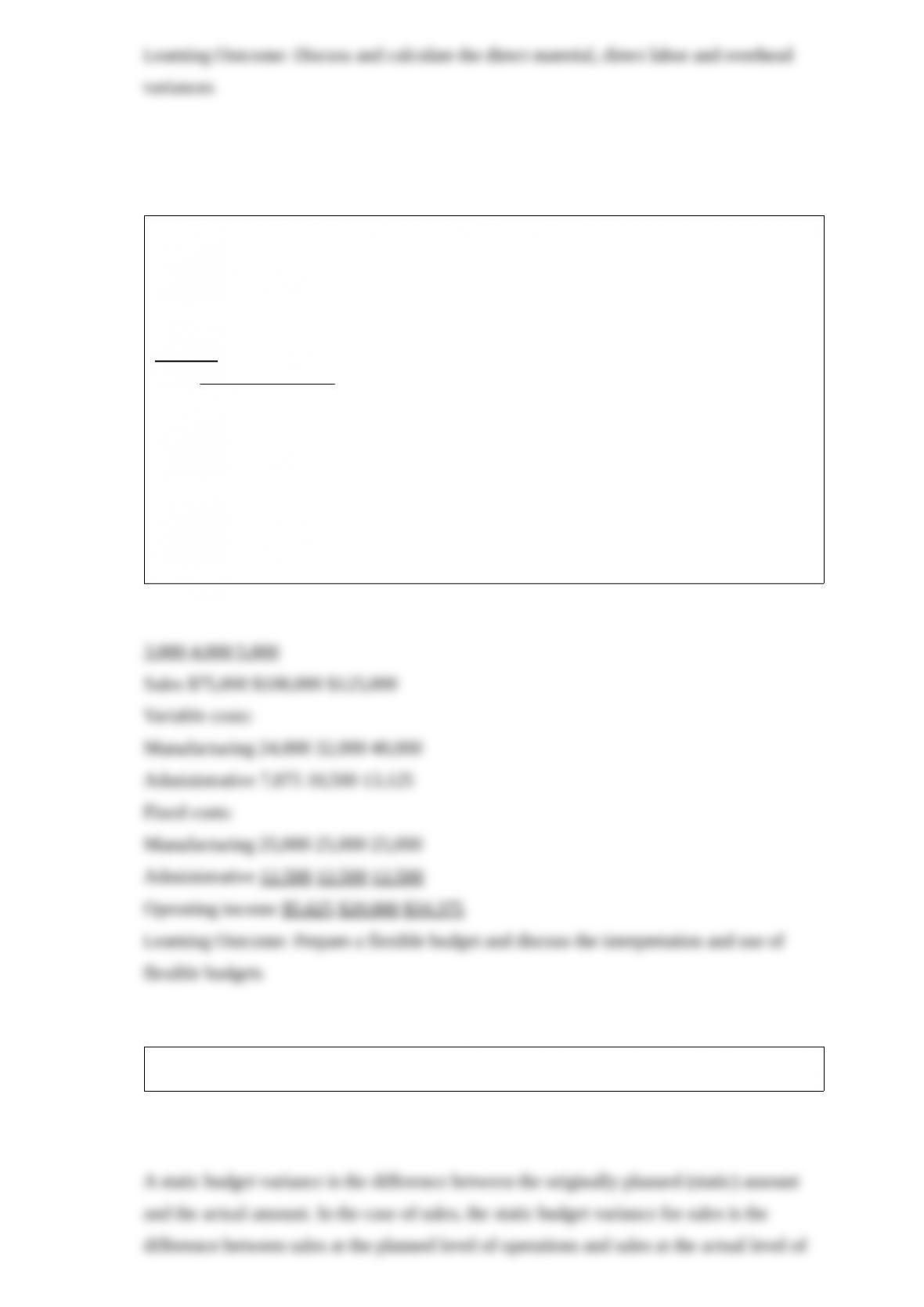
Fill in the blanks to complete the flexible budget for Mammoth Company. Assume the
different levels of output are in the relevant range.
____________________________________________________________
Budget Various Levels of Output
Formula
Per Unit
Units 3,000 4,000 5,000
Sales $25 _____ _____ _____
Variable costs:
Manufacturing _____ _____ $32,000 _____
Administrative $2.625 _____ _____ _____
Fixed costs:
Manufacturing _____ _____ $25,000
Administrative $12,500 _____ _____
Operating income _____ _____ _____
Differentiate between a static budget variance and a flexible budget variance.
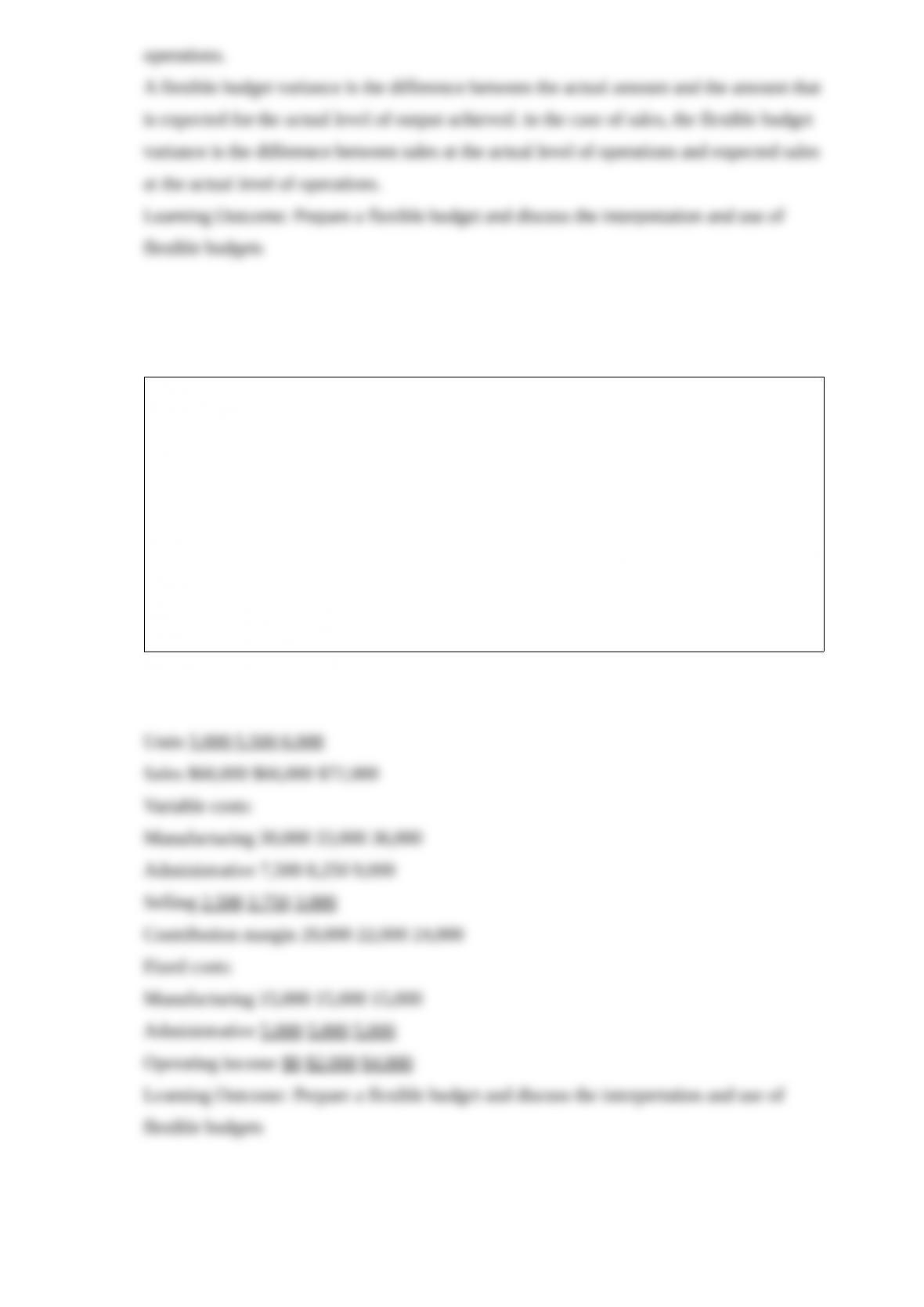
Use the following data to prepare a flexible budget for possible production levels of
5,000, 5,500 and 6,000 units. Assume all levels of production are in the same relevant
range.
Sales price $12.00 per unit
Variable costs:
Manufacturing $6.00 per unit
Administrative $1.50 per unit
Selling $0.50 per unit
Fixed costs(at 5,000 units):
Manufacturing $15,000
Administrative $5,000
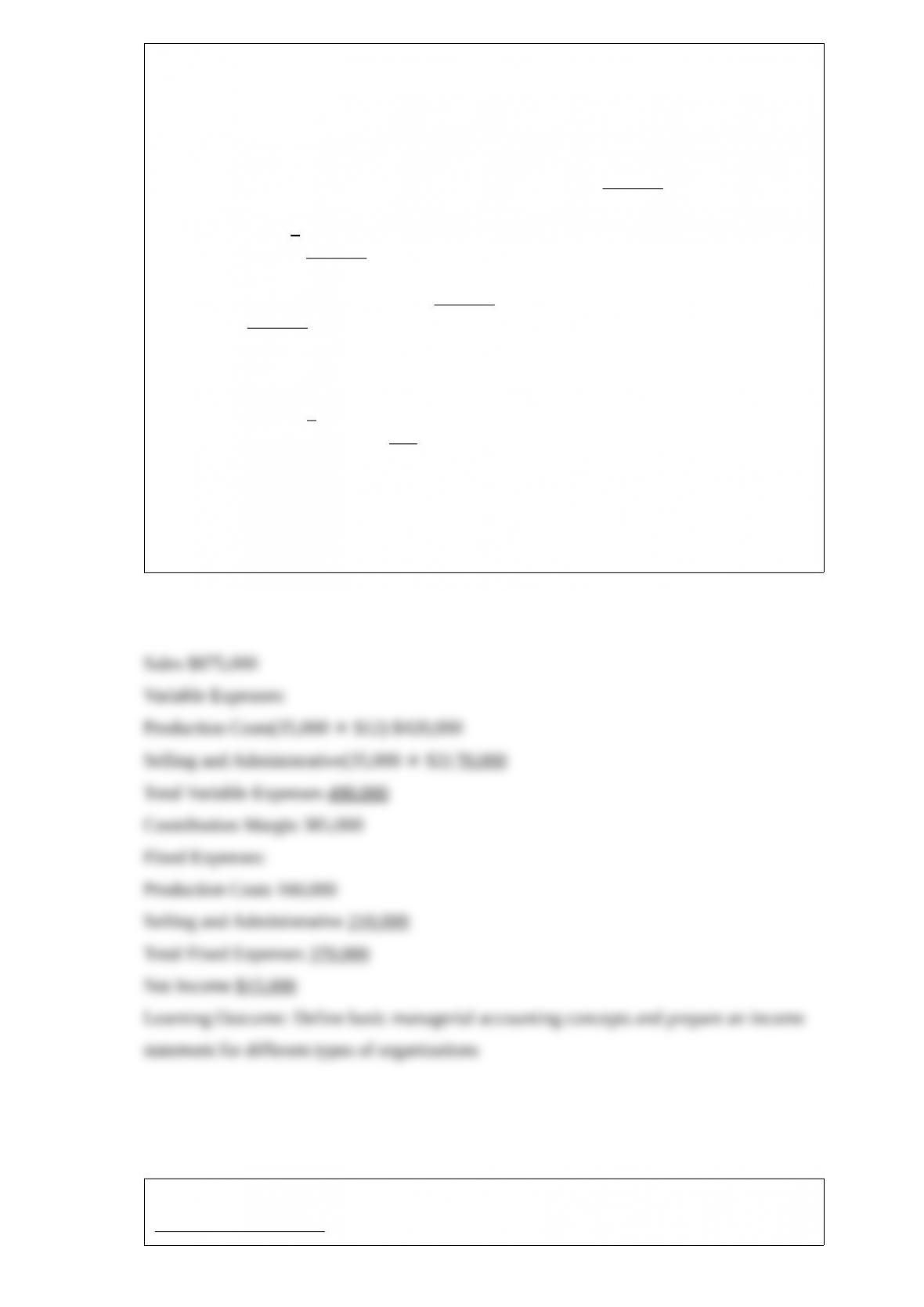
Whitney Company has just completed its first year of operations. The company’s
accountant has prepared an absorption costing income statement for the year as seen
below:
Sales (35,000 units at $25) $875,000
Beginning Inventory 0
Cost of Goods Manufactured (35,000 × $12) + $160,000 = 580,000
Cost of Goods Available 580,000
Ending Inventory 0
Cost of Goods Sold 580,000
Gross Margin 295,000
Selling and Administrative Expenses 280,000
Net Income $15,000
The variable production costs per unit are determined as follows:
Direct materials $5
Direct labor 6
Variable production 1
Total variable production costs $12
The company’s fixed production costs are $160,000 per year. The company’s selling and
administrative expenses consist of $210,000 per year in fixed expenses and $2 per unit
in variable expenses.
Required:
Prepare the company’s income statement in the contribution format.
The McGraw Company has the following information available:
Month Budgeted Sales

June $68,000
July 72,000
August 74,000
September 76,000
October 78,000
The cost of goods sold rate is 65% and the desired ending inventory level is 25% of the
next month’s cost of sales.
Required:
Prepare a purchases and cost of goods sold budget for July, August and September.
The balances on December 31, 2015 are available for Matthew Company:
Accounts payable $2,550
Accounts receivable 3,550
Accumulated depreciation 6,250
Retained earnings, December 31, 2014 6,450
Cash 2,300
Cost of goods sold 52,300
Depreciation expense 2,500
Dividends declared 8,800
Equipment 29,000
Income tax expense 10,700
Interest expense 1,150
Inventory 6,250
Long-term notes payable 11,500
Paid-in capital 4,450
Prepaid rent 350
Rent expense 4,000
Sales 120,000
Wage expense 41,900
Wages payable 3,000
Required:
Prepare a multiple-step income statement for the year ended December 31, 2015.
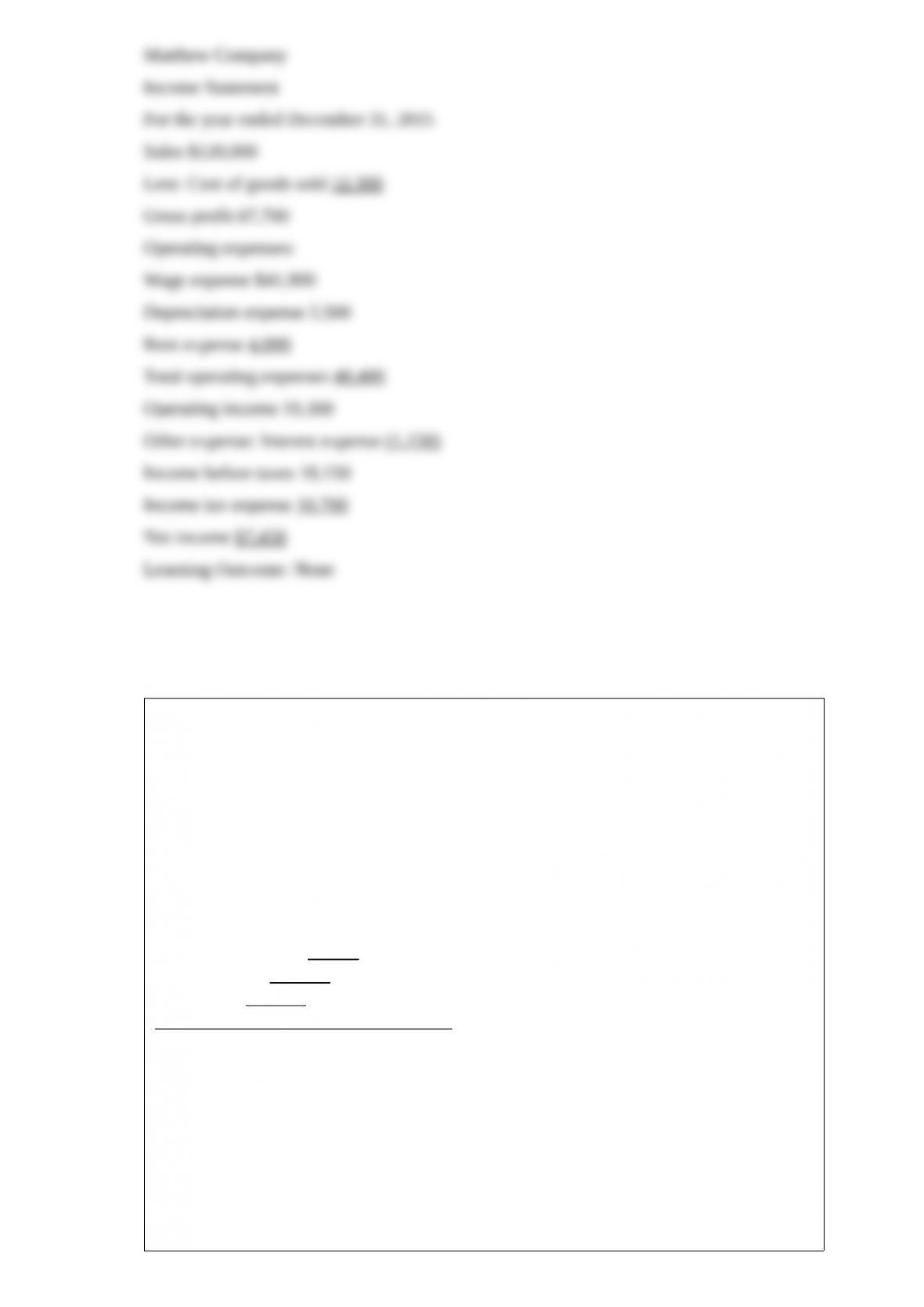
For the year ended December 31, 2015, the following information is available for the
Kansas Company:
Sales $891,000
Cost of goods sold 662,000
Depreciation expense 16,000
Amortization expense 3,000
Wage expense 91,000
Rent expense 4,000
Loss on sale of fixed assets 2,000
Interest expense 13,000
Income tax expense 38,000
Total expenses 829,000
Net income $62,000
December 31, 2014 December 31, 2015
Cash $10,000 $12,800
Accounts receivable $10,000 $19,200
Inventory $20,000 $14,100
Prepaid rent $2,000 $1,700
Accounts payable $22,000 $24,400
Wages payable $12,000 $11,300
Taxes payable $2,000 $3,100
Required:
Prepare the operating activities section of the statement of cash flows for the year
ending December 31, 2015. Use the indirect method.
Jorgensen Company has the following data:
Month Budgeted Sales
April $154,000
May 160,000
June 142,000
July 136,000
Budgeted Operating Expenses Per Month
Wages $12,600
Advertising 27,200
Depreciation 19,000
Rent 20,400
Freight-out 20% of sales
Sales commission 5% of sales
Required:
Prepare a schedule of cash disbursements for operating expenses for April, May and
June. All cash expenses are paid when incurred.
Listed below are the transactions for Kaiman Company:
1. The owners invest $100,000 in the company in exchange for common stock.
2. The company purchases equipment costing $30,000 with a note payable. The
equipment has a ten year life and no salvage value. The company uses the straight-line
method of depreciation.
3. The company purchases inventory costing $10,000 by paying cash.
4. The company paid $8,000 for four months’ rent in advance.
5. The company sold inventory for $9,000 cash. The cost of the inventory was $5,000.
6. The company used one month of rent.
7. The company declared a cash dividend of $500.
8. Depreciation expense on the equipment was recorded for the month.
Required:
Prepare journal entries for the above transactions.
Why will management control systems in nonprofit organizations probably never be as
highly developed as those in profit-seeking firms?