Which one of the following will not occur in an organization that gives managers
throughout the organization maximum freedom to make decisions? (CMA adapted)
A. more effective solutions to operational problems
B. individual managers regarding the managers of other segments as they do external
parties
C. two divisions of the organization having competing models that aim for the same
market segments
D. delays in securing approval for the introduction of new products
E. greater knowledge of the marketplace and improved service to customers
Answer:
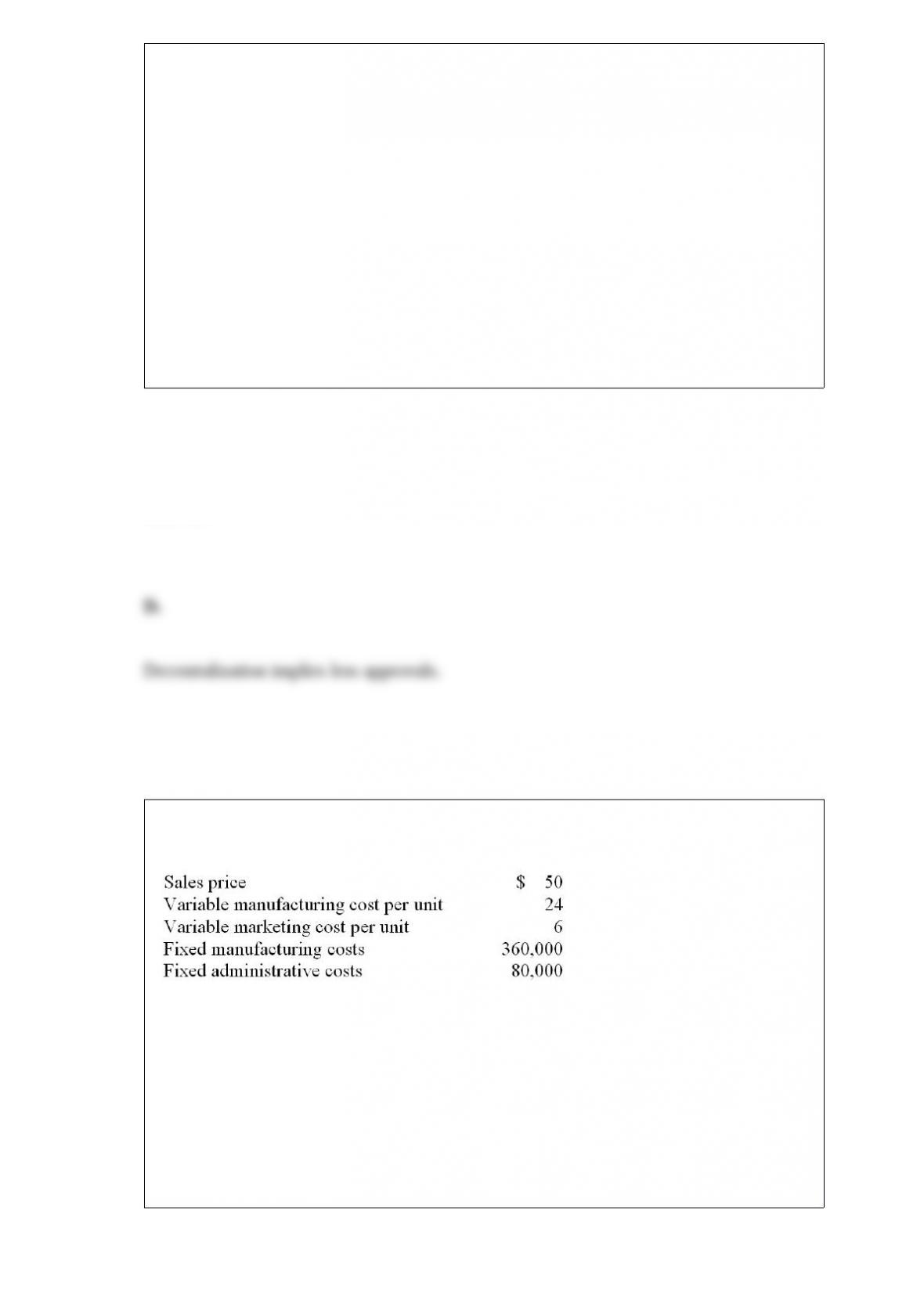
You have been provided with the following information regarding the VLCD
Manufacturing Company:
This information is based on forecasted sales of 30,000 units.
Required:
(a) What are the expected operating profits for the upcoming year?
(b) What is the break-even point in units?
(c) If $180,000 of operating profits is desired, how many units must be sold?
Answer:
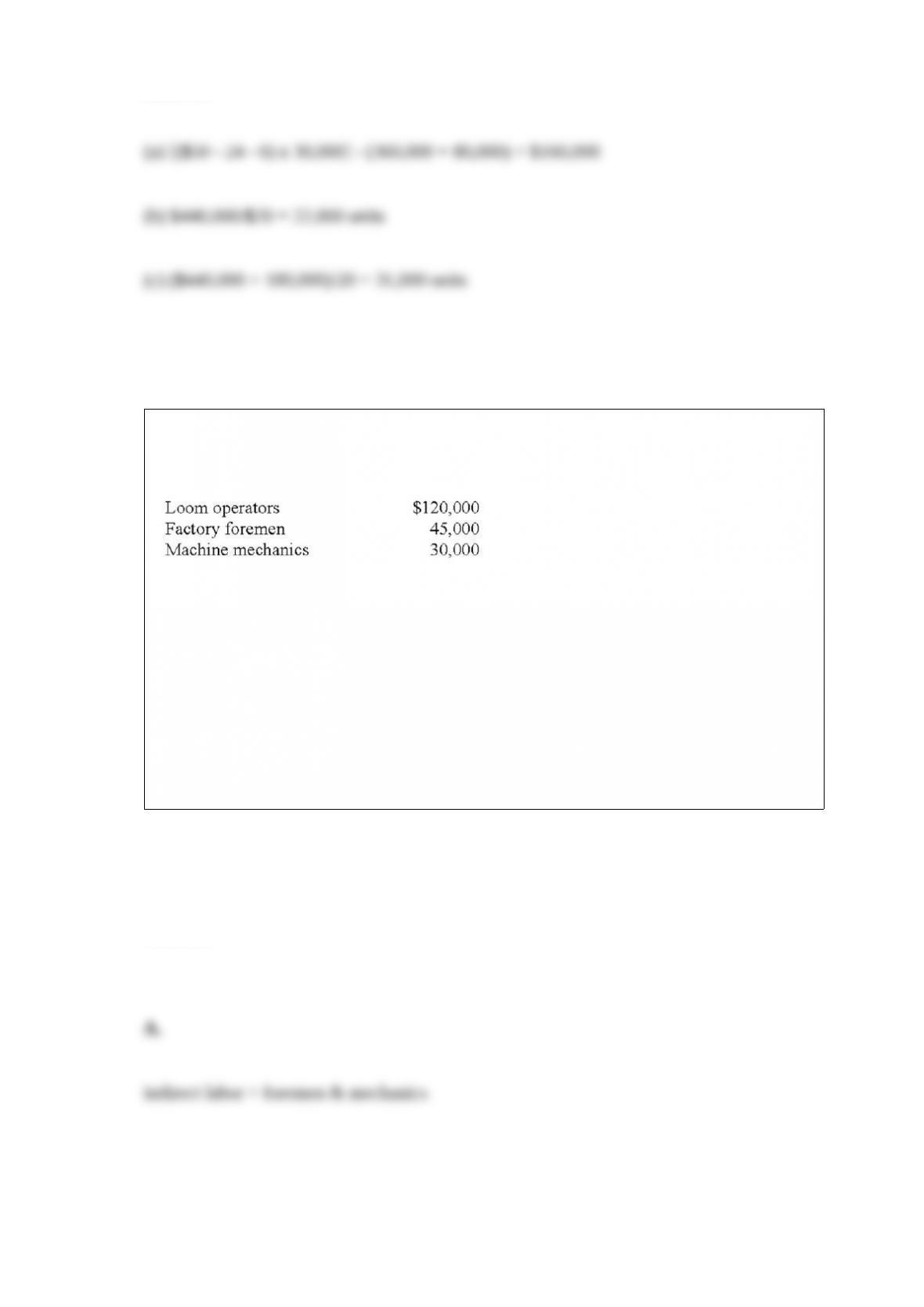
Fab Co. manufactures textiles. Among Fab’s 2010 manufacturing costs were the
following salaries and wages:
What was the amount of Fab’s 2010 indirect labor? (CPA adapted)
A. $75,000
B. $165,000
C. $150,000
D. $120,000
Answer:
Which of the following terms is not an alternative for master budget?
A. budget plan
B. static budget
C. profit plan
D. planning budget
Answer:
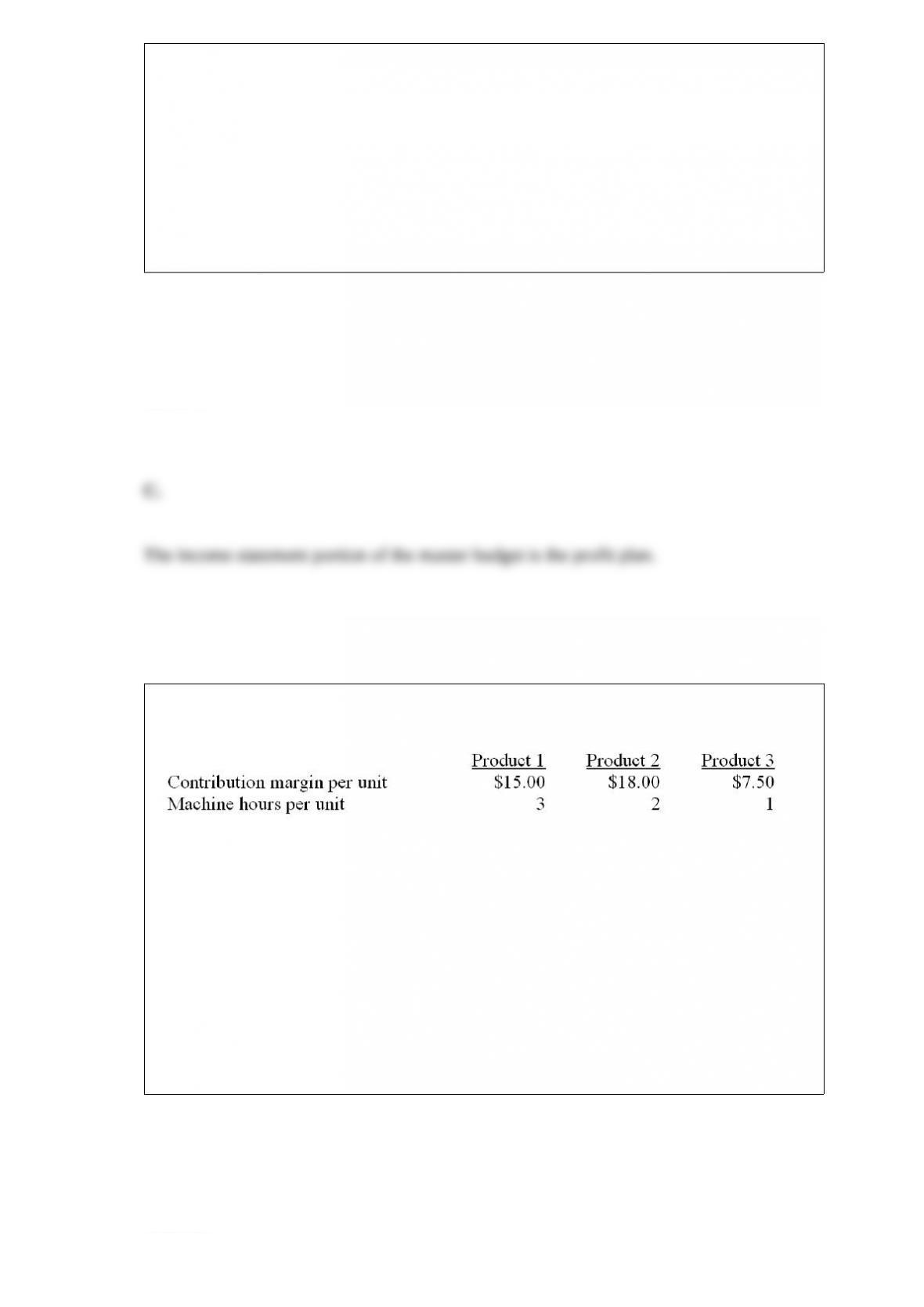
Zurek Inc has 5,400 machine hours available each month. The following information
on the company’s three products is available:
The market demand is limited to 2,000 units of each of the three products. What is the
maximum possible contribution margin that Zurek could make in any month?
A. $81,000
B. $46,500
C. $43,000
D. $51,000
Answer:
How would property taxes paid on a factory building be classified in a manufacturing
company?
A. Fixed, period cost.
B. Fixed, product cost.
C. Variable, period cost.
D. Variable, product cost.
Answer:
Which of the following organizations would most likely use a process costing system?
A. Gasoline refinery
B. Automobile retailer
C. Airplane manufacturer
D. Public accounting firm
Answer:
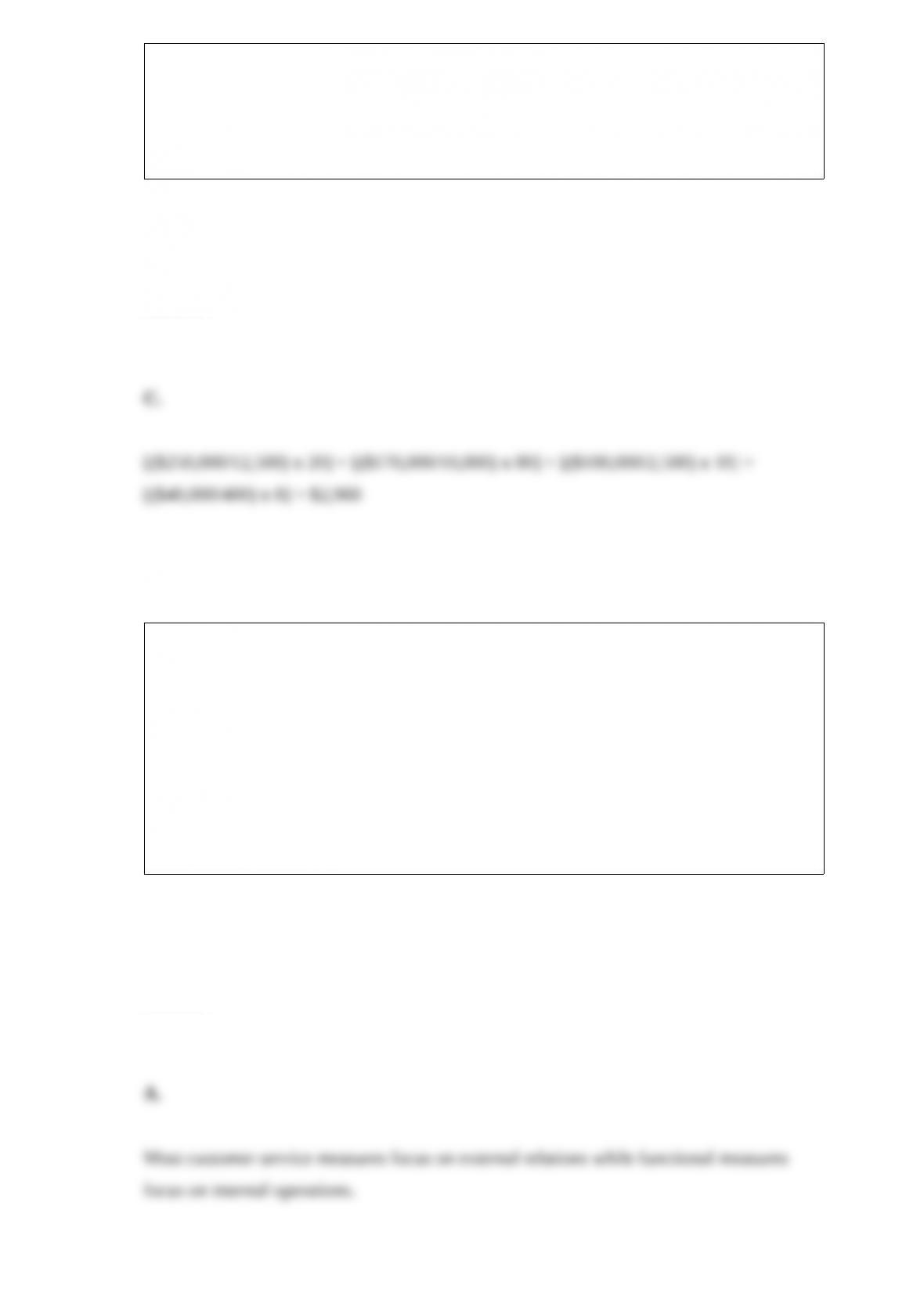
Scottso Enterprises has identified the following overhead costs and cost drivers for the
coming year:
Budgeted direct labor cost was $200,000 and budgeted direct material cost was
$800,000. The following information was collected on three jobs that were completed
during the month:
If the company uses activity-based costing (ABC), how much overhead cost should be
assigned to Job B-32?
A. $4,200
B. $2,600
C. $2,960
D. $3,480
Answer:
Functional performance measures differ from customer satisfaction performance
measures in that they are used primarily to evaluate
A. internal processes.
B. external processes.
C. benchmark processes.
D. continuous improvement processes.
Answer:
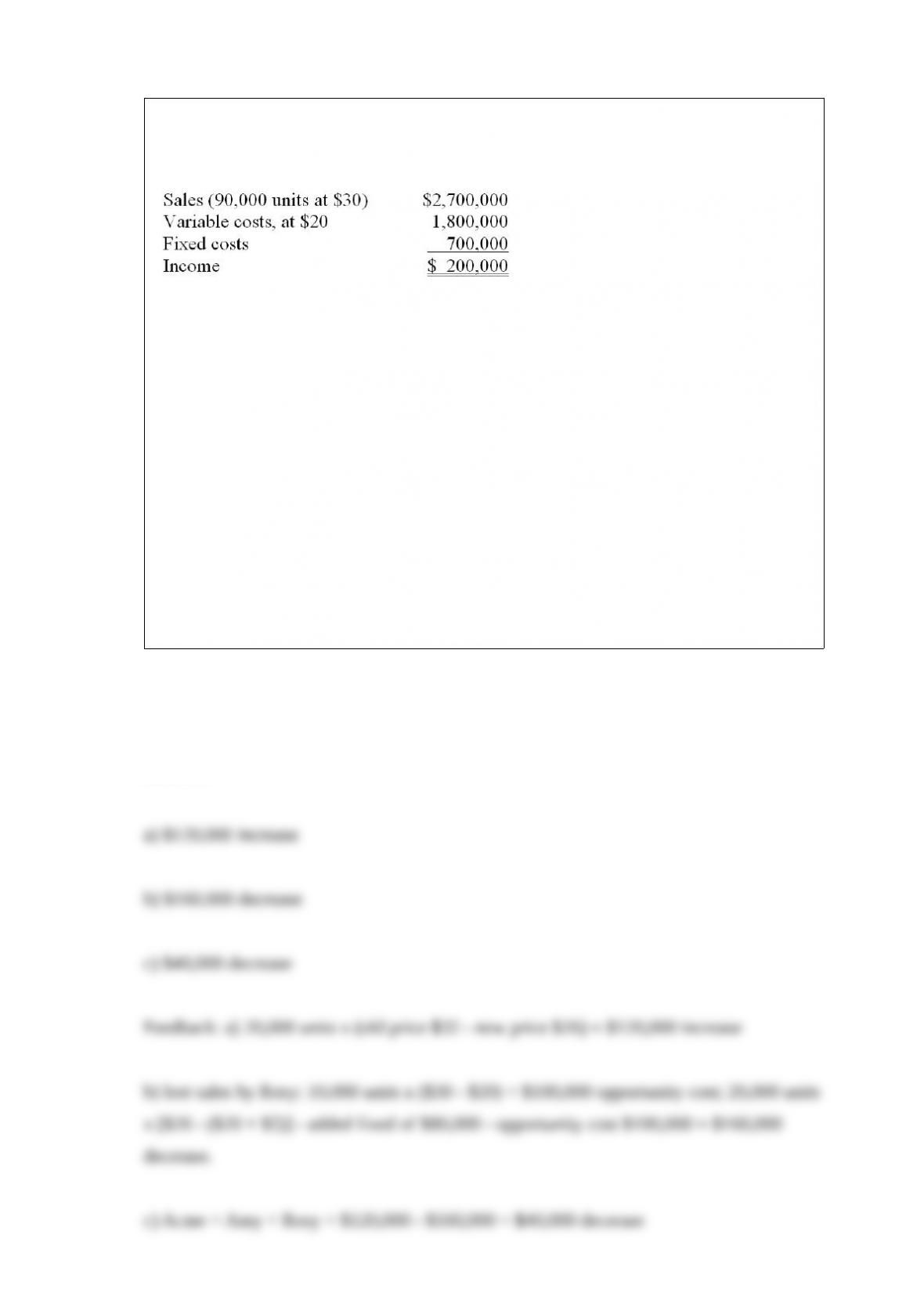
Rosy Division of Acme Inc. has a capacity of 100,000 units and expects the following
results for the year.
Amy Division of Acme Inc. currently purchases 20,000 units of a part for one of its
products from an outside supplier at $32 per unit. Amy’s manager believes she could
use a minor variation of Rosy’s product instead, and offers to buy the units from Rosy at
$26. Making the variation desired by Amy would cost Rosy an additional $5 per unit
and would increase Rosy’s annual cash fixed costs by $80,000. Rosy’s manager agrees
to the deal offered by Amy’s manager.
Required:
a) Find the effect of the deal on Amy’s income
b) Find the effect of the deal on Rosy’s income.
c) Find the effect of the deal on the income of Acme Inc. as a whole.
Answer:
Rockford Manufacturing Corporation uses a responsibility accounting system in its
operations. Which one of the following items is least likely to appear in a performance
report for a manager of one of Rockford’s assembly lines? (CMA adapted)
A. direct labor
B. materials
C. repairs and maintenance
D. depreciation on the manufacturing facility
E. supervisory salaries
Answer:
NorWest Shoe Company has two retail stores, one in Albertville and the other in
Bloomer. The Albertville store had sales of $100,000, a contribution margin of 35
percent, and a segment margin of $14,000. The company’s two stores have total sales of
$250,000, contribution margin of 32 percent, and a total segment margin of $31,000.
The contribution margin for the Bloomer store must have been
A. $65,000
B. $170,000
C. $105,000
D. $45,000
Answer:
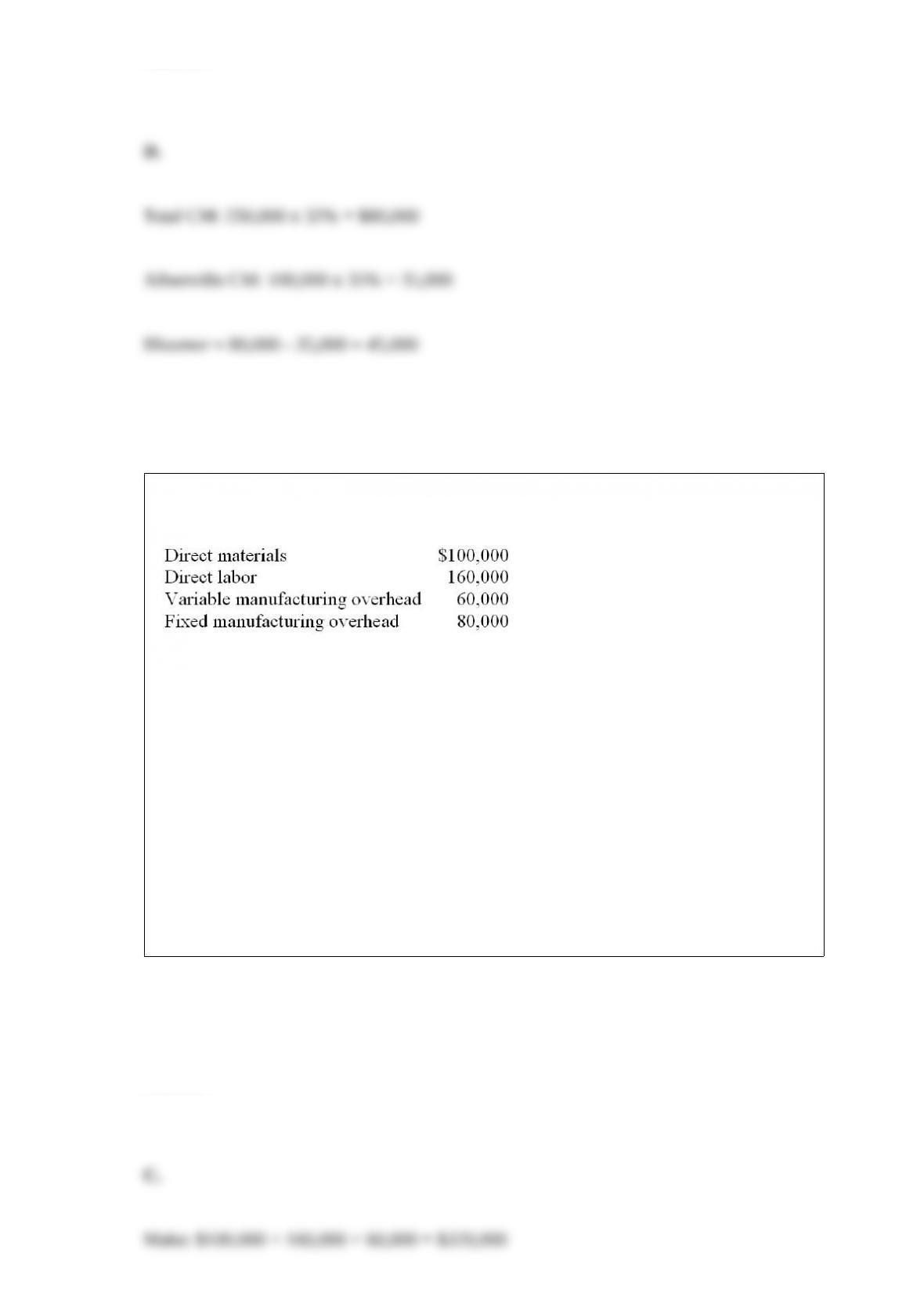
Bryon Industries manufactures 20,000 components per year. The manufacturing cost of
the components was determined as follows:
An outside supplier has offered to sell the component for $17. If Bryon purchases the
component from the outside supplier, the manufacturing facilities would be unused and
could be rented out for $10,000. If Bryon purchases the component from the supplier
instead of manufacturing it, the effect on income would be:
A. a $70,000 increase
B. a $50,000 decrease
C. a $10,000 decrease
D. a $30,000 increase
Answer:
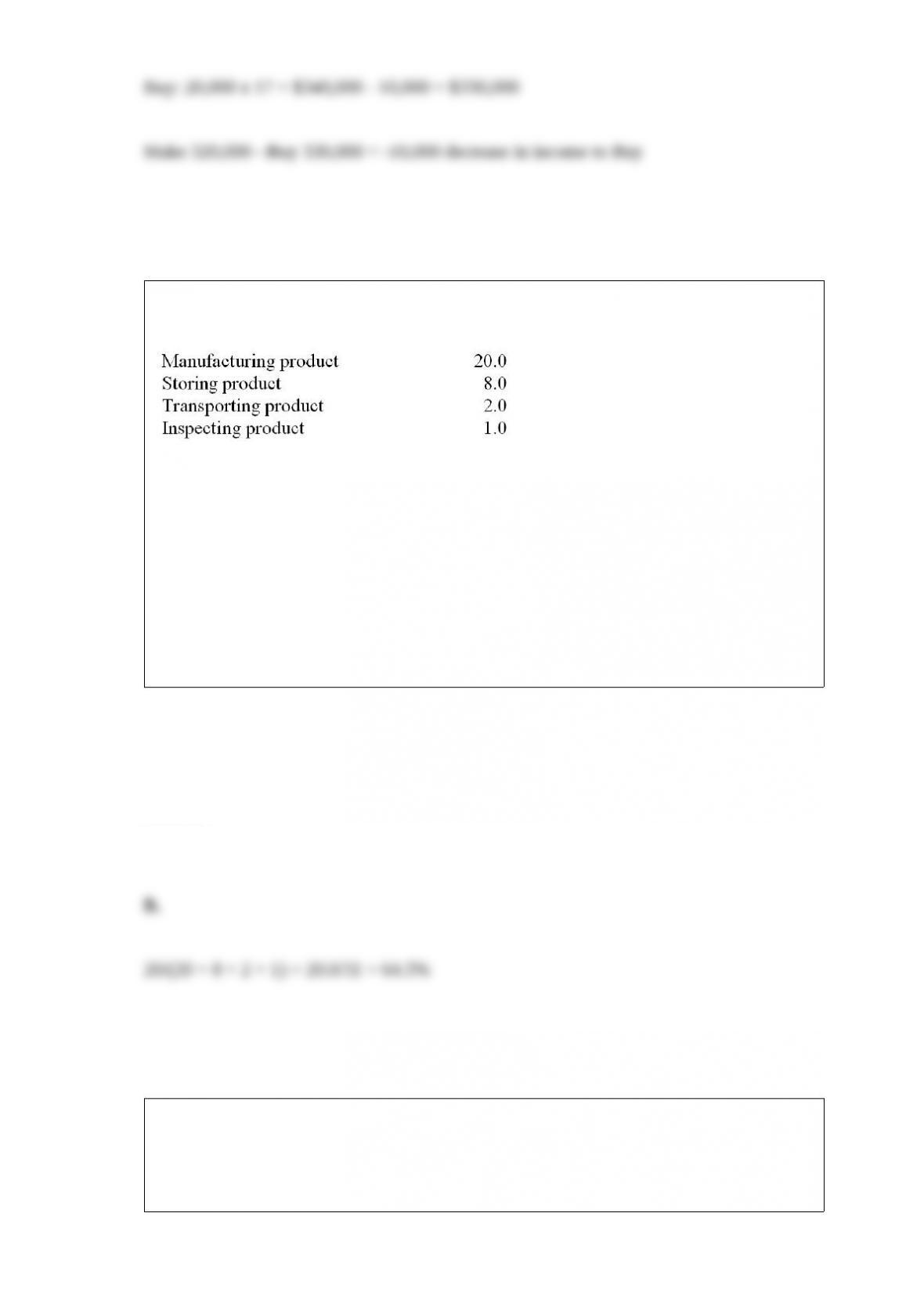
The Pepin Company collected the following information (in days):
What is the manufacturing cycle efficiency?
A. 28.6%
B. 64.5%
C. 71.4%
D. 90.9%
Answer:
The Document Creation Center (DCC) for Alegis Corp. provides photocopying and
document services for three departments in the St. Paul office. The following budget
has been prepared for the year.
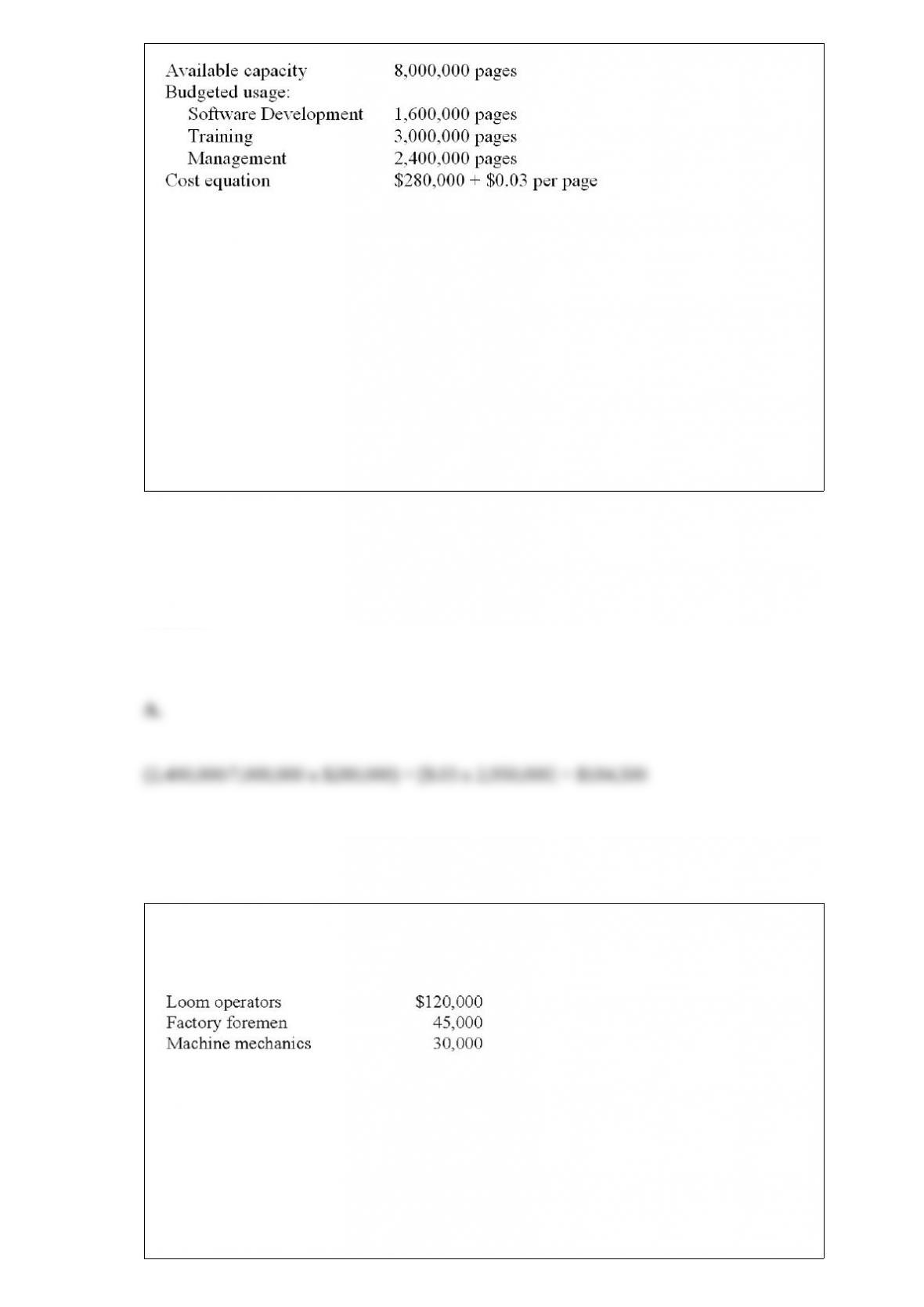
If DCC uses a dual-rate for allocating its costs, how much cost will be allocated to the
Management Department, assuming the Management Department actually made
2,950,000 copies during the year?
A. $184,500
B. $191,750
C. $211,783
D. $206,500
Answer:
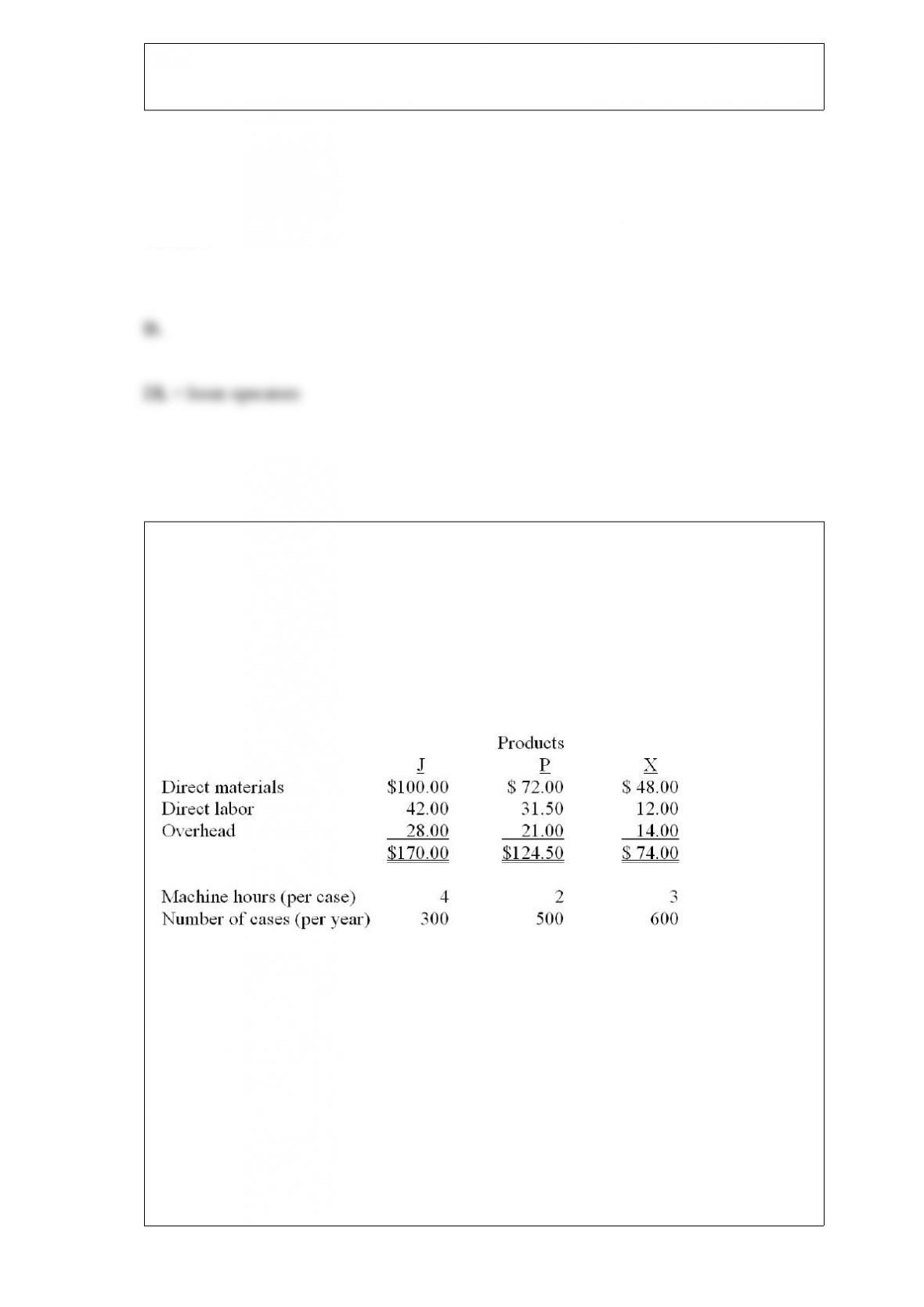
Fab Co. manufactures textiles. Among Fab’s 2010 manufacturing costs were the
following salaries and wages:
What was the amount of Fab’s 2010 direct labor? (CPA adapted)
A. $195,000
B. $165,000
C. $150,000
D. $120,000
Answer:
Smelly Perfume Company manufactures and distributes several different products.
They currently use a plantwide allocation method for allocating overhead at a rate of $7
per direct labor hour. Cindy is the department manager of Department C which
produces Products J and P. Department C has $16,200 in traceable overhead. Diane is
the department manager of Department D which manufactures Product X. Department
D has $11,100 in traceable overhead. The product costs (per case of 24 bottles) and
other information are as follows:
If Smelly changes its overhead allocation to departmental rates, what is the product cost
per case for Product X assuming Departments C and D use direct labor hours and
machine hours as their respective allocation bases?
A. $79.50
B. $80.48
C. $74.00
D. $78.50
Answer:
Donnelly Corporation manufactures and sells T-shirts imprinted with college names
and slogans. Last year, the shirts sold for $7.50 each, and the variable cost to
manufacture them was $2.25 per unit. The company needed to sell 20,000 shirts to
break even. The after tax net income last year was $5,040. Donnelly’s expectations for
the coming year include the following: (CMA adapted)
• The sales price of the T-shirts will be $9
•Variable cost to manufacture will increase by one-third
•Fixed costs will increase by 10%
•The income tax rate of 40% will be unchanged.
The number of T-shirts Donnelly Corporation must sell to break even in the coming year
is
A. 17,000 units.
B. 19,250 units.
C. 20,000 units.
D. 22,000 units.
Answer:
Return on investment (ROI) can be decomposed into the asset turnover and the
A. gross margin ratio.
B. profit margin ratio.
C. operating margin ratio.
D. contribution margin ratio.
Answer:
Which of the following statements is (are) true?
(1). An asset is a cost that will be matched with revenues in a future accounting period.
(2). Opportunity costs are recorded as intangible assets in the current accounting
period.
A. Only (1) is true.
B. Only (2) is true.
C. Both (1) and (2) are true.
D. Neither (1) nor (2) are true.
Answer:
Red Company had Work-in-Process Inventories that were 45% complete at the start of
the month. Work-in-Process at the end of the month was 10% complete. Materials were
added at the beginning of the process. If weighted-average process costing is used, the
total equivalent units for materials will equal the number of units
A. transferred out during the period.
B. started and completed during the period.
C. started into the process during the period.
D. transferred out during the process plus the units in the ending inventory.
Answer:
The predetermined overhead rate for manufacturing overhead for 2008 is $4.00 per
direct labor hour. Employees are expected to earn $5.00 per hour and the company is
planning on paying its employees $100,000 during the year. However, only 75% of the
employees are classified as “direct labor.” What was the estimated manufacturing
overhead for 2008?
A. $60,000
B. $75,000
C. $80,000
D. $93,750
Answer:
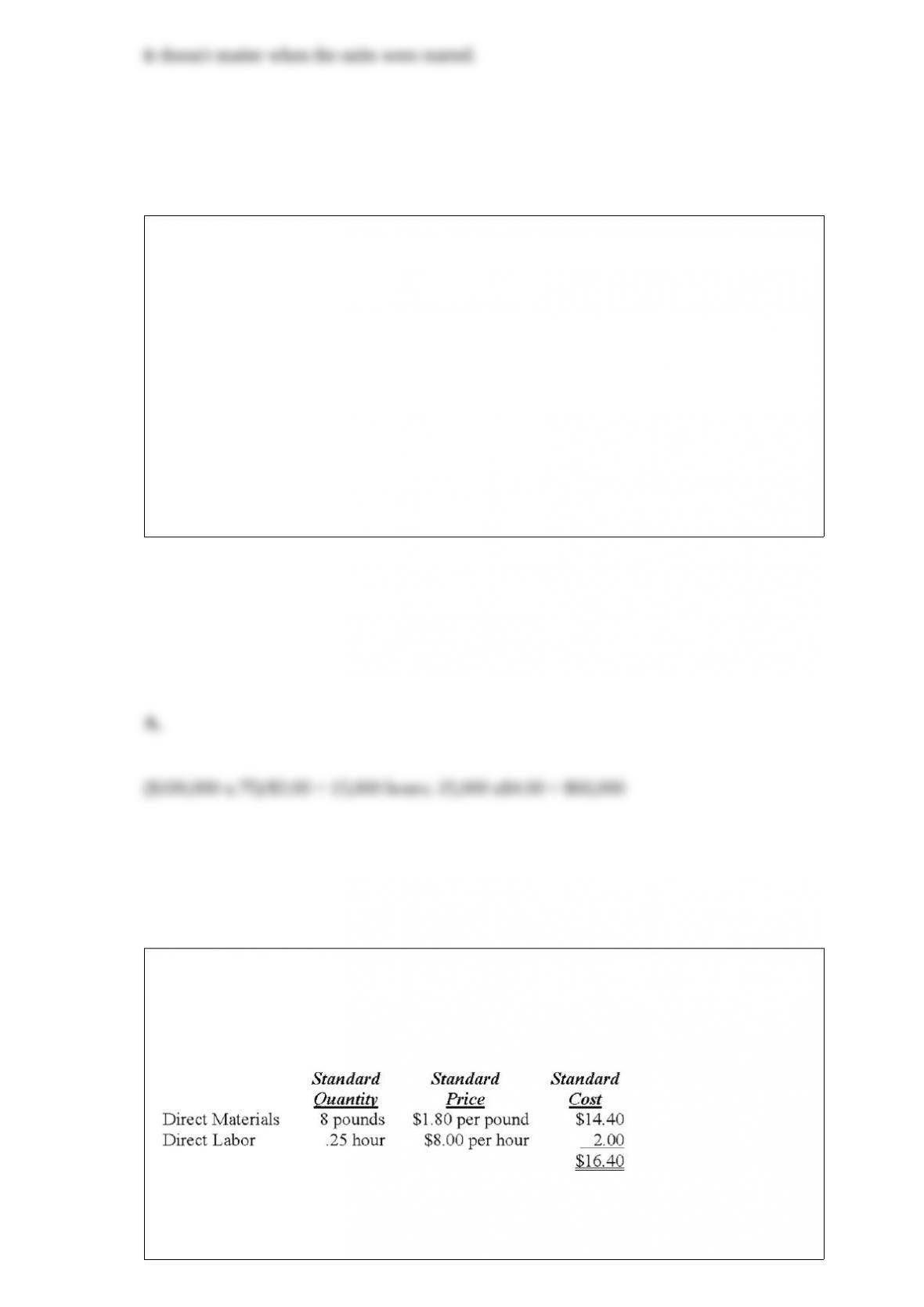
Arrow Industries employs a standard cost system in which direct materials inventory is
carried at standard cost. Arrow has established the following standards for the prime
costs of one unit of product.
During November, Arrow purchased 160,000 pounds of direct materials at a total cost
of $304,000. The total factory wages for November were $42,000, 90% of which were
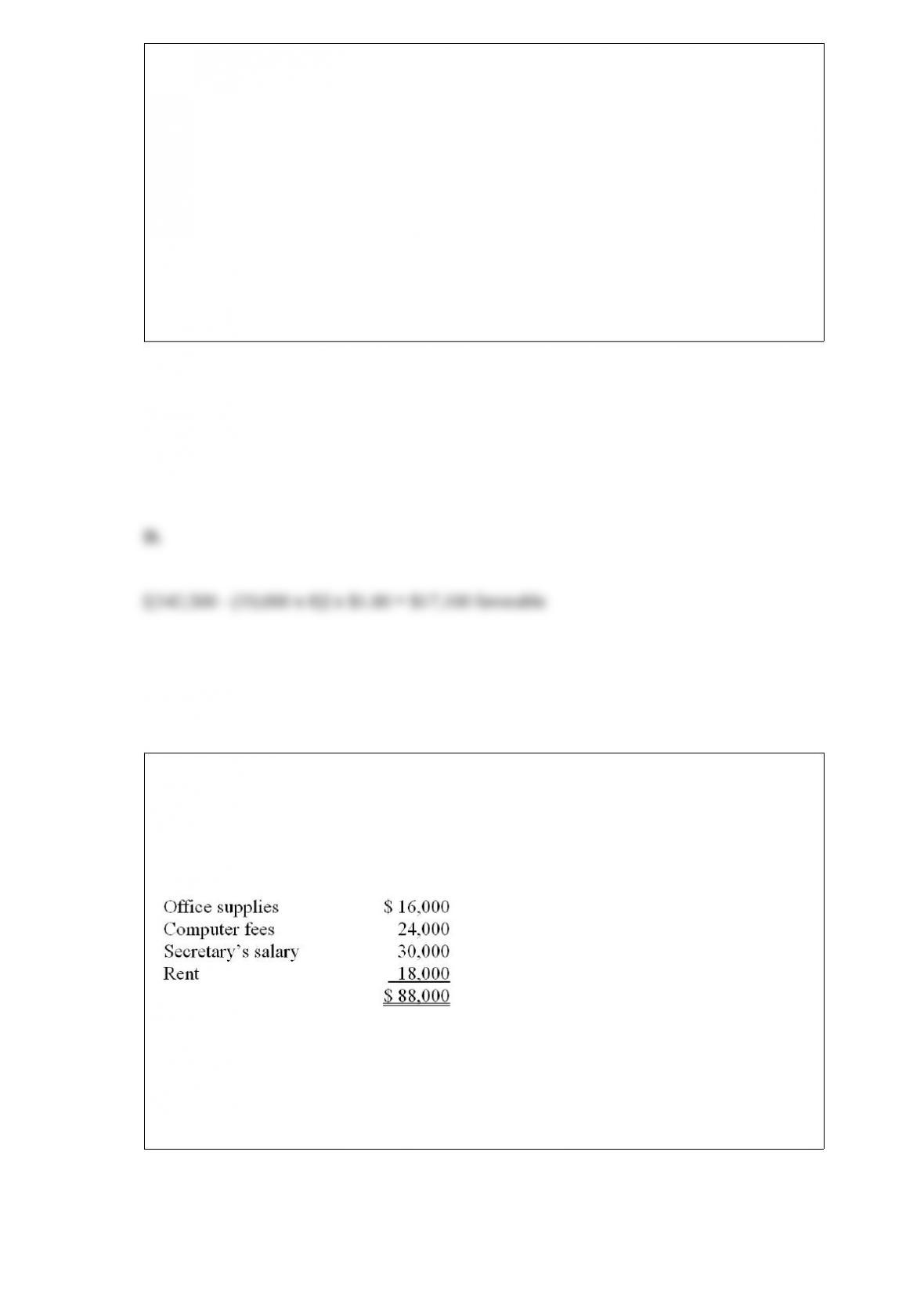
for direct labor. Arrow manufactured 19,000 units of product during November using
142,500 pounds of direct materials and 5,000 direct labor hours.
What is the direct materials efficiency (quantity) variance for November?
A. $14,250
B. $14,400
C. $16,000
D. $17,100
Answer:
Terri Martin Nerdmeister, CPA provides bookkeeping and tax services to her clients.
She charges a fee of $60 per hour for bookkeeping and $90 per hour for tax services.
Martin estimates the following costs for the upcoming year:
Operating profits declined last year and Ms. Martin has decided to use activity-based
costing (ABC) procedures to evaluate her hourly fees. She gathered the following
information from last year’s records:
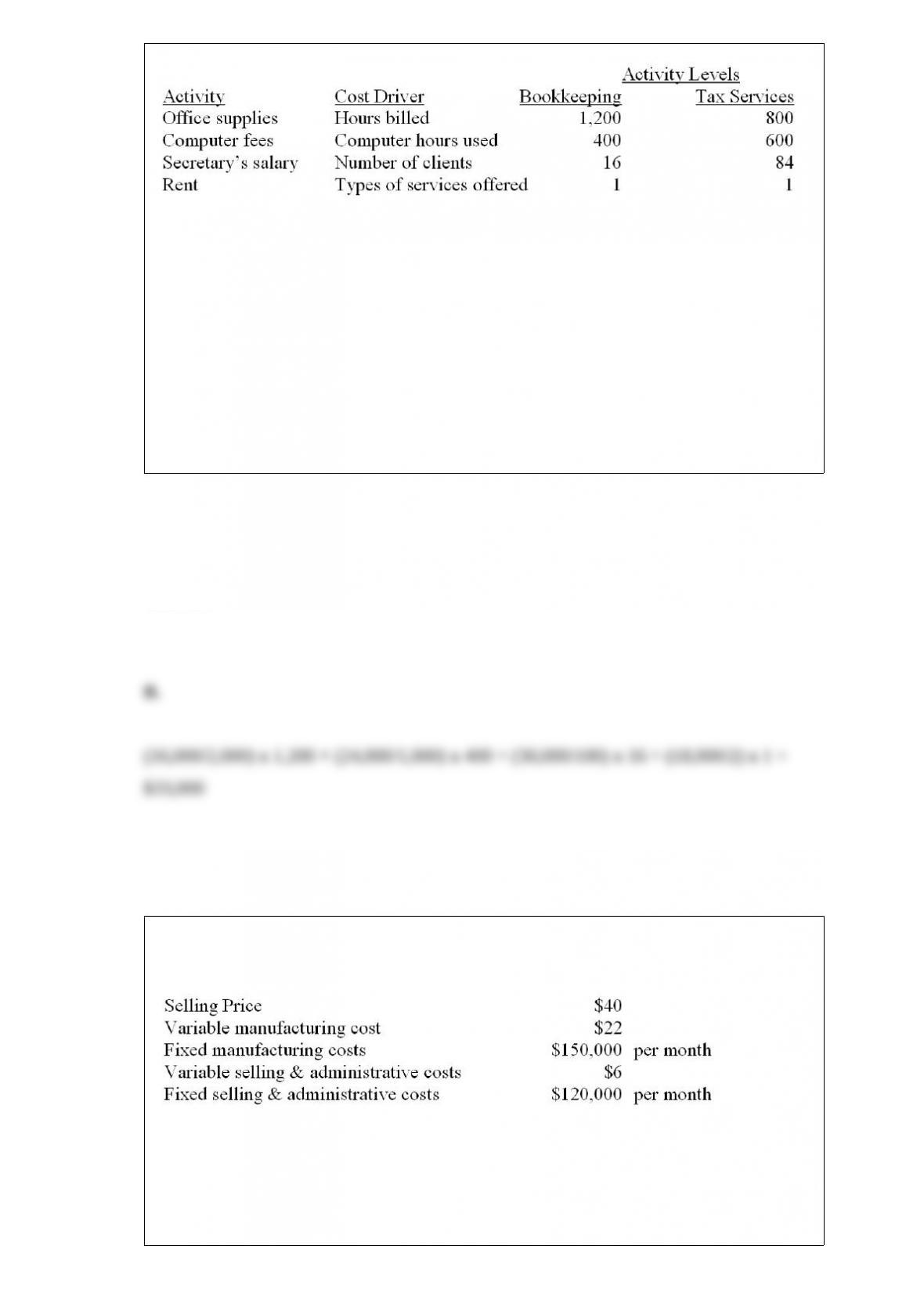
What is the total cost allocated to the bookkeeping services using activity-based
costing?
A. $24,000
B. $33,000
C. $35,000
D. $44,000
Answer:
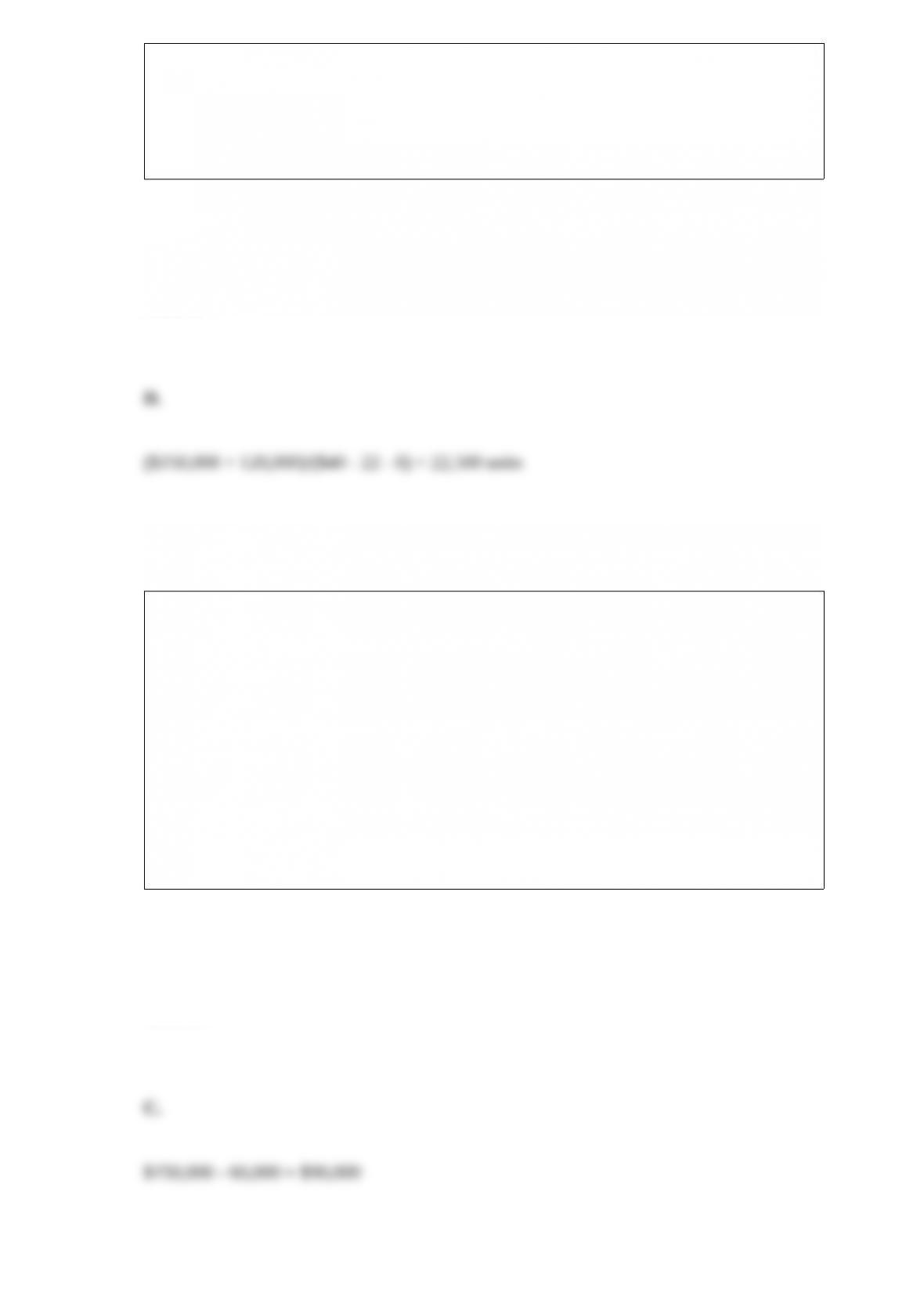
Sanfran has the following data:
How many units must Sanfran produce and sell in order to break-even?
A. 8,333 units
B. 12,500 units
C. 15,000 units
D. 22,500 units
Answer:
In 2010, the Turnkey Company had consulting revenues of $1,000,000 while costs
were $750,000. In 2011, Turnkey will be introducing a new service that will generate
$150,000 in sales revenues and $60,000 in costs. Assuming no changes are expected for
the other services, the differential operating profit for 2011 is
A. $250,000.
B. $150,000.
C. $90,000.
D. $60,000.
Answer:
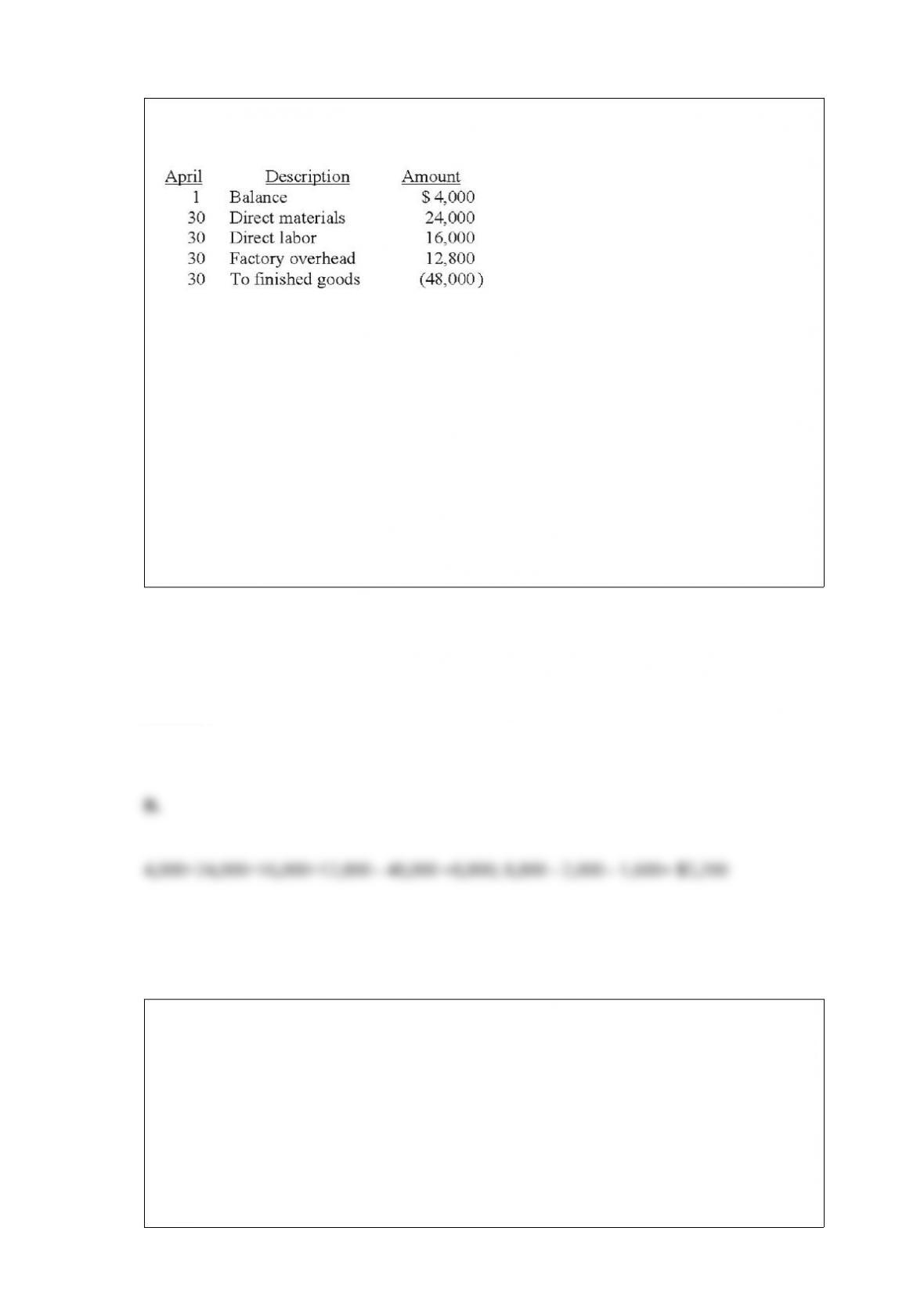
Birk Co. uses a job order costing system. The following debits (credits) appeared in
Birk’s work-in-process account for the month of April:
Birk applies overhead to production at a predetermined rate of 80% of direct labor cost.
Job No. 5, the only job still in process on April 30 has been charged with direct labor of
$2,000. What was the amount of direct material charged to Job No.5? (CPA adapted)
A. $3,000
B. $5,200
C. $8,800
D. $24,000
Answer:
The condensed flexible budget of the Scooter Company for the year is given as
$160,000 + $1.25/direct labor hour. The company produces a single product that
requires 2.5 direct labor-hours to complete.
Assume that the company chooses 100,000 direct labor-hours as the denominator level
of activity, but actually worked 96,000 hours during the year producing 37,000 units.
Actual overhead costs for the year are:
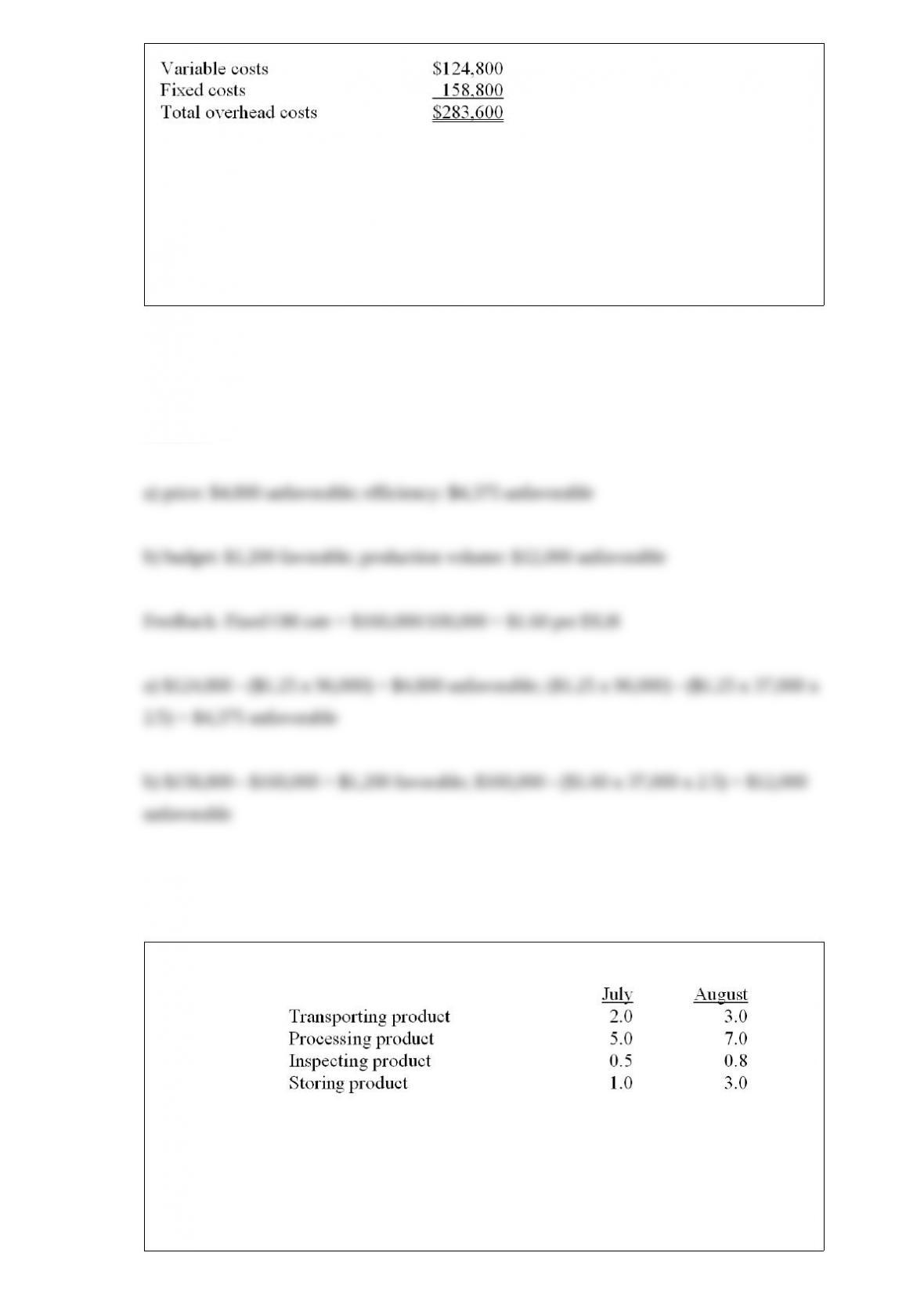
Required: (Be sure to indicate whether the variances are favorable or unfavorable.)
a) Compute the variable overhead price variance and the variable overhead efficiency
variance.
b) Compute the fixed overhead spending (budget) variance and the production volume
variance.
Answer:
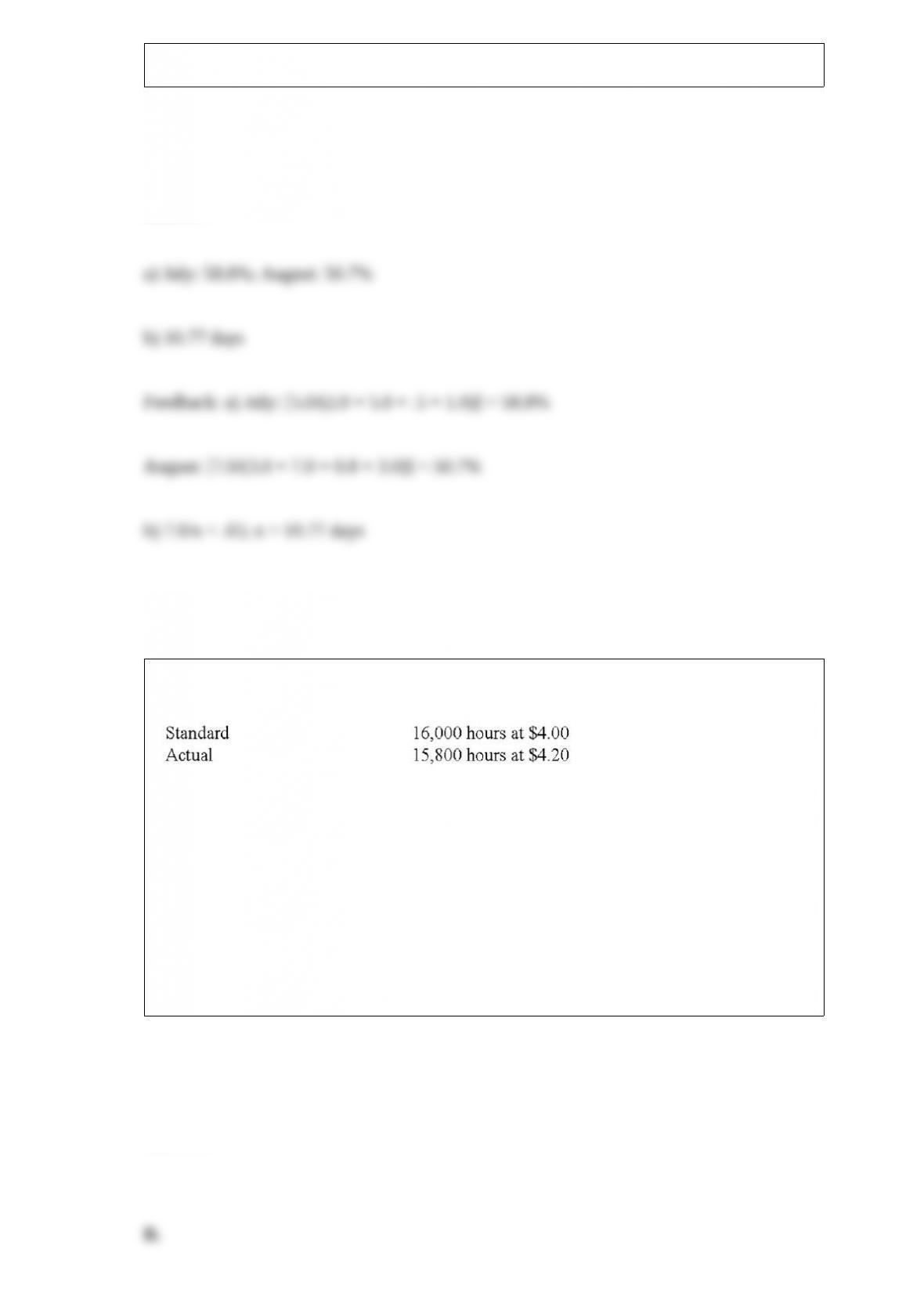
The XYZ Manufacturing Company collected the following information (in days) for
July and August.
Required:
a) Calculate the manufacturing cycle efficiency for July and August.
b) Assume September’s processing time will be the same as August’s. If XYZ’s target
for manufacturing cycle efficiency is 65%, what will September’s target for
manufacturing cycle time be?
Answer:
Given the following information in standard costing:
What is the total direct labor cost variance?
A. $3,160, favorable
B. $3,160, unfavorable
C. $2,360, favorable
D. $2,360, unfavorable
Answer:
An operations costing system is
A. identical to a process costing system except that actual cost is used for
manufacturing overhead.
B. the same as a process costing system except that materials are allocated on the basis
of batches of production.
C. the same as a job order costing system except that materials are accounted for in the
same way as they are in a process costing system.
D. the same as a job order costing system except that no overhead allocations are made
since actual costs are used throughout.
E. a system in which manufacturing activities are finely divided into individual, discrete
steps or operations.
Answer:
Donnelly Corporation manufactures and sells T-shirts imprinted with college names
and slogans. Last year, the shirts sold for $7.50 each, and the variable cost to
manufacture them was $2.25 per unit. The company needed to sell 20,000 shirts to
break even. The after tax net income last year was $5,040. Donnelly’s expectations for
the coming year include the following: (CMA adapted)
• The sales price of the T-shirts will be $9
•Variable cost to manufacture will increase by one-third
•Fixed costs will increase by 10%
•The income tax rate of 40% will be unchanged.
Sales for the coming year are expected to exceed last year’s by 1,000 units. If this occurs,
Donnelly’s sales volume in the coming year will be
A. 22,600 units.
B. 21,960 units.
C. 23,400 units.
D. 21,000 units.
Answer: