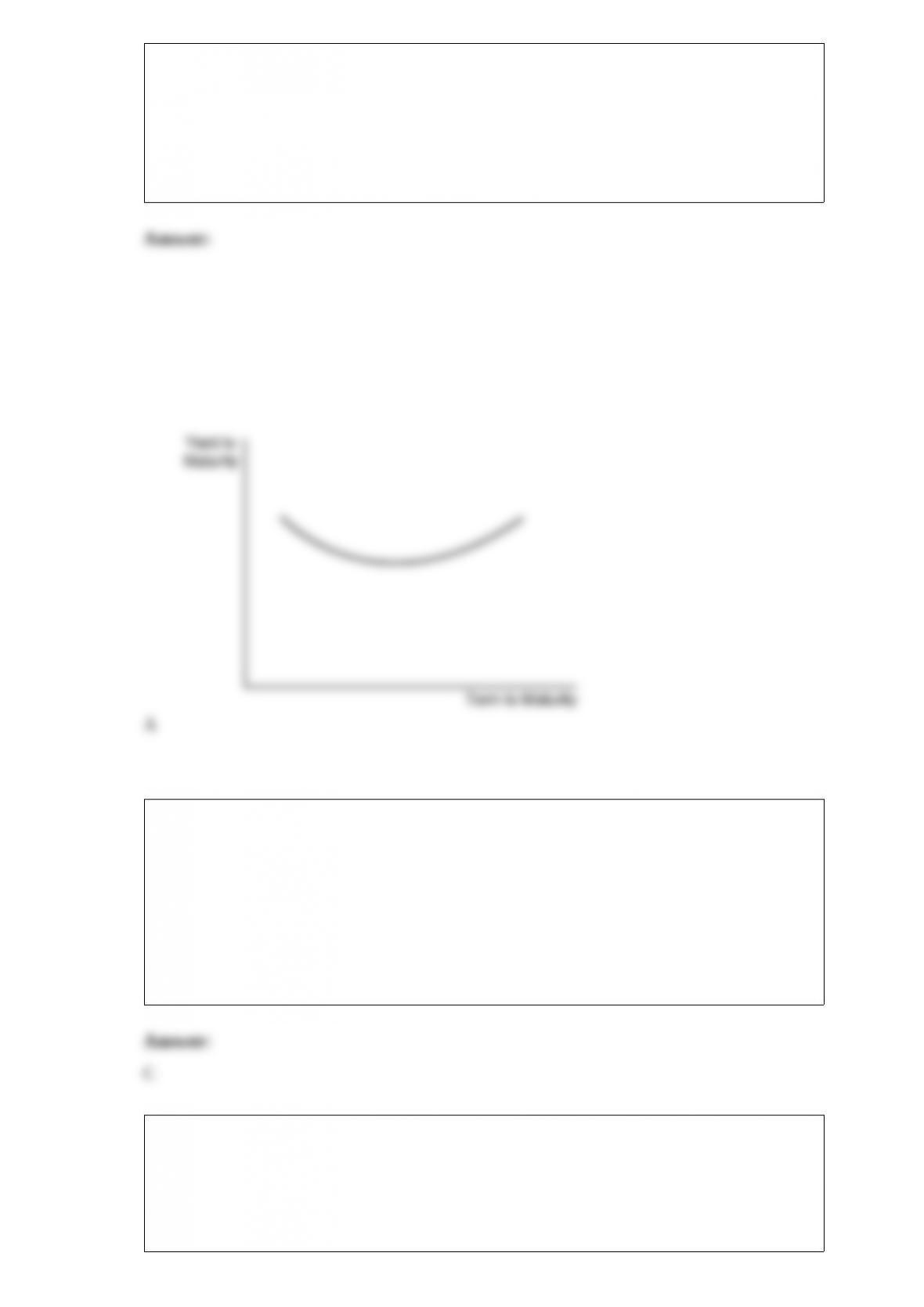
1) The steeply upward sloping yield curve in the figure above indicates that ________
interest rates are expected to ________ in the future
A) short-term; rise
B) short-term; fall moderately
C) short-term; remain unchanged
D) long-term; fall moderately
2) If the price paid by a parent company to acquire the debt of a subsidiary is greater
than the book value of the liability, a ________ occurs.
A) realized loss on the retirement of debt from the viewpoint of the subsidiary
B) realized gain on the retirement of debt from the viewpoint of the subsidiary
C) constructive loss on the retirement of debt from the viewpoint of the consolidated
entity
D) constructive gain on the retirement of debt from the viewpoint of the consolidated
entity
3) If the yield curve is flat for short maturities and then slopes downward for longer
maturities, the liquidity premium theory (assuming a mild preference for shorter-term
bonds) indicates that the market is predicting
A) a rise in short-term interest rates in the near future and a decline further out in the
future

B) constant short-term interest rates in the near future and a decline further out in the
future
C) a decline in short-term interest rates in the near future and a rise further out in the
future
D) a decline in short-term interest rates in the near future and an even steeper decline
further out in the future
4) The key focus of government fund accounting concerns
A) capital expenditures
B) intergovernmental transfers from the general fund
C) income measurement
D) the current ability to provide and fund services and goods
5) A particularly attractive feature of the ________ is that it tells you what the market is
predicting about future short-term interest rates by just looking at the slope of the yield
curve
A) segmented markets theory
B) expectations theory
C) liquidity premium theory
D) separable markets theory

6) Paggle Corporation owns 80% of Spillway Inc.’s common stock that was purchased
at its underlying book value. At the time of purchase, the book value and fair value of
Spillway’s net assets were equal. The two companies report the following information
for 2011 and 2012 .
During 2011, one company sold inventory to the other company for $50,000 which cost
the transferor $40,000. As of the end of 2011, 30% of the inventory was unsold. In
2012, the remaining inventory was resold outside the consolidated entity.
2011 Selected Data:PaggleSpillway
Sales Revenue $600,000 $320,000
Cost of Goods Sold320,000155,000
Other Expenses100,00089,000
Net Income $180,000 $76,000
Dividends Paid19,0000
2012 Selected Data:PaggleSpillway
Sales Revenue$580,000 $445,000
Cost of Goods Sold300,000180,000
Other Expenses130,000171,000
Net Income$150,000 $94,000
Dividends Paid16,0005,000
For 2011, consolidated net income will be what amount if the intercompany sale was
downstream?
A) $180,000
B) $253,000
C) $256,000
D) $259,000

7) On June 30, 2011, the Able, Baker, and Charlie partnership had the following fiscal
year-end balance sheet:
Cash$8,000Accounts payable$14,000
Accounts receivable12,000Loan from Charlie10,000
Inventory28,000Able, capital (20%)28,000
Plant assets-net24,000Baker, capital (20%)20,000
Loan to Able12,000Charlie,capital (60%)12,000
Total assets$84,000Total liab./equity$84,000
The percentages shown are the residual profit and loss sharing ratios. The partners
dissolved the partnership on July 1, 2011, and began the liquidation process. During
July the following events occurred:
*Receivables of $6,000 were collected.
*All inventory was sold for $8,000.
*All available cash was distributed on July 31, except for
$4,000 that was set aside for contingent expenses.
The cash available for distribution to the partners on July 31, 2011 is
A) $ 4,000
B) $ 8,000
C) $14,000
D) $22,000
8) Pelga Company routinely receives goods from its 80%-owned subsidiary, Swede
Corporation. In 2011, Swede sold merchandise that cost $80,000 to Pelga for $100,000.
Half of this merchandise remained in Pelga’s December 31, 2011 inventory. This
inventory was sold in 2012 . During 2012, Swede sold merchandise that cost $160,000
to Pelga for $200,000. $62,500 of the 2012 merchandise inventory remained in Pelga’s
December 31, 2012 inventory. Selected income statement information for the two
affiliates for the year 2012 was as follows:
PelgaSwede
Sales Revenue$500,000$400,000
Cost of Goods Sold400,000320,000
Gross profit$100,000$80,000
What amount of unrealized profit did Pelga Company have at the end of 2012?
A) $10,000
B) $12,500
C) $50,000
D) $62,500
9) Under the Revised Uniform Principal and Income Act, gains or losses incurred on

investments that occur after the death of the decedent
A) are considered to be income of the estate
B) are included in the inventory fair value at the time of death
C) are taxed separately from other estate income
D) are adjustments to the principal of the estate
10) A decrease in the liquidity of corporate bonds will ________ the price of corporate
bonds and ________ the yield of Treasury bonds, everything else held constant
A) increase; increase
B) decrease; decrease
C) increase; decrease
D) decrease; increase
11) Pinkerton Inc. owns 10% of Sable Company. In the most recent year, Sable had net
earnings of $40,000 and paid dividends of $6,000. Pinkerton’s accountant mistakenly
assumed Pinkerton had considerable influence over Sable and used the equity method
instead of the cost method. What is the impact on the investment account and net
earnings, respectively?
A) By using the equity method, the accountant has understated the investment account
and overstated the net earnings
B) By using the equity method, the accountant has overstated the investment account
and understated the net earnings
C) By using the equity method, the accountant has understated the investment account
and understated the net earnings
D) By using the equity method, the accountant has overstated the investment account
and overstated the net earnings
12) Paiva Corporation owns 80% of Ackroyd Corporation’s outstanding common stock
and Ackroyd owns 80% of the outstanding common stock of Bailey Corporation. Bailey
Corporation owns 10% of the outstanding common stock of Ackroyd Corporation. The
cost of the investments was equal to book value and there were not fair value/book
value differences for the investments. The separate net incomes for the three affiliated
companies for the year ended December 31, 2011 (excluding investment income) are as
follows: Paiva Corporation, $100,000, Ackroyd Corporation, $50,000, and Bailey
Corporation, $30,000. Use the conventional approach.
Symbols used:
P = Income of Paiva on a consolidated basis

A = Income of Ackroyd on a consolidated basis
B = Income of Bailey on a consolidated basis
Bailey’s noncontrolling interest share for 2011 is
A) $7,609
B) $8,044
C) $15,652
D) $23,696
13) What funds are reported in Government-wide financial statements?
A) Governmental only
B) Proprietary only
C) Governmental and proprietary
D) Governmental, proprietary and fiduciary
14) Similar operating segments may be combined if the segments have similar
economic characteristics. Which one of the following is a similar economic
characteristic under GAAP?
A) The segments’ management teams
B) The tax reporting law sections
C) The distribution method for products or services
D) The expected rates of return and risk for the segments’ productive assets
15) When yield curves are downward sloping,
A) long-term interest rates are above short-term interest rates
B) short-term interest rates are above long-term interest rates
C) short-term interest rates are about the same as long-term interest rates
D) medium-term interest rates are above both short-term and long-term interest rates
16) From the standpoint of accounting theory, which of the following statements is the
best justification for the preparation of consolidated financial statements?
A) In substance the companies are separate, but in form the companies are one entity

B) In substance the companies are one entity, but in form they are separate
C) In substance and form the companies are one entity
D) In substance and form the companies are separate entities
17) When preparing their year-end financial statements, the Warner Company includes
a footnote regarding their hedging activities during the year. Which of the following is
not required to be disclosed?
A) How hedge effectiveness is determined and assessed
B) The specific types of risks being hedged, and how they are being hedged
C) Alternative hedging options declined
D) The net gain or loss reported for the period for fair value hedges and where in the
financial statements it is reported
18) Pace Corporation owns 70% of Abaza Corporation and 60% of Babon Corporation.
Abaza Corporation owns 20% of Babon Corporation. Pace’s investment in Abaza was
consummated in one transaction at a purchase price $20,000 in excess of the book
value. Pace’s purchase of Babon was made in one transaction at a price $30,000 above
book value. Abaza’s investment in Babon was completed in one transaction at a
purchase price $10,000 in excess of the book value. The purchase price differential for
all three investments was attributable to goodwill. (There were no fair value/book value
differences in assets and liabilities for each investment.) Pace’s separate net income for
the current year is $100,000. Abaza’s separate net income is $190,000, which includes a
$10,000 unrealized loss on the sale of land to Pace. Babon’s separate net income is
$150,000. Separate net incomes exclude investment income.
The amount of noncontrolling interest share for the current year is
A) $69,000
B) $85,000
C) $95,000
D) $99,000
19) Pierce Manufacturing owns all of the outstanding voting common stock of Sylvia
Company, as acquired several years ago when the book values and fair values of
Sylvia’s net assets were equal.
In 2010, Pierce set out to re-structure the company, and in doing so, re-aligned the
manufacturing processes to streamline the use of automated equipment. As a result,
they set out to move certain equipment around between the facilities owned by both
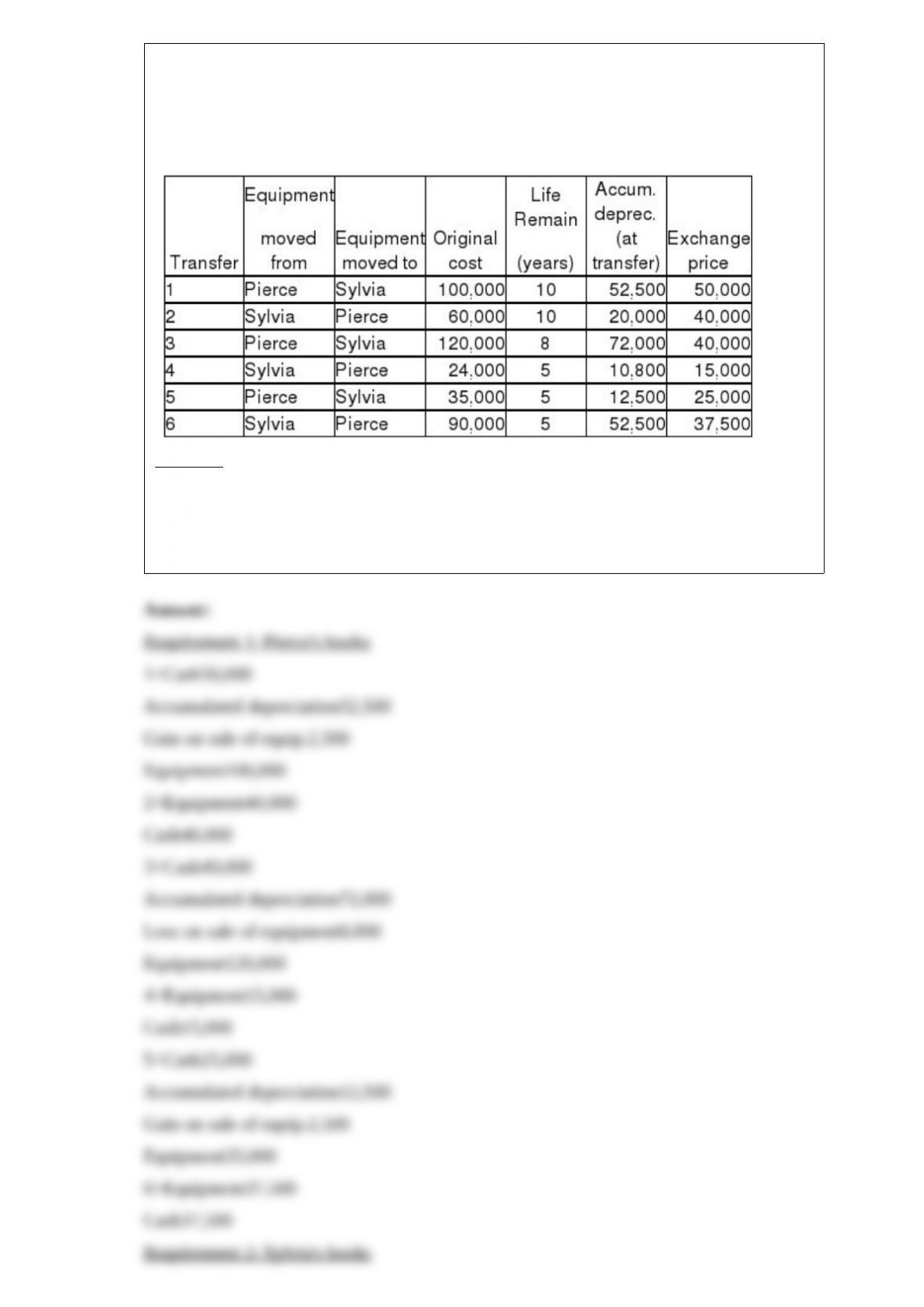
Pierce and Sylvia, and ultimately agreed on the following transfers and exchange
prices. It was agreed that the exchange price would be paid in cash on January 1, 2011,
the date the equipment was transferred. Straight-line depreciation is used and the
different pieces of equipment have no salvage value.
Required:
1> Prepare the journal entry that Pierce would record for each transfer listed.
2> Prepare the journal entry that Sylvia would record for each transfer listed.
3> Prepare the consolidation worksheet entries that would be required as a result of the
above transactions for 2011 .

20) Parrot Incorporated purchased the assets and liabilities of Sparrow Company at the
close of business on December 31, 2011 . Parrot borrowed $2,000,000 to complete this
transaction, in addition to the $640,000 cash that they paid directly. The fair value and
book value of Sparrow’s recorded assets and liabilities as of the date of acquisition are
listed below. In addition, Sparrow had a patent that had a fair value of $50,000.
Book ValueFair Value
Cash$120,000$120,000
Inventories220,000250,000
Other current assets630,000600,000
Land270,000320,000
Plant assets-net 4,650,000 4,600,000
Total Assets$5,890,000
Accounts payable$1,200,000$1,200,000
Notes payable2,100,0002,100,000
Capital stock, $5 par700,000
Additional paid-in capital1,400,000
Retained Earnings 490,000
Total Liabilities & Equities$5,890,000
Required:
1>Prepare Parrot’s general journal entry for the acquisition of Sparrow, assuming that
Sparrow survives as a separate legal entity.
2>Prepare Parrot’s general journal entry for the acquisition of Sparrow, assuming that
Sparrow will dissolve as a separate legal entity.
21) Paradise Corporation owns 100% of Aldred Corporation, 90% of Balme
Corporation, 80% of Calder Corporation, 75% of Dale Corporation, 20% of East
Corporation, and 8% of Faber Corporation. Paradise, Aldred, Balme and Calder belong
to an affiliated group. All of these corporations are domestic corporations. During 2011,
Paradise Corporation reports net income of $1,500,000. This net income includes the
full amount of dividends received from Aldred and Faber, but does not include the
dividends received from Balme, Calder, Dale, and East Corporations. All investees have
paid out all of their net income in the form of dividends. Paradise’s share of the various
dividend distributions is as follows:
From Aldred:$90,000
From Balme:$92,000
From Calder:$88,000
From Dale:$66,000
From East:$50,000
From Faber:$40,000
Required:
Calculate the correct amount of taxable income for Paradise Corporation if a
consolidated tax return is filed.
22) Journalize the following municipal zoo transactions in the Lackluster County
Enterprise Fund:
1>The zoo issued $1,000,000 of 5% revenue bonds at 99 on July 1, 2011 (an interest
payment date). The bond proceeds are to be used for a new polar bear exhibit and the
issue will mature in 20 years. Interest is paid on January 1 and July 1 .
2>Depreciation for the year-ended December 31, 2011 included $175,000 for buildings
and $105,000 for outdoor exhibit areas.
3>The zoo paid $800,000 in construction costs for the new exhibit. The exhibit is still
under construction.
4>Interest on the revenue bonds was accrued at year-end, December 31, 2011 .
Straight-line amortization is used for bond discounts and premiums.
23) At December 31, 2010, the stockholders’ equity of Gost Corporation and its
80%-owned subsidiary, Tree Corporation, are as follows:
Gost Tree
Common stock, $10 par value$20,000$12,000
Retained earnings8,0006,000
Totals$28,000$18,000
Gost’s Investment in Tree is equal to 80 percent of Tree’s book value. Tree Corporation
issued 225 additional shares of common stock directly to Gost on January 1, 2011 at
$18 per share.
Required:
1> Compute the balance in Gost’s Investment in Tree account on January 1, 2011 after
the new investment is recorded.
2> Determine the increase or decrease in goodwill from Gost’s new investment in the
225 Tree shares. Use four decimal places for the ownership percentage. Assume the fair
values of Tree’s assets and liabilities are equal to book values.
24) Aqua Corporation filed a petition under Chapter 7 of the bankruptcy act in January,
2011 . On February 28, the following information was presented regarding Aqua’s
financial status.
Book ValuesFair Values
Cash$50,000$50,000
A/R – net100,00090,000
Inventories80,00060,000
Fixed Assets – net200,000230,000
Priority Claims80,000
A/P100,000
N/P110,000
Mortgage Payable200,000
The Note Payable is secured by Accounts Receivable, and the Mortgage Payable is
secured by the Fixed Assets.
Required:
Calculate the amount expected to be available for unsecured claims and the percentage
recovery that the unsecured class should expect to receive.
25) Pattalle Co purchases Senday, Inc. on January 1 of the current year for $70,000
more than the fair value of Senday’s net assets. Push-down accounting is used. At that
date, the following values exist:
Requirement: Determine what amounts will appear in the listed accounts on Pattalle’s
general ledger, on Senday’s general ledger, and on the consolidated balance sheet
immediately following the acquisition. Make sure you post the entry to record the
investment on Pattalle’s books.
26) On January 2, 2011, Pilates Inc. paid $900,000 for all of the outstanding common
stock of Spinning Company, and dissolved Spinning Company. The carrying values for
Spinning Company’s assets and liabilities are recorded below.
Cash$200,000
Accounts Receivable220,000
Copyrights (purchased)400,000
Goodwill120,000
Liabilities(180,000)
Net assets$760,000
On January 2, 2011, Spinning anticipated collecting $185,000 of the recorded Accounts
Receivable. Pilates entered into the acquisition because Spinning had Copyrights that
Pilates wished to own, and also unrecorded patents with a fair value of $100,000.
Required:
Calculate the amount of goodwill that will be recorded on Pilate’s balance sheet as of
the date of acquisition.

27) At December 31, 2011, Pandora Incorporated issued 40,000 shares of its $20 par
common stock for all the outstanding shares of the Sophocles Company. In addition,
Pandora agreed to pay the owners of Sophocles an additional $200,000 if a specific
contract achieved the profit levels that were targeted by the owners of Sophocles in
their sale agreement. The fair value of this amount, with an agreed likelihood of
occurrence and discounted to present value, is $160,000. In addition, Pandora paid
$10,000 in stock issue costs, $40,000 in legal fees, and $48,000 to employees who were
dedicated to this acquisition for the last three months of the year. Summarized balance
sheet and fair value information for Sophocles immediately prior to the acquisition
follows.
Book ValueFair Value
Cash$100,000$100,000
Accounts Receivable280,000250,000
Inventory520,000640,000
Buildings and Equipment (net)750,000870,000
Trademarks and Tradenames0500,000
Total Assets$1,650,000
Accounts Payable$200,000$190,000
Notes Payable900,000900,000
Retained Earnings550,000
Total Liabilities and Equity$1,650,000
Required:
1>Prepare Pandora’s general journal entry for the acquisition of Sophocles assuming
that Pandora’s stock was trading at $35 at the date of acquisition and Sophocles
dissolves as a separate legal entity.
2>Prepare Pandora’s general journal entry for the acquisition of Sophocles assuming
that Pandora’s stock was trading at $35 at the date of acquisition and Sophocles
continues as a separate legal entity.
3>Prepare Pandora’s general journal entry for the acquisition of Sophocles assuming
that Pandora’s stock was trading at $25 at the date of acquisition and Sophocles
dissolves as a separate legal entity.
4>Prepare Pandora’s general journal entry for the acquisition of Sophocles assuming
that Pandora’s stock was trading at $25 at the date of acquisition and Sophocles survives
as a separate legal entity.