Patterson Division had sales revenue of $200,000, operating profit of $10,000, and a
division investment of $300,000. Its profit margin percentage is
A.66.7%
B.150.0%
C.3.3%
D.5.0%
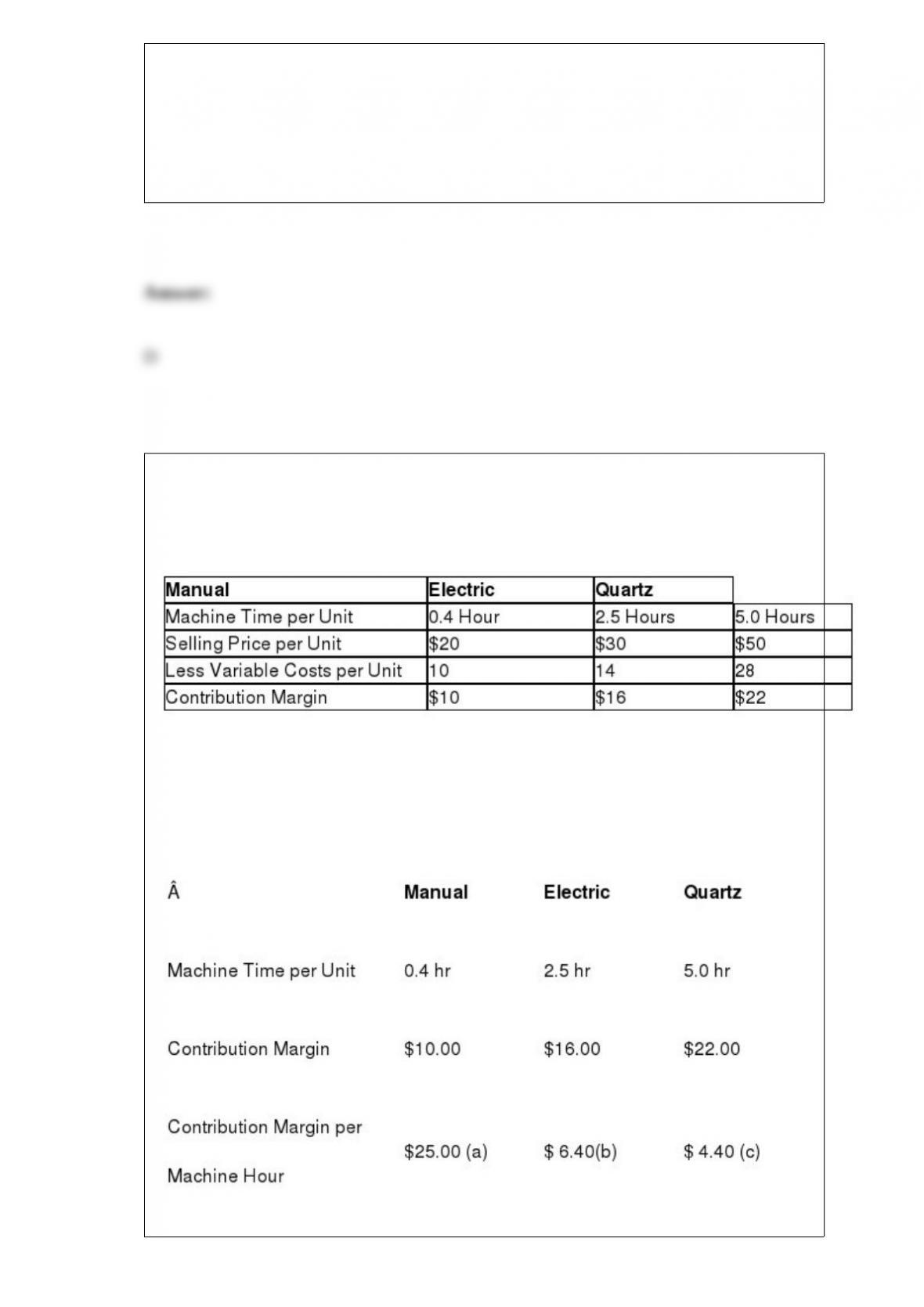
Dropping a product line. Timepiece Products, a clock manufacturer, operates at
capacity. Constrained by machine time, the company decides to drop the most
unprofitable of its three product lines. The accounting department came up with the
following data from last year’s operations:
Required:
Which line should Timepiece Products drop? (Hint: Compute the contribution per
machine hour because machine time is the constraint.)
(Timepiece Products; dropping a product line.)
Which statement is true concerning mixed costs?
A.Mixed costs have both fixed and random components.
B.Mixed costs have both random and variable components.
C.Mixed costs have both fixed and variable components.
D.Mixed costs have either fixed or variable components.
Any item for which the manager wishes to measure cost is called a(n)
A.direct cost.
B.indirect cost.
C.cost object.
D.target cost.
Moss Point Manufacturing has just completed a major change in its quality control
(QC) process. Previously, products had been reviewed by QC inspectors at the end of
each major process, and the company’s ten QC inspectors were charged as direct labor
to the operation or job. In an effort to improve efficiency and quality, a computer video
QC system was purchased for $250,000. The system consists of a minicomputer, 15
video cameras, other peripheral hardware, and software.
The new system uses cameras stationed by QC engineers at key points in the production
process. Each time an operation changes or there is a new operation, the cameras are
moved, and a new master picture is loaded into the computer by a QC engineer. The
camera takes pictures of the unit in process, and the computer compares them to the
picture of a “good” unit. Any differences are sent to a QC engineer who removes the
bad units and discusses the flaws with the production supervisors. The new system has
replaced the 10 QC inspectors with two QC engineers.
The operating costs of the new QC system, including the salaries of the QC engineers,
have been included as factory overhead in calculating the company’s plant-wide factory
overhead rate, which is based on direct labor dollars.
The company’s president is confused. His vice president of production has told him how
efficient the new system is, yet there is a large increase in the factory overhead rate. The
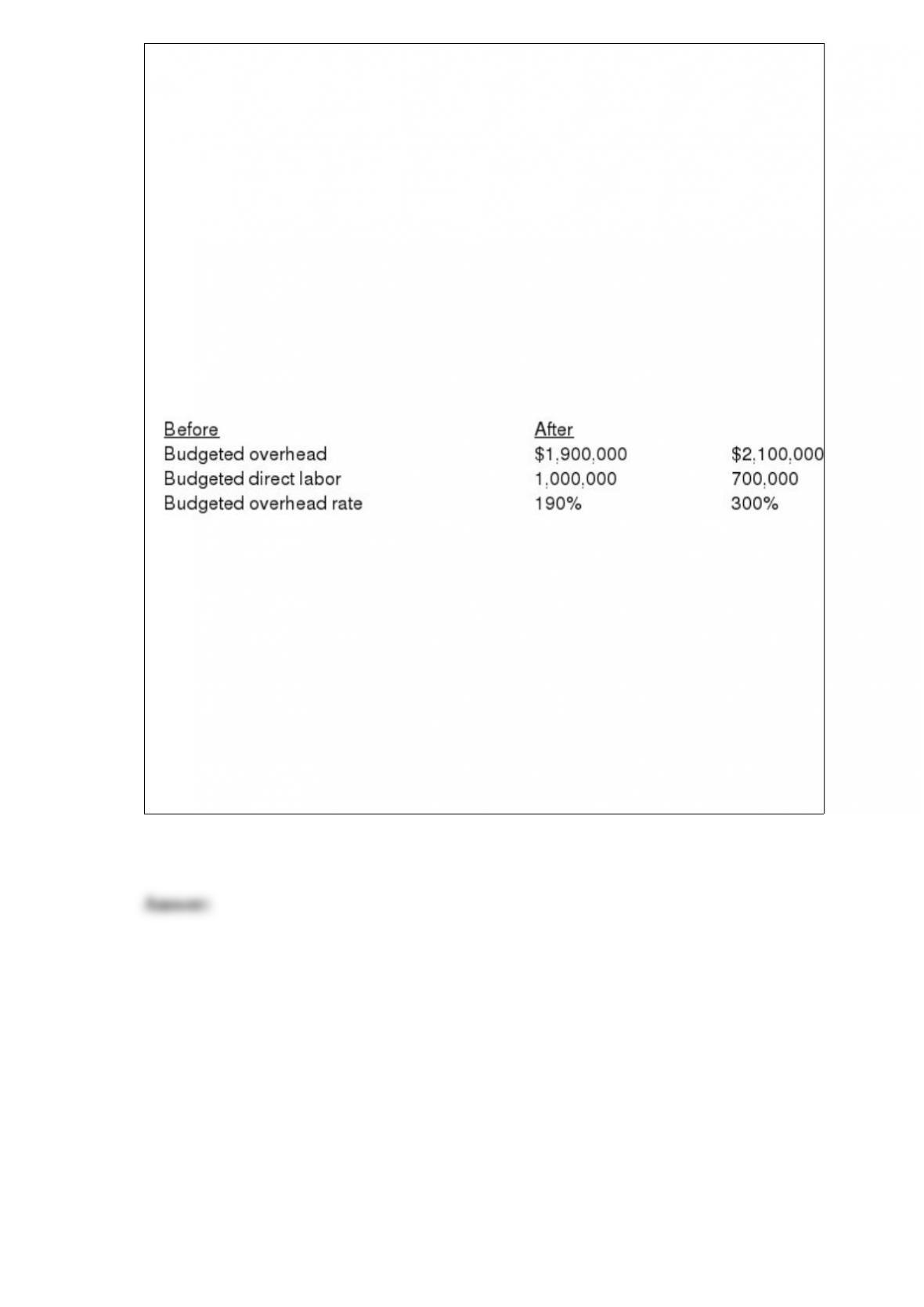
computation of the rate before and after is shown below.
“Three hundred percent,” lamented the president. “How can we compete with such a
high factory overhead rate?”
REQUIRED:
a. Discuss the development of factory overhead rates. Why do we need Factory
overhead rates and how are they computed? Discuss the accuracy of the computation of
a factory overhead rate.
b. Explain why the increase in the overhead rate should not have a negative impact on
Moss Point Manufacturing.
c. Explain, in the greatest detail possible, how Moss Point Manufacturing could change
its overhead accounting system to eliminate confusion over product costs.
d. Discuss how an activity-based costing system might benefit Moss Point
Manufacturing.

A company purchased an asset at a cost of $80,000. Annual operating cash flows are
expected to be $30,000 each year for 4 years. At the end of the asset life, there will be
no residual (salvage) value. What is the net present value if the cost of capital is 12
percent? (Ignore income taxes.)
A.$40,000.
B.$24,400.
C.$11,120.
D.$5,650.
Which of the following represents a general framework for guiding management’s
operating decisions containing projected activity levels for the next year?
A.organizational goals implementation plan.
B.strategic long-range profit plan.
C.master budget.
D.none of the above.
Marshall Manufacturing Co.
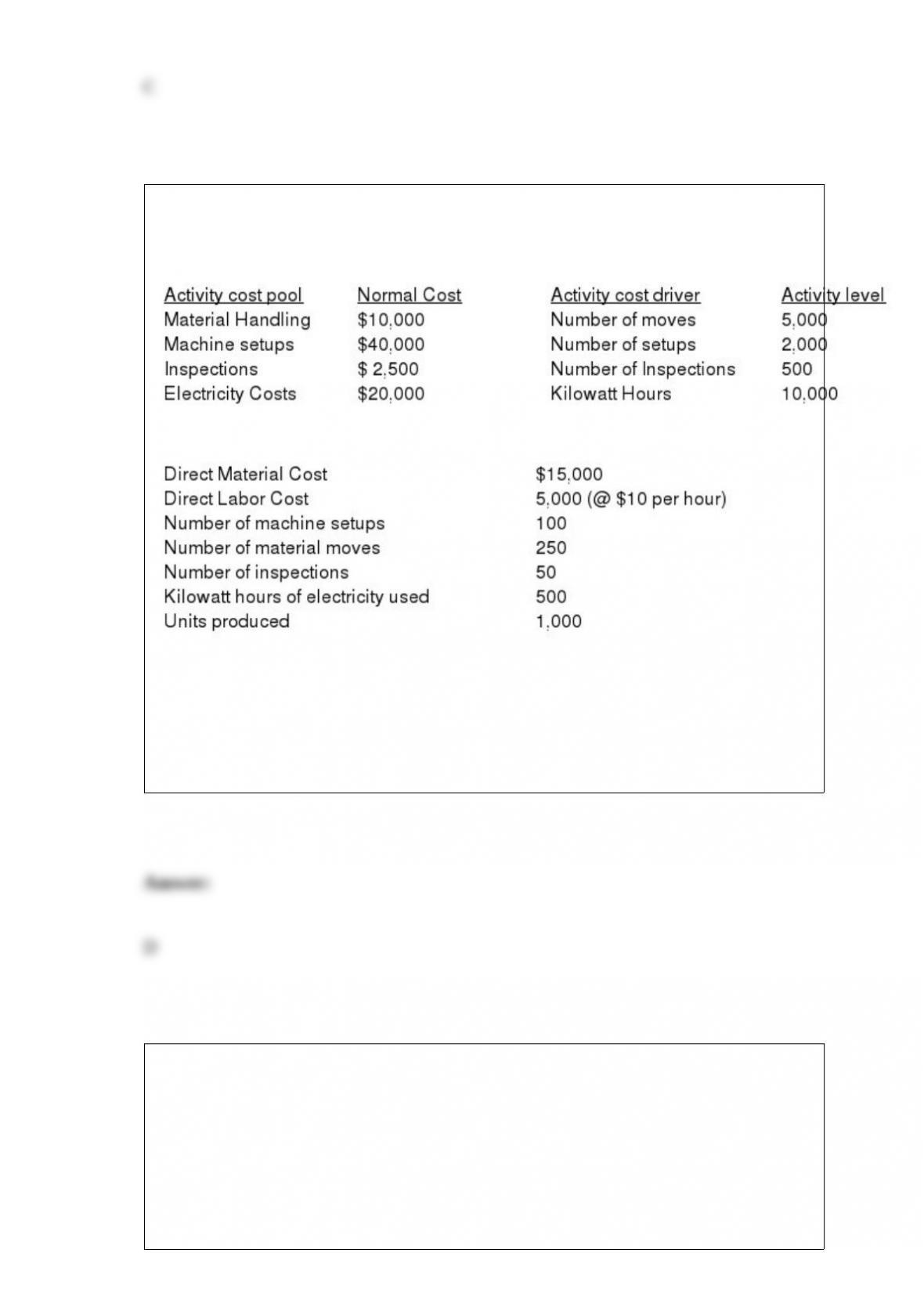
Marshall Manufacturing Co. uses an activity-based costing system. The company has
gathered the following information concerning various cost pools and activity drivers;
The following data was collected and is specific to Item No. 824.
Refer to Marshall Manufacturing Co. What would be the unit cost for the machine setup
activity at Marshall Manufacturing Co.?
A.$ 4.00
B.$80.00
C.$ 2.00
D.$20.00
Why are joint-process costs are allocated?
A.Due to the need to assign joint-process costs to two or more products manufactured
from a common input.
B.Due to the need to assign joint-process costs to two or more products manufactured
from different inputs.
C.Due to the need to assign joint-process costs to two or more products manufactured
from a common output.
D.Due to the need to assign joint-process costs to two or more products manufactured

from different outputs.
A company’s selling price is $18 per unit, variable cost is $6 per unit, and fixed costs
are $36,000. If fixed costs increased by $6,000, how many additional units must be sold
to break even?
A.5,000
B.1,000
C.500
D.250
Which of the following is a non-value added cost?
A.Running machines.
B.Performing surgeries.
C.Waiting for work.
D.Speaking to customers.
Concerning cost, which of the following is/are true?
A.Lowering cost results from the organization’s ability to use resources more efficiently
to obtain its objectives.

B.Reducing costs is important because of the long-run relation between product cost
and price.
C.If two products provide the same quality and services, the customer will choose the
product with the lower price.
D.All of the answers are correct.
Which of the following are not controlled by a manager of a profit center?
A.Revenues
B.Costs
C.Investments
D.Profits
Which of the following best describes the term €benchmarking?€
A.producing a particular product at the lowest possible cost.
B.designing the highest quality product in a given market.
C.developing the best selling product
D.improvement gained through measuring one’s products against the best products.
Which is not an example of a cost driver?

A.General and administrative expenses.
B.Machine hours.
C.Number of inspections.
D.Number of different customers.
The balanced scorecard is used to tie performance measures to which of the following?
A.organizational goals.
B.short-term objectives only.
C.long-term objectives only.
D.regulatory requirements.
What is a fundamental principle of internal control to prevent fraud?
A.Separate duties and responsibilities.
B.Require employee collusion.
C.Eliminate internal audits.
D.Eliminate independent audits.
What transfer pricing basis is considered a good estimation of differential cost plus
opportunity cost?
A.Market price-based transfer pricing
B.Variable cost-based transfer pricing
C.Fixed price-based transfer pricing
D.Fixed cost-based transfer pricing
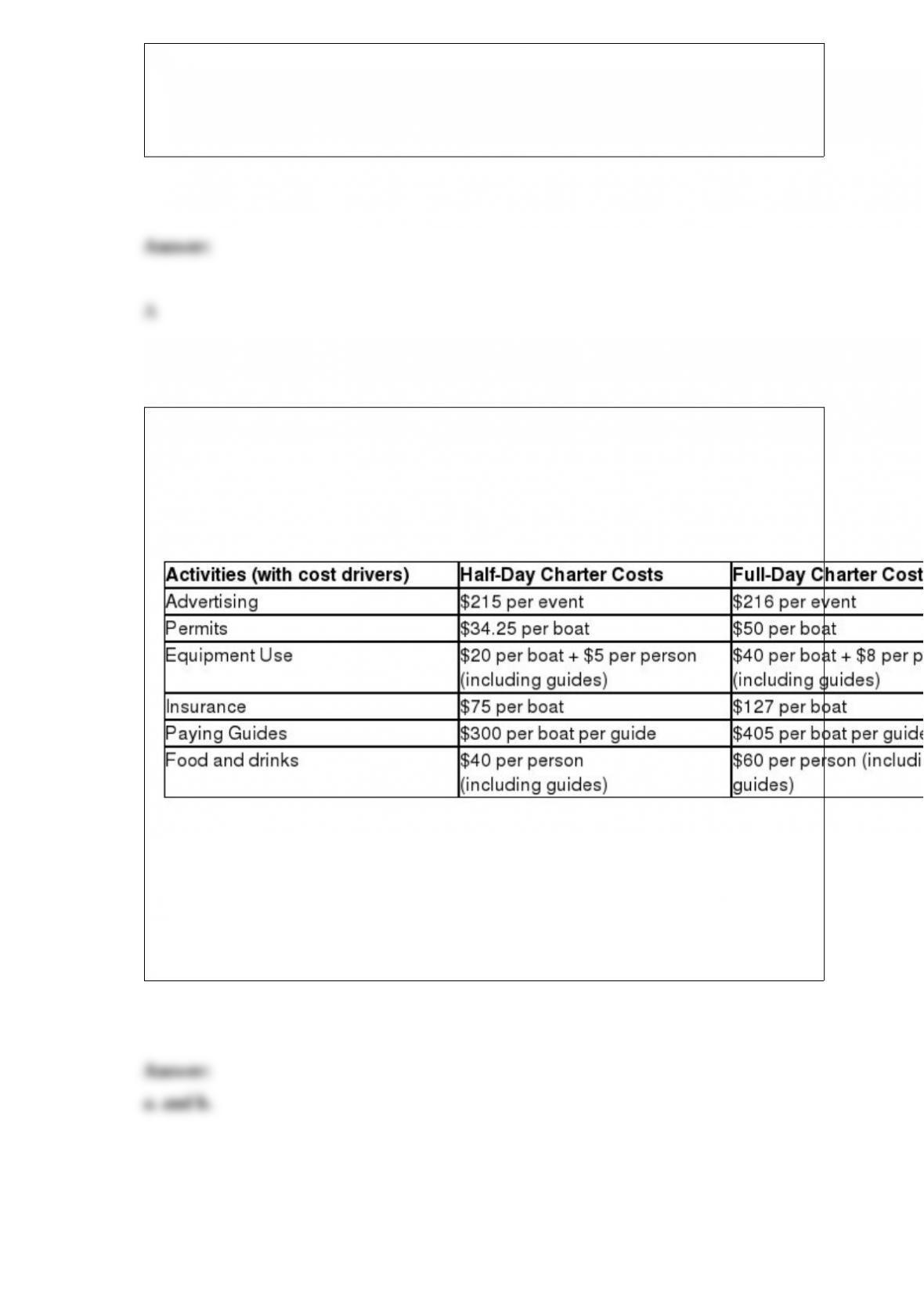
Activity-based costing. Carlton Fisher, the manager of Kingfish Charters, uses
activity-based costing to compute the costs of his deep-sea fishing charters. Each
chartered boat holds six paying customers and a guide. The company offers two types
of charters to corporations planning events-half-day trips for beginners and full-day
trips for more seasoned fishermen. The breakdown of the costs is as follows:
Required:
a. Compute the cost of a corporate event requiring four boats for half-day charters for
28-persons (including four guides).
b. Compute the cost of a corporate event requiring four boats for full-day charters for
28-persons (including four guides).
c. Recommend a minimum price per customer to the manager if he wants to cover his
costs.
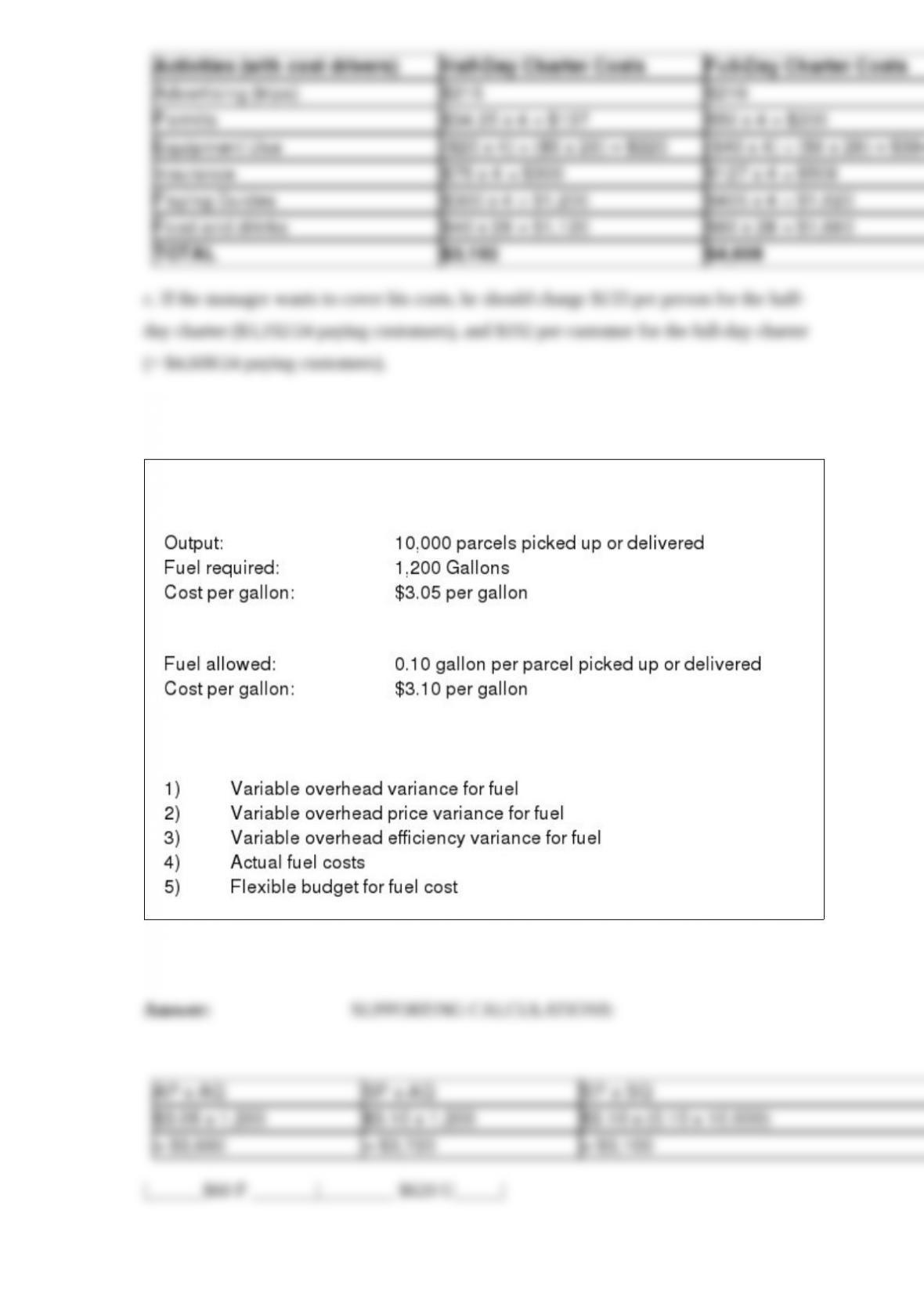
Sally’s Delivery Company reports the following information for 2010:
Actual:
Standard:
REQUIRED:
Calculate the following:
Why do firms make trade-offs in quality control costs and failure costs?
How can the cost hierarchy be used to organize cost information for decision-making?
Managers use several tools to identify quality problems. These tools-control charts,
cause and effect analysis, and Pareto charts-provide signals about quality control.
Describe each of these tools and discuss how they are used by managers to identify
quality problems.
Waldo Mining Company currently is operating at less than 50% of practical capacity.
The management of the company expects sales to drop below the present level of
10,000 tons of ore per month very soon. The sales price per ton is $3 and the variable
cost per ton is $2. Fixed costs per month total $10,000.
Management is concerned that a further drop in sales volume will generate a loss and,
accordingly, is considering the temporary suspension of operations until demand in the
metals market rebounds and prices once again rise. Management has implemented a
cost reduction program over the past year that has been successful in reducing costs to
the point that suspension of operations appears to be the only viable alternative.
Management estimates that suspension of operations would reduce fixed costs from
$10,000 to $4,000 per month.
REQUIRED:
Why does management estimate that the fixed costs will persist at $4,000 even though
the mine is temporarily closed?
Summarize the recommendations of the Treadway Commission. Explain the steps
managers should take to reduce the possibility of fraudulent financial reporting.
Explain the costs, benefits, and weaknesses of the various cost estimation methods.
Identify the underlying assumptions of cost-volume-profit analysis.
Are avoidable costs relevant in all situations where discontinuance of a product line or
business segment decisions are made?
Explain incentive compensation plans and what they should accomplish.