For a company using target costing, market price minus profit equals target price.
In a job-order cost system, each department has a work in process account.
The method used to allocate service department costs can cause overstatement of costs
for some cost objects and understatement for others.
The purchasing department is considered to have primary responsibility for the
materials usage variance.
The successful implementation of an activity-based costing system depends on
employees’ attitudes and cooperation.
A company can use target profit analysis to determine the level of sales required to earn
a target loss.
Depreciation on a capital investment (such as equipment) has the effect of decreasing
the amount of income taxes that the company owning the asset must pay.
The higher the magnitude of a company’s operating leverage, the more benefit the
company will receive from a given percentage increase in revenue.
Four purposes or advantages for budgeting involve planning, coordination, performance
measurement, and punative action.
Management by exception means that only unfavorable cost variances are investigated.
When using the indirect method, the amount of net cash flow from operating activities
will be the same as it would be if the direct method were used.
Generally accepted accounting principles require that a company use variable costing
for financial reporting.
Jensen Company has a contribution margin ratio of 45%. This means that its variable
costs are 55% of sales.
For a manufacturer, direct costs include direct materials, direct labor, and
manufacturing overhead.
Product costs flow through the manufacturer’s inventory accounts in the following
order: raw materials, finished goods, and cost of goods sold.
The accounting profession assumes that financial statement users have an expert
knowledge of business.
In general, budget variances should not be used to single out managers for praise or
punishment.
Companies operating in a highly automated environment that produce many different
products with varying levels of production should use activity-based cost drivers to
improve the accuracy of their cost allocations.
Managerial accounting is designed to satisfy needs of external users including creditors,
investors, and governmental agencies.
A merchandising business paid $2,500 to purchase inventory and $50 to have the
inventory delivered to its customers. Its product costs were $2,550.
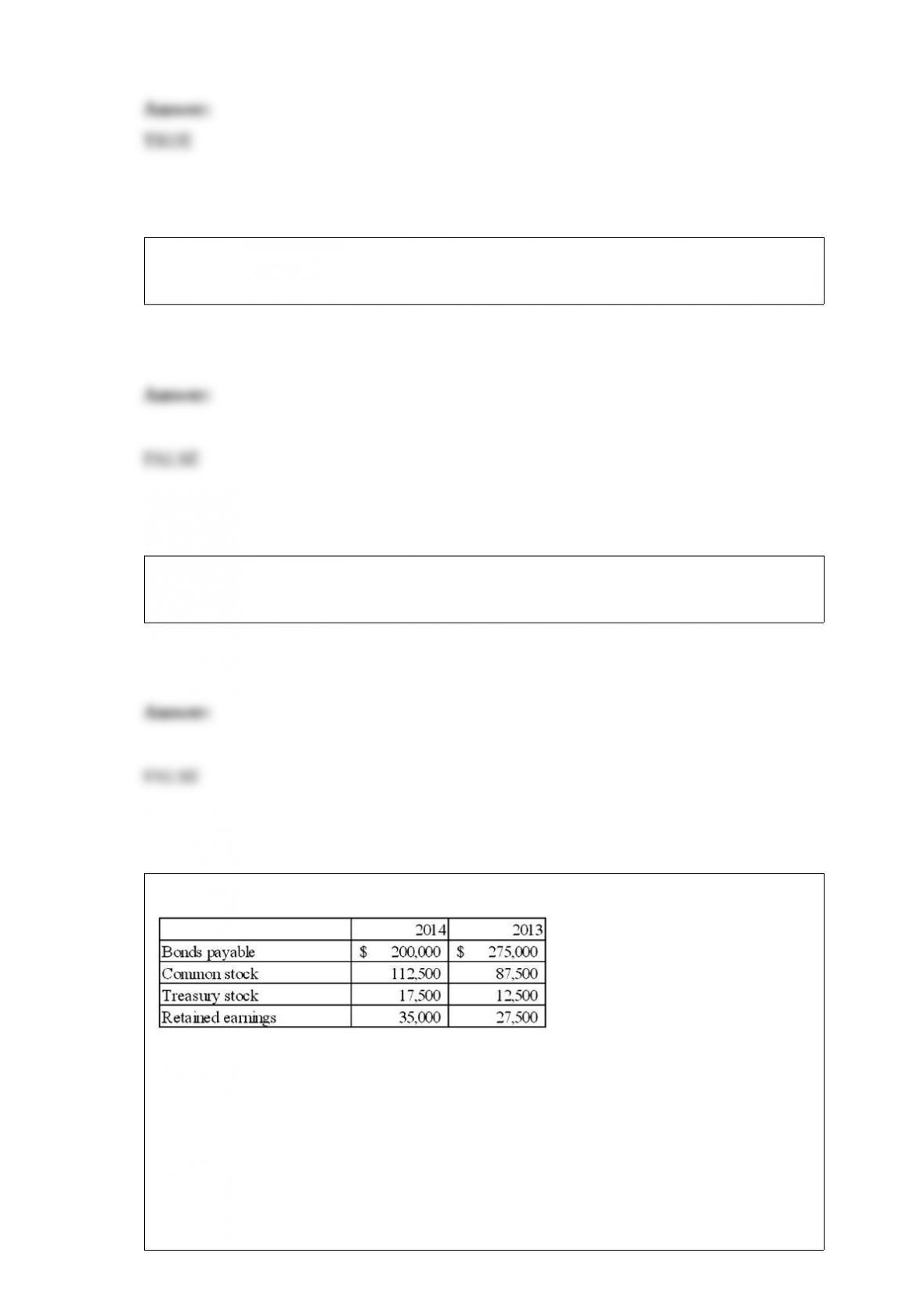
The following information was drawn from the year-end balance sheets of White, Inc.
White, Inc. uses the cost method to account for treasury stock. What is the amount of
cash outflows for the purchase of treasury stock?
A. $7,500
B. $17,500
C. $25,000

D. None of these answers is correct.
Miller Company makes two types of chairs. One of the chairs is a rocking chair. The
other is a straight-back chair. Both chairs are made by hand. Miller Company uses a
company-wide overhead rate that is based on direct labor hours to assign overhead costs
to the two products. If Miller automates the production of straight-back chairs and
continues to use direct labor hours as a company-wide allocation basis:
A. rocking chairs will be overcosted.
B. straight back chairs will be overcosted.
C. rocking chairs will be undercosted.
D. there should be no impact on unit cost.
Budgeted cash payments for inventory would appear on the:
A. inventory purchases budget and the pro forma income statement.
B. capital budget and pro forma statement of cash flows.
C. cash budget and pro forma balance sheet.
D. inventory purchases budget and pro forma statement of cash flows.
Select the incorrect statement concerning the present value index (PVI).
A. The PVI is computed by dividing the total present value of the cash inflows by the
present value of the cash outflows.
B. The PVI should be used to evaluate two or more projects whose initial investments
differ.
C. The lower the PVI, the better.
D. A project whose PVI is positive will also have a positive net present value.
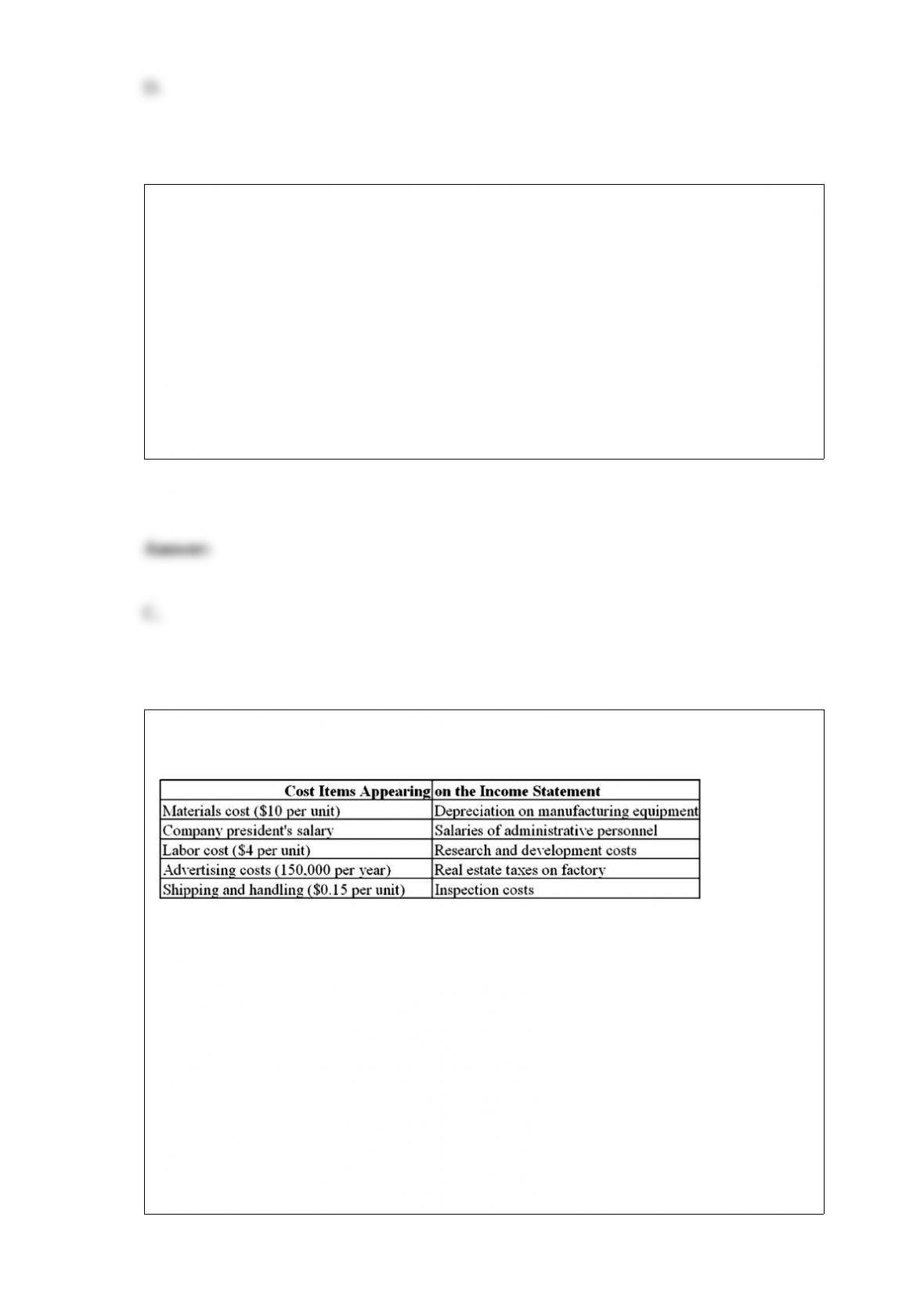
Easton Company makes and sells scooters. Easton incurred the following costs in its
most recent fiscal year:
Easton can currently purchase the scooters it makes from another company. If the
company purchases the scooters, Easton would still continue to use its own logo, sales
staff, and advertising programs. Which of the following costs would be classified as a
unit-level cost?
A. Company president’s salary
B. Depreciation on manufacturing equipment
C. Materials cost
D. Real estate taxes on factory
Cooper Company sells a product at $50 per unit that has unit variable costs of $20. The
company’s break-even sales volume is $150,000. How much profit will the company
make if it sells 4,000 units?
A. $210,000
B. $120,000
C. $60,000
D. $30,000
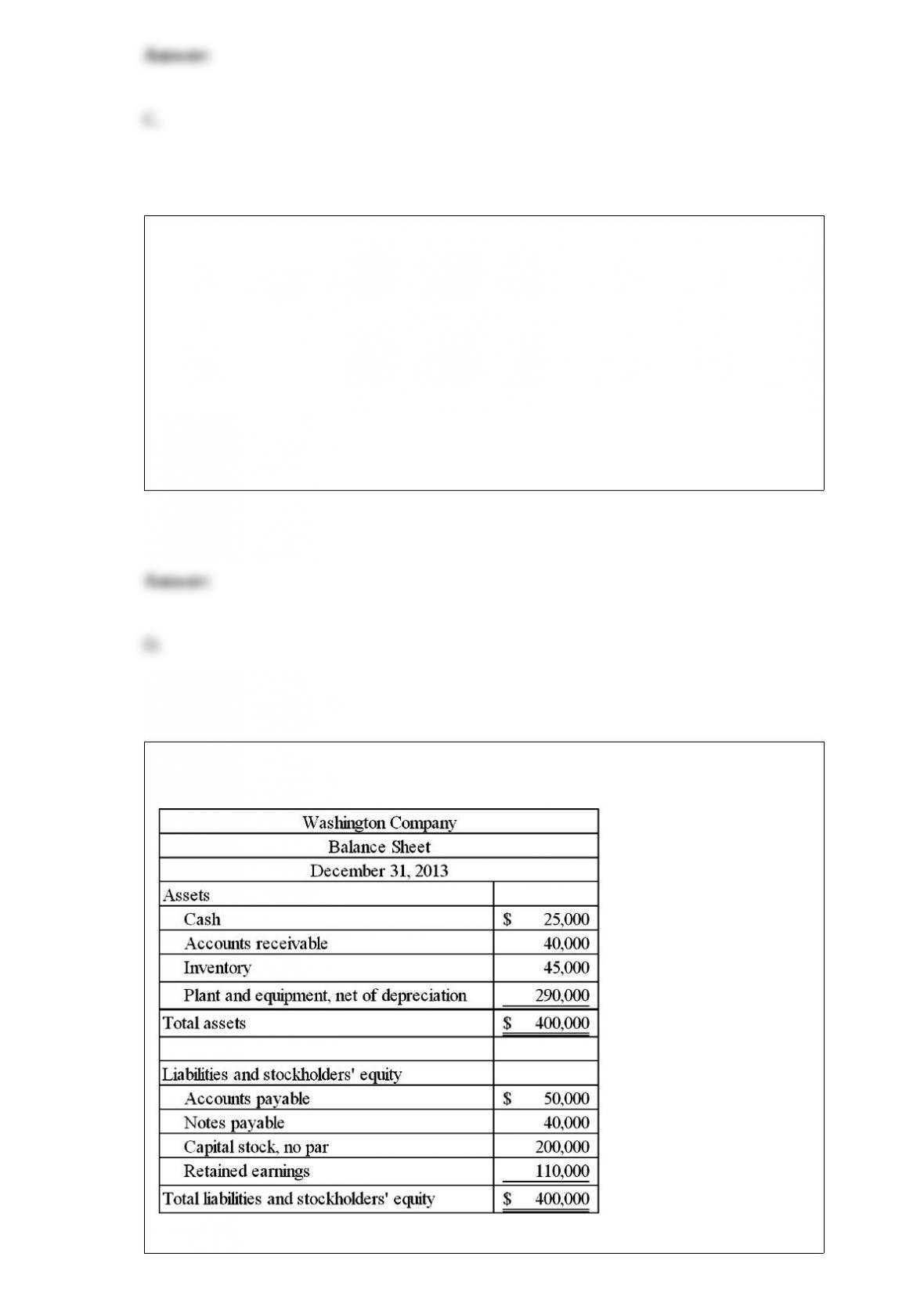
Washington Company’s balance sheet as of December 31, 2013 is provided below:

In anticipation of preparing the operating budget for the upcoming period, the firm’s
accountant has gathered the following information:
(a) Sales are budgeted at $320,000 for January 2014. Of these sales, half will be cash
sales and half will be credit sales. Eighty percent of the credit sales are collected in the
month of sale and the remainder is collected in the next month. Therefore, all of the
December 31 receivables will be collected in January.
(b) Inventory purchases are expected to total $200,000 during January, all on account.
Sixty percent of all purchases are paid for in the month of purchase and the remainder is
paid in the following month. Therefore, all of the December 31 accounts payable will
be paid during January. The inventory account is expected to have a $40,000 balance at
January 31, 2014.
(c) Selling and administrative expenses for January are budgeted at $100,000 (exclusive
of depreciation). S&A expenses are paid in cash. Depreciation is budgeted at $3,000 for
the month.
(d) The notes payable will be paid in April. There is no cash outflow related to the note
in January.
The sales manager wishes to purchase a new display case for the showroom during
January if sufficient funds are available. The equipment has a cost of $9,000.
Required:Can the company afford to purchase the display equipment without
additional borrowing? Prepare a cash budget for January 2014 to support your answer.
Be sure to show your computations.
Which method of evaluating capital investment decisions uses the concept of present
value to compute a rate of return?
A. Internal rate of return
B. Unadjusted rate of return
C. Net present value
D. Payback
The purchase of raw materials on account is:
A. An asset use transaction.
B. An asset exchange transaction.

C. An asset source transaction.
D. A claims exchange transaction.
In a job-order cost system, the subsidiary accounts for the work in process account are
the:
A. Standard cost cards.
B. Job cost sheets.
C. Individual accounts payable accounts.
D. Cost of production report.
Which of the following statements is true?
A. Indirect costs can easily be traced to a cost object; direct costs cannot be easily
traced to a cost object.
B. Both direct and indirect costs can easily be traced to a cost object.
C. Neither direct nor indirect costs are easily traced to a cost object.
D. Direct costs can be traced easily to a cost object, but indirect costs cannot be easily
traced to a cost object.

Which of the following statements is incorrect?
A. A predetermined overhead rate may be used to allocate overhead costs when volume
varies during the year.
B. A predetermined overhead rate is calculated using actual cost and volume data.
C. A predetermined overhead rate is calculated by dividing costs by volume, using a
measure of volume such as direct labor hours or direct materials cost.
D. A company may need to allocate overhead costs to products to make pricing
decisions for the products.
Keene Company allocates overhead on the basis of direct labor hours. It allocates
overhead costs of $8,000 to two different jobs as follows:
Job 1: (10 hours) = $4,000; Job 2: (10 hours) = $4,000
The production process for Job 2 was then automated. Now Job 2 requires only two
hours of direct labor but four hours of mechanical processing. As a result, total
overhead increased to $12,000. How much overhead cost will be assigned to Job 1 after
automation?
A. $10,000
B. $6,000
C. $4,000
D. $2,000
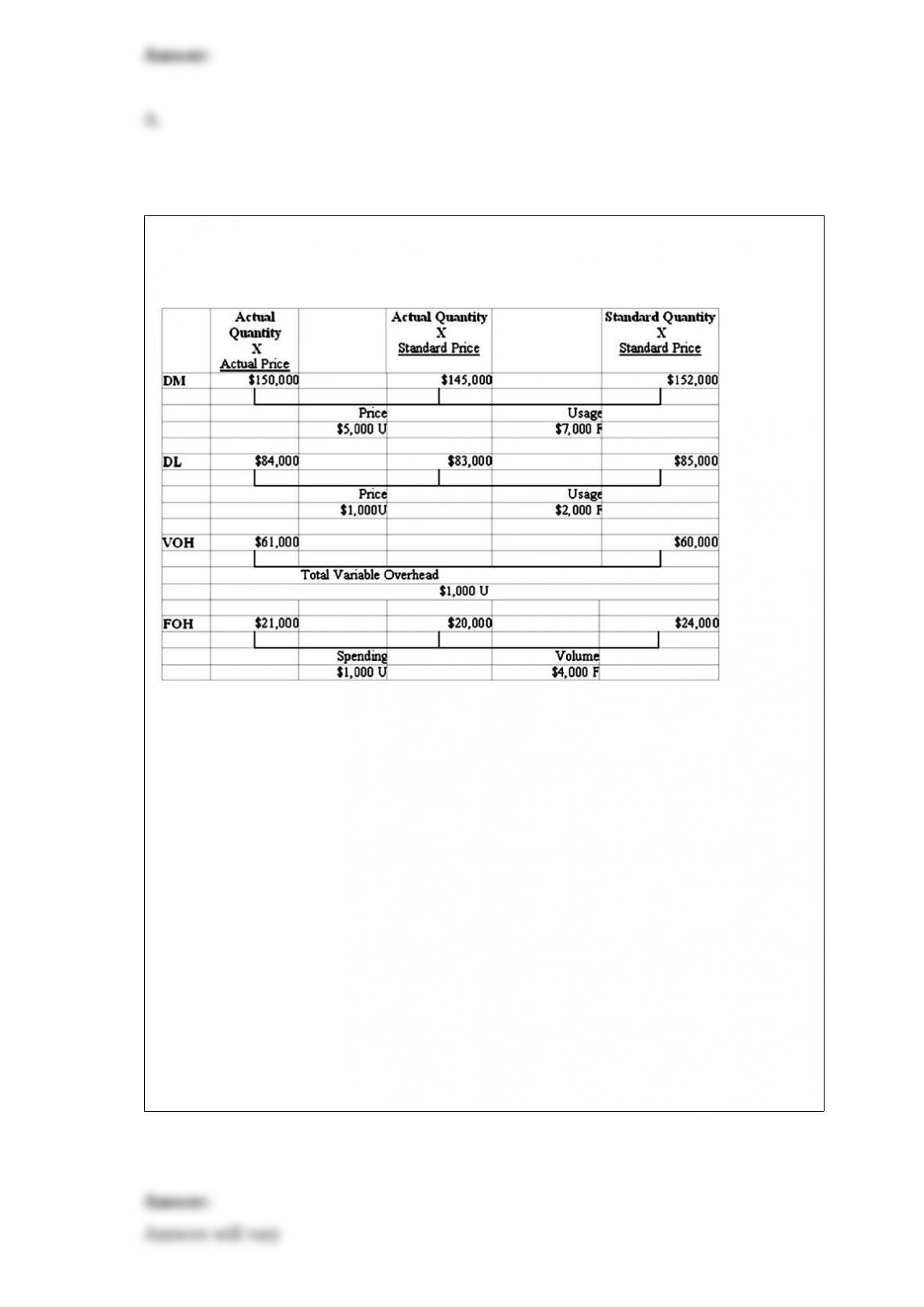
Newton Company’s management accountant prepared the following variance report for
management:
Required:
1) Identify which manager (if any) would likely be held responsible (at least prior to
further investigation) for each of the following variances:
(a) Direct material price variance
(b) Direct materials usage variance
(c) Direct labor price variance
(d) Direct labor usage variance
(e) Fixed cost spending variance
(f) Fixed cost volume variance
2) Provide at least two possible explanations for each of the following variances: the
direct materials price variance and the direct labor usage variance.
A credit to the raw materials account represents:
A. raw materials added to production.
B. raw materials purchased.
C. raw materials available for use.
D. none of these.

Select the correct formula for computing the cost to be assigned to ending inventory in
a process costing system.
A. Ending inventory equivalent units × cost per equivalent unit
B. Ending inventory units × cost per equivalent unit
C. Beginning inventory cost + transferred-in costs
D. Beginning inventory units + units transferred in – units transferred out
The application of estimated manufacturing overhead to jobs is:
A. An asset exchange transaction.
B. An asset source transaction.
C. An asset use transaction.
D. A claims exchange transaction.
Which of the following is not one of the assumptions underlying cost-volume-profit
analysis?
A. Costs are non-linear.
B. Production equals sales.
C. All costs can be segregated into fixed and variable components.
D. Revenues are linear.
How are indirect costs assigned to cost objects? Are they traced to cost objects?
Indicate whether each of the following statements is true or false.
Volume measures include number of labor hours, quantity of direct materials used, and
number of units sold.
A variable overhead cost should be allocated to cost objects using a volume measure as
the allocation base.
A causal relationship exists between a fixed overhead cost and the volume of
production.
The allocation base used by a manufacturer to allocate overhead costs may affect the
apparent profitability of the various products the company makes.
Fixed indirect costs are often allocated using arbitrary allocation bases.
Indicate whether each of the following statements is true or false.
Under variable costing, the cost of inventory includes variable product costs and
variable selling and administrative expenses.
Under absorption costing, the income statement is prepared using a contribution margin
approach.
Variable costing is not allowed for external financial reporting, but many companies
find it useful for internal managerial reports.
Under absorption costing, fixed manufacturing costs are expensed in the period
incurred.
Under variable costing, fluctuations in sales influence net income, but fluctuations in
production do not.
Baker charges its customers $60 per hour in 2014. The chief operating officer expected
that the company would provide 40,000 hours of service to clients. However, the vice
president for marketing argues that the actual number of hours may range from 36,000
to 44,000 hours. Baker’s standard variable cost is $32.50 per hour, and its standard fixed
cost is $750,000.
Required:Prepare flexible budgets for 36,000, 40,000, and 44,000 hours.
Indicate whether each of the following statements about financial statement analysis is
true or false.
Ratio analysis may involve studying relationships between an item reported on the
balance sheet and another reported on the income statement.
Comparing sales in 2014 with sales for 2013 is a form of vertical analysis.
Comparing net income in 2014 with sales for 2014 is a form of horizontal analysis.
Liquidity ratios measure a company’s ability to generate cash flows in the short term.
Working capital is calculated by using the following formula: current assets – current
liabilities.