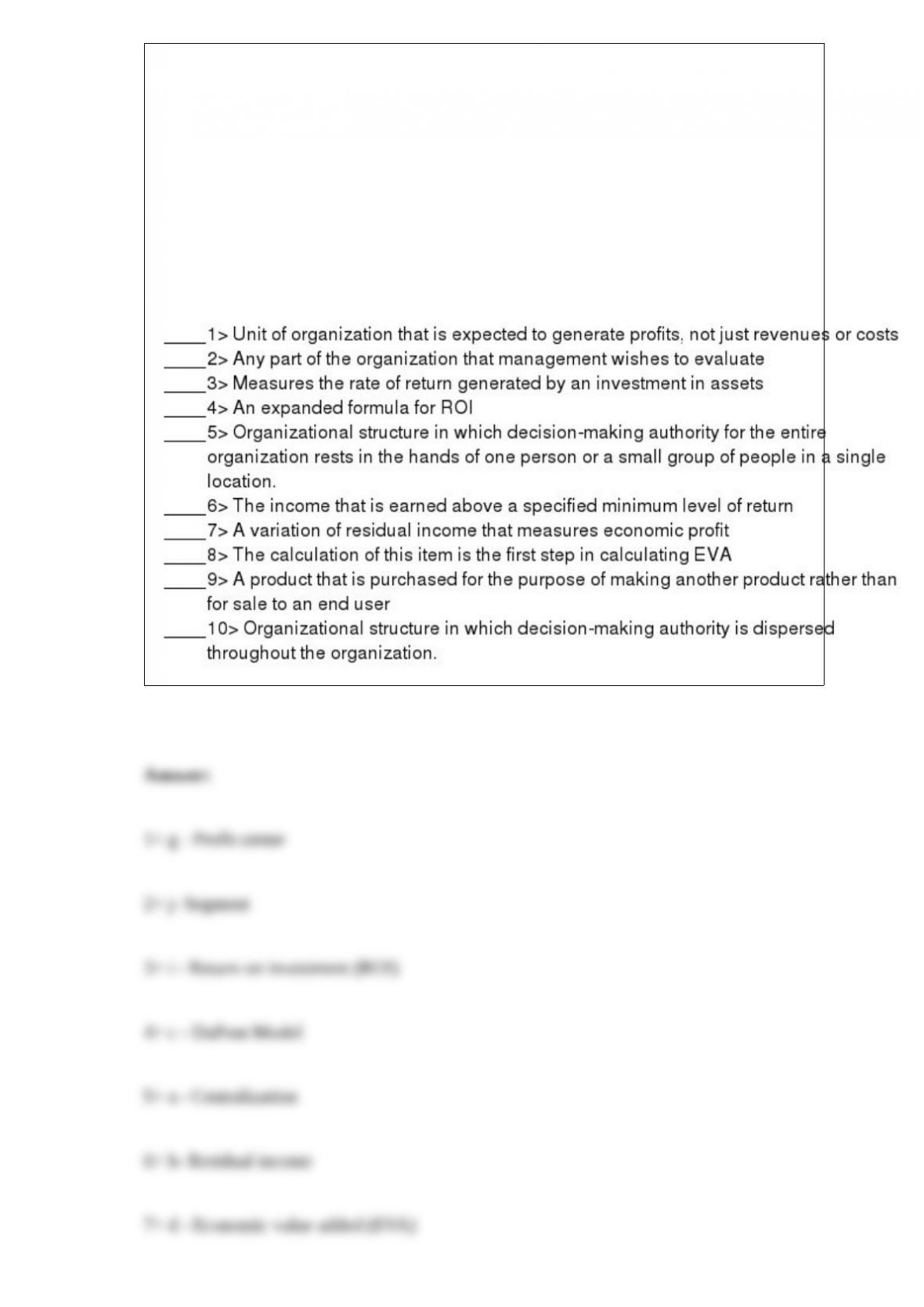
Match the following terms to the appropriate statement by placing the letter to the left
of each statement. a. Centralization f. Net operating profit
b. Decentralization g. Profit center
c. DuPont Model h. Residual income (ROI)
d. Economic value added (EVA) i. Return on investment
e. Intermediate product j. Segment

The Theory of Constraints was developed by Eli Goldratt to
a. Maximize the performance of a value chain by focusing on constraints that limit an
organization ‘s output.
b. Maximize the performance of a value chain by focusing on those processes that do
not have constraints.
c. Limit or eliminate defective product that constrain production.
d. None of these answer choices are correct.
Assume a scattergraph shows $100 at no activity and $1,500 at an activity level of
1,000 units. The variable cost per unit is:
a.$2.00
b.$1.40
c.$2.50
d.$5.00
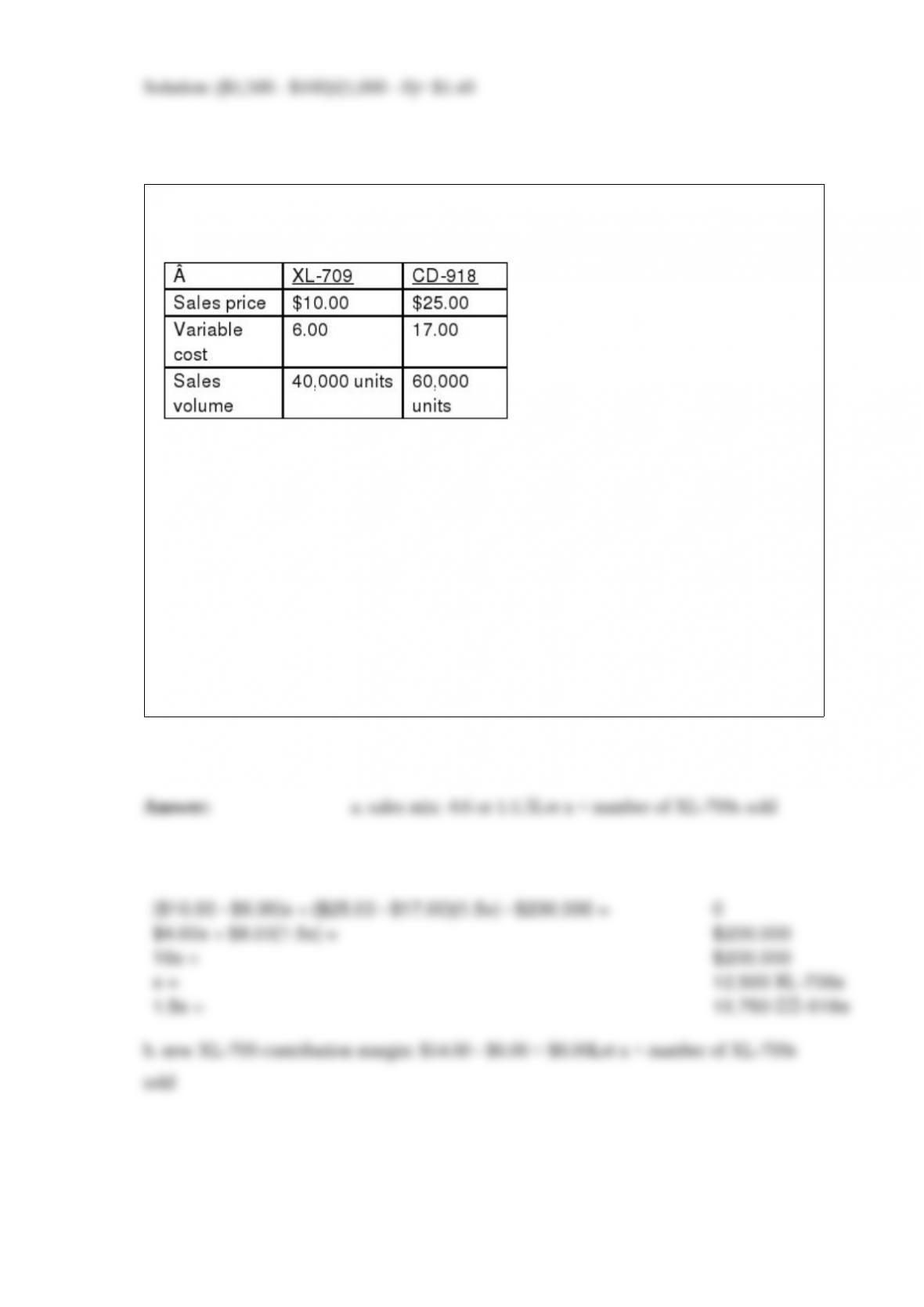
Herzig Industries sells two electrical components with the following characteristics.
Fixed costs for the company are $200,000 per year.
Required:
a. How many units of each product must Herzig Industries sell in order to break even?
b. Herzig’s vice president of sales has determined that due to market changes, the sales
price of component XL-709 can be increased to $14.00 with no impact on sales volume.
What will be Herzig’s new breakeven point in units?
c. Returning to the original information, Herzig’s vice president of marketing believes
that spending $80,000 on a new advertising campaign will increase sales of component
CD-918 to 80,000 units, without affecting the sales of product XL-709. How many
units of each product must Herzig sell to break even under this new scenario?
One purpose of controlling activities is to
a.Monitor day-to-day operations to ensure that processes are operating as expected.
b.Translate long-term strategy into a short-term plan.
c.To perform variance analysis and prepare performance reports.
d.None of these answer choices are correct.
Which of the following is not an assumption of the internal rate of return model?
a. The amount and timing of all cash flows is known exactly
b. All cash flows occur at the end of the year

c. Cash inflows from the project are reinvested in another project earning a return equal
to the internal rate of return
d. All of these answer choices are assumptions of the internal rate of return model.