1) The formal management control system includes shared values, loyalties, and mutual
commitments among members of the company, company culture, and norms about
acceptable behavior for managers and other employees.
2) Reducing the investment base involves decreasing idle cash, managing credit
judiciously, determining proper inventory levels, and spending carefully on long-term
assets.
3) In a multinational company, budgeting is primarily done to evaluate the firm’s
performance relative to its budgets.
4) Return on investment is an accounting measure of income minus a dollar amount for
required return on an accounting measure of investment.
5) The potential benefit that is given up when one alternative is selected over another is
called an opportunity cost.
6) Selling costs can be either direct or indirect costs.
7) Under standard costing the cost per equivalent-unit calculation is more difficult than
in either weighted average or FIFO.
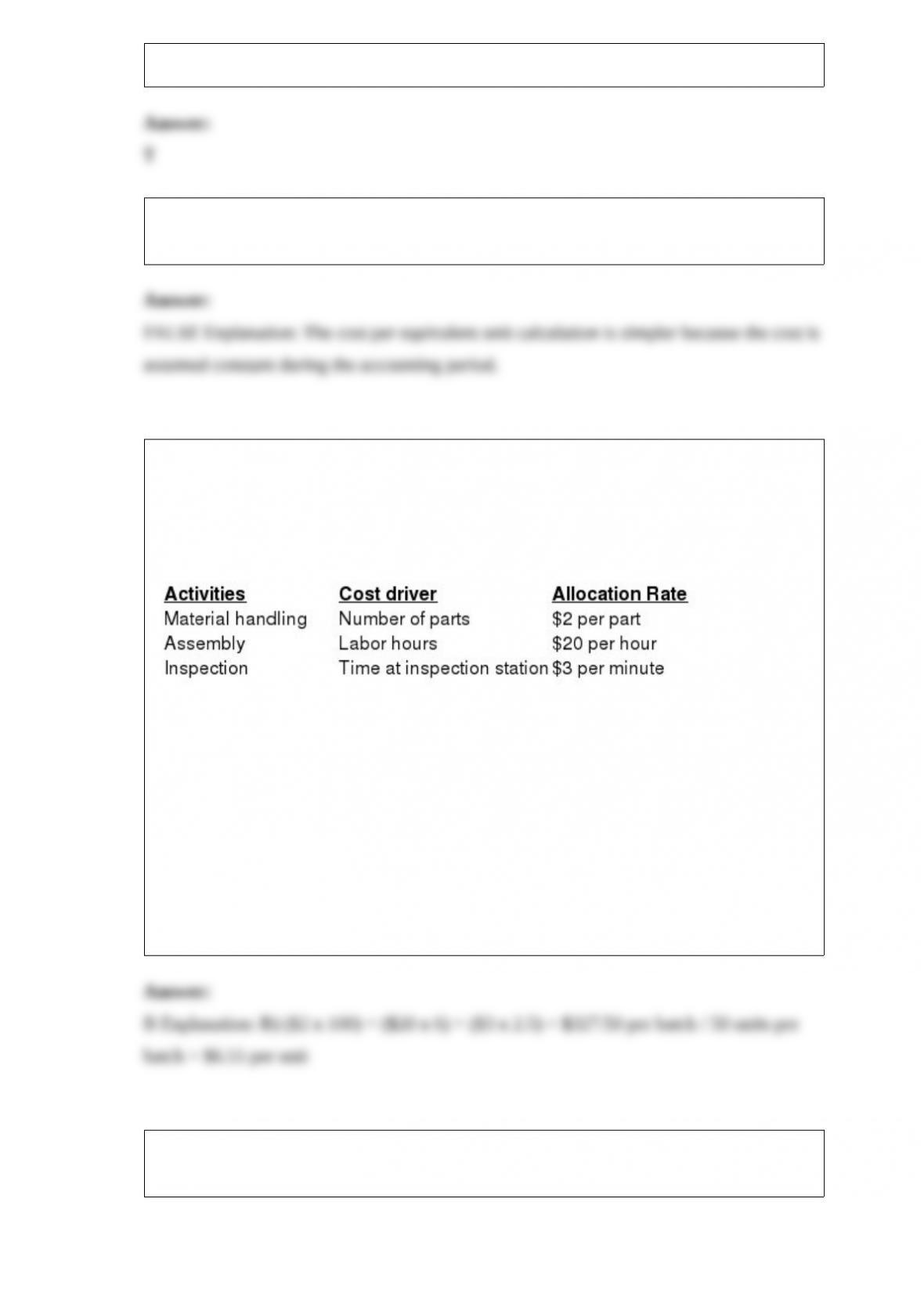
8) Nichols Inc. manufactures remote controls. Currently the company uses a plant-wide
rate for allocating manufacturing overhead. The plant manager is considering
switching-over to ABC costing system and has asked the accounting department to
identify the primary production activities and their cost drivers which are as follows:
The current traditional cost method allocates overhead based on direct manufacturing
labor hours using a rate of $200 per labor hour.
What are the indirect manufacturing costs per remote control assuming an
activity-based-costing method is used and a batch of 50 remote controls are produced?
The batch requires 100 parts, 6 direct manufacturing labor hours, and 2.5 minutes of
inspection time.
A) $4.00 per remote control
B) $6.55 per remote control
C) $24.00 per remote control
D) $327.50 per remote control
9) Uninder Company uses the high-low method to estimate the cost function. The
information for 2015 is provided below:
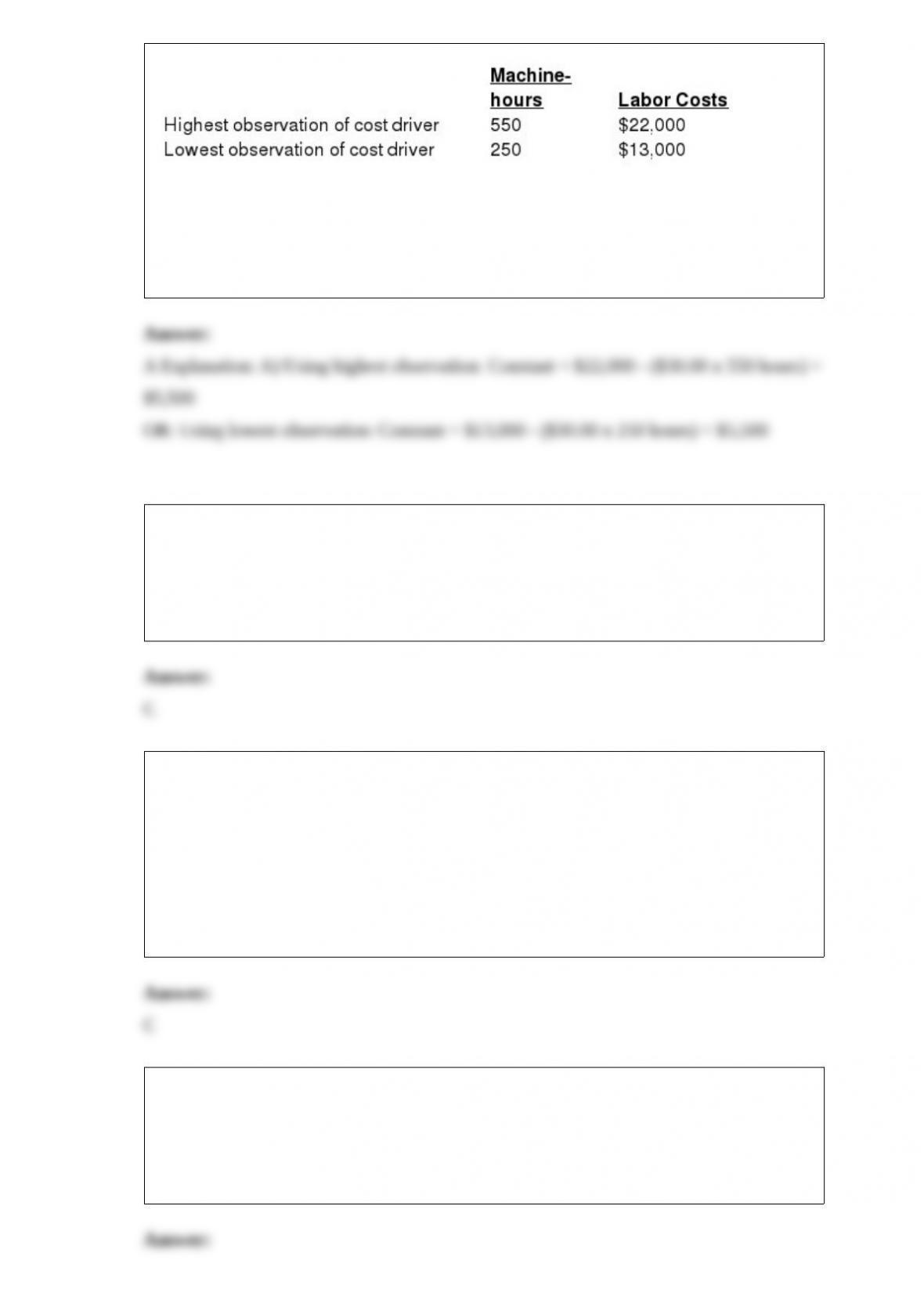
What is the constant for the estimated cost equation?
A) $5,500
B) $13,000
C) $16,500
D) $22,000
10) Which of the following statements is true of main products and byproducts?
A) A byproduct will never become a main product.
B) A main product will never become a byproduct.
C) Product classifications may change over time.
D) Product classifications remains constant over time.
11) Which of the following is true of refinement of a costing system?
A) While refining a costing system, companies should identify as many indirect costs as
is economically feasible.
B) A homogeneous cost pool will use multiple cost drivers to allocate costs.
C) It reduces the use of broad averages for assigning the cost of resources to cost
objects.
D) It is likely to yield the most decision-making benefits when direct costs are a high
percentage of total costs.
12) Cost assignment ________.
A) includes future and arbitrary costs
B) encompasses allocating indirect costs to a cost object
C) is the same as cost accumulation
D) is the difference between budgeted and actual costs
13) The cost to be predicted is referred to as the ________.
A) independent variable
B) dependent variable
C) cost driver
D) regression
14) Which of the following is included in product cost for pricing and product-mix
decisions?
A) design costs
B) sunk costs
C) opportunity costs
D) cost of capital
15) Dropping an unprofitable customer will ________.
A) eliminate long-run costs assigned to that customer
B) eliminate most short-run costs assigned to that customer
C) decrease long-run profitability
D) increase the potential to cross-sell other products that are more desirable
16) The nominal approach to incorporating inflation into the net present value method
predicts ________.
A) cash inflows and outflows in nominal monetary units and uses a real rate as the
required rate of return
B) cash inflows and outflows in real monetary units and uses a nominal rate as the
required rate of return
C) cash inflows and outflows in real monetary units and uses a real rate as the required
rate of return
D) cash inflows and outflows in nominal monetary units and uses a nominal rate as the
required rate of return
17) Cysco Corp has a budget of $1,200,000 in 2015 for prevention costs. If it decides to
automate a portion of its prevention activities, it will save $100,000 in variable costs.
The new method will require $50,000 in training costs and $140,000 in annual
equipment costs. Management is willing to adjust the budget for an amount up to the
cost of the new equipment. The budgeted production level is 200,000 units.
Appraisal costs for the year are budgeted at $500,000. The new prevention procedures
will save appraisal costs of $50,000. Internal failure costs average $30 per failed unit of
finished goods. The internal failure rate is expected to be 5% of all completed items.
The proposed changes will cut the internal failure rate by one-half. Internal failure units
are destroyed. External failure costs average $50 per failed unit. The company’s average
external failures average 2.5% of units sold. The new proposal will reduce this rate to
1%. Assume all units produced are sold and there are no ending inventories.
How much will appraisal costs change assuming that the new prevention methods
reduce material failures by 30% in the appraisal phase?
A) $150,000 decrease
B) $229,000 decrease
C) $50,000 increase
D) $50,000 decrease
18) The sales-volume variance is sometimes due to ________.
A) the difference between selling price and budgeted selling price
B) quality problems leading to customer dissatisfaction
C) unexpected increase in manufacturing labor time
D) unexpected increase in the use of quantities of inputs of raw material
19) Regier Company had planned for operating income of $10 million in the master
budget but actually achieved operating income of only $7 million.
A) The static-budget variance for operating income is $3 million favorable.
B) The static-budget variance for operating income is $3 million unfavorable.
C) The flexible-budget variance for operating income is $3 million favorable.
D) The flexible-budget variance for operating income is $3 million unfavorable.
20) The ________ describes the flow of goods, services, and information from the
initial sources of materials and services to the delivery of products to consumers.
A) customer list
B) enterprise requirements plan (ERP)
C) material requirements plan (MRP)
D) supply chain
21) The gross margin for December is:
A) $1,193,100
B) $929,100
C) $1,369,400
D) $2,597,800
22) Using activity-cost rates rather than department indirect-cost rates to allocate costs
results in different product costs when ________.
A) a single activity accounts for a sizable portion of department costs
B) there are several homogeneous cost pools
C) different activities have the same cost-allocation base
D) different products use different resources in the same proportion
23) With a step fixed-cost function ________.
A) the cost varies with the changes in the activity
B) fixed cost is often approximated with a continuous variable-cost function
C) fixed cost changes proportionally with the level of activity
D) the cost remains the same over wide ranges of the activity in each relevant range
24) Ventaz Corp. purchased assets for its overseas branch for $10,000. The rate of
conversion at the time of purchase of asset was $1.306 / Euro. What is the value of
assets after two years if the rate is $1.508 / Euro and the average rate being $1.407 /
Euro?
A) 7,657 Euros
B) 5,080 Euros
C) 4,070 Euros
D) 3,780 Euros
25) Springfield Corporation, whose tax rate is 30%, has two sources of funds: long-term
debt with a market value of $6,000,000 and an interest rate of 8%, and equity capital
with a market value of $15,000,000 and a cost of equity of 12%. What is Springfield’s
weighted average cost of capital (WACC)?
A) 9.17%
B) 9.57%
C) 10.17%
D) 11.17%
26) Which of the following statements is a valid argument for Argon to reduce its
manufacturing capacity?
A) Argon’s strategy is to grow its business as L3 have unlimited demand.
B) Argon can call back the expelled employees if the reduced capacity level proves to
be insufficient.
C) Argon already has a high employee turnover rate and a few more will make no
difference.
D) Argon wants to reduce product costs as they want to be the cost leaders.
27) Heliem Corp. uses the balanced scorecard technique to achieve its long term
objectives. Managers of Heliem came to know that all the balanced scorecards
objectives were achieved other than financial perspective measures for the previous
period. While the learning and growth and internal business processes perspective
measures were achieved with relative ease, Heliem had to strive extremely hard to
achieve customer oriented measures. The company had failed miserably in achieving its
financial measures.
Using the given information, evaluate the strategy of Heliem and its implementation.
28) Rich Glasses manufactures glass bottles. January and February operations were
identical in every way except for the planned production.
January had a production denominator of 74,000 units.
February had a production denominator of 66,600 units.
Fixed manufacturing costs totaled $222,000.
Sales for both months totaled 62,000 units with variable manufacturing costs of $4 per
unit. Selling and administrative costs were $0.60 per unit variable and $51,000 of fixed.
The selling price was $10 per unit.
Required:
Compute the operating income for both months using absorption costing.
29) The Laramie Factory produces expensive boots. It has two departments that process
all the items. During January, the beginning work in process in the tanning department
was 40% complete as to conversion and 100% complete as to direct materials. The
beginning inventory included $6,000 for materials and $18,000 for conversion costs.
Ending work-in-process inventory in the tanning department was 40% complete. Direct
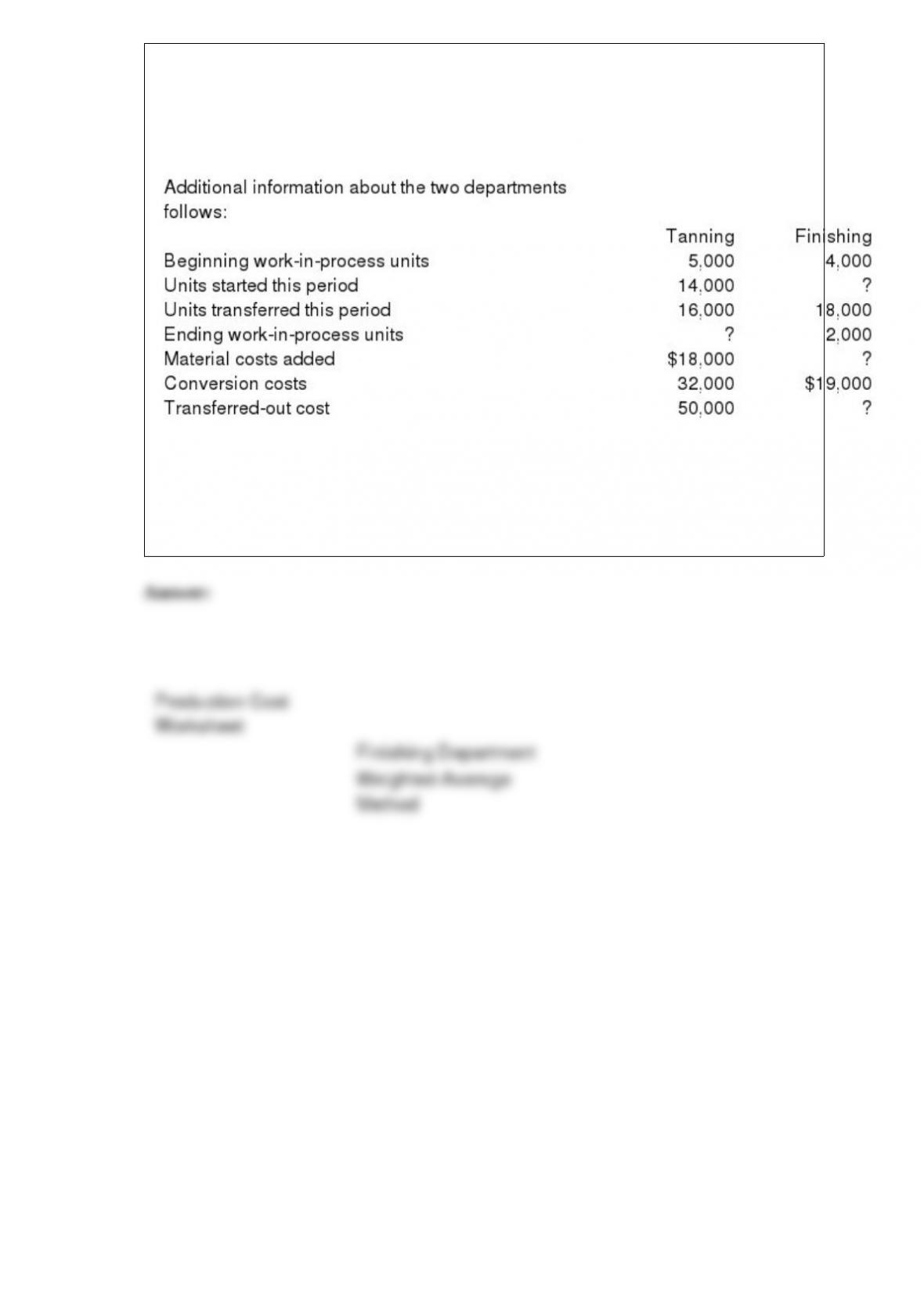
materials are added at the beginning of the process.
Beginning work in process in the finishing department was 60% complete as to
conversion. Beginning inventories included $7,000 for transferred-in costs and $10,000
for conversion costs. Ending inventory was 30% complete.
Required:
Prepare a production cost worksheet using weighted-average costing for the finishing
department.
30) Explain what is meant by sensitivity analysis in budgeting, and discuss how
managers might use sensitivity analysis in practice.
31) The Allianz Company produces a specialty wood furniture product, and has the
following information available concerning its inventory items:
Relevant ordering costs per purchase order$450
Relevant carrying costs per year for each package:
Required annual return on investment15%
Required other costs per year$4
Annual demand is 30,000 packages per year. The purchase price per package is $48.
Picture Company has one particular product that has an annual demand of 5,000 units.
Total manufacturing costs per unit total $50. Ordering costs for the product total $60
per purchase order. Currently, the carrying costs per unit are 25% of manufacturing
costs.
Required:
Determine the economic manufacturing order quantity.
32) What are the four alternative methods for evaluating capital budgeting projects?
What is an advantage and disadvantage of each method?
33) Discuss the behavioral considerations that provide value to strategic decision
making.
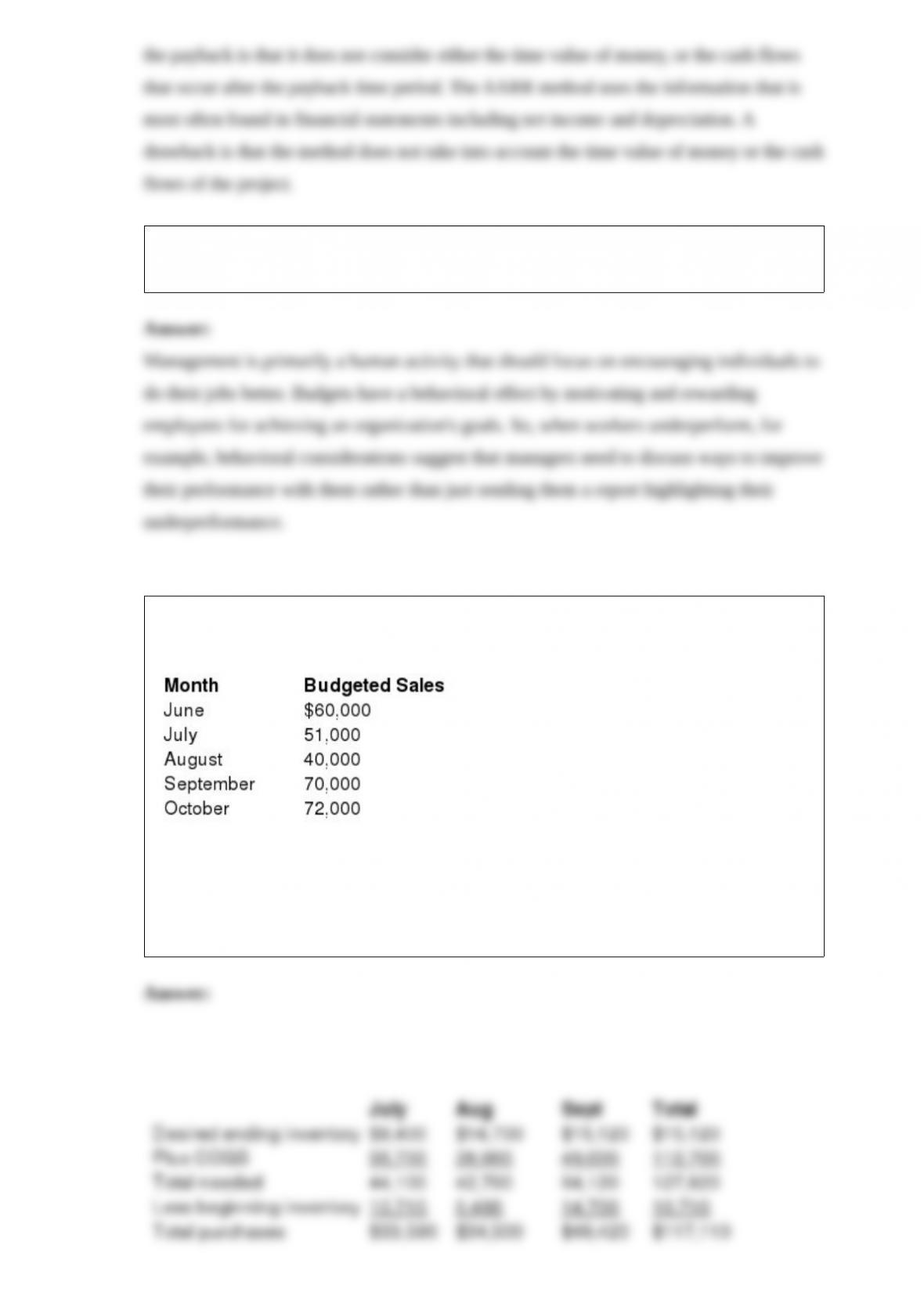
34) Favata Company has the following information:
In addition, the cost of goods sold rate is 70% and the desired inventory level is 30% of
next month’s cost of sales.
Required:
Prepare a purchases budget for July through September.
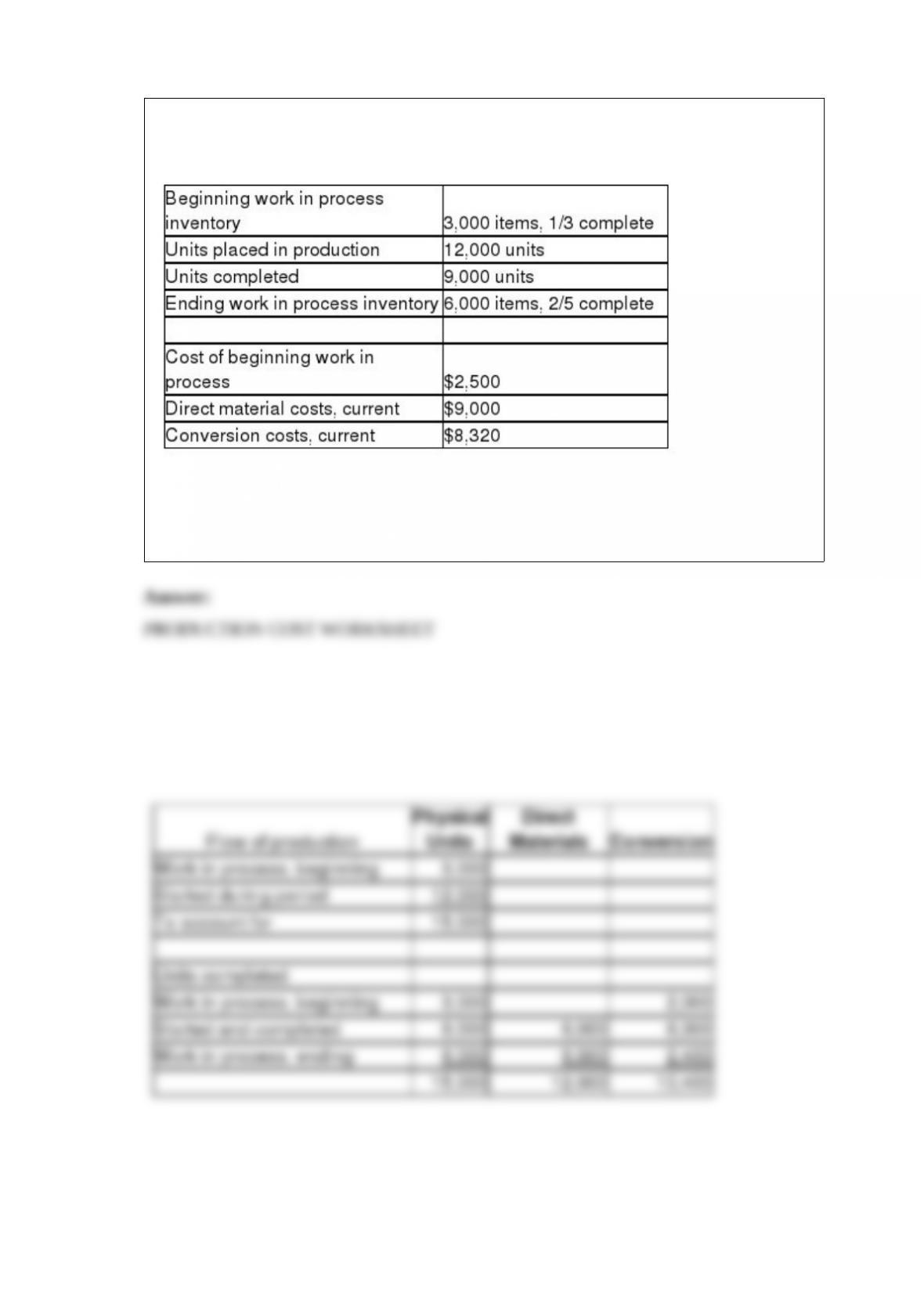
35) Shining Star Company uses an automated process to clean and polish its souvenir
items. For March, the company had the following activities:
Direct materials are placed into production at the beginning of the process and
conversion costs are incurred evenly throughout the process.
Required:
Prepare a production cost worksheet using the FIFO method.
36) What advice would you give a company to avoid the appearance of predatory
pricing?