1) The management of Roger Corporation would like to investigate the possibility of
basing its predetermined overhead rate on activity at capacity rather than on the
estimated amount of activity for the year. The company’s controller has provided an
example to illustrate how this new system would work. In this example, the allocation
base is machine-hours and the estimated amount of the allocation base for the upcoming
year is 49,000 machine-hours. In addition, capacity is 60,000 machine-hours and the
actual activity for the year is 47,900 machine-hours. All of the manufacturing overhead
is fixed and is $1,587,600 per year. For simplicity, it is assumed that this is the
estimated manufacturing overhead for the year as well as the manufacturing overhead at
capacity and the actual amount of manufacturing overhead for the year. Job T43G,
which required 130 machine-hours, is one of the jobs worked on during the year.
Required:
a. Determine the predetermined overhead rate if the predetermined overhead rate is
based on the amount of the allocation base at capacity.
b. Determine how much overhead would be applied to Job T43G if the predetermined
overhead rate is based on the amount of the allocation base at capacity.
c. Determine the underapplied or overapplied overhead for the year if the predetermined
overhead rate is based on the amount of the allocation base at capacity.
2) Federick Clinic uses client-visits as its measure of activity. During October, the clinic
budgeted for 3,000 client-visits, but its actual level of activity was 3,040 client-visits.
The clinic has provided the following data concerning the formulas used in its
budgeting and its actual results for October:
Data used in budgeting:
Actual results for October:
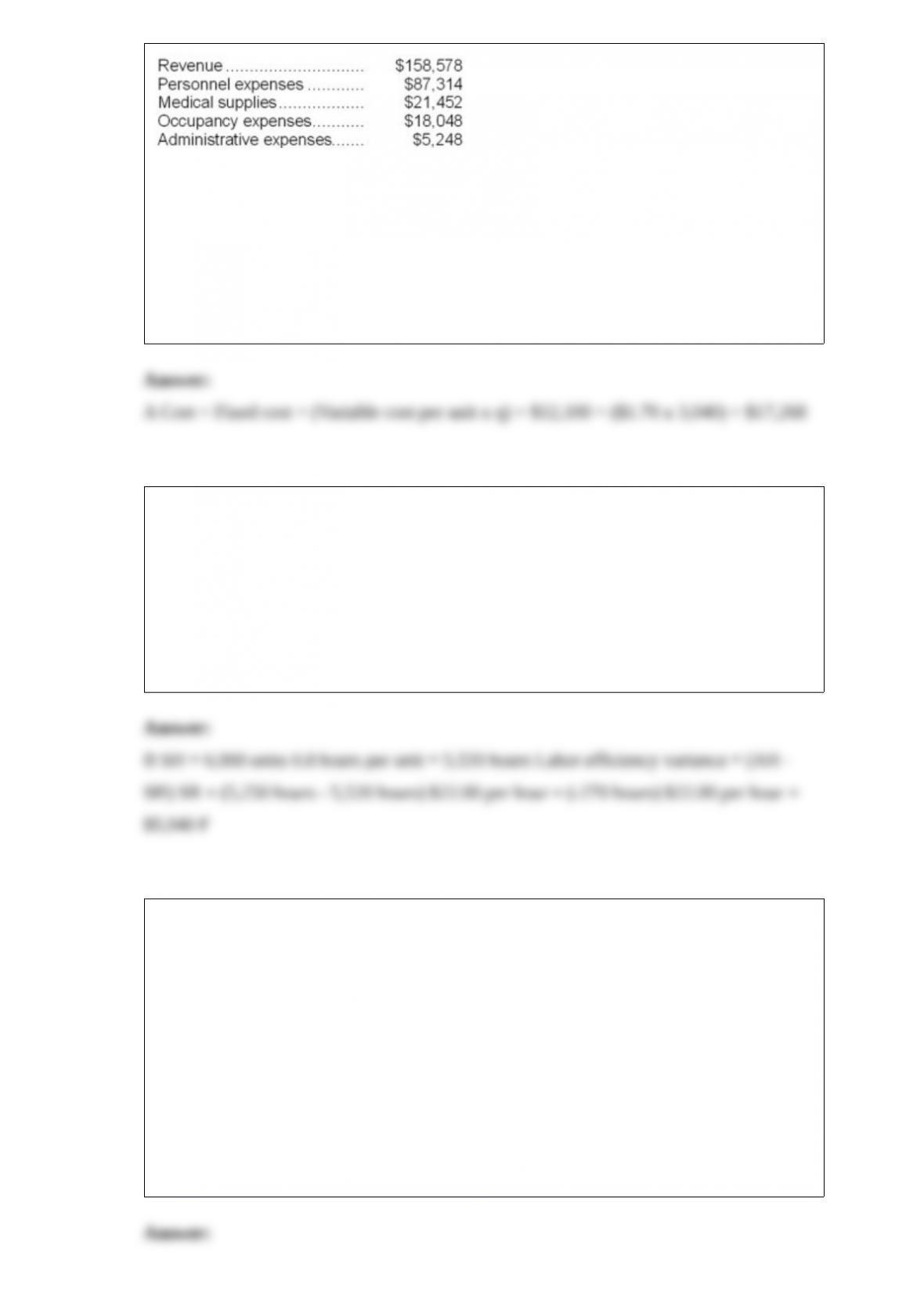
The occupancy expenses in the flexible budget for October would be closest to:
A.$17,268
B.$18,289
C.$17,811
D.$17,200
3) Midgley Corporation makes a product whose direct labor standards are 0.8 hours per
unit and $22.00 per hour. In April the company produced 6,900 units using 5,250 direct
labor-hours. The actual direct labor cost was $113,925.
The labor efficiency variance for April is:
A.$5,940 U
B.$5,940 F
C.$5,859 F
D.$5,859 U
4) Salter Corporation uses the FIFO method in its process costing system. The company
reported 25,000 equivalent units for materials last month. The company’s beginning
work in process inventory consisted of 6,000 units, 40% complete with respect to
materials. The ending work in process inventory consisted of 4,000 units, 70%
complete with respect to materials. The number of units started during the month was:
A.25,400 units
B.23,400 units
C.22,600 units
D.24,600 units
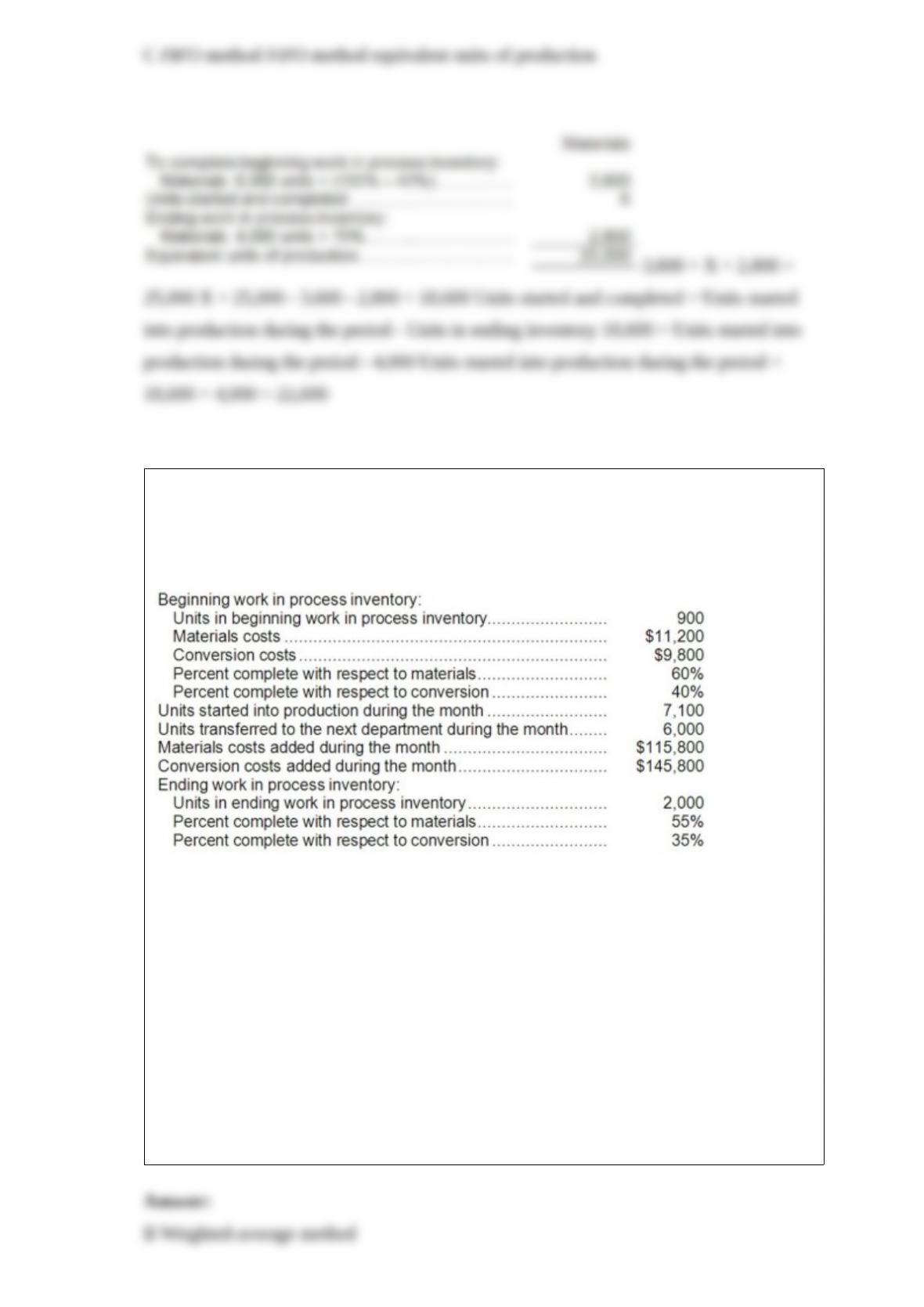
5) Jublot Corporation uses the weighted-average method in its process costing system.
Data concerning the first processing department for the most recent month are listed
below:
Note: Your answers may differ from those offered below due to rounding error. In all
cases, select the answer that is the closest to the answer you computed. To reduce
rounding error, carry out all computations to at least three decimal places.
The cost per equivalent unit for materials for the month in the first processing
department is closest to:
A.$16.31
B.$17.89
C.$14.48
D.$15.88
6) The gross margin for October is:
A) $232,000
B) $260,000
C) $397,500
D) $196,500
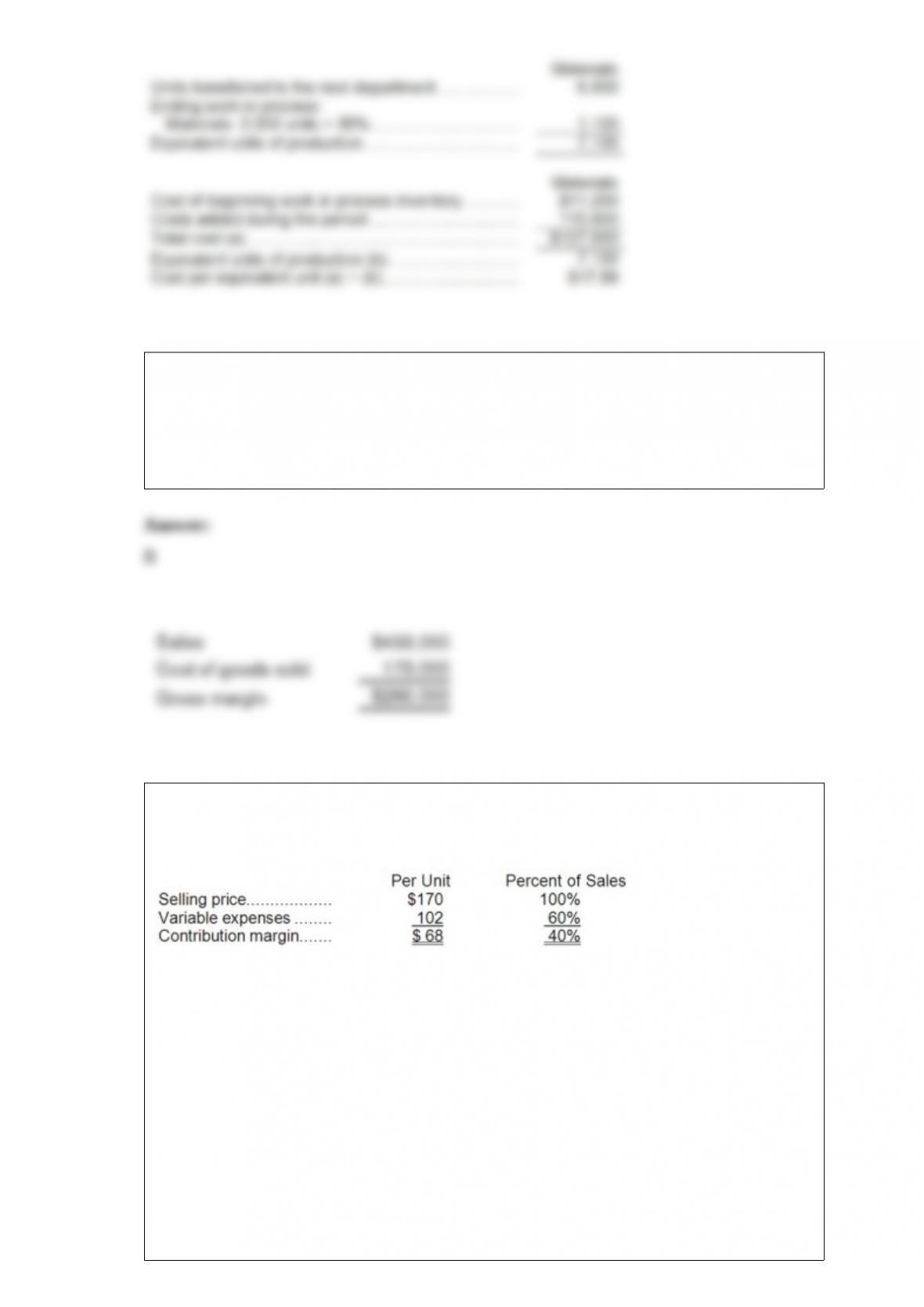
7) Boenisch Corporation produces and sells a single product with the following
characteristics:
The company is currently selling 8,000 units per month. Fixed expenses are $406,000
per month. Consider each of the following questions independently.
Management is considering using a new component that would increase the unit
variable cost by $3. Since the new component would increase the features of the
company’s product, the marketing manager predicts that monthly sales would increase
by 400 units. What should be the overall effect on the company’s monthly net operating
income of this change?
A.decrease of $2,000
B.increase of $26,000
C.increase of $2,000
D.decrease of $26,000
8) Emco Company uses direct labor cost as a basis for computing its predetermined
overhead rate. In computing the predetermined overhead rate for last year, the company
misclassified a portion of direct labor cost as indirect labor. The effect of this
misclassification will be to:
A.understate the predetermined overhead rate.
B.overstate the predetermined overhead rate.
C.have no effect on the predetermined overhead rate.
D.cannot be determined from the information given.
9) ( The management of Stanforth Corporation is investigating automating a process.
Old equipment, with a current salvage value of $24,000, would be replaced by a new
machine. The new machine would be purchased for $516,000 and would have a 6 year
useful life and no salvage value. By automating the process, the company would save
$173,000 per year in cash operating costs. The simple rate of return on the investment is
closest to:
A.17.7%
B.16.9%
C.33.5%
D.16.7%

10) Lacy Corporation uses the absorption costing approach to cost-plus pricing
described in the text to set prices for its products. Based on budgeted sales of 86,000
units next year, the unit product cost of a particular product is $81.60. The company’s
selling and administrative expenses for this product are budgeted to be $1,247,000 in
total for the year. The company has invested $360,000 in this product and expects a
return on investment of 12%.
The markup on absorption cost for this product would be closest to:
A.12.0%
B.18.4%
C.29.8%
D.17.8%