1) Beta Company uses a predetermined overhead rate based on direct labor hours to
allocate manufacturing overhead to jobs. The company estimated that it would incur
$600,000 of manufacturing overhead during the year and that 150,000 direct labor
hours would be worked. During the year, the company actually incurred manufacturing
overhead costs of $582,000 and 135,000 direct labor hours were worked.
By how much was manufacturing overhead overallocated or underallocated for the
year?
A) $18,000 underallocated
B) $42,000 overallocated
C) $42,000 underallocated
D) $18,000 overallocated
2) The five steps of the process costing procedure are scrambled below:
1>Assign total costs to units completed and to units in ending WIP inventory.
2>Summarize total costs to account for.
3>Compute the cost per equivalent unit.
4>Summarize the flow of physical units.
5>Compute output in terms of equivalent units.
The correct order for these steps is:
A) 3, 1, 4, 2, 5
B) 5, 3, 1, 4, 2
C) 2, 4, 5, 1, 3
D) 4, 5, 2, 3, 1
3) Traditional performance management systems can be adapted to include measures of
environmental costs, savings, and liabilities. The number of local, organic products
available at a grocery store is an example of a key performance indicator (KPI)
classified under which perspective of the balanced scorecard?
A) Learning and growth perspective
B) Community perspective
C) Internal business perspective
D) Financial perspective
4) A wave of accounting scandals around the turn of the 21st century prompted which
of the following?
A) XBRL
B) IFRS
C) SOX
D) ISO
5) Costs that remain the same among alternatives are
A) sunk costs
B) irrelevant costs
C) controllable costs
D) uncontrollable costs
6) Which of the following is most likely NOT to use process costing?
A) DuPont Chemical
B) Exxon-Mobile (gasoline)
C) Ashley Custom Furnishings
D) General Mills (cereal)
7) On the statement of cash flows, which of the following would be considered an
investing activity?
A) A purchase of treasury stock
B) A sale of land
C) Depreciation of equipment
D) A sale of inventory
8) All of the following are overarching principles in the IMA Statement of Ethical
Professional Practice except
A) responsibility
B) objectivity
C) integrity
D) fairness
9) Which of the following are the internal decision-makers of a company?
A) Vendors
B) Managers
C) Shareholders
D) Customers
10) Fixed costs divided by weighted-average contribution margin per unit equals
A) breakeven sales in units
B) margin of safety ratio
C) breakeven sales in dollars
D) contribution margin ratio
11) Benace Parts and Supply makes a variety of car parts. The company produces 6,000
A90 parts each year. Each A90 sells for $7 and has a contribution margin of $2.
Currently, $16,000 of fixed manufacturing overhead is allocated to the A90 product
line. If Benace Parts and Supply discontinues the A90 product line, $7,000 of fixed
manufacturing overhead costs would be avoided. What would be the impact on total
operating income if the A90 product line were to be discontinued?
A) Increase in total operating income of $5,000
B) Decrease in total operating income of $5,000
C) Increase in total operating income of $4,000
D) Decrease in total operating income of $4,000
12) Comfort Cloud manufactures seats for airplanes. The company has the capacity to
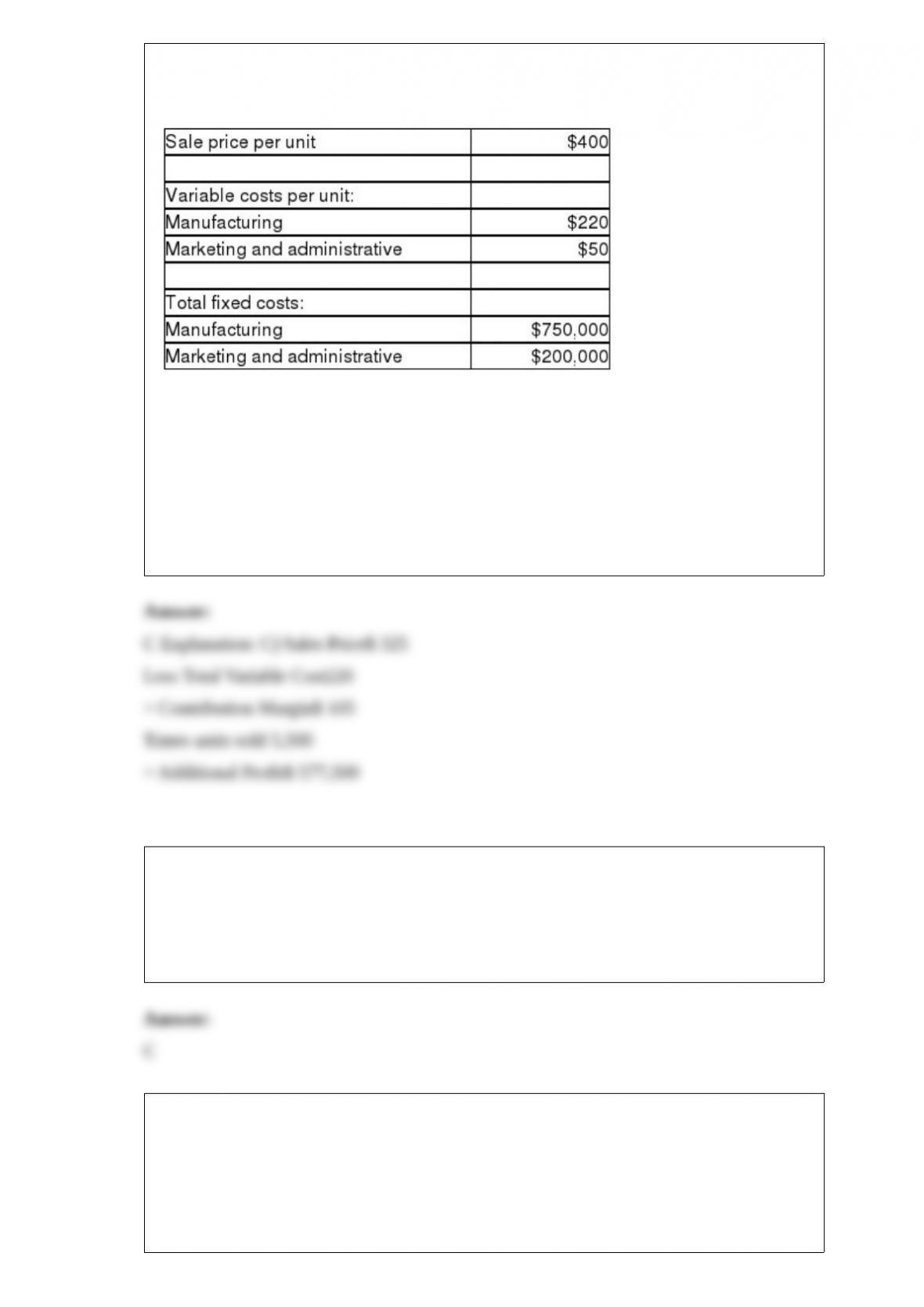
prroduce 100,000 seats per year, but is currently producing and selling 75,000 seats per
year. The following information relates to current production:
If a special sales order is accepted for 5,500 seats at a price of $325 per unit, fixed costs
remain unchanged, and no variable marketing and administrative costs will be incurred
for this order, how would operating income be affected? (NOTE: Assume regular sales
are not affected by the special order.)
A) Increase by $2,997,500
B) Increase by $302,500
C) Increase by $577,500
D) Decrease by $577,500
13) Budgets are used for all of the following, except
A) planning for the future
B) controlling operations
C) recording actual results
D) directing operations
14) Chemical Supply Incorporated budgeted two and one half hours of direct labor per
unit at $11.75 per hour to produce 650 units of product. The 650 units were completed
using 1,750 hours of direct labor at $12.50 per hour. What is the direct labor rate
variance?
A) $1,219 favorable
B) $1,313 favorable
C) $1,219 unfavorable
D) $1,313 unfavorable
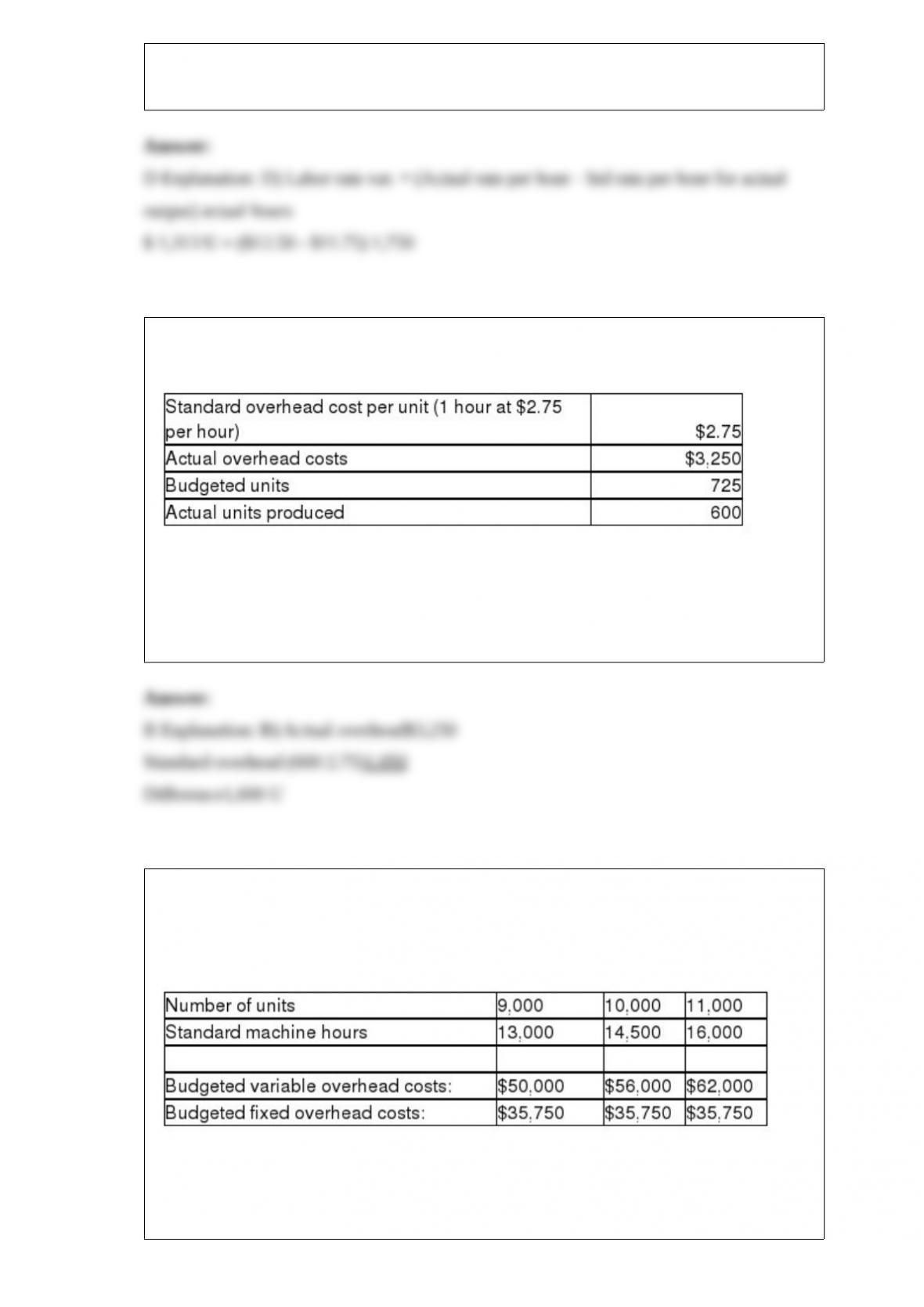
15) Batchelder Manufacturing reported the following budgeted and actual figures for
one of its products:
Given this data, what is the total variable overhead variance for this product?
A) $1,600 favorable
B) $1,600 unfavorable
C) $1,256 favorable
D) $1,256 unfavorable
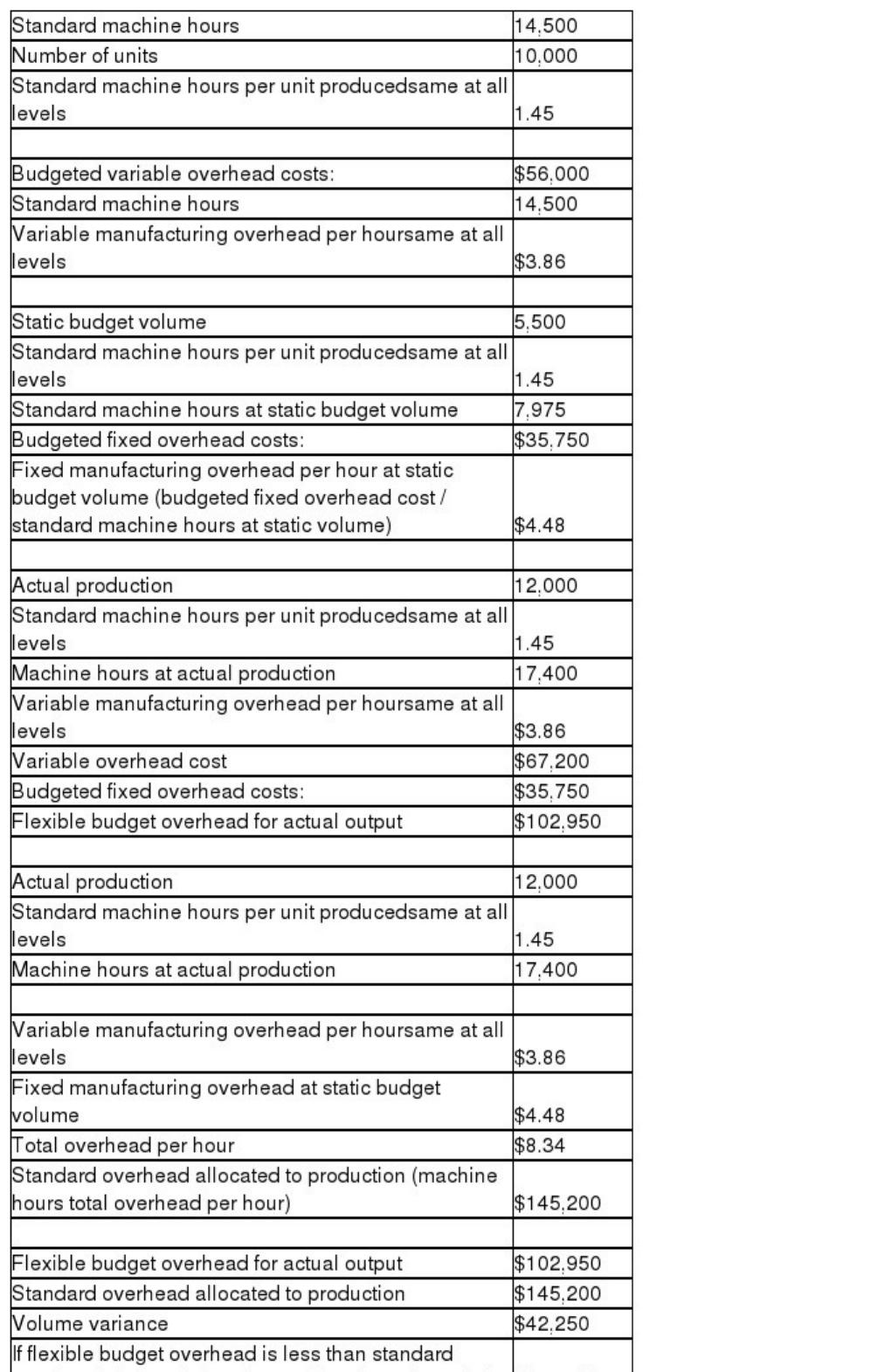
16) Litchfield Industries gathered the following information for the month ended June
31:
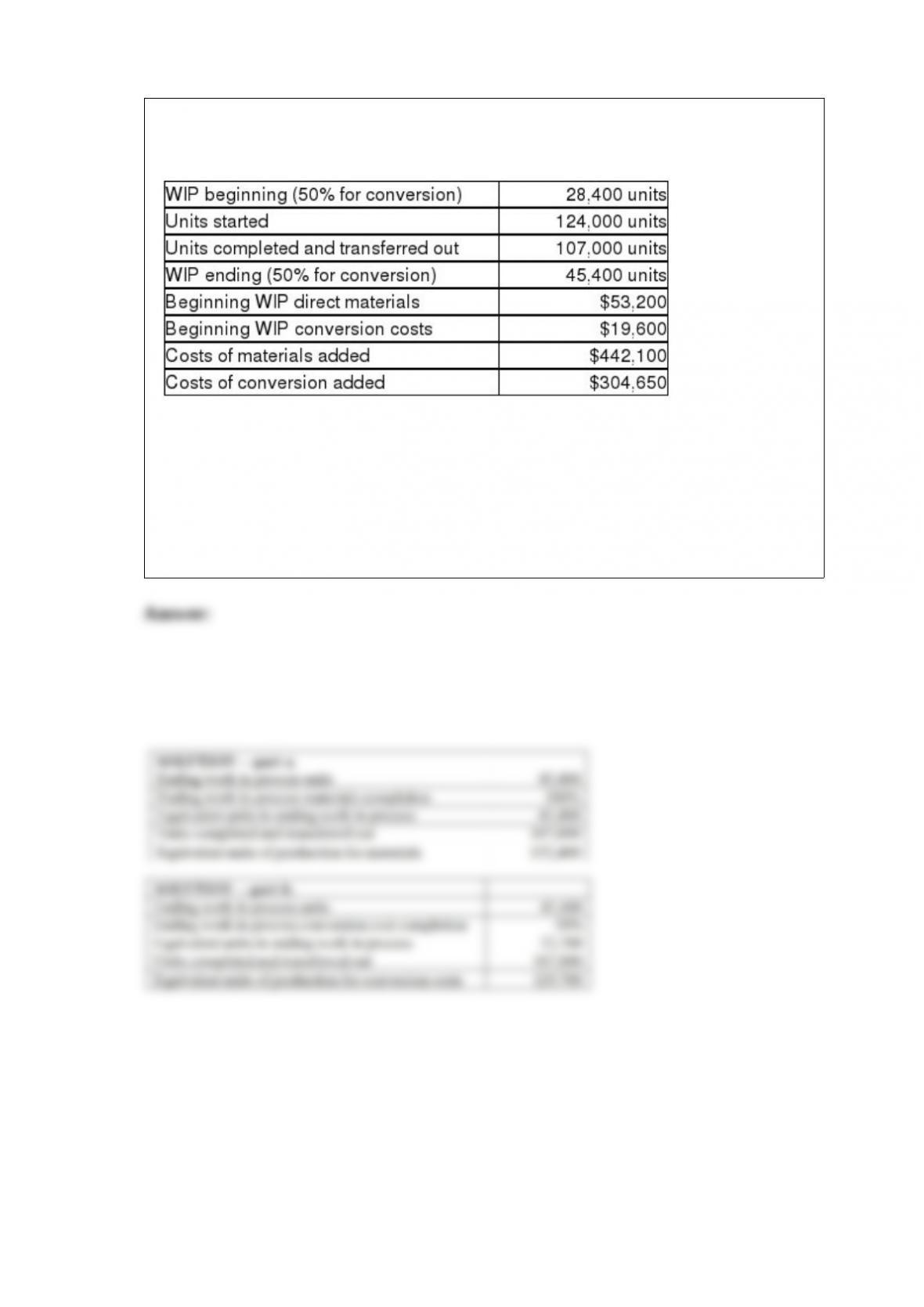
The static budget volume is 5,500 units:
Overhead flexible budget:
Actual production was 12,000 units. Actual overhead costs were $28,000 for variable
costs and $37,000 for fixed costs. Actual machine hours worked were 16,000 hours.
What is the fixed overhead volume variance? (Assume the allocation base for fixed
overhead costs is machine hours.)

A) $42,250 unfavorable
B) $42,250 favorable
C) $36,400 unfavorable
D) $36,400 favorable
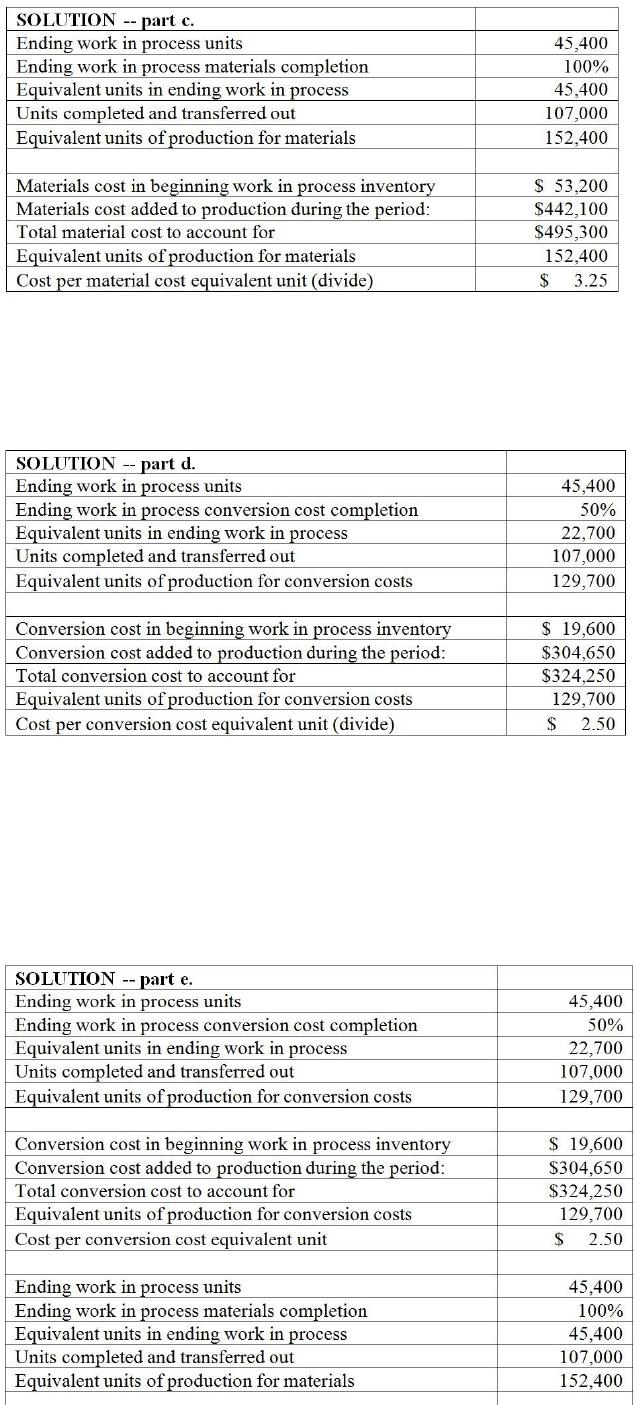
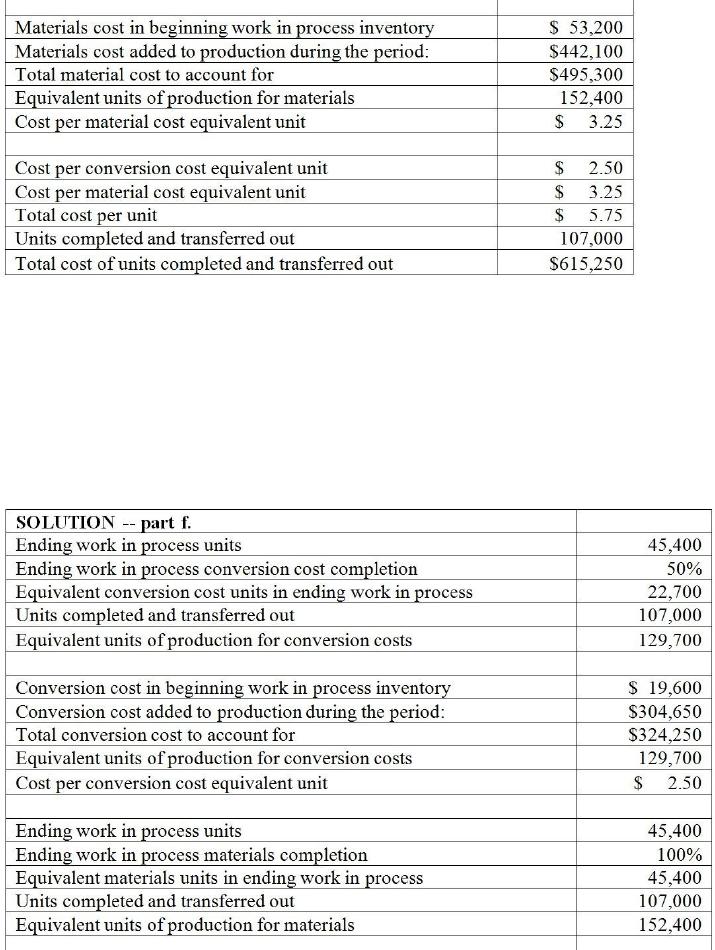
17) Direct materials are added at the beginning of the process and conversions costs are
uniformly applied. Other details include:
Required:
a.What are the total equivalent units for direct materials?
b.What are the total equivalent units for conversion costs?
c.What is the cost per equivalent unit for direct materials?
d.What is the cost per equivalent unit for conversion costs?
e.What is the total cost of units completed and transferred out?
f.What is the total cost of units remaining in ending WIP?
18) Which of the following is a measure of the amount of work done, expressed in
complete units of output?
A) Job costing
B) Process costing
C) Conversion costs
D) Equivalent units
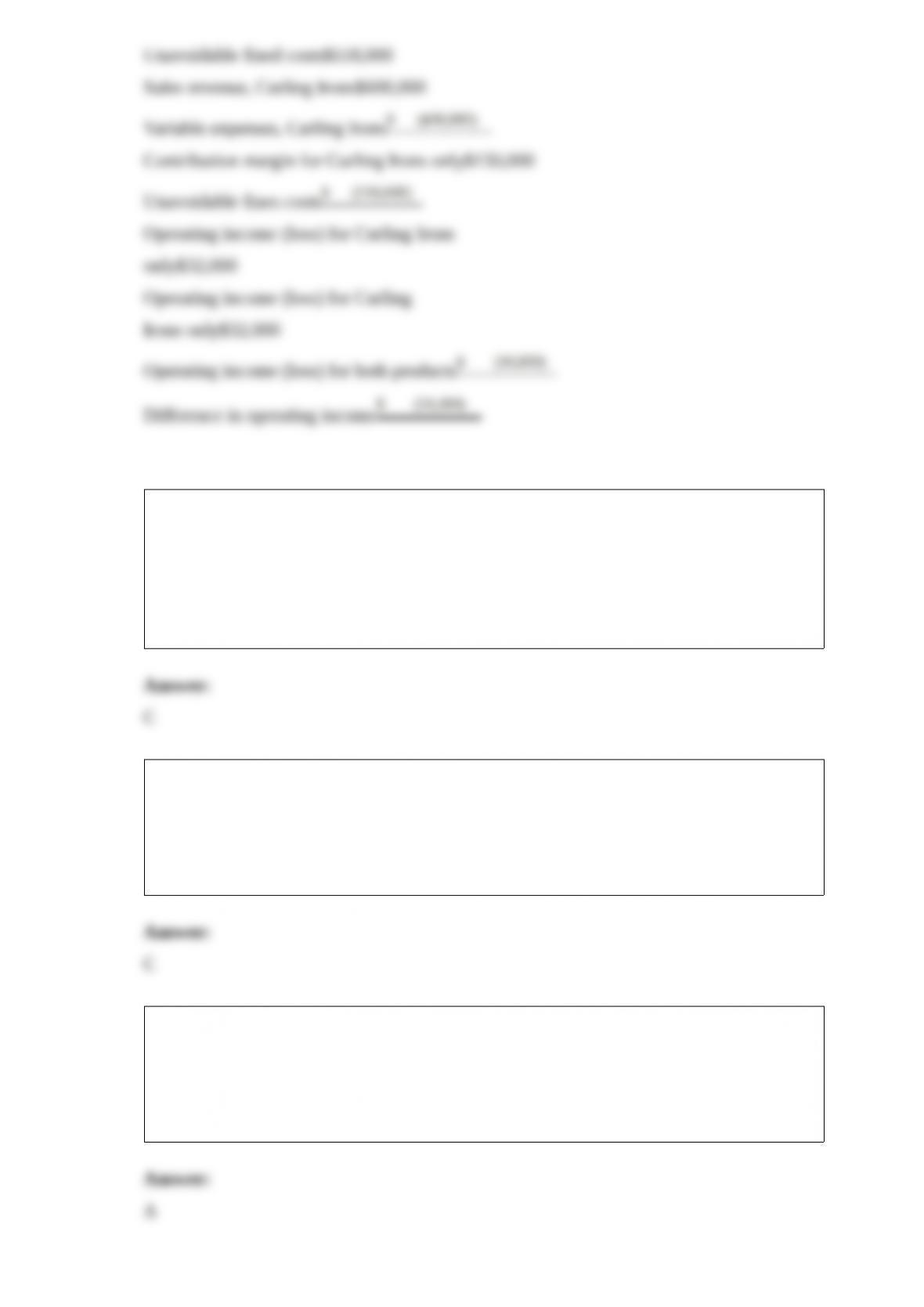
19) The income statement for Lovely Locks is divided by its two product lines, Curling
Irons and Straighteners, as follows:
If Lovely Locks can eliminate fixed costs of $32,000 by discontinuing the Straightener
line, then discontinuing it should result in which of the following?
A) Increase in total operating income of $50,000
B) Decrease in total operating income of $18,000
C) Increase in total operating income of $18,000
D) Decrease in total operating income of $50,000
20) The journal entry needed to record the receipt of a bill from the company’s
marketing agency would include a
A) debit to manufacturing overhead
B) debit to work in process inventory
C) debit to marketing expenses
D) credit to work in process inventory
21) If a job consists of a batch of identical units, how can managers find the unit cost?
A) By tracing direct materials to each unit
B) By multiplying the total job cost by the number of units in the job
C) By dividing the total job cost by the number of units in the job
D) By tracing direct labor to each unit
22) Which of the following are classified as manufacturing overhead?
A) Indirect labor and indirect materials
B) Direct materials and direct labor
C) All materials
D) Factory rent and direct labor
23) The formula for computing the dividend yield is
A) annual dividend per share of common stock/market price per share of common stock
B) market price per share of common stock/earnings per share
C) total stockholders’ equity/number of shares of outstanding common stock
D) (net income – preferred dividends)/number of shares of outstanding common stock
24) An equation of a line for total mixed costs is
A) y = vx + f
B) y = vx – f
C) f = vx – y
D) f = vx + y
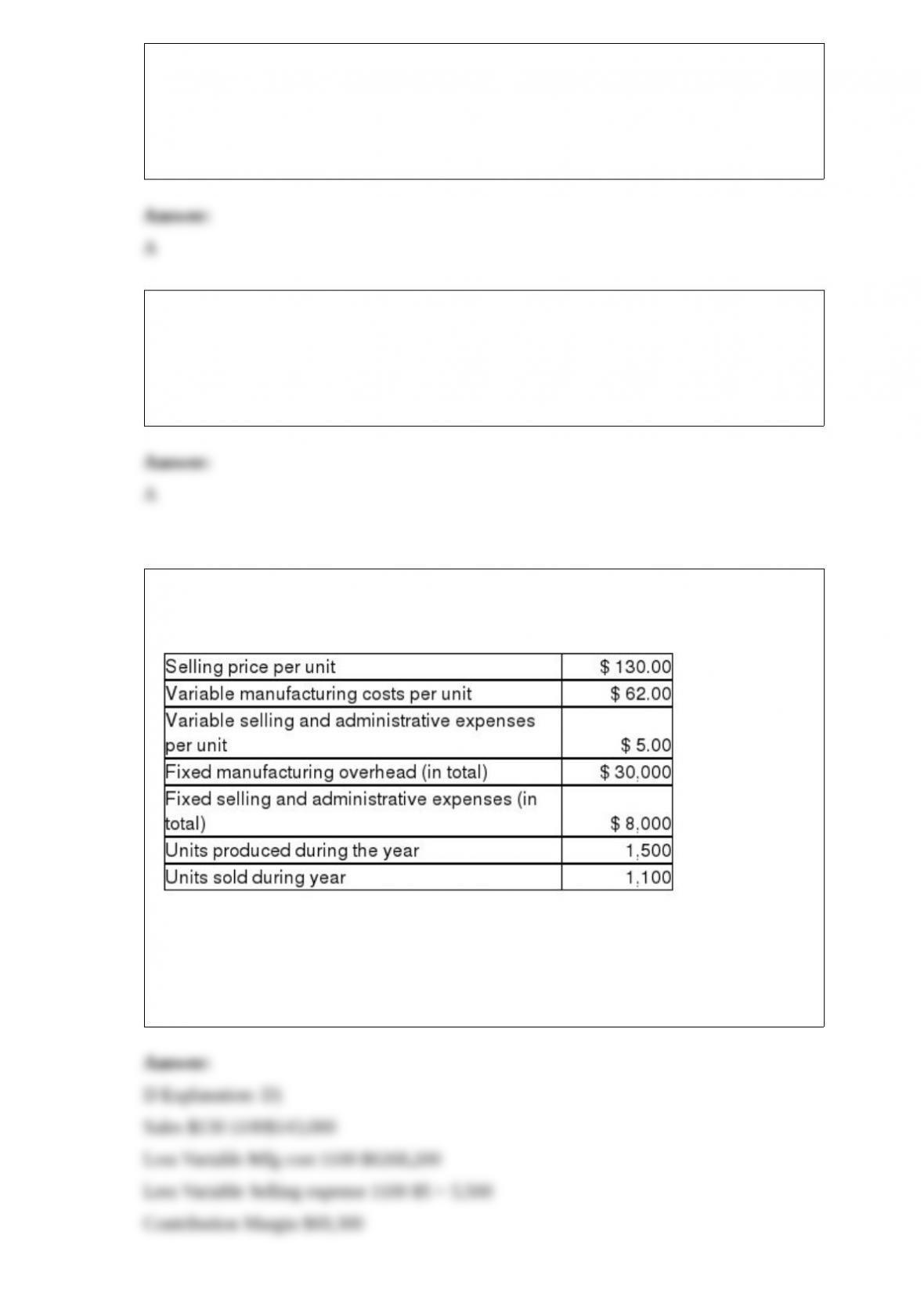
25) Neon Company manufactures widgets. The following data is related to sales and
production of the widgets for last year.
Using variable costing, what is the contribution margin for last year?
A) $216,700
B) $68,200
C) $143,000
D) $69,300
26) Cash received from providing services would be considered a
A) cash inflow from investing activities
B) cash outflow from operating activities
C) cash inflow from financing activities
D) cash inflow from operating activities
27) A ________ is a document which is prepared by manufacturing personnel to request
materials for the production process.
A) cost ticket
B) job cost record
C) materials requisition
D) manufacturing ticket
28) All of the following are relevant to the decision to replace equipment except the
A) cost of old equipment
B) selling price of old equipment
C) future maintenance costs of old equipment
D) cost of new equipment
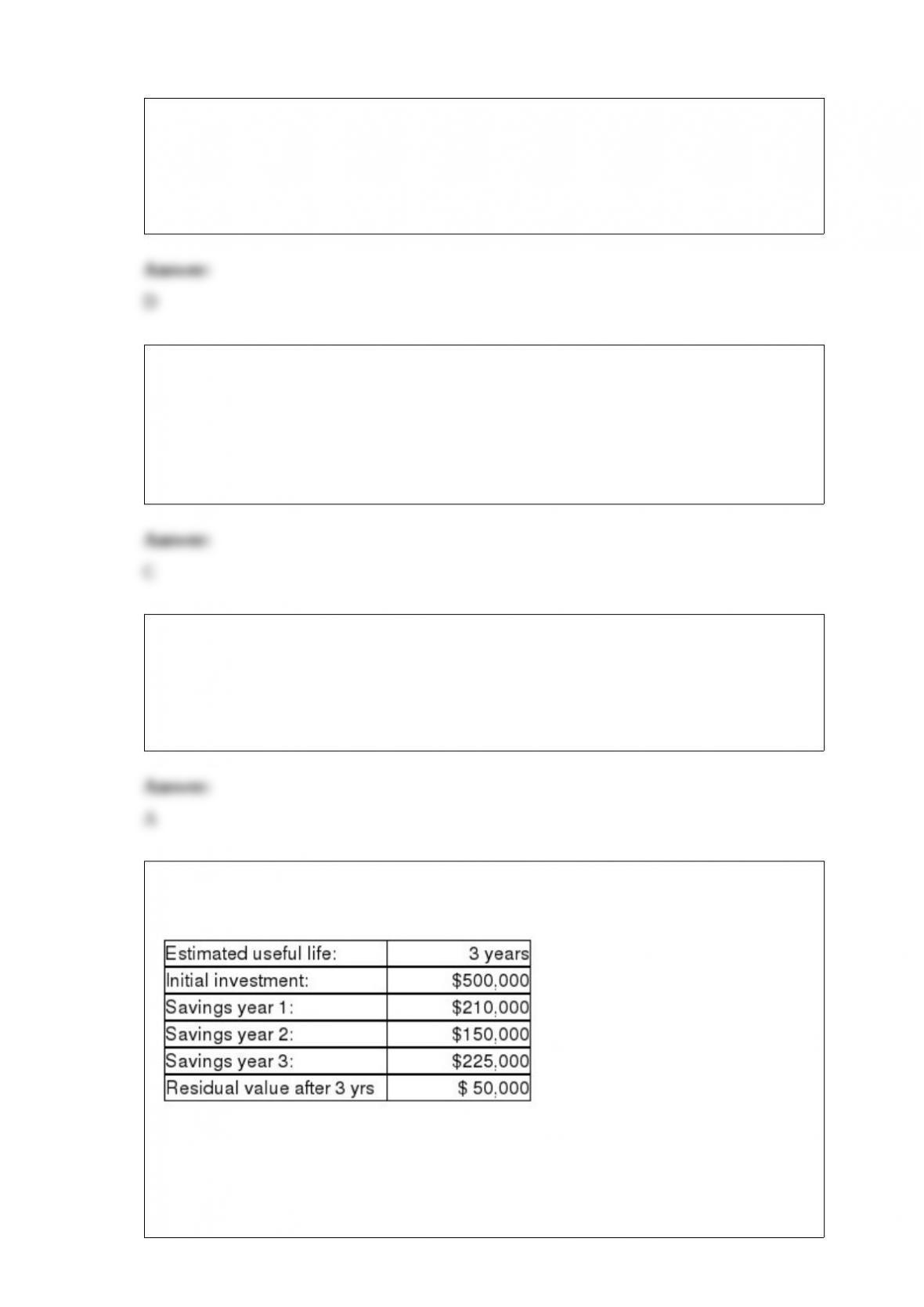
29) The Hanna Company uses straight-line depreciation and is considering a capital
expenditure for which the following relevant cash flow data have been estimated:
Total operating income from the asset over the 3-year period is
A) $85,000
B) $150,000
C) $435,000
D) $135,000
30) Which of the following is an example of overhead in a factory?
A) Wages of machine operators
B) Wages of administrators in the corporate office
C) Wages of factory maintenance personnel
D) Salaries of salespersons
31) Which of the following cost behaviors cannot be accurately represented by a single
straight line?
A) Variable costs
B) Mixed costs
C) Fixed costs
D) Step costs
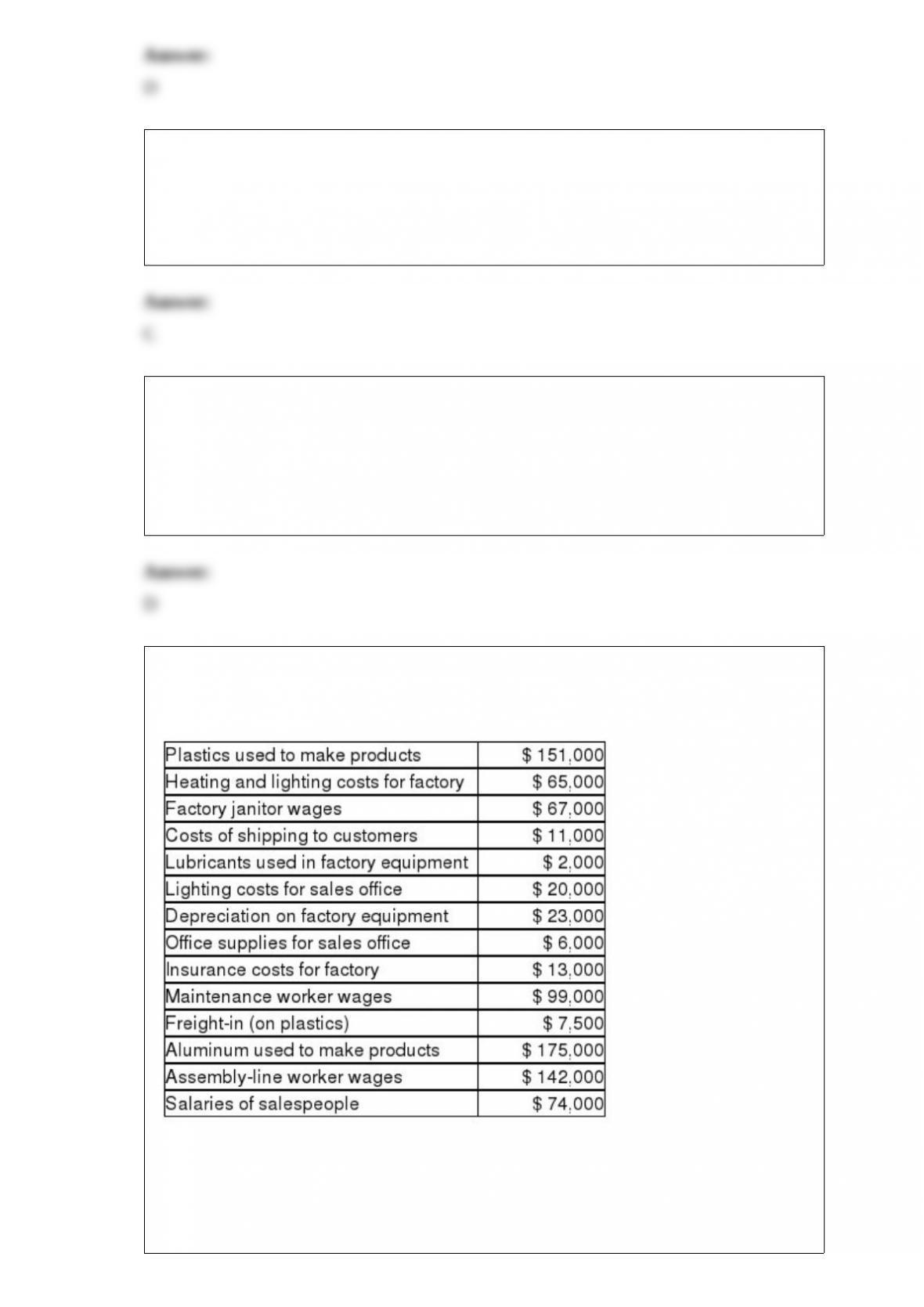
32) Winner’s Sporting Equipment manufactures sporting goods. Selected costs from the
past year include:
Period costs for Winner’s Sporting Equipment totaled
A) $91,000
B) $37,000
C) $188,000
D) $111,000
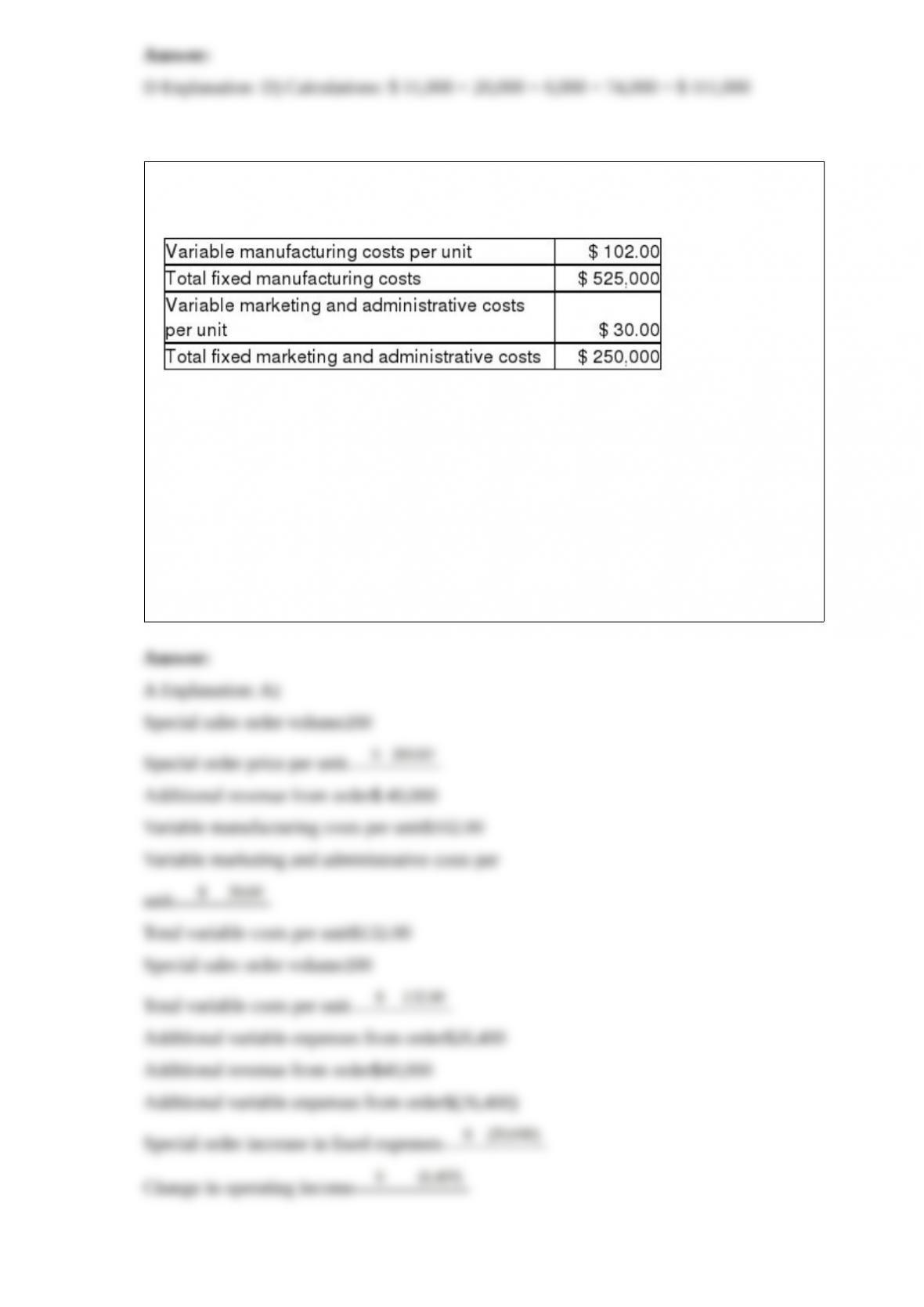
33) The following information relates to current production of outdoor chaise lounges
Backyard Posh:
The regular selling price per chaise lounge is $300.00. The company is analyzing the
opportunity to accept a special sales order for 200 chaise lounges at a price of $200.00
per unit. Fixed costs would increase by $20,000. The company has the capacity to
produce 15,000 chaise lounges per year, but is currently producing and selling 10,000
chaise lounges per year. Regular sales will not be affected by the special order. If the
company were to accept this special order, how would operating income be affected?
A) Decrease by $6,400
B) Increase by $13,600
C) Decrease by $13,600
D) Increase by $6,400
34) Corny and Sweet grows and sells sweet corn at its roadside produce stand. The
selling price per dozen is $3.75, variable costs are $1.25 per dozen, and total fixed costs
are $750.00. How many dozens of ears of corn must Corny and Sweet sell to
breakeven?
A) 1,125
B) 200
C) 300
D) 175
35) The Jones Corporation uses a process system. During the current period, 2,500 units
were started and 1,100 units were completed and transferred out. Ending units were
60% complete for materials and 45% complete for conversion costs. Direct materials
costs added were $35,405 and conversion costs added were $32,870. There was no
beginning WIP inventory and conversion costs are added evenly throughout the
process. At the end of the period, the total equivalent units for direct materials are:
A) 1,730
B) 1,940
C) 1,100
D) 2,500
36) On the statement of cash flows, which of the following section includes activities
that increase and decrease long-term liabilities and owners’ equity?
A) Operating section
B) Financing section
C) Investing section
D) None of the above