1) Which of the following is NOT correct regarding the rate of return on assets?
a. The rate of return on assets measures managements ability to productively employ all
its resources
b. The rate of return on assets measures the return on all assets used regardless of how
the assets are financed
c. The rate of return on assets is a measure of profitability
d. The rate of return on assets measures the return on the investment made by the
owners of the entity
2) Depreciation of noncurrent operating assets is an accounting process for the purpose
of
a. reporting declining asset values on the balance sheet
b. allocating asset costs over the periods benefited by use of the assets
c. accounting for costs to reflect the change in general price levels
d. setting aside funds to replace assets when their economic usefulness expires
3) Golden Construction Company uses the percentage-of-completion method for
long-term construction contracts. The company started a project with a contract price of
$2,750 in 2014. Given the following data, what is the balance in Construction in
Progress for this contract at the end of 2014?
a. $150
b. $400
c. $550
d. $1,750
4) An analysis and aging of the accounts receivable of Mahi Company at December 31
revealed the following data:
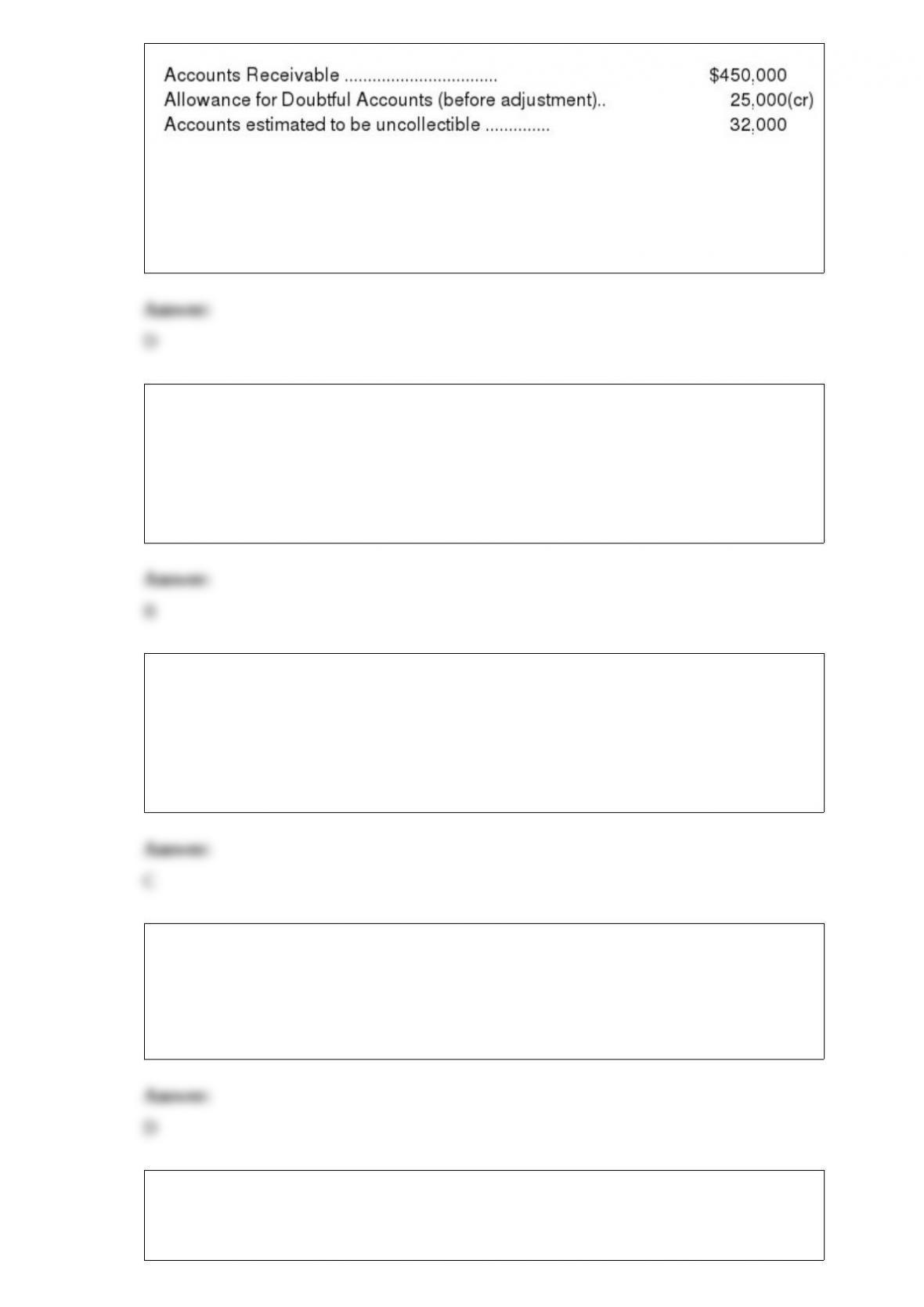
The net realizable value of the accounts receivable at December 31 should be
a. $450,000
b. $443,000
c. $425,000
d. $418,000
5) The ending inventory for Wyeth Company was overstated by $6,000 in 2014. The
overstatement will cause Wyeth Companys
a. retained earnings to be understated on the 2014 balance sheet
b. 2015 balance sheet not to be misstated
c. cost of goods sold to be overstated on the 2014 income statement
d. cost of goods sold to be understated on the 2015 income statement
6) When preparing a statement of cash flows using the indirect method, the
amortization of trademarks should be reported as a(n)
a. increase in cash flows from investing activities
b. reduction in cash flows from investing activities
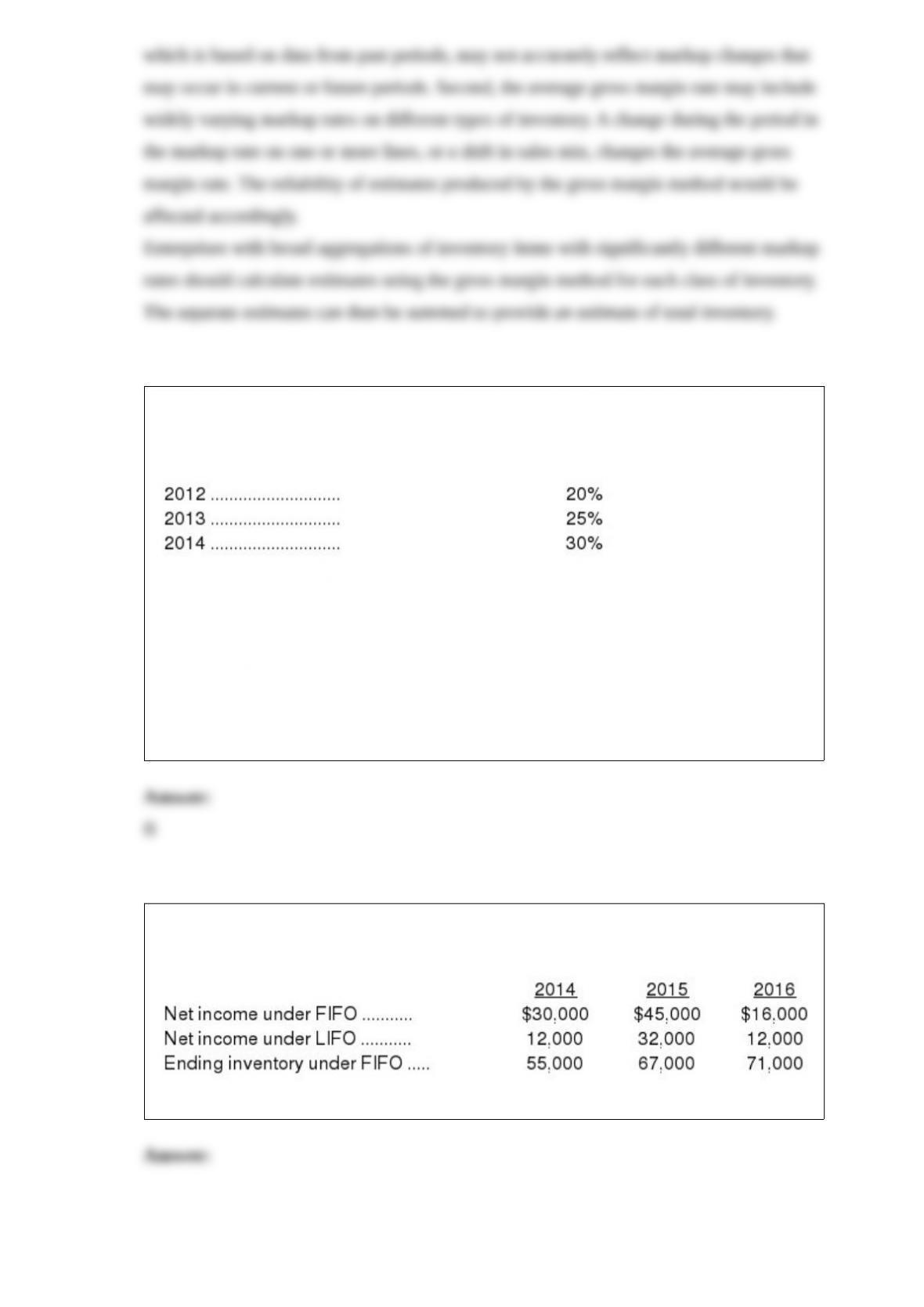
c. increase in cash flows from operating activities
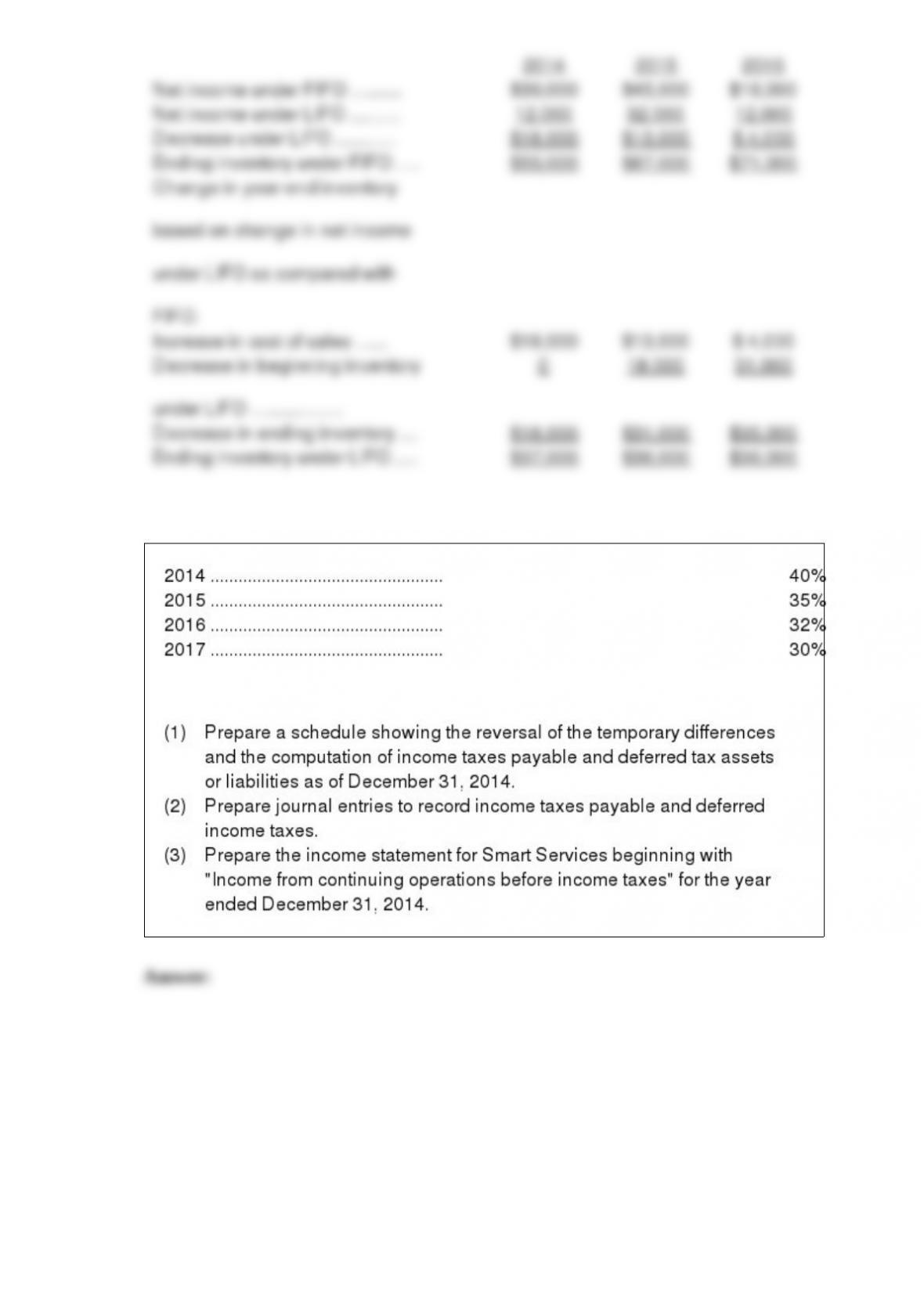
d. reduction in cash flows from operating activities
7) Which of the following would NOT be classified as cash?
a. Personal checks
b. Travelers’ checks
c. Cashiers’ checks
d. Postdated checks
8) On June 30, 2014, Island Inc. had outstanding 10 percent, $1,000,000 face amount,
15-year bonds maturing on June 30, 2019. Interest is paid on June 30 and December 31,
and bond discount and bond issue costs are amortized on these dates. The unamortized

balances on June 30, 2014, of bond discount and bond issue costs were $55,000 and
$20,000, respectively. Island reacquired all of these bonds at 96 on June 30, 2014, and
retired them. Ignoring income taxes, how much gain or loss should Island record on the
bond retirement?
a. Loss of $15,000
b. Loss of $35,000
c. Gain of $5,000
d. Gain of $40,000
9) In a statement of cash flows (indirect method), an increase in inventories should be
presented as
a. a deduction from net income from continuing operations
b. an inflow and outflow of cash
c. an addition to net income
d. an inflow of cash
10) On March 1, 2012, Forest Co. borrowed cash and signed a 36-month,
interest-bearing note on which both the principal and interest are payable on February
28, 2015. At December 31, 2014, the liability for accrued interest should be
a. 10 months’ interest
b. 22 months’ interest
c. 34 months’ interest
d. 36 months’ interest
11) On July 1, 2008 Magda Corporation issued for $960,000 one thousand of its 9
percent, $1,000 callable bonds. The bonds are dated July 1, 2008, and mature on July 1,
2018. Interest is payable semiannually on January 1 and July 1. Magda uses the
straight-line method of amortizing bond discount. The bonds can be called by the issuer
at 101 at any time after June 30, 2013. On July 1, 2014, Magda called in all of the
bonds and retired them. Ignoring income taxes, how much loss should Magda report on
this early extinguishment of debt for the year ended December 31, 2014?
a. $50,000
b. $34,000
c. $26,000
d. $10,000
12) Record the following transactions and events of Royal Wulff Company in general
journal form. If the item does not require a journal entry, write “no entry.”
(a) Sold merchandise costing $4,500 for $1,000 cash and $7,000 on open account. A
perpetual inventory system is used.
(b) Purchased land and building for $100,000 cash and a $300,000 mortgage. The land
was recently appraised at $60,000 and the building at $340,000.
(c) Received payment on account, $12,000.
(d) Estimated that utilities expense for the coming six months will total $7,600.
(e) Declared a cash dividend totaling $13,500. The dividend will be paid in six weeks.
13) A contingent loss should be disclosed in a note to the financial statements but
should not be recorded as a liability if the
a. possibility of loss is remote
b. actual incurrence of a loss is reasonably possible
c. outcome is uncertain
d. contingency involves pending or threatened litigation
14) Which of the following is an appropriate presentation of treasury stock?
a. As a marketable security
b. As a deduction at cost from total stockholders’ equity
c. As a deduction at cost from total contingent liabilities
d. As a deduction at par from total stockholders’ equity
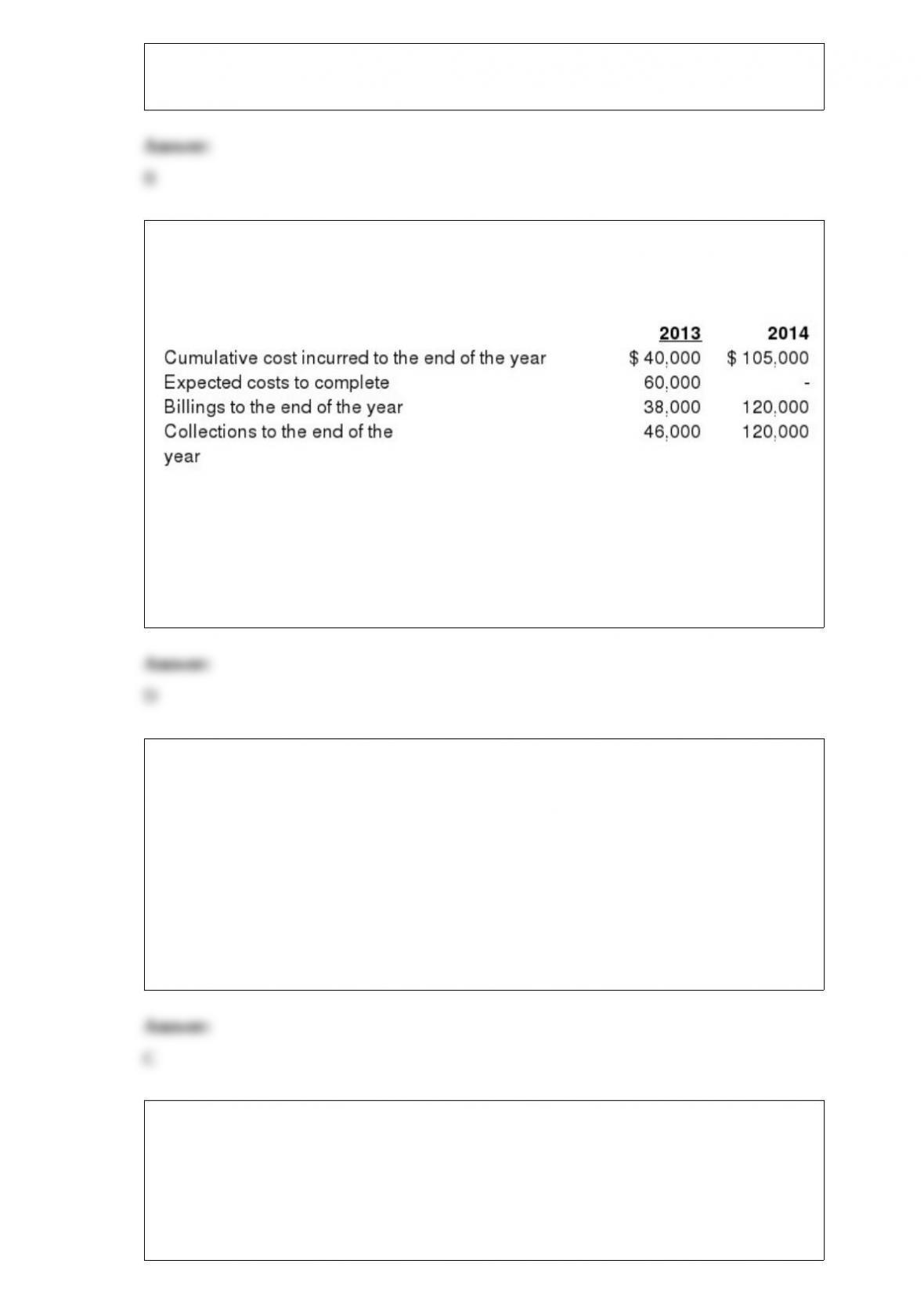
15) Johann Builders has a fixed -price contract providing $120,000 of revenue.
Construction on the contract was begun in 2013 and was completed in 2014.
Information relating to the contract is as follows:
What amount of income should Johann recognize in 2014 assuming that the company
appropriately uses the percentage-of-completion method of income recognition?
a. $9,286
b. $15,000
c. $17,000
d. $7,000
16) Comet Corporation’s liability account balances at June 30, 2013, included a 10
percent note payable. The note is dated October 1, 2011, and carried an original
principal amount of $600,000. The note is payable in three equal annual payments of
$200,000 plus interest. The first interest and principal payment was made on October 1,
2012. In Comet’s June 30, 2013, balance sheet, what amount should be reported as
Interest Payable for this note?
a. $10,000
b. $15,000
c. $30,000
d. $45,000
17) For which of the following reporting issues has the FASB adopted substantially the
same approach as the IASB?
a. Segment reporting
b. Earnings per share
c. Statement of cash flows
d. Pension plans

18) According to FASB ASC Topic 280 (Segment Reporting) how do firms identify
reportable segments?
a. By designations used inside the firm
b. By product lines
c. By industry classification
d. By geographic regions
19) On December 31, 2013, Breezeway, Inc., reported a current deferred tax liability of
$140,000 and a noncurrent deferred tax asset of $40,000. At the end of 2014,
Breezeway reported a current deferred tax liability of $100,000, and a noncurrent
deferred tax liability of $44,000. The deferred tax expense for 2014 is
a. $144,000
b. $44,000
c. $36,000
d. $4,000
20) Ending inventory for 2012 is overstated by $5,500 due to a faulty count and costing.
The tax rate is 39%. Assume the same accounting methods for both financial reporting
and taxes. The error is discovered late in 2014. The 2014 annual report shows the
financial statements for 2012, 2013, 2014 on a comparative basis.
Which of the following is correct regarding the reporting of this error in the 2014
annual report?
a. A journal entry is made to report the prior period adjustment, and the 2012 and 2013
statements are shown corrected
b. No journal entry is needed, and the 2012 and 2013 statements are shown as they were
in the 2013 annual report
c. No journal entry is needed, and the 2012 and 2013 statements are shown corrected
d. A journal entry is made to report the prior period adjustment, and the 2012 and 2013
statements are shown as they were in the 2013 annual report
21) The inventory write-down rule under IAS 2 can best be labeled
a. lower of cost or market
b. lower of cost or net realizable value
c. lower of net realizable value or market

d. lower of ceiling or floor
22) In a statement of cash flows (indirect method), depreciation is treated as an
adjustment to reported net income because depreciation
a. is an inflow of cash to a reserve account for asset replacement
b. reduces the reported net income and involves an inflow of cash
c. reduces the reported net income but does not involve an outflow of cash
d. usually represents a significant portion of operating expenses
23) The August 31 bank statement of Mervin Inc. showed a balance of $113,000.
Deducted in arriving at this amount was a customer’s NSF check for $2,400 that had
been returned. Mervin had received no prior notice concerning this check. In addition to
the bank statement, other records showed there were deposits in transit totaling $17,200
and that outstanding checks totaled $10,800. What is the cash balance per books at
August 31 (prior to adjustments)?
a. $121,800
b. $119,400
c. $117,000
d. $115,400
24) Which of the following items is not a modifying convention?
a. Matching
b. Materiality
c. Industry practices
d. Conservatism
25) A company enters into a futures contract with the intent of hedging an expected
purchase of some equipment from a German company for DM350,000 on December
31. The contract requires that if the U.S. dollar value of DM700,000 is greater than
$350,000 on December 31, the company will receive the difference. Alternatively, if the
U.S. dollar value is less than $350,000, the company will pay the difference. Which of
the following statements is correct regarding this contract?
a. The Deutsche mark futures contract effectively hedges against the effect of exchange

rate changes on the U.S. dollar value of the Deutsche mark commitment
b. The futures contract exceeds the amount of the commitment and thus hedges
movements in the Deutsche mark exchange rate
c. The futures contract is a contract to sell Deutsche marks at a fixed price
d. The extra DM350,000 would be accounted for as a speculative investment
26) On July 1, Riverwalk Corporation issued 2,000 shares of its $10 par common and
4,000 shares of its $10 par preferred stock for a lump sum of $80,000. At this date,
Riverwalk’s common stock was selling for $18 per share and the preferred stock for
$13.50 per share. The amount of proceeds allocated to Riverwalk’s preferred stock
should be
a. $40,000
b. $48,000
c. $54,000
d. $60,000
27) The cost recovery method is
a. used only when circumstances surrounding a sale are so uncertain that earlier
recognition is impossible
b. the most common method of accounting for real estate sales
c. similar to percentage-of-completion accounting
d. never acceptable under generally accepted accounting principles
28) NPR leased a special crane to WLRN that cost NPR $40,000. The lease term was
six years and the annual rentals were $10,000 per year, payable at the end of each year.
The implicit interest rate was 10 percent. NPR recognized a gross margin of
a. $3,553
b. $4,000
c. $20,000
d. $24,000
29) When the direct write-off method of recognizing bad debt expense is used, the entry
to write off a specific customer account would

a. increase net income
b. have no effect on net income
c. increase the accounts receivable balance and increase net income
d. decrease the accounts receivable balance and decrease net income
30) See information for Lantern, Inc.above. Given this information, what is the cost per
unit available for sale during the year when using the average cost method (rounded to
the nearest cent)?
a. $2.61
b. $3.31
c. $3.10
d. $3.53
31) An adjusting entry will not take the format of which one of the following entries?
a. A debit to an expense account and a credit to an asset account
b. A debit to an expense account and a credit to a revenue account
c. A debit to an asset account and a credit to a revenue account
d. A debit to a liability account and a credit to a revenue account
32) All of the following are a component of comprehensive income except
a. unrealized gains and losses on trading securities
b. foreign currency translation adjustment
c. deferred gains and losses on derivative financial instruments
d. change in the minimum pension liability
33) Refer to the Sculley Corporation information above. Sculley’s quick (acid test) ratio
as December 31, 2014, is
a. 1.44 to 1
b. 1.50 to 1
c. 1.67 to 1
d. 1.66 to 1

34) Nevada Enterprises purchased a machine on January 2, 2013, at a cost of $140,000.
An additional $70,000 was spent for installation, but this amount was charged
erroneously to repairs expense. The machine has a useful life of five years and a salvage
value of $40,000. As a result of the error,
a. retained earnings at December 31, 2014, was understated by $34,000 and 2014
income was overstated by $6,000
b. retained earnings at December 31, 2014, was understated by $42,000 and 2014
income was overstated by $6,000
c. retained earnings at December 31, 2014, was understated by $34,000 and 2014
income was overstated by $14,000
d. 2013 income was understated by $70,000
35) Costs that can be reasonably associated with specific revenues but NOT with
specific products should be
a. charged to expense in the period incurred
b. allocated to specific products based on the best estimate of the production processing
time
c. expensed in the period in which the related revenue is recognized
d. capitalized and then amortized over a period not to exceed 60 months
36) Under current GAAP, a company with a complex capital structure and potential
earnings per share dilution must present
a. basic and diluted earnings per share
b. primary and fully diluted earnings per share
c. basic and primary earnings per share
d. basic earnings per share and cash flow per share
37) The collection of credit sales is usually predictable and reasonably assured as a
result of credit approval, collections procedures, and historical evidence. In such cases,
revenue is appropriately recognized at the point of sale. If a company makes credit sales
to customers of relatively poor credit risk, however, recognition of revenue at the point
of sale may be inappropriate. Although revenue may have been earned and is
measurable, ultimate collection of the proceeds on the sale are highly uncertain. The
creditor in such circumstances may defer the recognition of revenue until the amount
due is collected. The installment sales method thus may be used. Under the installment
sales method, both sales and cost of sales are recognized in the period of sale, but the
related gross margin is deferred to those periods in which cash is collected. The gross
margin rate for the installment sales is computed and multiplied times the cash
collection to determine the portion of deferred gross margin to be recognized.
Required:
Evaluate the conceptual soundness of the installment sales method.
38) The gross margin method is a method for estimating inventory based on the
assumption that a constant gross margin estimated on recent sales can be used to
estimate inventory values from current sales. The gross margin method is not acceptable
for use in external financial statements, but can be used to test the accuracy of other
cost flow assumptions.
Required:
Identify reasons that make the gross margin method unacceptable for external financial
statements.
39) For three consecutive years, 2012-2014, Siamese Corporation has reported income
before taxes of $200,000 for both financial reporting purposes and tax reporting
purposes. During this time, Siamese income tax rates were as follows:
In 2015, Siamese’ tax rate changed to 35 percent. Also in 2015, the company reported a
loss for both financial reporting and tax reporting purposes of $200,000. Assuming the
company uses the carryback provisions, the amount Siamese’ should report as an
income tax refund receivable in 2015 is
a. $45,000
b. $50,000
c. $60,000
d. $67,500
40) The following data relate to the first three years of operation for the Clarke
Company:
Compute the ending inventory under LIFO for each year. (Ignore income taxes.)
41) Use the provisions of FASB Statement No. 109.