
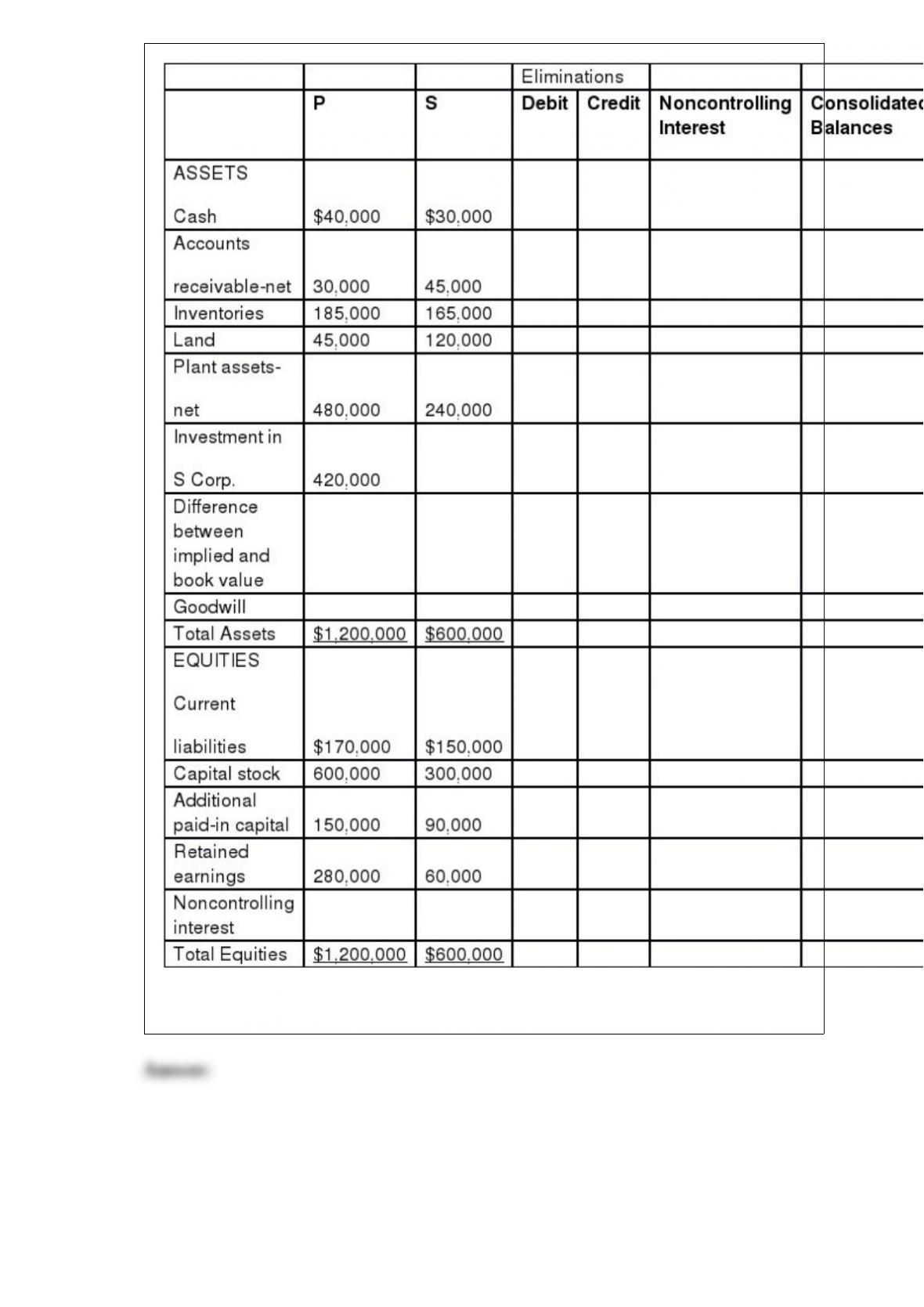
1) P Corporation paid $420,000 for 70% of S Corporations $10 par common stock on
December 31, 2013, when S Corporations stockholders equity was made up of
$300,000 of Common Stock, $90,000 of Other Contributed Capital and $60,000 of
Retained Earnings. Ss identifiable assets and liabilities reflected their fair values on
December 31, 2013, except for Ss inventory which was undervalued by $60,000 and
their land which was undervalued by $25,000. Balance sheets for P and S immediately
after the business combination are presented in the partially completed work-paper
below.
Required:
Complete the consolidated balance sheet workpaper for P Corporation and Subsidiary.
2) On December 1, 2013, Dorn Corporation agreed to purchase a machine to be
manufactured by a company in Brazil. The purchase price is 1,150,000 Brazilian reals.
To hedge against fluctuations in the exchange rate, Dorn entered into a forward contract
on December 1 to buy 1,150,000 reals on April 1, the agreed date of machine delivery,
for $0.375 per real. The following exchange rates were quoted:
Forward Rate
DateSpot Rate(Delivery on 4/1)
December 10.3900.375
December 310.3700.373
April 10.385–
Required:
Prepare journal entries necessary for Dorn during 2013 and 2014 to account for the
transactions described above.
3) SFAS No. 142 requires that goodwill impairment be tested annually for each
reporting unit. Discuss the necessary steps of the goodwill impairment test.
4) The two alternative views of consolidated financial statements are the parent
company concept and the economic entity concept. Briefly explain the differences
between the concepts.
5) What requirements must be satisfied if a foreign subsidiary is to be consolidated?
6) What is the essential procedural difference between workpaper eliminating entries
for unrealized intercompany profit made when the selling affiliate is a less than wholly
owned subsidiary and those made when the selling affiliate is the parent company or a
wholly owned subsidiary?
7) When a parent company that records its investment using the cost method during a
fiscal year sells a portion of its investment, explain the correct accounting for any
differences between selling price and recorded values.
8) Business combinations may be classified into three types based upon the
relationships among the combining entities (e.g., combinations with suppliers,
customers, competitors, etc.). Identify and define these types.
9) What effect would cumulative preferred stockhave on the allocation of a net loss to
the common stockholders?
10) What is the objective of the temporal method of translation?