
All of the following are examples of product-level costs except:
A. product inspection costs.
B. product advertising costs.
C. engineering design costs.
D. patent costs.
Howard Lumber Company mistakenly classified a product cost as an expense that
totaled $20,000. The company produced 2,000 units of product and sold 1,000 of them
during the year. Management is paid a bonus equal to 2% of net income. In the year in
which the mistake was made:
A. product costs were overstated.
B. management bonuses were underpaid.
C. the company’s income statement portrayed a more favorable position than actually
existed.
D. the company’s net income was overstated.
Horizontal analysis is also known as:
A. Liquidity analysis.
B. Trend analysis.

C. Revenue analysis.
D. Variance analysis.
Which of the following statements regarding unit-level activities is(are) true?
I. Unit-level activities occur each time a batch of units is produced.
II. Unit-level costs follow a variable cost behavior pattern.
III. Unit-level activities benefit the production as a whole and are not related to any
specific product.
A. I only
B. I and II
C. II and III
D. II only
Timberlake Company planned for a production and sales volume of 12,000 units.
However, the company actually makes and sells 13,000 units.
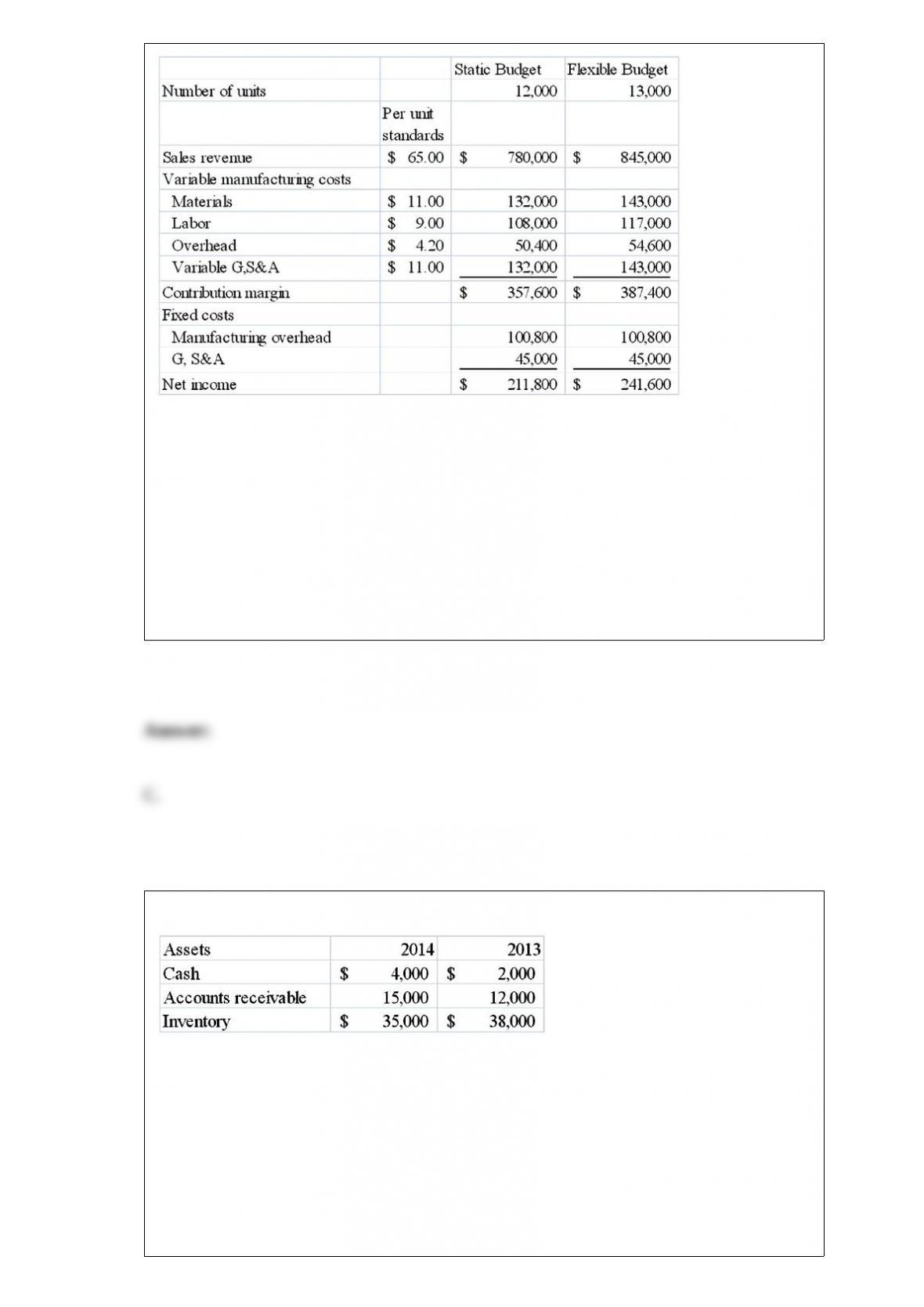
What was the total variable cost volume variance?
A. $29,800 unfavorable
B. $29,800 favorable
C. $35,200 unfavorable
D. $35,200 favorable
The following balance sheet information was provided by Western Company:
Assuming 2014 net credit sales totaled $270,000, what was the company’s average days
to collect receivables? (Use 365 days in a year. Do not round your intermediate
calculations.)
A. 18.25 days
B. 47.31 days

C. 16.22 days
D. 20.28 days
On January 1, 2014, Steigel Company had a balance of $720,000 in its land account.
During 2014, Steigel sold land that had cost $240,000 for $440,000 cash. The balance
in the land account on December 31, 2014, was $980,000.
Based on this information what is the net cash outflow from investing activities?
A. $60,000
B. $120,000
C. $200,000
D. $280,000
Select the incorrect statement regarding ratio analysis.
A. Ratio analysis is a specific form of horizontal analysis.
B. There are many different ratios available for evaluating a firm’s performance.
C. Some ratios involve an account from the balance sheet and one from the income
statement.
D. Ratio analysis involves making comparisons between different accounts in the same
set of financial statements.
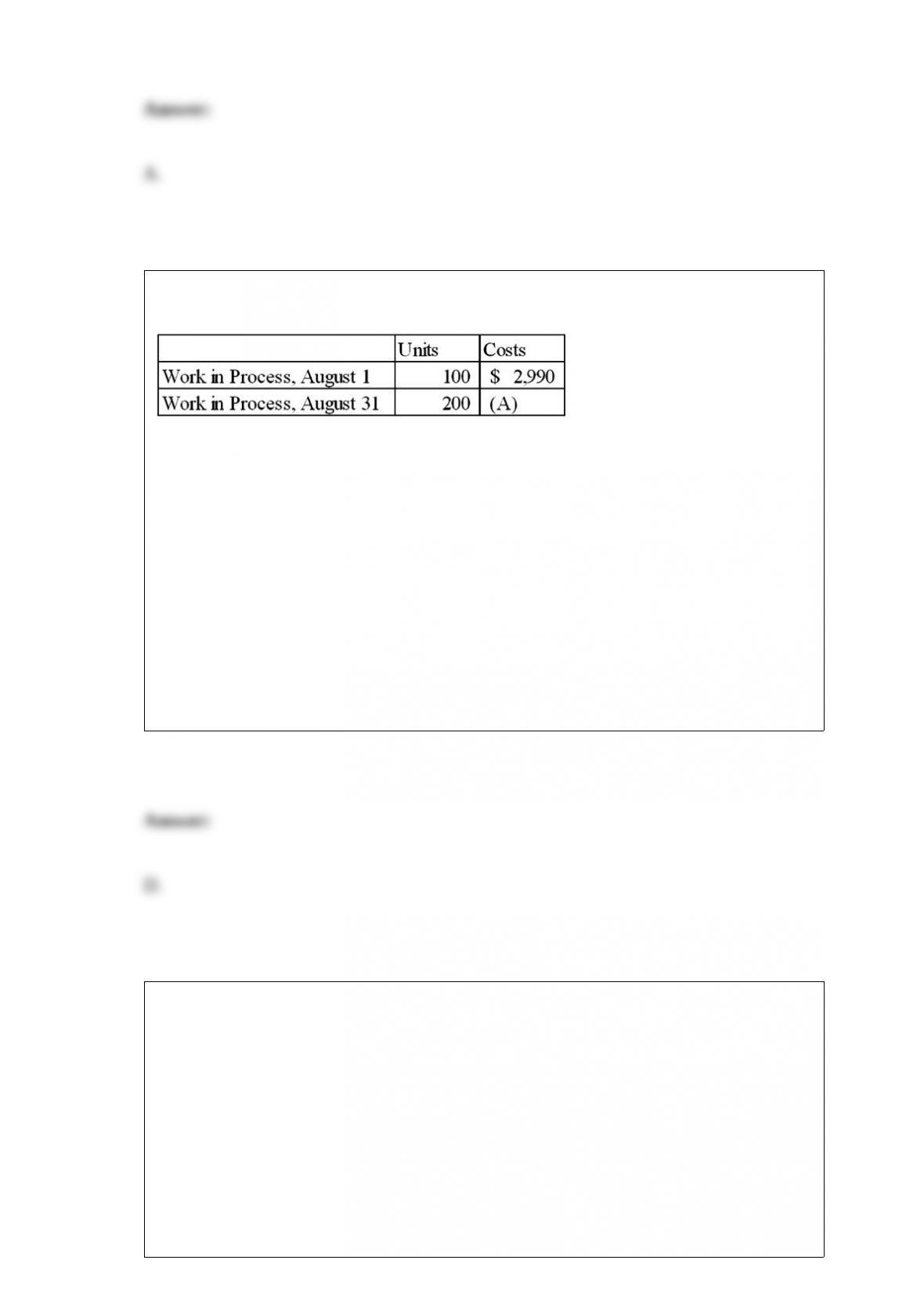
Cameron Company uses a process cost system to account for its production. The
following information was available for August:
During the month, 800 units were started into production, and $5,000 in costs were
incurred. Ending inventory was 50% complete. The cost of the units transferred out
would be (Do not round your intermediate calculations. Round your final answer to the
nearest dollar):
A. $6,392.
B. $5,000.
C. $5,085.
D. None of these.
For a product made by George Company, last year’s standards for labor were 2 hours at
$12 per hour. Which of the following considerations should George take into account in
setting the standards for this year?
A. George should revisit the prior year standards.
B. George should consider whether or not the prior year standards were achieved.
C. George should consider any changes that may influence worker productivity.
D. All of these answers are correct.

Style Monthly magazine reported $650,000 of revenue for the month. At the beginning
of the month, its unearned revenue account had a balance of $190,000. At the end of the
month, the account had a balance at $156,000. Based on this information, what is the
amount of cash received from revenue?
A. $460,000
B. $650,000
C. $684,000
D. $616,000
Select the false statement from the following.
A. Only direct costs are traced to cost objects.
B. The same cost may be assigned to more than one cost object.
C. General, selling, and administrative costs cannot be assigned to a cost object.
D. A given cost can be driven by more than one cost driver.
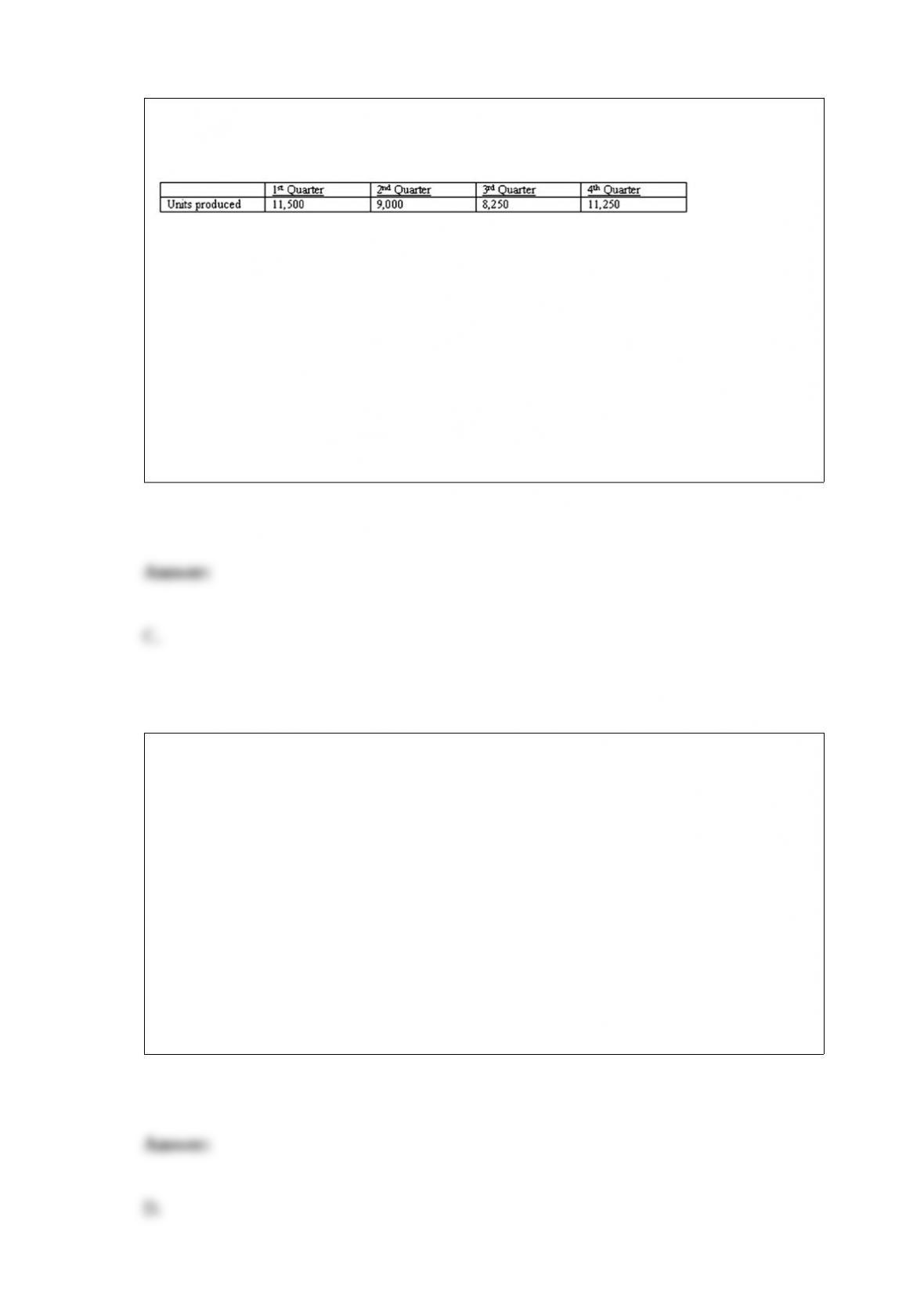
Michael & Co. expects overhead costs of $60,000 per month and direct production
costs of $24 per unit. The estimated production activity for the 2013 accounting period
is as follows:
The predetermined overhead rate based on units produced is (rounded to the nearest
penny) is:
A. $1.50 per unit.
B. $2.67 per unit.
C. $18.00 per unit.
D. $42.00 per unit.
Alex brought his lunch today but now a co-worker has asked him to go to the deli
across the street. Select the correct statement from the following.
A. The cost of the lunch Alex had brought is relevant to Alex’s decision to have lunch
with his friend.
B. The cost of the lunch that Alex had brought has nothing to do with his current
decision.
C. The cost to buy lunch at the deli is not relevant because it has not yet been incurred.
D. The cost of the lunch Alex already has represents the opportunity cost of dining with
his friend.
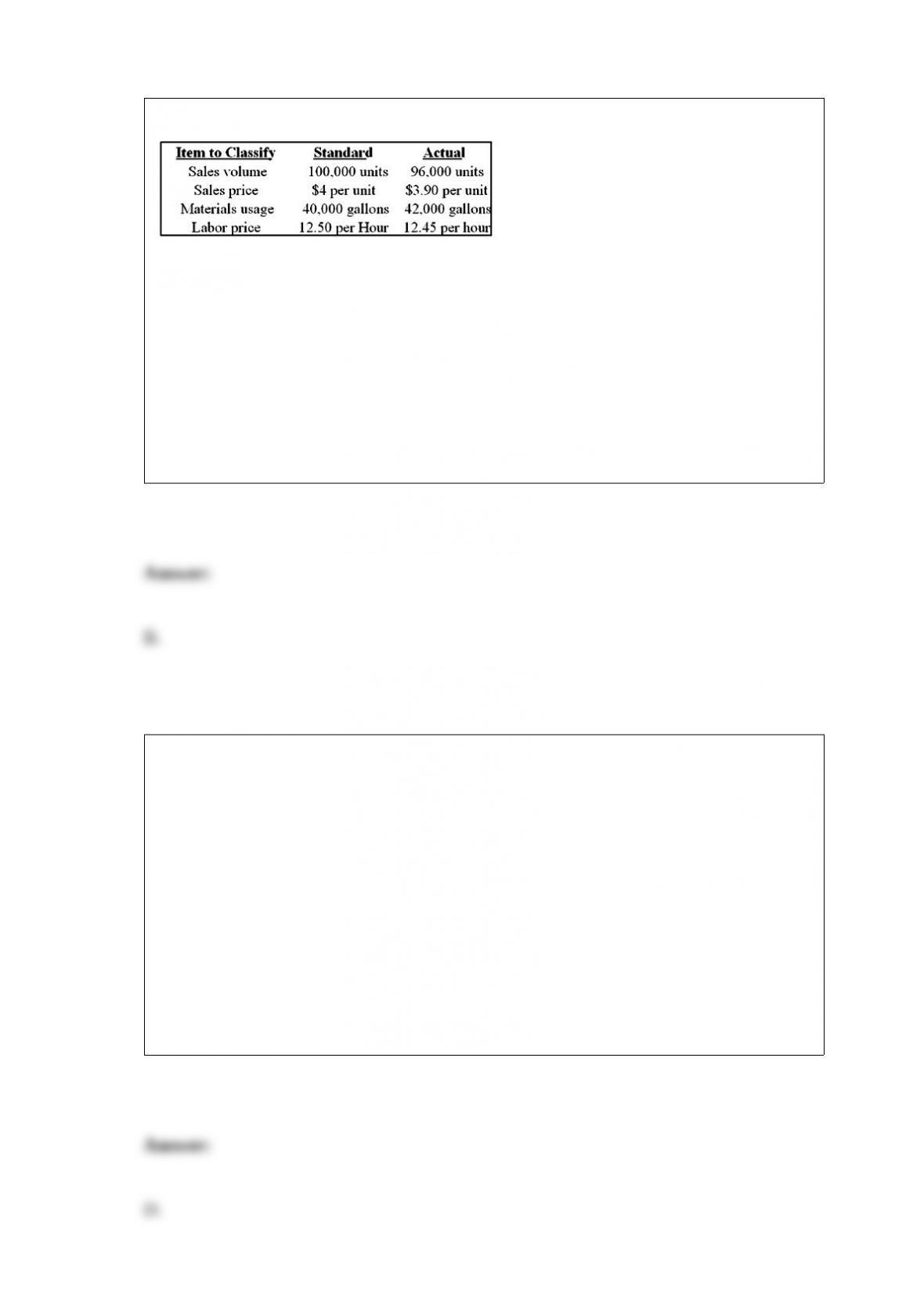
The sales volume variance was:
A. $25,600 favorable.
B. $25,600 unfavorable.
C. $25,000 unfavorable.
D. $25,000 favorable.
White Company budgeted for $200,000 of fixed overhead cost and volume of 40,000
units. During the year, the company produced and sold 39,000 units and spent $210,000
on fixed overhead.
The fixed overhead cost volume variance is:
A. $10,000 favorable.
B. $10,000 unfavorable.
C. $5,000 favorable.
D. $5,000 unfavorable.

Erie Company began the accounting period with $27,000 in accounts receivable. The
ending balance in accounts receivable was $10,000. If the credit sales during the period
were $44,000, what is the amount of cash received from customers?
A. $27,000
B. $44,000
C. $81,000
D. $61,000
Which of the following is a benefit associated with budgeting?
A. Promotes planning and coordination
B. The ability to take corrective action to improve performance
C. Enhances performance measurement
D. All of these answers are correct
The purposes of the postaudit for capital investments include all of the following
except:
A. continuous improvement.

B. rewarding managers for increasing idle cash.
C. determining whether the project generated the results expected.
D. encouraging managers to closely scrutinize capital investment decisions.
Which of the following statements is correct?
A. Establishing standards is the least difficult aspect of using a standard cost system.
B. Managers should be praised or punished based on variances.
C. A favorable variance may indicate the existence of unfavorable conditions.
D. Budget slack exists when performance standards are set at an ideal, unachievable
level.
In vertical analysis, each item is expressed as a percentage of:
A. Total expenses on the income statement.
B. Net income on the income statement.
C. Sales on the income statement.
D. None of these answers is correct.
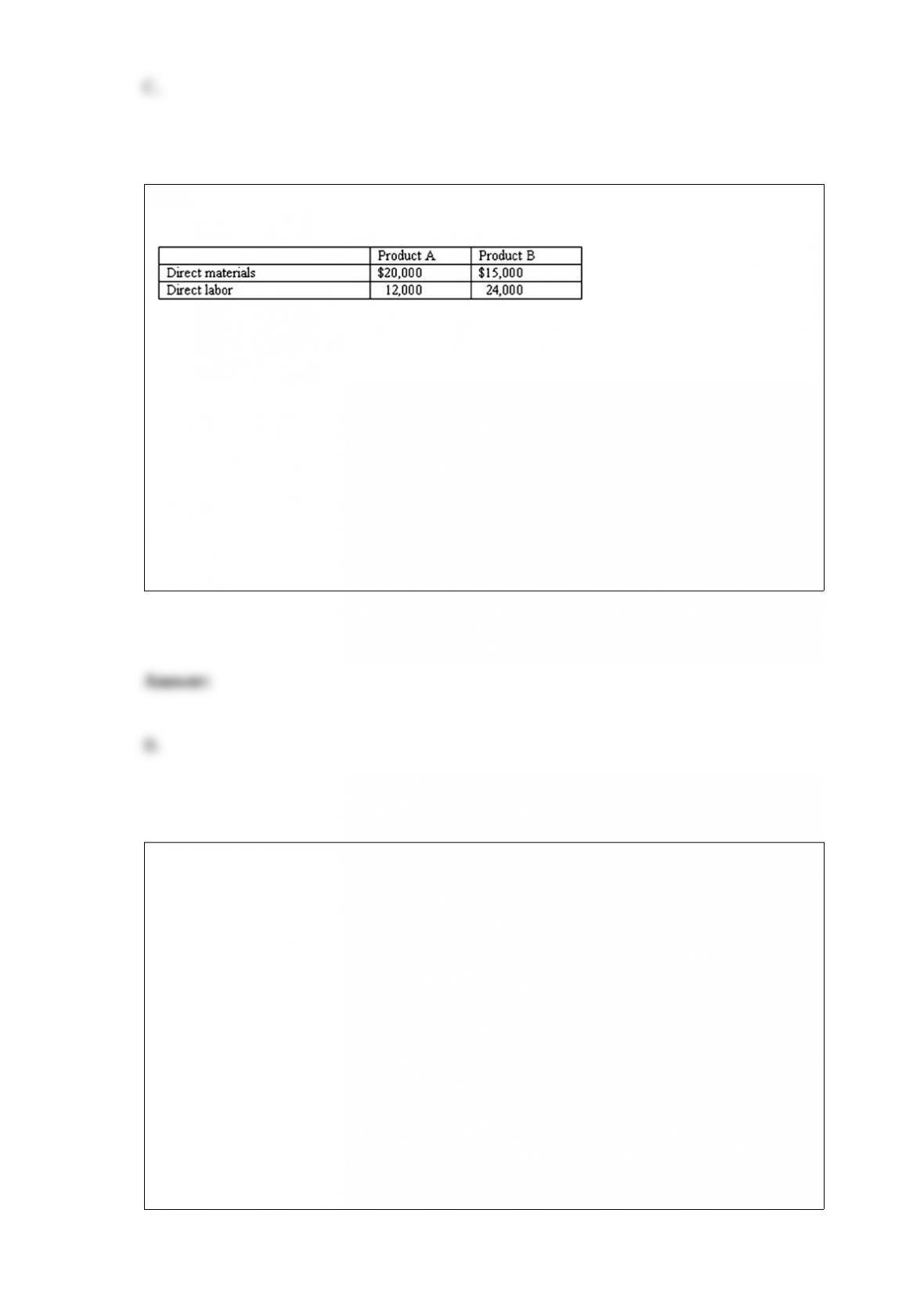
Sheddon Industries produces two products. The products’ identified costs are as
follows:
The company’s overhead costs of $108,000 are allocated based on direct labor cost.
Assume 4,000 units of product A and 5,000 units of Product B are produced. What is
the cost per unit for product B? (Do not round your intermediate calculations.)
A. $7.80
B. $22.20
C. $16.80
D. None of these answers is correct.
During its first year of operations, Silverman Company paid $14,000 for direct
materials and $19,000 for production workers’ wages. Lease payments and utilities on
the production facilities amounted to $17,000 while general, selling, and administrative
expenses totaled $8,000. The company produced 5,000 units and sold 3,000 units at a
price of $15.00 a unit.
What is the amount of finished goods inventory on the balance sheet at year-end?
A. $10,000
B. $20,000
C. $4,000
D. $15,000
Why would a company often calculate and use average costs of its products and
services rather than actual costs?
What are the assumptions on which cost-volume-profit analysis is based? Are there any
additional assumptions for a multiproduct company?
Indicate whether each of the following statements is true or false.
Wages paid to production workers are classified as Wages Expense.
Wages paid to production workers represent an asset exchange transaction.
Supplies used in production are considered an indirect input and accounted for as part
of manufacturing overhead.
Raw materials are indirect inputs to the production process.
The payment of wages to production workers is classified on the statement of cash
flows as an operating activity.
Indicate whether each of the following statements is true or false.
Estimated cost data must often be used in making decisions because actual cost
information is not yet available.
Managers often accumulate both estimated and actual cost data for the same cost object.
A direct cost must be allocated to a cost object.
For a department in a retail store, cost of goods sold is a direct cost.
Determining whether a cost is direct or indirect depends on the selection of cost object.
Indicate whether each of the following statements is true or false.
A capital investment is a purchase of a long-term operational asset.
Investments in capital assets normally are recovered by selling the assets.
The profitability of a business is greatly influenced by the quality of its capital
investment decisions.
A capital investment decision exchanges current cash inflows for future cash outflows.
The time value of money concept is often used in making capital investment decisions.
How can a manager’s time horizon affect his/her decision making?
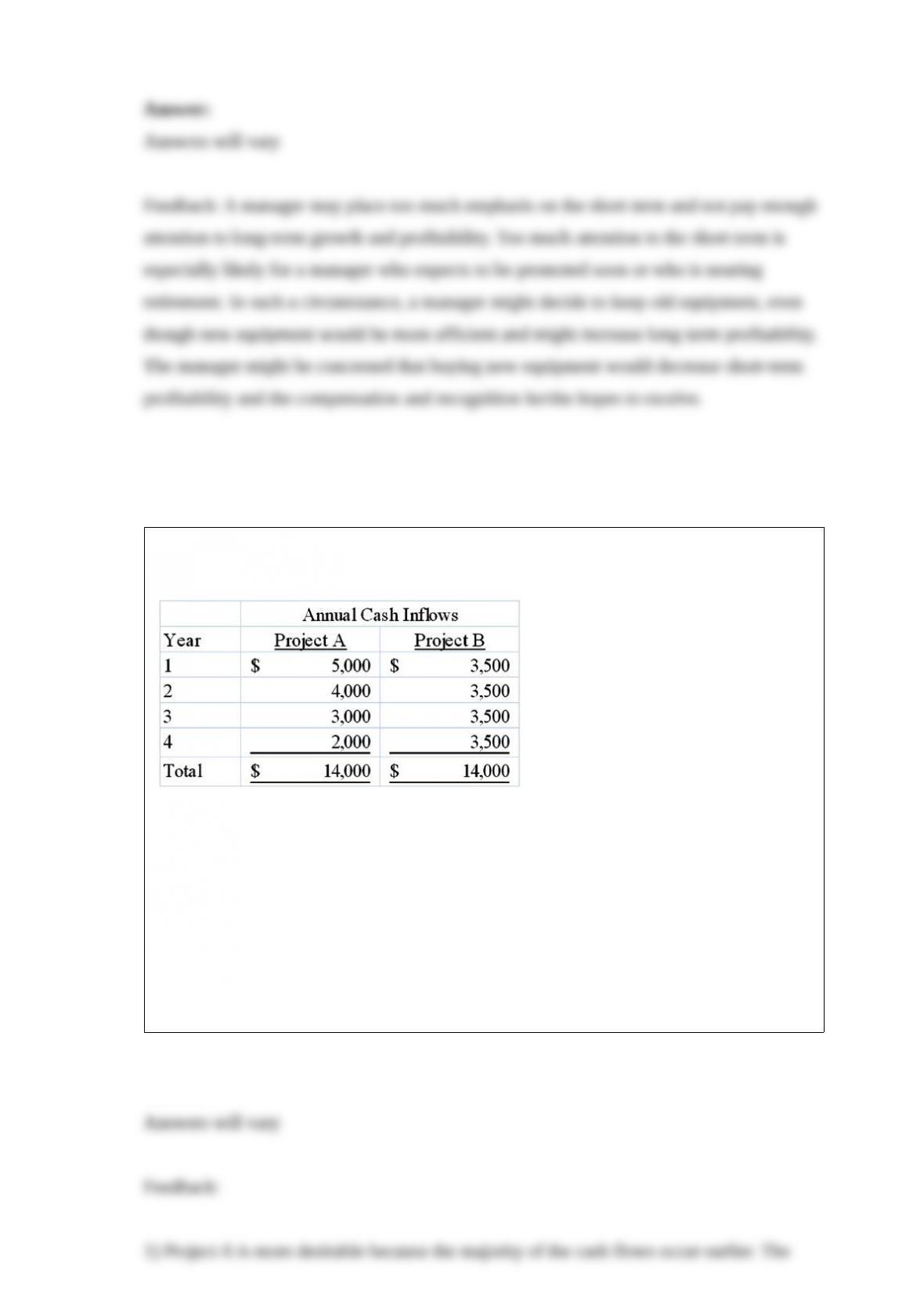
Chichester Company is considering investing in the following two mutually exclusive
projects:
Required:
1) Which project is more desirable strictly in terms of cash inflows? Why?
2) Compute the present value of each project’s cash inflows assuming the company’s
required rate of return is 10%.
3) What is the maximum amount Chichester should be willing to pay for each project?
4) Suppose each project costs $10,000. Which project(s) should be accepted?
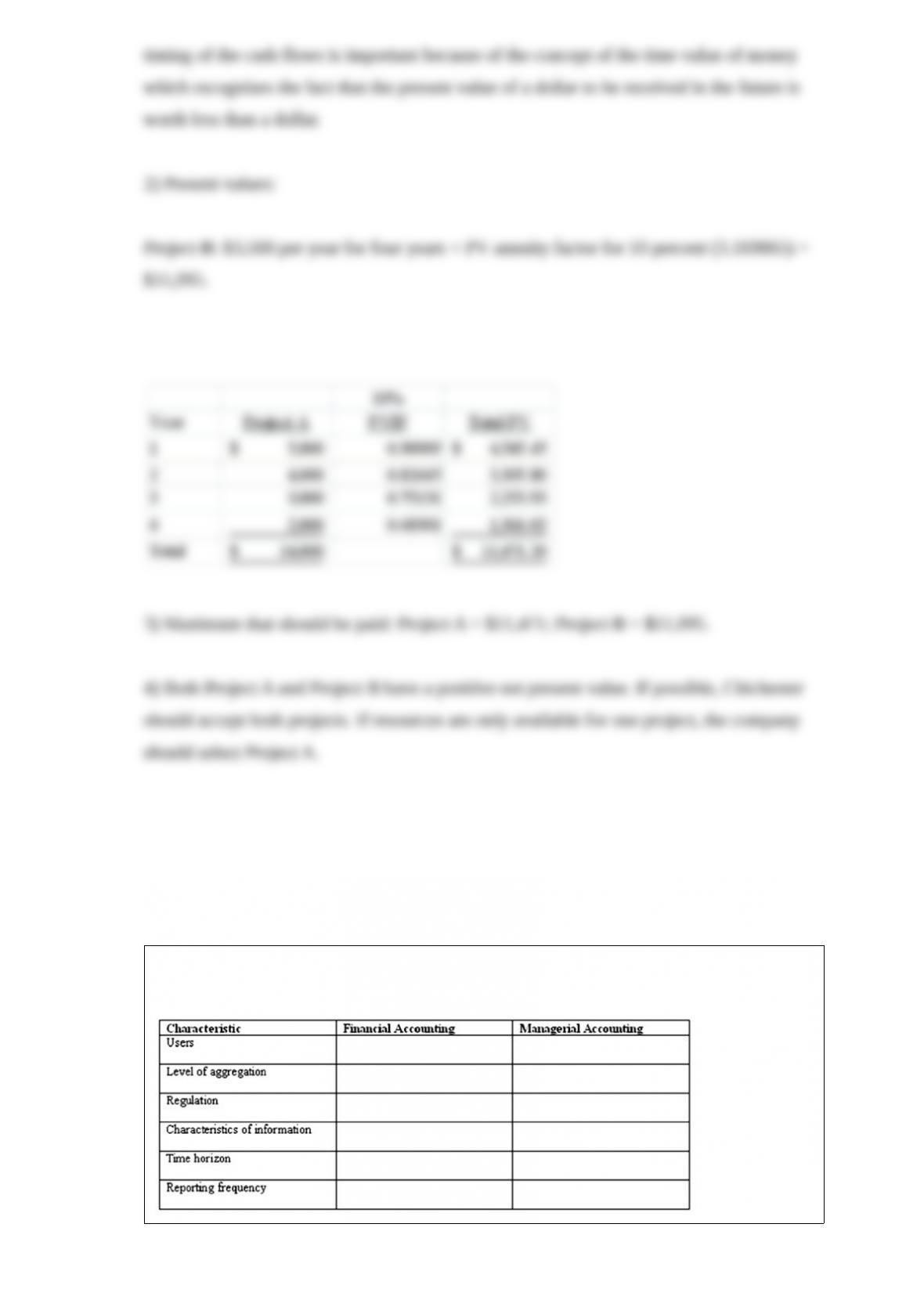
Complete the following table to compare and contrast financial and managerial
accounting.
Vance Electronics expects to make 100,000 Bluetooth speakers during 2014. Direct
materials cost per unit are estimated at $12, and direct labor cost is expected to be $4
per unit. The total manufacturing overhead for the year is budgeted at $850,000.
Required:
1) Calculate the amount of overhead that should be allocated to each speaker during the
year.
2) Assume that, during the month of October, Vance made and sold 8,000 speakers.
What would the cost of goods sold be for the month?
3) Assume that the company sells the speakers at cost plus 40% of cost. What would be
the selling price for each speaker?