
Assume that the audit team wishes to determine the extent to which a particular control
policy was functioning as intended. Identifying applications of the control throughout
the period under audit would be most closely related to which of the following steps in
sampling?
A. Determining the objective of sampling
B. Defining the characteristic of interest
C. Defining the population
D. Determining the sample size
The firm of Banta, Brown, and Burgess, CPAs, requires that audit documentation
contain the initials of the preparer and the reviewer in the top right-hand corner. This
procedure provides evidence of professional concern regarding which generally
accepted auditing standard?
A. Independence
B. Adequate technical competence and capabilities
C. Adequate planning and supervision
D. Gathering sufficient competent evidence
If a golf professional is interested in determining whether a golf ball can be hit over 300
yards, which of the following relationships between the adjusted sample estimate of
distance and the actual distance would represent sampling risk?

A. Adjusted Estimate = 295 yards, Actual = 298 yards.
B. Adjusted Estimate = 305 yards, Actual = 301 yards.
C. Adjusted Estimate = 310 yards, Actual = 295 yards.
D. All of the above are examples of sampling risk
Which of the following auditing procedures most likely would assist auditors in
identifying conditions and events that may indicate substantial doubt about an entity’s
ability to continue as a going concern?
A. Inspecting title documents to verify whether any assets are pledged as collateral
B. Confirming with third parties the details of arrangements to maintain financial
support
C. Reconciling the client’s cash balance with the cut-off bank statement and the bank
confirmation
D. Comparing the entity’s depreciation and asset capitalization policies to other entities
in the industry
This year, Blakeney Enterprises engaged a new auditor who must
A. attempt to communicate with the predecessor auditor before accepting the
engagement.
B. review the predecessor’s audit documentation if the audit is to be in accordance with
GAAS.

C. seek the SEC’s permission to accept the engagement if Blakeney is publicly owned.
D. reject the engagement if the change in auditors resulted from a dispute with the
predecessor.
Which of the following is not part of the definition of proportionate liability adopted by
the Private Securities Litigation Reform Act?
A. The total responsibility for loss is divided among all parties responsible for the loss.
B. Defendants who knowingly committed a violation of securities laws remain jointly
and severally liable.
C. The full amount of damages may be recovered from any defendants involved in the
action.
D. A solvent defendant’s liability may be increased by 50 percent if other defendants are
insolvent.
If the date of an entity’s financial statements is December 31, the date of the auditor’s
report is February 20, and the audit report release date is February 22, which of the
following is considered a subsequent event?
A. A significant acquisition that was announced on February 1 and will be finalized on
October 1.
B. A court settlement on March 3 related to a case that was pending on December 31.
C. Losses from the devaluation of a foreign currency that became finalized on February

21.
D. The entity’s announcement of a major restructuring plan on December 30 that will be
implemented during the upcoming year.
An auditor noted that client sales had increased 10 percent for the year. At the same
time, cost of goods sold as a percentage of sales had decreased from 45 percent to 40
percent and year-end accounts receivable had increased by 8 percent. The auditor is
most likely concerned about
A. unrecorded costs.
B. improper credit approvals.
C. improper sales cut-off.
D. fictitious sales.
For which of the following audit tests would an auditor most likely use attributes
sampling?
A. Inspecting purchase orders for proper approval by supervisors
B. Making an independent estimate of recorded payroll expense
C. Determining that all payables are recorded at year end
D. Selecting accounts receivable for confirmation of account balances
An auditor vouched data for a sample of employees in a payroll register to approved
clock card data to provide assurance that
A. payments to employees are computed at authorized rates.
B. employees work the number of hours for which they are paid.
C. separation of duties exists between the preparation and distribution of the payroll.
D. internal controls relating to unclaimed payroll checks are operating effectively.
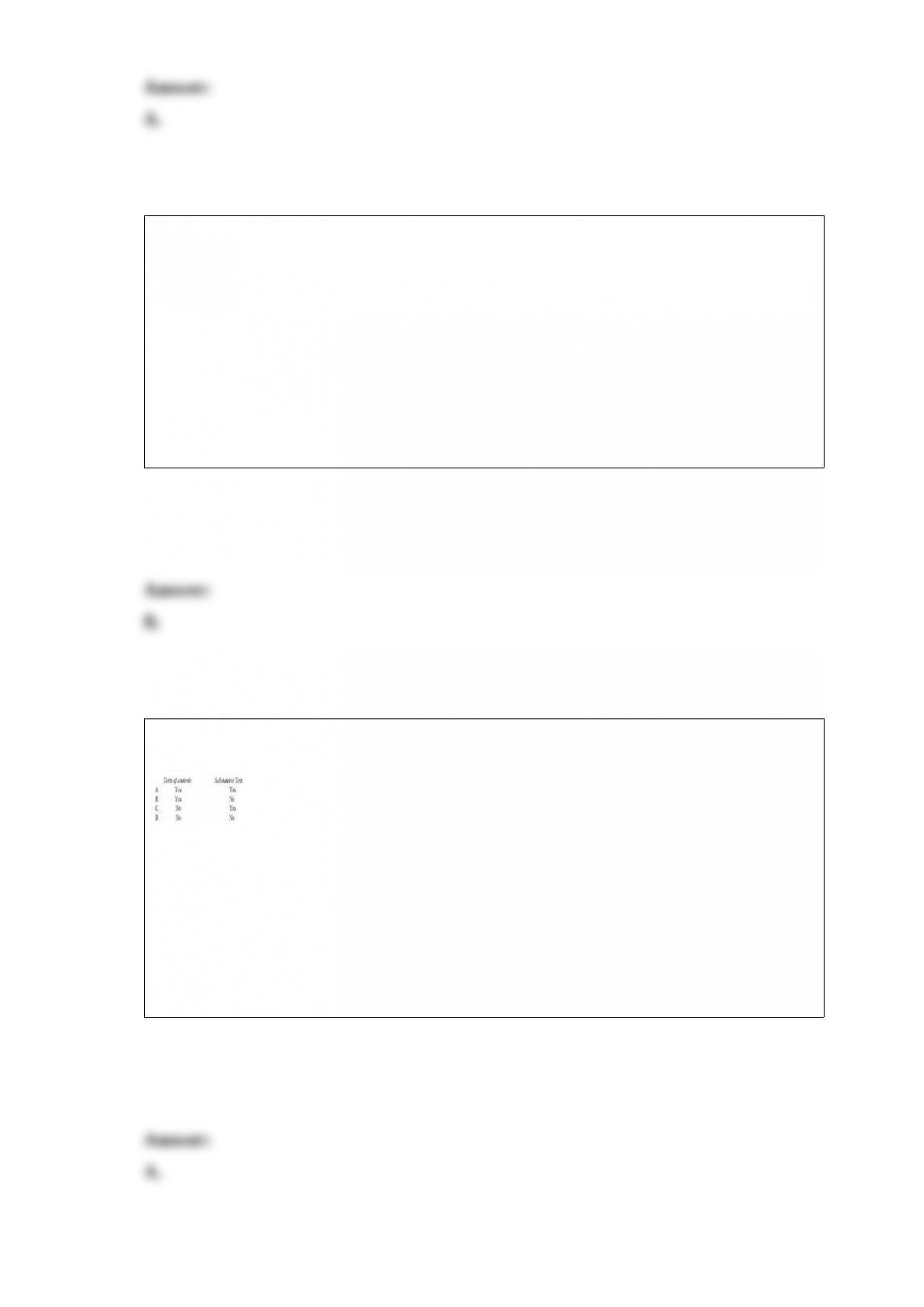
During a financial statement audit an internal auditor may provide direct assistance to
the independent CPA in performing.
A. Option A
B. Option B
C. Option C
D. Option D

To whom should written representations be addressed?
A. Auditors
B. Board of directors
C. Client
D. Stockholders
Compiled financial statements of a nonpublic entity should be accompanied by a report
stating that
A. the scope of the accountant’s procedures has not been restricted in testing the
financial information that is the representation of management.
B. the accountant assessed the accounting principles used and significant estimates
made by management.
C. the accountant does not express an opinion or any other form of assurance on the
financial statements.
D. a compilation consists primarily of inquiries of entity personnel and analytical
procedures applied to financial data.
Third-party plaintiffs bringing action under common law need not prove
A. they were damaged or suffered an economic loss.
B. reliance on the financial statements.

C. the financial statements were direct cause of loss.
D. breach of contract.
Which of the following statements best describes the impact on an audit when a client
uses computerized processing of transactions?
A. The objective of the audit examination focuses on detection of fraud and theft
through the computer.
B. The type of substantive procedures performed by the audit team change because of
the use of computerized processing.
C. The effectiveness of computer controls implemented by the client over its
computerized processing may need to be evaluated by audit teams.
D. Different independence standards are introduced for audit teams when clients utilize
computerized processing.
Which of the following client control activities is not usually performed in the vouchers
payable (accounts payable) department?
A. Determining the mathematical accuracy of the vendors’ invoices.
B. Writing checks for the treasurer’s signature to take advantage of purchase discounts.
C. Controlling the mailing of the check and remittance advice.
D. Checking the prices on the vendor’s invoice.

Samantha, CPA decided to stratify the population in her statistical sampling plan.
Which of the following is the most likely reason she used this approach?
A. It eliminates the need for random selection.
B. The population is relatively homogenous in terms of the dollar amount of
components or transactions.
C. It reduces her expected sample size.
D. It eliminates the need for calculating the projected misstatement in the account being
examined.
Which of the following would not be included in the supporting documents for a
voucher?
A. Purchase order.
B. Vendor invoice.
C. Receiving report.
D. Blank check.

The acceptable level of detection risk is inversely related to the
A. assurance provided by substantive tests.
B. risk of misapplying audit procedures.
C. preliminary judgment about materiality levels.
D. risk of failing to discover material misstatements.
Which of the following sampling activities is not performed during the planning stage
of the audit?
A. Define the population.
B. Determine the sample size.
C. Determine the objective of sampling.
D. Define the characteristic of interest.
Nonsampling risk can occur in which of the following types of sampling plans?
A. Statistical sampling: Yes; Nonstatistical sampling: Yes
B. Statistical sampling: Yes; Nonstatistical sampling: No

C. Statistical sampling: No; Nonstatistical sampling: Yes
D. Statistical sampling: No; Nonstatistical sampling: No
In which of the following circumstances would auditors be most likely to express an
adverse opinion?
A. The chief executive officer refuses to provide the auditors access to minutes of board
of directors’ meetings.
B. Tests of controls show that the entity’s internal control is so ineffective that it cannot
be relied upon.
C. The financial statements are not in accordance with generally accepted accounting
principles regarding the capitalization of leases.
D. Information comes to the auditors’ attention that raises substantial doubt about the
entity’s ability to continue as a going concern.
Management fraud generally refers to
A. unintentional mistakes.
B. noncompliance.
C. intentional distortions of financial statements.
D. violations of GAAS.

The auditing standards of the Institute of Internal Auditors required internal auditors to
follow the ethics standards established by the AICPA.
Which of the following set of conditions would provide the auditor with the smallest
sample size under monetary unit sampling (RIA = risk of incorrect acceptance, EM =
expected misstatement, TM = tolerable misstatement, PS = population size)?
A. RIA = 5%, EM = $7,500, TM = $15,000, PS = $150,000
B. RIA = 5%, EM = $5,000, TM = $10,000, PS = $200,000
C. RIA = 5%, EM = $2,000, TM = $10,000, PS = $100,000
D. RIA = 5%, EM = $7,500, TM = $15,000, PS = $300,000
When examining the client’s internal control, what is the relationship of each of the
following with sample size?
A. Option A

B. Option B
C. Option C
D. Option D
Selecting a sample of notes payable transactions and vouching payments to canceled
checks is a test of the ASB balance assertion of
A. accuracy.
B. completeness.
C. existence.
D. presentation.
AR 90 requires adequate documentation for a review engagement. Which items are
required to be documented?
A. Analytical procedures: Yes; Management representations: No; Understanding of
internal controls: No
B. Analytical procedures: No; Management representations: Yes; Understanding of
internal controls: No
C. Analytical procedures: Yes; Management representations: Yes; Understanding of
internal controls: No

D. Analytical procedures: Yes; Management representations: Yes; Understanding of
internal controls: Yes
Which of the following most closely represents an unrestricted random selection
procedure?
A. Identifying a starting point within the population and bypassing a fixed number of
items
B. Matching items in the population to a series of randomly-selected numbers
C. Randomly selecting invoices to customers whose last names start with “W”
D. Randomly picking items from an accounts receivable file
Having an audit charter is important for internal audit departments. Which of the
following items is generally not a reason to have an audit charter?
A. It provides a commitment from management to support the internal audit
department’s activities.
B. It defines the skills and competencies required by the internal audit department.
C. It defines the department’s authority and responsibility.
D. It defines the reporting requirements for internal audit departments.
Which of the following would normally be considered earliest in the audit examination?
A. Determination of materiality levels for use during the audit
B. Consideration of the ability of the entity’s internal control to prevent or detect errors
C. Preparation of a written audit plan
D. Evaluation of the type of audit opinion to be issued, based on the auditor’s findings
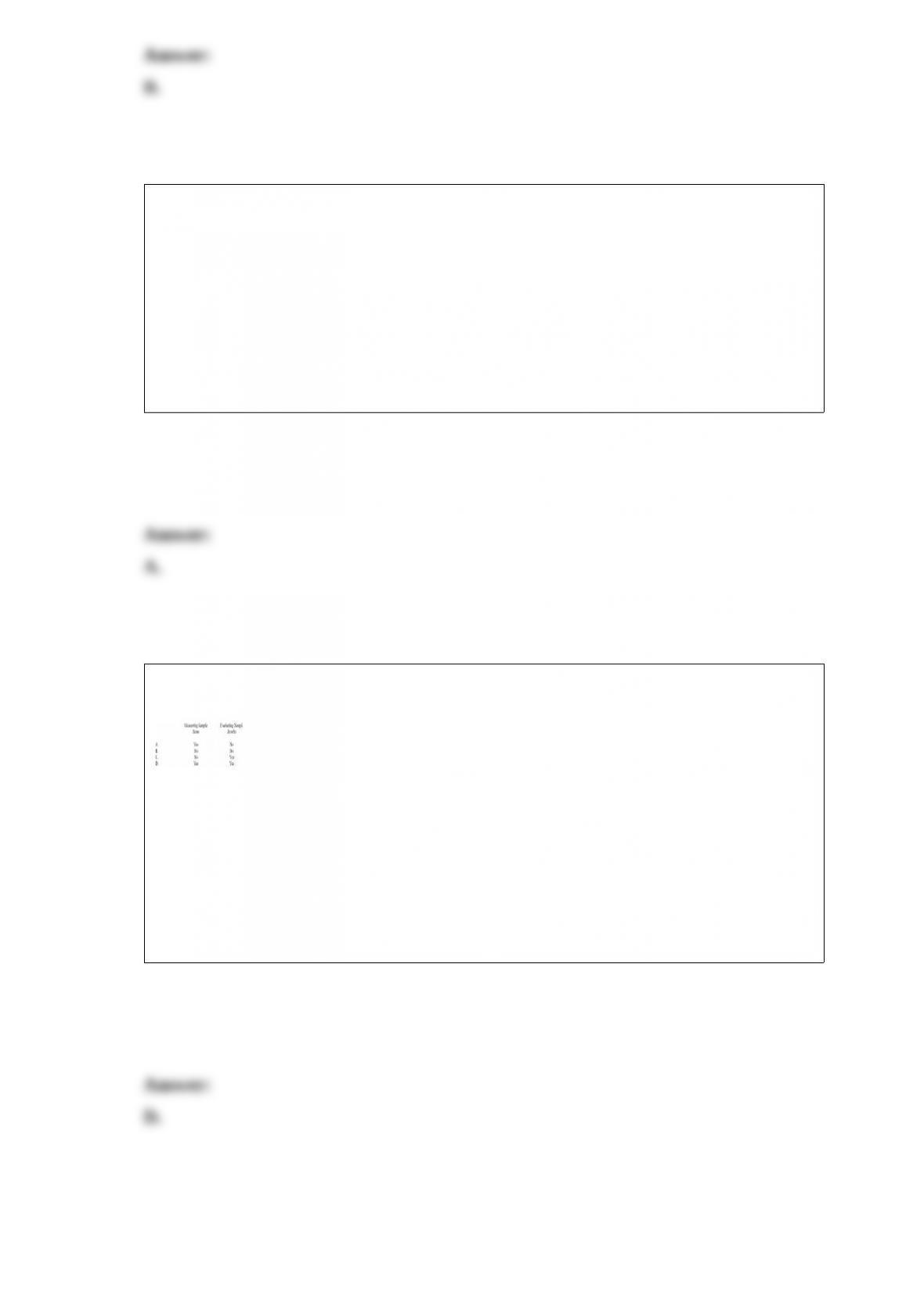
Documentation is required during which of the following stages of the sampling
process?
A. Option A
B. Option B
C. Option C
D. Option D