
Which statement is true in an activity-based costing environment?
A.Managers do not need to know product costs.
B.Companies use departmental overhead rates.
C.Companies compute the rate for each cost driver in each activity center.
D.Companies compute the rate for up to three cost drivers in each activity center.
When measuring a division’s operating costs, indirect controllable operating costs
include
A.labor used in the division’s production.
B.salary of the division manager (controlled by top management)
C.costs of providing centralized services, such as data processing and employee
training.
D.company president’s salary.
The method of cost estimation which studies the physical relation between the
quantities of inputs and output is known as:
A.regression.
B.account analysis.
C.engineering methods.

D.All of the answers are correct.
The critical success factor(s) that relate to meeting customer requirements do not
include
A.service.
B.quality.
C.quantity.
D.cost.
What recent management innovation is the continuous process of measuring one’s own
products, services, and activities against the best levels of performance inside one’s own
organization or in other organizations?
A.Benchmarking
B.Total quality management
C.Theory of constraints
D.Strategic cost analysis
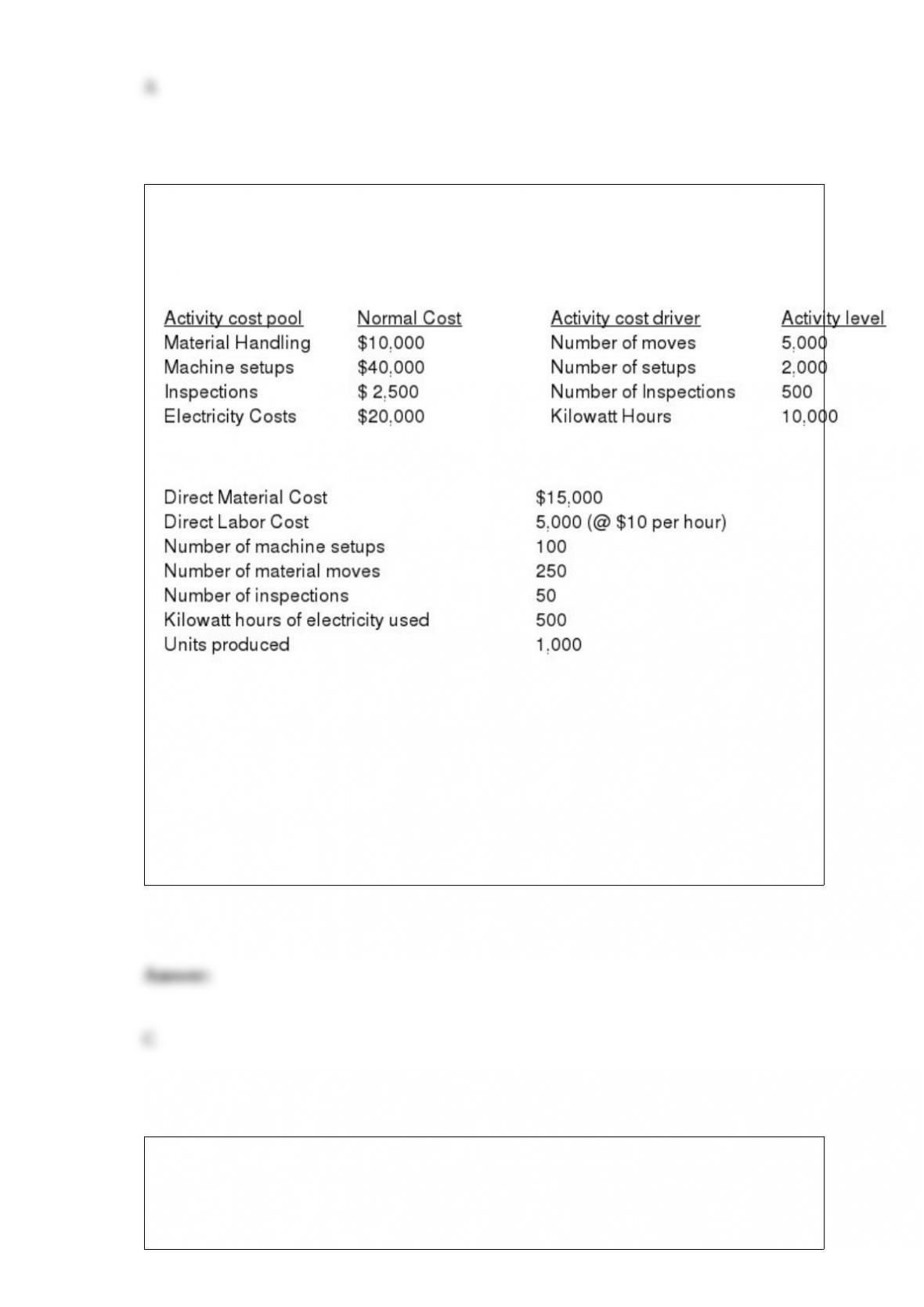
Marshall Manufacturing Co.
Marshall Manufacturing Co. uses an activity-based costing system. The company has
gathered the following information concerning various cost pools and activity drivers;
The following data was collected and is specific to Item No. 824.
Refer to Marshall Manufacturing Co. What is the cost of one unit of item 824?
A.$ 3.75
B.$116.25
C.$ 23.75
D.None of the above
The products that result from processing a common input in the forest products, oil and
gas, chemicals and mining industries are called
A.natural products.

B.common products.
C.joint products.
D.environmentally-sound products.
A comprehensive master budget does not include individual schedules for which of the
following budgets?
A.materials purchase budget.
B.capital budget.
C.work-in-process budget.
D.cash outlays budget.
Which of the following are steps needed for using the net present value method for
making long-term decisions using discounted cash flows?
A.estimate the amounts of future cash inflows and future cash outflows in each period
for each alternative under consideration.
B.discount the future cash flows to the present using the project’s discount rate.
C.accept or reject the proposed project, or select one from a set of mutually exclusive
projects.
D.all of the above.

Which of the following statements is true?
A.In the long run the price of a product must cover its costs or the organization will no
longer make the product.
B.In the long run the price of a product must cover its sunk costs or the organization
will no longer make the product.
C.In the long run the price of a product must cover its internal failure costs or the
organization will no longer make the product.
D.In the long run the price of a product must cover its external failure costs or the
organization will no longer make the product.
Which of the following statements is true concerning activity-based costing (ABC)?
A.ABC can distort product costs.
B.ABC fails to recognize that the demand for overhead activities is driven by
product-sustaining activities.
C.ABC permits management to focus on the increased efficiencies and better resource
utilization.
D.ABC first assigns costs to products, then to cost pools.

Most managerial decision models require which costing method?
A.standard costing unit cost data.
B.variable costing unit cost data.
C.full-absorption costing unit cost data.
D.normal costing unit cost data.
Which of the following is not a step accountants must follow in activity-based costing?
A.Identify the activities that consume resources and assign costs to them.
B.Identify the cost drivers associated with each activity.
C.Compute a cost rate per cost driver.
D.Compute the variance between the estimated cost driver and the actual cost driver.
The value chain ends with which of the following?
A.production.
B.marketing.

C.distribution.
D.customer service.
Which of the following defines Economic value added (EVA)?
A.annual after-tax operating profit minus the total annual cost of capital.
B.annual before-tax operating profit minus the total annual cost of capital.
C.annual after-tax operating profit plus the total annual cost of capital.
D.annual before-tax operating profit plus the total annual cost of capital.
Effective incentive compensation plans must induce individual behavior compatible
with increasing the firm’s wealth. Why are special awards given?
A.to improve short-term performance.
B.as a long-term incentive.
C.for particular actions or extraordinary performance.
D.None of the answers is correct.

All of the following are key developments that have helped reshape the discipline of
managerial accounting except:
A.the convergence of U.S. GAAP with IFRS
B.global strategies
C.total quality management
D.integrated information systems
Response time improvements often drive simultaneous improvements in
A.economy and efficiency.
B.economy and effectiveness.
C.quality and productivity.
D.quantity and efficiency.