
Two ratios that provide insight on the relationship between credit sales and receivables
are:
A. Current ratio and inventory turnover ratio.
B. Accounts receivable turnover and average days to collect receivables.
C. Average days to collect receivables and asset turnover.
D. Accounts receivable turnover and current ratio.
Select the incorrect statement regarding the cost of production report.
A. The report consists of two sections, a units section and a costs section.
B. The report is produced monthly by job or batch.
C. The cost inputs on the report come from the work in process account.
D. The report indicates the cost of units transferred out.
Outdoor Living Company has just received a special order for 500 hammocks. Outdoor
Living has sufficient idle capacity to accept the order. Accepting the order will increase
Outdoor Living’s variable manufacturing costs. Which type of cost is considered a sunk
cost to Outdoor Living’s decision of whether to accept or reject the special order?
A. Raw materials to make the 500 hammocks
B. Labor cost to make the 500 hammocks

C. Depreciation on equipment that would be used to make the hammocks
D. Materials handling cost
Select the incorrect statement concerning opportunity costs.
A. Opportunity costs are relevant costs.
B. Opportunity costs are cumulative.
C. Opportunity costs are future oriented.
D. Opportunity costs are not recorded in the books.
When would a cost variance be listed as unfavorable?
A. When actual costs are less than budgeted costs
B. When actual costs exceed budgeted costs
C. When actual costs are equal to budgeted costs
D. When actual sales are less than budgeted sales

Virginia Company paid $7,500 cash for various manufacturing overhead costs. As a
result of this transaction:
A. total assets increase.
B. total assets, total equity, and net income are not affected.
C. total assets, total equity, and net income decrease.
D. none of these.
Which of the following is not an assumption made when performing cost-volume-profit
analysis?
A. Number of units produced is greater than the number of units sold.
B. Worker efficiency is held constant.
C. The company produces within the relevant range of activity.
D. There is a linear relationship between cost and volume for both fixed and variable
cost.
You are considering an investment in IBM stock and wish to assess the firm’s long-term
debt-paying ability and its use of debt financing. All of the following ratios can be used
to assess solvency except:

A. Number of times interest is earned.
B. Debt to assets ratio.
C. Debt to equity ratio.
D. Net margin.
Harris Company produces a product whose cost is $10. Assuming the company uses a
cost-plus pricing system, what selling price would the company set to earn a profit
margin of 20% of cost?
A. $2.00
B. $12.50
C. $50.00
D. $12.00
The 2014 income statement of Winter Co. reported wages expense of $160,000. The
December 31, 2013 balance sheet showed a balance in wages payable of $16,000 while
the December 31, 2014 balance sheet showed a balance in wages payable of $22,000.
What amount of cash was paid for wages in 2014?
A. $176,000
B. $166,000
C. $154,000
D. $144,000
Chesterfield Corporation has been operating well above its break-even point. What will
happen to Chesterfield’s margin of safety if the variable cost per unit increases?
A. The break-even point would decrease, and the margin of safety would decrease.
B. The break-even point would decrease, and the margin of safety would increase.
C. The break-even point would increase, and the margin of safety would decrease.
D. The break-even point would increase, and the margin of safety would increase.
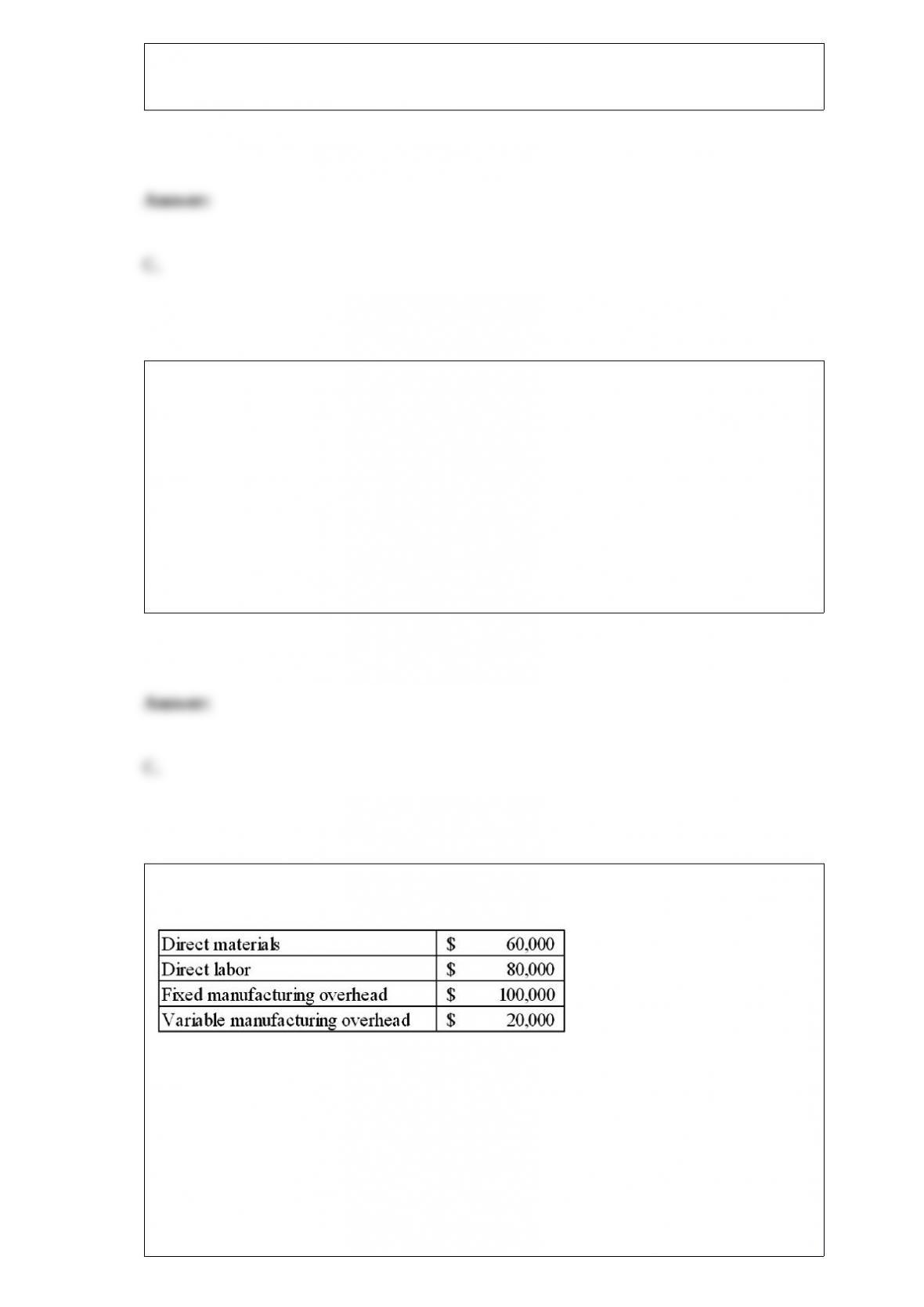
The accounting records for Grant Manufacturing Company disclosed the following cost
information for 2014:
Assume the company produced 10,000 units of inventory, sold 6,000 of these units in
2014 for $192,000, and that there was no beginning inventory. Under variable costing,
the contribution margin for the year would be:
A. $100,000.
B. $40,000.

C. $32,000.
D. none of these.
One of the tasks that managers at Omaha Company have to complete during the
budgeting process is to develop a contingency plan for their organization in case a
downturn occurs in their business. This budgeting requirement is an example of:
A. performance measurement.
B. planning.
C. budget coordination.
D. taking corrective action.
When would a sales price variance be listed as unfavorable?
A. When the actual sales price is less than the standard sales price.
B. When the actual sales price is equal to the standard sales price.
C. When the actual sales price is greater than the standard sales price.
D. When the actual sales volume is less than the budgeted sales volume.

Benitez Company makes wicker and wooden slat picnic baskets. It requires
approximately 1 hour of labor to make one basket of either type. Wicker baskets are
produced in batches of 100 units and require 0.5 machine hours per basket. Wooden slat
baskets are produced in batches of 50 units and require 0.75 machine hours per basket.
Setup is required for each batch. During the most recent accounting period, the
company made 8,000 wicker baskets and 2,000 wooden slat baskets. Setup costs
amounted to $24,000 for the baskets produced during the period. If activity-based
costing is used to allocate overhead costs to the two products, the amount of setup cost
assigned to the wicker baskets will be:
A. $17,455.
B. $19,200.
C. $12,000.
D. $16,000.
Breezy Company is disposing of equipment that was originally purchased for $600,000
and has $240,000 of accumulated depreciation to date. The same equipment would cost
$800,000 to replace. What is the total amount of sunk cost?
A. $240,000
B. $360,000
C. $840,000
D. $800,000

Which of the following statement(s) regarding activity-based costing is(are) true?
I. Use of activity based costing improves cost tracing by using more cause-and-effect
relationship to assign indirect costs to activity centers.
II. An activity based system is characterized by multiple cost pools and multiple volume
and activity cost drivers.
III. Activity-based costing can cause distortion of cost, assigning too much cost to some
products and too little to others.
A. I and III
B. I and II
C. II and III
D. III only
O’Hare Company, is a manufacturing firm that uses a job-order cost system to
determine the costs of its products. During 2014, O’Hare recognized depreciation of
$600 on manufacturing equipment. Which of the following describes the effect of this
event on the accounting equation?
A. Total assets and total equity are unaffected.
B. Both total assets and total equities increase.
C. Total assets and net income decrease.
D. Total assets increase and net income increase.

Haas Company paid $48,000 cash to purchase raw materials. The recognition of this
event will:
A. not affect total assets, decrease net income and cash flow.
B. decrease total assets, total equity, and net income.
C. not affect total assets, total equity, and net income.
D. decrease total assets, net income, and net cash flow from investing activities.
Select the correct statement regarding flexible budgets.
A. A flexible budget can only be prepared for a single level of activity.
B. A flexible budget is not used for planning.
C. A flexible budget shows expected revenues and costs at a variety of activity levels.
D. A flexible budget is also known as the master budget.
Describe how the unadjusted rate of return for a capital investment is calculated. Should
it be based on the net cost of the investment or the average investment?
Indicate whether each of the following statements is true or false.
In making a decision to eliminate a segment of a business, managers should compare
differential revenues for the segment to its avoidable costs.
Eliminating one segment of a business generally has no effect on the other segments.
Eliminating one segment of a business has no effect on the customers of the other
segments.
The opportunity cost, alternative use for facilities, should be considered in deciding
whether to retain a segment of a business.
A decision to eliminate a segment of a business is likely to have long-term
consequences because re-establishing the segment might be difficult.
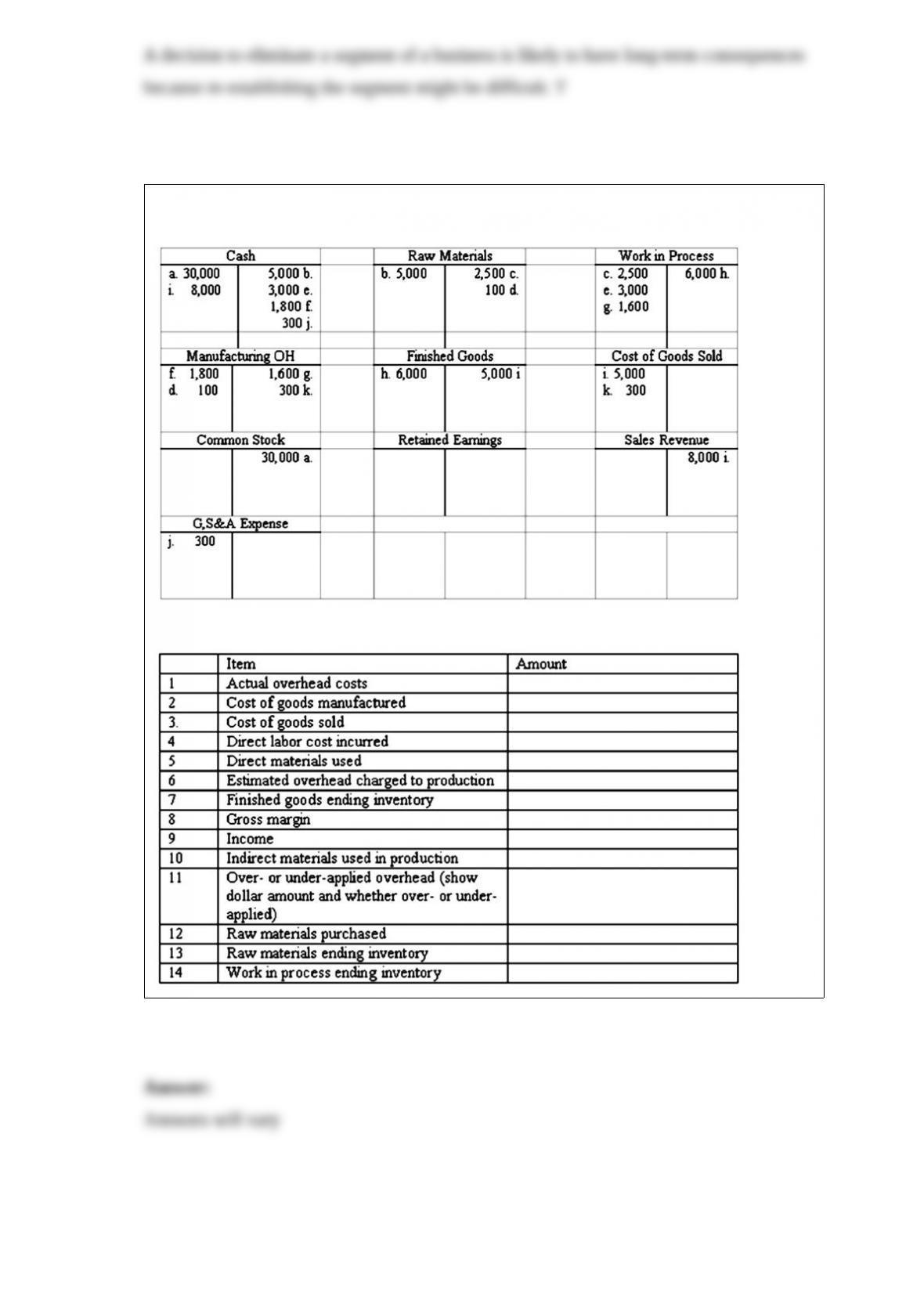
Selected accounts from Madison Company are provided below:
Required:Determine the following:
Describe the decision rules management should use for accepting and rejecting capital
projects under each of the following capital budgeting models: net present value model,
internal rate of return model, payback period, and the unadjusted rate of return model.
Indicate whether each of the following statements is true or false.
Information prepared using allocated costs often is used in evaluating the performance
of managers.
Information prepared using allocated costs should not be used in budgeting and
resource allocation decisions within a company.
A cost that is indirect with respect to one cost object may be direct with respect to other
cost objects.
Fixed costs generally are direct costs, and variable costs generally are indirect.
An allocation base causes a cost to be incurred.
Indicate whether each of the following statements is true or false.
Indirect costs cannot be traced to a cost object in a cost-effective manner.
For a factory with several departments, each department could be treated as a cost
object.
Depreciation on a factory building is a direct cost for the departments in the factory.
For a factory with several departments, depreciation on equipment used in one
department would be a direct cost to that department.
An individual cost cannot be both fixed and direct with respect to a particular cost
object.
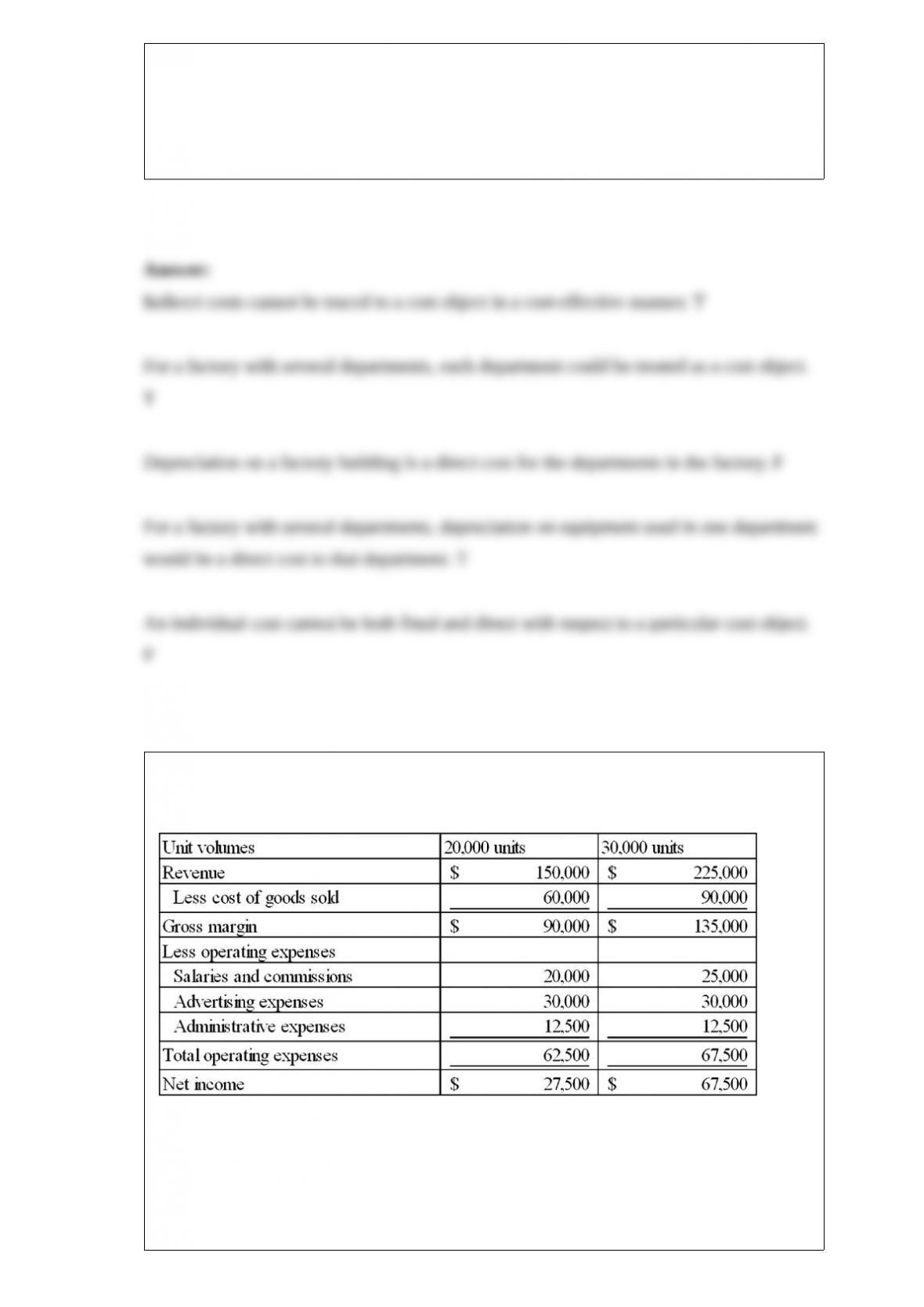
Maryland Novelties Company produces and sells souvenir products. Monthly income
statements for two activity levels are provided below:
Required:
1) Identify the mixed expense(s).
2) Use the high-low method to separate the mixed costs into variable and fixed
components.
3) Prepare a contribution margin income statement at the 20,000-unit level.
Why does a company use its cost of capital as the minimum required rate of return for
its capital investment decisions?