As of January 1 of the current year, the Grackle Company had accounts receivables of
$50,000. The sales for January, February, and March of 2012 were as follows:
$120,000, $140,000 and $150,000. 20% of each month’s sales are for cash. Of the
remaining 80% (the credit sales), 60% are collected in the month of sale, with
remaining 40% collected in the following month. What is the accounts receivable
balance as of March 31?
A.$72,000
B.$48,000
C.$58,720
D.$$60,000
Answer:
On October 1, Ramos Co. signed a $90,000, 60-day discounted note at the bank. The
discount rate was 6%, and the note was paid on November 30. (Assume a 360-day year
is used for interest calculations.)
Answer:
Widgeon Co. manufactures three products: Bales; Tales; and Wales. The selling prices
are: $55; $78; and $32, respectively. The variable costs for each product are: $20; $50;
and $15, respectively. Each product must go through the same processing in a machine
that is limited to 2,000 hours per month. Bales take 5 hours to process, Tales take 7
hours, and Wales take 1 hour.
What is the contribution margin per machine hour for Bales?
A.$5
B.$7
C.$35
D.$28
Answer:
The sales, income from operations, and invested assets for each division of Wren
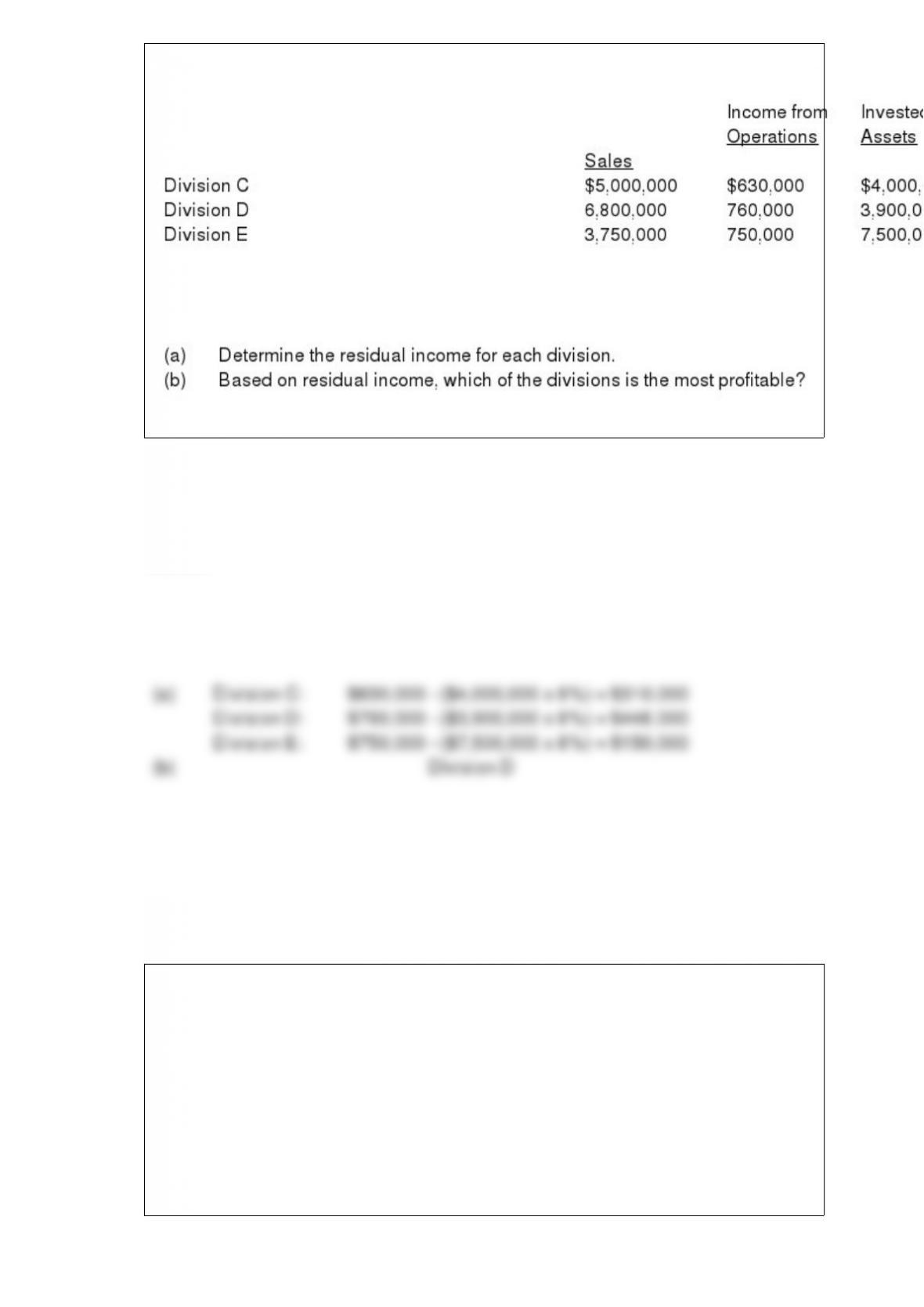
Company are as follows:
Management has established a minimum rate of return for invested assets of 8%.
Answer:
If fixed costs are $400,000, the unit selling price is $25, and the unit variable costs are
$15, what is the break-even sales (units) if the variable costs are increased by $2?
A.50,000 units
B.30,770 units
C.40,000 units
D.26,667 units
Answer:
On November 1st, clients of Great Designs Company prepaid $4,250 for services to be
provided in the future at a rate of $85 per hour.
(a) Journalize the receipt of this cash.
(b) As of November 30th, Great Designs shows that 15 hours of services have been
provided on this agreement. Prepare the necessary journal entry to record this.
(c) Determine the total unearned fees in hours and dollars at November 30th.
Answer:
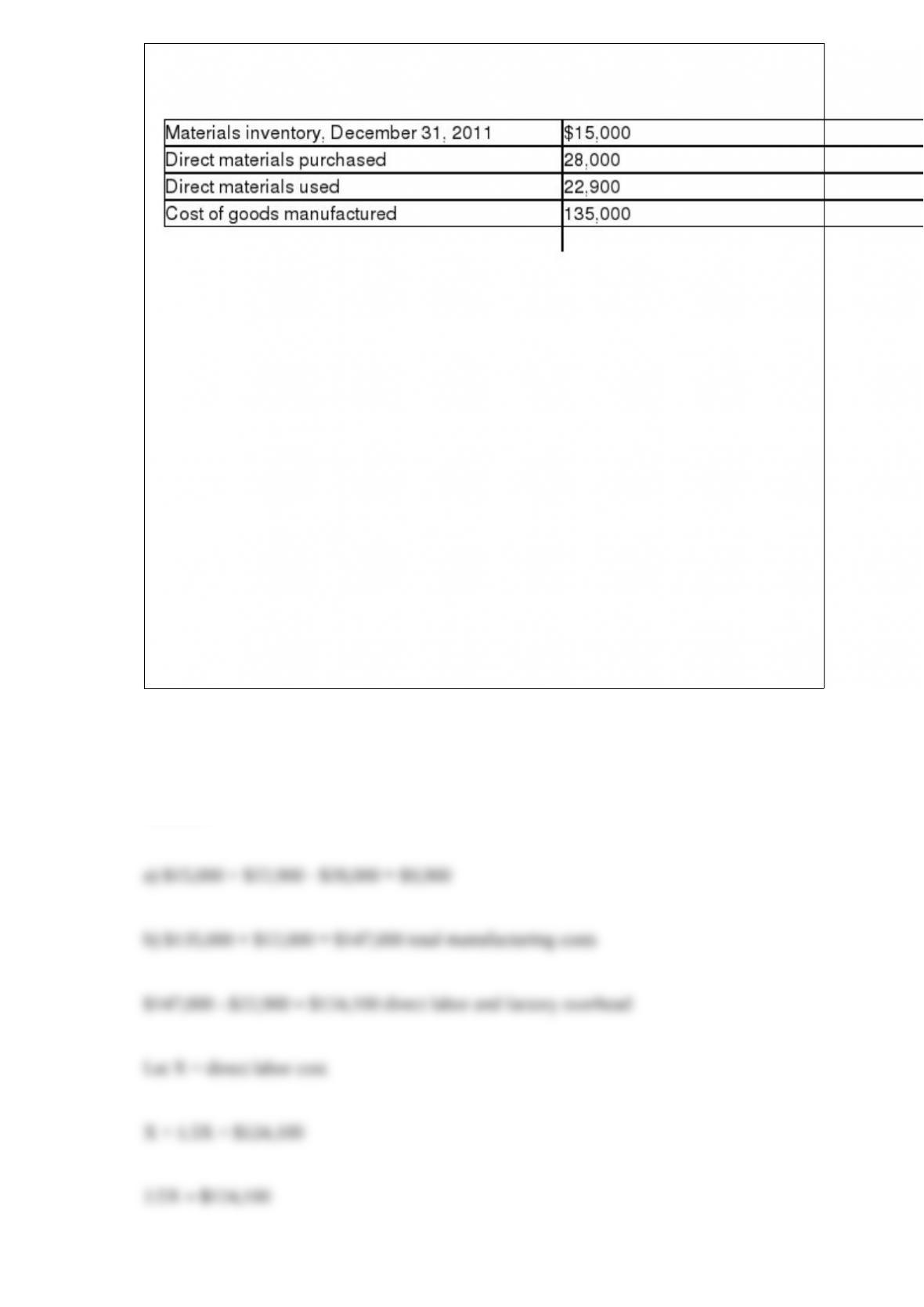
Sineath Industries had a fire and some of its accounting records were destroyed.
Available information is presented below for the year ended December 31, 2011.
Additional information is as follows:
Factory overhead is 150% of direct labor cost.
Finished goods inventory decreased by $18,000 during the year.
Work in process inventory increased by $12,000 during the year.
Calculate:
a) materials inventory, January 1, 2011
b) direct labor cost
c) factory overhead incurred
d) cost of goods sold
Answer:

Materials used by Jefferson Company in producing Division C’s product are currently
purchased from outside suppliers at a cost of $10 per unit. However, the same materials
are available from Division A. Division A has unused capacity and can produce the
materials needed by Division C at a variable cost of $8.50 per unit. A transfer price of
$9.50 per unit is negotiated and 25,000 units of material are transferred, with no
reduction in Division A’s current sales.
How much would Jefferson’s total income from operations increase?
A.$37,500
B.$100,000
C.$62,500
D.$150,000
Answer:
Supplies purchased on account were incorrectly recorded as Office Equipment. The
correcting entry would be
A.Supplies, debit; Office Equipment, credit.
B.Accounts Receivable, debit; Supplies, credit.
C.Office Equipment, debit; Supplies Expense, credit.
D.Supplies, debit; Accounts Payable, credit.
Answer:
Cash receipts received from the issuance of a mortgage notes payable would be
classified as
A.investing activities.
B.operating activities.
C.either financing or investing activities.
D.financing activities.
Answer:
Production estimates for July are as follows:
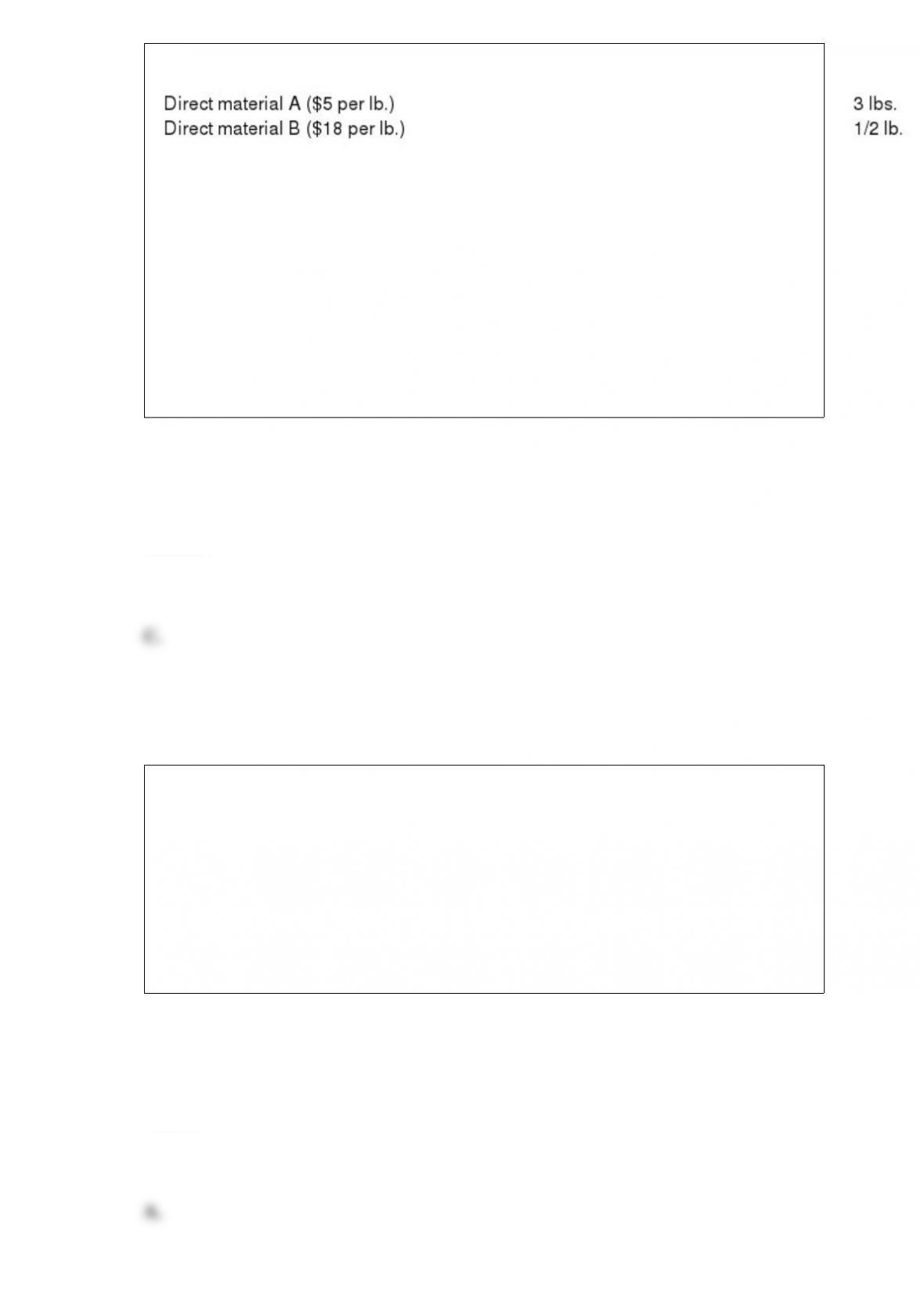
For each unit produced, the direct materials requirements are as follows:
The number of pounds of materials A and B required for July production is:
A.216,000 lbs. of A; 36,000 lbs. of B
B.216,000 lbs. of A; 72,000 lbs. of B
C.234,000 lbs. of A; 39,000 lbs. of B
D.225,000 lbs. of A; 37,500 lbs. of B
Answer:
Earning revenue
A.increases assets, increases owner’s equity.
B.increases assets, decreases owner’s equity
C.increases one asset, decreases another asset
D.decreases assets, increases liabilities
Answer:

A ten-year bond was issued at par for $250,000 cash. This transaction should be shown
on a statement of cash flows under
A.investing activities
B.financing activities
C.noncash investing and financing activities
D.operating activities
Answer:
The financial statement that presents a summary of the revenues and expenses of a
business for a specific period of time, such as a month or year, is called a(n)
A.prior period statement
B.statement of owner’s equity
C.income statement
D.balance sheet
Answer:

At the end of the fiscal year, the usual adjusting entry for depreciation on equipment
was omitted. Which of the following statements is true?
A.Total assets will be understated at the end of the current year.
B.The balance sheet and income statement will be misstated but the statement of
owner’s equity will be correct for the current year.
C.Net income will be overstated for the current year.
D.Total liabilities and total assets will be understated.
Answer:
Manicotti Corporation sells a single product. Budgeted sales for the year are anticipated
to be 640,000 units, estimated beginning inventory is 108,000 units, and desired ending
inventory is 90,000 units. The quantities of direct materials expected to be used for each
unit of finished product are given below.
Material A .50 lb. per unit X $ .60 per pound
Material B 1.00 lb. per unit X $1.70 per pound
Material C 1.20 lb. per unit X $1.00 per pound
The dollar amount of direct material A used in production during the year is:
A.$186,600
B.$181,200
C.$240,000
D.$210,600
Answer:
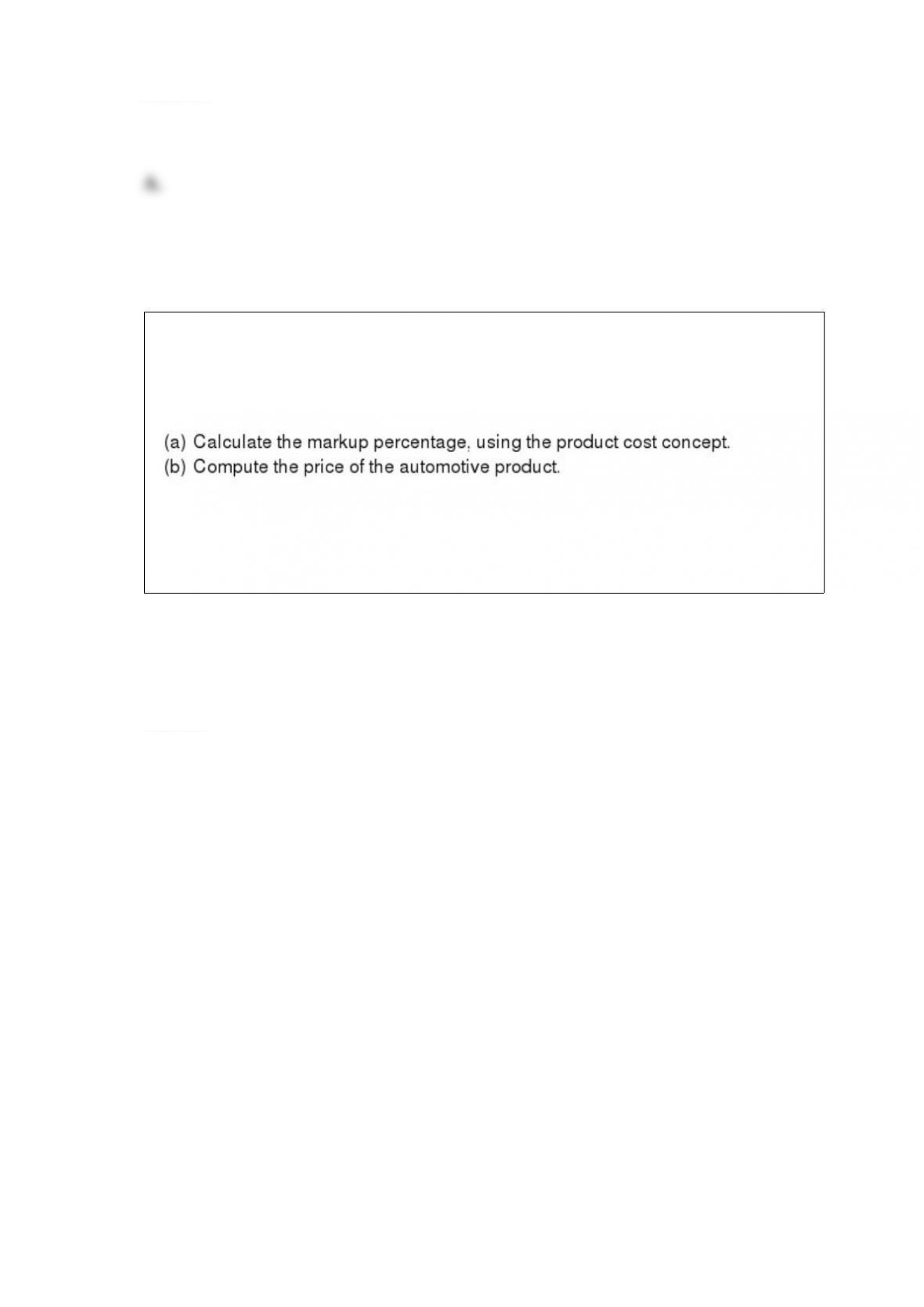
Goshawks Co. produces an automotive product and incurs total manufacturing costs of
$2,600,000 in the production of 80,000 units. The company desires to earn a profit
equal to a 12% rate of return on assets of $960,000. Total selling and administrative
expenses are $105,000.
Round your markup percentage to one decimal place, and other intermediate
calculations and final answer to two decimal places.
Answer:
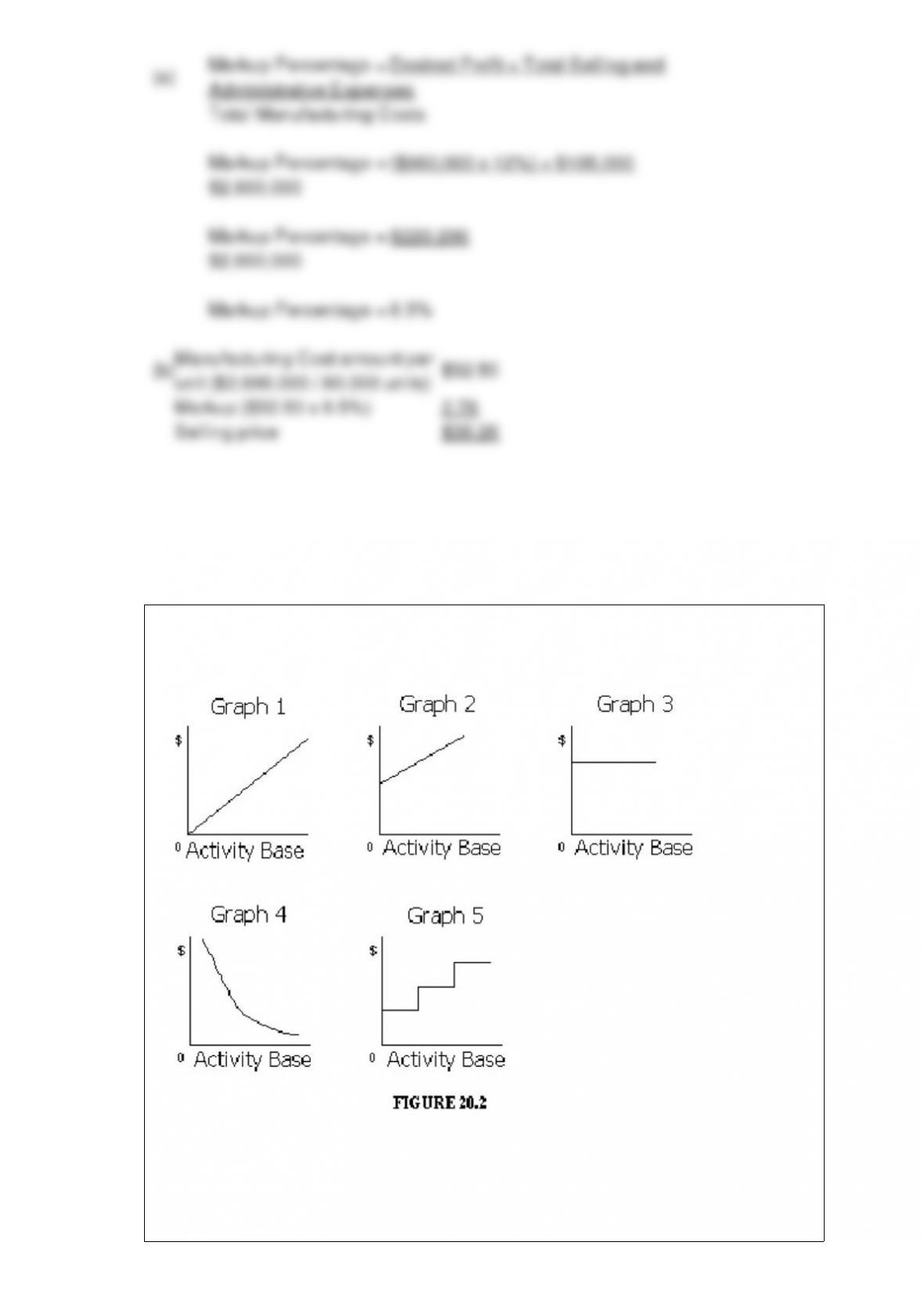
The cost graphs in the illustration below shows various types of cost behaviors.
For each of the following costs, identify the cost graph that best describes its cost
behavior as the number of units produced and sold increases:
(a) Sales commissions of $6,000 plus $.05 for each item sold.

(b) Rent on warehouse of $12,000 per month.
(c) Insurance costs of $2,500 per month.
(d) Per-unit cost of direct labor.
(e) Total salaries of quality control supervisors. One supervisor must be added for each
additional work shift.
(f) Total employer pension costs of $.35 per direct labor hour.
(g) Per-unit straight-line depreciation costs.
(h) Per-unit cost of direct materials.
(i) Total direct materials cost.
(j) Electricity costs of $5,000 per month plus $.0004 per kilowatt-hour.
(k) Per-unit cost of plant superintendent’s salary.
(l) Salary of the night-time security guard of $3,800 per month.
(m) Repairs and maintenance costs of $3,000 for each 2,000 hours of factory machine
usage.
(n) Total direct labor cost.
(o) Straight-line depreciation on factory equipment.
Answer:

Partners Ken and Macki each have a $40,000 capital balance and share income and
losses in a 3:2. Cash equals $20,000, noncash assets equal $120,000, and liabilities
equal $60,000. If the noncash assets are sold for $60,000, and both partners agree to
make up an capital deficits with personal cash contributions, Partner Macki will
eventually receive cash of
A.$0.
B.$4,000.
C.$16,000.
D.$24,000.
Answer:
The management of Indiana Corporation is considering the purchase of a new machine
costing $400,000. The company’s desired rate of return is 10%. The present value
factors for $1 at compound interest of 10% for 1 through 5 years are 0.909, 0.826,
0.751, 0.683, and 0.621, respectively. In addition to the foregoing information, use the
following data in determining the acceptability in this situation:
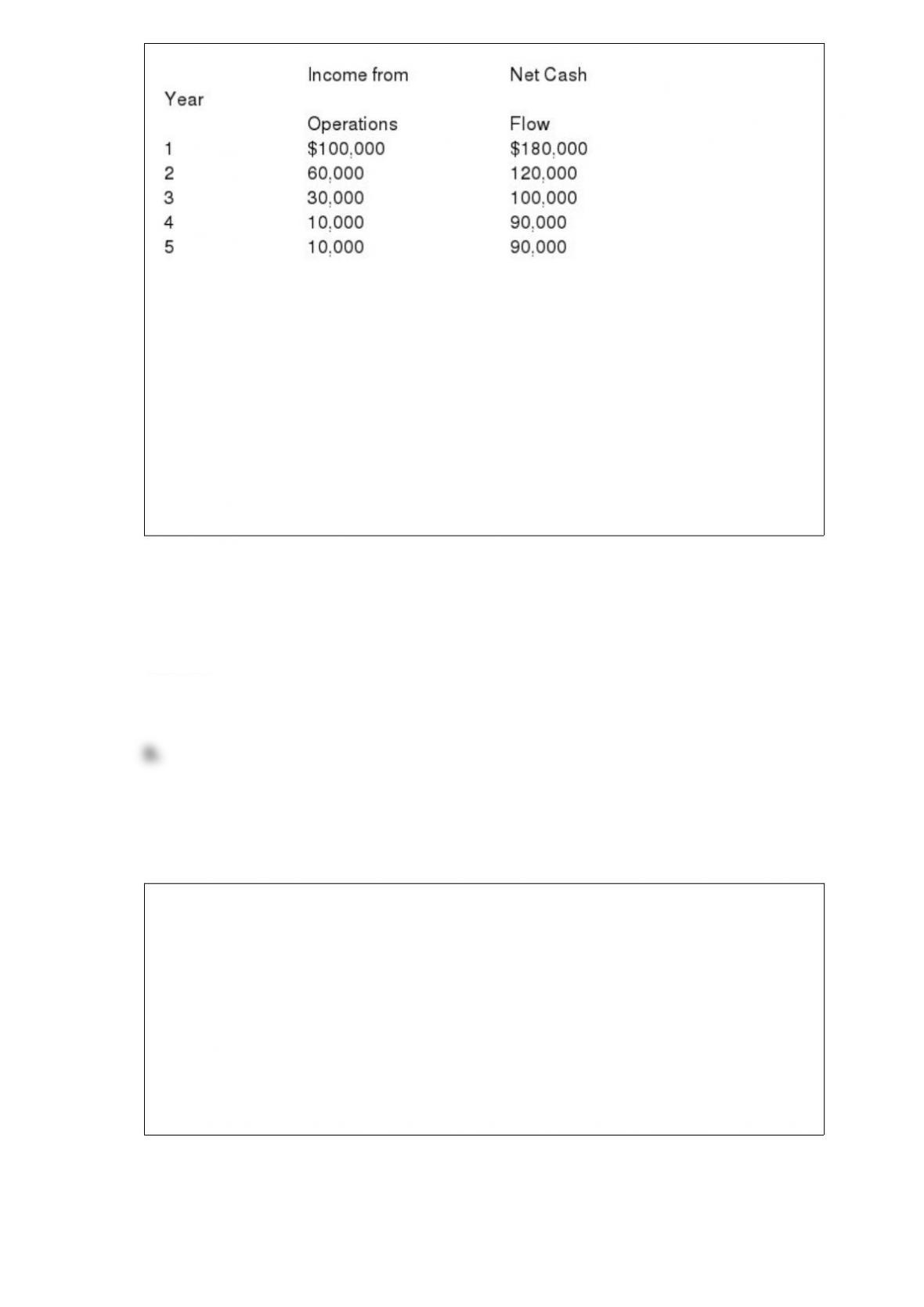
The average rate of return for this investment is:
A.18%
B.21%
C.53%
D.10%
Answer:
The relative distribution of sales among the various products sold by a business is
termed the:
A.business’s basket of goods
B.contribution margin mix
C.sales mix
D.product portfolio
Answer:
The general term used to indicate delaying the recognition of an expense already paid
or of a revenue already received is
A.depreciation
B.deferral
C.accrual
D.inventory
Answer:
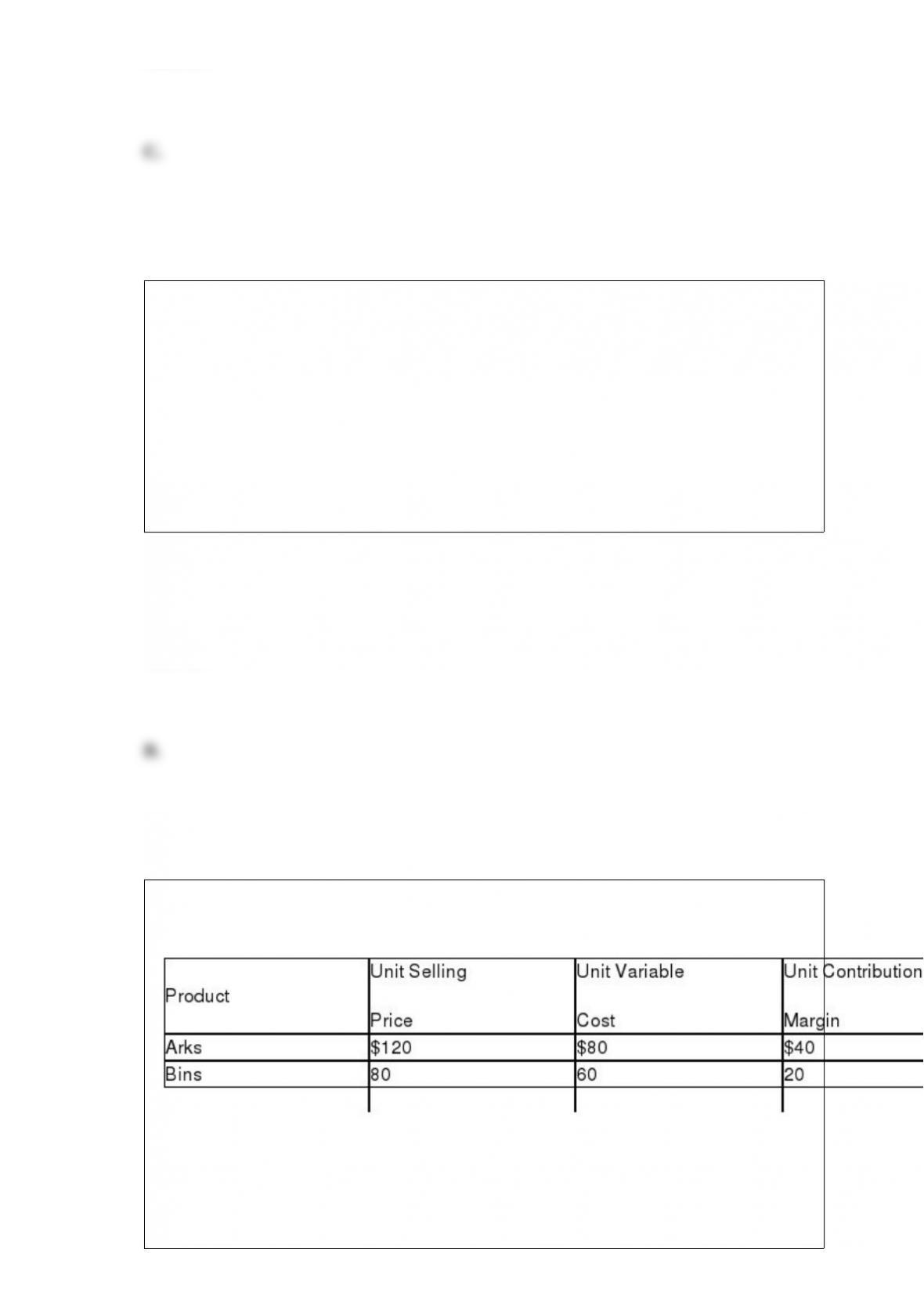
Carter Co. sells two products, Arks and Bins. Last year Carter sold 14,000 units of Arks
and 56,000 units of Bins. Related data are:
Assuming that last year’s fixed costs totaled $960,000, what was Carter Co.’s
break-even point in units?
A.40,000 units

B.12,000 units
C.35,000 units
D.28,000 units
Answer:
Residual value is also known as all of the following except
A.scrap value
B.trade in value
C.salvage value
D.net book value
Answer:
Cash receipts from interest and dividends are classified as
A.financing activities

B.operating activities.
C.investing activities.
D.either financing or investing activities.
Answer:
Harold Corporation just started business in January 2012. They had no beginning
inventories. During 2012 they manufactured 12,000 units of product, and sold 10,000
units. The selling price of each unit was $20. Variable manufacturing costs were $4 per
unit, and variable selling and administrative costs were $2 per unit. Fixed
manufacturing costs were $24,000 and fixed selling and administrative costs were
$6,000.
What would be the difference in Harold Corporation’s Net income for 2012 if they used
variable costing instead of absorption costing?
A.No difference
B.$2,000 greater
C.$4,000 less
D.$6,000 less
Answer:

A loss on disposal of a segment would be reported in the income statement as a(n)
A.administrative expense
B.other expense
C.deduction from income from continuing operations
D.selling expense
Answer:
The adjusting entry to adjust supplies was omitted at the end of the year. This would
effect the income statement by having
A.expenses understated and therefore net income overstated
B.revenues understated and therefore net income understated
C.expenses understated and therefore net income understated
D.expenses overstated and therefore net income understated
Answer:
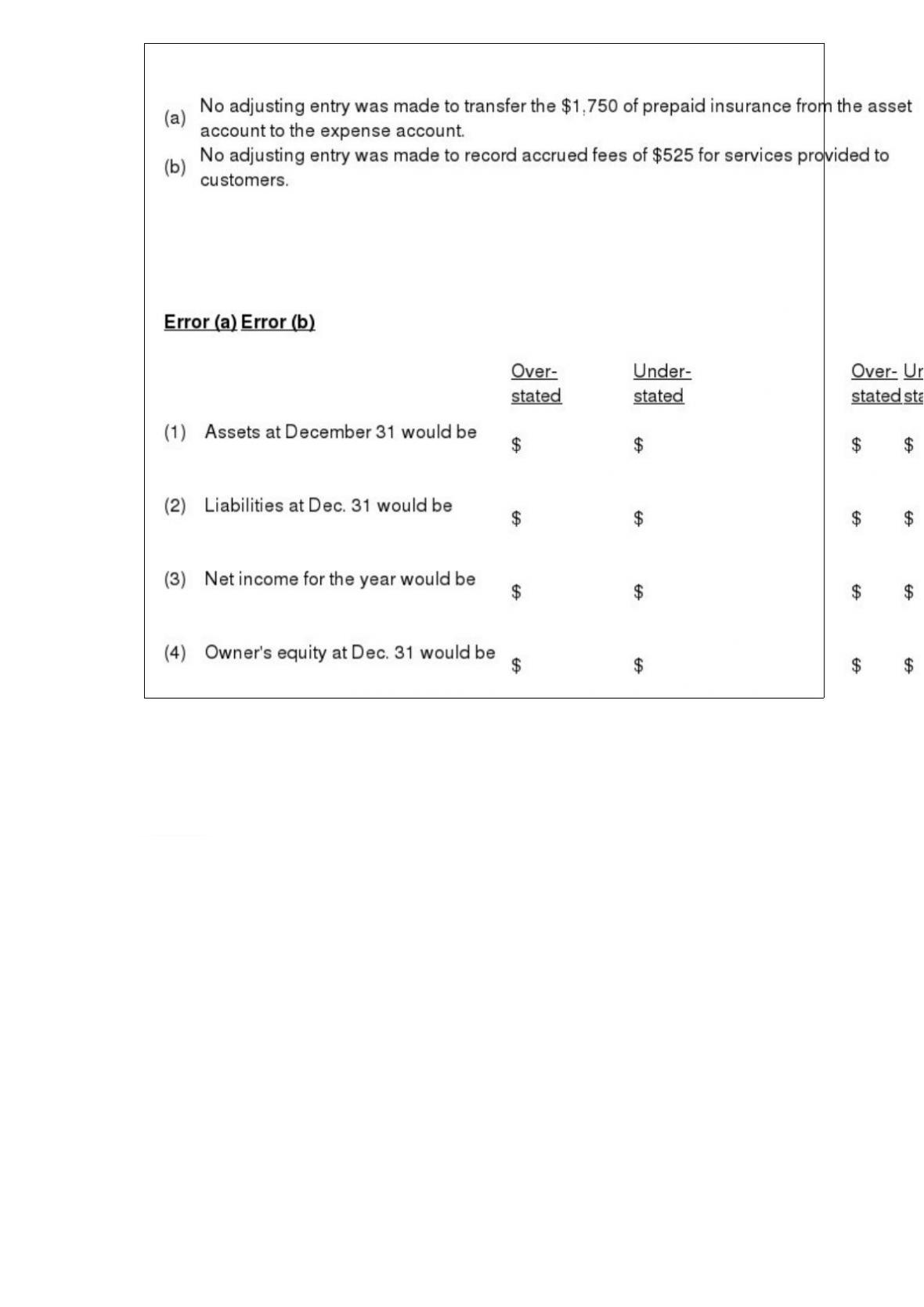
At the end of the fiscal year, the following adjusting entries were omitted:
Assuming that financial statements are prepared before the errors are discovered,
indicate the effect of each error, considered individually, by inserting the dollar amount
in the appropriate spaces. Insert “0” if the error does not affect the item.
Answer:
The entries to record cost and sale of a finished good on account is:
A.debit Cost of Goods Sold, credit Finished Goods
B.debit Cost of Goods Sold, credit Finished Goods, debit Accounts Receivable, credit
Sales
C.debit Sales Expense, credit Finished Goods, credit Cash, credit Accounts Receivable
D.debit Work in Process, credit Finished Goods, debit Accounts Receivable, credit
Sales
Answer:
The materials requisition is used to

A.release materials from the storeroom to the factory
B.release finished goods to the shipping department
C.record the acquisition of materials from a vendor
D.record and electronically transmit materials data in place of a receiving report
Answer:
Which of the following is true in regards to a Limited Liability Company?
A.Makes up 10% of business organizations in the United States.
B.Combines the attributes of a partnership and a corporation.
C.Provides tax and liability advantages to the owners.
D.All are correct.
Answer: