1) The costs of goods purchased will vary under the different inventory methods of
specific identification, FIFO, LIFO, and weighted average.
2) Long-term investments include investments in land or other assets not used in a
company’s operations.
3) A company’s cost of inventory was $317,500. Due to phenomenal demand the market
value of its inventory increased to $323,000. This company should write up the value of
its inventory according to the consistency principle.
4) An investor purchased $50,000 of bonds and holds them to maturity. The investor’s
journal entry to record the proceeds should include a debit to Cash for $50,000 and a
credit to Long-Term Investments for $50,000.
5) A company holds $40,000 of 7% bonds as a held-to-maturity security. Assuming all
prior interest entries have been accounted for, the bondholder’s journal entry to record
receipt of the semiannual interest payment includes a debit to Cash for $2,800 and a
credit to Interest Revenue for $2,800.
6) A partnership has an unlimited life.
7) Computer networks are links among computers giving different users and different
computers access to common databases and programs.
8) In a make or buy decision, management should focus on costs that are constant under
the two alternatives.
9) Market prospects are the ability to provide financial rewards sufficient to attract and
retain financing.
10) Degree of operating leverage (DOL) is defined as total contribution margin in
dollars divided by pretax income.
11) All necessary numbers to prepare the income statement can be taken from the
income statement columns of the work sheet, including the net income or net loss.
12) The FASB requires a reconciliation of net income to net cash provided or used by
operating activities when the direct method is used.
13) In a job order cost accounting system, indirect labor costs are debited to the Factory
Overhead account.
14) The only way that a shareholder can affect the management of a corporation is to
get elected to the corporation’s board of directors.
15) When units are purchased at different costs over time, determining the cost per unit
assigned to inventory items is simple.
16) The following data has been collected about a company’s stockholders’ equity
accounts:
The treasury shares were all purchased at the same price.
The cost per share of the treasury stock is:
A.$1.15
B.$1.28
C.$11.50
D.$10.50
E.$10.00
17) Beewell’s net income for the year ended December 31, Year 2 was $185,000.
Information from Beewell’s comparative balance sheets is given below. Compute the
cash paid for dividends during Year 2.
A.$79,000
B.$106,000
C.$95,000
D.$50,000
E.$145,000
18) A company’s Inventory balance at 12/31/11 was $188,000 and $200,000 at
12/31/10. Its Accounts Payable balance at 12/31/11 was $84,000 and $80,000 at
12/31/10, and its cost of goods sold for 2011 was $720,000. The company’s total
amount of cash payments for merchandise in 2011 equals:
A.$704,000
B.$712,000
C.$720,000
D.$728,000
E.$736,000
19) On March 15, Carter Company purchased 10,000 shares of Tonya Corp. stock for
$35,000. The investment is classified as available-for-sale securities. On June 30, the
stock had a fair value of $38,000. Carter should do all of the following except:
A.Record an increase to the Fair value Adjustment-AFS account
B.Record an increase to the Unrealized Gain – Equity account
C.Report the increase in the equity section of the balance sheet
D.Report the increase in the asset section of the balance sheet
E.Record an increase to the Unrealized Gain – Income account
20) Tops had cost of goods sold of $9,421 million, ending inventory of $2,089 million,
and average inventory turnover of $1,965 million. Its days’ sales in inventory equals:
A.0.21
B.4.51
C.4.79
D.76.1 days
E.80.9.days
21)
Abrams, Inc., provides the following results of March’s operations:
Required:(a) Determine the total overhead cost variance for March.
(b) Applying the management by exception approach, which of the variances shown are
of greatest concern? Why?
22) Operating activities:
A.Are the means organizations use to pay for resources like land, buildings and
equipment
B.Involve using resources to research, develop, purchase, produce, distribute and
market products and services
C.Involve acquiring and disposing of resources that a business uses to acquire and sell
its products or services
D.Are also called asset management
E.Are also called strategic management
23) Which of the following accounting principles would require that all goods and
services purchased be recorded at cost?
A.Going-concern assumption
B.Matching principle
C.Cost principle
D.Business entity assumption
E.Consideration assumption
24) To determine the production budget for an accounting period, consideration is given
to all of the following except:
A.Budgeted ending inventory
B.Budgeted beginning inventory
C.Budgeted sales
D.Budgeted overhead
E.Ratio of inventory to future sales
25) On May 1, Fine and Max formed a partnership. Fine contributed cash of $90,000
and equipment valued at $152,000. Max contributed land valued at $120,000 and a
building valued at $250,000. The partnership also assumed responsibility for Max’s
$110,000 long-term note payable associated with the land and building. The partners
agreed to share income as follows: Fine is to receive a salary allowance of $38,000,
both are to receive an annual interest allowance of 8% of their beginning-year capital
investments, and any remaining income or loss is to be shared equally. During the year,
Fine withdrew $40,000 and Max withdrew $42,000 cash. After the adjusting and
closing entries are made to the revenue and expense accounts at the end of the year, the
Income Summary account had a credit balance of $140,000. Prepare the journal entries
to record (a) the partners’ initial capital investments, (b) their cash withdrawals, and (c)
closing of both the Withdrawals and Income Summary accounts.
26) Which of the following statements is incorrect?
A.The normal balance of accounts receivable is a debit
B.The normal balance of owner’s withdrawals is a debit
C.The normal balance of unearned revenues is a credit
D.The normal balance of an expense account is a credit
E.The normal balance of the owner’s capital account is a credit
27) Changes in retained earnings may be reported in the:
A.Statement of cash flows
B.Balance sheet
C.Statement of stockholders’ equity
D.Multiple-step income statement
E.Single-step income statement
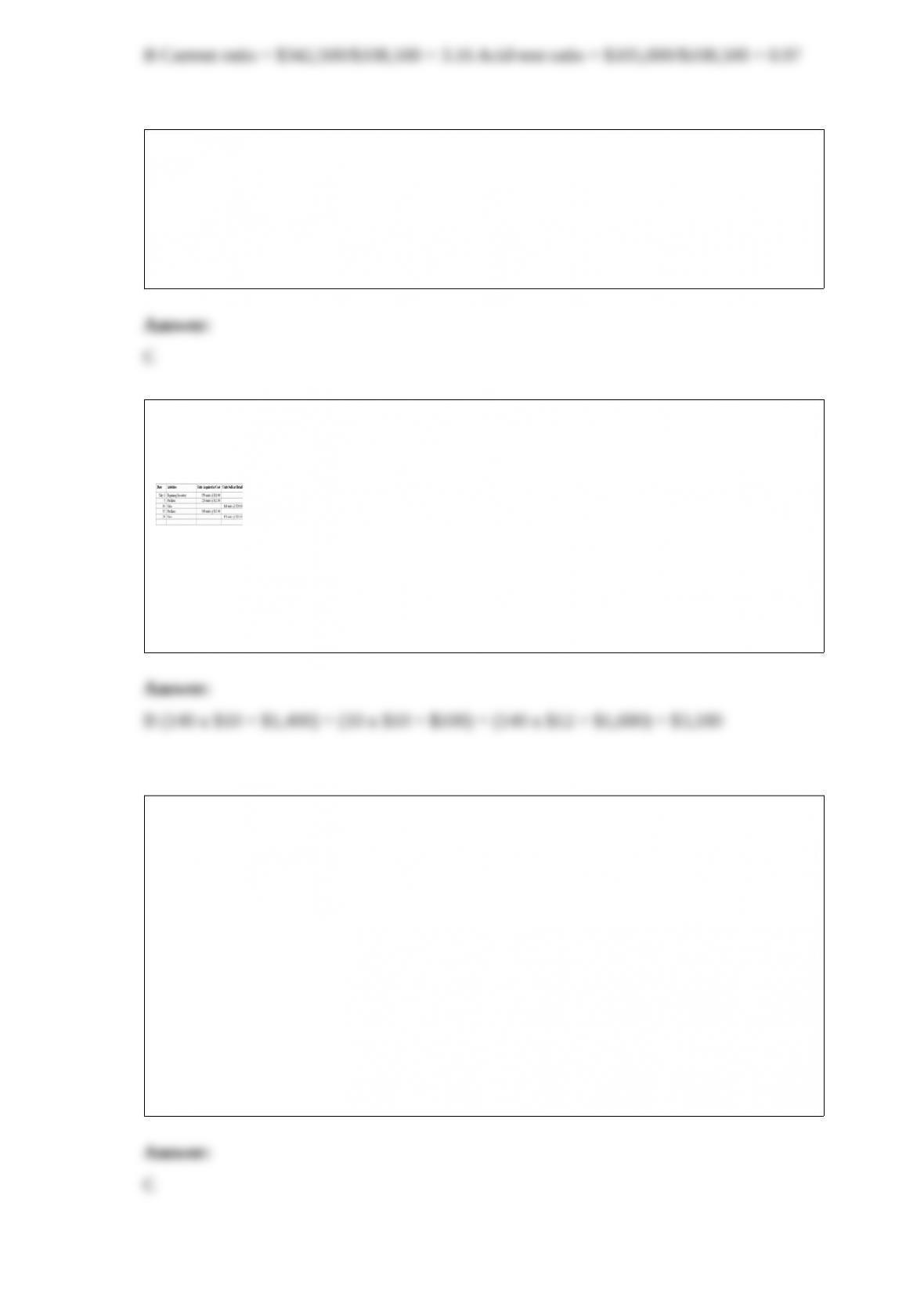
28) Using the following year-end information for Brim, LLC, calculate the current ratio
and acid-test ratio:
A.3.01 and 1.21
B.3.16 and .97
C.3.04 and 1.21
D.1.09 and 4.77
E.None of these
29) Operating budgets include all the following budgets except the:
A.Sales budget
B.Selling expense budget
C.Cash budget
D.Merchandise purchases budget
E.General and administrative expense budget
30) Perch Company reported the following purchases and sales for its only product.
Perch uses a perpetual inventory system. Determine the cost assigned to cost of goods
sold using FIFO.
A.$2,260
B.$3,180
C.$1,860
D.$3,580
E.$2,100
31) Which of the following statements is most accurate?
A.In process costing, estimating the degree of completion of units is usually more
accurate for conversion costs than for direct materials
B.The weighted average method uses the stage of completion of the current period’s
beginning goods in process inventory account in calculating equivalent units
C.The weighted average method focuses on the total costs and total equivalent units
completed to date; this is the major difference between the weighted average method
and the FIFO method of calculating equivalent units of production
D.The FIFO method of calculating equivalent units of production merges the work and
the costs of the beginning inventory with the work and the costs done during the current
period
E.It is not possible for there to be a significant difference between the cost of completed
units between the weighted average and the FIFO methods

32) On November 12, Kera, Inc., a U.S. Company, sold merchandise on credit to
Kakura of Japan at a price of 1,500,000 yen. The exchange rate was $0.00837 on the
date of sale. On December 31, when Kera prepared its financial statements, the
exchange rate was $0.00843. Kakura paid in full on January 12, when the exchange rate
was $0.00861. On January 12, Kera should prepare the following journal entry:
A.Debit Cash $12,915; credit Accounts Receivable-Kakura $12,555; credit Foreign
Exchange Gain $360
B.Debit Cash $12,555; debit Foreign Exchange Loss $360; credit Accounts
Receivable-Kakura $12,915
C.Debit Cash $12,915; credit Accounts Receivable-Kakura $12,645; credit Foreign
Exchange Gain $90
D.Debit Cash $12,645; debit Foreign Exchange Loss $90; credit Accounts
Receivable-Kakura $12,915
E.Debit Cash $12,915; credit Accounts Receivable-Kakura $12,645; credit Foreign
Exchange Gain $270
33) The statement of cash flows is:
A.Another name for the statement of financial position
B.A financial statement that presents information about changes in equity during a
period
C.A financial statement that reports the cash inflows and cash outflows for an
accounting period, and that classifies those cash flows as operating activities, investing
activities, or financing activities
D.A financial statement that lists the types and amounts of assets, liabilities, and equity
of a business on a specific date
E.A financial statement that lists the types and amounts of the revenues and expenses of
a business for an accounting period
34) Which of the following costs would not be classified as factory overhead?
A.Property taxes on maintenance machinery
B.Expired insurance on factory equipment
C.Wages of the factory janitor
D.Metal doorknobs used on wood cabinets produced
E.Small tools used in production
35) Jane and Castle are partners and share equally in income or loss. Jane’s current
capital balance is $140,000 and Castle’s is $130,000. Jane and Castle agree to accept
Sean with a 30% interest in the partnership. Sean invests $108,000 in the partnership.
The amount credited to Sean’s capital account is:
A.$108,000
B.$102,600
C.$110,500
D.$115,000
E.$113,400
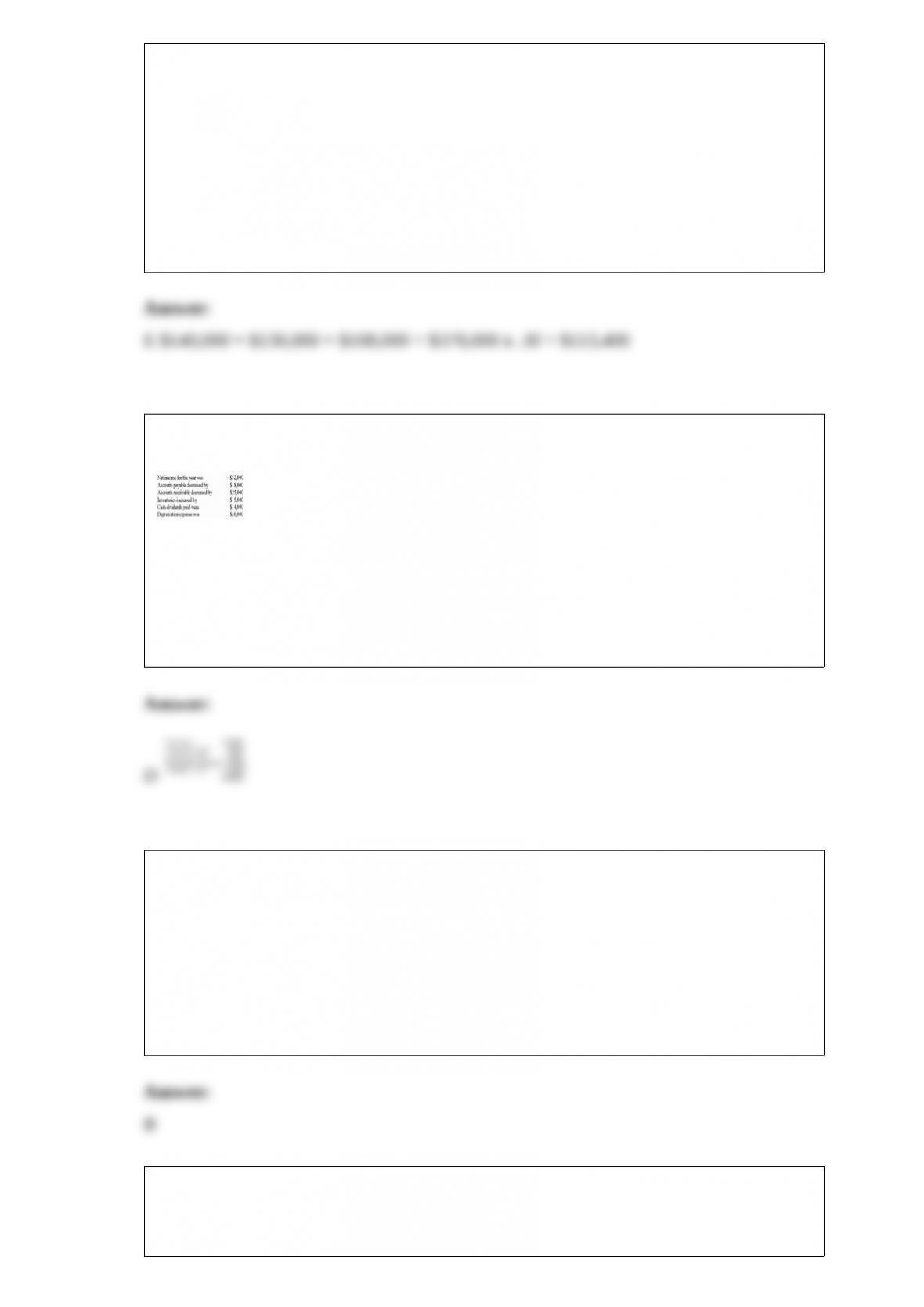
36) In preparing a company’s statement of cash flows for the most recent year on the
indirect method, the following information is available:
Net cash provided by operating activities was:
A.$120,000
B.$44,000
C.$70,000
D.$84,000
E.$30,000
37) A trade discount is:
A.A term used by a purchaser to describe a cash discount given to customers for prompt
payment.
B.A reduction in price below the list price.
C.A term used by a seller to describe a cash discount granted to customers for prompt
payment.
D.A reduction in price for prompt payment.
E.Also called a rebate.
38) Bard Manufacturing uses a job order cost accounting system. During one month
Bard purchased $198,000 of raw materials on credit; issued materials to production of
$195,000 of which $30,000 were indirect. Bard incurred a factory payroll of $150,000,
paid in cash, of which $40,000 is classified as indirect labor. Bard uses a predetermined
overhead application rate of 150% of direct labor cost. The journal entry to record
payment of the factory payroll is:
A.Debit Goods in Process Inventory $150,000; credit Factory Payroll $150,000
B.Debit Goods in Process Inventory $150,000; credit Cash $150,000
C.Debit Factory Payroll $150,000; credit Cash $150,000
D.Debit Goods in Process Inventory $110,000; debit Factory Overhead $40,000; credit
Factory Payroll $150,000
E.Debit Goods in Process Inventory $110,000; debit Factory Overhead $40,000; credit
Cash $150,000
39) A company purchased a tract of land for its natural resources at a cost of
$1,500,000. It expects to mine 2,000,000 tons of ore from this land. The salvage value
of the land is expected to be $250,000. The depletion expense per ton of ore is:
A.$0.75
B.$0.625
C.$0.875
D.$6.00
E.$8.00
40) With on-line systems, all information storage should be off-line to protect the data.
41) Brewer Company specializes in selling used cars. During the month, the dealership
sold 22 cars at an average price of $15,000 each. The budget for the month was to sell
20 cars at an average price of $16,000. Compute the dealership’s sales price variance for
the month.
A.$22,000 unfavorable
B.$10,000 favorable
C.$22,000 favorable
D.$32,000 unfavorable
E.$32,000 favorable
42) A budget system based on expected activities and their levels that enables
management to plan for resources required to perform the activities is:
A.Traditional budgeting
B.Management budgeting
C.Master budgeting
D.Activity-based budgeting
E.Cash budgeting
43) What is gross margin ratio? How is it used as an indicator of profitability?
44) Hancock reported assets of $13,362 million at January 1 and $13,369 million as of
December 31 of the current year. Hancock’s net cash flows from operations were $2,204
million. Calculate the cash flow on total assets ratio for Hancock.
45) Information for Gifford, Inc., as of December 31 follows. Prepare a manufacturing
statement for the year ended December 31.
46) What is a manufacturing budget?
47) The _____________________ method of assigning costs to inventory and cost of
goods sold assumes that the inventory items are sold in the order acquired.
48) On March 1, a company issues bonds with a par value of $300,000. The bonds
mature in 10 years, and pay 6% annual interest, payable each June 30 and December
31. The bonds sell at par value plus interest accrued since January 1. Prepare the
general journal entry to record the issuance of the bonds on March 1
49) Using the selected information given below for Bliss Company, calculate return on
assets, debt ratio, and profit margin. Comment on the results of operations and the
financial position of the company for the year.
Return on assets = ($950,000-795,000)/((1,900,000+1,500,000)/2) =9.1%
Debt ratio=$850,000/1,900,000=44.7%
Profit margin=$155,000/950,000=16.3%