
1) lifo is inappropriate where unit costs tend to decrease as production increases.
2) bond issues that mature in installments are called serial bonds.
3) both ifrs and u.s. gaap allow that if determining the effect of a change in accounting
principle is considered impracticable, then a company should report the effect of the
change in the period in which it believes it practicable to do so.
4) because of the historical cost principle, fair values may not be disclosed in the
balance sheet.
5) assets purchased on long-term credit contracts should be recorded at the present
value of the consideration exchanged.
6) ifrs allows for revaluation of long-term tangible and intangible assets with the
differences impacting equity but not net income.
7) the cause for litigation must have occurred on or before the date of the financial
statements to report a liability in the financial statements.

8) permanent differences do not give rise to future taxable or deductible amounts.
9) an adjustment for wages expense, earned but unpaid at year end, is an example of an
accrued expense.
10) if a company sells its product but gives the buyer the right to return it, the company
should not recognize revenue until the sale is collected.
11) a company must accrue a liability for sick pay that accumulates but does not vest.
12) porter corp. purchased its own par value stock on january 1, 2012 for $20,000 and
debited the treasury stock account for the purchase price. the stock was subsequently
sold for $12,000. the $8,000 difference between the cost and sales price should be
recorded as a deduction from
a.additional paid-in capital to the extent that previous net “gains” from sales of the same
class of stock are included therein; otherwise, from retained earnings
b.additional paid-in capital without regard as to whether or not there have been previous
net “gains” from sales of the same class of stock included therein
c.retained earnings
d.net income
13) the financial accounting foundation
a.oversees the operations of the fasb
b.oversees the operations of the
c.provides information to interested parties on financial reporting issues
d.works with the financial accounting standards advisory council to provide
informa-tion to interested parties on financial reporting issues

14) which perspective is adopted as part of the objective of general-purpose financial
reporting?
a.decision-usefulness perspective
b.proprietary perspective
c.entity perspective
d.financial reporting perspective
15) ewing company sells household furniture. customers who purchase furniture on the
installment basis make payments in equal monthly installments over a two-year period,
with no down payment required. ewing’s gross profit on installment sales equals 40% of
the selling price of the furniture.
for financial accounting purposes, sales revenue is recognized at the time the sale is
made. for income tax purposes, however, the installment method is used. there are no
other book and income tax accounting differences, and ewing’s income tax rate is 30%.
if ewing’s december 31, 2013, balance sheet includes a deferred tax liability of
$450,000 arising from the difference between book and tax treatment of the installment
sales, it should also include installment accounts receivable of
a.$3,750,000
b.$1,500,000
c.$1,125,000
d.$450,000
16) on january 1, 2013, evans company granted tim telfer, an employee, an option to
buy 2,000 shares of evans co. stock for $25 per share, the option exercisable for 5 years
from date of grant. using a fair value option pricing model, total compensation expense
is determined to be $15,000. telfer exercised his option on september 1, 2013, and sold
his 1,000 shares on december 1, 2013. quoted market prices of evans co. stock during
2013 were
the service period is for three years beginning january 1, 2013. as a result of the option
granted to telfer, using the fair value method, evans should recognize compensation
expense for 2013 on its books in the amount of
a.$18,000
b.$15,000
c.$5,000
d.$3,000
17) jamison company uses ifrs for its financial reporting. it produces machines that sell
globally. all sales are accompanied by a one-year warranty. at the end of the year, the
company has the following data:
2,000 units were sold during the year.
the trend over the past five years has been that 4% of the machines were defective in
some way and had to be repaired. of this 4%, half required a full replacement at a cost
of $3,000 per unit and half were able to be repaired at an average cost of $300.
what is the expected value of the warranty cost provision?
a.$240,000
b.$132,000
c.$264,000
d.$120,000
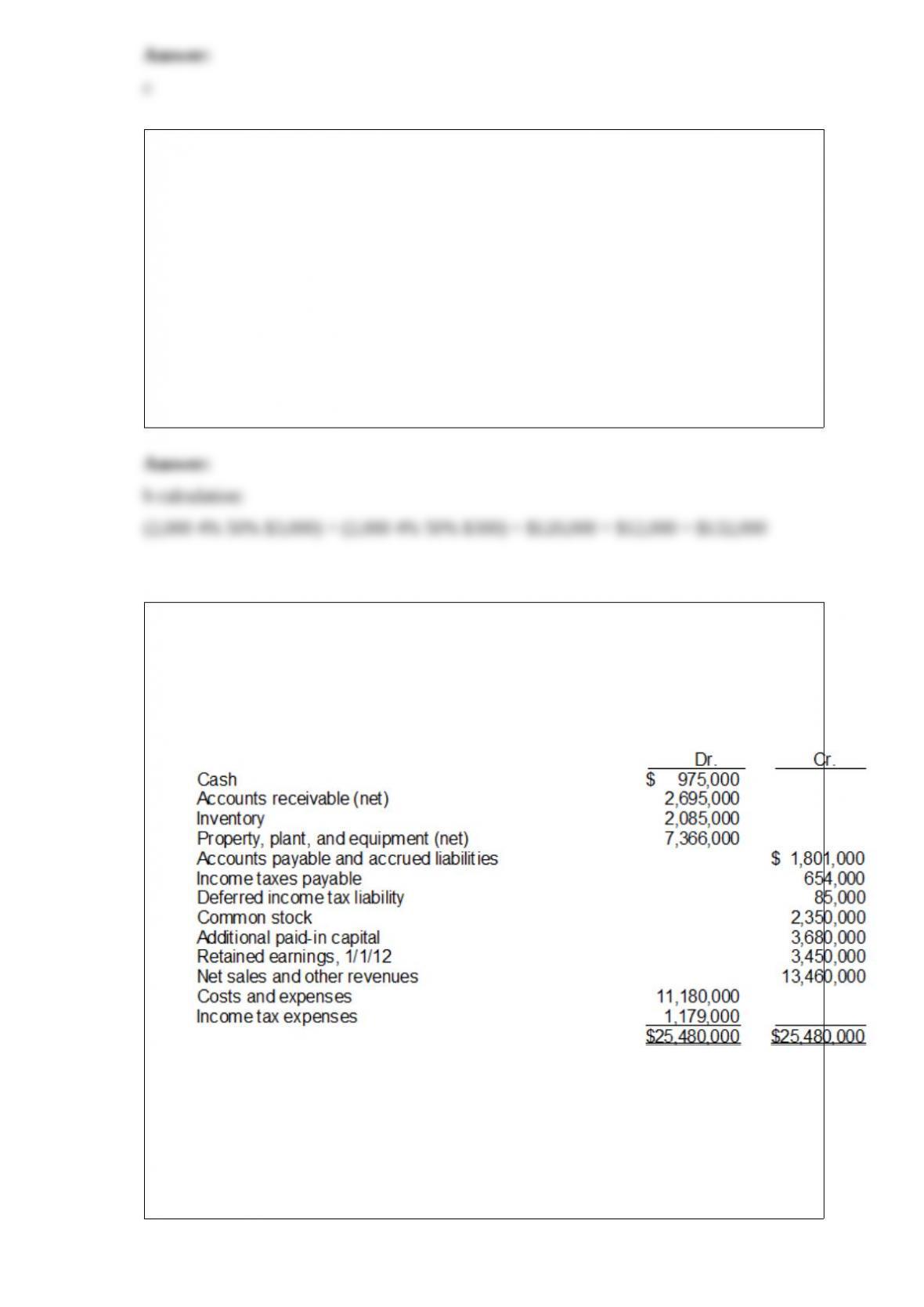
18) the following trial balance of reese corp. at december 31, 2012 has been properly
adjusted except for the income tax expense adjustment.
reese corp.
trial balance
december 31, 2012
other financial data for the year ended december 31, 2012:
in reese’s december 31, 2012 balance sheet,
the current assets total is
a.$6,280,000
b.$5,755,000
c.$5,605,000
d.$5,155,000

19) the two fundamental qualities that make accounting information useful for decision
making are
a.comparability and timeliness
b.materiality and neutrality
c.relevance and faithful representation
d.faithful representation and comparability
20) a deferred tax liability is classified on the balance sheet as either a current or a
noncurrent liability. the current amount of a deferred tax liability should generally be
a.the net deferred tax consequences of temporary differences that will result in net
taxable amounts during the next year
b.totally eliminated from the financial statements if the amount is related to a
noncurrent asset
c.based on the classification of the related asset or liability for financial reporting
purposes
d.the total of all deferred tax consequences that are not expected to reverse in the
operating period or one year, whichever is greater
21) which method of inventory pricing best approximates specific identification of the
actual flow of costs and units in most manufacturing situations?
a.average cost
b.first-in, first-out
c.last-in, first-out
d.base stock
22) stine corp.’s trial balance reflected the following account balances at december 31,
2012:
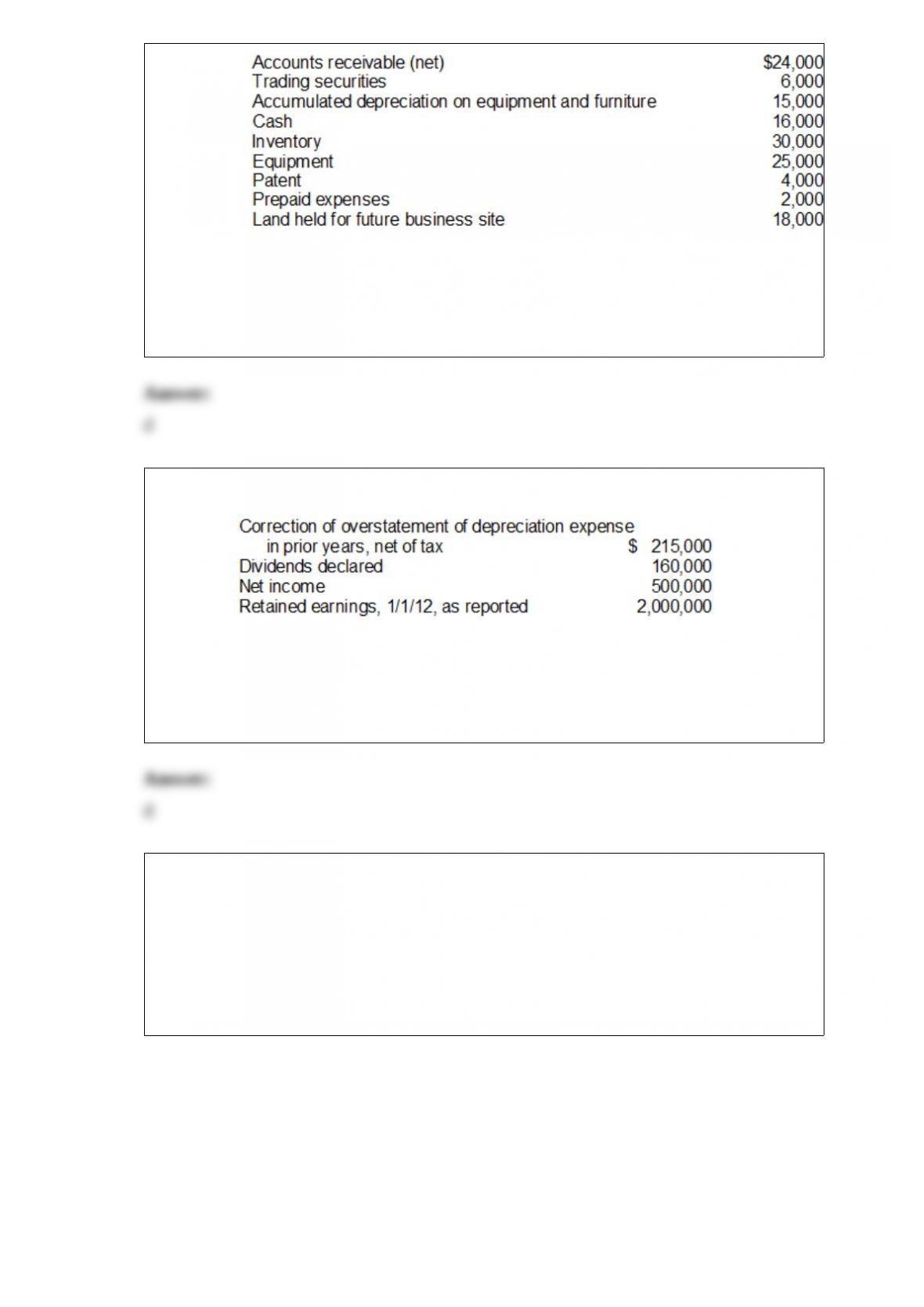
in stine’s december 31, 2012 balance sheet, the current assets total is
a.$95,000
b.$87,000
c.$82,000
d.$78,000
23) leonard corporation reports the following information:
leonard should report retained earnings, 12/31/12, at
a.$1,785,000
b.$2,125,000
c.$2,340,000
d.$2,555,000
24) financial statements for kiner company are given below:
kiner company
balance sheet
january 1, 2013
kiner company
balance sheet
january 1, 2013
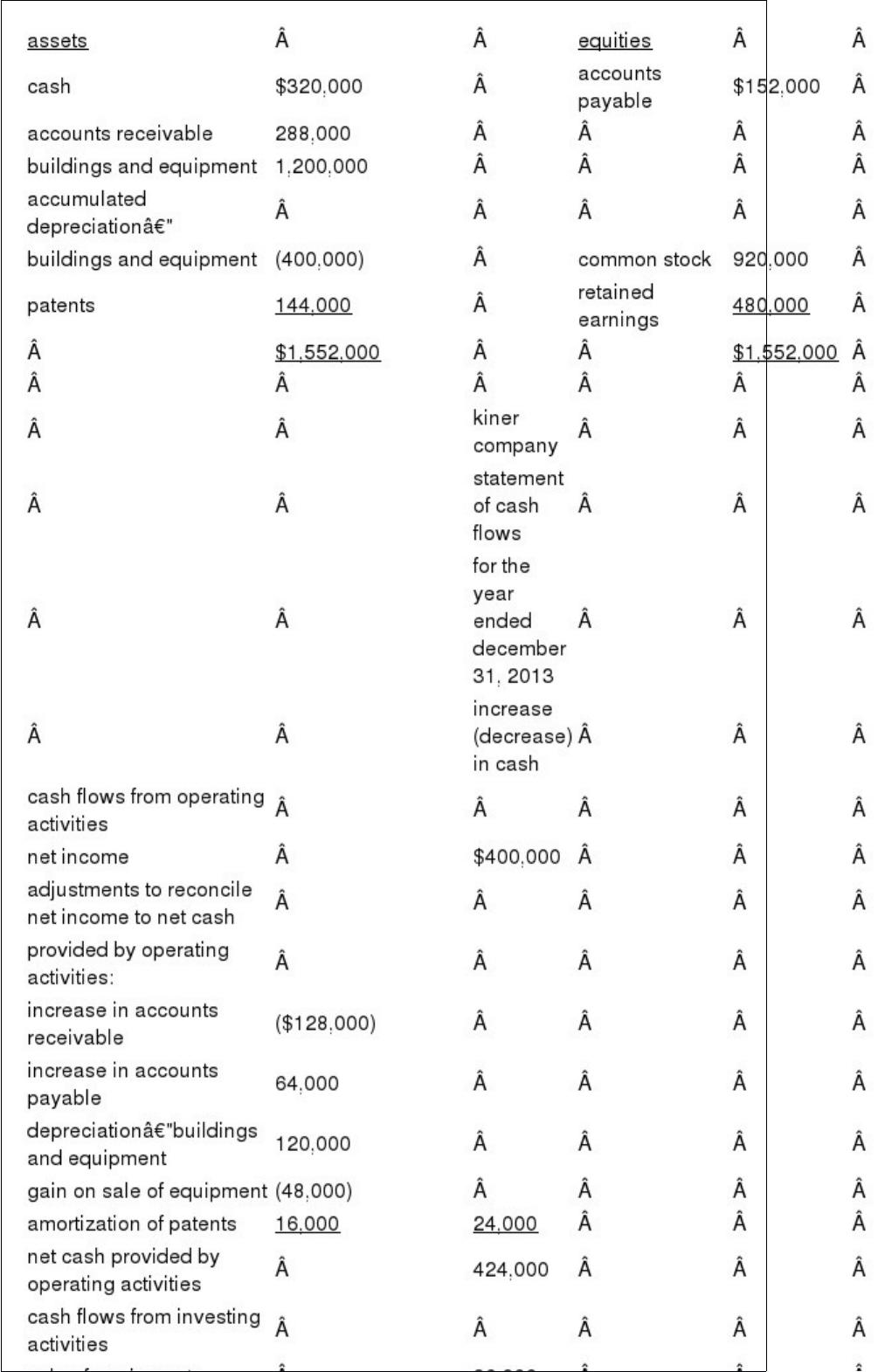

total assets on the balance sheet at december 31, 2013 are $2,216,000. accumulated
deprecia-tion on the equipment sold was $112,000.
the book value of the buildings and equipment at december 31, 2013 was
a.$1,016,000
b.$1,040,000
c.$1,424,000
d.$1,176,000
25) which factor would be greater the present value of $1 for 10 periods at 8% per
period or the future value of $1 for 10 periods at 8% per period?
a.present value of $1 for 10 periods at 8% per period
b.future value of $1 for 10 periods at 8% per period
c.the factors are the same
d.need more information
26) which of these is not a major characteristic of a plant asset?
a.possesses physical substance
b.acquired for use in operations
c.yields services over a number of years
d.all of these are major characteristics of a plant asset.
27) a company changes from straight-line to an accelerated method of calculating
depreciation, which will be similar to the method used for tax purposes. the entry to
record this change should include a
a.credit to accumulated depreciation
b.debit to retained earnings in the amount of the difference on prior years
c.debit to deferred tax asset
d.credit to deferred tax liability
28) sauder corporation reports the following information:
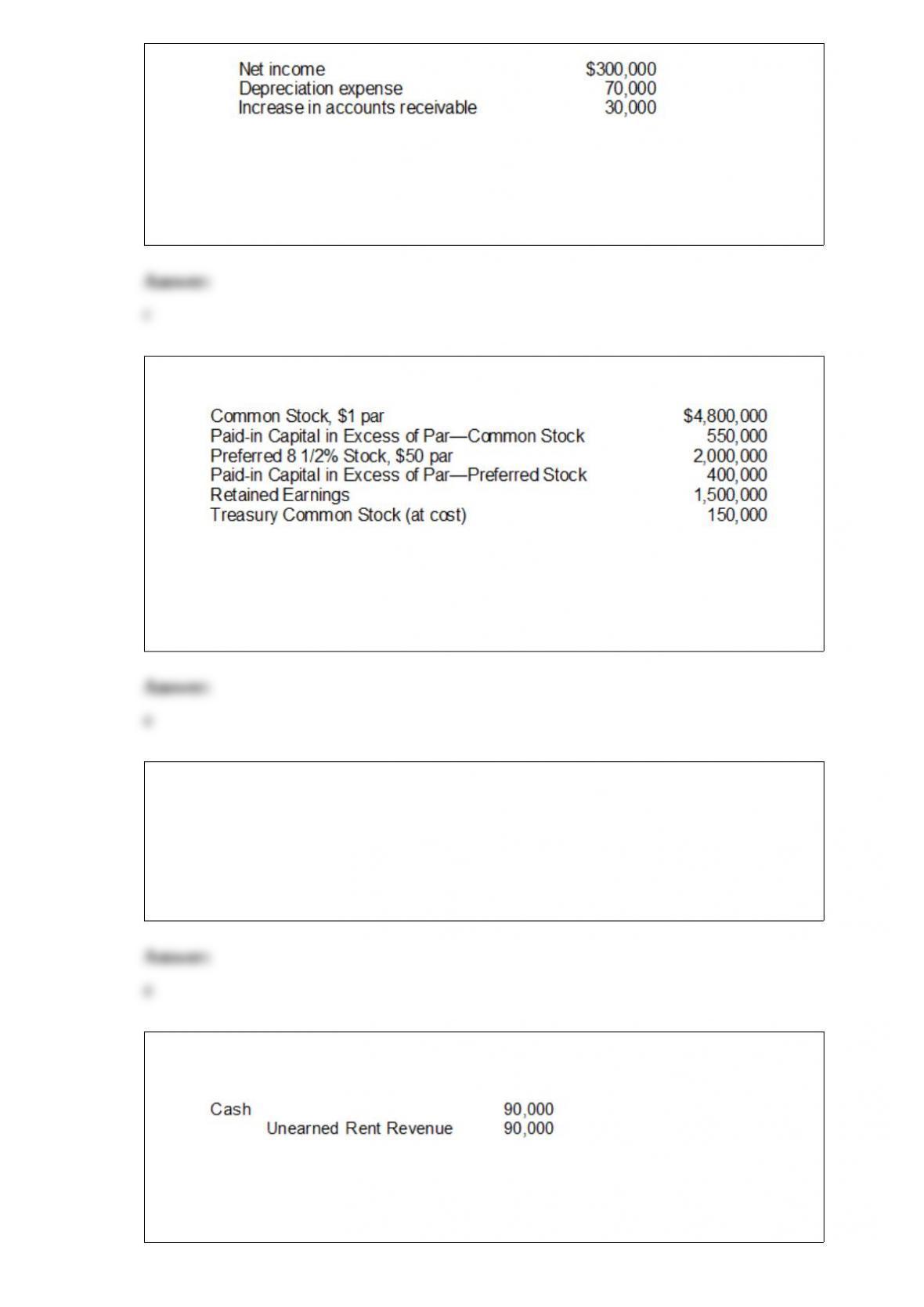
sauder should report cash provided by operating activities of
a.$200,000
b.$260,000
c.$340,000
d.$400,000
29) presented below is information related to hale corporation:
the total stockholders’ equity of hale corporation is
a.$9,100,000
b.$9,250,000
c.$7,600,000
d.$7,750,000
30) designated market value
a.is always the middle value of replacement cost, net realizable value, and net realizable
value less a normal profit margin
b.should always be equal to net realizable value
c.may sometimes exceed net realizable value
d.should always be equal to net realizable value less a normal profit margin
31) kraft company made the following journal entry in late 2012 for rent on property it
leases to danford corporation.
the payment represents rent for the years 2013 and 2014, the period covered by the
lease. kraft company is a cash basis taxpayer. kraft has income tax payable of $138,000
at the end of 2012, and its tax rate is 35%.
assuming the income taxes payable at the end of 2013 is $153,000, what amount of
income tax expense would kraft company record for 2013?
a.$121,500
b.$137,250
c.$168,750
d.$184,500
32) during 2012, lopez corporation disposed of pine division, a major component of its
business. lopez realized a gain of $1,800,000, net of taxes, on the sale of pine’s assets.
pine’s operating losses, net of taxes, were $2,100,000 in 2012. how should these facts be
reported in lopez’s income statement for 2012?
33) how would the declaration and subsequent issuance of a 10% stock dividend by the
issuer affect each of the following when the fair value of the shares exceeds the par
value of the stock?
34) both ifrs and u.s. gaap require current assets to be listed first on the balance sheet.
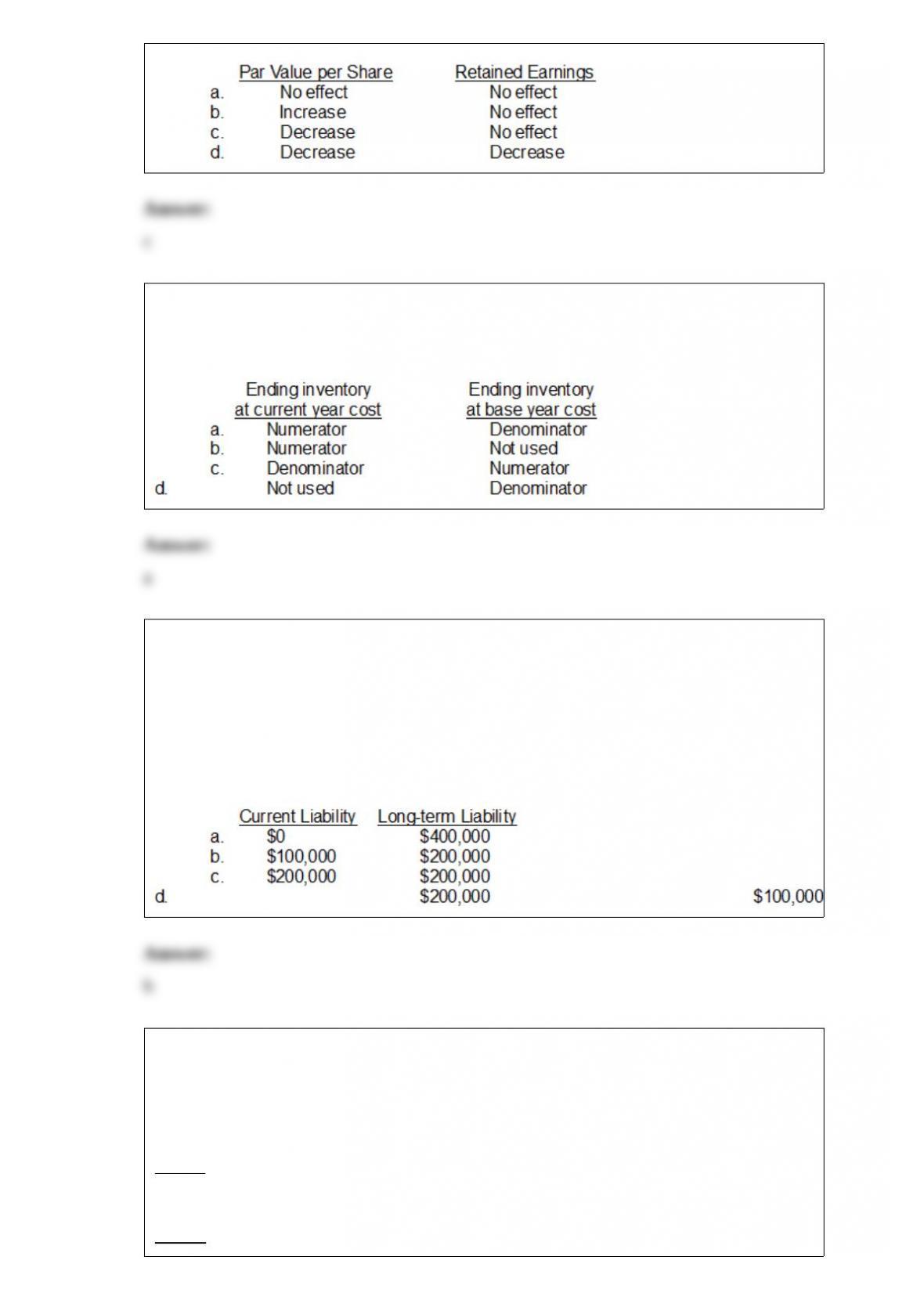
35) what effect does the issuance of a 2-for-1 stock split have on each of the following?
36) when the double extension approach to the dollar-value lifo inventory cost flow
method is used, the inventory layer added in the current year is multiplied by an index
number. how would the following be used in the calculation of this index number?
37) on january 4, 2012, kiley co. leased a building to dodd corp. for a ten-year term at
an annual rental of $100,000. at inception of the lease, dodd received $400,000
covering the first two years’ rent of $200,000 and a security deposit of $200,000. this
deposit will not be returned to dodd upon expiration of the lease but will be applied to
payment of rent for the last two years of the lease. what portion of the $400,000 should
be shown as a current and long-term liability in kiley’s december 31, 2012 balance
sheet?
38) bates company has entered into two lease agreements. in each case the cash
equivalent purchase price of the asset acquired is known and you wish to find the
interest rate which is applicable to the lease payments.
instructions
calculate the implied interest rate for the lease payments.
lease a lease a covers office equipment which could be purchased for $108,144. bates
company has, however, chosen to lease the equipment for $30,000 per year, payable at
the end of each of the next 5 years.
lease b lease b applies to a machine which can be purchased for $114,978. bates
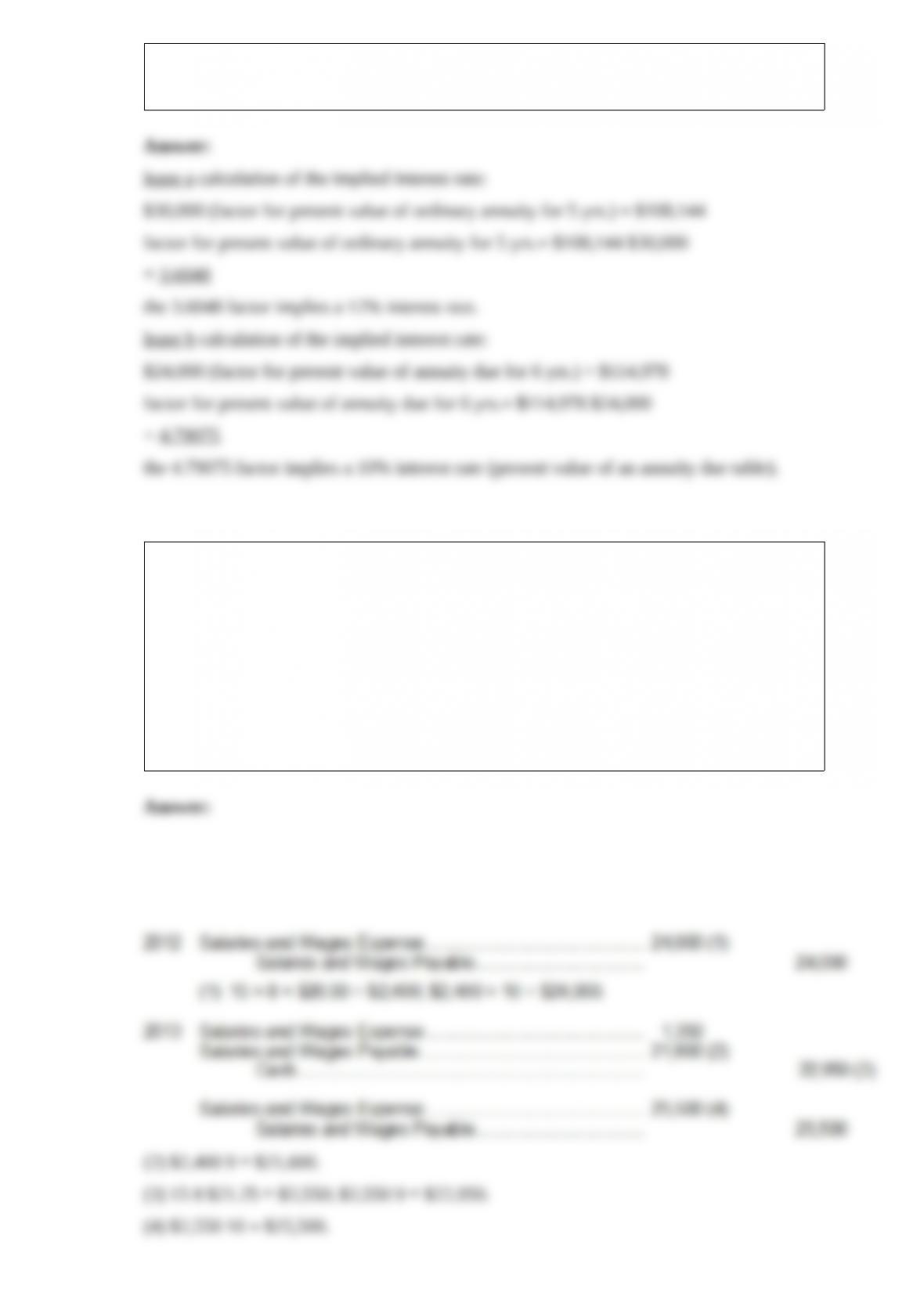
company has chosen to lease the machine for $24,000 per year on a 6-year lease.
payments are due at the start of each year.
39) yates co. began operations on january 2, 2012. it employs 15 people who work
8-hour days. each employee earns 10 paid vacation days annually. vacation days may be
taken after january 10 of the year following the year in which they are earned. the
average hourly wage rate was $20.00 in 2012 and $21.25 in 2013. the average vacation
days used by each employee in 2013 was 9. yates co. accrues the cost of compensated
absences at rates of pay in effect when earned.
instructions
prepare journal entries to record the transactions related to paid vacation days during
2012 and 2013.
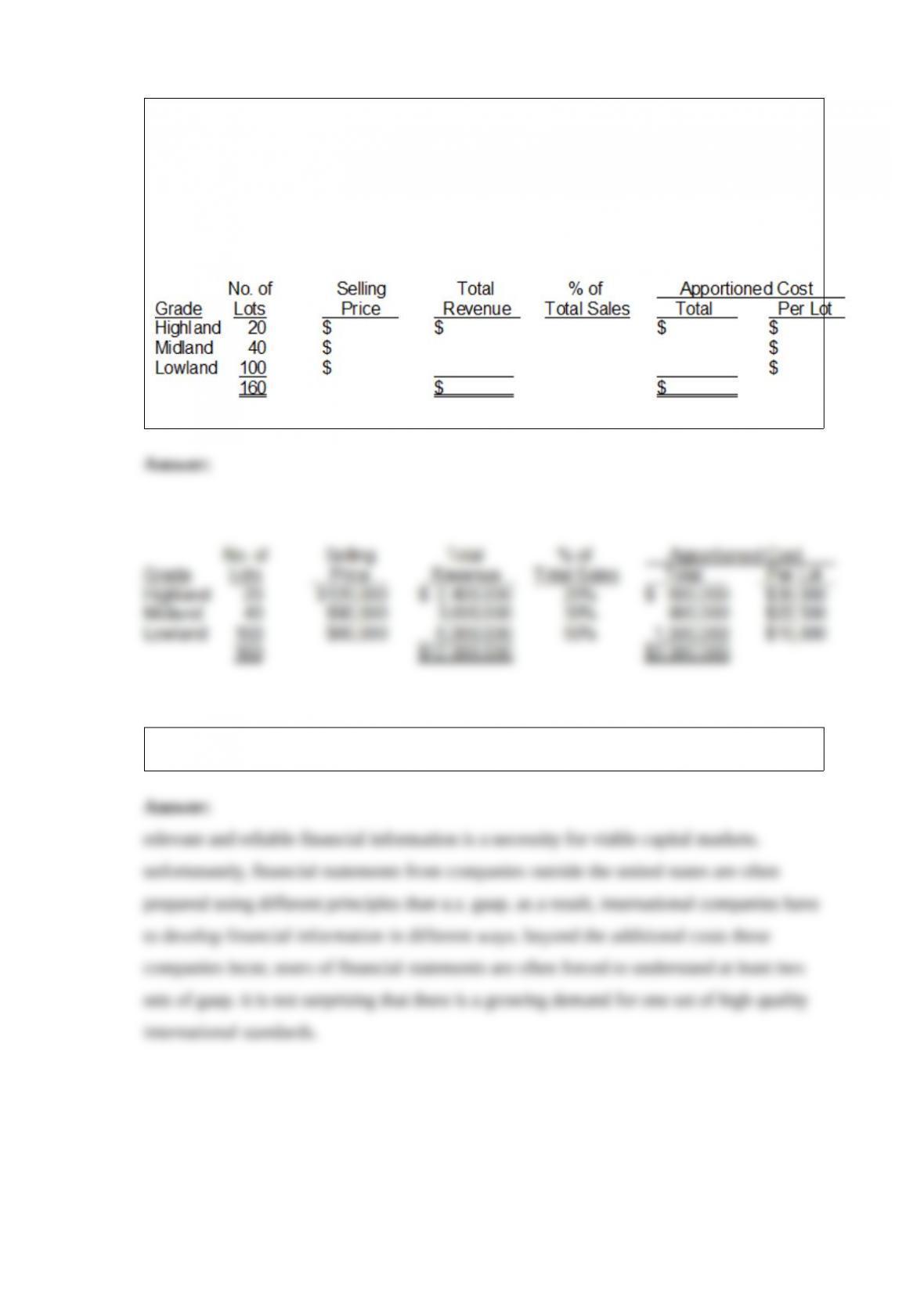
40) doran realty company purchased a plot of ground for $900,000 and spent
$2,100,000 in developing it for building lots. the lots were classified into highland,
midland, and lowland grades, to sell at $120,000, $90,000, and $60,000 each,
respectively.
instructions
complete the table below to allocate the cost of the lots using a relative sales value
method.
41) why would it be advantageous for u.s. gaap and international gaap to be the same?