In process costing, all materials are added at the beginning of the production process,
then labor and overhead is added during the production process.
Operating income = Sales revenue – Variable cost per unit – Total fixed costs.
The cost of goods manufactured includes the cost of everything that is finished during
the period, whether or not it was started during the period.
The learning and growth perspective answers the question, “Are we improving our
business processes in order to deliver maximum value to our customers. “
Budgeting will be ineffective unless it is tied to strategy and used to manage an
organization ‘s overall performance.
If the amount of underapplied or overapplied manufacturing overhead is small, most
companies will make the entry to close the Manufacturing Overhead account by
charging the entire amount to Work in Process.
When preparing the statement of cash flows using the indirect method, non-cash
expenses such as amortization is added to net income to arrive at cash flows from
operating activities.
In an activity-based costing system, the greater the level of detail the company wants to
collect, the greater the chance of misclassifying some costs and activities.
Budgetary slack is also referred to as
a. Budgetary padding.
b. Bottom-up slack.
c. Top-down slack.
d. None of these answer choices are correct.
Holly Industries manufactures artificial holiday wreaths. Its most popular wreath
requires 3 yards of artificial pine boughs and 15 sprigs of holly berries. In August, the
company purchased 4,000 yards of artificial pine bough, and 20,000 sprigs of holly
berries. Holly paid $2.65 per yard for the artificial pine bough, and purchased 4 boxes
of 5,000 sprigs of holly berries for $7,000 per box. The standard price for artificial pine
bough is $2.60 per yard, and the standard price per sprig of holly berry is $1.45. During
August, Holly produced 1,250 wreaths and used 3,625 yards of artificial pine bough
and 19,000 sprigs of holly berries. What is Holly’s direct materials price variance for
artificial pine boughs for August?
a. $200 favorable
b. $200 unfavorable
c. $325 favorable
d. $325 unfavorable
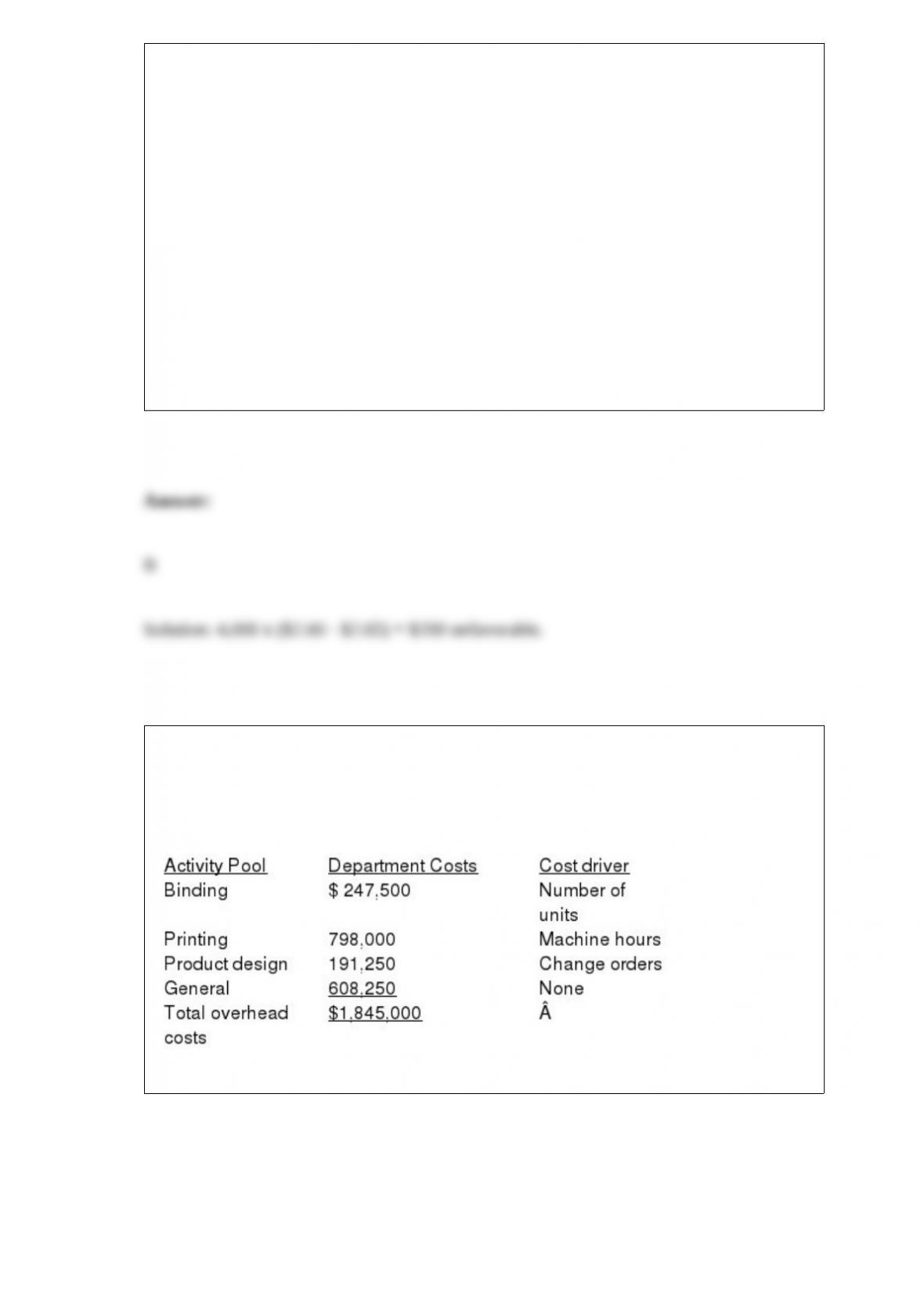
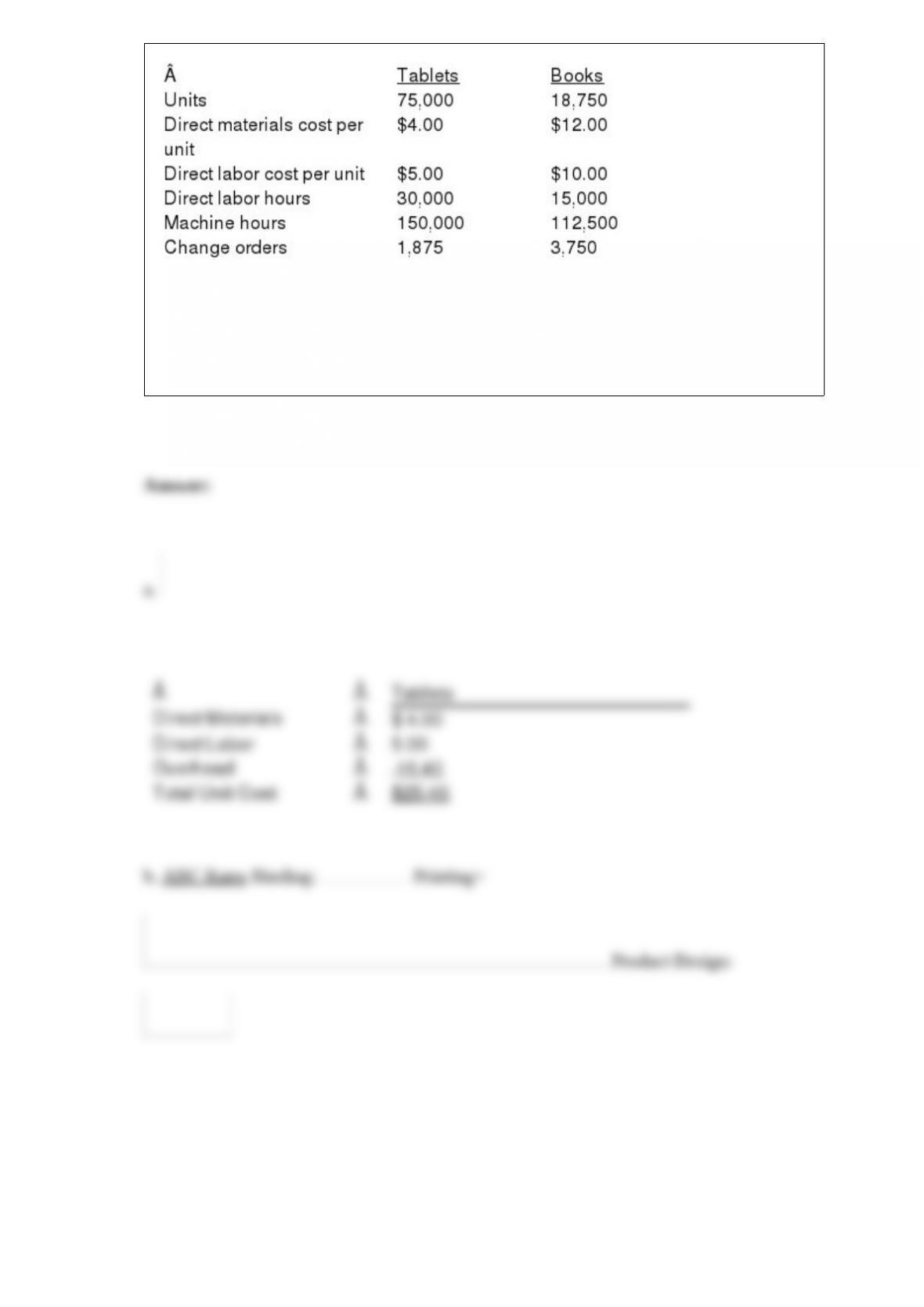
Stockin Company produces Tablets and Books. Total overhead costs traditionally have
been allocated on the basis of direct labor hours. After implementing activity-based
costing, managers determined the following cost pools and cost drivers. They also
decided that general costs should no longer be allocated to products.
Other information is as follows:
Required:
a. Determine the unit product cost for Tablets using the traditional costing system.
b. Determine the unit product cost for Tablets using the activity-based costing system.
Given a present value factor of 3.7907, assuming a 10% discount rate, the present value
of an annuity of $20,000 payment each year for five years is
a. $5,276
b. $26,380
c. $75,814
d. $379,070
When using a standard costing system, which of the following should be recorded to
transfer units to finished goods inventory?

a. Debit finished goods for actual cost and credit work in process for actual cost
b. Debit finished goods for standard cost and credit work in process for standard cost
c. Debit finished goods for standard cost and credit work in process for actual cost
d. Debit finished goods for actual cost and credit work in process for standard cost
The “plus” in cost-plus pricing is often referred to as
a. Extra profit.
b. Margin of Safety.
c. Markup.
d. Gross profit.
Braxton Manufacturing is considering the purchase of new computerized equipment.
The machine costs $75,000 and would generate $22,000 in annual cost savings over its
5-year life. At the end of 5 years, the equipment would have a $5,000 salvage value.
Braxton’s required rate of return is 12%. The machine’s net present value is
a. $695
b. $4,305
c. $7,143

d. $79,306
In selecting the measures for the balanced scorecard, managers should choose between
four and seven measures for each perspective to avoid
a. Strategy overload
b. Measurement overload
c. Information overload
d. Scorecard overload
Your professor is considering retirement. Which of the following will not be relevant in
his decision?
a. The amount of retirement benefits he will receive if he retires
b. The amount of salary he will receive if he does not retire
c. The cost of commuting to and from school
d. All of these answer choices are relevant in making his decision.

Managers use the capital budgeting techniques to make which of the following two
types of capital budgeting decisions?
a. Screening decisions and preference decisions.
b. Screening decisions and pricing decisions.
c. Preference decisions and pricing decisions.
d. None of these answer choices are correct.
To calculate the weighted-average cost of capital we need to know
a. The relative percentage of capital provided by each source.
b. The required rate of return.
c. Both the relative percentage of capital provided by each source and the required rate
of return.
d. Neither the relative percentage of capital provided by each source nor the required
rate of return.
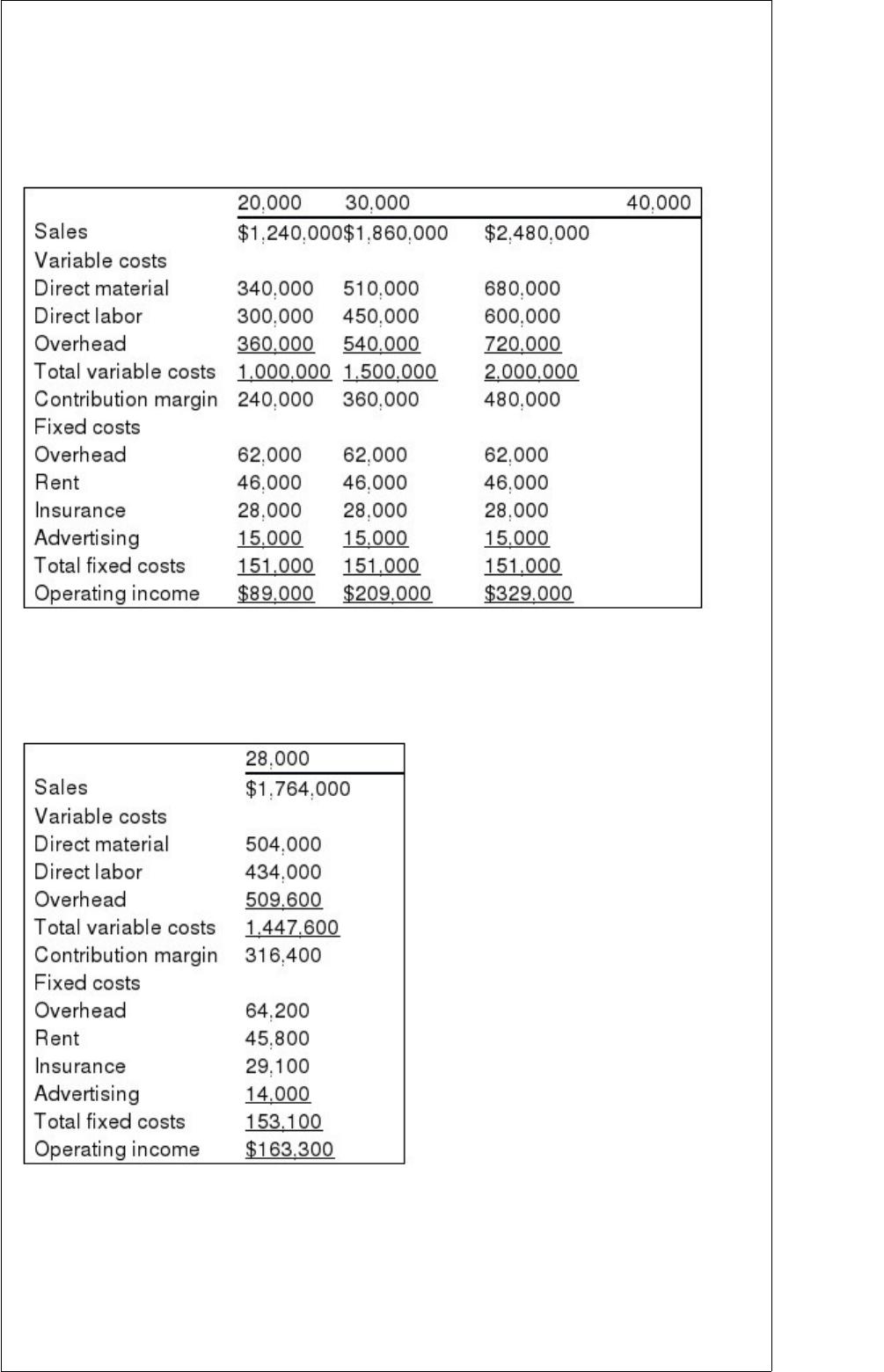
Kevin Jarvis is the controller of Bitterroot Industries. Kevin prepared the following
budgeted income statement at various levels of sales. After careful review of the
budgeted income statements, and after discussions with the sales and production
managers, the CEO determines that the best alternative is to base the budget on a sales
volume of 30,000 units.
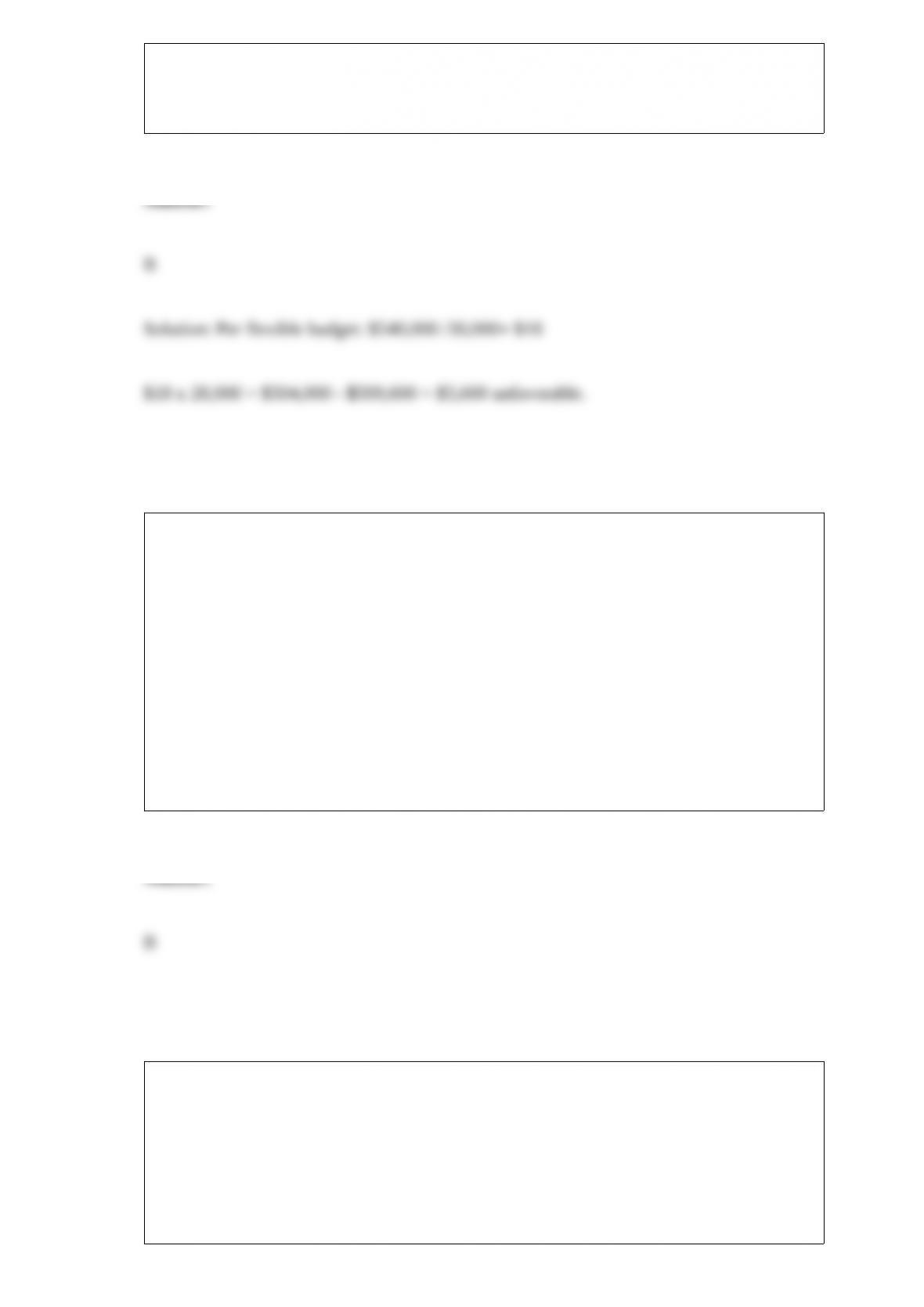
Actual results for the year were 28,000 units, reflected in the following income
statement:
What is the flexible budget variance for variable overhead?
a. $5,600 favorable
b. $5,600 unfavorable
c. $30,400 favorable
d. $34,000 unfavorable
When using the balanced scorecard to monitor performance, the internal business
processes perspective answers which of the following questions?
a. Are we developing employees and providing technologies that facilitate change and
improvement?
b. Are we improving our business processes in order to deliver maximum value to our
customers?
c. Are we meeting our stakeholders’ expectations?
d. Are we growing in a manner to be competitive in the industry?
The calculation for the standard direct labor cost is
a. Standard wage rate per direct labor hour x actual quantity of direct labor hours.
b. Standard wage rate per direct labor hour x standard quantity of direct labor hours.
c. Actual wage rate per direct labor hour x standard quantity of direct labor hours.

d. Actual wage rate per direct labor hour x actual quantity of direct labor hours.
Which of the following is not classified as a period cost?
a. The cost of toner for the sales department laser printer
b. The salary for the president of the company
c. The cost of utilities for the factory building
d. All of the answer choices are classified as period costs.
In changing from a traditional costing system to an activity-based costing system,
overhead costs tend to shift from high-volume standard products to low-volume
premium products because
a. All overhead costs are indirect.
b. Premium products usually consume more activities per unit than standard products.
c. Standard products use more total activities than premium products.
d. None of these answer choices are correct.
When indirect materials are used, which of the following accounts increases?
a. Raw Materials Inventory
b. Work in Process Inventory
c. Finished Goods Inventory
d. Manufacturing Overhead
Because the organization’s vision and strategy lie at the heart of the balanced scorecard,
the first step in developing the scorecard is to clarify the strategic focus. As part of this
process, organizations may develop a strategy map.
Required:
a. What is a strategy map?
b. Discuss the process of building a balance scorecard.
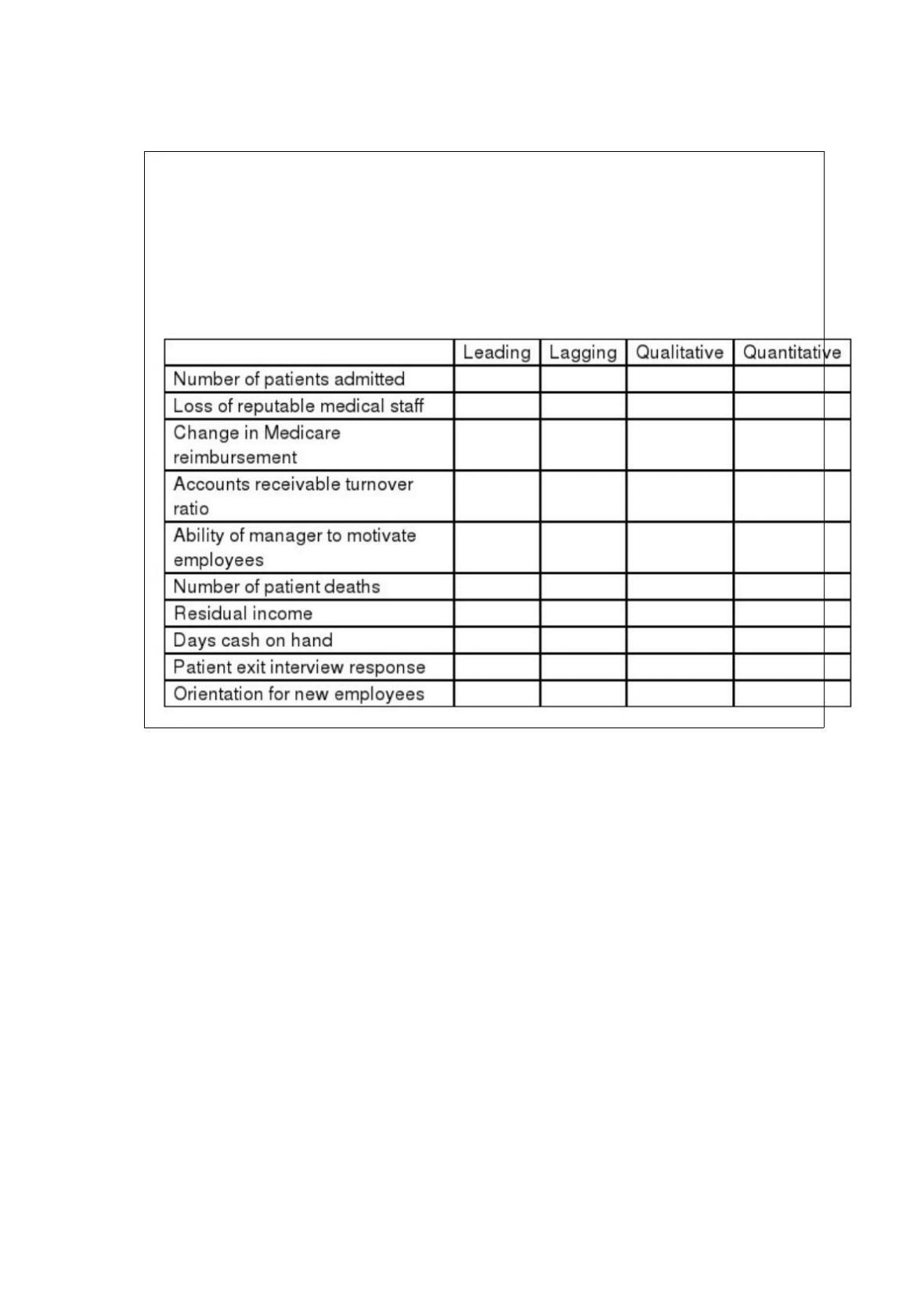
Community Hospital is reassessing their performance measurements. The hospital
accounting administrator has asked supervisors to submit items they believe should be
used in evaluating performance related to their individual departments. The supervisors
have submitted a number of suggestions. Indicate by placing an “X ” in the appropriate
column whether the following measures are leading or lagging and qualitative or
quantitative. Each item may classify as more than one measure.
List the four balanced scorecard perspectives.
A cost center manager ‘s performance is measured largely by comparing the actual costs
incurred to the flexible budget.
Press Smart’s pressing machine sells for $185,556. At this price, the annual cost savings
that the pressing machine will generate for Rob’s Dry Cleaner over its 8-year life will
yield an internal rate of return of 12%. Rob’s Dry Cleaner requires that all projects
achieve a return of 15%.
Required
What price does Rob’s Dry Cleaner need to negotiate with Press Smart so that the
system will achieve that return?
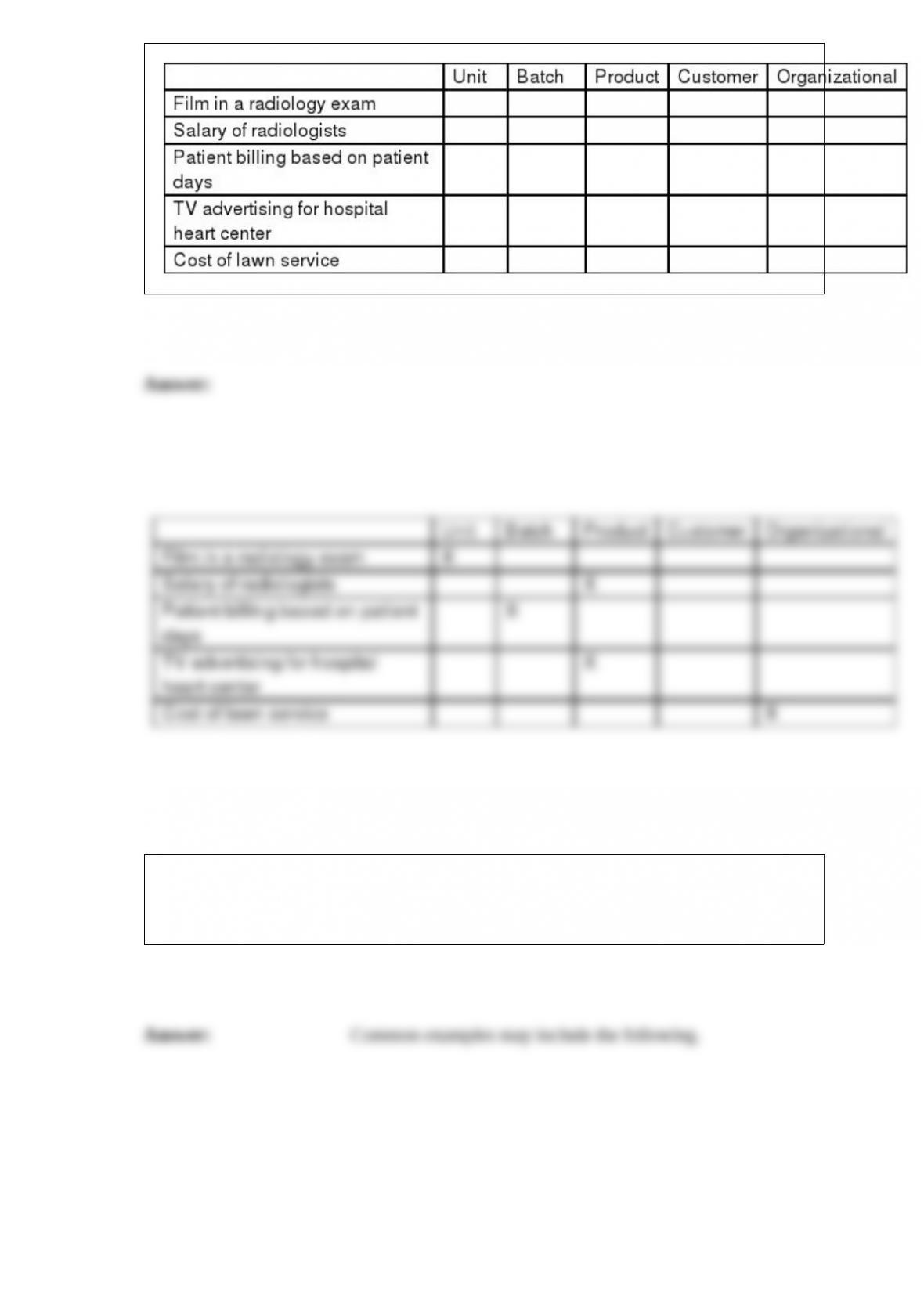
Place an “X” in the column that corresponds to the type of activity level referred to in
the following hospital setting.
Two ways to develop a competitive advantage is through product differentiation and
low-cost production. List three examples of managerial accounting information a
company might need to monitor each of these strategies.
A key component of a positive ethical environment is “tone at the top.” Discuss what
this term means, and why this is a key component.