The variable overhead spending variance is calculated as
a. Actual cost – (actual quantity x standard price).
b. Actual cost – (standard quantity x standard price).
c. Standard cost – (actual quantity x actual price).
d. Actual results minus flexible budget amount.
Camping Suppliers, Inc. manufactures two types of safety strobe lights, one that is
visible for one mile and one that is visible for two miles. Manufacturing overhead has
been applied on the basis of direct labor costs. Camping Suppliers has gathered some
activity information and is interested in implementing an activity-based costing system.
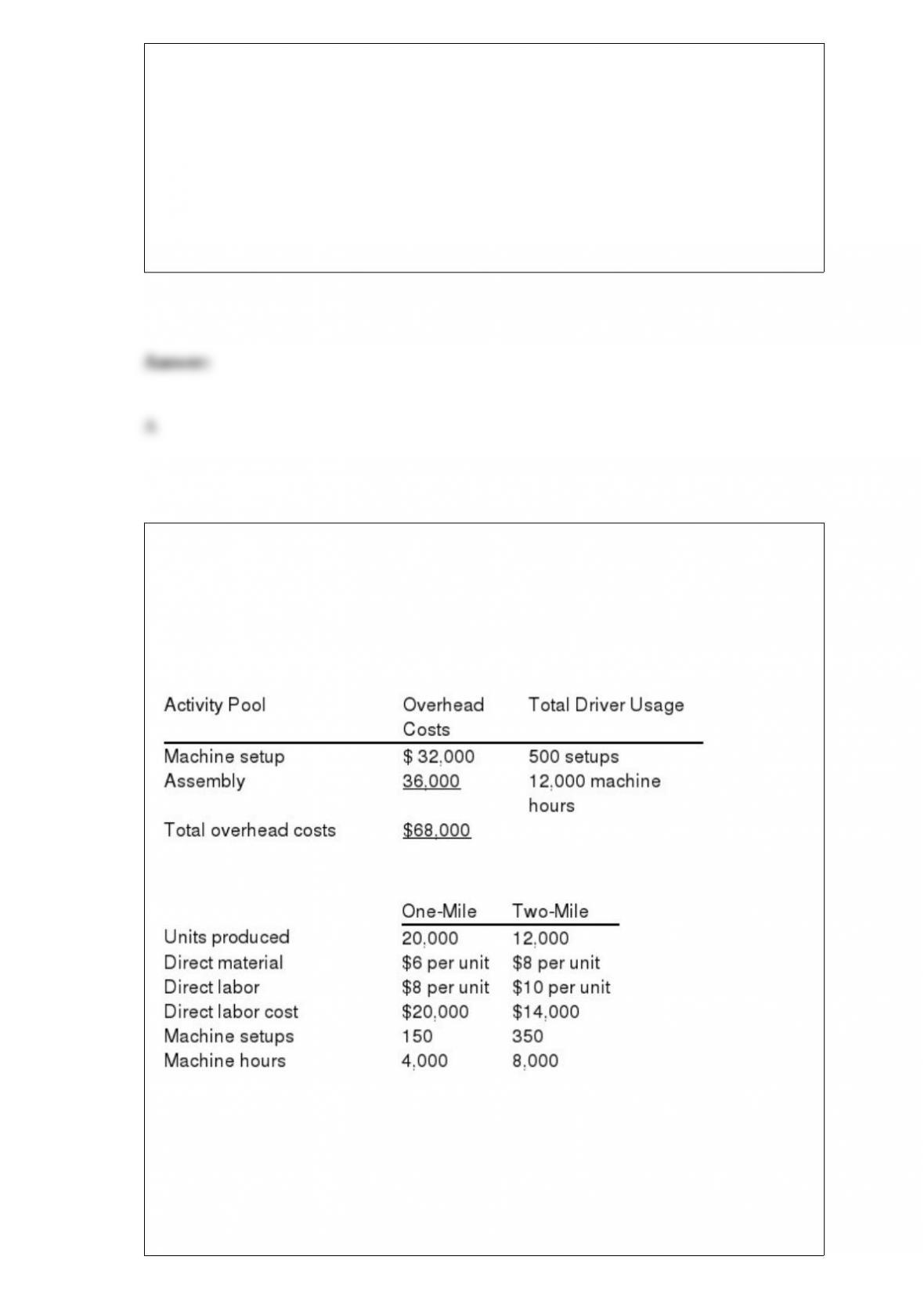
The company wants all overhead costs to be allocated to products. The overhead cost
pools and activity drivers are as follows:
Other product information is as follows:
Required:
a. Using the traditional method, calculate the predetermined overhead rate as a
percentage of direct labor cost.
b. Using the activity-based costing approach, determine the two activity rates.
c. Using the activity-based costing approach, determine the unit product cost for the one
mile light.
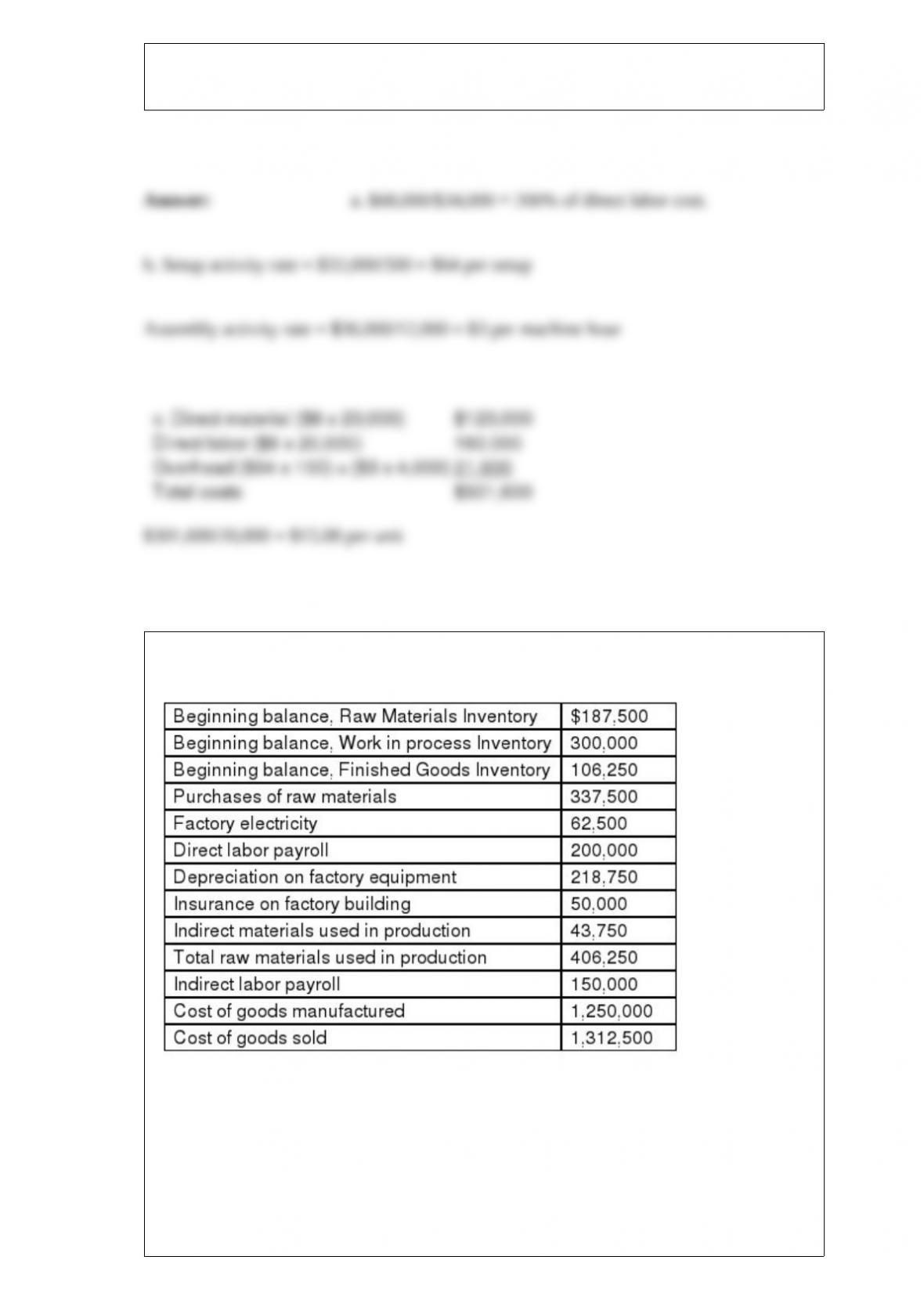
Basil Industries reported the following information for December:
What was the ending balance in Basil’s Work in Process Inventory account?
a. $181,250
b. $137,500
c. $75,000
d. $262,500
Which of the following is not relevant in the decision to accept a special order?
a. Depreciation on factory equipment.
b. Variable cost of the product.
c. Sales commissions based on a percentage of the sales price.
d. All of these answer choices are relevant.
Investors, employees, managers, and creditors are all interested in a company’s ability
to remain profitable over the long-run. Answer the following questions relating to
profitability ratios. a. What does the gross margin percentage measure and how is it
calculated? b. What does the return on assets measure and how is it calculated? c. What
does the return on common stockholders’ equity measure and how is it calculated?

To calculate the present value of any future amount, you can use which of the following
tables?
a. Present value of $1 received in n periods
b. Future value of $1 received in n periods
c. Present value of an annuity
d. Future value of an annuity
Which of the following is not a reason a company would be willing to accept new
business at a loss?
a. The company has the expectation that it will make up for it in later years.
b. The company has the expectation that certain customers can influence other potential
customers.
c. The company has the expectation that its estimates will prove incorrect and that the
business will result in a profit.
d. All of these answer choices are correct.

The formula for margin of safety in units is
a. Current unit sales minus breakeven unit sales.
b. Actual net income minus budgeted net income.
c. Actual sales minus budgeted sales.
d. Breakeven sales minus budgeted sales.
At the breakeven point
a. Sales revenue equals zero.
b. Contribution margin equals total variable costs.
c. Sales revenue equals total costs.
d. Operating income equals total costs.
The Transformer division of Lorman Industries produces transformers that can be sold
to outside customers or transferred to the Electronics division of the company. The
following information has been collected by Lorman ‘s controller:
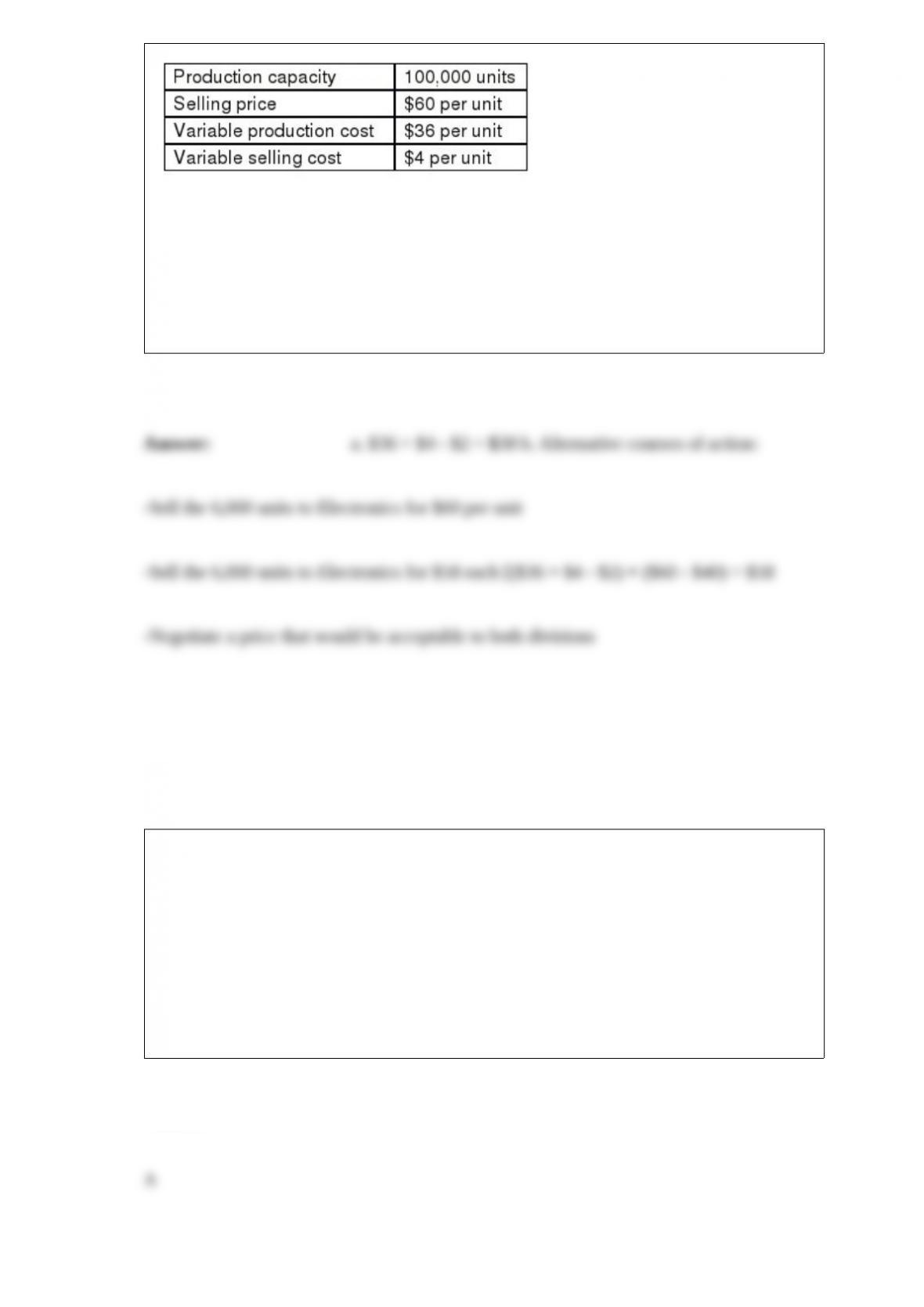
Number of transformers needed by Electronics 6,000 If the Transformer division
transfers its units to the Electronics division, it can avoid $2 of the variable selling cost.
Required: a. If the Transformer division can only sell 80,000 units to outside customers,
what is the lowest acceptable transfer price that it is willing to accept for the 6,000
units? b. If the Transformer division can sell all 100,000 units to outside customers, list
three courses of actions that the division might consider to provide the units to
Electronics.
Product-level activities are also referred to as
a. Product-sustaining activities.
b. Product resource activities.
c. Batch-level activities.
d. None of these answer choices are correct..