Facility-level costs are not involved in decisions to eliminate a segment of a business.
Wayne Company wishes to allocate overhead costs in a heavily automated production
department. Direct labor hours would be a less appropriate cost driver than machine
hours.
Joint costs are irrelevant in a decision to sell a joint product at the split-off point or
process it further.
On a cost-volume-profit graph, the total revenue line begins at the break-even point and
slopes upward to the right.
One of the potential dangers from outsourcing is the possible occurrence of low-ball
pricing.

The assumption regarding ordinary annuities is that cash flows occur at the end of each
period.
Contribution margin can only be determined if costs are separated into product and
period costs.
An increase in prevention costs may result in decreases in appraisal, internal failure,
and external failure costs and a decrease in total quality costs.
If managers’ performance is evaluated solely on the current year’s profitability,
managers are likely to make decisions that lead to the company’s long-term profitability.
The concept of cost of quality is not applicable in service-type businesses such as
accounting firms.
Relevant costs are frequently called unavoidable costs.
Blanton Company wishes to allocate rent expense of $24,000 to its three operating
departments, A, B, and C. Assuming the three departments occupy 10,000, 20,000 and
30,000 square feet respectively, the cost allocation rate for Department C is $0.80 per
square foot.
The indirect method for preparing the statement of cash flows begins with the amount
of sales revenue reported on the income statement.

Service companies do not have work in process and finished goods accounts.
In preparing the statement of cash flows by the indirect method, noncash revenues and
gains are added to net income.
A cost that is part selling cost and part manufacturing cost is referred to as a mixed cost.
Under the direct method, cash payments to suppliers would be reported in the operating
section of a cash flow statement.
The time spent moving a product from one processing department to the next
processing department is an example of a value-added activity.

Job-order and process cost systems are used only in the United States.
In which account is the actual amount of costs such as factory utilities and maintenance
initially recorded?
A. Work in process inventory
B. Manufacturing overhead
C. Raw materials inventory
D. Supplies inventory
As of December 31, 2013, Gant Corporation had a current ratio of 1.29, quick ratio of
1.05, and working capital of $18,000. The company uses a perpetual inventory system
and sells merchandise for more than it cost. On January 1, 2014 Gant paid $3,600 on
accounts payable. Which of the following statements is incorrect?
A. Gant’s quick ratio will increase and its current ratio will decrease.
B. Gant’s quick ratio will increase.

C. Gant’s working capital will remain the same.
D. Gant’s current ratio will increase.
Kokko Company makes a product that is expected to require 2 hours of labor per unit of
product. The standard cost of labor is $6.00. Kokko actually used 2.1 hours of labor per
unit of product. The actual cost of labor was $6.25 per hour. Kokko made 1,100 units of
product during the period. Based on this information alone, the labor usage variance is:
A. $190 favorable.
B. $660 unfavorable.
C. $600 favorable.
D. $660 favorable.
During 2013, the Kemp Construction Company built 23 custom homes that ranged in
size from 2,500 square feet to 8,000 square feet. One home was completed each month
during January, February, and March. Three homes were completed during April and
May. Two homes were completed during each of the months from June through
December. Based upon this information, the most appropriate allocation base (i.e., cost
driver) for the assignment of indirect overhead costs to each house would be the:
A. Number of homes built during the month.
B. Number of months in the year.
C. Number of homes built during the year.

D. Size of the home.
Sturbridge Company manufactures fine furniture and grandfather clocks. Sturbridge has
an excellent reputation, and each grandfather clock sells for several thousand dollars.
Which of the following should not be treated as direct costs, assuming the cost object is
individual clocks?
A. The clock face
B. The timing mechanism for each clock
C. Wood
D. Depreciation on clock-making equipment
Beta Company determined that its manufacturing overhead for 2014 was overapplied
by $1,400. It closed the amount to cost of goods sold. The recognition of this
transaction will:
A. Decrease cost of goods sold.
B. Increase cost of goods sold.
C. Have no impact on cost of goods sold.
D. None of these.

The study of an individual financial statement item over several accounting periods is
called:
A. Horizontal analysis.
B. Vertical analysis.
C. Ratio analysis.
D. Time and motion analysis.
Newton Company is considering the purchase of an asset that will provide a
depreciation tax shield of $10,000 per year for 10 years. Assuming the company is
subject to a 40% tax rate during the period, and a zero salvage value, what is the
depreciable cost of the new asset?
A. $100,000
B. $250,000
C. $400,000
D. Can’t be determined from the information provided

The Ferguson Company estimated that October sales would be 100,000 units with an
average selling price of $6.00. Actual sales for October were 105,000 units and average
selling price was $5.95.
The sales volume variance was:
A. $30,000 favorable.
B. $30,000 unfavorable.
C. $29,750 favorable.
D. $29,750 unfavorable.
Which of the following costs would be classified as a direct cost for a company that
produces motorcycles?
A. Rent of manufacturing facility that produces motorcycles
B. Seats used in the motorcycles
C. Wages of motorcycle assembly workers
D. Both Seats used in the motorcycles and Wages of motorcycle assembly workers are
correct.
Former NFL coach Joe Gibbs is highly sought after as a guest speaker. His fee can run
as high as $150,000 for a single two-hour appearance. Recently, he was asked to speak
at a seminar offered by the National Sports in Education Foundation (NSEF). Due to
the charitable nature of the organization, Mr. Gibbs offered to speak for $100,000.

NSEF planned to invite 350 guests who would each make a $500 contribution to the
organization. The Foundation’s executive director was concerned about committing so
much of the organization’s cash to this one event. So instead of the $100,000 fee she
countered with an offer to pay Mr. Gibbs 50% of the revenue received from the seminar
and no other payments.
Required:
(a) Classify the two offers in terms of cost behavior (fixed vs. variable).
Scenario A, NSEF pays Gibbs a $100,000 fee:
Scenario B, NSEF pays Gibbs 50% of revenue:
(b) Compute the budgeted income (assuming there are no other expenses) under each of
the following scenarios:
1) NSEF agrees to pay the $100,000 fee, and 350 guests actually attend the seminar;
and
2) NSEF pays Mr. Gibbs 50% of revenue, and 350 guests attend the seminar.
(c) For each scenario ($100,000 fee vs. 50% of revenue), compute the percentage
increase in profit that would result if the Foundation is able to increase attendance by 20
percent over the original plan (to a total of 420).
(d) For each scenario, compute NSEF’s cost per contributor if 350 attend and if 420
contributors attend.
(e) Summarize the impact on risk and profits of shifting the cost structure from fixed to
variable costs.

During 2014, the Abbot Company had the following changes in account balances:
1) The accumulated depreciation account had a beginning balance of $25,000 and an
ending balance of $35,000. The increase was due to depreciation expense.
2) The long-term notes payable account had a beginning balance of $40,000 and an
ending balance of $15,000. The decrease was due to repayment of debt.
3) The accounts receivable account had a beginning balance of $60,000 and an ending
balance of $50,000.
4) The equipment account had a beginning balance of $25,000 and an ending balance of
$92,500. The increase was due to the purchase of equipment for cash.
5) The long term investments account (marketable securities) had a beginning balance
of $18,000 and an ending balance of $12,500. The decrease was due to the sale of
investments at cost.
6) The amount of cash dividends declared and paid during the year was $22,000.
7) The interest payable account had a beginning balance of $2,250 and an ending
balance of $1,250.
What is the net cash flow from investing activities?
A. $62,000 outflow
B. $62,000 inflow
C. $72,000 inflow
D. $72,000 outflow
The following information was drawn from Eckerd Company’s 2014 and 2013 year-end
balance sheets.

$50,000 of new bonds were issued during 2014. What is the amount of cash flow
associated with the repayment of bond liabilities?
A. $120,000
B. $150,000
C. $30,000
D. Cannot be determined
Select the correct statement regarding activity-based costing (ABC).
A. ABC does not use cost drivers.
B. ABC uses a single activity center but multiple cost drivers.
C. ABC uses multiple activity cost centers and multiple cost drivers.
D. ABC uses multiple activity cost centers but a single cost driver.
During its first year of operations, Silverman Company paid $14,000 for direct
materials and $19,000 for production workers’ wages. Lease payments and utilities on
the production facilities amounted to $17,000 while general, selling, and administrative
expenses totaled $8,000. The company produced 5,000 units and sold 3,000 units at a
price of $15.00 a unit.
What is Silverman’s cost of goods sold for the year?
A. $50,000

B. $24,600
C. $30,000
D. $41,000
Select the incorrect statement from the following.
A. If overhead costs are allocated on the basis of activities, the amount of overhead
allocated to a particular product can be reduced by increasing the number of activities
required by the product, thereby spreading the overhead costs over more units.
B. Activity costs are considered relevant for decision making because the cost of an
activity will be avoided if the activity is eliminated.
C. In highly automated environments where companies produce many different
products with varying levels of production, activity-based cost drivers are superior to
volume-based drivers.
D. Activity-based cost drivers produce a better cost allocation than volume-based
drivers because they distribute only relevant costs to the appropriate products.
If a company had a pure variable cost structure, what would be the relationship between
contribution margin and net income, and what would be the magnitude of operating
leverage?
Indicate whether each of the following statements is true or false.
An inventory purchases budget is prepared based on sales projections from the sales
budget.
The amount of budgeted purchases of inventory equals cost of goods sold plus the
beginning inventory less ending inventory.
The inventory purchases budget generally includes a schedule of cash payments for the
period.
The amount of cost of goods sold reported on the pro forma income statement comes
from the inventory purchases budget.
The inventory purchases budget indicates the amount expected for ending inventory,
which is reported on the pro forma income statement.
Illustrate with examples how cost definitions are independent and context sensitive. In
other words, indicate how a cost can be classified as fixed or variable and direct or
indirect, depending on the situation.
What are examples of budget gamesmanship that may occur in a company, and how can
the gamesmanship be reduced?
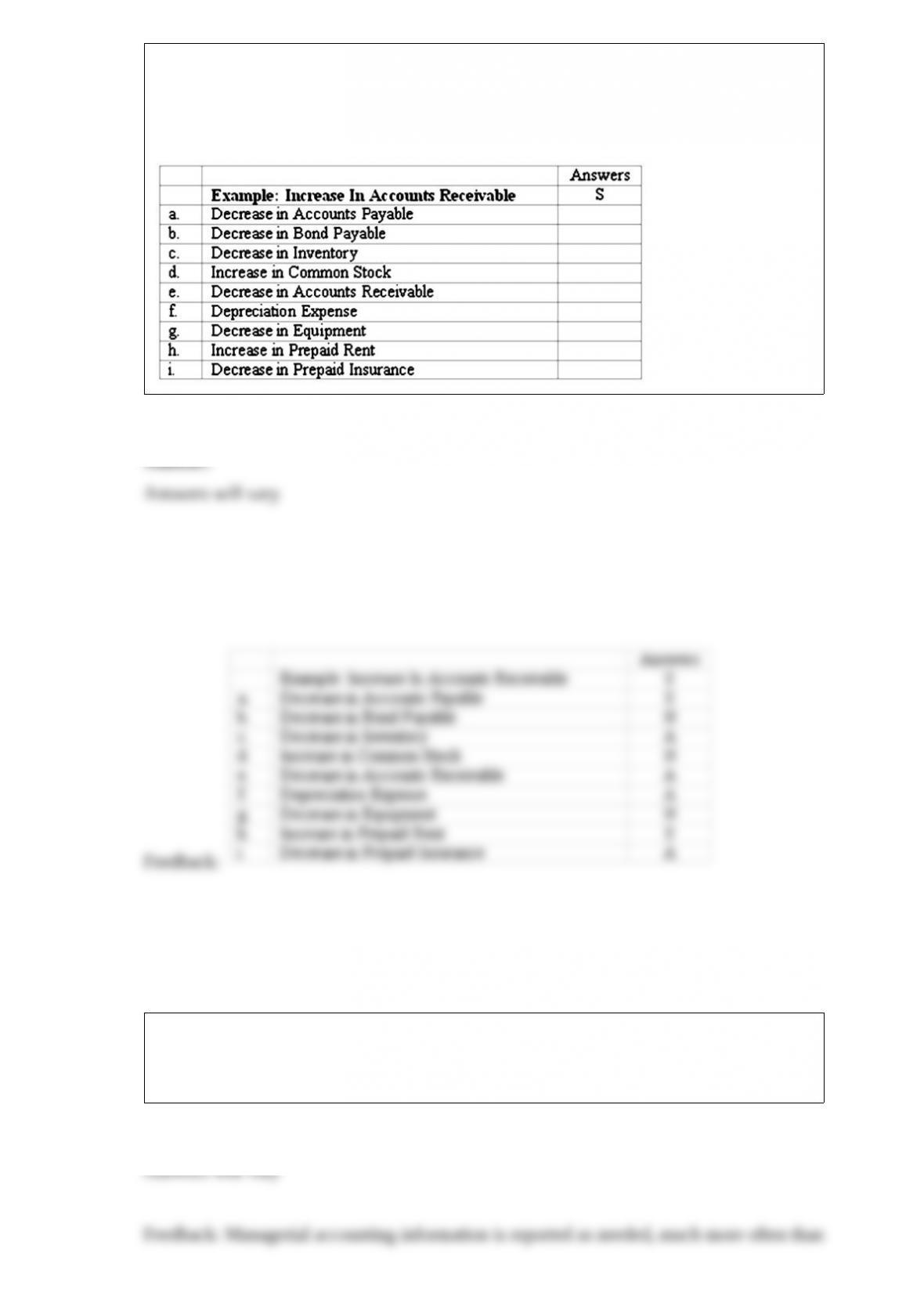
Assuming the use of the indirect method to prepare the statement of cash flows, indicate
whether each of the following items would be added to net income, subtracted from net
income or not included in the operating activity section. Use the letters “A” for added;
“S” for subtracted or “N” for not included in operating activity section.
Financial accounting information is reported periodically, primarily at the end of each
fiscal year. When is managerial accounting information reported to managers of an
organization?
Indicate whether each of the following statements is true or false.
Companies group several individual overhead costs into cost pools to simplify the
allocation process.
A cost pool should include costs that will all be allocated to a single cost object.
When a cost pool is used, costs are allocated individually to the cost object.
Using cost pools to group costs generally does not reduce the usefulness of the resulting
product costs.
If you were drawing a cost-volume-profit graph for a company, what lines would you
plot on the graph?