When a process cost accounting system assigns the cost of materials to a production
department, the journal entry debits the Raw Materials Inventory account and credits
the Goods in Process Inventory account for that department.
Cost-volume-profit analysis is a precise tool for perfectly predicting the profit
consequences of cost changes, price changes, and volume changes.
The choice of an inventory valuation method can have a major impact on gross profit
and cost of sales.
When materials are used as indirect materials, their cost is debited to the Factory
Overhead account.
The legitimate claims of a business’s creditors take precedence over the claims of the
business owner.
It is acceptable to record cash received in advance of providing products or services to
revenue accounts.
Gain or loss on the disposal of assets is determined by comparing the disposed asset’s
book value to the market value of any assets received.
Process cost accounting systems are commonly used by companies that manufacture
standardized products by passing them through a series of manufacturing steps.
The LIFO method of inventory valuation can result in a company’s ending inventory
being valued at less than the inventory’s replacement cost because LIFO inventory
leaves the oldest costs in inventory.
The income of a corporation is subject to taxation.
All stock dividends are recorded at par value and no paid-in capital in excess of par
value is ever recorded.
The purchase of stock in another company is classified as a financing activity.
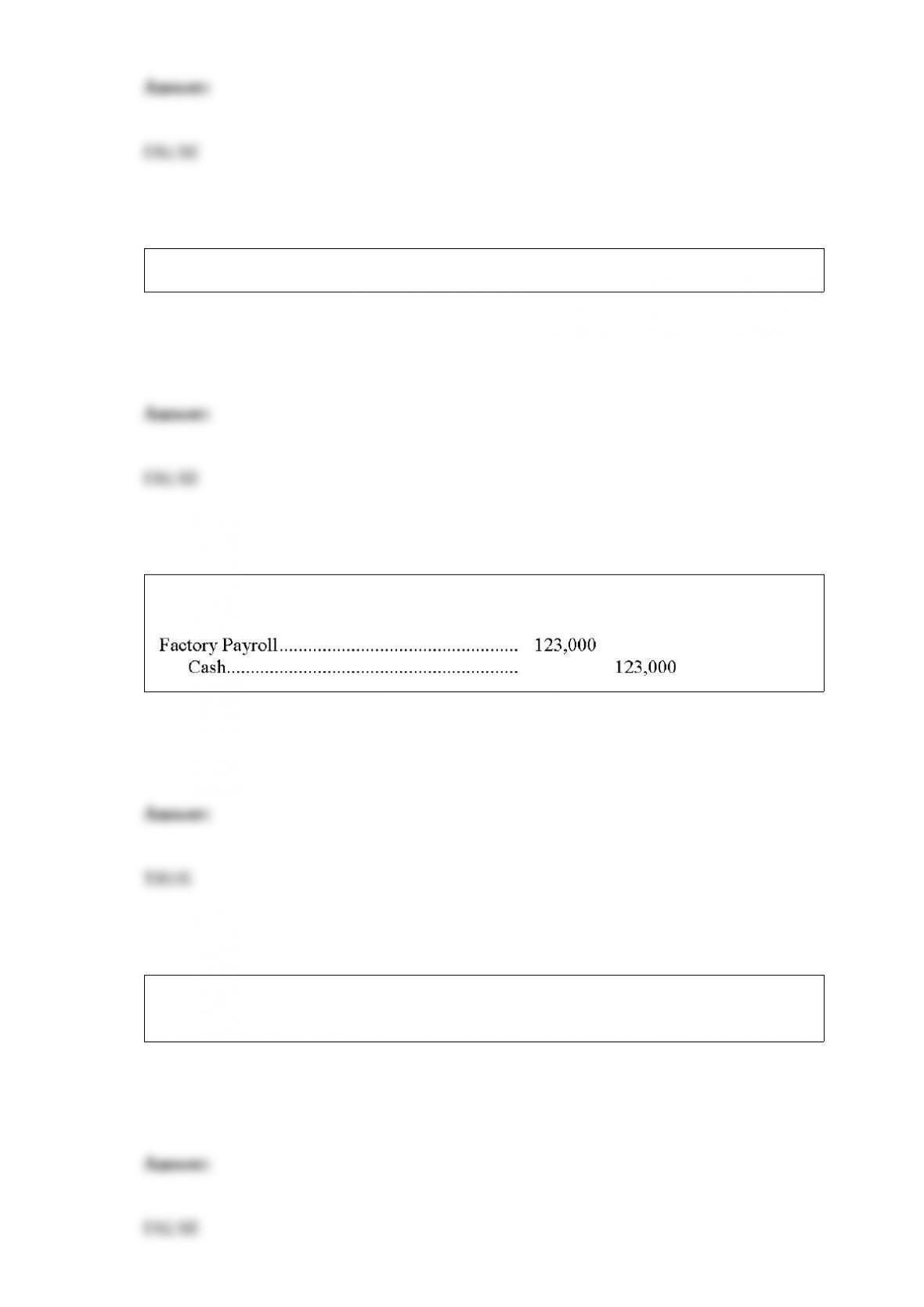
If the factory labor cost for a month was $123,000 (paid in cash), the following journal
entry would be recorded by the process cost accounting system:
Brouski had $750 million in accounts receivable and $2,900 million in net sales for the
current period. Its days’ sales uncollected ratio equals 3.9 days.
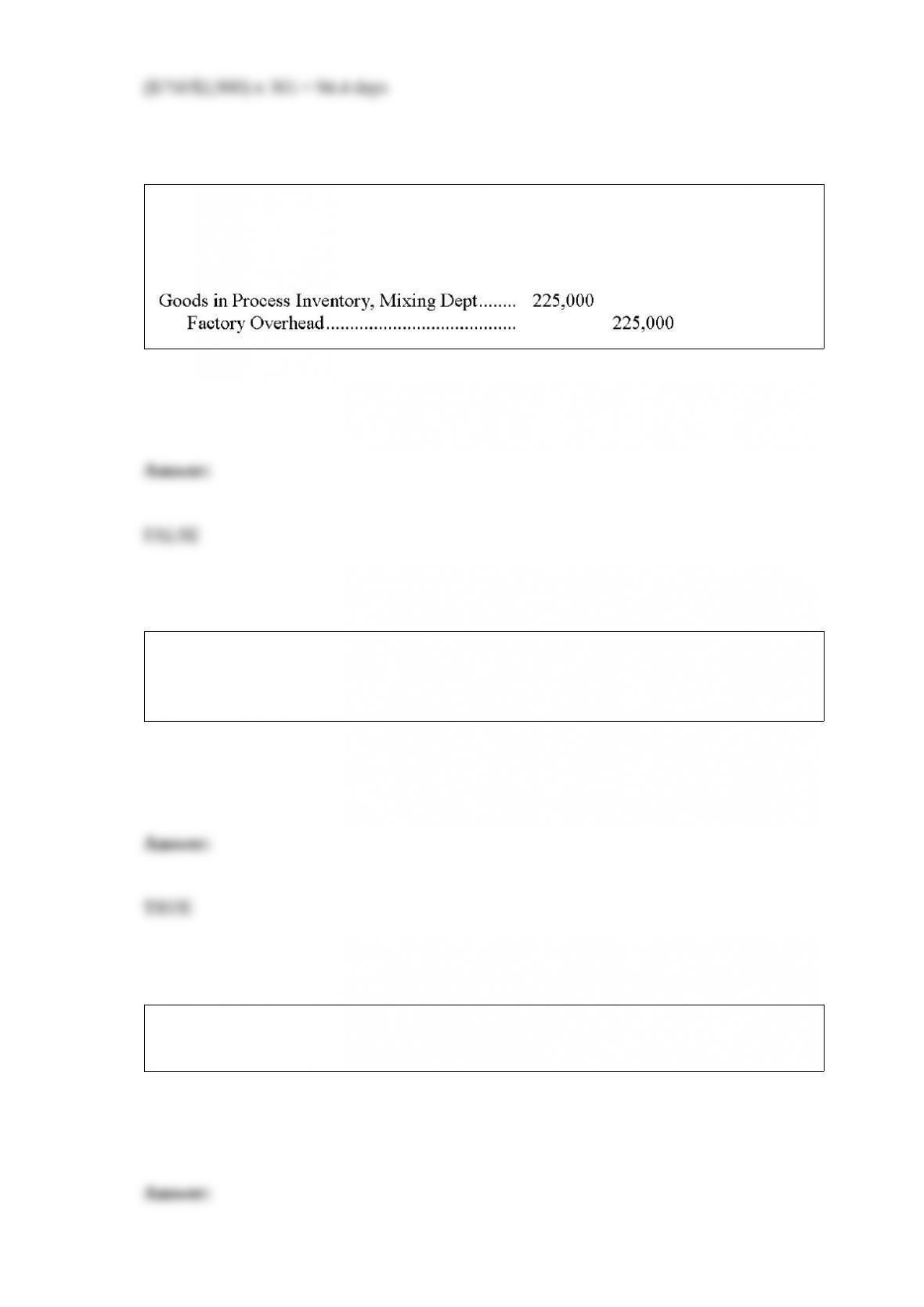
If the predetermined overhead allocation rate is 225% of direct labor cost, and the
Mixing Department’s direct labor cost for the reporting period is $10,000, the following
entry would be made to record the allocation of overhead to the products processed in
this department:
General-purpose financial statements include the (1) income statement, (2) balance
sheet, (3) statement of changes in equity (or statement of retained earnings), (4)
statement of cash flows, and (5) notes to these statements.
An invoice is an itemized statement of goods prepared by the vendor listing the
customer’s name, items sold, sales prices, and terms of sale.
The days’ sales uncollected ratio is calculated by dividing accounts receivable by net
sales and then multiplying by 365.
Under the net method an invoice for $2,000 with terms of 2/10, n/30 should be recorded
with a debit to Inventory and a credit to Accounts Payable of $2,000.
Callable bonds have an option exercisable by the issuer to retire them at a stated dollar
amount prior to maturity.
The report form is considered to be the only correct format for the balance sheet.
An opportunity cost requires a future cash outlay and is relevant for decision making.
In closing the accounts at the end of a period, the partners’ capital accounts are credited
for their share of the partnership loss or debited for their share of the partnership net
income.
Debit means the right side of an account.
Accountants use the term “process cost accounting system” because these systems use a
number of trained individuals and computers to process the collected cost information.
The work sheet is a book of original entry used to record transactions and events as they
occur.
Return on total assets for a cost center is a useful measure to evaluate the cost center
manager.
The price-earnings ratio reveals information about the stock market’s expectations for a
company’s future growth in earnings, dividends, and economic opportunities.
When a company bills a customer for $600 for services rendered, the journal entry to
record this transaction will include a $600 debit to Services Revenue.
Incidental costs often added to the costs of inventory include import duties, freight,
storage, and insurance.
A note payable can be used to extend the payment due on an account payable.
When the contract rate is above the market rate, a bond sells at a discount.
The days’ sales uncollected ratio measures a company’s ability to manage its debt.
Sales discounts is a contra revenue account, meaning that the Sales Discounts account
is added to the Sales account when computing a company’s net sales.

An unincorporated association of two or more persons to carry on a business for profit
as co-owners is a:
A.Partnership.
B.Proprietorship.
C.Contractual company.
D.Mutual agency.
E.Voluntary organization.
A hybrid costing system would be most appropriate when:
A.A manufacturer is able to standardize processes while at the same time attempting to
cater to individual customer needs.
B.Large quantities of identical products are being produced.
C.The volume of production is low and costs are high.
D.There is no standardization of units of production.
E.All of these would necessitate a hybrid costing system.
Net income divided by net sales is the:
A.Return on total assets.

B.Profit margin.
C.Current ratio.
D.Total asset turnover.
E.Days’ sales in inventory.
At the end of the accounting period, the owners of debt securities:
A.Must report the dividend income accrued on the debt securities.
B.Must retire the debt.
C.Must record a gain or loss on the interest income earned.
D.Must record a gain or loss on the dividend income earned.
E.Must accrue interest earned on the debt securities.
A company had sales of $695,000 and cost of goods sold of $278,000. Its gross margin
equals:
A.$(417,000).
B.$695,000.
C.$278,000.
D.$417,000.
E.$973,000.
If one unit of Product X used $2.50 of direct materials and $3.00 of direct labor, sold
for $8.00, and was assigned overhead at the rate of 30% of direct labor costs, how much
gross profit was realized from this sale?
A.$8.00.
B.$5.50.
C.$2.50.
D.$1.60.
E.$0.90.
The cost of land can include:
A.Purchase price.

B.Assessments by local governments.
C.Costs of removing existing structures.
D.Fees for insuring the title.
E.All of these.
Dividing accounts receivable by net sales and multiplying the result by 365 is the:
A.Profit margin.
B.Days’ sales uncollected.
C.Accounts receivable turnover ratio.
D.Average accounts receivable ratio.
E.Current ratio.
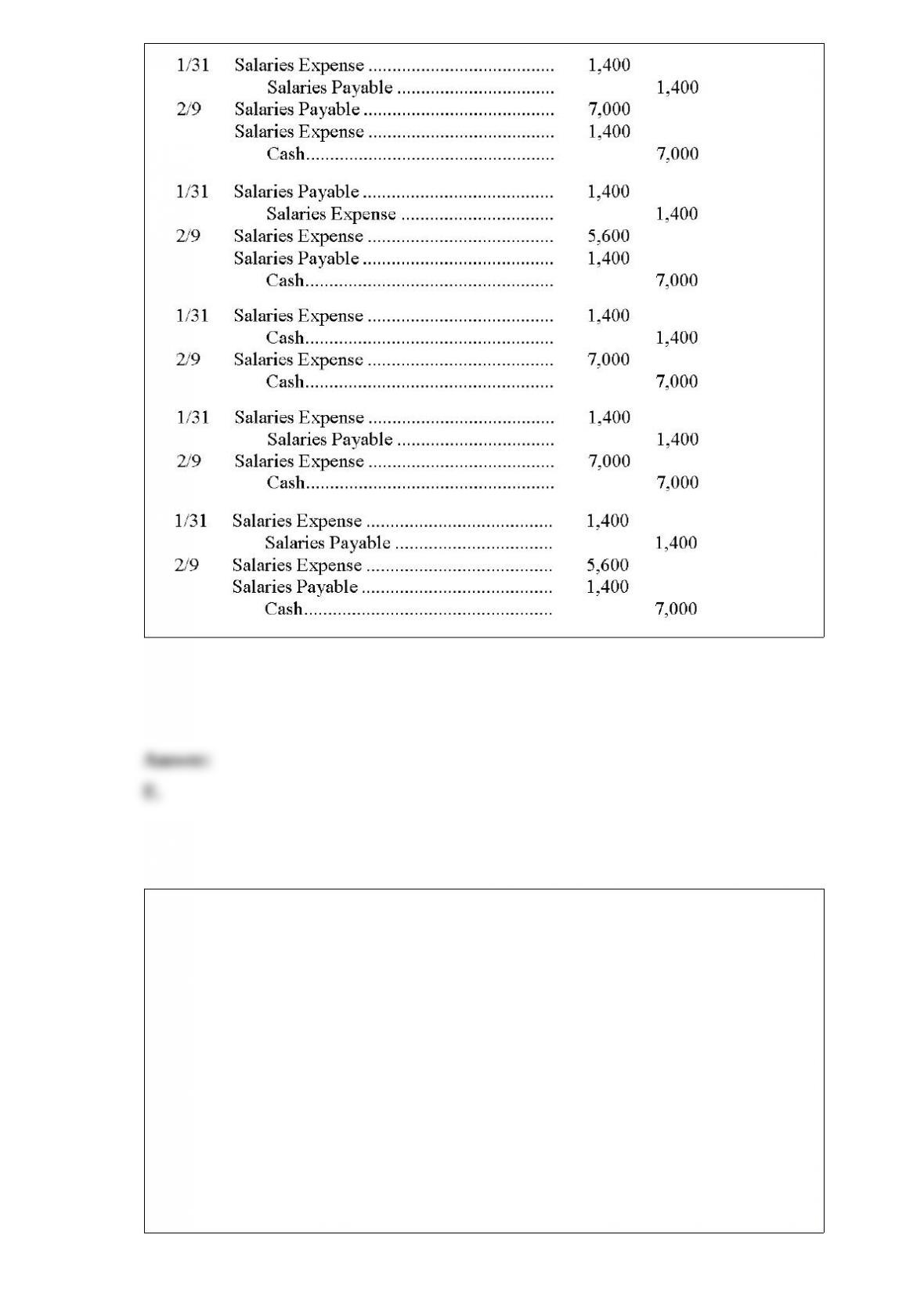
A company recorded 2 days of accrued salaries of $1,400 for its employees on January
31. On February 9, it paid its employees $7,000 for these accrued salaries and for other
salaries earned through February 9. The January 31 and February 9 journal entries are:
A.
B.
C.
D.
E.
An employee earned $4,300 working for an employer. The current rate for FICA social
security is 6.2% and the rate for FICA Medicare 1.45%. The employer’s total FICA
payroll tax for this employee is:
A.$ 62.35.
B.$266.60.
C.$328.95.
D.$657.90.
E.Zero, since the FICA tax is a deduction from an employee’s pay, and not an employer
tax.
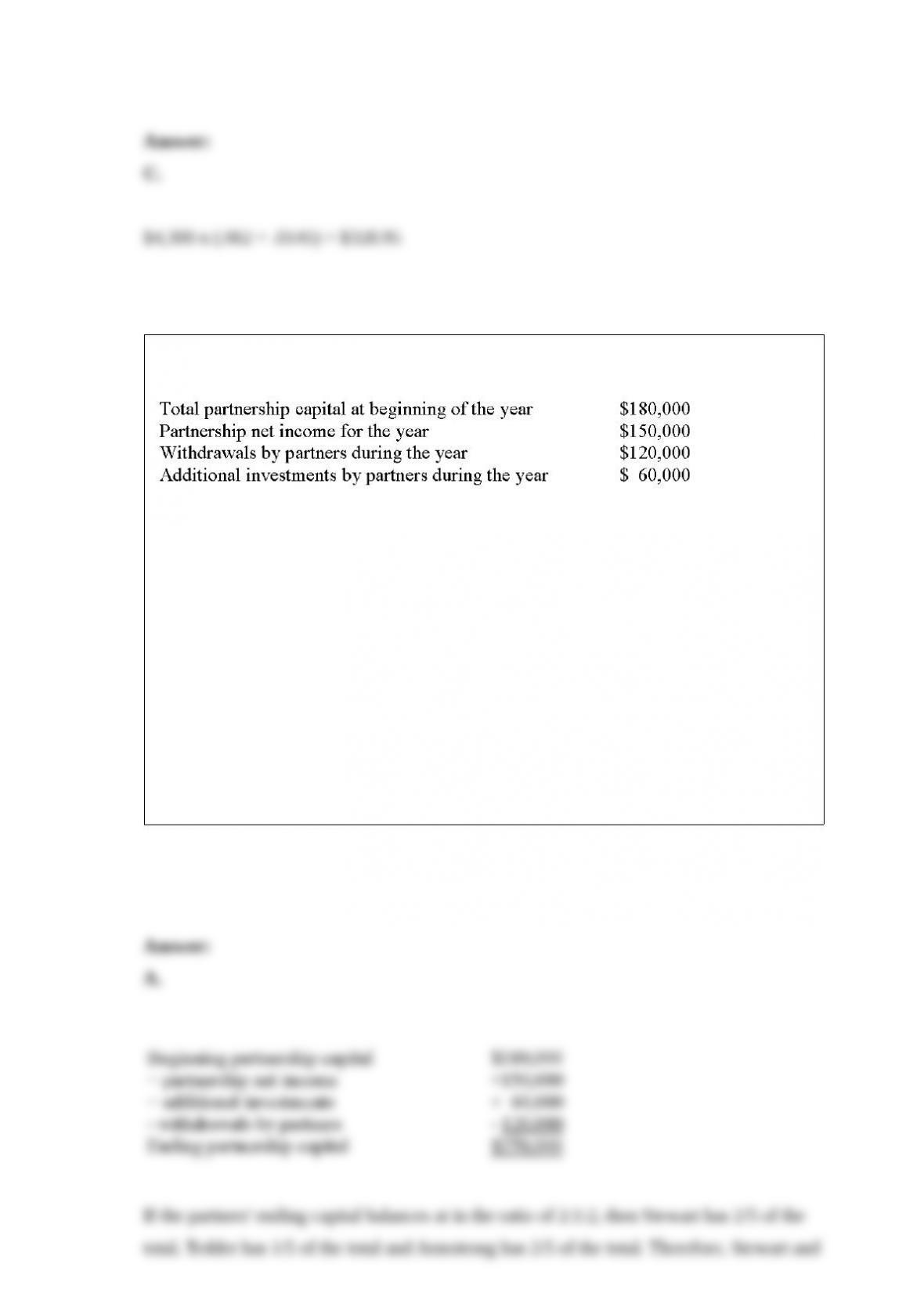
The following information is available on Stewart Enterprises, a partnership, for the
most recent fiscal year:
There are three partners in Stewart Enterprises: Stewart, Tedder and Armstrong. At the
end of the year, the partners’ capital accounts were in the ratio of 2:1:2, respectively.
Compute the ending capital balances of the three partners.
A.Stewart = $108,000; Tedder = $54,000; Armstrong = $108,000.
B.Stewart = $90,000; Tedder = $90,000; Armstrong = $90,000.
C.Stewart = $204,000; Tedder = $102,000; Armstrong = $204,000.
D.Stewart = $84,000; Tedder = $102,000; Armstrong = $84,000.
E.Stewart = $60,000; Tedder = $30,000; Armstrong = $60,000.
The number of days’ sales uncollected:
A.Is used to evaluate the liquidity of receivables.
B.Is calculated by dividing accounts receivable by sales.
C.Measures a company’s ability to pay its bills on time.
D.Measures a company’s debt to income.
E.Is calculated by dividing sales by accounts receivable.
A company plans to decrease a $200 petty cash fund to $75. The current balance in the
account includes $45 petty cash payment in receipts and $165 in currency. The entry to
reduce the fund will include a:
A.Debit to Cash Short and Over for $10.
B.Debit to Cash for $90.
C.Debit to Miscellaneous Expenses for $35.
D.Credit to Petty Cash for $165.
E.Credit to Cash for $90.

Failure by a promissory note’s maker to pay the amount due at maturity is known as:
A.Protesting a note.
B.Closing a note.
C.Dishonoring a note.
D.Discounting a note.
E.Depreciating a note.
Match the following definitions and terms by placing the letter that identifies the best
definition in the blank space next to the term.
a. A simple form used as a helpful tool in understanding the effect of transactions and
events on specific accounts.
b. The most flexible type of journal, it can be used to record any kind of transaction.
c. A journal entry that affects at least three accounts.
d. A written promise from a customer to pay a definite sum of money on a specified
future date.
e. A record of the increases and decreases in a specific asset, liability, equity, revenue,
or expense item.
f. A list of all accounts used by a company and the identification number assigned to
each account.
g. The process of transferring journal entry information to the ledger.
h. A list of accounts and their balances at a point in time; the total debit balances should

equal the total credit balances.
i. A column in journals where individual account numbers are entered when entries are
posted to ledger accounts.
j. Liabilities created when customers pay in advance for products or services; satisfied
by delivering the products or services in the future.
1)Account
2)General journal
3)Posting reference column
4)T-account
5)Note receivable
6)Chart of accounts
7)Posting
8)Compound journal entry
9)Trial Balance
10)Unearned revenues
The difference between the amount received from issuing a note payable and the
amount repaid is referred to as:
A.Interest.
B.Principle.
C.Face Value.
D.Cash.
E.Accounts Payable.

The statement of cash flows reports information on:
A.Revenue activities.
B.Operating activities.
C.Financing activities.
D.Investing activities.
E.B, C, and D.
The Malcolm Baldridge Award was established by
A.The United Nations.
B.The U.S. Chamber of Commerce.
C.The Malcolm Baldridge Foundation.
D.The U.S. Congress.
E.The SEC.
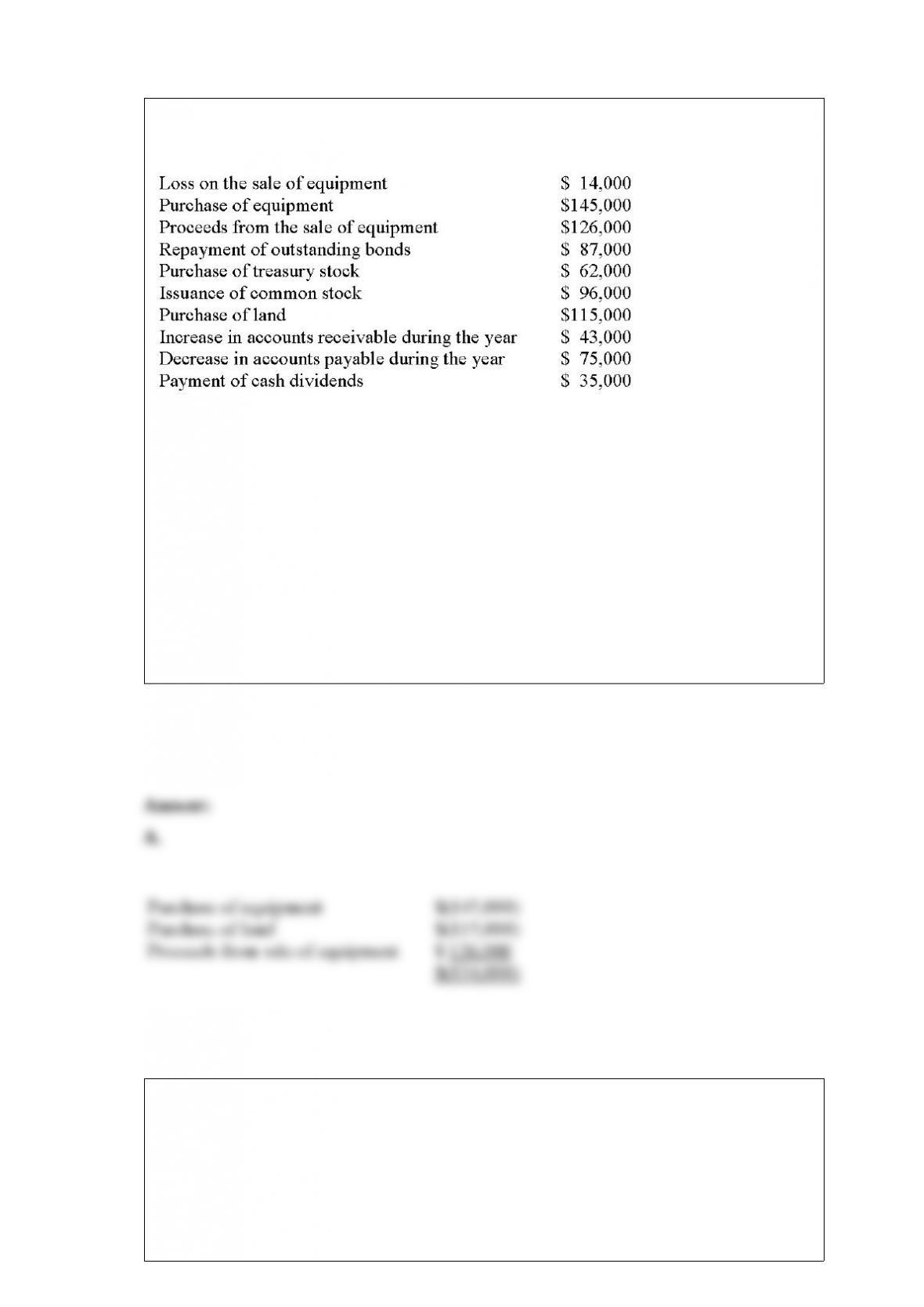
In preparing a company’s statement of cash flows for the most recent year, the
following information is available:
Net cash flows from investing activities for the year were:
A.$134,000 of net cash used by investing activities.
B.$134,000 of net cash provided by investing activities.
C.$120,000 of net cash used by investing activities.
D.$252,000 of net cash used by investing activities.
E.$221,000 of net cash provided by investing activities.
The difference between the total budgeted overhead cost and the overhead applied to
production using the predetermined overhead rate is the:
A.Production variance.
B.Volume variance.
C.Overhead cost variance.
D.Quantity variance.
E.Controllable variance.
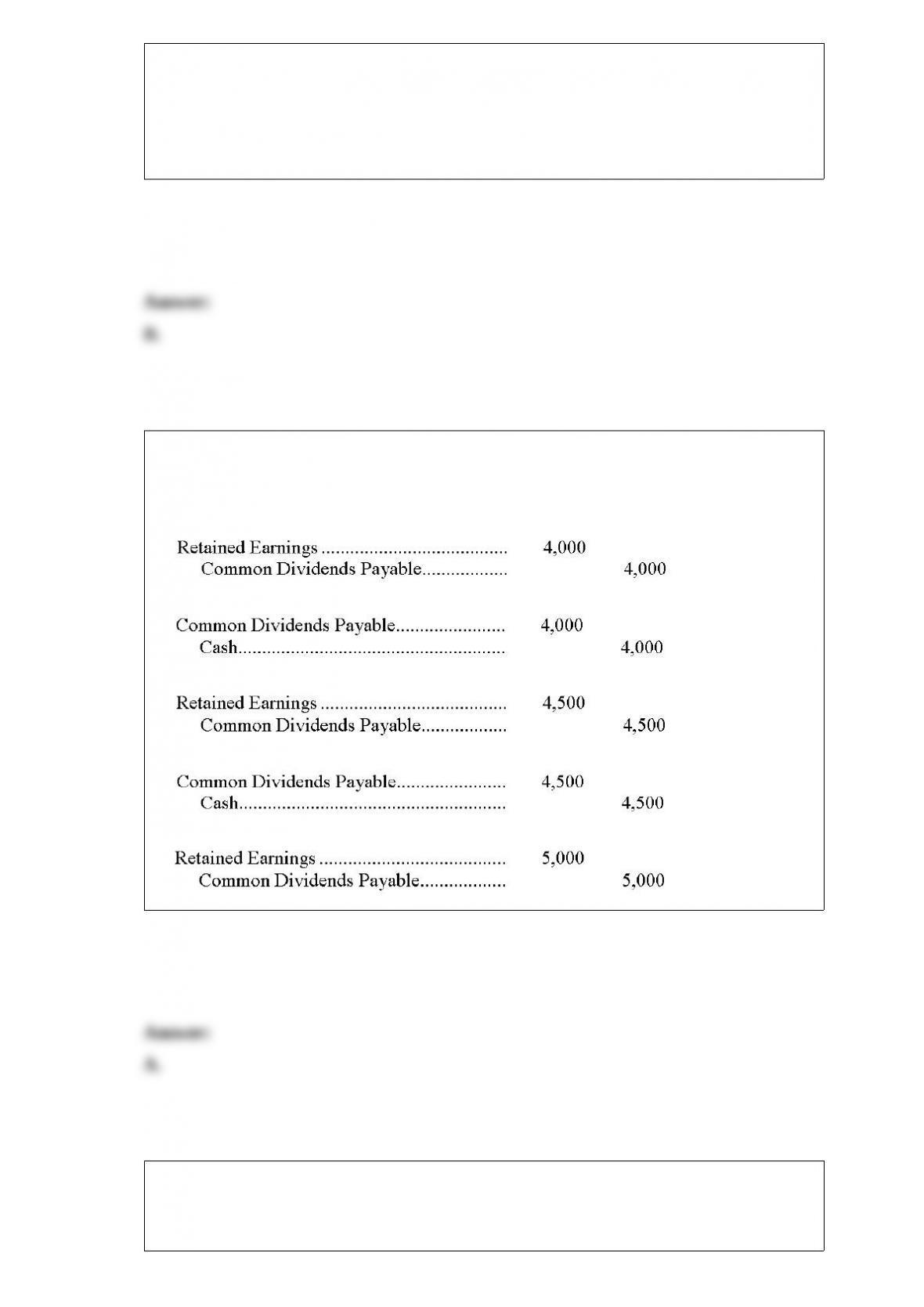
A company declared a $0.50 per share cash dividend. The company has 20,000 shares
authorized, 9,000 shares issued, and 8,000 shares of common stock outstanding. The
journal entry to record the dividend declaration is:
A.
B.
C.
D.
E.
Deltan Corp. allocates overhead to production on the basis of direct labor costs. Deltan’s
total estimated overhead is $450,000 and estimated direct labor is $180,000. Determine
the amount of overhead to be allocated to finished goods inventory if there is $20,000
of total direct labor cost in the jobs in the finished goods inventory.
A.$ 8,000.
B.$20,000.
C.$70,000.
D.$50,000.
E.$90,000.
If the liabilities of a company increased $74,000 during a period of time and equity in
the company decreased $19,000 during the same period, what was the effect on the
assets?
A.Assets would have increased $55,000.
B.Assets would have decreased $55,000.
C.Assets would have increased $19,000.
D.Assets would have decreased $19,000.
E.None of these.
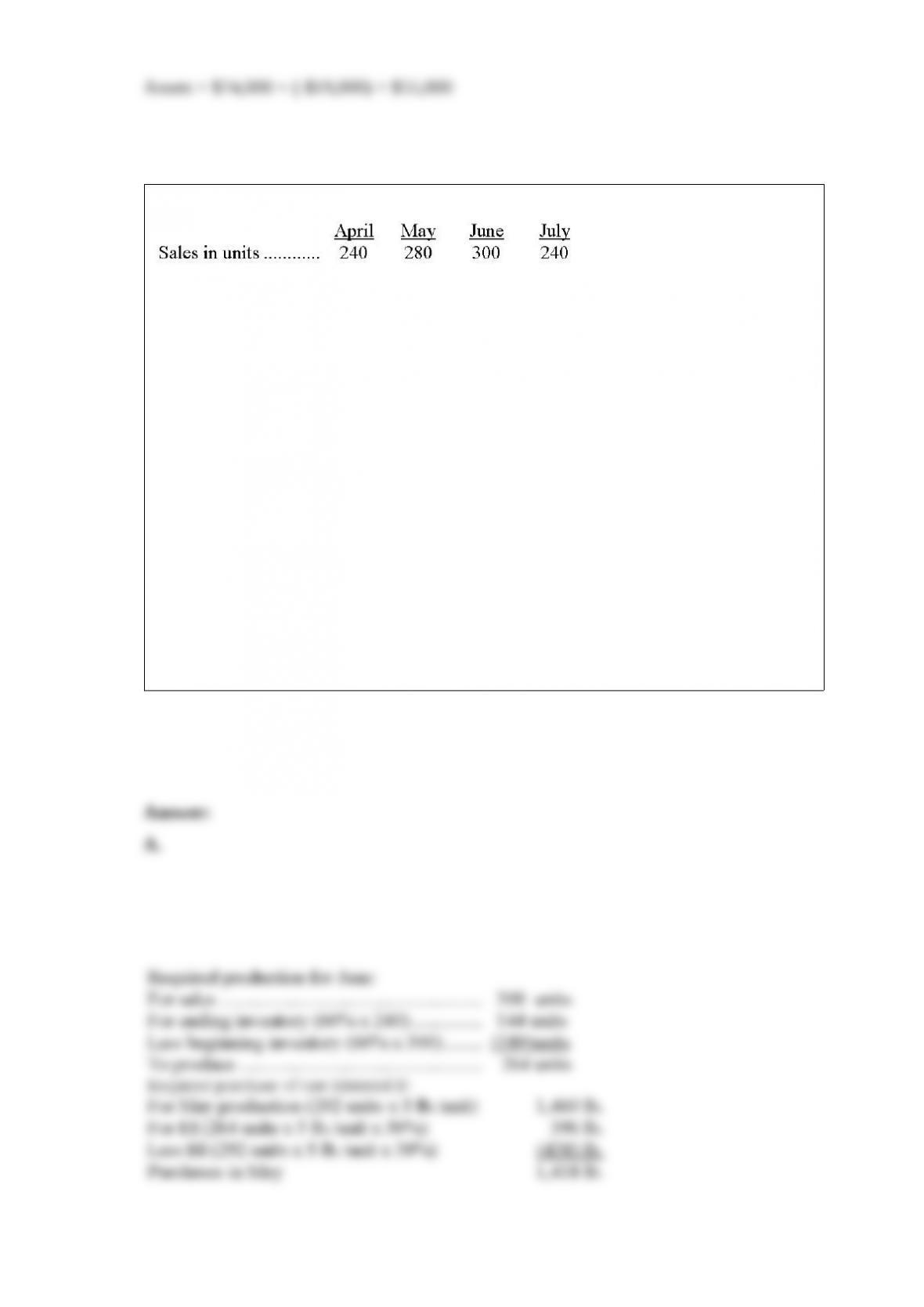
Kyoto, Inc. predicts the following sales in units for the coming four months:
Although each month’s ending inventory of finished units should be 60% of the next
month’s sales, the March 31 finished goods inventory is only 100 units. A finished unit
requires five pounds of raw material B. The March 31 raw materials inventory has 200
pounds of B. Each month’s ending inventory of raw materials should be 30% of the
following month’s production needs.
The budgeted purchases of pounds of raw material B during May should be:
A.1,418 lb.
B.1,460 lb.
C.1,502 lb.
D.264 lb.
E.283 lb.
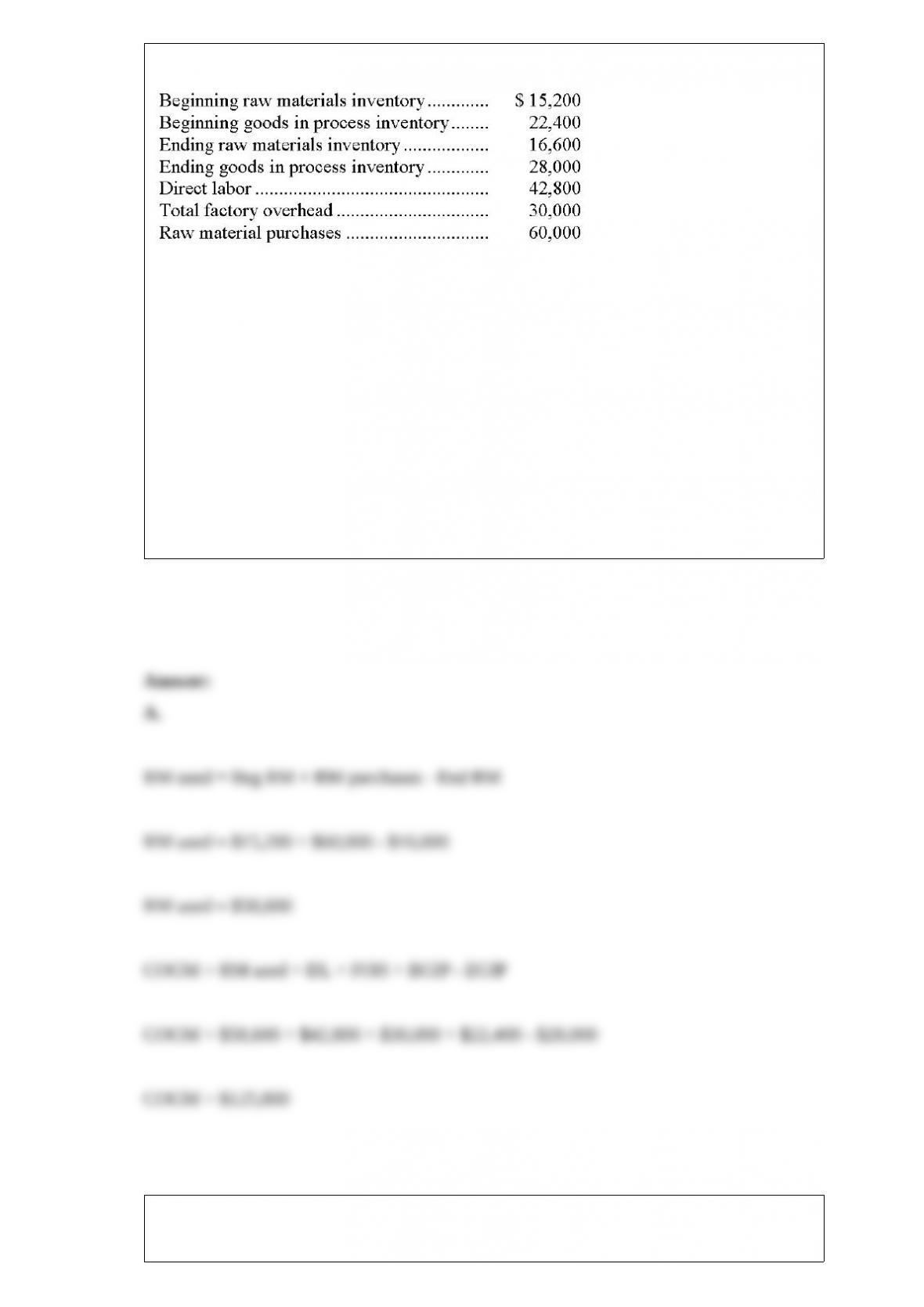
Current information for the Austin Company follows:
All raw materials used were traceable to specific batches of product. Austin Company’s
cost of goods manufactured for the year is:
A.$125,800.
B.$128,600.
C.$131,400.
D.$137,000.
E.$139,000.
The difference between actual and standard cost caused by the difference between the
actual quantity and the standard quantity is called the:

A.Controllable variance.
B.Standard variance.
C.Budget variance.
D.Quantity variance.
E.Price variance.
Amortizing a bond discount:
A.Allocates a part of the total discount to each interest period.
B.Increases the market value of the Bonds Payable.
C.Decreases the Bonds Payable account.
D.Decreases interest expense each period.
E.Increases cash flows from the bond.
Interim financial statements refer to financial reports:
A.That cover less than one year, usually spanning one, three, or six-month periods.
B.That are prepared before any adjustments have been recorded.
C.That show the assets above the liabilities and the liabilities above the equity.
D.Where revenues are reported on the income statement when cash is received and
expenses are reported when cash is paid.
E.Where the adjustment process is used to assign revenues to the periods in which they
are earned and to match expenses with revenues.
Book value per share:
A.Reflects the value per share if a company is liquidated at balance sheet amounts.
B.Is assets divided by equity.
C.Is assets divided by the number of common share outstanding.
D.Measures the worth of assets.
E.Is equal to par value per share.
Identify the five steps involved in managerial decision making.
___________________________ is a statistical method of identifying an estimated line
of cost behavior.
A _______________ cost is one that remains unchanged in amount when volume of
activity varies from period to period within a relevant range. A ______________ cost is
one that changes in proportion to changes in volume of activity.
_________________________ securities reflect a creditor relationship while
____________________ securities reflect an owner relationship.
A company purchased mining property containing 7,350,000 tons of ore for $1,837,500.
In year 1, it mined and sold 857,000 tons of ore and in year 2, it mined and sold
943,000 tons of ore. Calculate the depletion expense for year 1 and year 2. What was
the book value of the property at the end of year 2?
What is the primary purpose for using a responsibility accounting system?
______________ is the area of accounting aimed at serving external users.
The issue price of bonds is found by computing the present value of the bond’s cash
payments, discounted at the _______________ rate of interest at the time of issuance.
A company recently paid $1,500,000 on January 1 to buy a building with an estimated
useful life of 20 years and a salvage value of $25,000. Calculate the depreciation
expense for the third year after acquisition using declining-balance depreciation.
Explain where each of the following items should appear in the financial statements of
a corporation:
(1) The accounting department discovered that an entry was made last year to Prepaid
Insurance instead of to Insurance Expense. The after-tax effect of the charge to Prepaid
Insurance was $11,000.
(2) The company grants five of its employees the option to purchase 100 shares of its $5
par value common stock at it current market price of $20 per share anytime with the
next five years. None of the employees exercised the options in the current year.
At the beginning of the year, a company had $120,000 worth of liabilities. During the
year, assets increased by $160,000 and at year-end they equaled $360,000. Liabilities
decreased $20,000 during the year. Calculate the beginning and ending values of equity.
______________ activities involve using resources to research, develop, purchase,
produce, distribute, and market products and services.
When a job is finished, its job cost sheet is completed and moved from the jobs in
process file to the ____________________ file.