
The PCAOB requires that the auditor will express an opinion on the financial
statements as a whole.
The existence of fair value estimates that are unreasonable or unsupportable is
indicative of a potential fraud scheme.
Users rely on the auditors’ independent assessment of financial statement presentation
because few users have direct knowledge of the company’s operations.
If a company has only a few long-lived assets of relatively high value, the most efficient
approach for an auditor would be to use tests of details for obtaining evidence.

Inherent and control risks are risk controlled by the client.
The auditor can be satisfied with less than persuasive evidence in the audit process
because of the belief that management is honest.
The PCAOB requires the audit be conducted with due professional care, which is a
standard of care that would be expected of a reasonably prudent auditor.

Most organizations use a perpetual inventory system to manage inventory.
During the counting process of inventory, the client arranges not to ship or receive
goods or segregates all goods received during the process to be labeled and counted as
“after inventory.”
When it is discovered that an important audit procedure was not performed, the SEC
imposes sanctions against the audit firm responsible.
Auditors need to choose materiality amounts carefully because once a materiality
judgment has been made, it cannot be revised.

The auditor needs to obtain absolute assurance as to whether the financial statements
are free from material misstatement.
If the market value of the reporting unit is below book value and a significant amount
of goodwill exists, the presumption is that there has been an impairment of goodwill.
An integrated audit requires the auditor to assess the effectiveness of internal controls.

An example of attribute testing involves obtaining evidence that the client has matched
the vendor invoice details with a purchase order and receiving report before payment
approval.
Audit firms use close supervision and review of audit work to ensure that audits are
conducted with due professional care.
Assertions are relevant to the audit process because they are the representations of
management embodied in the financial statements.
The discovery of an intentional misstatement, even if immaterial, could impact the
auditor’s opinion on the effectiveness of the client’s internal control over financial
reporting.

The SEC has authority to establish GAAP for all business enterprises.
All organizations should evaluates and communicates internal control deficiencies in a
timely manner to those parties responsible for taking corrective action, including senior
management and the board of directors, as appropriate.
Assertions about existence address whether assets and liabilities exist and assertions
about occurrence address whether recorded transactions, such as sales transactions,
have occurred

Analytical procedures help auditors assess the overall presentation of the financial
statements.
Auditors should have heightened skepticism regarding period-end adjusting journal
entries that relate to accounts with significant estimates.
One of the advantages of a computerized accounting system is that the computerized
system eliminates the need for internal controls.
The auditor will come up with an independent estimation of the allowance for doubtful
accounts based on a thorough understanding of the client and the client’s business that is
compared to the recorded allowance.

Estimates are based on both subjective and objective factors.
All audit evidence is the result of the application of audit procedures.
The significant judgments related to “net finance receivables” include assessing the
allowance for noncollectibility.

The Public Company Accounting Oversight Board (PCAOB) requires mandatory audit
firm rotation after six years, with a cooling off period of four years.
Management of companies should have the ability to hire and fire the external auditor.
The cash account is not part of the acquisitions and payment cycle.
The first stage in an audit is performing a risk assessment.

Consideration of fraud in financial statement audits is a relatively new concept derived
originally from the Sarbanes-Oxley Act.
The tracing of a sample of receiving reports through the recording process tests the
completeness assertion.
Forensic accountants need to have excellent interviewing and people skills.

According to the framework for professional decision making, the first step in
decision-making is to structure the audit problem
According to COSO studies, the majority of the frauds took place at companies that
were listed on the Over-The-Counter (OTC) market, rather than those listed on the
NYSE or NASDAQ.
An inherent risk related to asset impairment is management is not typically interested in
writing down the asset value.
The auditor selects entity-wide controls for testing, but NOT transaction controls
specific to long-lived assets.

Which method focuses on assuring that the year-end balance sheet is correct and does
not consider the impact of prior-year uncorrected misstatements reversing in later
years?
A.Rollover.
B.Iron curtain.
C.Dual.
D.Percentage.
The emphasis in verifying petty cash is normally on which of the following?
A.Year-end balance.
B.Controls over petty cash.
C.Transactions for the period.
D.Balance sheet classification.

Hardman and Jennings, LLP, an audit firm, compares bad debt expense of a client in the
current period to bad debt recorded for the past three periods. Hardman and Jennings is
performing which type of analysis?
A.Trend.
B.Ratio.
C.Critical.
D.Reasonableness.
Which one of the following components of the system of internal controls influences
the tone for the organization?
A.Control risk assessment.
B.Control environment.
C.Information and communication.
D.Monitoring.
Which of the following procedures is a substantive procedure that relates to the rights
and obligations assertion?
A.Assess management’s impairment estimates.
B.Examine documents of title.

C.Recalculate amortization expense.
D.Inquire management about assets that are idle.
Which of the following represents a typical substantive audit procedure for cash
balances?
A.Verify material deposits-in-transit to subsequent statements.
B.Review cash confirms received by the client from the bank.
C.Foot cutoff bank statements provided by the financial institutions.
D.Perform kiting techniques to transfer cash between two client accounts.
Which of the following are not included in a fixed-asset ledger?
A.List of all the assets.
B.Estimated useful life.
C.salvage value.
D.All the above are included.

MUS sampling has all of the following advantages over other statistical methods except
which of the following?
A.Easier to apply than other statistical sampling approaches.
B.Sample sizes are relatively small.
C.It is a relatively easy way to make sure that negative balances and zero balances are
included in the sample.
D.Usually results in a highly efficient sample size.
E.None of the above is an advantage.
What is information about a client that cannot be subpoenaed by a court of law called?
A.Confidential information.
B.Privileged communication.
C.Contingent information.
D.Audit communication.
Which one of the following accounts would an auditor most likely test by performing

analytical procedures?
A.Sales commissions expense.
B.Legal expenses.
C.Repairs and maintenance expense.
D.Travel expense.
Which of the following best describes professional skepticism?
A.An intent to deceive.
B.An attitude of intrusion and obstinacy.
C.A character that does not waver.
D.A questioning mind.
Which one of the following is a potential problem with management’s communication
of financial information that causes third parties to desire the independent auditor’s
assessment of the financial statement presentation?
A.Complexity of transactions affecting the financial statements.
B.Lack of criteria on which to base information.
C.Remoteness of the user from the organization.

D.Both A and C.
E.Both A and B.
Audit reports are designed to promote clear communication between the auditor and the
financial statement user. Which of the following is not delineated in the audit report?
A.What was audited and the relative responsibilities of the client and the auditor.
B.The experience level of the audit team.
C.The nature of the audit opinion formulation process.
D.The auditor’s opinion on the fairness of the financial statements.
Which of the following would not be used as part of analytical procedure for
marketable securities?
A.Develop expectations about the level of amounts in ending balances.
B.Develop expectations about the relationship between the balances.
C.Verify ending balances prior to calculating the percent change.
D.Review changes in the balances, risk composition, and classification types.

The risk of material misstatement due to fraud relating to revenue recognition should be
A.approached in a manner that is identical to control risk assessment.
B.given lower priority to the risk of embezzlement.
C.ordinarily presumed by the auditor.
D.assumed to have been considered by the FASB.
Adverse opinions affect the standard audit report in which of the following ways?
A.Modifying the scope paragraph.
B.Adding an explanatory paragraph before the opinion paragraph.
C.Modifying the opinion paragraph to read ” does not present fairly.”
D.Both B and C.
E.All of the above.
Which of the following types of audit evidence is the least reliable?

A.Evidence from the client’s organization.
B.Evidence derived from a well-controlled system.
C.Evidence from independent outside sources.
D.Original documents.
A sample of positive confirmations is mailed for material accounts receivable balances.
Frequently there is a lack of response. Which of the following is not an acceptable
alternative procedure?
A.Subsequent collection.
B.Inquiry of management.
C.Mailing second and third confirmations.
D.Examination of supporting documents.
Violations of GAAP resulting in qualified opinions affect the standard audit report
through which of the following?
A.Modifying the scope paragraph.
B.Adding an explanatory paragraph before the opinion paragraph.
C.Modifying the opinion paragraph to read “except for.”
D.Both B and C.

E.All of the above.
For which of the following special purpose financial statements is an
emphasis-of-matter paragraph alerting readers about the preparation in accordance with
the special purpose framework not required?
A.Cash basis.
B.Tax basis.
C.Regulatory basis for general use.
D.Contractual basis.
What is the purpose of an ethical framework?
A.To provide a defined methodology to solve the ethical problem.
B.To provide a defined methodology to aid the user in making complex ethical
decisions.
C.To provide a defined program to solve ethical dilemmas.
D.To provide all of the above.

Which one of the following is not an example of an additional procedure that typically
relates to the discovery of subsequent events?
A.Partner review of all workpapers.
B.Reading interim financial statements and comparing them to the audited statements to
note significant changes.
C.Reading the board of directors’ minutes for all meetings during the year and after
year- end through the end of field work.
D.Management inquiry.
How can an auditor use inquiry to gain a better understanding of internal controls?
A.By interviewing key employees to gain further insight into the internal control
environment.
B.By observing the safeguarding of assets by checking locked doors and safes.
C.By tracing a transaction from the boundary of the organization through to the final
reporting.
D.By documenting thoroughly the internal control through the use of narratives.

How many paragraphs does the standard review report for U.S. nonpublic companies or
development stage companies have?
A.One.
B.Two.
C.Three.
D.Four.
An additional partner review of the audit and its findings is typically performed by an
experienced member of the firm. Which of the following individuals is most qualified
to perform this concurring partner review?
A.The engagement partner who has worked on the client for three years.
B.An employee of the enforcement division of the SEC.
C.An experienced partner of the firm who did not actively participate on the audit.
D.A partner of another firm or office who knows the client well and who was a vital
member of the audit team.
Which of the following best describes management responsibilities under the
Sarbanes-Oxley Act of 2002?
A.Certify the accuracy of financial statements.
B.Establish a corporate code of conduct.

C.Accept responsibility for restated earnings.
D.All of the above.
In the audit of consolidated financial statements under U.S. auditing standards when
more than one CPA firm is involved and the principal audit firm chooses to mention the
other firm(s), the wording of which paragraph(s) is modified?
A.Introductory Paragraph: No; Scope Paragraph: No; Opinion Paragraph: Yes.
B.Introductory Paragraph: No; Scope Paragraph: Yes; Opinion Paragraph: Yes.
C.Introductory Paragraph: Yes;Scope Paragraph: Yes; Opinion Paragraph: Yes.
D.Introductory Paragraph: Yes;Scope Paragraph: Yes; Opinion Paragraph: No.
Which of the following statements reflects an auditor’s responsibility for detecting
fraud?
A.An auditor is not responsible for discovering fraudulent acts involving employee
collusion.
B.The audit should be planned to detect fraud caused by departures from GAAP.
C.An auditor is only responsible for detecting fraudulent financial reporting.
D.An auditor should design the audit to provide reasonable assurance of detecting

errors and fraud that are material to the financial statements.
According to the AICPA principles, which of the following is incorrect?
A.If the auditor has reservations about the fairness of financial statement presentation,
the reason(s) must be stated in the auditor’s report.
B.If there is a material departure from GAAP in the financial statements, the auditor
should explicitly state the nature of the departure and the dollar effects where
determinable.
C.Auditors should state the reasons why an unqualified opinion cannot be issued.
D.Auditors should issue an unqualified opinion in all cases where companies have
provided an entire set of financial statements and footnotes that include all years
presented for comparative purposes.
The written record that forms the basis for the auditor’s conclusions is referred to as
what?
A.Audit documentation.
B.Audit adjustment.
C.Accounting records.
D.Footing.
Rule 101 on integrity and objectivity only applies to covered members as defined by the
AICPA.
Explain the meaning of due professional care.
Bacon, CPAs, is the principal auditor for Martin Industries, a U.S. public company.
However, Bacon decides to refer to the work of Hsu and Wen, CPAs, who audited a
wholly owned subsidiary of the entity and issued an unqualified opinion.
REQUIRED:
Which type of audit report would you suggest be issued this year and why?
Outline the major elements of an audit program to determine whether there is a
goodwill impairment, and if there is, the extent of the goodwill impairment.
Discuss the procedures the audit team will most likely perform during the physical
observation of inventory.
Under what circumstances would an auditor issue an unqualified opinion modified by
an explanatory paragraph? Would the paragraph go before or after the opinion
paragraph?
What is nonsampling risk and how can it be eliminated?
What are the five major phases of the acquisition and payment process?
Explain what is meant by a cutoff bank statement, and discuss the purpose of the cutoff
bank statement in the audit of cash.
Explain ratio analysis as an analytical procedure used by auditor. Give examples of the
ratios that auditor might want to compute for revenue cycle accounts.
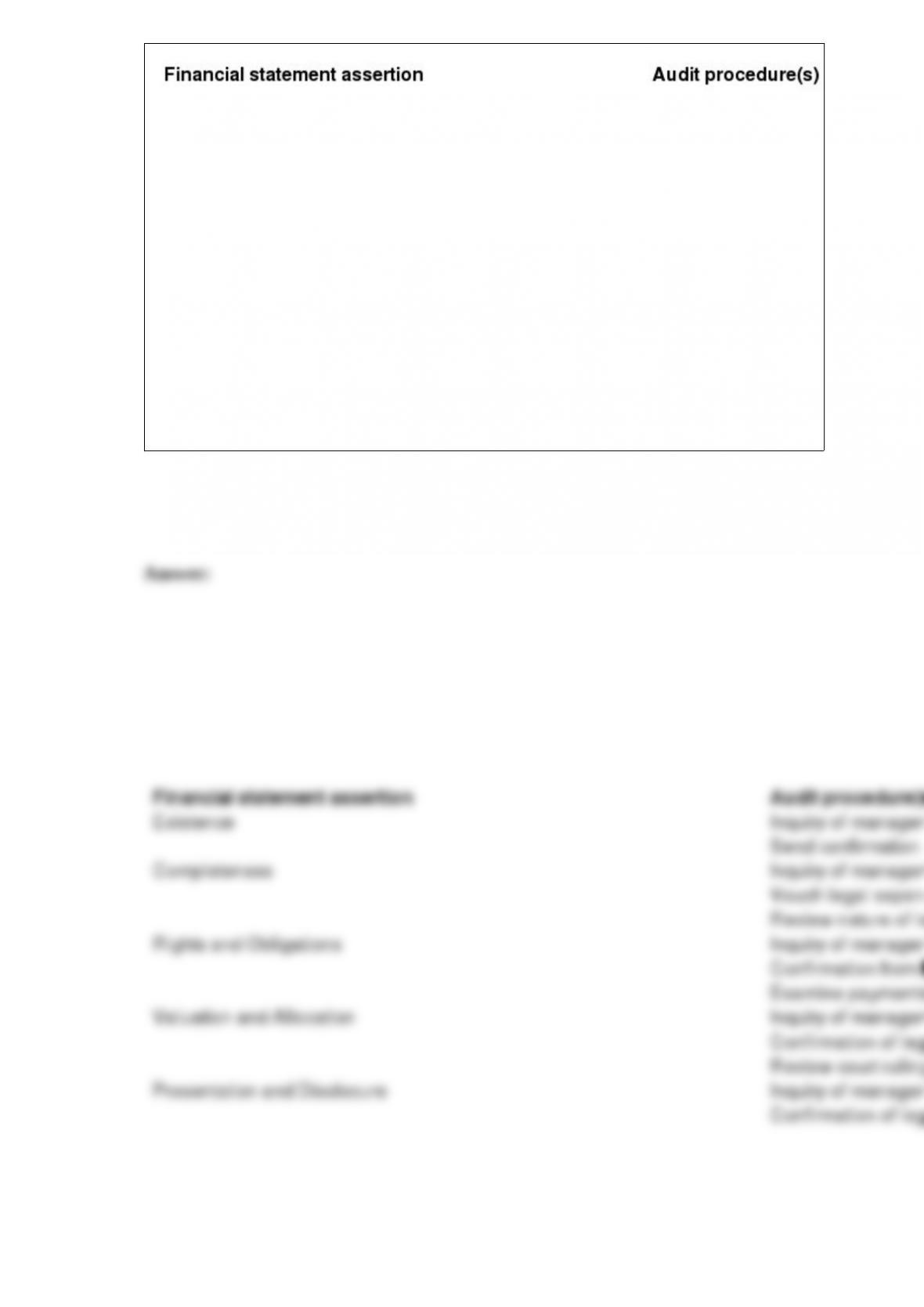
Businesses often have litigation against them that the auditor has to identify and
adequately disclose. List the financial assertions that apply to Contingencies. For each
assertion indicate two or three audit procedures that would address that assertion.
Organize you answer as follows:
There are nine specific actions an auditor can undertake to collect evidence.
Identify each action and provide an example.
Identify and demonstrate the audit assertions and different approaches to the obtaining
audit evidence for an audit of cash balances in a financial statement audit.
What is a bank cutoff statement and how is it used by an auditor?
A banker friend and you were discussing compiled financial statements. He said,”
When CPAs associate their name with compiled financial statements, their only
responsibility is to the client and that is limited to the proper summarization and
presentation on the financial statement information provided by the client. The opinion
clearly states that the auditor has not conducted an audit and does not express an
opinion on this fair presentation. Therefore, if users rely on compiled financial
statements, they do so at their own peril and can never hold the CPA responsible for
inadequate performance. Users should interpret the financial statements as if they had
been prepared by management.”
REQUIRED: How would you respond to your friend?
The auditor will discuss contingencies with the appropriate executives and management
of the company. Identify at least five sources of evidence to corroborate management’s
representations regarding contingencies.