In a period of falling prices, the inventory costing method that assigns a value to
inventory that approximates current cost is:
A) FIFO
B) LIFO.
C) Specific identification.
D) Weighted average
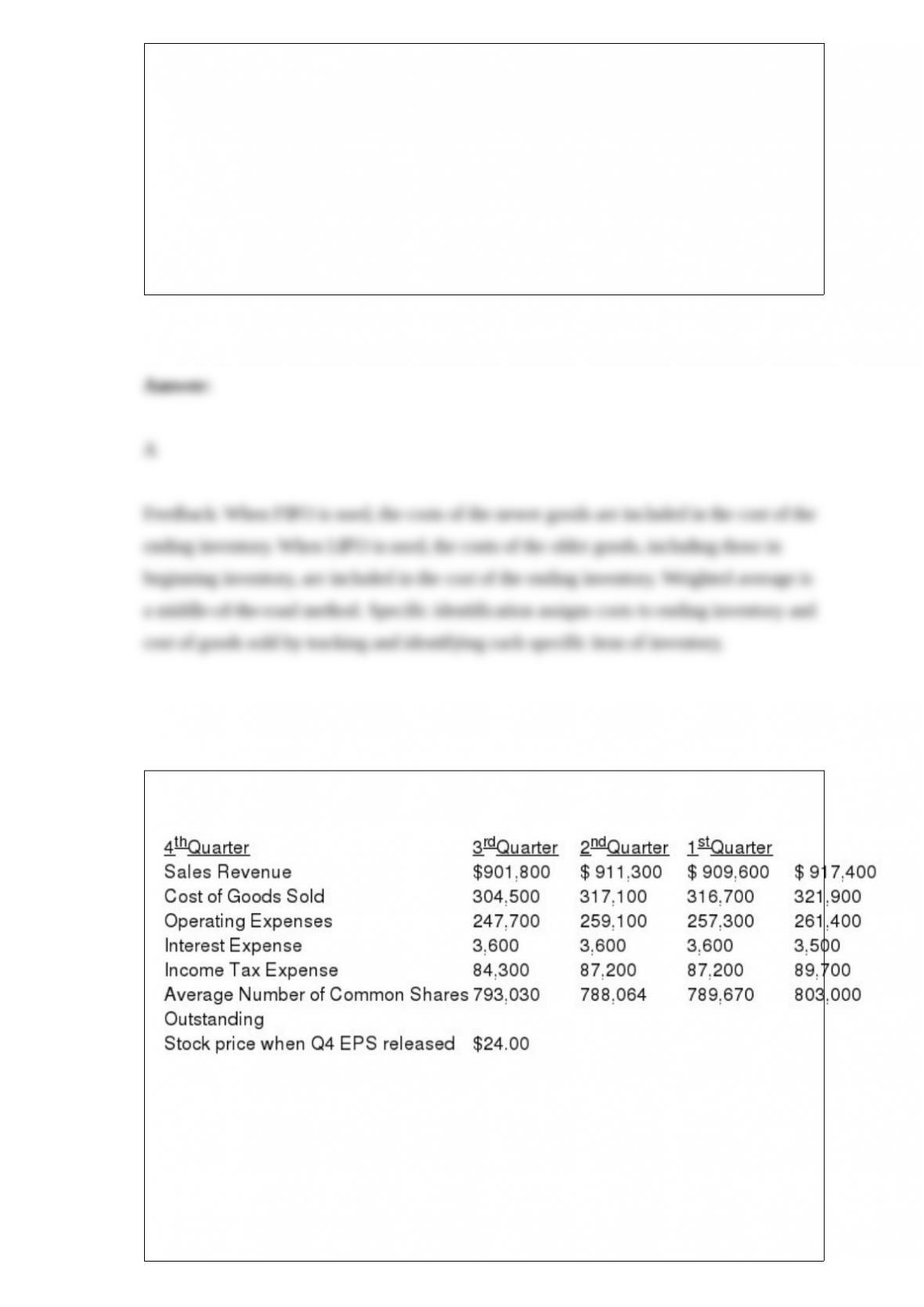
Mercedes, Co. has the following quarterly financial information.
Required:
Part a. Calculate the gross profit percentage for each quarter.
Part b. Calculate the net profit margin for each quarter.
Part c. Calculate the EPS for each quarter.
Part d. Calculate the Price/Earnings ratio at the end of the year.
Part e. Evaluate the company’s profitability.
Round all ratios to two decimal places.
A company issued $300,000, 10-year, 10% bonds at 105.
Use the information above to answer the following question. What is the total amount
of interest expense that will be recorded over the life of these bonds?
A) $300,000
B) $285,000
C) $315,000
D) $330,000
The book value of a depreciable asset can never be less than its:
A) historical cost.
B) market value.
C) capitalized cost.
D) residual value.
This month, a company performed $517,000 of services and incurred total expenses of
$438,000. The company was paid in cash for all its services and paid cash for all its
expenses. These transactions would cause:
A) revenues to increase by $517,000, expenses to increase by $438,000, and Retained
Earnings to decrease by $79,000.
B) Cash to increase by $517,000, expenses to increase by $438,000, and Common
Stock to increase by $79,000.
C) revenues to increase by $517,000, expenses to increase by $438,000, and Cash to
increase by $79,000.
D) revenues to increase by $79,000, expenses to increase by $438,000, and Cash to
increase by $517,000.
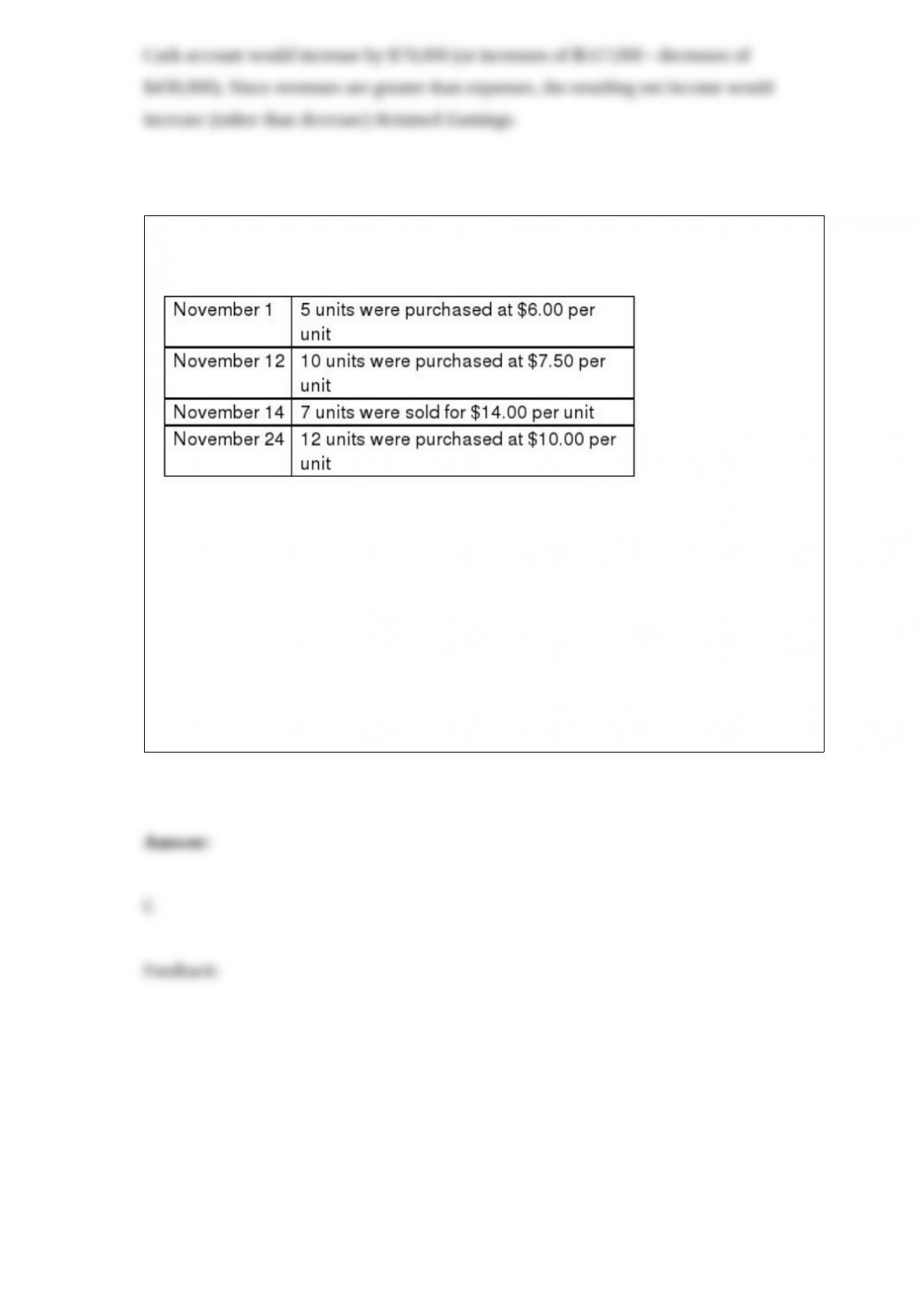
A company uses a weighted-average perpetual inventory system. The following
transactions took place during the month of November:
What is the per-unit value of ending inventory on November 30 if this company uses a
weighted-average perpetual inventory system? (Round each per unit cost to two
decimal points.)
A) $6.00
B) $7.00
C) $8.80
D) $13.00
A company has current assets of $5 million and net income of $10 million. Current
liabilities total $2.5 million, interest expense is $2 million, and income tax expense is
$3 million. What is the times interest earned ratio for this company?
A) 0.5
B) 7.5
C) 0.3
D) 2.0
The journal entry to establish a petty cash fund should include a debit to:
A) Cash and a credit to Petty Cash.B) Petty Cash and a credit to Cash.C) Petty Cash and
a credit to Accounts Receivable.D) Cash and a credit to Petty Cash Shortage.
The days to collect receivables increased from 32 last year to 48 this year. Which of the
following statements is correct?
A) The company is likely to see its Bad Debt Expense decrease.
B) The company is becoming more efficient at collecting payment.
C) The receivables turnover rate must have increased from last year to this year.
D) The receivables turnover rate decreased from approximately 11.4 to 7.6 from last
year to this year.
The separate entity assumption means:
A) a company’s financial statements reflect only the business activities of that company.
B) each separate owner’s finances must be revealed in the financial statements.
C) each separate entity that has a claim on a company’s assets must be shown in the
financial statements.
D) if the business is a sole proprietorship, the owners’ personal activities are included in
the company’s financial statements.
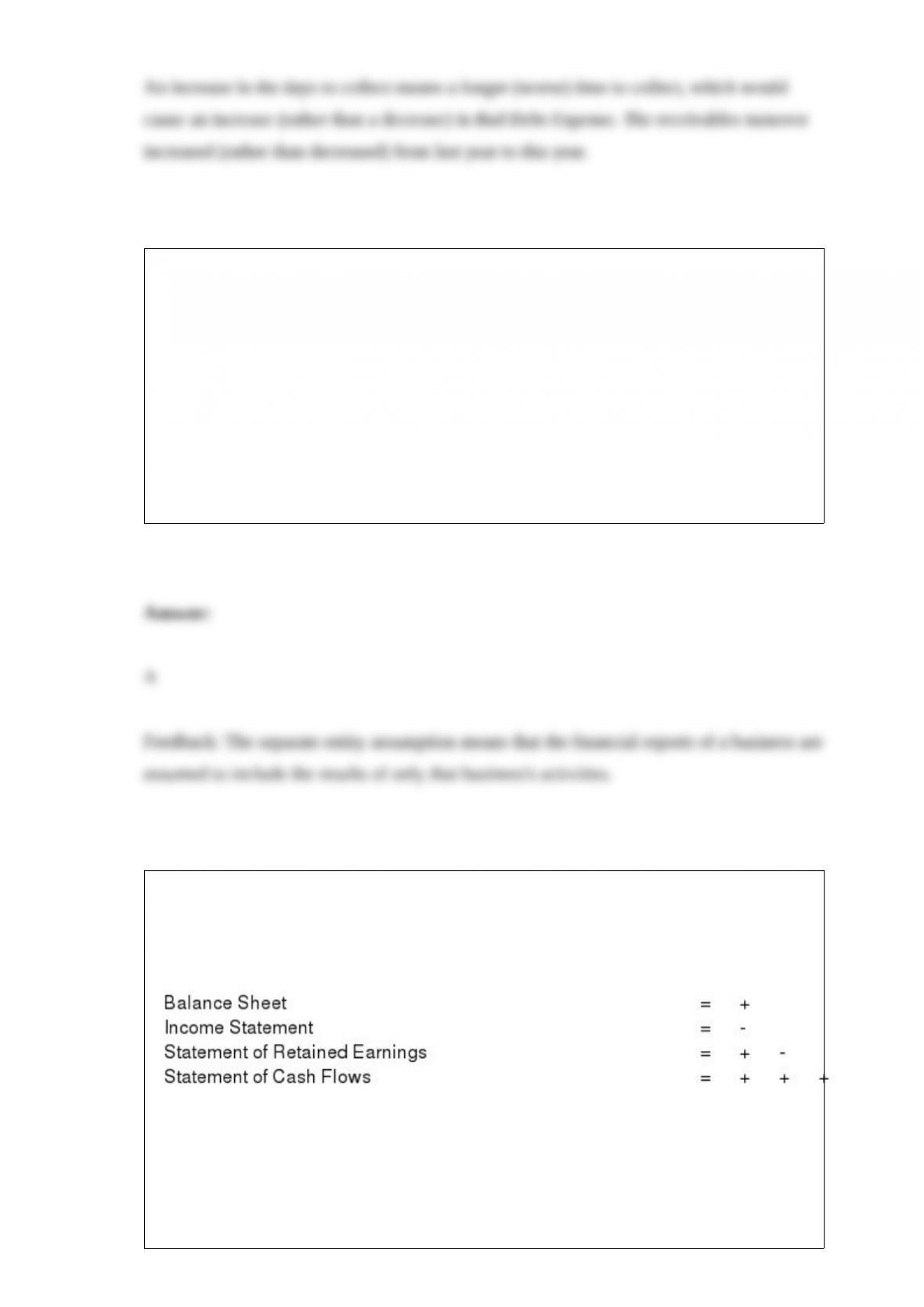
Choose the appropriate letter to match the terms to the blanks below to complete the
relevant equation for each financial statement.
FINANCIAL STATEMENT EQUATION
TERM
A. Cash at beginning of year
B. Net cash flow from operating activities
C. Balance of retained earnings from previous year
D. Net cash flow from investing activities
E. Liabilities
F. Net cash flow from financing activities
G. Balance of retained earnings at end of year
H. Net income
I. Revenue
J. Assets
K. Stockholders’ equity
L. Expenses
M. Cash at end of year
N. Dividends paid
The Retained Earnings balance was $22,900 on January 1. Net income for the year was
$18,100. If Retained Earnings had a credit balance of $23,800 after closing entries were
made for the year, and if additional stock of $5,200 was issued during the year, what
was the amount of dividends declared during the year?
A) $17,200
B) $23,700
C) $23,300
D) $13,000
Jensen Company uses the percentage of credit sales method for calculating Bad Debt
Expense. The company reported $216,000 in total sales during the year; $178,000 of
which were on credit. Jensen has experienced bad debt losses of 6% of credit sales in
prior periods. What is the estimated amount of Bad Debt Expense for the year?
A) $12,960
B) $10,680
C) $38,000
D) $11,000
At the end of the accounting period, but before closing entries are made, Harry, the
proprietor of Harry’s Bar and Grill, has a debit balance of $24,500 in his drawing
account and a credit balance of $72,300 in his capital account. Which of the following
statements is correct?
A) Harry’s net income was $47,800.
B) During the closing process, Harry will debit the drawing account for $24,500 and
credit the capital account for $24,500.
C) During the closing process, Harry will debit the capital account for $24,500 and
credit the drawing account for $24,500.
D) Harry’s Retained Earnings account was $47,800.
A cumulative dividend preference means that:
A) preferred stockholders are paid dividends before common stockholders are paid
dividends for the current year only.
B) unpaid dividends to preferred stockholders accumulate and must be paid before
common stockholders receive dividends.
C) preferred stockholders are paid their full fixed dividend rate each period as long as
the company is in operation.
D) unpaid cash dividends to preferred stockholders must be replaced with stock
dividends during the current period.
Assume a company uses the indirect method to prepare its statement of cash flows. If
the Supplies account increases and Salaries and Wages Payable decreases during an
accounting period, what does the company do with the changes in these accounts to
calculate cash flows from operating activities?
A) Both are added to net income.
B) The change in Salaries and Wages Payable is added to net income; the change in
Supplies is subtracted from net income.
C) Both are subtracted from net income.
D) The change in Supplies is added to net income; the change in Salaries and Wages
Payable is subtracted from net income.
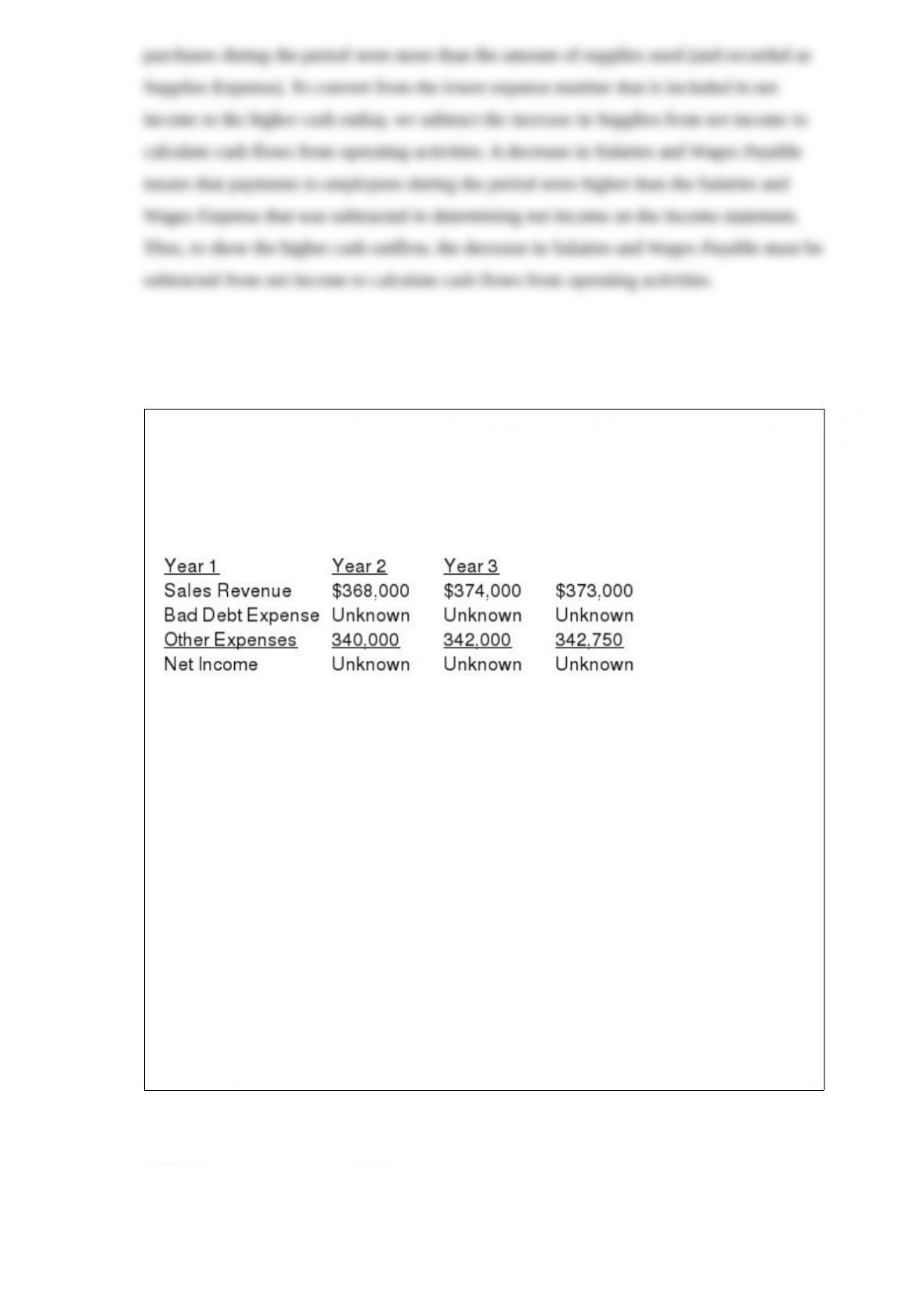
The Dubious Company operates in an industry where all sales are made on account.
The company has experienced bad debt losses of 1% of credit sales in prior periods.
Presented below is the company’s forecast of sales and expenses over the next three
years.
Required:
Part a. Calculate Bad Debt Expense and net income for each of the three years,
assuming uncollectible accounts are estimated as 1.0% of sales.
Part b. Briefly describe the trend in net income changes from Year 1 to Year 2 and from
Year 2 to Year 3.
Part c. Assume that the company changes its estimate of uncollectible credit sales to
1.0% in Year 1, 2.0% in Year 2 and 1.5% in Year 3. Calculate the Bad Debt Expense
and net income for each of the three years under this alternative scenario.
Part d. Briefly describe the trend in net income changes determined in requirement c
from Year 1 to Year 2 and Year 2 to Year 3
Part e. Explain some of the factors that might cause the estimate of uncollectible
accounts to vary from year to year (as in the assumption set forth in part c above).
On June 12, because management knew with near certainty that it had no chance of
collection, Sheave Company wrote off a customer’s account balance in the amount of
$350. On November 3, the customer mailed a payment for $350 to Sheave. To record
the receipt of this payment from the customer, the company would debit:
A) Bad Debt Expense and credit Cash.
B) Accounts Receivable and credit Bad Debt Expense, and then debit Cash and credit
Allowance for Doubtful Accounts.
C) Cash and credit Accounts Receivable.
D) Accounts Receivable and credit Allowance for Doubtful Accounts, and then debit
Cash and credit Accounts Receivable.
Which of the following would decrease net income?
A) Failing to post an adjusting entry to accrue revenue
B) Understating the amount of Depreciation Expense recorded
C) Failing to prepare an adjusting entry to recognize the portion of prepaid rent that has
expired
D) Overstating the year-end balance of the Supplies account