Your company issues $500,000 in bonds at an issue price of 98. The company will
record:
A. a debit of $490,000 to cash, a debit of $10,000 to a contra-liability account to reflect
the discount, and a credit of $500,000 to bonds payable.
B. a debit of $490,000 to cash, a debit of $10,000 to a contra-asset account to reflect the
discount, and a credit of $500,000 to bonds payable.
C. a debit of $500,000 to bonds payable, a credit of $10,000 to a contra-liability account
to reflect the discount, and a credit to cash of $490,000.
D. a debit of $490,000 to bonds payable, a debit of $10,000 to a contra-asset account to
reflect the discount, and a credit to cash of $500,000.
Answer:
Which of the following misstatements would cause the net profit margin to be
understated?
A. Recording the entire costs of supplies purchased, but not used, as an expense.
B. Failing to adjust for insurance expired.
C. Failing to accrue wages incurred but not yet paid for the current period.
D. Recording rent received but not yet earned
Answer:
Use the information above to answer the following question. What is the amount of
cash paid for rent?
A. $9,000
B. $11,000
C. $10,000
D. $12,000
Answer:
Which of the following is not used to calculate the times interest earned ratio?
A. Net income
B. Income tax expense
C. Interest earned on investments
D. Interest expense
Answer:
Multiple terms or descriptions are used to present the same idea in the area of bonds.
Match all the appropriate terms or concepts that could be used to complete the blanks in
the following using the effective interest method.
The cash payments made to creditors who have bought a company’s bond are
determined by multiplying the 1) _____________ times the 2) _____________ rate.
The interest expense to the company, in the first period a bond is outstanding, is
determined by multiplying the 3) _____________ times the 4) _____________ rate.
A. premium
B. face value
C. issue price
D. discount
E. maturity value
F. stated interest
G. actual money received by issuer
H. market interest
Answer:
When the direct method is used to determine the cash flows from operating activities,
which of the following adjustments must be made to interest expense to determine total
interest payments?
A. Add all changes in interest payable.
B. Add decreases in interest payable and subtract increases in interest payable.
C. Add increases in interest payable and subtract decreases in interest payable.
D. Subtract all changes in interest payable.
Answer:
Fraud investigators identify three things that must exist for accounting fraud to occur.
Which of the following is not one of the three elements of the fraud triangle?
A. The incentive to commit fraud.
B. The opportunity to commit fraud.
C. The ability to rationalize and conceal fraud.
D. The lack of a business Code of Ethics.
Answer:
The Grass is Greener Corporation is owed $11,890 from a client for landscaping. The
account is overdue and the client is having difficulty paying. Why might the Grass is
Greener Corporation extend a note receivable to the client?
A. The loan will decrease the net income of the Grass is Greener Corporation for the
current accounting period.
B. The loan will strengthen the Grass is Greener Corporation’s legal right to be repaid
with interest.
C. The loan will reduce the tax liability for the Grass is Greener Corporation.
D. The loan will eliminate any doubts of collection of the amount due.
Answer:
Which of the following will happen if the accrual adjustment entry is not made to
record expenses incurred but not yet recorded?
A. Both expenses and liabilities will be overstated.
B. Both expenses and liabilities will be understated.
C. Expenses will be understated and liabilities will be overstated.
D. Expenses will be overstated and liabilities will be understated.
Answer:
When preparing this month’s bank reconciliation, you find that you failed to record a
$95 deposit for a payment you received from a customer. You immediately prepare a
journal entry to record the deposit. Which of the following describes the actions to be
taken when preparing next month’s bank reconciliation?
A. You must decrease the balance per bank by $95.
B. You must increase the balance per bank by $95.
C. You must increase the balance per books by $95.
D. No further action is necessary.
Answer:
Choose the appropriate letter to match the term and the definition. Not all definitions
will be used.
Term
_____ 1/ Deposits in transit
_____ 2/ Income from operations
_____ 3/ Perpetual inventory system
_____ 4/ Merchandising company
_____ 5/ Gross profit
_____ 6/ Sales discount
_____ 7/ Manufacturing company
_____ 8/ Shrinkage
_____ 9/ Periodic inventory system
Definition
A. When a company gives a discount for early payment on goods it sells.
B. A company that buys goods from suppliers and sells them to someone else.

C. When a company tracks goods in stock only by physically counting them by the end
of the accounting period.
D. Net Sales revenue minus cost of goods sold and minus total operating expenses.
E. When a company lowers its selling price to reduce excess inventory.
F. A company that buys raw materials and makes goods to sell.
G. When a company authorizes the transfer of funds electronically to another bank.
H. Loss of inventory due to theft, error, or fraud.
I. Physical money or any financial instrument banks accept for deposit.
J. When a company receives a lower price on goods it buys in bulk.
K. When a company has made a deposit that the bank has not yet recorded.
L. Sales revenue minus cost of goods sold.
M. When a company tracks goods in stock by adjusting inventory every time a purchase
or sale takes place.
Answer:
Travis County Bank agrees to lend Backyard Corporation $200,000 on January 1.
Backyard signs a $200,000, 4%, 9-month note. Interest is due at maturity on September
30. The fiscal year ends June 30.
Use the information above to answer the following question. On January 1, which of
the following journal entries will be made by Backyard to record the proceeds and issue
of the note?
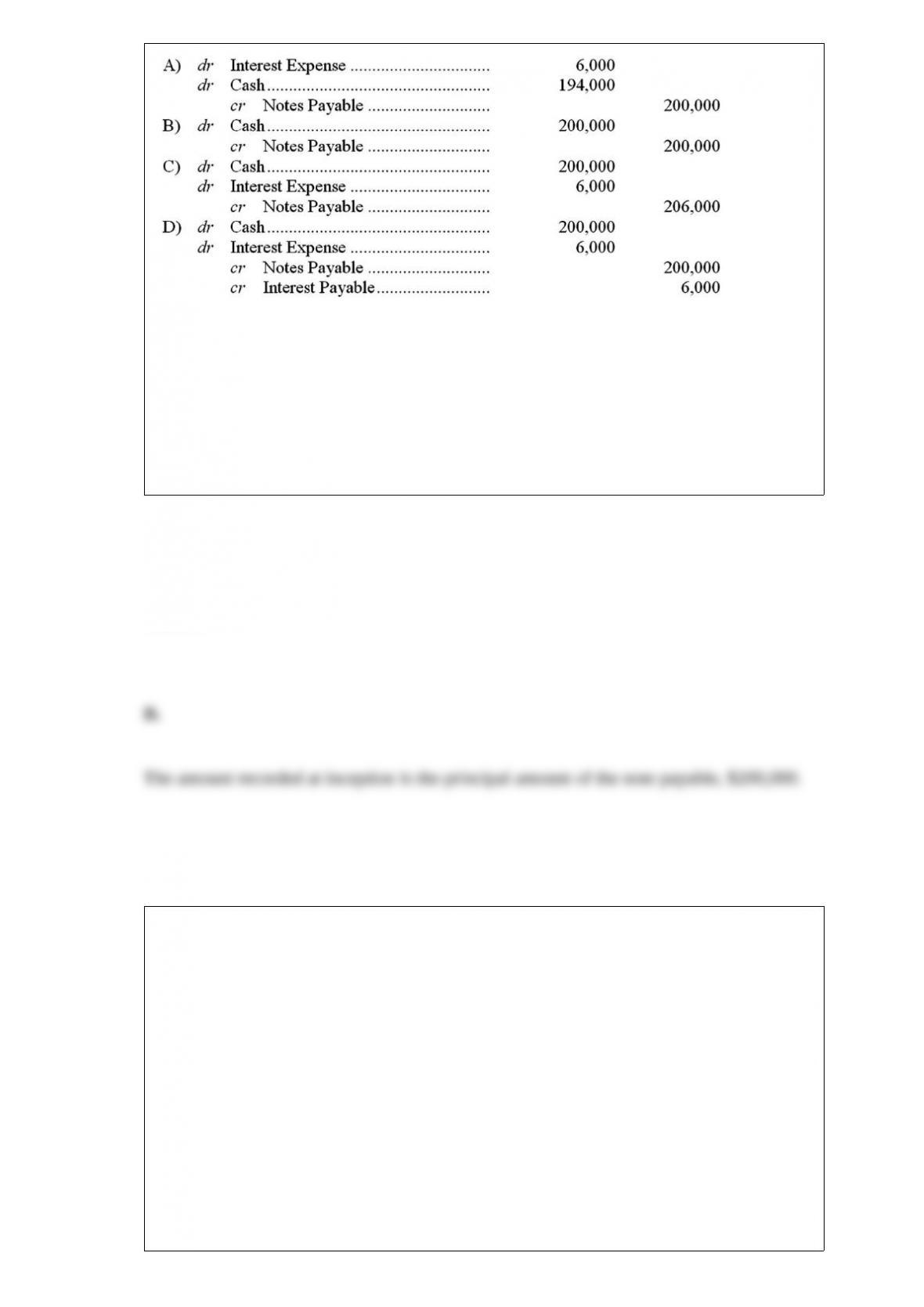
A. Option A
B. Option B
C. Option C
D. Option D
Answer:
Coca-Cola reported net sales revenues of $18.8 billion and cost of goods sold of $5.6
billion, while PepsiCo reported revenues of $22.3 billion and cost of goods sold of $9.3
billion. Which of the following statements is correct?
A. While PepsiCo generated more revenues than Coca-Cola, PepsiCo generated a lower
gross profit percentage.
B. Coca-Cola generated a lower gross profit percentage because its sales revenue was
lower.
C. PepsiCo did a better job of controlling product costs as a percentage of sales than did
Coca-Cola.
D. The selling price of Coca-Cola products must have been higher than the price of
Pepsi Co products.
Answer:
Which of the following accounts would be classified as a current liability?
A. Dividends declared.
B. Unearned revenue.
C. Wages expense.
D. Accounts receivable.
Answer:
Which of the following is not a recordable transaction?
A. Issued shares of stock to investors in exchange for cash contributions of $4,000.
B. Ordered inventory from suppliers for $3,000.
C. Sold equipment to another company for $3,000 and accepted a note from the
company promising payment in 6 months.
D. Borrowed money from the bank by signing a promissory note for $2,000.
Answer:
An understatement of the beginning inventory balance causes:
A. Cost of goods sold to be understated and net income to be understated.
B. Cost of goods sold to be understated and net income to be overstated.
C. Cost of goods sold to be overstated and net income to be understated.
D. Cost of goods sold to be overstated and net income to be correct.
Answer:
If the calculation of cash flows from operating activities starts with net income, the
company:
A. is using the net income method.
B. will remove the effects of all noncash items included in the calculation of net
income.
C. is using the direct method.
D. will add all noncash items not included in the calculation of net income.
Answer:
Your company issues a 5-year bond with a face value of $10,000 and a stated interest
rate of 7%. The market interest rate is 5%. The issue price of the bond is calculated as:
A. the present value of $10,000 to be received in 5 years plus the present value of $700
per year for 5 years.
B. the face value of the bonds, $10,000.
C. the amount investors would have to pay to earn 7% interest.
D. the amount investors would have to pay to earn an average of the stated interest rate
and the market interest rate.
Answer:
Which of these accounts would normally not be affected by an adjustment?
A. Supplies.
B. Revenues.
C. Expenses.
D. Cash.
Answer:
Dividends are reported on the:
A. Income statement.
B. Balance sheet.
C. Statement of retained earnings.
D. Income statement and balance sheet.
Answer:
The MegaHit Film Studio owns a production lot and related equipment. How would
MegaHit Company classify these assets on its balance sheet?
A. Tangible asset
B. Natural resource
C. Intangible asset
D. Goodwill
Answer:
At the start of the first year of operations, retained earnings on the balance sheet would
be:
A. equal to zero.
B. equal to contributed capital.
C. equal to stockholders’ equity.
D. equal to the net income.
Answer:
On January 1, 2014, Horton Inc. sells a machine for $23,000. The machine was
originally purchased on January 1, 2012 for $40,000. The machine was estimated to
have a useful life of 5 years and a salvage value of $0. Horton uses straight-line
depreciation. In recording this transaction:
A. a loss of $1,000 would be recorded.
B. a gain of $1,000 would be recorded.
C. a loss of $17,000 would be recorded.
Answer:
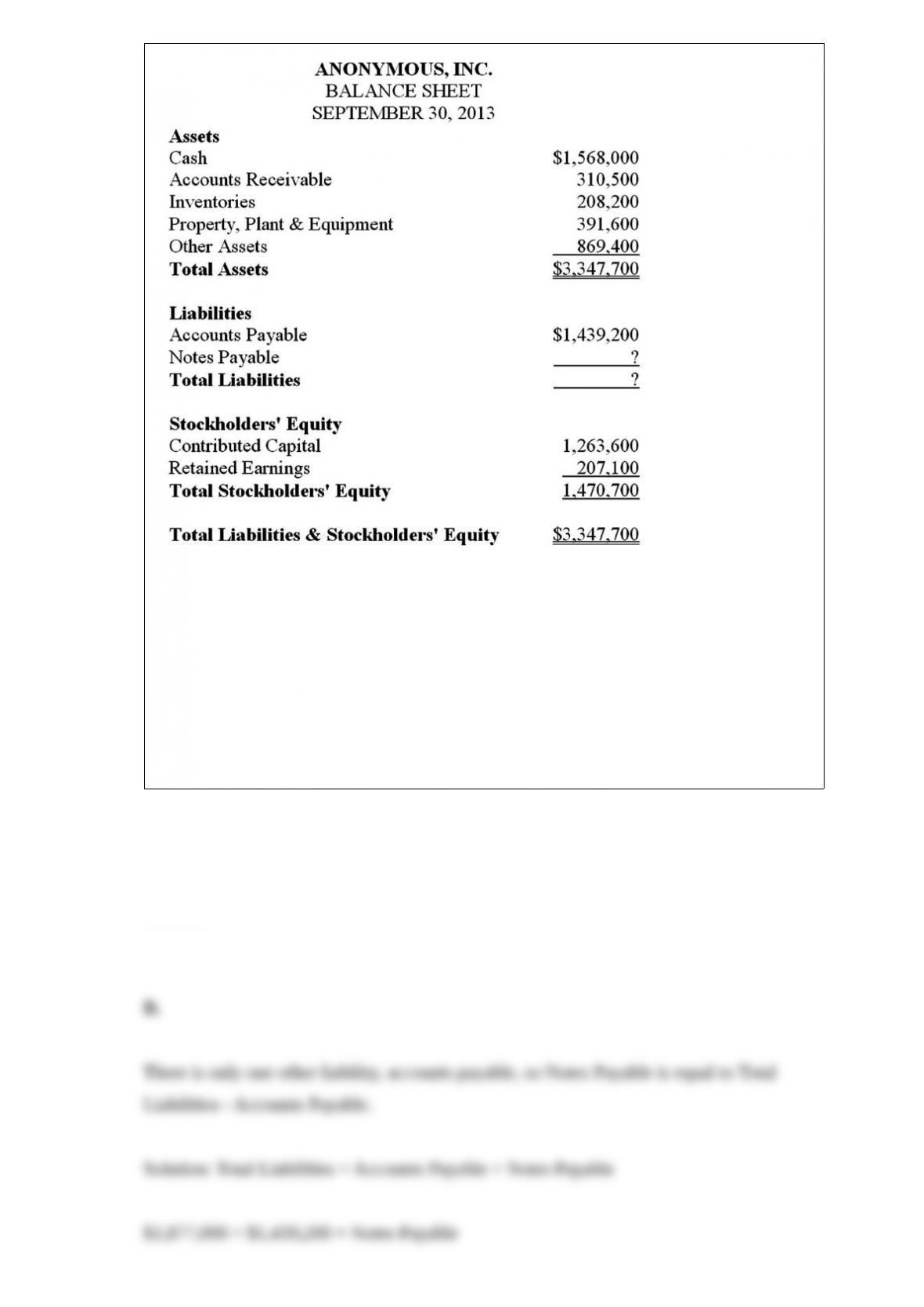
What is the missing amount for Notes Payable?
A. $207,100
B. $437,800
C. $1,439,200
D. $3,347,700
Answer:
A company lends a major client $90,000 for one year at a 7% annual interest rate.
Interest payments are to be made twice a year, and interest is accrued monthly. In July,
the company receives an interest payment for January through June. The company
would record receipt of the interest payment in which of the following ways?
A. Debit Interest Receivable for $3,150 and credit Interest Revenue for $3,150.
B. Debit Cash for $3,150 and credit Notes Receivable for $3,150.
C. Debit Interest Revenue for $3,150 and credit Cash for $3,150.
D. Debit Cash for $3,150 and credit Interest Receivable for $3,150.
Answer:
Cinno Company reported net income of $20,000 for the year ended December 31, 2014.
During the year, inventories decreased by $7,000, accounts payable decreased by
$8,000, depreciation expense was $10,000, and accounts receivable increased by
$6,500. Net cash provided by operations in 2014, computed using the indirect method
was:
A. $10,500.
B. $22,500.
C. $38,500.
D. $51,500.
Answer:
If a company’s P/E ratio suddenly decreases:
A. you should sell the stock as soon as possible.
B. you should buy more of the stock to increase your average gain.
C. the company probably announced higher earnings forecasts.
D. the market must have reacted to some bad news that is expected to affect the
company in the future.
Answer:
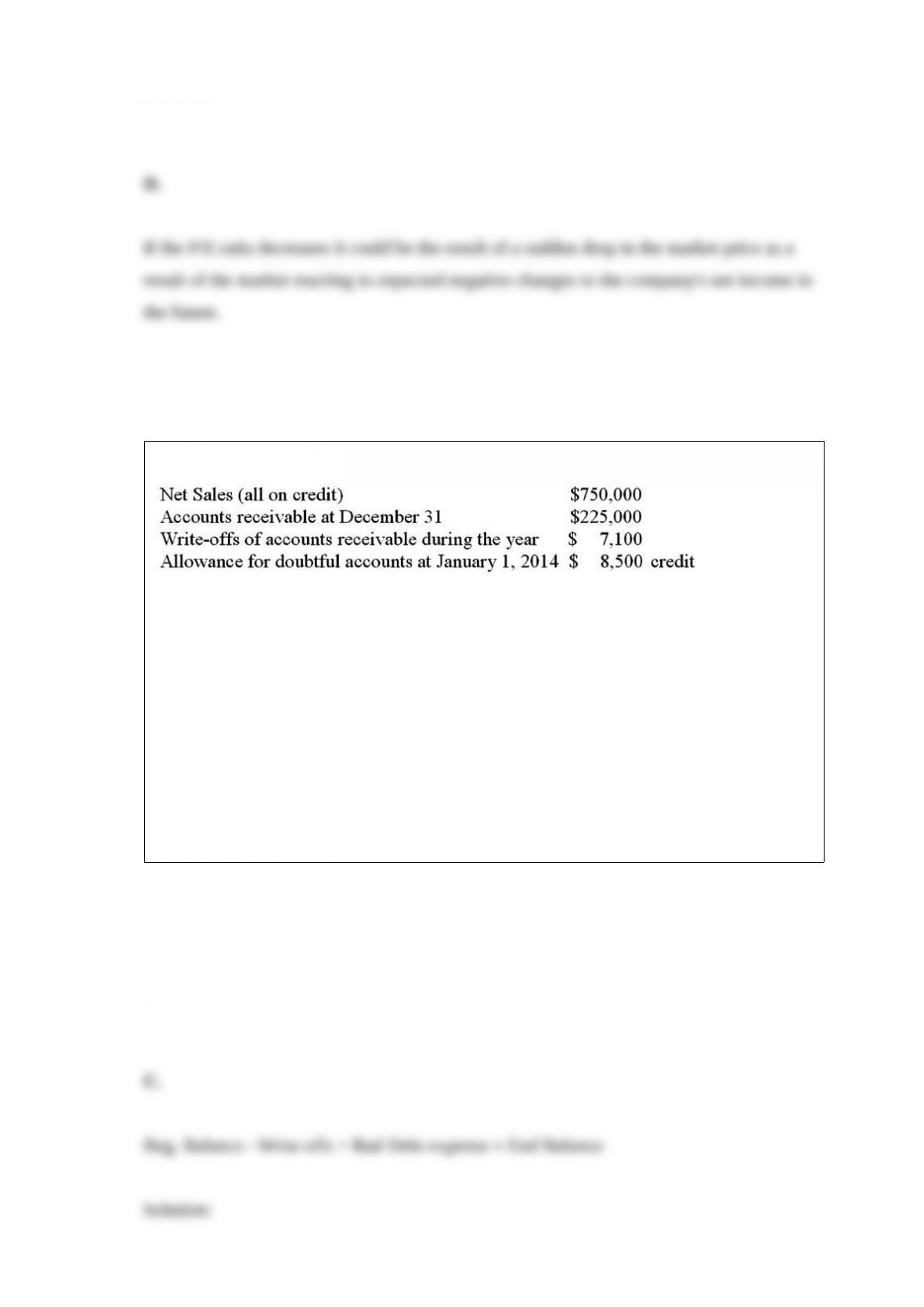
At December 31, 2014, a company’s records include the following:
Use the information above to answer the following question. Assuming the entry to
record bad debt expense was $8,250, what is the balance in the allowance for doubtful
accounts after this entry was made?
A. $6,850
B. $8,250
C. $9,650
D. $1,150
Answer:
A times interest earned ratio of 11 means that the company’s:
A. net income is large enough to pay interest and taxes 11 times.
B. net cash flow from operations before taxes and interest is large enough to pay
interest and taxes 11 times.
C. net cash flow from operations is large enough to pay interest and taxes 11 times.
D. income before taxes and interest is large enough to pay interest 11 times.
Answer:
The net sales of a company is $300,000. The cost of goods available for sale is
$280,000 and the gross profit percentage is 35%. What is the amount of ending
inventory?
A. $105,000
B. $195,000
C. $85,000
D. $70,000
Answer:
Accounting information serves a valuation function when it is used by:
A. managers to run the business.
B. directors to protect stockholders’ interests.
C. government officials to protect the public’s interests.
D. investors to estimate how much the business is worth.
Answer:
This month, a company performed $517,000 of services and incurred total expenses of
$438,000. If the company was paid in cash for all its services and paid cash for all its
expenses, these transactions would cause:
A. revenues to increase $517,000, expenses to increase $438,000, and retained earnings
to decrease $79,000.
B. cash to increase $517,000, expenses to increase $438,000, and contributed capital to
increase $79,000.
C. revenues to increase $517,000, expenses to increase $438,000, and cash to increase
$79,000.
D. revenues to increase $79,000, expenses to increase $438,000, and cash to increase
$517,000.
Answer:
Significant differences between GAAP and IFRS exist in all of the following areas
except:
A. classification of preferred stock.
B. allowability of LIFO for inventory costing.
C. depreciation of equipment.
D. the order in which current and noncurrent accounts are presented on the balance
sheet.
Answer:
Which of the following terms does not mean the same as the others?
A. Tangible assets.
B. Fixed assets.
C. Property, plant, and equipment.
D. Long-lived assets.
Answer: