1) Pearl Manufacturing Company provides glassware machines for major department
store retailers. The company has been investigating a new piece of machinery for its
production department. The old equipment has a remaining life of five years and the
new equipment has a value of $239,400 with a five-year life. The expected additional
cash inflows are $63,000 per year. What is the payback period for this investment?
A) 2.5 years
B) 4.5 years
C) 3.8 years
D) 5 years
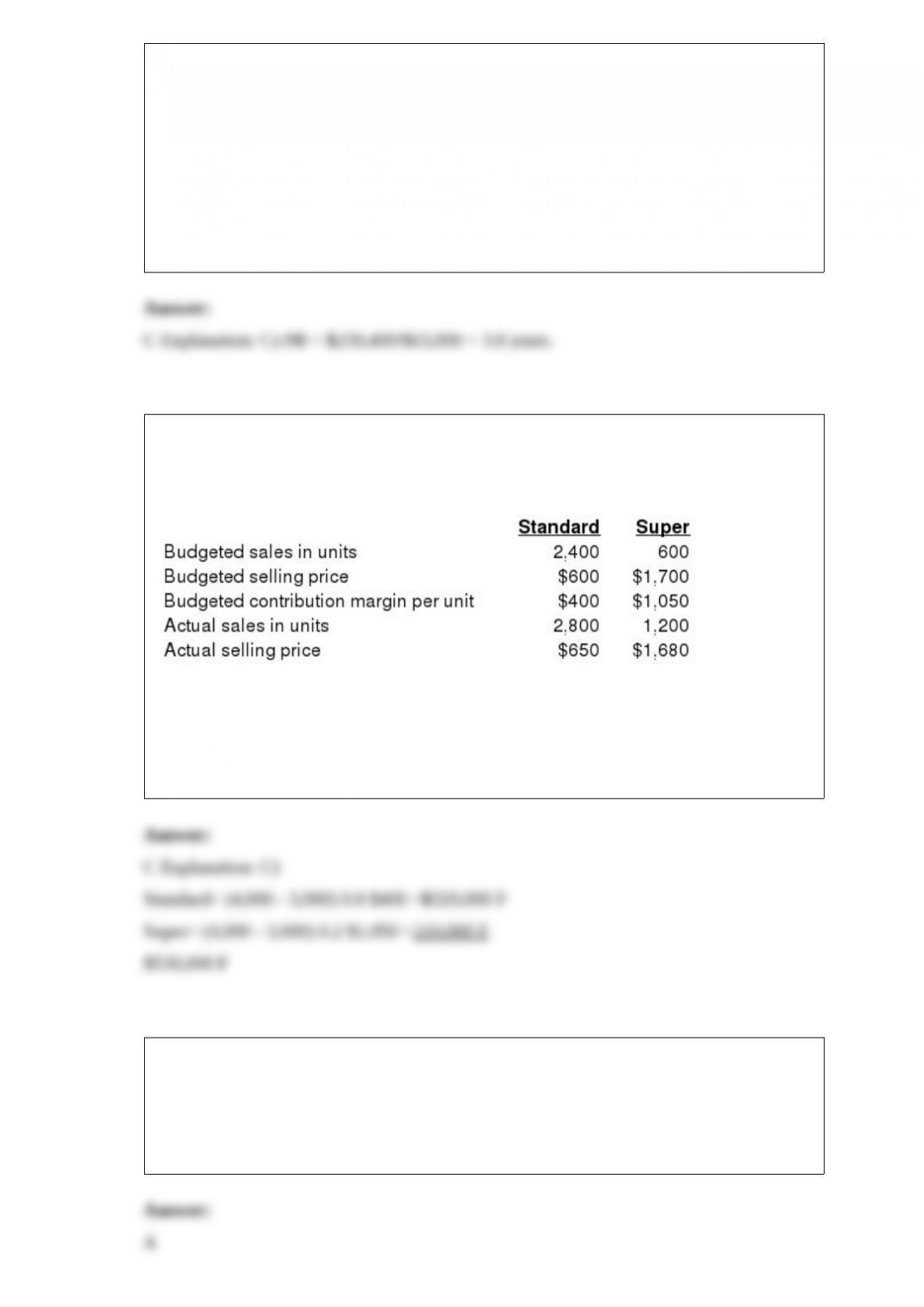
2) The Corata Appliance Manufacturing Corporation manufactures two vacuum
cleaners, the Standard and the Super. The following information was gathered about the
two products:
What is the total sales-quantity variance in terms of the contribution margin?
A) $260,000 favorable
B) $790,000 favorable
C) $530,000 favorable
D) $290,000 favorable
3) A company should use cost-based transfer prices ________.
A) when a company’s product is specialized
B) the market for the intermediate product is perfectly competitive
C) the interdependencies of subunits are minimal
D) there is no benefit from market-based transfer price

4) Henry Inc., a manufacturing firm, is able to produce 1,000 pairs of sneakers per hour,
at maximum efficiency. There are three eight-hour shifts each day. Due to unavoidable
operating interruptions, production averages 800 units per hour. The plant actually
operates only 27 days per month. Based on the current budget, Henry estimates that it
will be able to sell only 500,000 units due to the entry of a competitor with aggressive
marketing capabilities. But the demand is unlikely to be affected in future and will be
around 515,000. Assume the month has 30 days.
What is the theoretical capacity for the month?
A) 1,000,000 units
B) 720,000 units
C) 518,800 units
D) 240,000 units
5) An important difference between financial measures of quality and nonfinancial
measures of quality is that ________.
A) financial measures of quality tend to be useful indicators of future long-term
performance, while nonfinancial measures have more of a short-term focus
B) nonfinancial measures of quality tend to be useful indicators of future long-term
performance, while financial measures of quality have more of a short-term focus
C) nonfinancial measures are generally too subjective to have any long-term value,
while financial measures are too objective for taxation purposes
D) nonfinancial measures are generally too subjective to have any short-term value,
while financial measures are too objective to have medium-term value
6) ________ means minimum constraints and maximum freedom for managers at the
lowest levels of an organization to make decisions and to take actions.
A) Total centralization
B) Use of market-based transfer pricing
C) Total decentralization
D) Use of negotiated transfer pricing
7) At the Verill Company, the cost of the library and information center has always been
charged to the various departments based upon number of employees. Recently,
opinions gathered from the department managers indicate that the number of engineers
within a department might be a better predictor of library and information center costs.
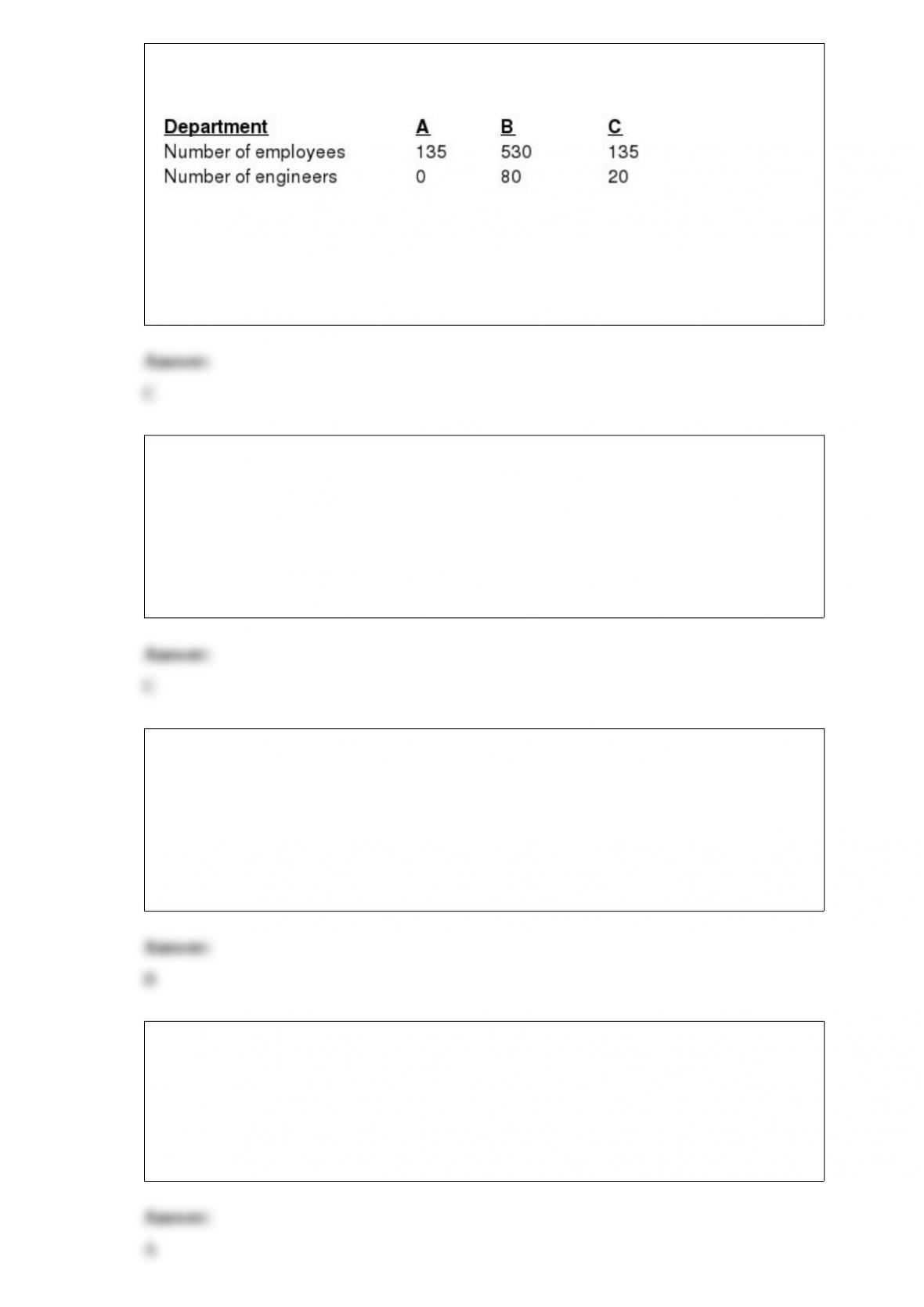
Total library and information center costs are $200,000.
Which cost estimation method is being used by Verill Company?
A) the regression analysis method
B) the marginal costing method
C) the conference method
D) the operating costing method
8) Which of the following companies is likely to use a hybrid-costing system?
A) Best Fit Corp., which manufactures pharmaceuticals
B) Rida Corp., which processes and sells, after import, a single variant of Turkish
marble to real estate companies
C) Fast run, which sells a limited range of televisions, which go through similar
manufacturing process
D) Karoline Corp., which manufactures and sells a single model of cap
9) ________ is the practice of charging a higher price for the same product or service
when demand approaches the physical limit of the capacity to produce that product or
service.
A) Price discrimination
B) Peak-load pricing
C) Demand-based pricing
D) Customer preference pricing
10) If a sales-volume variance was caused by poor-quality products, then the ________
would be in the best position to explain the variance.
A) production manager
B) sales supervisor
C) financial supervisor
D) logistic manager
11) All of the following would be classified as product costs except:
A) property taxes on production equipment.
B) insurance on factory machinery.
C) salaries of the marketing staff.
D) wages of machine operators.
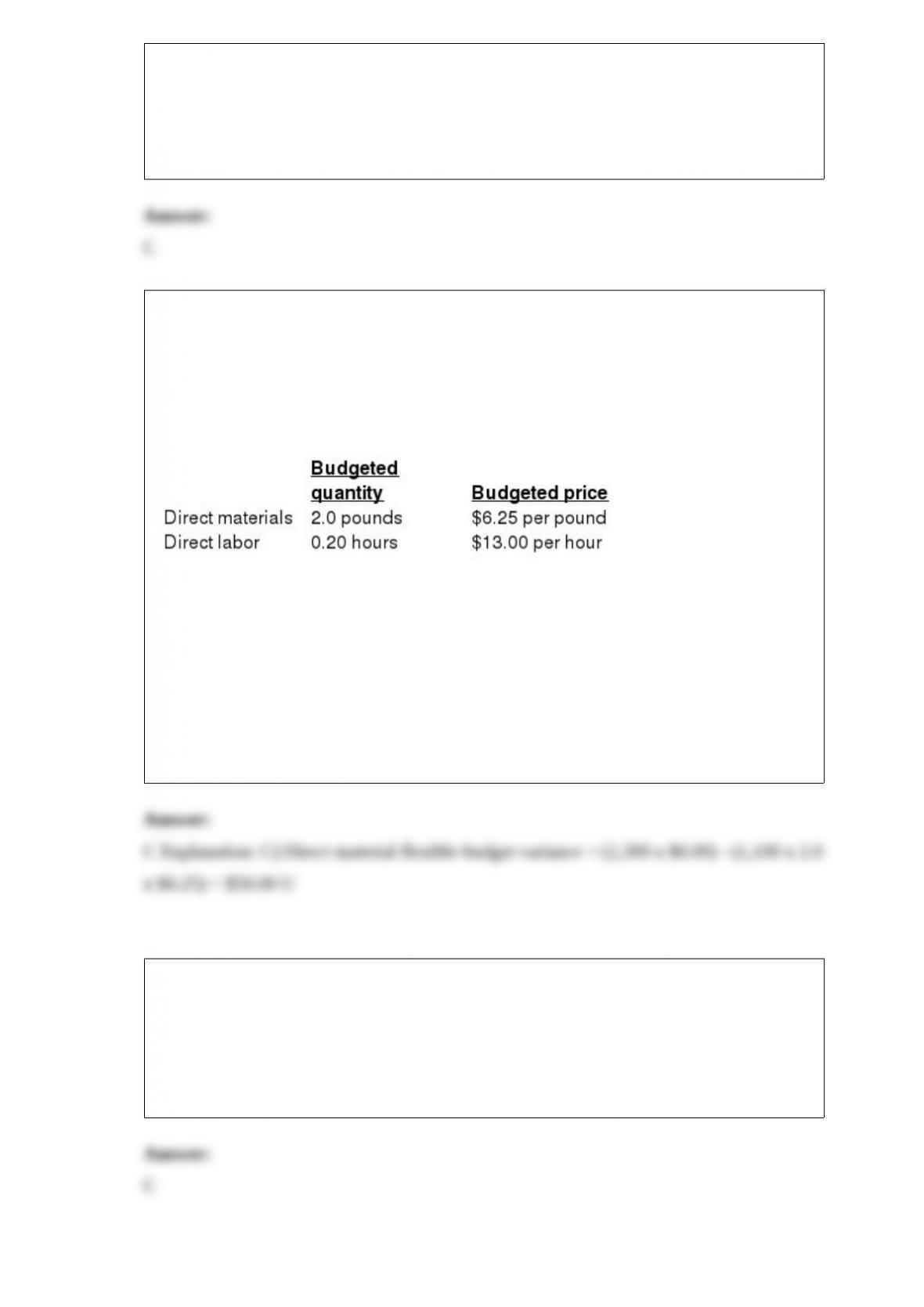
12) Demizio Valley Orchards, Inc. (DVO), developed standard costs for direct material
and direct labor. In 2015, DVO estimated the following standard costs for one of their
most well loved products, the DVO classic Grandma’s large apple pie which had a
brown sugar coating on the top of the crust as well as including cranberry and mince
ingredients in addition to the apples.
During September, DVO produced and sold 1,100 pies using 2,300 pounds of direct
materials at an average cost per pound of $6.00 and 200 direct labor hours at an average
wage of $13.25 per hour.
September’s direct material flexible-budget variance is ________.
A) $100.00 unfavorable
B) $150.00 favorable
C) $50.00 unfavorable
D) $575 favorable
13) Comparison of the actual results for a project to the costs and benefits expected at
the time the project was selected is referred to as ________.
A) the audit trail
B) management control
C) a post-investment audit
D) a cost-benefit analysis
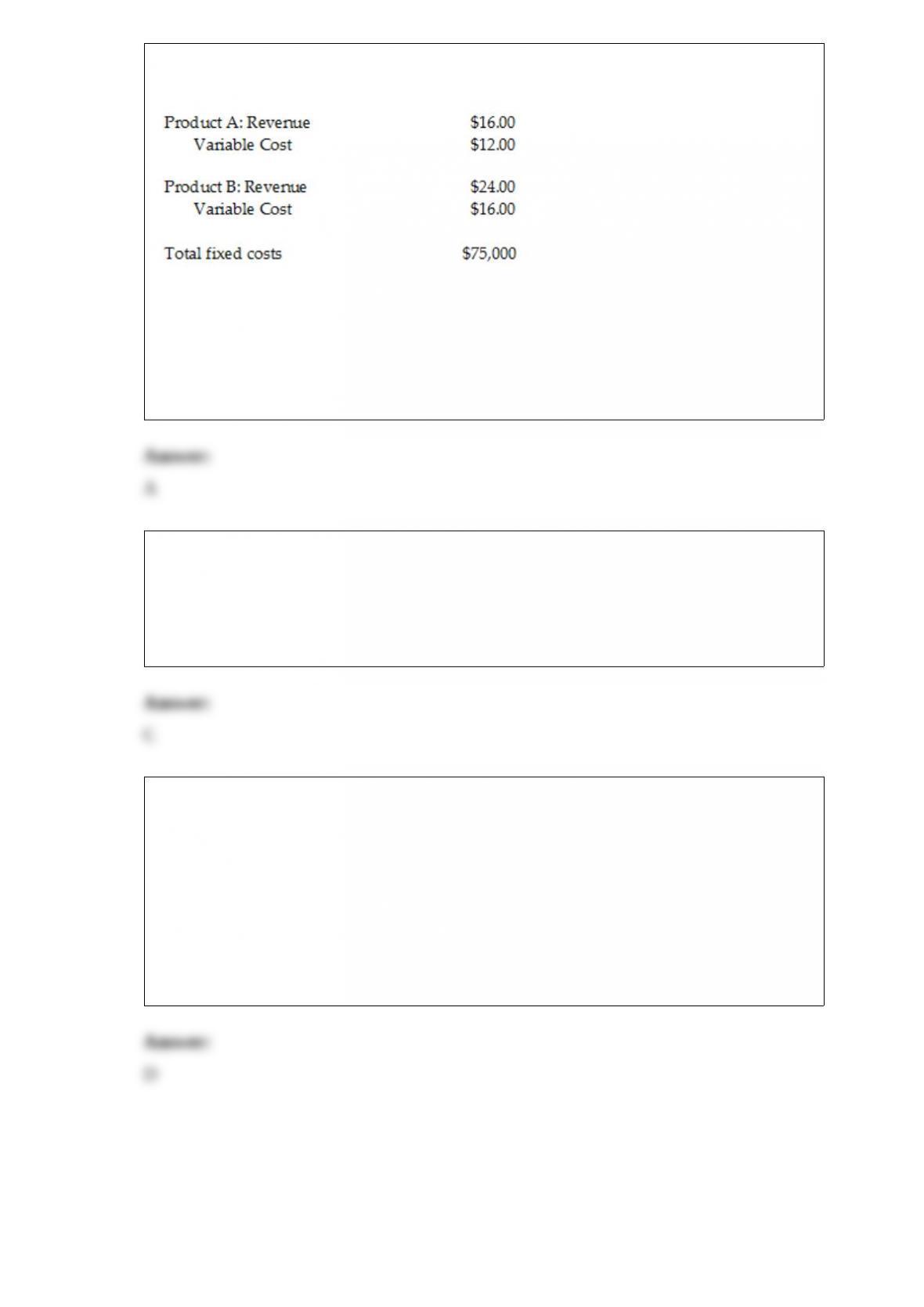
14) The following information is for the Jeffries Corporation:
If the sales mix shifts to four units of Product A and one unit of Product B, then the
breakeven point will ________.
A) increase
B) stay the same
C) decrease
D) either decrease or remain same
15) For an automobile manufacturer, period costs include the cost of ________.
A) the dashboard
B) labor used for assembly
C) advertising
D) assembly-line equipment
16) Which of the following best describes a transfer price?
A) It is the price charged by an organization when it transfer goods to another
organization in lieu of services provided by it.
B) It is the price that is to be used while calculating revenue from sales to customers for
tax purposes.
C) It is the price that is charged by a department of an organization when it sells its
goods to its competitors.
D) It is the price one subunit charges for a product or service supplied to another
subunit of the same organization.