1) A corporation acts under its own name and not the name of its stockholders.
2) The sum of the cash in the petty cash fund and the total of the paid vouchers should
equal the opening balance in the petty cash account at all times.
3) The revenue recognition principle requires that sales revenues be recognized when it
is earned.
4) Trading securities are originally recorded at their cost.
5) When compared to the accelerated depreciation methods, the use of the straight-line
method increases a company’s tax liability.
6) Managers can use records produced by point-of-sale terminals to check inventory
levels.
7) Cash equivalents include accounts receivable expected to be collected within 90 days
or less.
8) There are two ways to format operating activities on the statement of cash flows.
9) Overstating ending inventory in the current year will understate the following year’s
net income.
10) The books need to be closed in order to prepare the accounts for the next period’s
transactions.
11) On a statement of cash flows, which of the following is a sign of a healthy
company?
A) Investing activities include more sales of long-term assets than purchases
B) Financing activities are dominated by borrowing
C) Operating activities are the major source of cash
D) Net Cash Provided by Operating Activities is less than net income
12) On the statement of retained earnings:
A) a net loss is shown in parentheses as a deduction
B) net income decreases retained earnings
C) dividends declared increase retained earnings
D) dividends paid increase retained earnings
13) Stockholders’ equity is divided into:
A) retained earnings and paid-in capital
B) retained earnings and common stock
C) assets and liabilities
D) common stock and preferred stock
14) The Public Company Oversight Board was created to oversee the:
A) SEC
B) management of public companies
C) audits of public companies
D) American Institute of Certified Public Accountants
15) On January 1, 2015, Benson Company purchases $100,000, 6% bonds at a price of
95 and a maturity date of January 1, 2020. Benson Company plans to hold the bonds
until their maturity date. Interest is paid semiannually, on January 1 and July 1. Benson
Company has a calendar year end. The adjusting entry on December 31, 2015 is:
A) debit Cash $3,000 and credit Interest Revenue $3,000
B) debit Cash $6,000 and credit Interest Revenue $6,000
C) debit to Interest Receivable $3,000, debit Held-to-Maturity Investment in Bonds for
$500 and credit Interest Revenue $3,500
D) debit to Interest Receivable $6,000 and credit Interest Revenue $6,000
16) Which of the following must be added to beginning Retained Earnings to compute
ending Retained Earnings?
A) Net income
B) Expenses
C) Dividends
D) All of the above
17) An unrealized gain on a trading security:
A) is recorded when a trading security is sold for more than its cost
B) is recorded when a trading security is sold for less than its cost
C) is recorded when the fair value of the trading security is more than its cost
D) is recorded when the fair value of the trading security is less than its cost

18) If a company has common stock and preferred stock outstanding, book value per
share is calculated as:
A) total paid-in capital divided by the number of common shares of stock outstanding
B) total paid-in capital divided by the number of common shares issued
C) total stockholders’ equity minus preferred equity divided by the number of common
shares outstanding
D) total stockholders’ equity minus preferred equity divided by the number of common
shares issued
19) When a company issues common stock at a price per share greater than its par value
per share, the excess should be credited to:
A) Retained Earnings
B) Common Stock
C) Paid-in Capital in Excess of ParCommon
D) Excess Capital
20) The cost of the inventory that a business has sold to customers is called:
A) inventory
B) cost of goods sold
C) purchases
D) gross profit
21) The adjustment for an accrued expense:
A) increases expenses and decreases assets
B) increases expenses and increases liabilities
C) decreases expenses and increases liabilities
D) decreases expenses and increases assets
22) Purdue Company had the following transactions pertaining to stock investments:
a.February 1, Purchased 3,000 shares of Hudson Company (10% ownership) at the
market price of $17 per share. Purdue Company intends to keep the stock for more than
one year and classifies the stock as available-for-sale.
b. June 1, Received cash dividends of $6,000 on Hudson Company stock.
c.October 1, Sold 3,000 shares of Hudson stock for $54,000.
The journal entry to record the purchase of the Hudson stock is:
A) debit Equity-Method Investment for $51,000 and credit Cash for $51,000
B) debit Investment in Available-for-Sale Securities for $51,000 and credit Cash for
$51,000
C) debit Cash for $51,000 and credit Common Stock for $51,000
D) debit Common Stock for $51,000 and credit Cash for $51,000
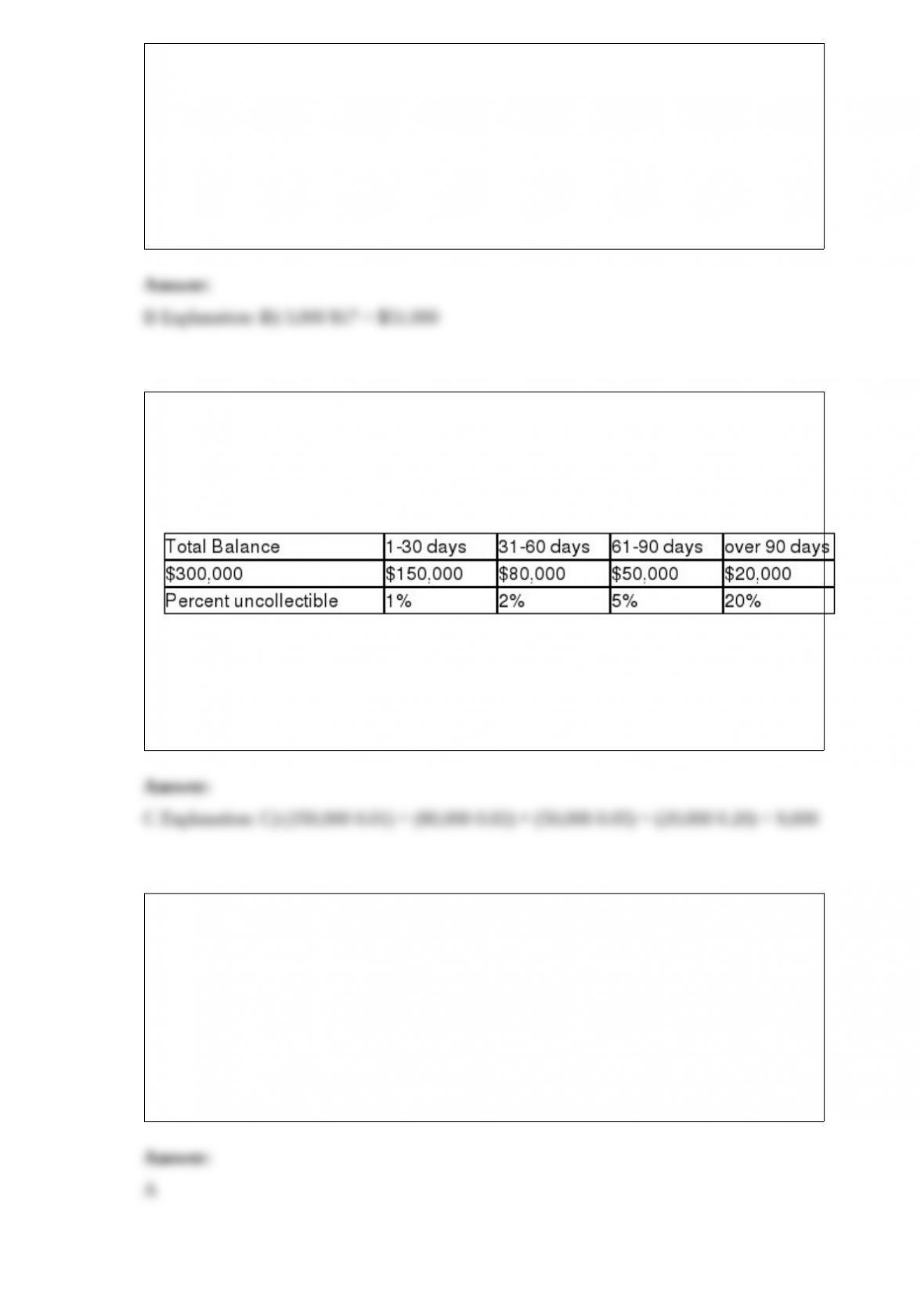
23) On December 31, 2015, Jerome Company has an accounts receivable balance of
$300,000 before any year-end adjustments. The Allowance for Doubtful Accounts has a
$1,000 credit balance. The company prepares the following aging schedule for accounts
receivable:
What is the Allowance for Uncollectible Accounts at December 31, 2015?
A) $0
B) $8,600
C) $9,600
D) $10,600
24) We have used transaction analysis and the accounting equation to record several
transactions for a company. The transactions are now recorded on a multi-column
spreadsheet of the assets, liabilities, and stockholders’ equity of the company. If you
wanted to prepare a statement of cash flows with this spreadsheet, which column would
you use?
A) Cash column
B) Accounts Receivable column
C) Retained Earnings column
D) Revenue column
25) Equipment costing $40,000 with a book value of $18,000 is sold for $20,000.
Which journal entry is used to record the sale?
A) debit Cash for $20,000 and credit Equipment for $20,000
B) debit Cash for $18,000, debit Accumulated Depreciation for $22,000 and credit
Equipment for $40,000
C) debit Cash for $20,000, debit Accumulated Depreciation for $22,000, credit
Equipment for $40,000 and credit Gain on Sale of Equipment for $2,000
D) debit Cash for $18,000, debit Loss on Sale of Equipment for $2,000 and credit
Equipment for $20,000
26) Which accounts are increased by debits?
A) Cash and Accounts Payable
B) Salaries Expense and Common Stock
C) Accounts Receivable and Utilities Expense
D) Accounts Payable and Service Revenue
27) On the statement of cash flows, financing activities involve:
A) purchasing investments
B) acquiring long-term assets
C) lending money
D) issuing notes payable
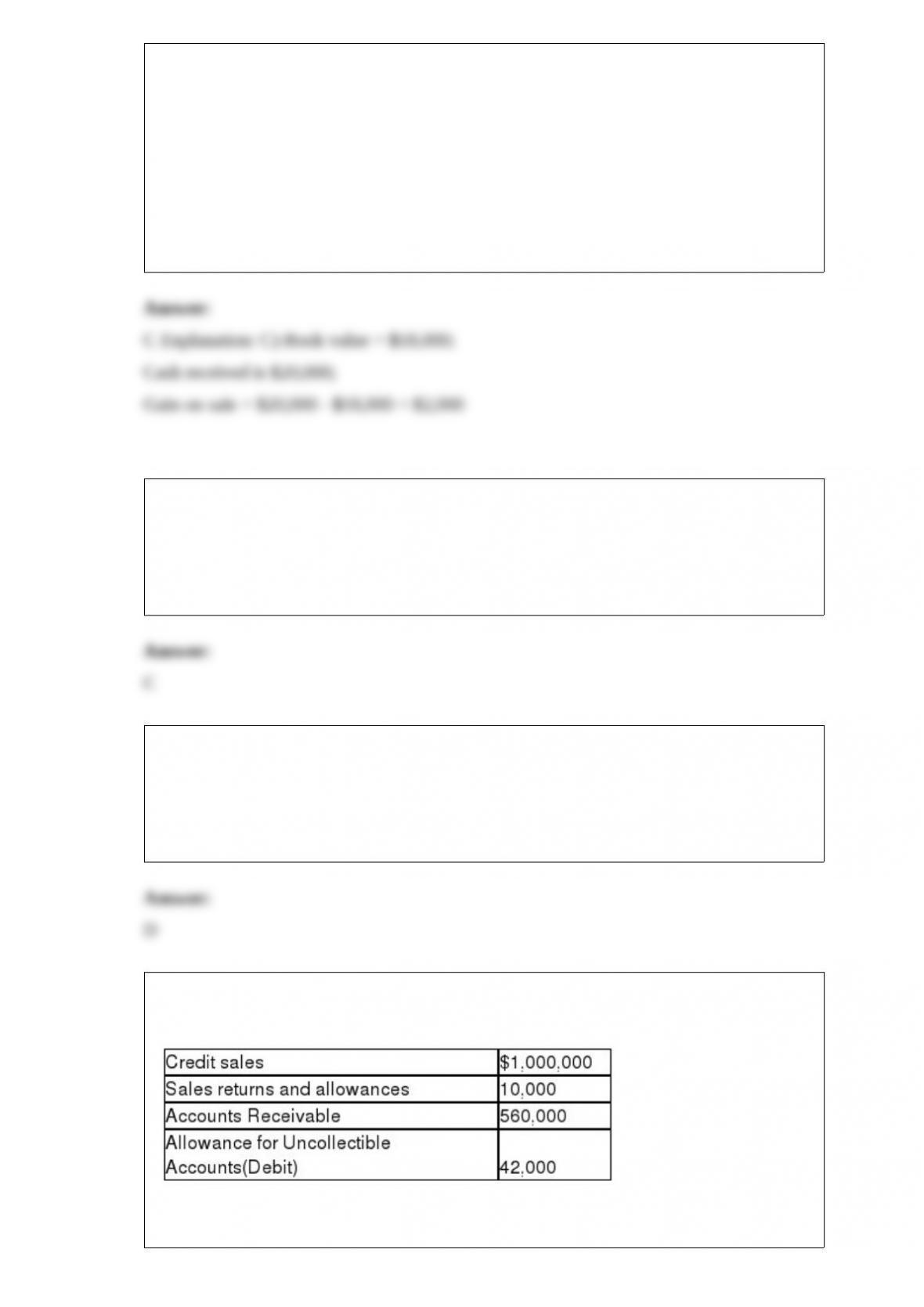
28) At the end of the year, Smith Company has the following information available:
The company uses the percent-of-sales method to estimate bad debts and has not
prepared the adjusting journal entry for Uncollectible-Account Expense at year end. In

the prior year, uncollectible accounts were estimated at 1% of credit sales. What should
the company do for uncollectible accounts at the end of the current year?
A) increase the percentage in the percent-of-sales method
B) reexamine credit policies
C) change to the direct write-off method
D) A and B
29) Which statement about the statement of cash flows is FALSE?
A) The statement of cash flows is based on information from several financial
statements
B) The statement of cash flows is based on information in a company’s balance sheet
only
C) The change in the Cash account on the comparative balance sheets is the check
figure for the statement of cash flows
D) The indirect method of preparing the statement of cash flows is used by most
companies in the United States
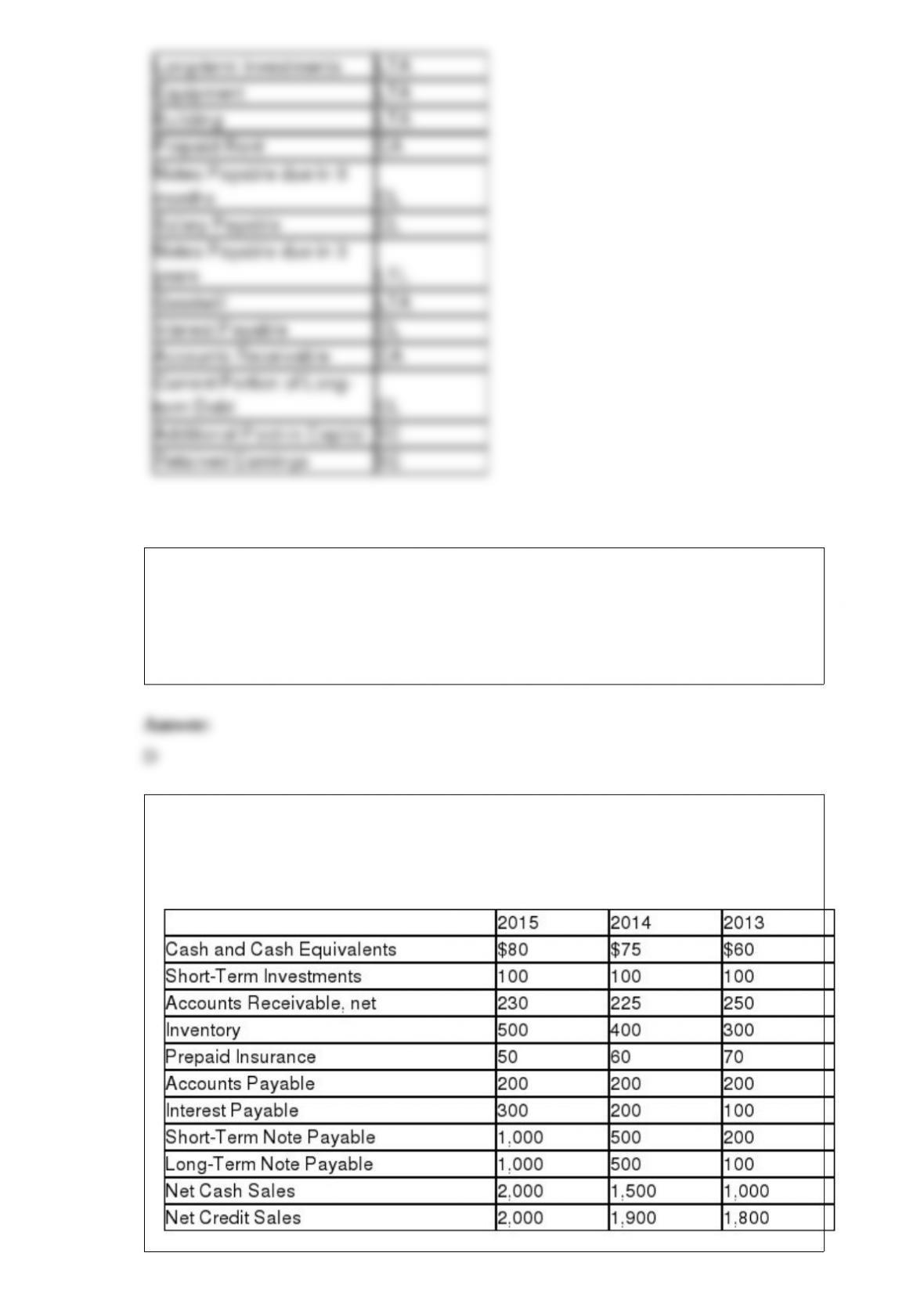
30) Indicate if the account is a current asset (CA), long-term asset (LTA), current
liability (CL), long-term liability (LTL), or stockholders’ equity(SE):
1>Long-term Investments________
2>Equipment________
3>Building________
4>Prepaid Rent________
5>Notes Payable due in 6 months________
6>Salary Payable________
7>Notes Payable due in 3 years________
8>Goodwill________
9>Interest Payable________
10>Accounts Receivable________
11>Current Portion of Long-term Debt________
12>Additional Paid-in Capital________
13>Retained Earnings________
31) Adjusting entries:
A) are needed for all balance sheet accounts
B) must be made on a daily basis to record supplies used during that day
C) are needed because errors have been made in previous journal entries
D) are made before the financial statements can be prepared
32) The comparative financial statements of Walters Company for 2015, 2014, and
2003 contain the following selected data:
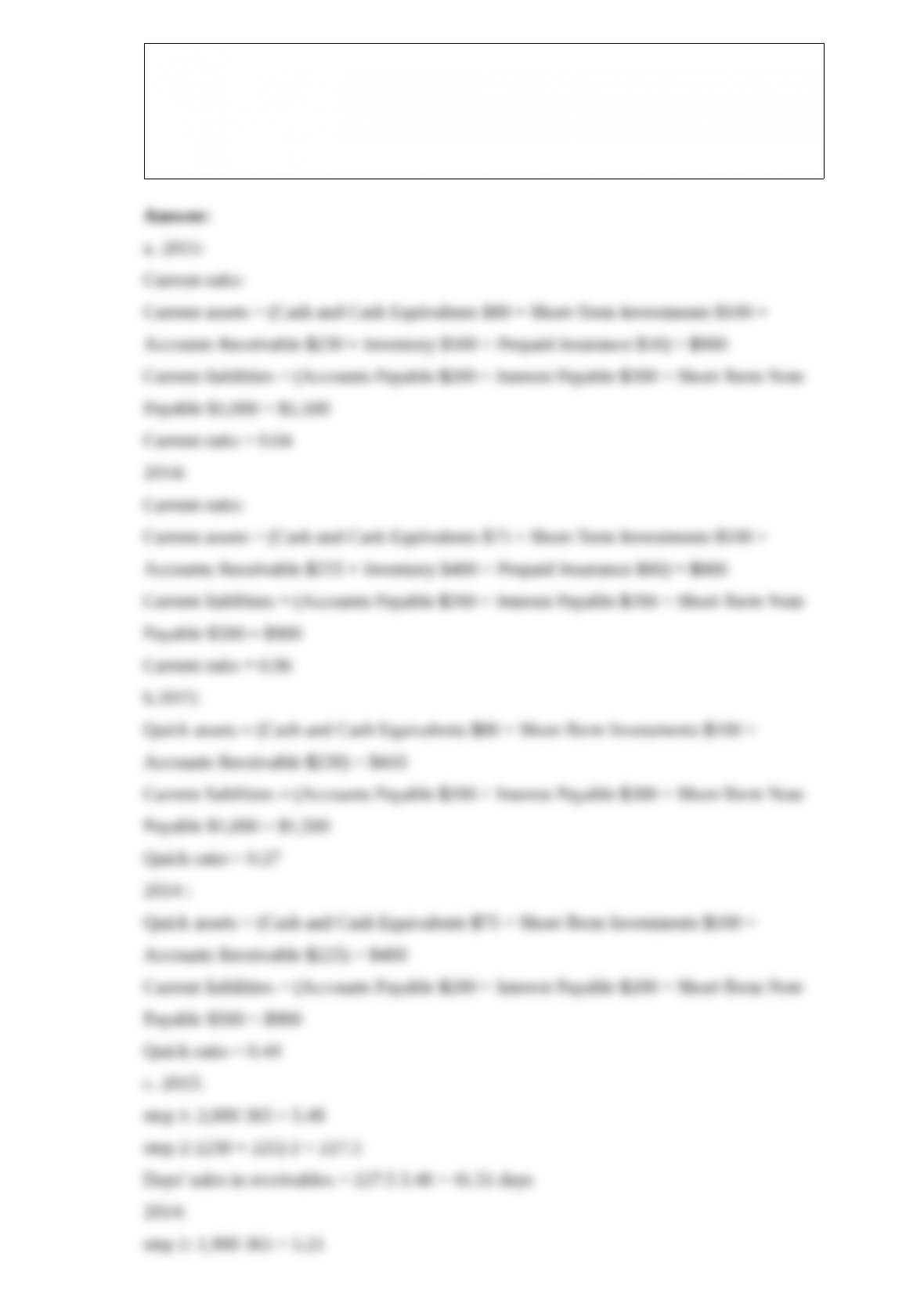
Compute the following ratios for 2015 and 2014 and indicate which ratios improved
and which ratios deteriorated:
a. Current ratio
b. Quick ratio
c. Days’ sales in receivables
33) Which of the following costs for a delivery vehicle should NOT be capitalized?
A) repair dented fender
B) service air conditioning system
C) repair air conditioning system
D) all of the above
34) Strategies to increase the current ratio may include:
A) increasing sales
B) paying off current liabilities before the end of the year
C) reclassifying long-term investments as short-term investments
D) all of the above
35) Which of the following transactions requires a journal entry?
A) The bank charged $50 for a stop payment on a check
B) The bank deducted $50 from your account incorrectly
C) The bank collected a note receivable with interest on your behalf
D) A and C
36) When treasury stock is purchased, accountants record treasury stock at:
A) the stock’s par value
B) the stock’s original selling price
C) the stock’s current market value
D) the difference between the original selling price and the par value
37) A company purchased medical equipment for $100,000 on January 1, 2015. The
company determined that the yearly depreciation expense is $10,000. What will be the
ending balance in the Accumulated DepreciationMedical Equipment at December 31,
2017?
A) $10,000
B) $30,000
C) $60,000
D) $100,000
38) Notes payable due in six months are reported as:
A) a reduction to notes receivable on the balance sheet
B) current assets on the balance sheet
C) current liabilities on the balance sheet
D) long-term liabilities on the balance sheet
39) Sweeten Corporation had sales of $900,000. The beginning Accounts Receivable
balance was $70,000 and the ending Accounts Receivable balance was $230,000. The
cash collected from customers for this reporting period is:
A) $670,000
B) $740,000
C) $970,000
D) $1,060,000
40) The current ratio is current assets:
A) minus current liabilities
B) divided by current liabilities
C) plus current liabilities
D) multiplied by current liabilities
41) Previously issued stock that a corporation purchases from shareholders is called:
A) outstanding stock
B) authorized stock
C) issued stock
D) treasury stock
42) To obtain a new customer, a business sells merchandise to the customer for $50.
Normally, the merchandise sells for $100. For this sale, the business should record
revenue of:
A) $50
B) $100
C) either amount
D) an average of the two amounts
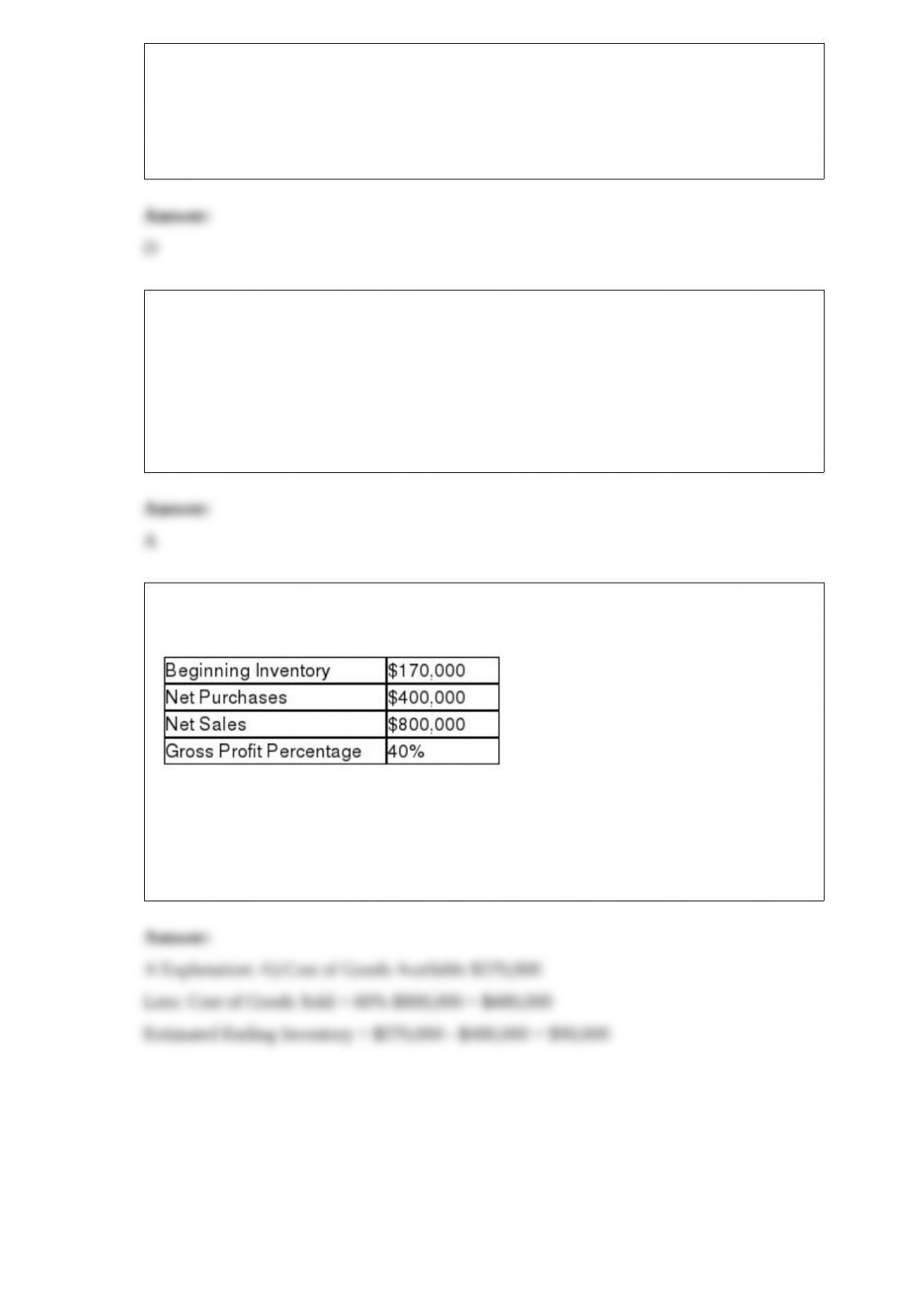
43) Lolita Company has the following information:
Lolita Company’s estimated ending inventory is:
A) $90,000
B) $160,000
C) $480,000
D) $570,000