
A variable cost system is an accounting system where standards are set for each
manufacturing cost element.
Answer:
The three inventory costing methods will normally each yield different amounts of net
income.
Answer:
A firm selling food should have higher inventory turnover rate than a firm selling office
furniture.
Answer:
The chart of accounts for a partnership, with the exception of drawing and capital
accounts, does not differ from the chart of accounts for a sole proprietorship.
Answer:
The profit center income statement should include only revenues and expenses that are
controlled by the manager.
Answer:
Dissolution is the term which solely means to liquidate the partnership.
Answer:
The system of accounting where revenues are recorded when they are earned and
expenses are recorded when they are incurred is called the cash basis of accounting.
Answer:
Processing methods are the means by which the system collects, summarizes, and
reports accounting information.
Answer:
In an investment center, the manager has the responsibility and the authority to make
decisions that affect not only costs and revenues, but also the plant assets invested in the
center.
Answer:
The difference between the balance in Accounts Receivable and the balance in the
Allowance for Doubtful Accounts is called the net realizable value.
Answer:

Budget performance reports prepared for the vice-president of production would
generally contain less detail than reports prepared for the various plant managers.
Answer:
Depending on the capacity of the plant, a company may best be served by further
processing some of the product and leaving the rest as is, with no further processing.
Answer:
To determine cash payments for merchandise for the cash flow statement using the
direct method, a decrease in accounts payable is added to the cost of merchandise sold.
Answer:
Equivalent units of production are always the same as the total number of physical units
finished during the period.
Answer:
All bank memos reported on the bank reconciliation require entries in the company’s
accounts.
Answer:
Equivalent units should be computed separately for direct materials and conversion
costs.
Answer:
The current year’s advertising costs are normally considered period costs.
Answer:
The ratio of sales to invested assets is termed the investment turnover component of the
rate of return on investment.
Answer:
Generally accepted accounting principles require accrual-basis accounting.
Answer:
Product costs are also referred to as inventoriable costs.
Answer:
On the balance sheet for a manufacturing business, the cost of direct materials, direct
labor, and factory overhead are categorized as either materials inventory, work in
process inventory, or finished goods inventory.
Answer:
If the maker of a note fails to pay the debt on the due date, the note is said to be
dishonored.
Answer:
Systems analysis is the final phase in the creation or revision of an accounting system.
Answer:
Purchased goods in transit should be included in the ending inventory of the buyer if the
goods were shipped FOB shipping point.
Answer:
Sales commissions expense for a department store is an example of a direct expense.
Answer:
The Drawings account is an example of an expense.
Answer:
The Limited Liability Company may elect to be manager managed rather than member
managed which means that only authorized members may legally bind the corporation.
Answer:
The cash account will always be debited.
Answer:
In preparing flexible budgets, the first step is to identify the fixed and variable
components of the various costs and expenses being budgeted.
Answer:

The budget procedure that requires all levels of management to start from zero in
estimating sales, production, and other operating data is called zero-based budgeting.
Answer:
In a defined benefits plan, the employer bears the investment risks in funding a future
retirement income benefit.
Answer:
The higher the times interest earned ratio, the better the creditors’ protection.
Answer:
Prior to the adjusting process, accrued expenses have
A.not yet been incurred, paid, or recorded

B.been incurred, not paid, but have been recorded
C.been incurred, not paid, and not recorded
D.been paid but have not yet been incurred
Answer:
Indicate whether each of the following represents an asset, liability, or owner’s equity:
(a) accounts payable
(b) wages expense
(c) capital
(d) accounts receivable
(e) withdrawal
(f) land
Answer:

Identify which of the following accounts appear on a balance sheet.
(a) Cash
(b) Fees Earned
(c) Joe Brown, Capital
(d) Wages Payable
(e) Rent Expense
(f) Prepaid Advertising
(g) Land
Answer:
When using a perpetual inventory system, the journal entry to record the cost of
merchandise sold is:
A.debit Cost of Merchandise Sold; credit Sales
B.debit Cost of Merchandise Sold; credit Merchandise Inventory
C.debit Merchandise Inventory; credit Cost of Merchandise Sold
D.No journal entry is made to record the cost of merchandise sold.

Answer:
Sales to customers who use bank credit cards, such as MasterCard and Visa, are
generally treated as
A.sales on account
B.sales returns
C.cash sales
D.sales when the credit card company remits the cash
Answer:
A common measure of liquidity is
A.ratio of net sales to assets.
B.dividends per share of common stock.
C.receivable turnover.
D.profit margin.

Answer:
A favorable cost variance occurs when
A.Actual costs are more than standard costs.
B.Standard costs are more than actual costs.
C.Standard costs are less than actual costs.
D.None of the above.
Answer:
The Corbit Corp. sold merchandise $10,000 for cash. The cost of the merchandise sold
was $7,590. The journal entry(s) to record this transaction would be
A.Cash 10,000
Merchandise Inventory 10,000
Cost of Merchandise Sold 7,590
Sales 7,590
B.Cash 10,000
Sales 10,000
Cost of Merchandise Sold 7,590

Merchandise Inventory 7,590
C.Cash 10,000
Sales 10,000
Cost of Merchandise Sold 10,000
Merchandise Inventory 10,000
D.Cash 7,590
Sales 7,590
Cost of Merchandise Sold 7,590
Merchandise Inventory 7,590
Answer:
Widgeon Co. manufactures three products: Bales; Tales; and Wales. The selling prices
are: $55; $78; and $32, respectively. The variable costs for each product are: $20; $50;
and $15, respectively. Each product must go through the same processing in a machine
that is limited to 2,000 hours per month. Bales take 5 hours to process, Tales take 7
hours, and Wales take 1 hour.
Assuming that Widgeon Co. can sell all of the products they can make, what is the
maximum contribution margin they can earn per month?
A.$49,000
B.$70,000
C.$56,000
D.$34,000

Answer:
The statement of cash flows is not useful for:
A.planning future investing and financing activities
B.determining a company’s ability to pay its debts
C.determining a company’s ability to pay dividends
D.calculating the net worth of a company
Answer:
The capital accounts of Harrison and Marti have balances of $160,000 and $110,000,
respectively, on January 1, 2014, the beginning of the current fiscal year. On April 10,
Harrison invested an additional $20,000. During the year, Harrison and Marti withdrew
$96,000 and $78,000, respectively, and net income for the year was $264,000. The
articles of partnership make no reference to the division of net income.
Based on this information, the statement of partners’ equity for 2010 would show what
amount as total capital for the partnership on December 31, 2010?
A.$228,000
B.$176,000
C.$404,000
D.$752,000
Answer:
On the first day of the current fiscal year, $1,500,000 of 10-year, 8% bonds, with
interest payable semiannually, were sold for $1,225,000. Present entries to record the
following transactions for the current fiscal year:
(a) Issuance of the bonds.
(b) First semiannual interest payment.
(c) Amortization of bond discount for the year, using the straight-line method of
amortization.
Answer:

Dove Corporation began its operations on September 1 of the current year. Budgeted
sales for the first three months of business are $250,000, $320,000, and $410,000,
respectively, for September, October, and November. The company expects to sell 25%
of its merchandise for cash. Of sales on account, 70% are expected to be collected in
the month of the sale, 30% in the month following the sale.
The cash collections in November are:
A.$317,750
B.$389,750
C.$490,000
D.$410,000
Answer:
Dorman Co. sold merchandise to Smith Co. on account, $23,500, terms 2/15, net 45.

The cost of the merchandise sold is $16,000. Dorman Co. issued a credit memo for
$1,750 for merchandise returned that originally cost $1,400. The Smith Co. paid the
invoice within the discount period. What is amount of net sales from the above
transactions?
A.$23,030
B.$21,750
C.$21,315
D.$13,808
Answer:
Spice Inc.’s unit selling price is $60, the unit variable costs are $35, fixed costs are
$125,000, and current sales are 10,000 units. How much will operating income change
if sales increase by 8,000 units?
A.$150,000 decrease
B.$175,000 increase
C.$200,000 increase
D.$150,000 increase
Answer:
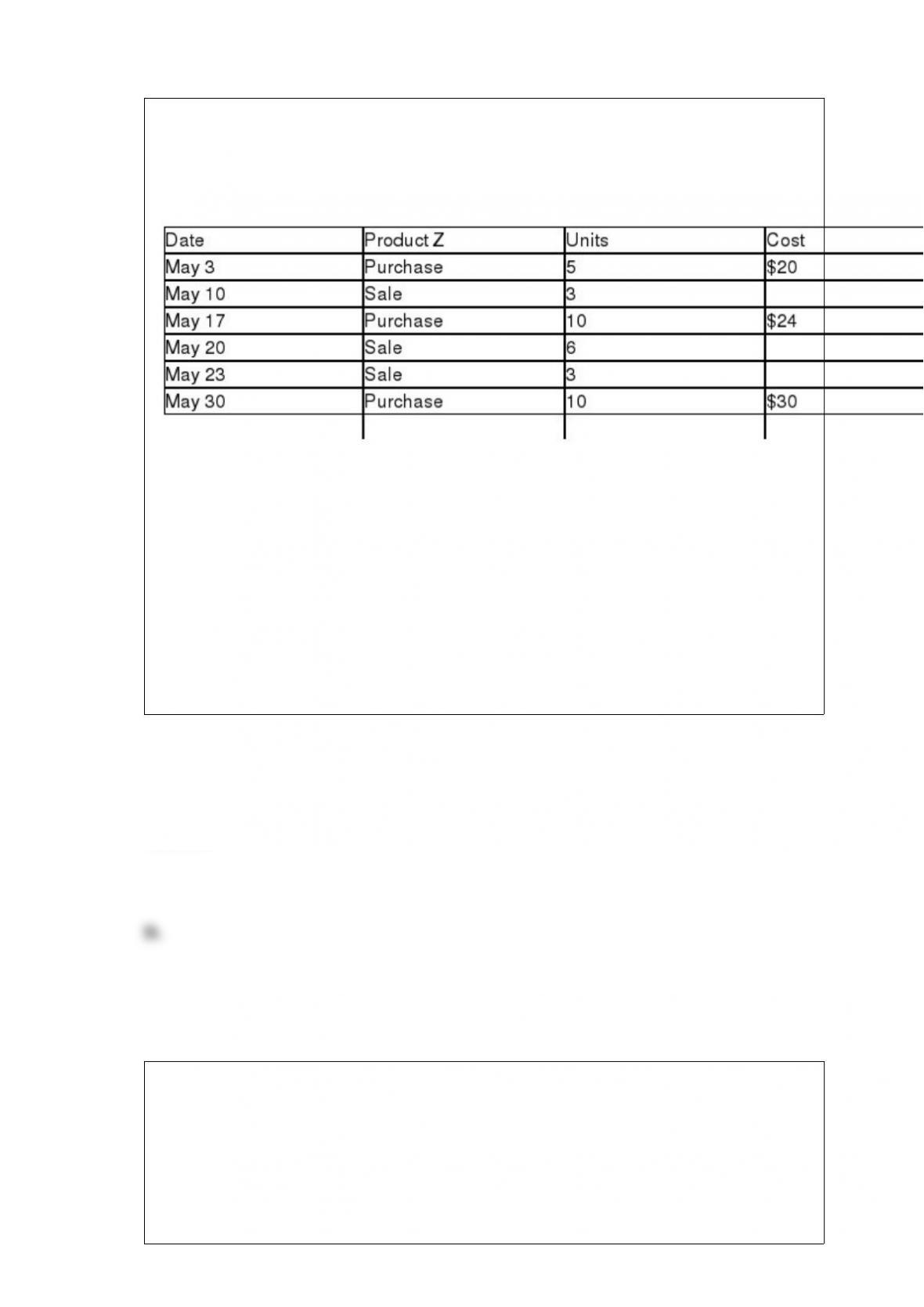
Use the following information to answer the following questions.
The Boxwood Company sells blankets for $60 each. The following was taken from the
inventory records during May. The company had no beginning inventory on May 1.
Assuming that the company uses the perpetual inventory system, determine the ending
inventory for the month of May using the LIFO inventory cost method.
A.$324
B.$372
C.$320
D.$364
Answer:
Which is the best example of a decentralized operation?
A.One owner who prepares plans and makes decisions for the entire company.
B.Each unit is responsible for their own operations and decision making.
C.In a major company, operating decisions are made by top management.

D.None of the above. All are examples of a centralized management.
Answer:
Which of the following items would not be classified as part of factory overhead?
A.Direct labor used
B.Amortization of manufacturing patents
C.Production supervisors’ salaries
D.Factory supplies used
Answer:
An alternative name for Bad Debt Expense is
A.Collection Expense.
B.Credit Loss Expense.
C.Uncollectible Accounts Expense.

D.Deadbeat Expense.
Answer:
Cool-It Company manufactures and sells commercial air conditioners. Because of
current trends, it expects to increase sales by 10 percent next year. If this expected level
of production and sales occurs and plant expansion is not needed, how should this
increase affect next year’s total amounts for the following costs.
Variable Costs Fixed Costs Mixed Costs
A. increase increase increase
B. increase no change increase
C. no change no change increase
D. decrease increase increase
Answer:
The calculation for annual depreciation using the straight-line depreciation method is
A.initial cost / estimated useful life
B.depreciable cost / estimated useful life
C.depreciable cost * estimated useful life
D.initial cost * estimated useful life
Answer:
Prepare entries to record the following:
(a) Issued 1,000 shares of $10 par common stock at $59 for cash.
(b) Issued 1,400 shares of common stock in exchange for equipment with a fair market
price of $60,000.
(c) Purchased 100 shares of treasury stock at $32.
(d) Sold 100 shares of treasury stock at $42.
Answer:
Elgin Company sells merchandise with a one year warranty. Sales consisted of 2,500
units in 2012 and 2,000 units in 2013. It is estimated that warranty repairs will average
$10 per unit sold, and 30% of the repairs will be made in 2012 and 70% in 2013 for the
2012 sales. Similarly, 30% of repairs will be made in 2013 and 70% in 2014 for the
2013 sales. In the 2013 income statement, how much of the warranty expense shown
will be due to 2012 sales?
A.$7,500
B.$17,500
C.$25,000
D.$0
Answer:

If fixed costs are $750,000 and variable costs are 60% of sales, what is the break-even
point in sales dollars?
A.$1,250,000
B.$450,000
C.$1,875,000
D.$300,000
Answer:
An acceleration in the collection of receivables will tend to cause the accounts
receivable turnover to
A.decrease
B.remain the same
C.either increase or decrease
D.increase
Answer:
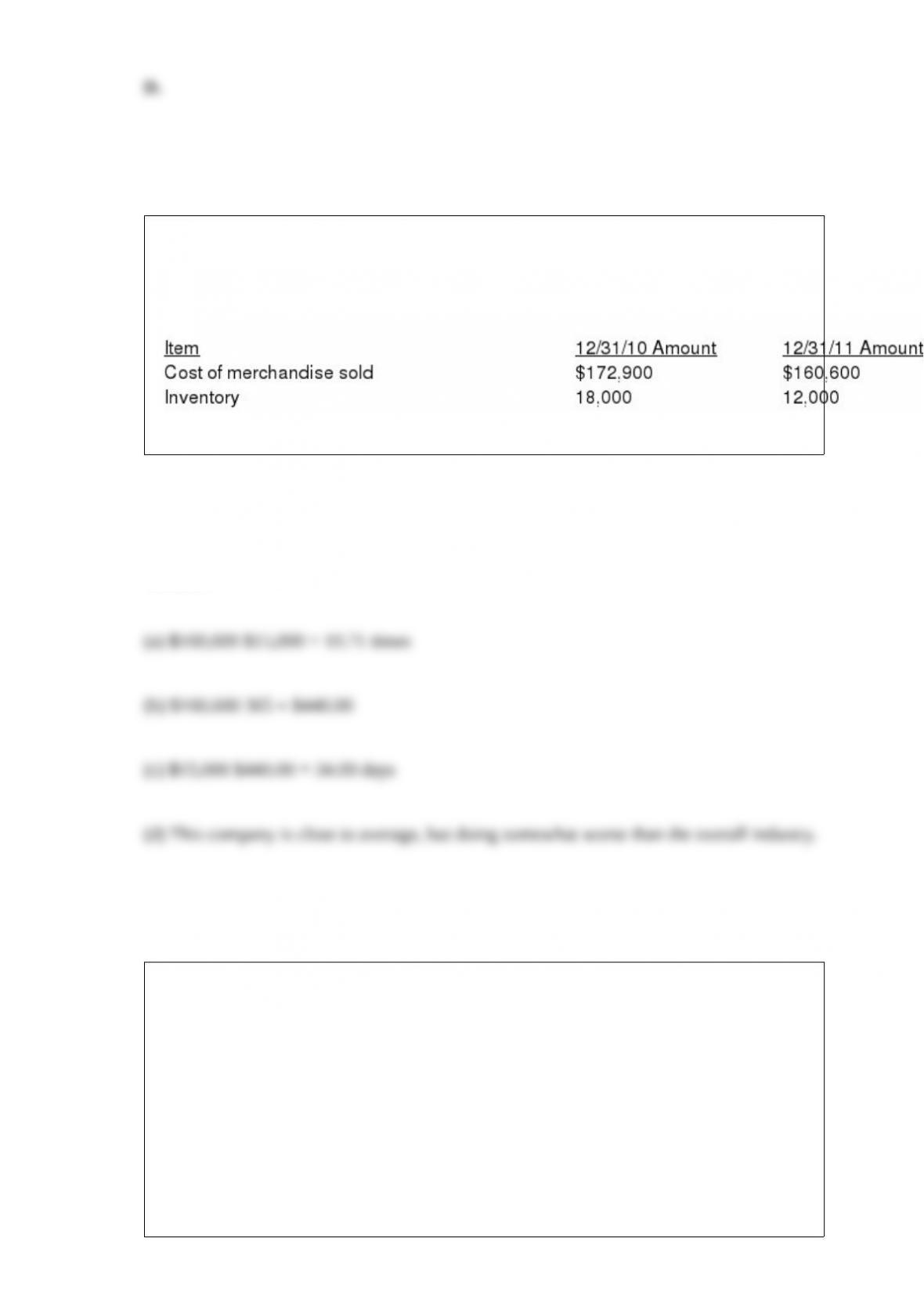
Based on the following information: compute (a) Inventory turnover; (b) Average daily
cost of merchandise sold; and (c) Number of days’ sales in inventory for 2011. Use a
365-day year. (d) If an inventory turnover of 12 is average for the industry, how is this
company doing?
Answer:
A company is contemplating investing in a new piece of manufacturing machinery. The
amount to be invested is $150,000. The present value of the future cash flows is
$143,000. Should the company invest in this project?
A.yes, because net present value is +$7,000
B.yes, because net present value is -$7,000
C.no, because net present value is +$7,000
D.no, because net present value is -$7,000

Answer:
The amount of deposits in transit is included on the bank reconciliation as a(n)
A.deduction from the balance per the company’s books
B.deduction from the balance per bank statement
C.addition to the balance per bank statement
D.addition to the balance per company books
Answer:
Costs that are used in generating revenues during the current period, but are not
involved in the manufacturing process are often referred to as:
A.period costs
B.conversion costs
C.factory overhead costs
D.product costs

Answer:
When a company replaces a component of property, plant and equipment, which
statement below does not account for one of the steps in the process?
A.book value of the replaced component is written off to depreciation expense
B.the asset cost of the replaced component is credited
C.any cost to remove the old component is charged to expense
D.the identifiable direct costs associated with the new component are capitalized
Answer:
Which of the following is not characteristic of a corporation?
A.The financial loss that a stockholder may suffer from owning stock in a public
company is limited.
B.Cash dividends paid by a corporation are deductible as expenses by the corporation.
C.A corporation can own property in its name.
D.Corporations are required to file federal income taxreturns.

Answer:
Management accountants usually provide for a minimum cash balance in their cash
budgets for which of the following reasons:
A.stockholders demand a minimum cash balance
B.to comply with U.S. GAAP
C.it provides a safety buffer for variations in estimates
D.to have funds available for major capital expenditures
Answer:
The operating budgets of a company include:
A.the cash budget
B.the capital expenditures budget
C.the financing budget
D.the production budget
Answer:
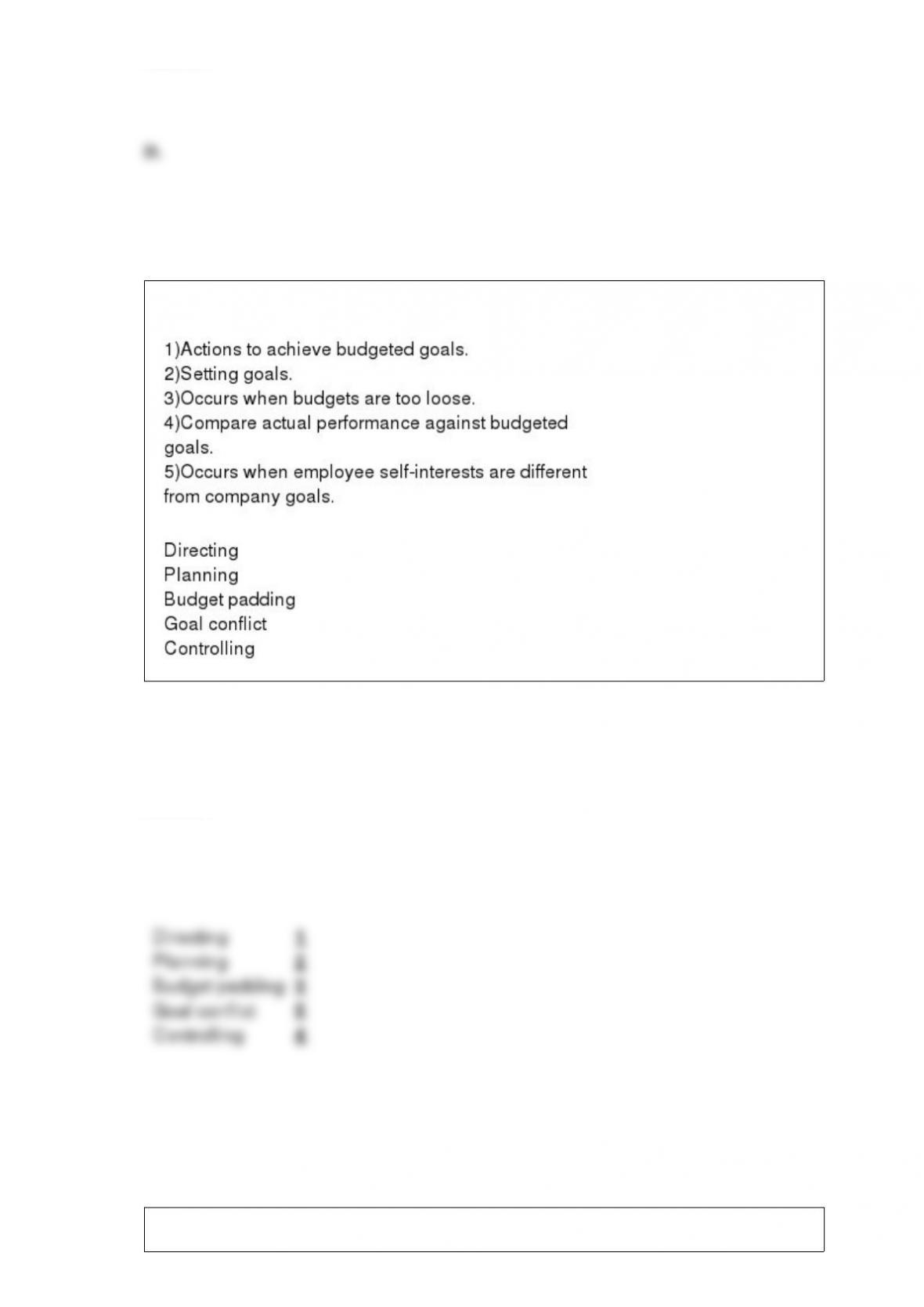
Match the following terms with the best definition given.
Answer:
On the basis of the following data, determine the value of the inventory at the lower of
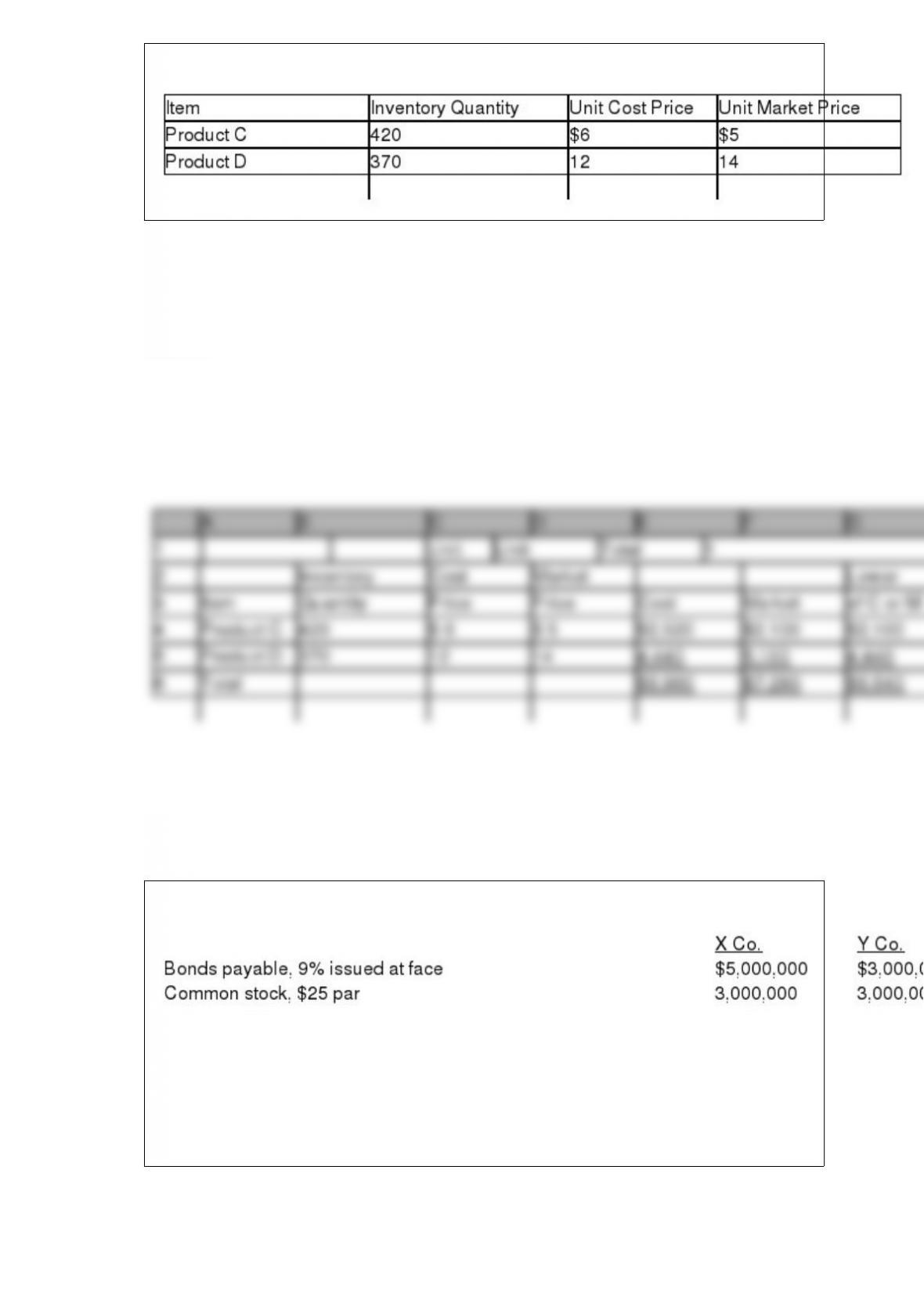
cost or market. Apply lower of cost or market to each inventory item. Show your work.
Answer:
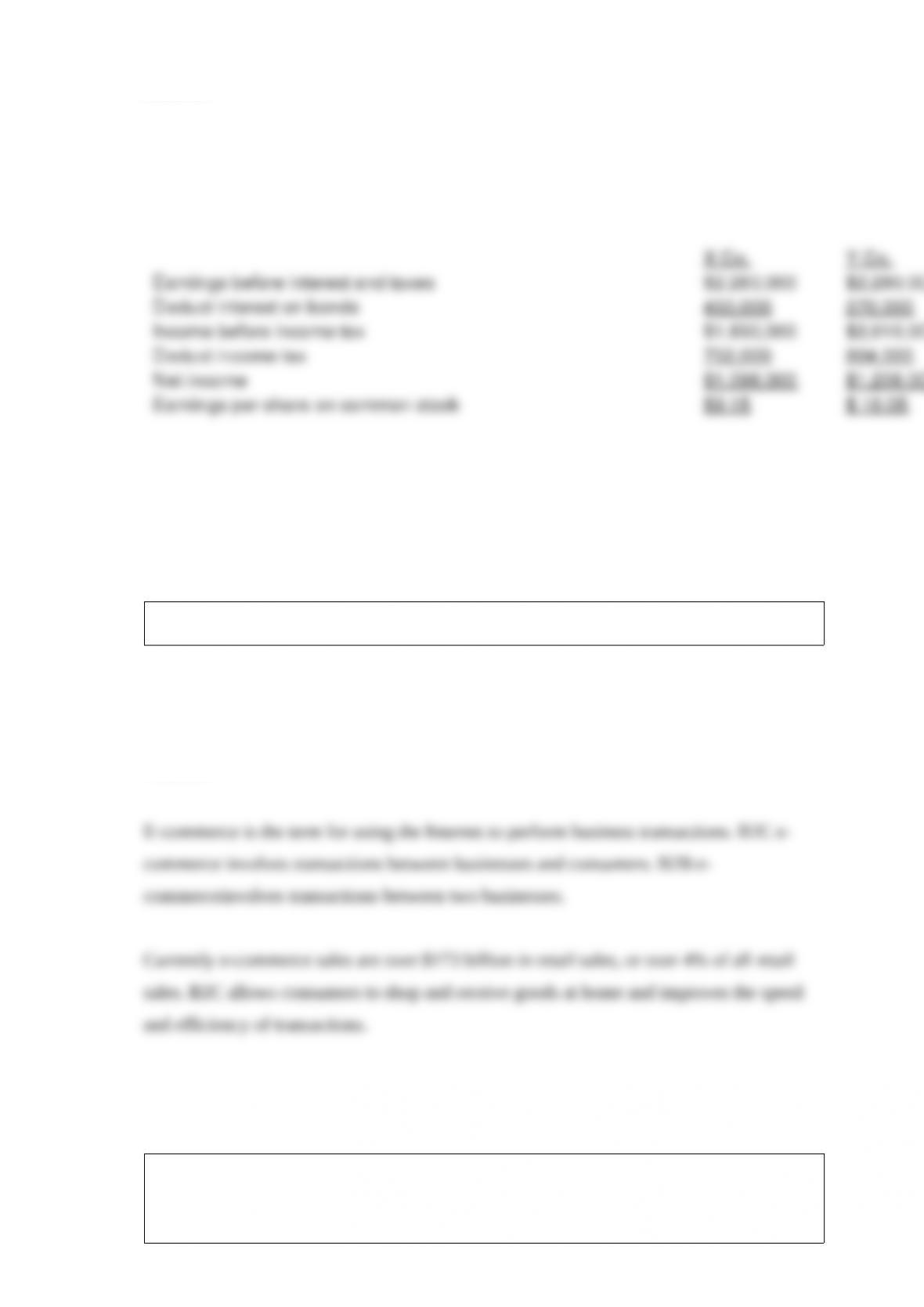
Two companies are financed as follows:
Income tax is estimated at 40% of income.
Determine for each company the earnings per share of common stock, assuming that
the income before bond interest and income taxes is $2,280,000 each.
Answer:
Describe and discuss e-commerce.
Answer:
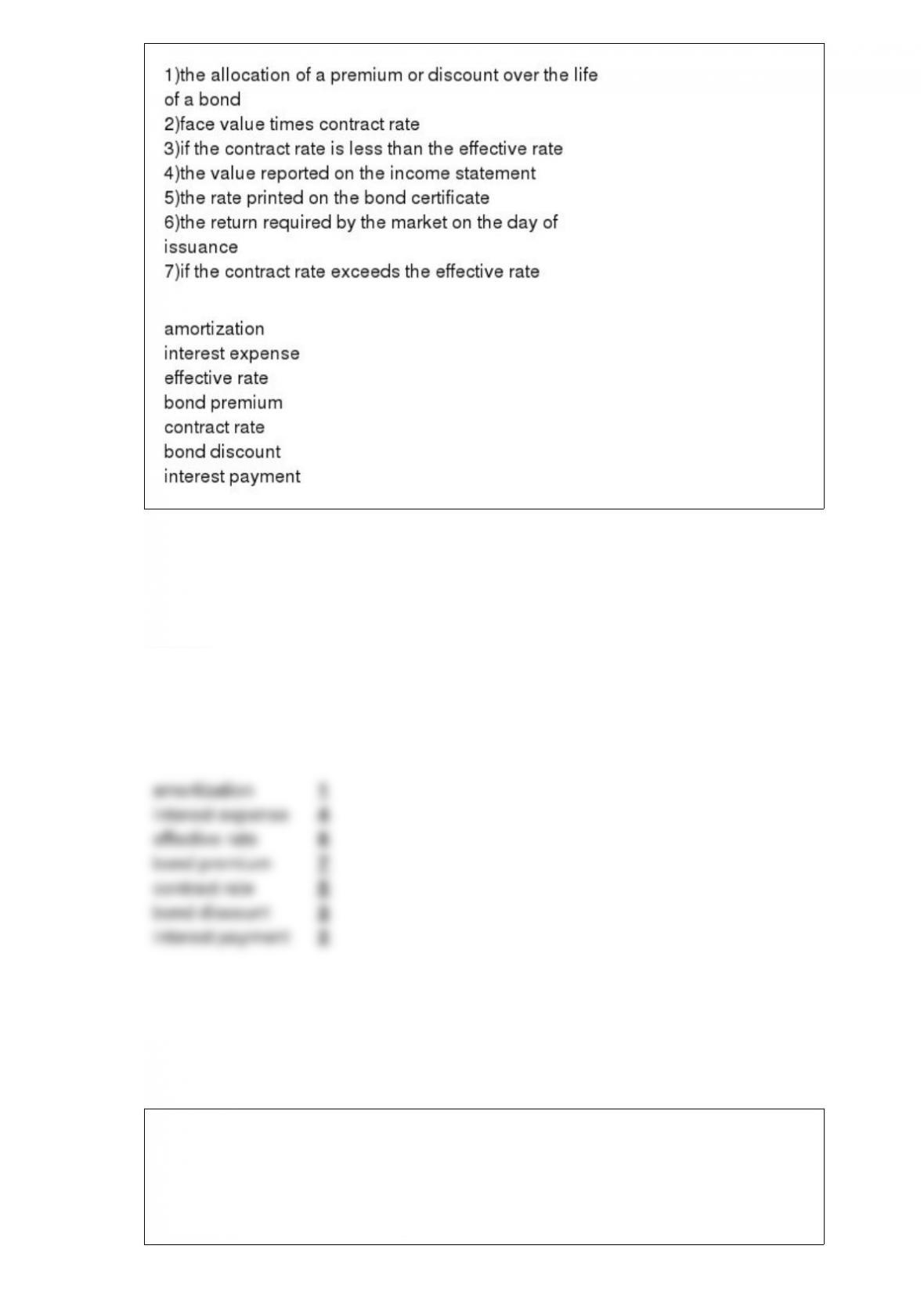
Match the following terms to the most appropriate
Answer:
The Stewart Cake Factory owns a building for its operations. Stewart uses only half of
the building and is considering two options for the unused space. The Candy Store
would like to purchase the half of the building that is not being used for $550,000. A
7% commission would have to be paid at the time of purchase. Ice Cream Delight
would like to lease the half of the building for the next 5 years at $100,000 each year.
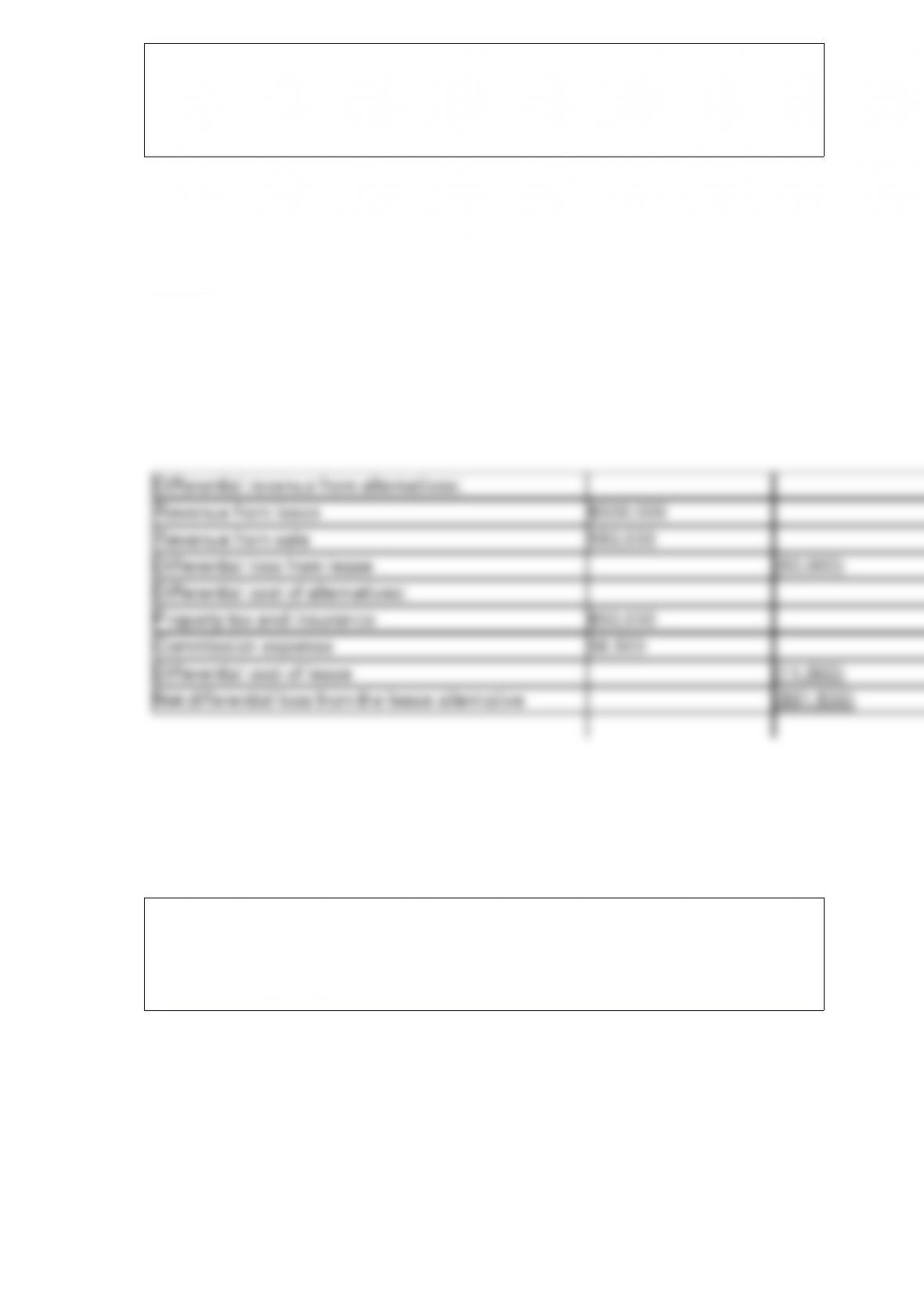
Stewart would have to continue paying $9,000 of property taxes each year and $1,000
of yearly insurance on the property, according to the proposed lease agreement.
Determine the differential income or loss from the lease alternative.
Answer:
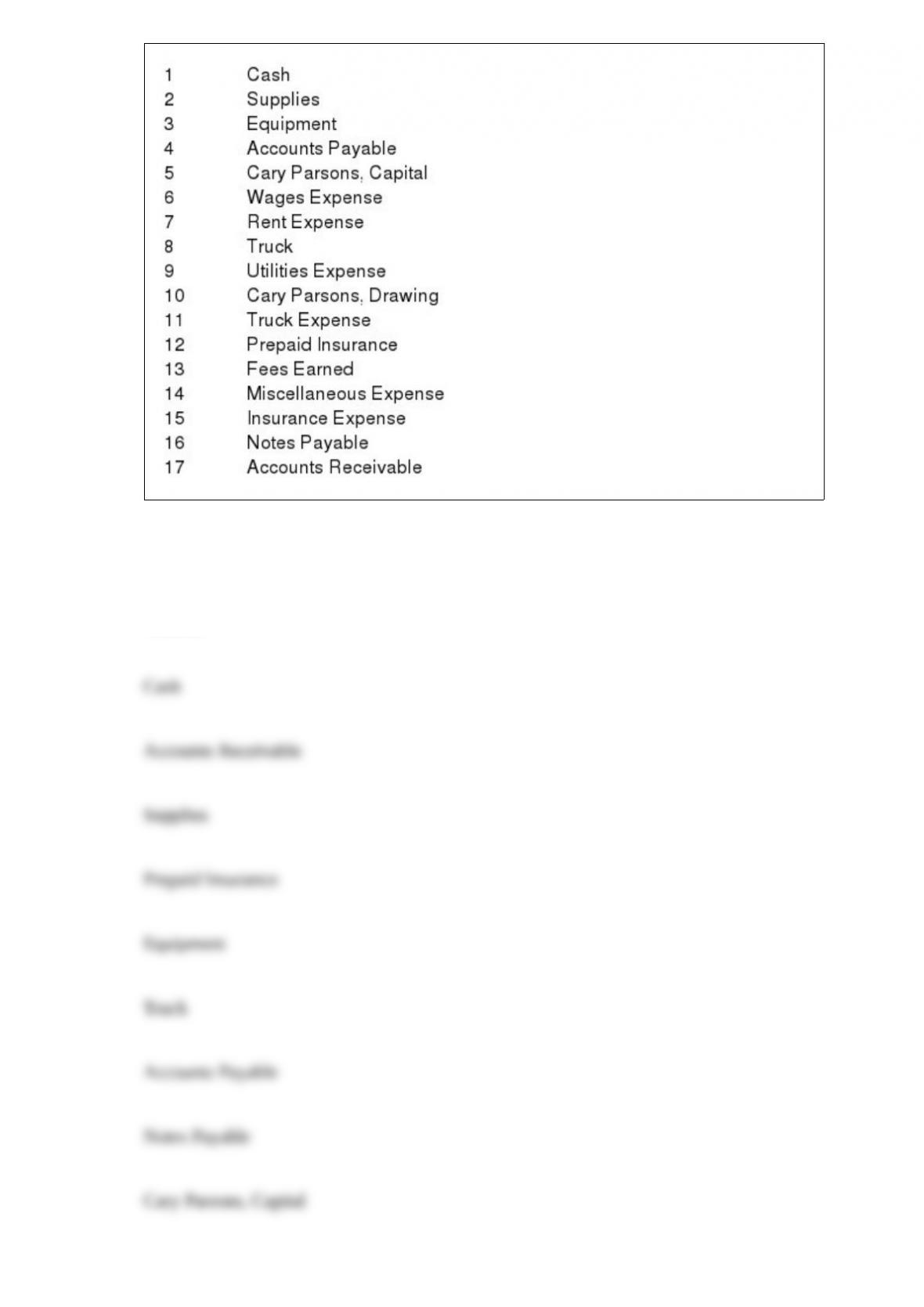
On January 1, 2010, Cary Parsons established a catering service. Listed below are
accounts she would like to open in the general ledger. List the accounts in the order in
which they should appear in the ledger and propose a two digit account numbering
scheme that is consistent with the rules of a proper chart of accounts.
Answer:
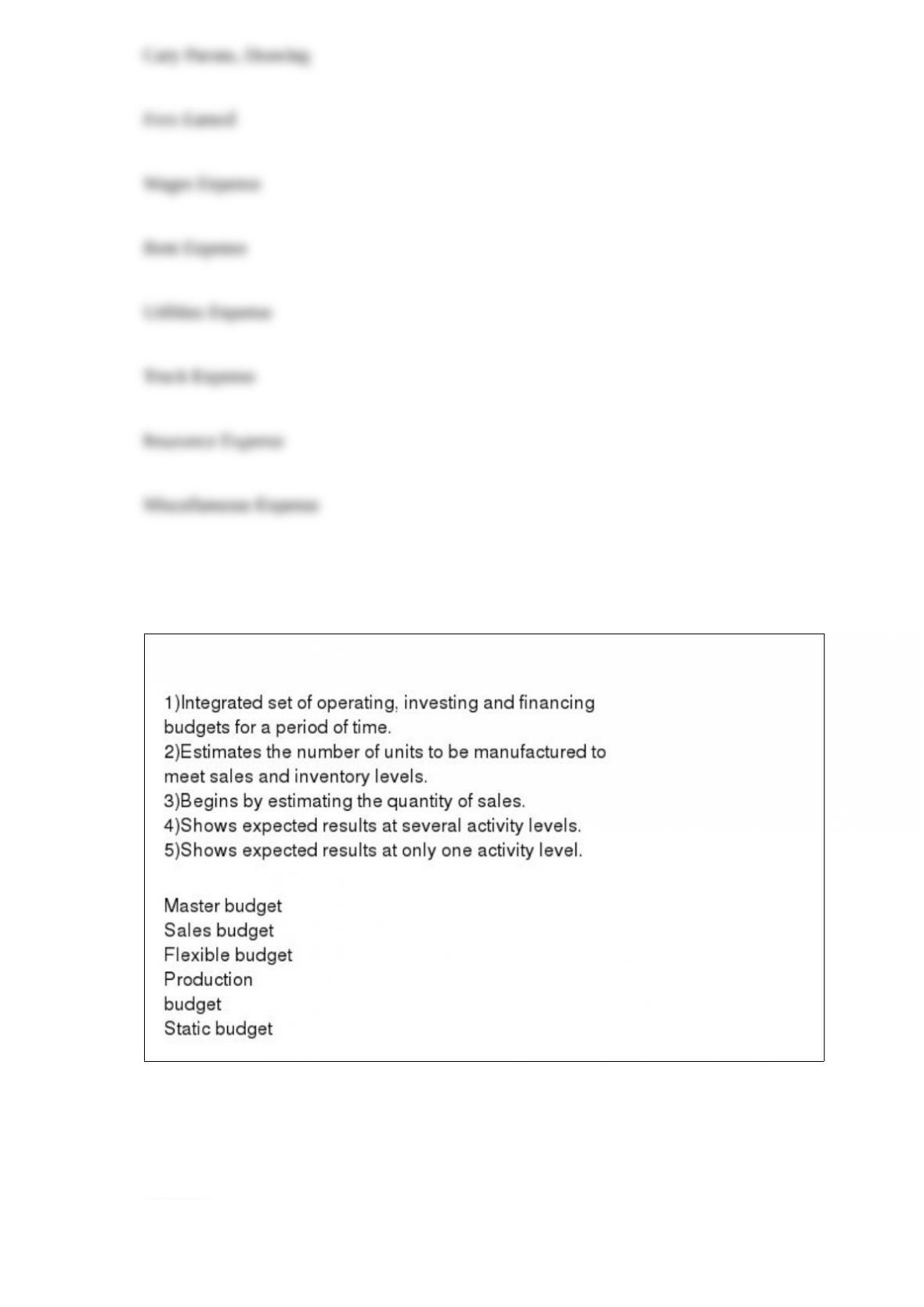
Match the following terms with the best definition given.
Answer:
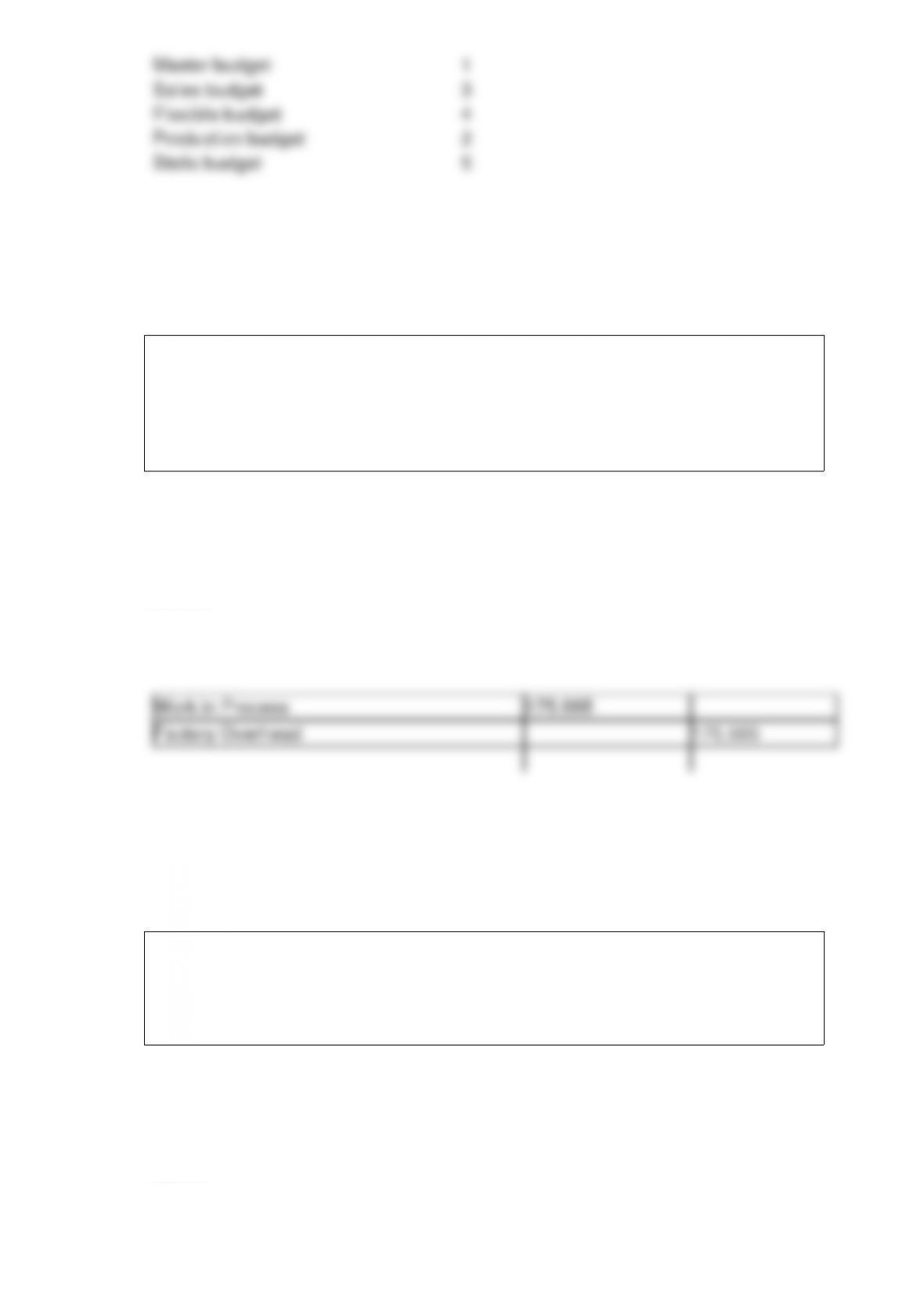
The Cavy Company estimates that the factory overhead for the following year will be
$1,470,000. The company has decided that the basis for applying factory overhead
should be machine hours, which is estimated to be 40,000 hours. The machine hours for
the month of April for all of the jobs was 4,780. Prepare the journal entry to apply
factory overhead.
Answer:
Vincent Corporation has 100,000 share of $100 par common stock outstanding. On
June 30, Vincent Corporation declared a 5% stock dividend to be issued on July 30 to
stockholders of record July 15. The market price of the stock was $132 a share on June
30. Journalize the entries required on June 30, July 15 and July 30.
Answer:
Tipper Co. is considering a 10-year project that is estimated to cost $700,000 and has
no residual value. Tipper seeks to earn an average rate of return of 15% on all capital
projects. Determine the necessary average annual income (using straight-line
depreciation) that must be achieved on this project for this project to be acceptable to
Tipper Co.
Answer:
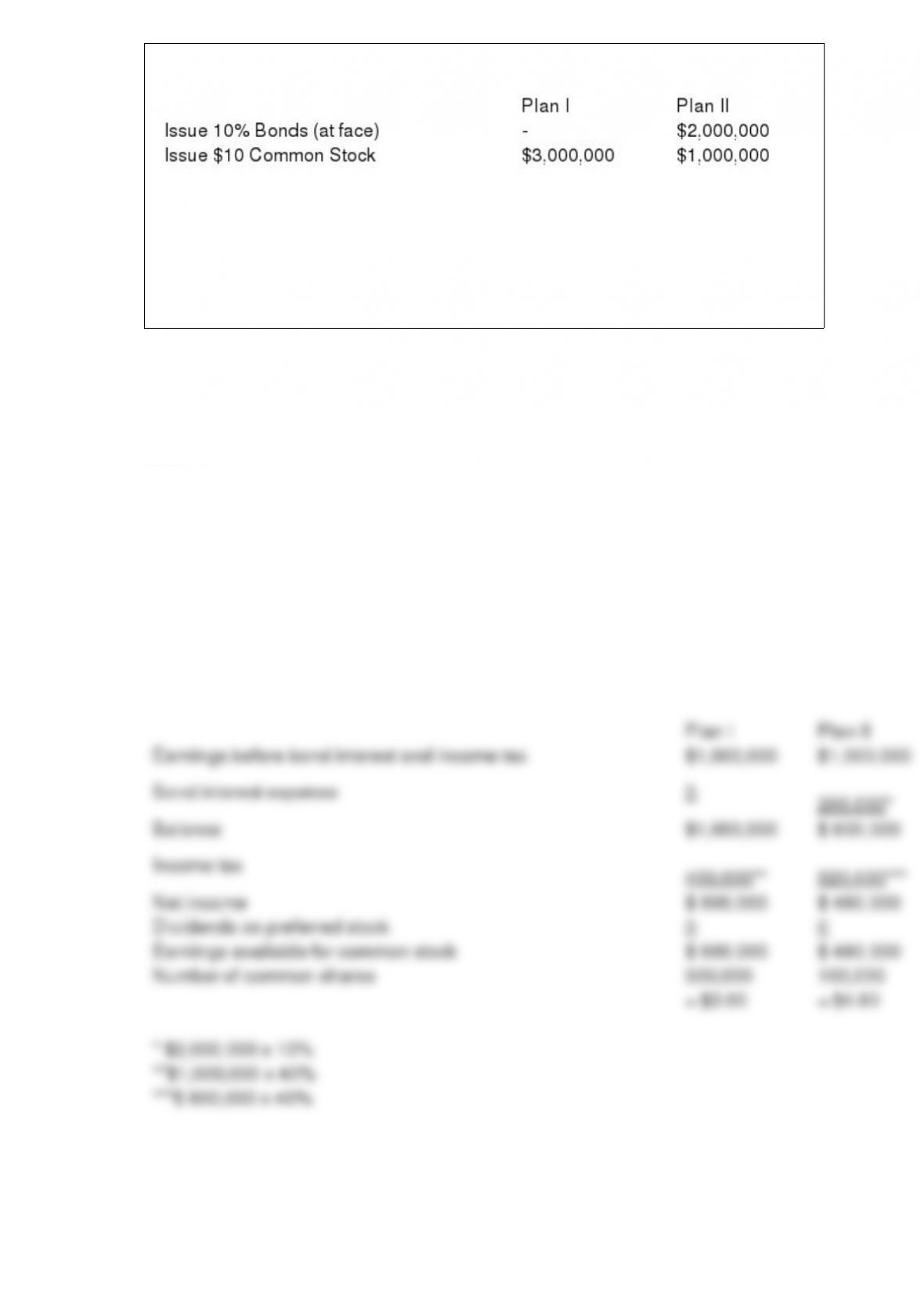
Jenson Co., is considering the following alternative plans for financing their company:
Income tax is estimated at 40% of income.
Determine the earnings per share of common stock under the two alternative financing
plans, assuming income before bond interest and income tax is $1,000,000.
Answer:
A copy machine acquired on March 1, 2011 with a cost of $1,410 has an estimated
useful life of 3 years. Assuming that it will have a residual value of $150, determine the
depreciation for the first and second year by the straight-line method.
Answer:
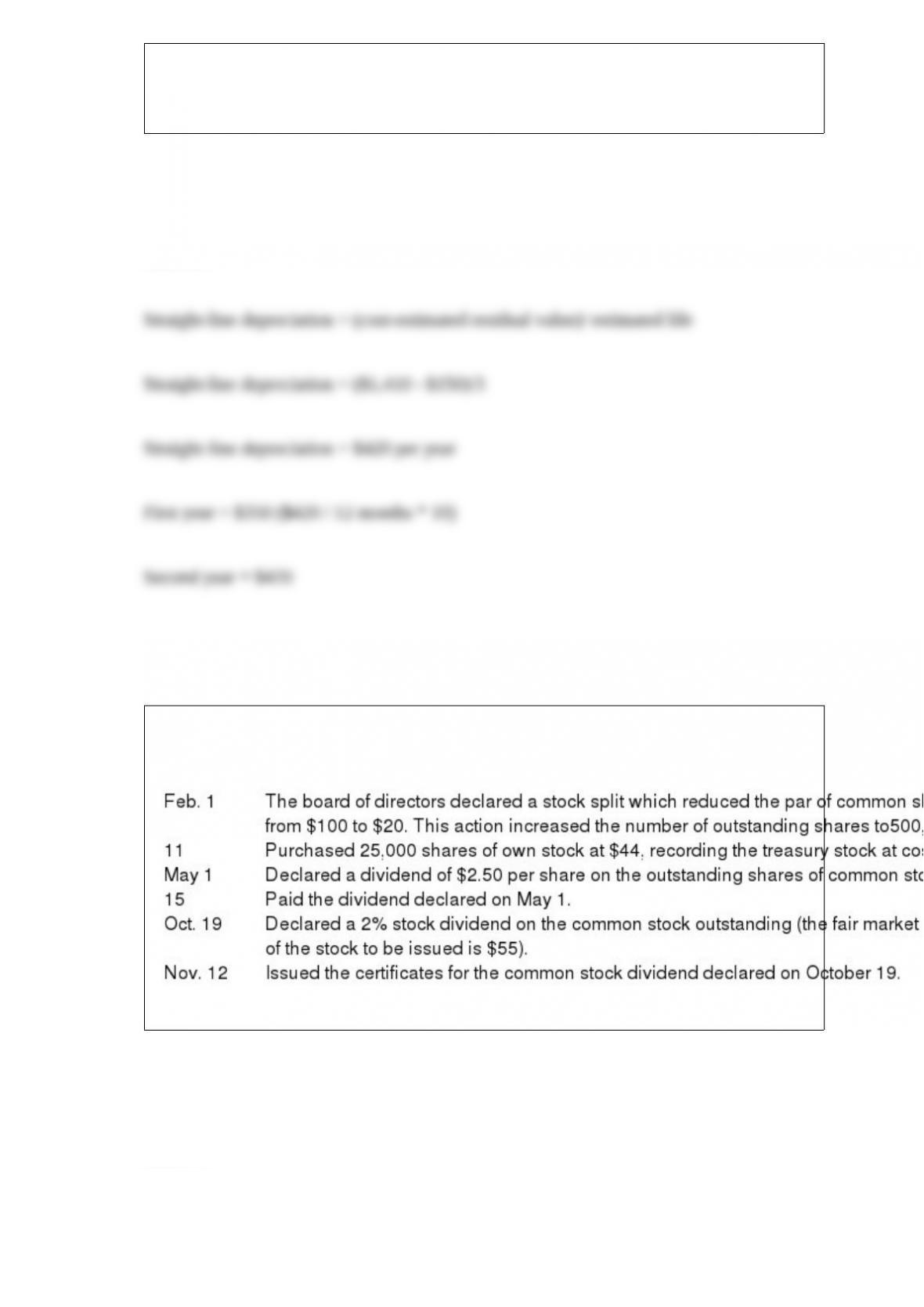
Prepare entries to record the following selected transactions completed during the
current fiscal year:
Answer:
During the current year, merchandise is sold for $117,500 cash and $241,750 on
account. The cost of the merchandise sold is $157,400. What is the amount of the gross
profit?
Answer:
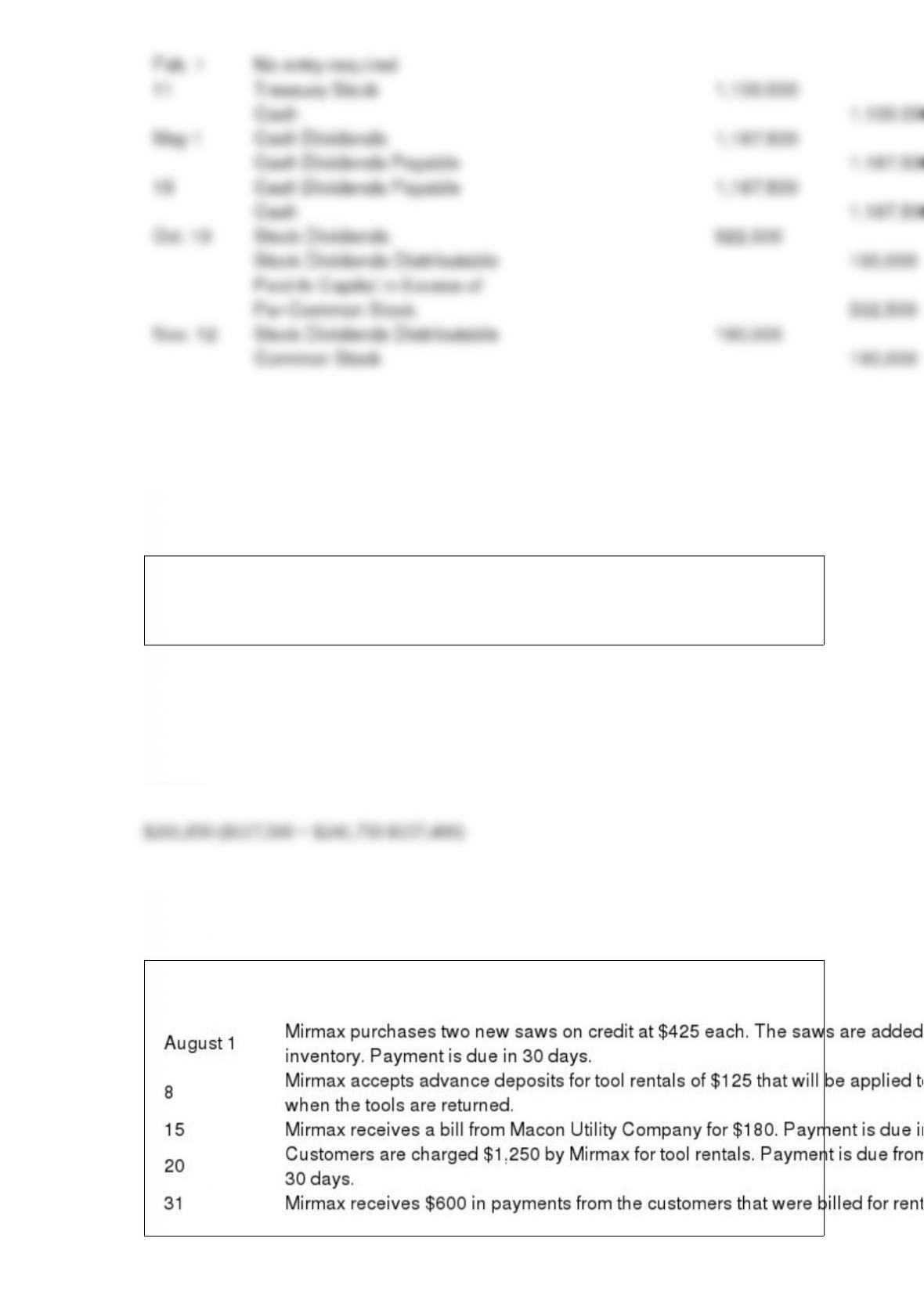
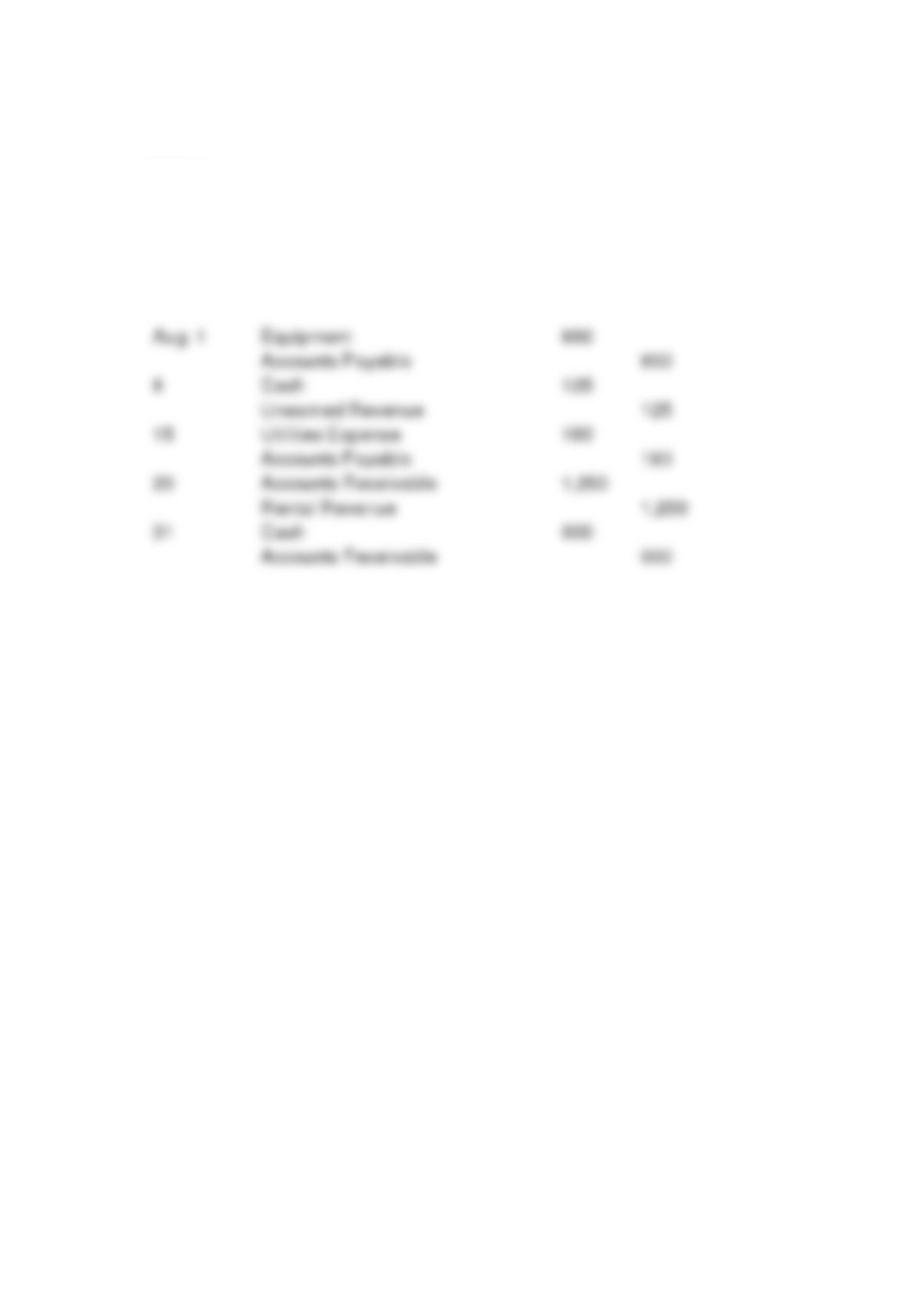
Journalize the five transactions for Mirmax Rentals described below.
Answer: