
When preliminary fraud risk is high the auditor should pay close attention to areas of
the audit that are highly subjective and should increase the predictability of the audit
procedures.
Audit staff performing audit work must be appropriately supervised by partners and
managers.
Auditors often recalculate the present value of capital lease agreements to assess
whether the relevant criteria for capitalizing the lease have been met.
For a client with serious going concern issues the auditor has to make a choice between
issuing an unqualified audit report with an explanatory paragraph or a disclaimer.

The standards of the PCAOB encompass three broad categories including: general
standards, fieldwork standards and reporting standards.
The audit committee is typically independent of the board of directors.
For the last several years, both the Financial Accounting Standards Board (FASB) and
the International Auditing and Assurance Standards Board (IAASB) have been
considering possible changes to the standard unqualified audit report.

Once the fraud assessment is complete in the planning stage, the auditor need not
consider fraud further.
By using Generalized Audit Software (GAS), the auditor can potentially audit the whole
population rather than taking a sample.
The audit committee must be composed of outsiders such as the organization’s attorney
and audit partner.
Some audit procedures may be performed prior to the end of the year under audit.

An auditor of a public client may assist a client in designing and implementing internal
controls over financial reporting.
Auditors need only understand the rules of accounting as the principles of accounting
are outdated.
Most audit firms use a schedule to accumulate the known and projected misstatements
and the carryover effects of prior-year uncorrected misstatements.

Audit firm portfolio management decisions are not important in achieving audit quality.
Audit documentation should generally be retained for at least seven years.
In performing substantive analytical procedures, the threshold for determining whether
differences between the client’s recorded balance and the auditor’s expectation should
be based on planning materiality.
Formal procedures for approving acceptance of returns that are beyond the warranty
period are an appropriate control procedure for identifying and recording returned
goods.
Alternative procedures to the confirmation of receivables include review of subsequent
collections and examination of supporting evidence.
Only the Big 4 audit firms can conduct audits of private companies in the United States.
Auditors and management should agree on what is considered material.
If scope limitations that are not client-imposed exist make it impossible for the auditor
to form an opinion, the auditor should render an adverse opinion.
Auditing exists because users need unbiased information on which to assess
management performance and make economic decisions.
U.S. accounting standards require organizations to use a two-step process to determine
the impairment of goodwill.
The primary sourceof evidence concerning contingencies is the client’s external
attorney.
One of the benefits of establishing a formal credit policy for granting credit is that
management is freed from the burden of monitoring accounts receivable.
Effective internal control over the cash account requires that the person responsible for
making the bank deposit does not post the increase to cash in the accounting system.
Audit evidence consists of both information that supports and corroborates
management’s assertions regarding the financial statements or internal control over
financial reporting and information that contradicts such assertions.
Material fraud perpetrated by management must always be reported by the auditor to
the SEC.
In observing the client’s inventory at year-end the auditor makes test counts that are
later traced into the client’s inventory compilation.
A management letter is not required.
Control activities may be implemented at the organizational level and at the
transactional level.
An inherent risk associated with intangible assets such as a patent is the accounting for
research and development costs
Internal control are needed for all activities of the organization
An auditor is not required to tell the reader of an audit report when there has been a
change in accounting principles that materially affects the financial statements.

For some engagements, the financial statements might be audited in accordance with
multiple auditing standards.
The AICPA, IASSB, and PCAOB have conceptually the same sets of financial
statement assertions, but the technical wording varies among the standards.
All companies attempting to comply with GAAP should refer to the Securities and
Exchange Commission for guidance as it supersedes all AICPA, PCAOB, FASB and
EITF literature.
In making judgments about the effect of the internal auditors’ work on the external
auditor’s procedures in specific audit areas, which of the following is not one of the
issues related to the specific audit areas that is considered by the external auditor?
A.Materiality of the financial statement amounts.

B.Risk of material misstatement of the assertions related to these financial statement
amounts.
C.Degree of subjectivity involved in the evaluation of the audit evidence gathered in
support of the assertions.
D.All of the above are considered by the auditor.
Scope limitations resulting in disclaimers under U.S. auditing standards affect the
standard audit report through which of the following?
A.Modifying the introductory paragraph
B.Eliminating the scope paragraph.
C.Adding an explanatory paragraph before the disclaimer paragraph.
D.Both B and C.
E.All of the above.
The inventory of Brown Company is distributed between 85 stores throughout the
United States, Puerto Rico and Mexico. Brown has a calendar year-end, uses a periodic
inventory system and performs a physical count on January 1st of each year. In the
planning of the audit of Brown, the engagement team must consider which of the
following?
A.Whether or not the finance departments in Mexico and Puerto Rico are available to
perform the audit testing on January 1st.

B.Which of the stores to randomly visit and how many items to test.
C.The risk of the company transporting items from Maine to Mexico between audit
counts.
D.Coordinating with the client which stores will be visited for inventory observation.
Electronic authorization privileges for cash transactions may be best assigned to
individuals based on which of the following?
A.Roles and activities falling within appropriate segregation of duties.
B.Identification cards with picture identification.
C.Encrypted passwords memorized by employees.
D.The principle of “absolute knowledge”.
Which of the following best describes the purpose of personnel policies and
procedures?
A.Ensure the organization hires the right people.
B.Ensure the organization complies with federal and state laws in its hiring and
retention decisions.
C.Ensure the organization has employees that are properly trained and supervised.
D.Ensure the organization performs all of the above.

Which one of the following organizations provides auditing standards for public
companies?
A.GAO.
B.AICPA.
C.GAAP.
D.PCAOB.
What is the typical scale for audit risk?
A.1% – 10%
B.1% – 5%
C.0% – 5%
D.0% – 10%

Why is auditing important in a free market society?
A.The public requires auditors to function as divisions of regulatory bodies.
B.Auditors detect all errors and fraud perpetrated by company employees.
C.It provides reliable information upon which to judge economic performance.
D.The auditor is an amiable insurance policy for investors.
E.All of the above are true.
A primary feature of automated control in the acquisition cycle includes which of the
following?
A.That authorization is no longer required.
B.Limits as to the number of items that can be received by the warehouse.
C.Calculated order quantities based on set criteria.
D.Funds transfer at the request of the controller.
If an auditor becomes aware of violations of the Foreign Corrupt Practices Act of 1977
(FCPA), the auditor should notify the CFO about the violations, their circumstance, and
the effect on the financial statements.

If the auditor is testing whether long-lived assets exist at the balance sheet date, which
assertion is being tested?
A.Completeness.
B.Rights and Obligations.
C.Existence.
D.Valuation
A transaction trail includes the documents and records that allow an auditor to trace a
transaction from its origination through to its final disposition, or vice versa.
If it is probable that the judgment of a reasonable person will be changed or influenced
by the omission or misstatement of information, then that information, which of the
following (based on the definition of FASB Statement No. 2) best describes that
information?
A.Insignificant.

B.Relevant.
C.Significant.
D.Material.
A date at which audit evidence is collected earlier than the balance sheet date is referred
to as what?
A.Subsequent date.
B.Cutoff period.
C.Significant date.
D.Interim date.
Which of the following is not required under the general standards of GAAS?
A.Technical training of the professionals.
B.Independence of the auditor in fact and appearance.
C.Conduct of an audit with the skill and care of a professional.
D.Review of the all of work and audit documentation of the audit staff.
E.None of the above are required.

An audit firm is not considered independent when it performs which of the following
services for a publicly traded audit client?
A.Tax return preparation as approved by the board of directors.
B.Basic accounting record keeping and financial statement preparation.
C.Accounting information system design and implementation.
D.Both B and C.
E.None of the above.
If the auditor believes that there is a remote probability that resolution of an uncertainty
will have a material effect on the financial statements, which of the following would the
auditor issue?
A.A disclaimer of opinion.
B.A standard unqualified opinion.
C.An adverse opinion.
D.An unqualified opinion with explanatory paragraphs.

What procedure has to be completed at or after the end of the period?
A.Assessment of control risk.
B.Engagement letter.
C.Evaluation of adjusting journal entries.
D.All procedures must be completed prior to period end.
Which of the following is not subject matter that would be attested to in a non-audit
attestation engagement?
A.Historical events such as the price of a market basket of goods on a certain date.
B.Corporate governance, compliance with law and regulations, or human resource
practices.
C.Management’s assertions about historical financial information and associated
disclosures.
D.Prospective financial information, performance measurements, or backlog data.
A. Define the term “contingent fee.”
B. Explain the circumstances under which a CPA may and may not accept a contingent
fee.

Which of the following is not an internal control the auditor would expect to find in
place for all cash processing systems?
A.Restrictive endorsement of checks.
B.Independent reconciliation.
C.Walkthrough.
D.Prenumbered cash receipt documents.
Which of the following items does the auditor ask the client to send to its legal counsel
requesting information about asserted claims?
A.A letter of audit inquiry.
B.A management representation letter.
C.A management letter.
D.A loss reserve confirmation.

On what information does the auditor base a going concern evaluation?
A.On separate procedures.
B.On the management discussion and analysis (MD&A).
C.On information obtained from normal audit procedures performed to test
management’s assertions.
D.On the statement of cash flows for the current period.
If no control deficiencies are identified, how will the extent of substantive testing
required differ from a setting where deficiencies in internal control were identified?
A.The extent of testing will be more.
B.The extent of testing will be less.
C.The extent of testing will be the same in the two settings.
D.The extent of testing is not affect by control deficiencies.

In an audit of financial statements, the risk of the high rate of return of products sold
includes relates to which of the following?
A.Sales that are recorded improperly.
B.An estimate of accrued returns that reduces net income.
C.A reduction of net sales for an increase to the sales returns and allowance account.
D.Consignment goods that are returned and forwarded to third parties.
In which of the following situations would a CPA not be considered independent?
A.A CPA has obtained an auto loan from a banking client in a prior year.
B.A CPA has obtained a home mortgage loan in 1988 from a client.
C.A CPA has obtained a $4,500 cash advance from a banking client in the current year.
D.A CPA has obtained a $6,500 cash advance from a client in the current year.
Which of the following is not a way that the disclosure and reporting requirements for
interim financial statements differ from those for annual financial statements?
A.Accruals for estimates of bad debt are not usually as precise on interim dates as they
are at year end.
B.Information disclosed in the latest annual statements does not have to be repeated in
the interim statements except for continuing contingencies and other uncertainties.

C.Accruals for estimates of income tax expenses are not usually as precise on interim
dates as they are at year end.
D.The interim information does not have to be filed with the SEC for public companies.
Which one of the following is an example of the contents of an opinion paragraph
found in an audit report?
A.”We have audited….”
B.”Nothing came to our attention…”
C.”The financial statements referred to above present fairly,…”
D.”An audit includes examining, on a test basis…”
When using MUS, an auditor found that the sampling interval should be $15,755. If
selecting the sample manually, the auditor should round the sample interval to which of
the following amounts?
A.$16,000.
B.$15,000.
C.$14,000.
D.$10,000.

Which of the following is NOT a reason why inventory is a complex accounting and
auditing area?
A.Diversity of items in inventory.
B.Low volume of activity.
C.Easily transportable.
D.Difficulty in applying the lower of cost or market principle.
When performing preliminary analytical procedures related to long-lived assets, which
of the following should the auditor compare the unaudited financial statements with?
A.Past results.
B.Industry trends.
C.Future company projections.
D.Both A and B.

The ease with which cash can be stolen is most related to which of the following risks?
A.Control risk.
B.Inherent risk.
C.Detection risk.
D.Liquidity risk.
Which of the following best represents an example of fraud utilizing the lapping
technique?
A.An employee transfers cash on the last day of the year in order to double record it in
the bank accounts.
B.An employee creates a fictional vendor and requests payment to a personal P.O. box.
C.An employee opens the mail to cover up payroll fraud received on a fictional person.
D.An employee covers up the stealing of receipts by posting to the wrong customer
accounts.
Which of the following is the most relevant assertion with regards to the audit of cash?
A.Completeness.
B.Rights and obligations.
C.Valuation and allocation.
D.Presentation and disclosure.
Describe the substantive procedures typically used to test leases.
Contrast the financial statement auditor’s consideration of fraud to that of a forensic
accountant.
Describe the management assertions relevant to cash and other liquid assets.
Explain the term “misstatement” as it applies to sampling during substantive procedures
and explain how the term may be interpreted differently by different auditors.

Morgan Thompson, CPA is a partner in a medium-sized CPA firm and takes an active
part in the conduct of every audit she supervises. She follows the practice of reviewing
all audit files of staff auditors on her team as soon as it is convenient, rather than
waiting until the end of the audit. When the audit is nearly finished, Thompson reviews
the audit files again to make sure that she has not missed anything significant. Because
she makes most of the major decisions on the audit, there is rarely anything that
requires further investigation. When she completes the review, she prepares a draft of
the financial statements, gets them approved by management, and has them assembled
in her firm’s office. No other partner reviews the audit documentation, because
Thompson is responsible for signing the audit reports.
REQUIRED:
(1) Evaluate the practice of not having a concurring partner review of the audit
documentation by another partner in the firm, (2) explain some of the procedures the
reviewer should perform as part of the review process, and (3) what documentation
should be included.
Define what a contingency is, describe the auditor’s main concerns about them, and
indicate how contingencies should be dealt with by management and the auditor.
Besides litigation, claims and assessments, what are some other types of contingencies?
What is audit quality?
On January 2, 2014, the Zoom Detail Shoppe received notice from its primary supplier
that all wholesale prices were being increased by 10%, effective immediately. Based on
this notice, Zoom revalued is December 31, 2013 inventory to reflect the higher costs.
The inventory is a large proportion of the total assets. The effect of the revaluation was
material to current assets, but not to total assets or net income. The increase is
adequately disclosed in the footnotes.
REQUIRED:
Which type of audit report would you suggest be issued this year and why?
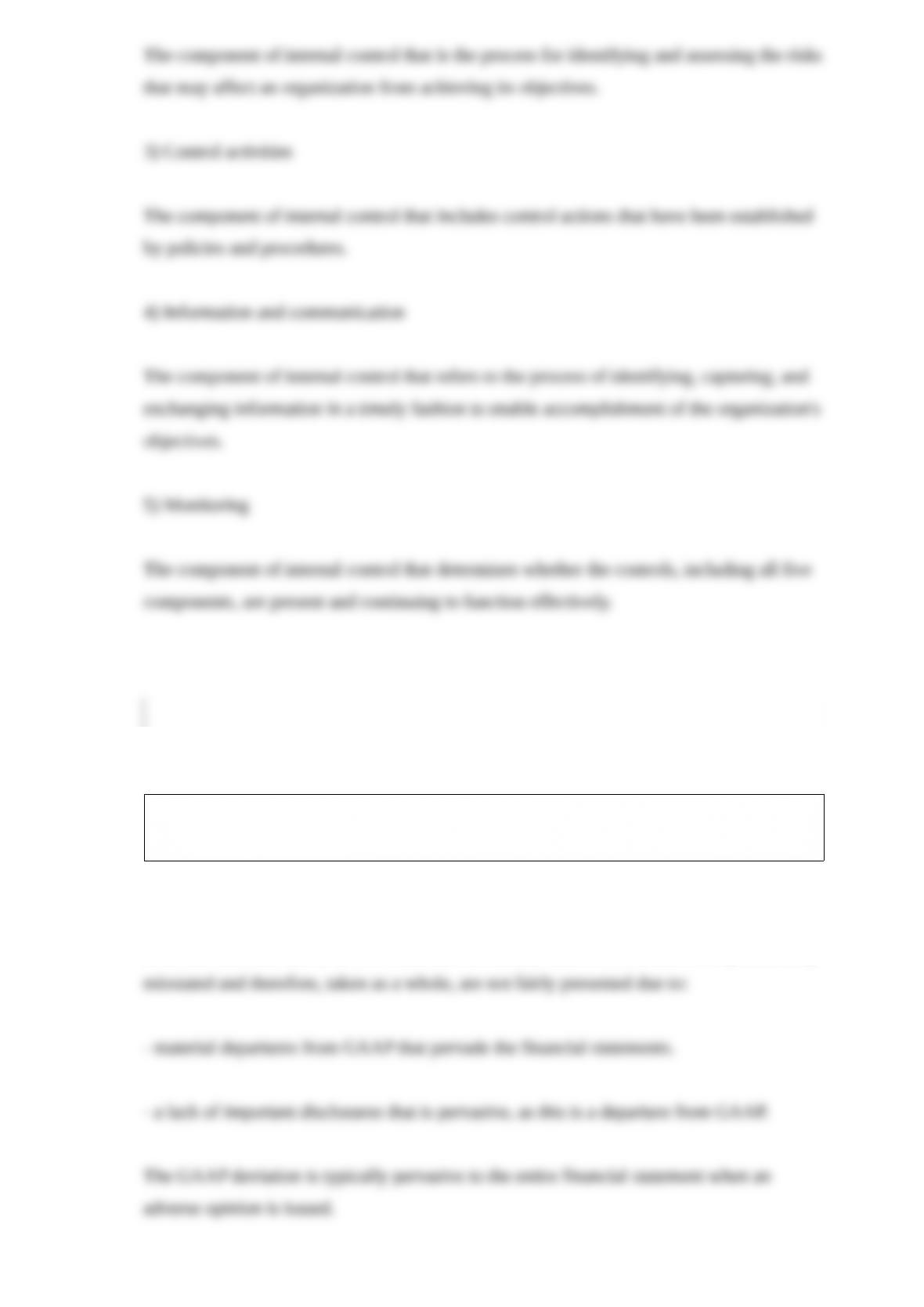
The five components of the COSO internal control system are conceptually and
logically integrated. List the five components of the model and describe how they are
integrated with each other in the internal control process.
Use the following format:
Under what circumstances would an auditor issue an adverse opinion?
Describe the concept and the purpose of dual-dating an audit report.
Identify the types of controls used to minimize potential misstatements of cash.

Aloe Products is an online retailer of lotions and other beauty supplies. The company
records revenues at the time that the customer orders are placed on the website, rather
than when goods are shipped. Goods are typically shipped two days after the order is
places. The auditor determines that the amount of orders placed but not shipped as of
the balance sheet date is not material.
REQUIRED:
Which type of audit report would you suggest be issued and why?
In your audit of Lomar Company for the calendar year 2014, you find a number of
items that you believe represent possible adjustments to the company’s books.
Management does not want to make any adjustments.
REQUIRED:
Assuming that Lomar is a public company describe how the adjustments might impact
your audit report on internal control over financial reporting.
How does a company measure the cost of an acquisition of another company? What
factors often complicate the determination of actual cost?