1) Which of the following is true of the Work-in-Process Control account?
A) It tracks all direct material purchases.
B) Its balance is the sum of amounts from all in-process individual job-cost records.
C) It is an expense account.
D) It tracks overhead costs in-process from beginning through completion.
2) Henry Inc., a manufacturing firm, is able to produce 1,000 pairs of sneakers per hour,
at maximum efficiency. There are three eight-hour shifts each day. Due to unavoidable
operating interruptions, production averages 800 units per hour. The plant actually
operates only 27 days per month. Based on the current budget, Henry estimates that it
will be able to sell only 500,000 units due to the entry of a competitor with aggressive
marketing capabilities. But the demand is unlikely to be affected in future and will be
around 515,000. Assume the month has 30 days.
What is the practical capacity for the month?
A) 1,000,000 units
B) 720,000 units
C) 518,400 units
D) 240,000 units
3) Conversion costs include ________.
A) direct materials and direct manufacturing labor costs
B) direct manufacturing labor and manufacturing overhead costs
C) direct materials and manufacturing overhead costs
D) only direct materials
4) Challenging budgets tend to ________.
A) discourage out-of-the-box and creative thinking as there is very little room for error
B) set unrealistic expectations and are perceived as overly ambitious and unachievable
C) increase anxiety without motivation not meeting them is viewed as a failure
D) motivate improved performance as employees work more intensely to avoid failure
5) An unfavorable variance indicates that ________.
A) the actual costs are less than the budgeted costs
B) the actual revenues exceed the budgeted revenues
C) the actual units sold are less than the budgeted units
D) the budgeted contribution margin is more than the actual amount
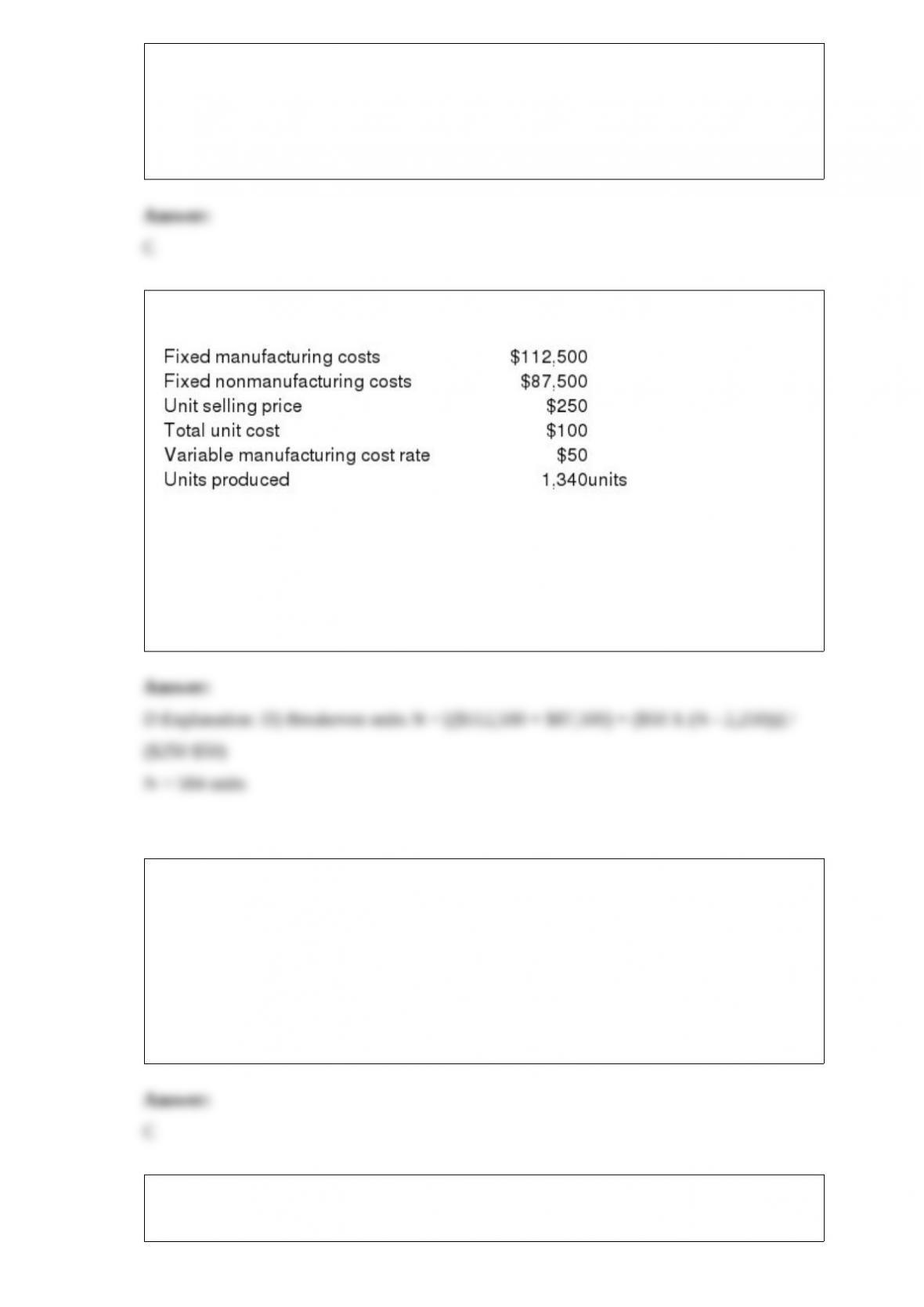
6) Greene Manufacturing incurred the following expenses during 2015:
What is the breakeven point in units using absorption costing if the units produced are
actually 2,250?
A) 1,330 units
B) 1,000 units
C) 887 units
D) 584 units
7) Which of the following statements best define splitoff point in joint costing?
A) It is the point at which managers decide to discontinue one or more of the products.
B) It is the point at which the managers decide to outsource some of its production
processes.
C) It is the juncture in a joint production process when two or more products become
separately identifiable.
D) It is the juncture at which decisions determining joint costs of various products to be
produced are taken.
8) Harbor Corp currently leases a corporate suite in an office building for a cost of
$280,000 a year. Only 80% of the corporate suite is currently being used. A start-up
business has proposed a plan that would use the other 20% of the suite and increase the
overall costs of maintaining the space by $20,000.
If the stand-alone method were used, what amount of cost would be allocated to the
start-up business?
A) $70,000
B) $66,000
C) $60,000
D) $74,000
9) Genent Company manufactures tires. Some of the company’s data was misplaced.
Use the following information to replace the lost data:
Actual Results Flexible Budget Variances Flexible Budget Sales-Volume Variances
Static Budget
Units sold 495,000 495,000 453,750
Revenues $185,150 $4,400 F (A) $6,160 U (B)
Variable costs (C) $880 U $69,780 $10,300 F $88,080
Fixed costs $36,430 $3,770 F $40,200 0 $40,200
Operating income $78,060 (D) $70,770 (E) $66,630
What is the total static-budget variance?
A) $11,430 favorable
B) $7,290 favorable
C) $4,140 unfavorable
D) $4,140 favorable
10) An example of a sunk cost in a capital budgeting decision for new equipment is
________.
A) the initial investment in working capital
B) the original price of an old equipment
C) the necessary transportation costs on a new equipment
D) the initial investment in a new equipment
11) Target reports ________.
A) only merchandise inventory
B) only finished goods inventory
C) direct materials inventory, work-in-process inventory, and finished goods inventory
accounts
D) no inventory accounts
12) The chart used to express customer profitability is called the whale curve because
________.
A) it is forward-bending at the point where customers start to become profitable and
thus resembles a humpback whale
B) it is forward-bending at the point where customers start to become unprofitable and
thus resembles a humpback whale
C) it is backward-bending at the point where customers start to become profitable and
thus resembles a humpback whale
D) it is backward-bending at the point where customers start to become unprofitable
and thus resembles a humpback whale