
1) Which of the following is correct regarding the effect that dilutive convertible bonds
have on the earnings per share computation?
a. The number of shares the bonds would convert to is added to the denominator;
interest, net of tax, is subtracted from the numerator
b. The number of shares the bonds would convert to is added to the denominator;
interest net of tax is added to the numerator
c. The number of shares the bonds would convert to is subtracted from the denominator;
interest, net of tax, is subtracted from the numerator
d. The number of shares the bonds would convert to is subtracted from the
denominator; interest, net of tax, is added to the numerator
2) At December 31, 2013, Morrison Company had 700 shares of common stock
outstanding. On September 1, 2014, an additional 300 shares of common stock were
issued. In addition, Morrison had $20,000 of 8 percent convertible bonds outstanding at
December 31, 2013, which are convertible into 400 shares of common stock. No bonds
were converted into common stock in 2014. Net income for the year ended December
31,2014, was $6,000. Assuming an income tax rate of 50 percent what would be the
companys diluted earnings per share for the year ended December 31, 2014?
a. $7.50
b. $5.67
c. $5.00
d. $4.33
3) A discount given to a customer for purchasing a large volume of merchandise is
typically referred to as a
a. quantity discount
b. cash discount
c. trade discount
d. size discount
4) In computing the earnings per share of common stock, noncumulative preferred
dividends not declared should be
a. deducted from the net income for the year, net of tax
b. added to the net income for the year
c. deducted from the net income for the year

d. ignored
5) Which of the following represents a permanent difference?
a. Point-of-sale revenue recognition for financial reporting purposes, installment
method for tax purposes
b. Goodwill amortization deducted on the tax return but not amortized for financial
reporting purposes
c. Straight-line depreciation for financial reporting purposes, accelerated depreciation
for tax purposes
d. Carryback, carryforward option for taxes, no such option for financial reporting
purposes
6) On January 1, 2014, Sudan Company purchased investment securities costing $4,000
and classified them as trading securities. During 2014, Sudan Company sold a portion
of these trading securities with a cost of $1,800 for $1,500. The market value of the
remainder of these trading securities at December 31, 2014, was $1,400. Sudan
prepares its statement of cash flows using the indirect method.
Which of the following represents the effect of these transactions on the statement of
cash flows for Sudan Company for the year ending December 31, 2014?
Operating Activities Investing Activities
a. $2,200 decrease No effect
b. $1,400 decrease No effect
c. $200 increase $1,500 decrease
d. $300 increase $1,500 decrease
7) Using the information above, the 1,000 shares of Upmann stock in this contract is
referred to as the
a. collateral
b. notional amount
c. option premium
d. derivative
8) An asset with a market value of $100,000 is leased on January 1, 2014. Five annual

lease payments are due each January 1 beginning January 1, 2014. The lessee
guarantees the $40,000 residual value of the asset as of the end of the lease term on
December 31, 2018. The lessors implicit interest rate is 8%.
What is the annual lease payment?
a. $18,227
b. $16,877
c. $23,191
d. $25,046
9) In an effort to improve the conceptual framework, the FASB, in conjunction with the
IASB has been moving towards more __________ standards.
a. rules approach
b. principles approach
c. broad approach
d. international approach
10) An improvement made to a machine increased its fair market value and its
production capacity by 25 percent without extending the machine’s useful life. The cost
of the improvement should be
a. Expensed
b. debited to Accumulated Depreciation
c. capitalized in the machine account
d. allocated between Accumulated Depreciation and the machine account
11) The accrual basis of accounting is based primarily on
a. conservatism and revenue realization
b. conservatism and matching
c. consistency and matching
d. revenue realization and matching
12) Which of the following is an example of a temporary difference that would result in
a deferred tax liability?
a. Use of straight-line depreciation for accounting purposes and an accelerated rate for

income tax purposes
b. Rent revenue collected in advance when included in taxable income before it is
included in pretax accounting income
c. Use of a shorter depreciation period for accounting purposes than is used for income
tax purposes
d. Investment losses recognized earlier for accounting purposes than for tax purposes
13) In calculating earning per share, stock options warrants, and rights are
a. always dilutive
b. never dilutive
c. dilutive if the exercise price is less than the average market price of the common
stock
d. dilutive if the exercise price is more than the average market price of the common
stock
14) For each of the journal entries below, write a description of the underlying event.
Assume that for prepaid expenses original debits are made to an expense account.
(a) Allowance for Doubtful Accounts ……………………. xxx
Accounts Receivable ………………………………….. xxx
(b) Interest Expense …………………………………………. xxx
Notes Payable ……………………………………………. xxx
Cash ………………………………………………………. xxx
(c) Cash ………………………………………………………… xxx
Unearned Revenue ……………………………………. xxx
(d) Supplies on Hand ………………………………………… xxx
Supplies Expense ………………………………………. xxx
(e) Cash ………………………………………………………… xxx
Accounts Receivable …………………………………. xxx
15) Which of the following accounts is not affected when an account receivable written
off as uncollectible is unexpectedly collected?
a. Cash
b. Accounts Receivable
c. Bad Debt Expense
d. Allowance for Bad Debts
16) Which of the following would be considered an executory cost?
a. Minimum lease payments
b. Interest expense incurred
c. Bargain purchase option
d. Maintenance costs
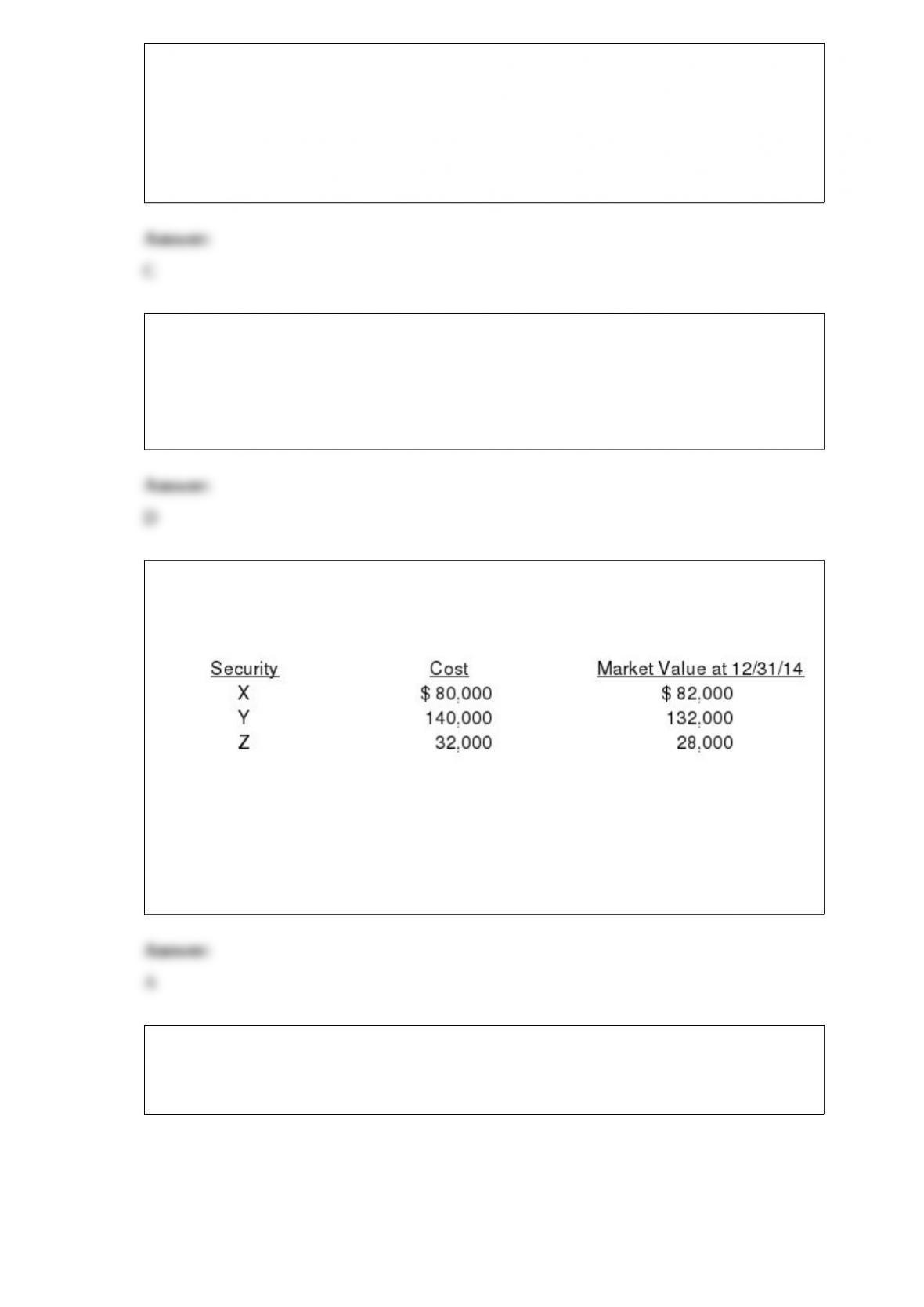
17) Angular Co. purchased the following portfolio of available-for-sale securities
during 2014 and reported the following balances at December 31, 2014. No sales
occurred during 2014. All declines are considered to be temporary.
Angular Co. should report what amount related to the securities transactions in its 2014
income statement?
a. $0
b. $2,000 unrealized loss
c. $10,000 unrealized loss
d. $12,000 unrealized loss
18) Chantal Company began operations on January 2, 2014, and appropriately used the
installment sales method of accounting. The following data are available for 2014 and
2015:

The realized gross profit for 2015 is
a. $1,440,000
b. $1,040,000
c. $920,000
d. $780,000
19) The main purpose of reporting diluted earnings per share is to
a. provide a comparison figure for debt holders
b. indicate earnings shareholders will receive in future periods
c. distinguish between companies with a complex capital structure and companies with
a simple capital structure
d. show the maximum possible dilution of earnings
20) Which of the following is not a justification for a change in depreciation methods?
a. A change in the estimated useful life of an asset as a result of unexpected
obsolescence
b. A change in the pattern of receiving the estimated future benefits from an asset
c. To conform to the depreciation method prevalent in a particular industry
d. A change in the estimated future benefits from the asset
21) Which of the following would NOT be classified as a current asset on a classified
balance sheet?
a. Investment securities (trading)
b. Short-term investments
c. Intangible assets
d. Prepaid expenses

22) Which of the following is NOT a short-term convergence topic that the IASB must
address in order to eliminate the reconciliation of accounts prepared under different sets
of standards of different countries?
a. Segment reporting
b. Accounting for income taxes
c. Accounting for impairments of assets
d. Accounting for research and development costs
23) Porter Corporation holds 10,000 shares of its $10 par common stock as treasury
stock, which was purchased in 2013 at a cost of $140,000. On December 10, 2014,
Porter sold all 10,000 shares for $260,000. Assuming that Porter used the cost method
of accounting for treasury stock, this sale would result in a credit to
a. Paid-In Capital from Treasury Stock of $120,000
b. Paid-In Capital from Treasury Stock of $110,000
c. Gain on Sale of Treasury Stock of $120,000
d. Retained Earnings of $120,000
24) A firm factors $40,000 of accounts receivable without recourse. The factor agrees to
provide financing based on these receivables, but imposes a 10% fee. In addition, the
transferor and transferee agree that $3,000 of sales returns and allowances can be
expected from these accounts. What is the loss or expense to recorded by the transferor?
a. $7,000
b. $4,000
c. $3,000
d. $0
25) Important constraints underlying the qualitative characteristics of accounting
information are
a. historical cost and going concern
b. materiality, conservatism, and cost-effectiveness
c. consistency, comparability, and conservatism
d. verifiability, neutrality, and representational faithfulness

26) A change in unearned revenue would be classified into which of the following
categories for purposes of disclosure in the statement of cash flows?
a. Operating cash flow
b. Investing cash flow
c. Financing cash flow
d. As an item reconciling earnings and operating cash flow
27) Moreland Corporation issued $200,000 of 10-year bonds on January 1. The bonds
pay interest on January 1 and July 1 and have a stated rate of 10 percent. If the market
rate of interest at the time the bonds are sold is 12 percent, what will be the issuance
price of the bonds?
a. $114,699
b. $177,059
c. $190,079
d. $224,926
28) Legal fees incurred in successfully defending a patent suit should be capitalized
when the patent has been
Internally Purchased from
Developed an Inventor
a. Yes No
b. Yes Yes
c. No Yes
d. No No
29) If a $1,000, 9 percent, 10-year bond was issued at 96 plus accrued interest one
month after the authorization date, how much cash was received by the issuer?
a. $967.50
b. $960.00
c. $1,007.50
d. $992.50
30) Which of the following is the primary factor in determining the functional currency

of a foreign subsidiary?
a. How the costs for the foreign entity’s product are determined
b. The denomination of the foreign entity’s financing
c. The location of the primary sales market that influences the price of the foreign
entity’s product
d. Management’s assessment of all relevant factors
31) If goods shipped FOB destination are in transit at the end of the year, they should be
included in the inventory balance of the
a. seller
b. common carrier
c. buyer
d. bank
32) The Mailer Corporation had the following classes of stock outstanding as of
December 31, 2014:
Common stock, $20 par value, 20,000 shares outstanding
Preferred stock, 6 percent, $100 par value, cumulative, 2,000 shares outstanding
No dividends were paid on preferred stock for 2012 and 2013. On December 31, 2014,
a total cash dividend of $200,000 was declared. What are the amounts of dividends
payable on both the common and preferred stock, respectively?
a. $0 and $200,000
b. $164,000 and $36,000
c. $176,000 and $24,000
d. $188,000 and $12,000
33) An adjusting entry in which revenue is recognized and a receivable is established
indicates that revenue has been
Earned Collected
a. Yes No
b. Yes Yes
c. No Yes
d. No No

34) Under international accounting standards, cash paid for dividends can be shown on
the statement of cash flows as
a. a financing activity only
b. an investing activity only
c. a financing or an operating activity
d. should not be shown on the statement of cash flows but rather on the income
statement
35) Which of the following is correct regarding earnings per share (EPS)?
a. If preferred stock is outstanding, dividends declared on the preferred stock are always
deducted from net income in calculating EPS
b. EPS can never be negative
c. All issues of convertible to common stock must be included in the calculation of
diluted EPS
d. If income from continuing operations is less than zero, potentially dilutive securities
are anti-dilutive
36) Chiclet Company decides at the beginning of 2014 to adopt the FIFO method of
inventory valuation. The company had been using the LIFO method for financial and
tax reporting since it inception on January 1, 2012. The profit-sharing agreement was in
place for all years prior to the year of change, 2014. Payments under this agreement are
not an inventoriable cost.
Which of the following statements regarding the accounting for the profit-sharing
agreement in connection with the change from LIFO to FIFO is correct?
a. The effects of the change in accounting principle on the profit-sharing agreement
must be treated retrospectively
b. The effects of the change in accounting principle on the profit-sharing agreement
should be reported only in the period in which the change in accounting principle was
made
c. It would be impracticable to determine the effect on the profit-sharing agreement as a
result of the change in accounting principle
d. There would be no effect on the profit-sharing agreement as a result of the change in
accounting principle
37) If the percentage-of-completion method is used, what is the basis for determining
the gross profit to be recognized in the second year of a three-year contract?
a. Cumulative actual costs and estimated costs to complete

b. Incremental cost for the second year only
c. Cumulative actual costs incurred only
d. No gross profit would be recognized in year 2
38) The term “comprehensive income” as defined by the FASB
a. must be reported on the face of the income statement
b. includes all changes in equity during a period except those resulting from
investments by and distributions to owners
c. is the net change in owners’ equity for the period
d. is synonymous with the term “net income”
39) Barter Company borrows $20,000 for one year a 9% interest, but must maintain a
$1,600 compensating balance. The effective rate of interest on this loan is
a. 9.0%
b. 17.0%
c. 9.8%
d. 8.0%
40) Glenn Manufacturing entered into a noncancelable lease for an office building on
January 1, 2014. The lease calls for payments of $24,000 a year for eight years. The
first payment is due on January 1, 2014, with the other payments due on December 31
of each year. Glenn has an incremental borrowing rate of 8 percent. The building is
amortized by Glenn over eight years using the straight-line method and assuming no
salvage value.
Prepare a partial balance sheet for Glenn for the year ending December 31, 2014,
disclosing the asset and the liability related to the leased building.

41) Statement of Financial Accounting Concepts No. 1, Objectives of Financial
Reporting by Business Enterprises, identifies investors and creditors as the primary
users of financial reporting information. Investors in public companies express their
opinions about an entitys equity securities through organized exchanges such as the
New York Stock Exchange. Given that investors represent one of the two primary
groups to which financial reporting is directed, accountants and auditors preparing and
opining on, respectively, the financial statements of public companies should be aware
of the effects of the quality of financial reporting on stock prices.
Required:
Identify four major periods of decline in worldwide stock prices for the years 1997
through 2002 and discuss the role (if any ) of financial reporting in these declines.
42) The first objective is the most general and states that financial information must be
useful in making decisions. The two subsequent objectives are progressively narrower
in scope.
The second objective indicates that in order to be useful, information provided must
assist users in determining the probability of receiving cash flows from the enterprise
and the amounts and timing of these cash flows.
43) A layaway sale is not really a sale because the seller still has custody and legal title
to the merchandise; Therefore, revenue from a layaway sale is not recognized until the
purchaser pays fully for the merchandise.
Diane is giving her husband Dennis an HD Projection System for Christmas. On
November 15th., Diane puts down a $1,200 deposit toward the full price of $3,200 at
TV Depot to place the system on layaway. On December 1st, Diane pays another
$1,000, and on December 15th., she makes the final $1,000 payment and takes the
system home to be Christmas wrapped.
TV Depots cost for the HD system is $2,400.
Required:
Make the necessary journal entries to record this transaction.
44) The projected benefit obligation is the actuarial present value of the benefits
attributed to employee service rendered to date. The projected benefit obligation is
based on the present value of vested and nonvested benefits accrued to date using
employees’ future salary levels.
Identify arguments that can be advanced for and against the use of the projected benefit
obligation concept in accounting for pensions.
45) The FASB has been struggling with the issue of determining the difference between
debt and equity financing for nearly twenty years. The Board is concerned that many
provisions of U.S. GAAP conflict with the definition of a liability given in the
Conceptual Framework. As a result, the Board is considering a new approach to
distinguishing between debt and equity financing.
The method currently favored by the FASB is called the basic ownership approach.
Required:
Explain the basic ownership approach and identify what effects, if any, this approach
would have on financial accounting and reporting.