Accrued liabilities could include all of the following except:
A) Wages and Salaries Payable.
B) Current Portion of Long-Term Debt.
C) Income Tax Payable.
D) Interest Payable.
The main purposes of internal controls include all of the following except:
A) prevention of error, theft, and fraud.
B) promotion of operational efficiency.
C) ensuring compliance with laws and regulations.
D) providing more favorable financial information.
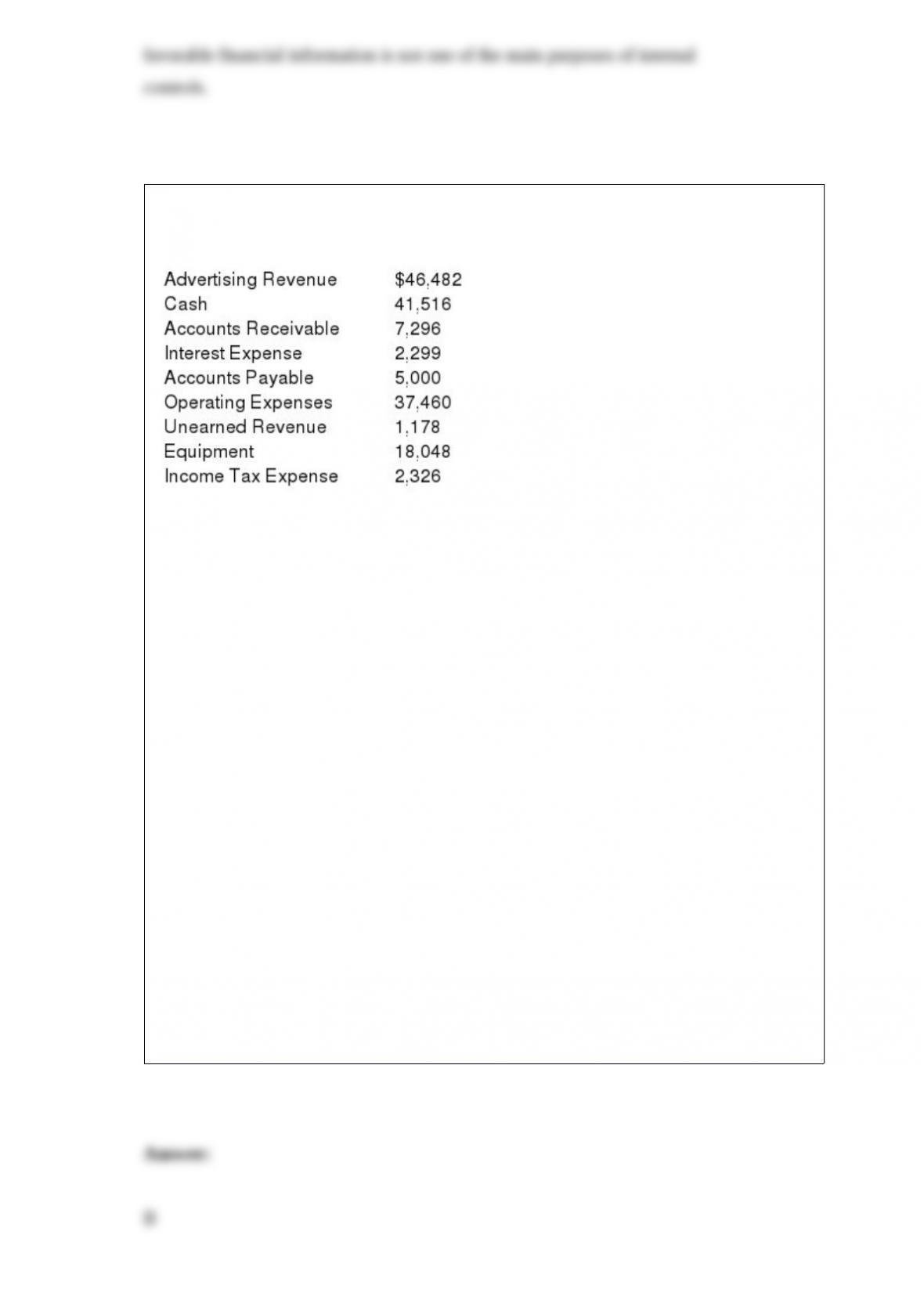
The following account balances are taken from the December 31, 2015, financial
statements of ABZ Advertising Company. The company uses accrual basis accounting.
The following activities occurred in 2016:
1> Performed advertising services on account, $55,000.
2> Received cash payments on account, $10,400.
3> Received deposits from customers for advertising services to be performed in 2017,
$2,500.
4> Made payments to suppliers on account, $5,000.
5> Incurred $45,000 of operating expenses; $39,000 was paid in cash and $6,000 was
on account and unpaid as of the end of the year.
Use the information above to answer the following question. Which of the following is
the journal entry that will be used to record activity #4?
A) Debit Operating Expense and credit Cash for $5,000
B) Debit Accounts Payable and credit Cash for $5,000
C) Debit Accounts Payable and credit Operating Expense for $5,000
D) Debit Cash and credit Accounts Payable for $5,000
Interest on an obligation is recorded:
A) as time passes.
B) when goods are purchased on account.
C) at maturity.
D) when a bank loan is obtained.
Employer payroll taxes:
A) represent the federal taxes withheld from the employees’ paychecks.
B) are the amounts paid by the employee.
C) are an added payroll expense beyond the wages and salaries earned by employees.
D) represent the FICA taxes withheld from employees’ paychecks.
On December 31, 2015, Newco borrowed $100,000 from First National Bank, and
signed a 12% note payable due in two years. Interest on the note is due at maturity.
Required:
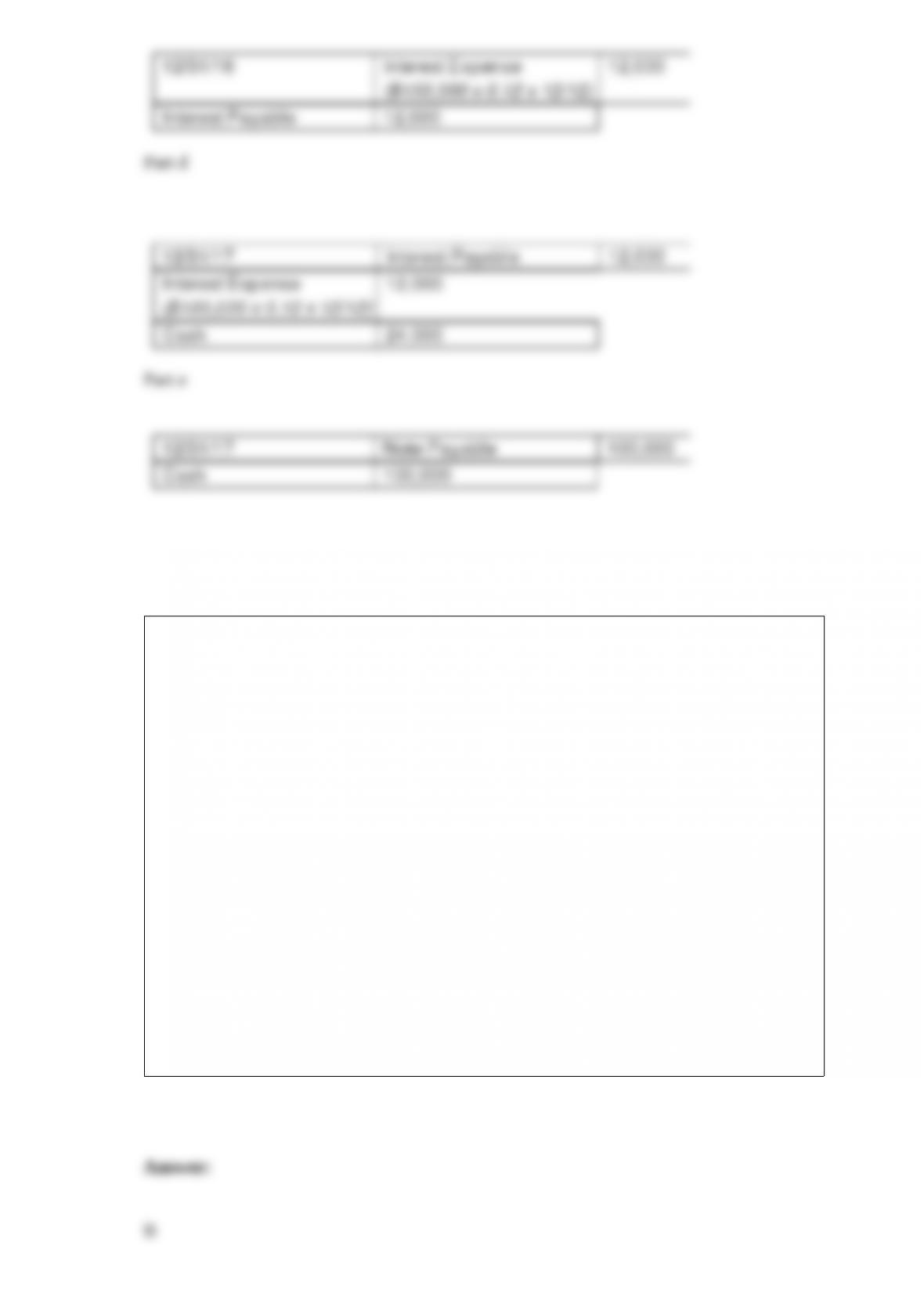
Part a. Prepare the journal entry to record the borrowing transaction.
Part b. Describe how the note should be reported on Newco’s classified balance sheets
at December 31, 2015 and December 31, 2016.
Part c. Prepare the required adjusting entry on December 31, 2016.
Part d. Prepare the journal entry to record the payment of the interest on December 31,
2017.
Part e. Prepare the journal entry to record the payment of the note on December 31,
2017.
Darin Company uses a perpetual inventory system. On October 1, Darin Company sold
inventory in the amount of $6,500 to Dee Company, terms 2/10, n/30. The items cost
Darin $4,200. On October 4, Dee returns some of the inventory. This inventory had a
selling price of $500 and a cost of $200. On October 8, Dee Company paid Darin
Company the amount due on that date.
Use the information above to answer the following question. What journal entry will be
prepared by Darin Company on October 8 to record the receipt of payment from Dee?
A) Debit Cash and credit Accounts Receivable for $6,500
B) Debit Cash for $5,880, debit Sales Discount for $120, and credit Accounts
Receivable for $6,000
C) Debit Cash for $6,370, debit Sales Discount for $130, and credit Accounts
Receivable for $6,500
D) Debit Cash for $6,300, debit Sales Returns & Allowances for $200, and credit
Accounts Receivable for $6,500
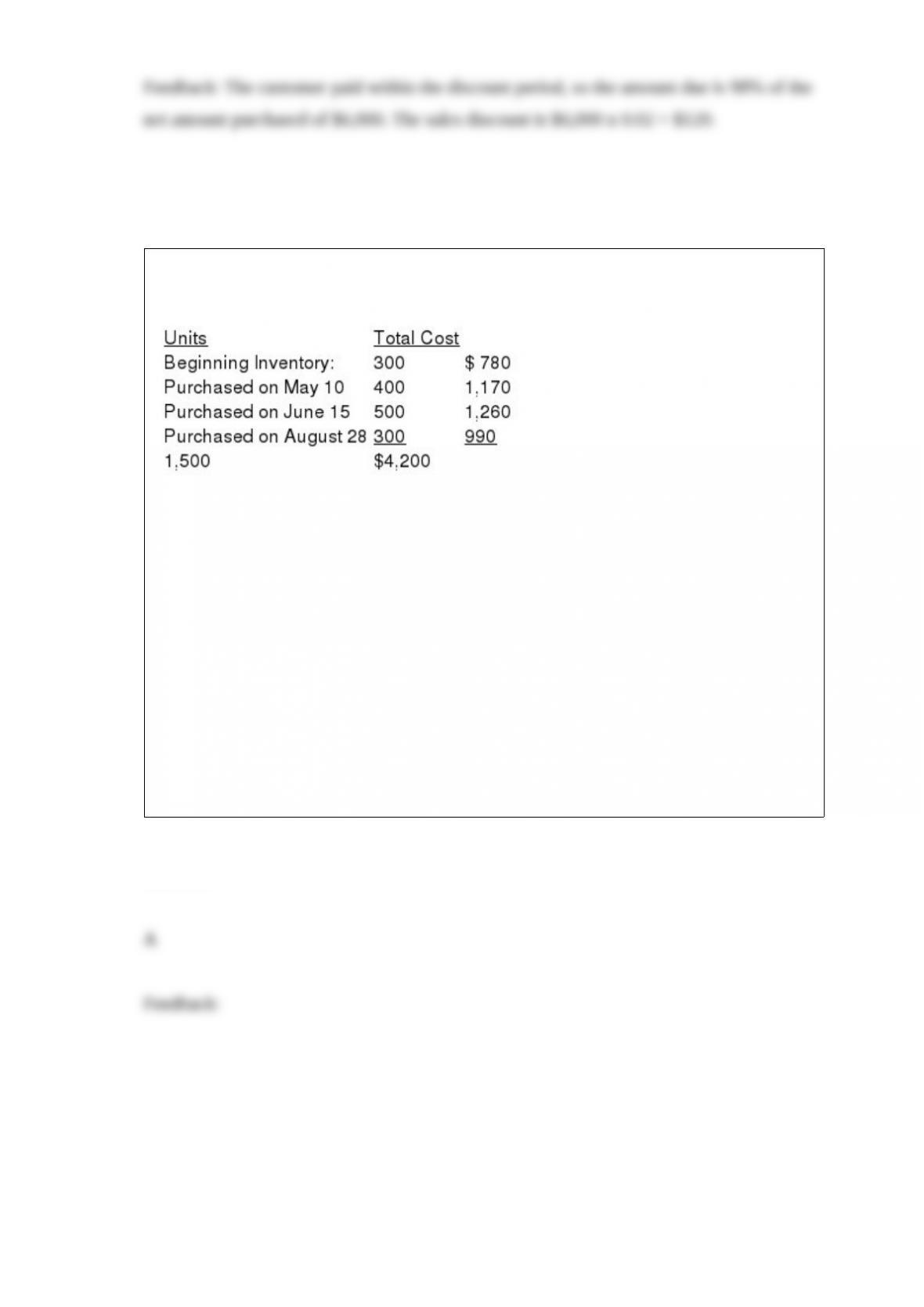
Bailey Company uses a periodic inventory system and its inventory records contain the
following information:
The company sold 1,000 units during June. There were no additional purchases or sales
during the remainder of the year. The company had 500 units were in its ending
inventory at the end of the year.
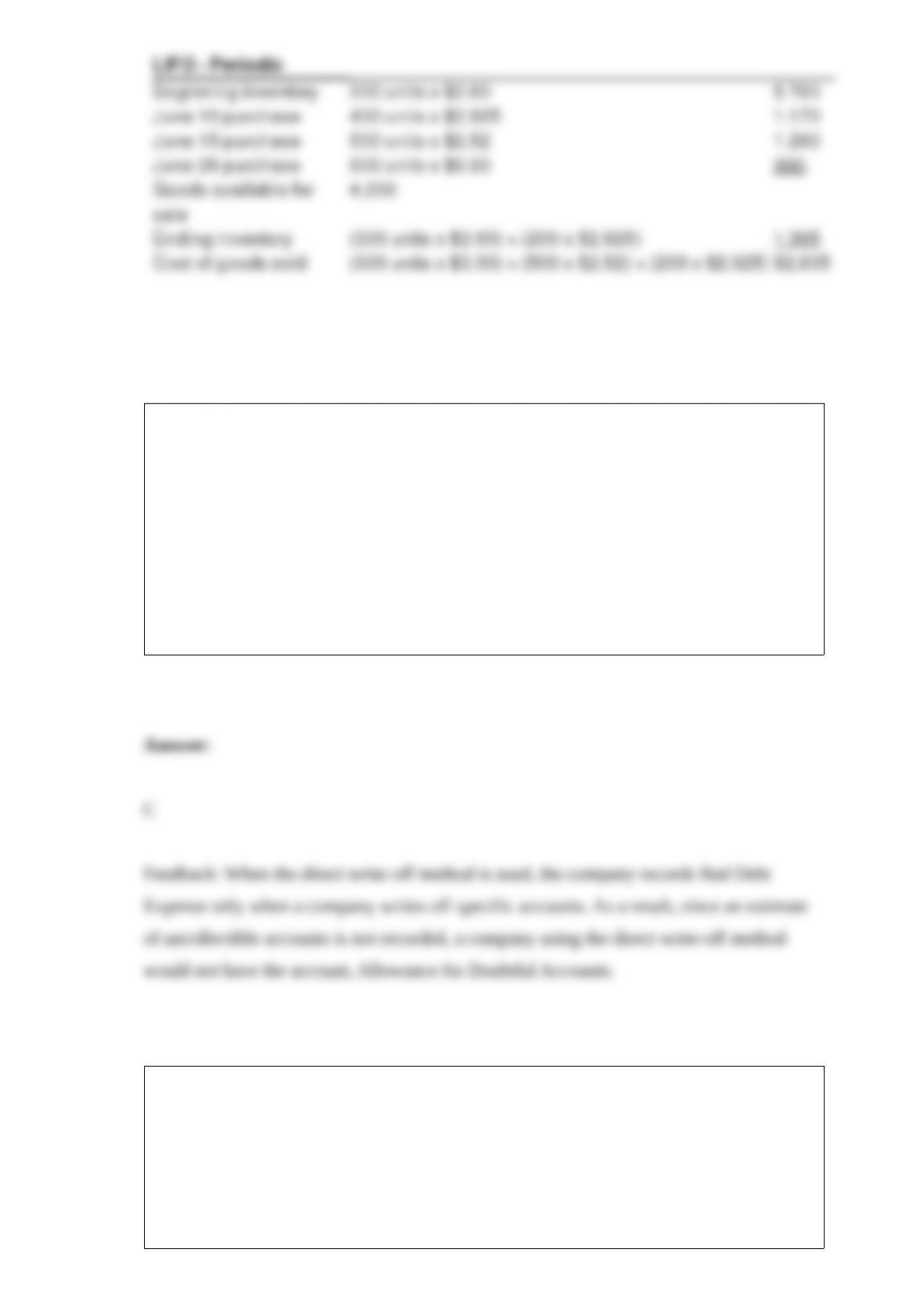
Use the information above to answer the following question. If Bailey Company uses
the LIFO costing method, what is the cost of its ending inventory?
A) $1,365
B) $1,494
C) $1,620
D) $2,835
When the direct write-off method is used to account for uncollectible accounts, which
of the following accounts would not be used?
A) Bad Debt Expense
B) Accounts Receivable
C) Allowance for Doubtful Accounts
D) Notes Receivable
Companies are concerned about the cost of extending credit for all the following
reasons except the:
A) time delay in receiving payment.
B) expense of the extra goods that must be produced or purchased for resale.
C) risk of nonpayment.
D) administrative costs associated with extending credit.